EXPAND YOUR READING!!

"Today the concept of truth is viewed with suspicion, because truth is identified with violence. Over history there have, unfortunately, been episodes when people sought to defend the truth with violence. But they are two contrasting realities. Truth cannot be imposed with means other than itself! Truth can only come with its own light. Yet, we need truth. ... Without truth we are blind in the world, we have no path to follow. The great gift of Christ was that He enabled us to see the face of God".Pope Benedict xvi, February 24th, 2012

The Church is ecumenical, catholic, God-human, ageless, and it is therefore a blasphemy—an unpardonable blasphemy against Christ and against the Holy Ghost—to turn the Church into a national institution, to narrow her down to petty, transient, time-bound aspirations and ways of doing things. Her purpose is beyond nationality, ecumenical, all-embracing: to unite all men in Christ, all without exception to nation or race or social strata. - St Justin Popovitch

Wednesday, 11 February 2015

FEBRUARY 11TH: OUR LADY OF LOURDES: A NEW ICON OF OUR LADY,A SERMON BY DR ROWAN WILLIAMS AND TWO FILMS

THEOTOKOS
by a monk of Pachacamac
Long after Our Lady appeared to Saint Bernadette at Lourdes, and after an intensive investigation, the French Episcopate recognised the authenticity of the apparitions.   They commissioned a famous sculptor to make a statue of Our Lady of Lourdes.   He visited Saint Bernadette and heard from her own lips all the information he could glean about the apparitions.    He then went back to his workshop and made an image of Our Lady according to her instructions.

He then visited her again in her convent to show her his statue.  He was surprised at her reaction.
"That is not Our Lady!" she exclaimed.
"But I made it exactly according to your instructions!" said the poor sculptor.
"I know; but it is not the Virgin," said Bernadette.
He then showed her a collection of pictures of Our Lady, each with its own title, "Our Lady of...." and asked her to point out to him the one that looks most like the Virgin that appeared to her.   She picked out one and showed it to him: it was the icon of Our Lady of Perpetual Succour, called in the East, "the Theotokos of the Passion."
"THAT is the Blessed Virgin!" she said emphatically, laying it before him.
"But it isn't anything like your description," said the poor man.
"I know, but it is the Virgin," she said.

What did St Bernadette see in the icon that was missing in the statue?   Remember that she had very little education and knew nothing of icons.   However, she was a saint, and there are things that saints know that they don't need to be taught.

The difference between an icon and a simple religious statue is that an icon is a fundamentally liturgical object, a liturgical proclamation of the Church's contact by the power of the Holy Spirit with the person or event depicted .   To paint an icon is a spiritual project, painted with prayer and religious awe, because the artist is putting his skills at the disposition of the Holy Spirit who wants to bring people into a relationship with whoever or whatever is the subject that is displayed on the icon.   The artist does not sign it: like St John the Baptist, he must decrease and let the subject matter increase.   Because iconography is a liturgical art and prayerfully looking at an icon is a liturgical act, an icon is not fully an icon until it has been blessed by the Church.

Did St Bernadette know all this?   Of course not!   But I think she at least dimly realised that, next to having an actual apparition of the Blessed Virgin, is having an icon of the Blessed Virgin, because it does not only remind us of her, it manifests the closeness of her presence.

Above is an icon of "Our Lady of Tenderness", recently painted by a monk of this monastery in Peru. "Our Lady of Tenderness", in icon-language, stresses the tender relationship between Mother and Son.   (Can you tell me how?)  Fr Alex is a pupil of Aidan Hart, an Orthodox iconographer and is at Belmont Abbey, our mother house, where he has been giving two courses, one on the theology of icons and another on actual painting icons.   He returns home to Pachacamac within a couple of weeks, but will be going back to Belmont in July to do another couple of courses.

'The babe in my womb leaped for joy.'  (Luke 1.44)

Mary comes to visit Elizabeth, carrying Jesus in her womb.  The Son of God is still invisible – not yet born, not even known about by Elizabeth;   yet Elizabeth recognises Mary as bearing within her the hope and desire of all nations, and life stirs in the deep places of her own body.  The one who will prepare the way for Jesus, John the Baptist, moves as if to greet the hope that is coming, even though it cannot yet be seen.

Mary appears to us here as the first missionary, 'the first messenger of the gospel' as Bishop Perrier of Lourdes has called her: the first human being to bring the good news of Jesus Christ to another;   and she does it simply by carrying Christ within her.  She reminds us that mission begins not in delivering a message in words but in the journey towards another person with Jesus in your heart.  She testifies to the primary importance of simply carrying Jesus, even before there are words or deeds to show him and explain him.  This story of Mary's visit to Elizabeth is in many ways a very strange one;  it's not about the communication of rational information from one speaker to another, but a primitive current of spiritual electricity running from the unborn Christ to the unborn Baptist.  But mission it undoubtedly is, because it evokes recognition and joy.  Something happens that prepares the way for all the words that will be spoken and the deeds that will be done.  The believer comes with Christ dwelling in them by faith, and God makes that current come alive, and a response begins, not yet in words or commitments, but simply in recognising that here is life.

When Mary came to Bernardette, she came at first as an anonymous figure, a beautiful lady, a mysterious 'thing', not yet identified as the Lord's spotless Mother.  And Bernardette – uneducated, uninstructed in doctrine – leapt with joy, recognising that here was life, here was healing.  Remember those accounts of her which speak of her graceful, gliding movements at the Lady's bidding;  as if she, like John in Elizabeth's womb, begins to dance to the music of the Incarnate Word who is carried by his Mother.  Only bit by bit does Bernardette find the words to let the world know;  only bit by bit, we might say, does she discover how to listen to the Lady and echo what she has to tell us.

So there is good news for all of us who seek to follow Jesus' summons to mission in his Name;  and good news too for all who find their efforts slow and apparently futile, and for all who still can't find their way to the 'right' words and the open commitment.  Our first and overarching task is to carry Jesus, gratefully and faithfully, with us in all our doings: like St Teresa of Avila, we might do this quite prosaically by having with us always a little picture or a cross in our pockets, so that we constantly 'touch base' with the Lord.  We can do it by following the guidance of the Orthodox spiritual tradition and repeating silently the Jesus Prayer, 'Lord Jesus Christ, Son of God have mercy on me, a sinner'.  And if we are faithful in thus carrying Christ with us, something will happen, some current will stir and those we are with will feel, perhaps well below the conscious surface, a movement of life and joy which they may not understand at all.  And we may never see it or know about it;  people may not even connect it with us, yet it will be there – because Jesus speaks always to what is buried in the heart of men and women, the destiny they were made for.  Whether they know it or not, there is that within them which is turned towards him.  Keep on carrying Jesus and don't despair: mission will happen, in spite of all, because God in Christ has begun his journey into the heart.

And when we encounter those who say they would 'like to believe' but can't, who wonder how they will ever find their way to a commitment that seems both frightening and hard to understand, we may have something to say to them too:  'Don't give up;  try and hold on to the moments of deep and mysterious joy;  wait patiently for something to come to birth in you.'  It certainly isn't for us as Christians to bully and cajole, and to try and force people into commitments they are not ready to make – but we can and should seek to be there, carrying Jesus, and letting his joy come through, waiting for the leap of recognition in someone's heart.

Of course, as often as not, we ourselves are the one who need to hear the good news;  we need people around us who carry Jesus, because we who call ourselves believers all have our moments of confusion and loss of direction.  Others fail us or hurt us;  the Church itself may seem confused or weak or even unloving, and we don't feel we are being nourished as we need, and directed as we should be.  Yet this story of Mary and Elizabeth tells us that the Incarnate Word of God is always already on the way to us, hidden in voices and faces and bodies familiar and unfamiliar.  Silently, Jesus is constantly at work, and he is seeking out what is deepest in us, to touch the heart of our joy and hope.

Perhaps when we feel lost and disillusioned, he is gently drawing us away from a joy or a hope that is only human, limited to what we can cope with or what we think on the surface of our minds that we want.  Perhaps it's part of a journey towards his truth, not just ours.  We too need to look and listen for the moments of recognition and the leap of joy deep within.  It may be when we encounter a person in whom we sense that the words we rather half-heartedly use about God are a living and actual reality.  (That's why the lives of the saints, ancient and modern, matter so much.)  It may be when a moment of stillness or wonder suddenly overtakes us in the middle of a familiar liturgy that we think we know backwards, and we have for a second the feeling that this is the clue to everything – if only we could put it into words.  It may be when we come to a holy place, soaked in the hopes and prayers of millions, and suddenly see that, whatever we as individuals may be thinking or feeling, some great reality is moving all around and beneath and within us, whether we grasp it or not.  These are our 'Elizabeth' moments – when life stirs inside, heralding some future with Christ that we can't yet get our minds around.

It's very tempting to think of mission as something to be done in the same way we do – or try to do – so much else, with everything depending on planning and assessments of how we're doing, and whether the results are coming out right.  For that matter, it's tempting to think of the Church's whole life in these sorts of terms.  Of course we need to use our intelligence, we need to be able to tell the difference between good and bad outcomes, we need to marshal all the skill and enthusiasm we can when we respond to God's call to share his work of transforming the world through Jesus and his Spirit.  But Mary's mission tells us that there is always a deeper dimension, grounded in the Christ who is at work unknown and silent, reaching out to the deeply buried heart of each person and making the connection;  living faithfully at the heart of the Church itself, in the middle of its disasters and betrayals and confusions, still giving himself without reserve.  All that we call 'our' mission depends on this;  and if we are wise, we know that we are always going to be surprised by the echoes and connections that come to life where we are not expecting it. 

True mission is ready to be surprised by God – 'surprised by joy', in the lovely phrase of  C. S. Lewis.  Elizabeth knew the whole history of Israel and how it was preparing the way for God to come and visit his people – but she was still surprised into newness of life and understanding when the child leapt in her womb.  Bernardette's neighbours and teachers and parish clergy knew all they thought they needed to know about the Mother of God – and they needed to be surprised by this inarticulate, powerless, marginal teenager who had leapt up in the joy of recognition to meet Mary as her mother, her sister, bearer of her Lord and Redeemer.   Our prayer here must be that, renewed and surprised in this holy place, we may be given the overshadowing strength of the Spirit to carry Jesus wherever we go, in the hope that joy will leap from heart to heart in all our human encounters;  and that we may also be given courage to look and listen for that joy in our own depths when the clarity of the good news seems far away and the sky is cloudy. 

But here today, with Elizabeth and Bernardette, we say, in thankful amazement, 'Why am I so favoured, that the mother of my Lord should come to me?'  And we recognise that our heart's desire is met and the very depth of our being stirred into new life. 

©  Rowan Williams 2008
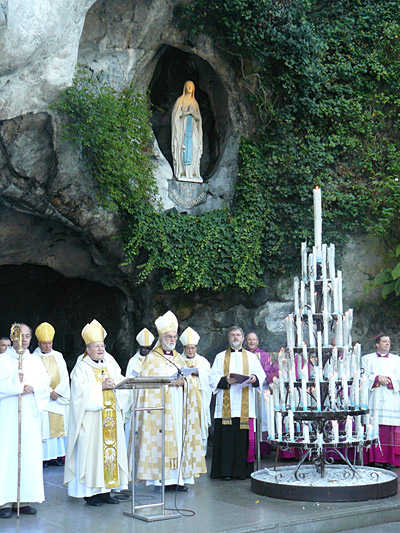

- See more at: http://rowanwilliams.archbishopofcanterbury.org/articles.php/1221/archbishop-of-canterburys-sermon-for-the-international-mass-at-lourdes#sthash.IWDN6HMx.dpuf


!


Prayer to the Theotokos

Our most gracious Queen, our hope, O Theotokos, who receivest the orphaned and art the intercessor for the stranger; the joy of those in sorrow, protectress of the wronged, see our distress, see our affliction! Help us, for we are helpless. Feed us, for we are strangers and pilgrims. Thou knowest our offences; forgive them, and resolve them as thou dost will. For we know no other help but thee, no other intercessor, no gracious comforter, only thee, O Theotokos to guard and protect us for ages of ages. Amen

please click on:

Saturday, 7 February 2015

TRADITIONAL LITURGY IN ITS POST-VATICAN II FORM - 6: WHAT WENT WRONG?


                           Liturgy in its post-Vatican II form  iv EP4


my quotations etc from Pope Benedict are largely taken from a talk by Helen Hull Hitchcock
Before we can answer the question, "What went wrong?" we must answer several false accusations against the "new" rite, because many conservatives grasp any rumour that is going, accept any accusation as long as it discredits the post-Vatican II mass. Here are a few false accusations.  

That the post-Vatican II liturgy is Protestant: In the previous articles in this series, I think we have demonstrated how careful the liturgists were in their choice of texts, how anxious they were to open up to Latin Catholics the very best of Catholic Tradition.   There is not a single Protestant word in the whole revision.   They were motivated by fidelity to Tradition, while accepting that the almost world-wide spread of the Latin Rite made it imperative, in the name of Catholic Tradition itself, to make it open to influences from the whole treasury of Catholic Tradition, which is made up of a number of traditions, each every bit as Catholic as the Latin tradition, all of which are of great value because they too are the product of grace


That the liturgy is the work of an interested group that imposed changes not envisaged by the Council which were imposed on a reluctant Church. 

 Stories of dirty tricks abounded during the Council on all sides of the debate.  It is only the "conservatives" that have kept this going to the present day.  It is likely that dirty tricks were employed as each side struggled for advantage to sway the Council in one way or another; but certain things must be borne in mind. 

 I was studying at Fribourg from September 1961 till the end of 1963.  Of course, the Council was matter for lively debate.  The English Benedictines studying at Fribourg started a quarterly journal called "Trident", mainly to get all the press releases from the Vatican; and we used to invite participants who were going to or from the Council to tea in my room, and they normally came.   We discussed all kinds of hot topics.   Here are a few examples.

 There was in the Council a number of sub-commissions on different aspects of liturgical reform.   A member of the sub-commission on concelebration was our Professor Hanggi (with an umlaut) of liturgy who gave us a talk on concelebration, both the history and the present possibilities.  He described how it would eventually look, and he was right in all details.  This was after the second session - very early indeed! 

It was the Melkite bishops who proposed that the liturgy should be in the language of the people.   They also proposed that the eucharistic prayer should contain the epiclesis.  I remember the discussion with liturgists, firstly that the epiclesis should be placed in the Roman Canon; and, this being rejected on the ground that the Roman Canon is complete in itself, and that to inject an epiclesis into the Canon would do violence to it, the prospect of one or more eucharistic prayers containing the epiclesis, was discussed.  I went to the ecumenical monastery of Chevetogne in Belgium where I heard for the first time the need to have more than one eucharistic prayer in order to save for the Church something from the Mozarabic, Gallican and other rites that had been swamped by the relentless advance of the Roman practice.  All this was long before Bugnini headed the Consilium, during the first half of the Council.

 Later, when the Consilium discussed these subjects, they went through an identical process: the results you know. Moreover, according to Archimandrite Robert Taft S.J., the eminent liturgical historian, every change was presented to the world's bishops; and, when the proposed change produced much opposition, it was dropped.

 I even remember discussing the priest presiding from the other side of the altar - we had seen it in the Protestant Communion service in Taize - a Protestant service with a Catholic theology.   The reason given was not that priest and people could look at each other, but that both priest and people would have an unhindered view of the altar, the focal point of the whole action.   All this was during the first half of the Council, and had nothing to do with Bugnini.   These discussions were not between crazy lefties, but responsible people.   What came out at the end of the process was largely faithful to what we heard and talked about early on. There were no surprises.

All these changes were done when Pope Paul VI was ill, too ill to concentrate on what was happening: it was done behind his back. He was co-composer of Eucharistic Prayer III with Dom Cipriano Vagaggini, was responsible for the short sentences - Milan-style - for the Offertory, and involved himself in many a discussion.  Those who are against the changes just don't want to own up to the fact that they are out of step with the Church. 

A very good history of what happened after the Council in the Consilium that is responsible for the texts has been given by Dom Cassian Folsom, Prior of the Benedictine monastery in Norcia, Italy.  I am sure that he and I do not see eye-to -eye on many things liturgical, but think his history of the post-conciliar work of this commission is very good and objective.  The fact that his account is very different from mine shows just how big the whole affair was, and that everything depends on where you were and with whom you talked.   I give you the truth;  so does he; but for the whole truth, we will have to wait for the historians.   Nevertheless, I believe he is actually wrong on one point, and I think that Fr Louis Bouyer has demonstrated it.  He writes on the reasons for the new eucharistic prayers:
4. Theological Shift to the "Horizontal": Part of the post-conciliar theological shift was a new stress on this-worldly realities, which often resulted in a style of prayer which was decidedly horizontal and man-centered. The hieratic, sacral and transcendent emphasis of the Roman canon, in contrast, was viewed as out of date and theologically incorrect. This is a fourth reason for the change from one Eucharistic Prayer to many."

The names most associated with the authorship of the new eucharistic prayers are Louis Bouyer and Cyprian Vagaggini.   The first resigned from the Consilium in protest because of the lack of a sense of transcendence, and also wrote a book on Monasticism as a sign of transcendence; while the second finished his days in a Camaldolese hermitage: hardly people who would be guilty of underestimating transcendence!!
I believe Fr Cassian is reading back into the prayers an interpretation of events that belongs to a later date, to the time when the "new Mass" was presented to the world.   It is a true interpretation of what happened when people began to celebrate the "new Mass" "in the spirit of Vatican II;"  but I don't think you will find a single phrase in any of the three new eucharistic prayers to support Fr Cassian's view.  Those who composed them lived in a different world and had totally different motives from both the "liberals" who won the publicity war after the Council and from the "New Liturgical Movement" that Fr Cassian Folsom seems to support. 


Ressourcement theology

To understand Vatican II you need to understand ressourcement theology which was an ad hoc, unplanned reality that formed itself in France after World War II without knowing that this is what they were doing, a group of theologians that were very concerned with the gradual disappearence of religion among the masses, that agreed about the general causes, blamed the inadequacy of current Catholic theology for its inability to cope with this tendency, and looked for its own solutions in Catholic Tradition.   Also, without fully realizing its significance for the history of the Church was their friendship with Russian theologians in exile, living in France, highly critical of theological tendencies in their own Church, identifying their main foe as a certain western scholasticism that had infected the East, and looked for the solution in Tradition.   The two sides, French and Russian, were surprised that they were agreed on the problems, identified the inadequacies of the same western scholasticism with its inability to cope with modern life, and found the solution in Tradition, even though this Tradition looked different from the perspective of each side.  The Orthodox looked to St Gregory Palamas, while the Catholics looked to western Fathers life Ambrose and Augustine, but also looked at the Eastern fathers as well.   Neither side was conscious of having crossed any line, nor even that it was itself a school of thought, neither side represented anybody but themselves, and neither side was trying to unite East and West.  Perhaps, because they wer not trying to do anything in particular, their defences were down, and they had an influence on each other that would not have been the case if their conversations had been more self-conscious.  Vatican II changed all that; and, thanks to them, much Orthodox thinking has entered the mainstream of Catholic theology.

The basic insights of ressourcement I have borrowed from Wiki:
 For the Catholic theologians associated with ressourcement or nouvelle théologie ”Henri de Lubac, Jean Daniélou, Yves Congar, and Hans Urs von Balthasar (among others)”the preeminent source for theological reflection is the word of God interpreted within the Church. In a secondary sense, the theologians of the tradition, especially the Fathers of the Church, represent abiding sources for the renewal of Christian theology. 
Accordingly, the project of ressourcement involved translating and interpreting texts from across the entire tradition, with particular attention given to the ever present fruitfulness of patristic exegesis. As de Lubac suggests, this task precluded “any overly preferential attachment to one school, system, or definite age; it demanded more attention to the deep and permanent unity of the faith, to the mysterious relationship (which escapes so many specialized scholars) of all those who invoke the name of Christ.” 
We have seen in the previous articles in this series how the application of the principles has transformed the Roman Rite, because ressourcement theology looks to the whole of Tradition and not just to the Roman strand of it.  Nevertheless, it is just those people mentioned above, the greater part of them, who are dissatisfied with the liturgy as it now is celebrated.   Why

Michael Deem writes about one of the very central and basic insights of ressourcement theology in general and of Henri de Lubac in particular:
In a rarely quoted essay from 1942, de Lubac writes: “Now, basically, this world is not by itself either sacred or secular, for it receives its significance only through man. It can become one or the other according to the way in which man behaves in its regard.”[3]
At the heart of de Lubac’s theology is a concern to re-establish in the consciousness of humanity the Christian principle that the sacred—the presence of God’s saving activity—is not some foreign, invading force in an otherwise mundane, secular world. Rather, nature is always incomplete and unfulfilled without the gratuitous sanctification wrought by grace, and it is peculiar to human nature to release the full splendor of the grace given to it. For de Lubac, as for the Fathers, anthropology and ecclesiology are fully intelligible only in light of one another.

It is a pity that this essay is rarely quoted because it is a key to so much.   I have only seen references to it, but it illumined many French theological minds at the time, and its echoes are still being heard.  What Henri de Lubach said is that the main reason for the lack of religion in the industrial cities of France and the modern world is the absence of any opportunity  for people in these cities to encounter the sacred. Without this, religion dies.   The liturgy should provide a sense of the sacred, but it is too clerical and in a foreign language: it needs to be reformed so that people can participate and so encounter the Sacred.

This was the motive why these theologians and liturgists were so enthusiastic for reform.   This is why you can see their signature in the Constitution on the Liturgy.   This is why Father Louis Bouyer and others wrote the new eucharistic prayers - Fr Cassian Folsom is totally wrong on this one - and this is the reason why Father Louis Bouyer resigned from the Consilium and why the ressourcement theologians were so bitterly disappointed at the final result.   Everything was going their way, the constitution and the eucharistic prayers, and then, another group with another agenda took over. Perhaps, in order to succeed, the ressourcement theologians needed to die.

The newspapers divided the Council fathers into two, easily distinguished parties, the "conservatives" who opposed change, and the progressives who sought change.   In this they did not do justice to either group, but it sold newspapers.   In the "progressive" group there were two main parties, not noticed at the time, but visible to any one who looked at the scene with a sharp, theological analysis - I confess that I failed that test.  If you look at them in general terms, you could be excused for not noticing the differences between them.

Both groups were very keen on ecumenism, hence both groups sent representatives to the same ecumenical meetings; but, as time went on, differences emerged.  

If you were to ask the ressourcement theologians, who is their ideal ecumenical partner, the answer would have been clear and immediate, the Orthodox and Oriental Orthodox Churches.   Firstly, these churches are churches of Tradition, that product of the synergy between the Holy Spirit and the Church which has its source in the Eucharistic assembly and in which Truth can be found; and, secondly, because they have preserved liturgies whose sacred character is successfully imparted to those who take part.  Thus, if you were to ask the French ressourcement theologians what living liturgies they would look to in order to help them form form a Latin rite Mass with more participation, then I think the would have looked East.   This means that the modern "monks and nuns of Bethlehem" and the "monastic family of Jerusalem" probably celebrate the liturgy more like Father Bouyer and company originally intended.

However, there are "progressives" for whom Tradition is of secondary importance, and for whom conformity to the modern world is paramount.   For them, their ideal ecumenical partner is the Anglican Church. If they looked at examples of modern liturgy to help them form a Latin rite Mass with greater participation, they tend to look at Anglican and other Protestant models.  I suppose Hans Kung is the most famous example.   We must look at the modern human being, see what makes him tick, what are his chief concerns, and mould our message to his needs.   Their response to the ressourcement theologians is that you cannot drive a car forward while only looking in the back mirror.  

 Modern human beings do not appreciate the "sacred", but they do respond to the challenge of human solidarity.   Therefore, to modernise the liturgy, we take the emphasis away from the "sacred" and put it on celebrating human togetherness in Christ.   And this is what they did.   Much of their support came from the fact that observers did not see the difference between the two groups.

People intent on modernizing the Church were in the majority in the Consilium that produced the new liturgy.   Because they left the writing of the new eucharistic prayers to the professionals, all thing went well, and the prayers were formed according to strict Ressourcement principles.  They tended to outvote the same professionals, so that, not so much the text, but the general presentation of the new liturgy was all about our oneness in Christ, all too human solidarity that forgot that "in Christ" means finding unity with each other on earth by sharing a close relationship with Christ, Our Lady and the saints in heaven.


That part of the Constitution on the Liturgy that says that our participation in the liturgy on earth is a sharing in the heavenly liturgy tended to be forgotten.   Too often, the sense of the sacred, of the mysterium tremendum, went completely out of the window.

   Conservatives, like the blog "Rorate Caeli" and bloggers like "Fr z" still don't see the differencer between the two groups; and when they see people like Pope Benedict reacting against the "new Mass", they believe he is on their side, when, in fact, he is a disappointed ressourcement theologian.  He was very bitter at first and talked about all that he worked for was in ruins, real liturgy, even though it needed reform, being replaced by an artificial construct, the work of intellectuals.   Like Pere Bouyer, one of the main objects of his ire was "Mass facing the people," which became the symbol of togetherness with each other replacing the "sacred", a man-centred liturgy as opposed to a God-centred liturgy. Remember that they put the wholesale loss of faith in industrial towns down to the loss of the "sacred", and they had centred their hopes on a reform of the liturgy that would unlock the "sacred" to be experienced by the masses.   The general falling away from Catholicism of people from western Europe and North America after the changes only re-inforced their conviction.

Pope Benedict dedicated much of his pontificate to try to repair the damage.  Before we look at his contribution, we must be aware of some things:
1)  He is German and not French, so he had not experienced the close relationship with Orthodox that his French colleagues had.   However, he was heir to the rich liturgical traditions of Bavaria which includes wonderful feast day Masses sung to Mozart and other great composers, with full orchestra; and he was heir as well to the liturgical movement inspired by the great German, highly theological Benedictine monasteries and with such names as Dom Odo Casel, the Canon Regular Parsch, and the Jesuit Jungmann.  He was western European, and was satisfied that the Latin rite should make use of its own resources to reform.
2) He is not a liturgist and was not privy to the reasons why the liturgists had done what they did.  During and after the Council, he was occupied in other things.   Thus his criticisms do not show any acquaintance with their motives, and sometimes he attributes motives to them that they did not have.
3) He and Archbishop Wojtyla did join the group of French theologians during the Council and agreed with their basic principles; though, perhaps because of the experience of Humanae Vitae and the enthusiastic acceptance by the bishops of what he considered a flawed liturgy, he ceased to believe in the present practicality of a general decentralization of the Church.   However, in all else, he has remained a ressourcement theologian, even though he adopted these principles, not from the French theologians, but together with Cardinal Frings, whose secretary he was.   He writes of Cardinal Frings:
Frings opposed the emphasis on magisterial sources from the nineteenth and twentieth centuries .   He expected the perspective of an ecumenical council to be directed toward Scripture itself and the whole of Tradition, including  especially the Greek Fathers.   Here too we see at work his desire for Catholicity without shortcuts.   One might even identify this desire as the distinctive theme characterizing all his influence on the Council.   We shall return again and again to this question of catholicity, in which his life's experience as a bishop is summed up.  Here he did not speak in favour of one trend or tendency, but as a pastor, as one speaking with the actual voice he had used in lifelong service in the Church.  He in fact shunned that positivism based on the magisterium on the most recent manifestations of which Louis Bouyer has recently made some informative remarks.   In connection with the debates with Charles Curran, Bouyer uncovers an absurd positivism in that apparently progressive mentality only to adhere to that in the Church which is defined as infallible.
Thus Cardinal Frings and he advocated catholicity without shortcuts, opposing this catholicity to any attempt to dilute its content whether by "conservatives" who concentrate on statements of the magisterium of the Council of Trent and from 1870 onwards  to decide what is authentically Catholic, or the progressives who wish to limit Catholic teaching to what had been defined infallibly.   Everything must be interpreted in the light of the whole Catholic Tradition, with special authority of the Church Fathers.  It is to Tradition as a whole that our principal loyalty is due, not just a part of it - this is the ressourcement position.  It led to our adopting a number of eucharistic prayers, something he didn't envisage, but is quite logical in the circumstances.

   As he could not accept de-centralisation, he became a Pope, who used Vatican I methods to bring about Vatican II decisions.   This involved, on his part, intense listening to everybody - of all people, he will be remembered as a humble listener - before he decided on his own authority.

  In this, Pope Francis is not very different, even as he moves to decentralize the Church.   Personally, I believe they are two steps in the right direction - but that will need another article.

3)  As a ressourcement theologian, Pope Benedict sees the papacy as a guardian of Tradition, and not its master.   This Tradition required renewal and change:
 We are gradually becoming aware today of how meaningless it was, in fact, of how unworthy and dishonest it was, when the priest prayed before the Gospel that God might purify his heart and lips… so that he might worthily and in a becoming manner proclaim the Word of God, when he knew very well that he was about to murmur this Word of God softly to himself just as he had done with the prayer, without any thought of proclaiming it… The word has lost its meaning and had become an empty ritual, and what the liturgical reform has done here was simply to restore meaning and validity to the word and to the Church’s worship which was enshrined in it.

Against those who claimed that there could be no deviation from the Missal of Pius Vth, he wrote:
“We must say to the ‘Tridentines’ that the Church’s liturgy is alive, like the Church herself, and is always involved in a process of maturing.… The Missal can no more be mummified than the Church herself”
Also: 
But he also remarked that the “old liturgy” was flawed. In particular, he notes that “the celebration of the old liturgy had slipped too much into the domain of the individual and the private, and that the communion between priests and faithful was insufficient” -- that people privately recited prayers from their prayer books during most of the Mass. He suggests that these factors probably accounted for the indifference of most Catholics when the old liturgical books disappeared: “People had never been in contact with the liturgy itself”

Nevertheless, the Church's post-Vatican II liturgy does need to reform, even though the "new liturgy" has been received by the Catholic episcopate and has been handed down, in continuity with what has been handed down since the Apostles. 

The first change to be changed was "Mass facing the people."  But there are examples in Tradition of the celebrant facing across the altar, notable in St Peter's itself!  This is what Pope Benedict said in "The Spirit of the Liturgy":
The ordering of St. Peter’s was then copied, so it would seem, in many other stational churches in Rome. For the purposes of this discussion, we do not need to go into the disputed details of this process. The controversy in our own century was triggered by another innovation. Because of topographical circumstances, it turned out that St. Peter’s faced west. Thus, if the celebrating priest wanted – as the Christian tradition of prayer demands – to face east, he had to stand behind the people and look – this is the logical conclusion – towards the people. For whatever reason it was done, one can also see this arrangement in a whole series of church buildings within St. Peter’s direct sphere of influence.
The liturgical renewal in our own century took up this alleged model and developed from it a new idea for the form of the liturgy. The Eucharist – so it was said – had to be celebrated versus populum (towards the people). The altar – as can be seen in the normative model of St. Peter’s – had to be positioned in such a way that priest and people looked at each other and formed together the circle of the celebrating community. This alone – so it was said – was compatible with the meaning of the Christian liturgy, with the requirement of active participation. This alone conformed to the primordial model of the Last Supper.

It must be said that this explanation is only true if facing east is as important to Catholic Tradition as those who oppose the change say it is - it is a reading back into history of our own liturgical concerns.   Pere Bouyer suggested that both priest and people prayed looking East, so that priest and altar were behind the community in a church like St Peter's that faced West, anything but the modern arrangement!! But there is absolutely no evidence for this: it is an invention of Pere Bouyer, mortally disappointed that togetherness had replaced sanctity in the ceremonial.  Pope Benedict chose a better solution, one that, in fact, solves the problem and allows both practices, facing the altar and facing the people.   Tradition dictates that all face East; but, because some churches faced West, then the altar became liturgical East, was counted as East within the drama of the liturgy.   It follows that whatever way the priest is facing, both priest and people are facing the altar. Even when the priest is looking towards the people, the true focal point is not the people, but the altar.   In fact, what the hermeneutic of continuity dictates is what those who originally suggested the change wanted, long before the modernizers came on the scene, that everything be centred on the altar.   

  However, he would say that authentic liturgy does not exist in the mind of liturgists, but in the celebrations of the Church.  It takes concrete celebration to discern what is needed, and we are now in a time of adaptation, of what he called "liturgical growth." He wrote:
“We might say that …[before] the liturgy was rather like a fresco [in the early 20th century]. It had been preserved from damage, but it had been almost completely overlaid with whitewash by later generations. In the Missal from which the priest celebrated, the form of the liturgy that had grown from its earliest beginnings was still present, but, as far as the faithful were concerned, it was largely concealed beneath instructions for and forms of private prayer. The fresco was laid bare by the Liturgical Movement and, in a definitive way, by the Second Vatican Council. For a moment its colors and figures fascinated us. But since then the fresco has been endangered by climatic conditions as well as by various restorations and reconstructions. In fact, it is threatened with destruction, if the necessary steps are not taken to stop these damaging influences. Of course, there must be no question of its being covered with whitewash again, but what is imperative is a new reverence in the way we treat it, a new understanding of its message and its reality, so that rediscovery does not become the first stage of irreparable loss.”
As a cardinal, he called for changes in the way the liturgy was going.   He wrote: 
“It must be clearly stated that a real reform of the Church presupposes an unequivocal turning away from the erroneous paths whose catastrophic consequences are already incontestable”. But he also stressed (ten years later, in the book-length interview with Vittorio Messori, published as The Ratzinger Report) that “Vatican II in its official promulgations, in its authentic documents, cannot be held responsible for this development which, on the contrary, radically contradicts both the letter and the spirit of the Council Fathers”; further, he said, “I am convinced that the damage that we have incurred in these twenty years is due, not to the ‘true’ Council, but to the unleashing within the Church of latent polemical and centrifugal forces; and outside the Church it is due to the confrontation with a cultural revolution in the West … with its liberal-radical ideology of individualistic, rationalistic and hedonistic stamp”  
 He was calling for the return of the "sacred", the loss of which was a main reason, he believed, for the apostasy of western Europe.   However, he was not calling for a return to the situation before the Council, in favour of the "old Mass" as it used to be, nor was he against the Missal of Paul VI.


Concerning the “so-called Tridentine liturgy”, he writes, there is “no such thing. The Council of Trent did not ‘make’ a liturgy”, he points out. The 1570 Missal is a revised version of the Roman Missal of about 100 years earlier, and differed only in tiny details. Pope Pius V promoted the exclusive use of the Missal to “help get rid of the uncertainties which had arisen in the confusion of liturgical movements in the Reformation period”, Cardinal Ratzinger writes, noting that an exception was made at that time for liturgies that were 200 or more years old, which were permitted to co-exist with the “new” revised Missal.
“We must say to the ‘Tridentines’ that the Church’s liturgy is alive, like the Church herself, and is always involved in a process of maturing.… The Missal can no more be mummified than the Church herself”, he writes.

However, Pope Benedict is the pope who has allowed the "old Mass", some would say, the "mummified Mass", to be celebrated at will, and he urged bishops to provide opportunities for those who want the old Mass to be able to attend.   Although he denied any basic difference between the new and the old, he knew that, for many, they are distinct liturgical experiences.  This act of his is a very good example of a ressourcement  theologian with full Vatican I papal authority.   To do this successfully, without doing violence to his theology, he had to be a humble listener, because in eucharistic ecclesiology the local eucharistic assembly is the source of Tradition, and it is the function of the Pope to guard and protect Tradition: neither he nor the bishops are masters of Tradition that springs from the synergy between the Holy Spirit and the Church.   Hence, although he sees the need for reform, he has retained reverence for the old Mass.   If it is a tradition that is still alive, he would be failing in his duty to simply forbid it.   Of course, accepting that Tradition is fed by eucharistic assemblies all over the world, in a plethora of rites and styles, does argue for a radical de-centralisation; but Pope Benedict felt unable to do that.   Instead, he humbly listened and then acted on his own authority in response to what he heard. 
 act


The  who first suggested the idea that the altar is "liturgical East" said that the attention of priest and people was not originally on the altar but on the figure of Christ Pantokrator in the apse: they were looking up at heaven.   Pope Benedict suggested that it would be too disturbing for the people to turn  the altar round to its traditional position again; but that a crucifix be placed at the centre of the altar to be the centre of attention for the priest.  

Personally, I have always concentrated on the altar's surface and heavenwards, and I only look at the people when I am addressing them.  Looking at the people when I am praying to God has always struck me as silly and distracting.

So, What went wrong?  Basically, the loss of the sacred.   Not always, not everywhere, but in a sufficient number of cases to cause concern..  In fact, things went a bit wild, with lots of liturgical experimentation, liturgical abuses etc.  

Before the changes, liturgy was not a favourite course in seminaries: too much interest in lace and funny hats led to comment.  Getting down to the nitty gritty with casuist Moral Theology was useful; concentrating on liturgy looked too much like self-indulgence.   Hence, your average priest knew little and cared less about liturgy: they just followed the rubrics, while   nuns said their rosaries. Then, all of a sudden, everybody became an expert, and much of the experimentation was in pure ignorance, and some was a crime calling to heaven for vengeance!!  

Let us remember what Pere Bouyer said about the reform:
These prefaces have brought back into use, with at times some modifications and adaptations, everything that is most substantial in the treasury of the old sacramentaries. And possibly the new compositions that have been added will not appear unworthy beside their ancient neighbours.....If we add to this necessary reform the new (or ancient!) Communicantes and Hanc Igiturs which will re-establish in the Roman canon, along with the fulness of the commemoration of the magnalia Dei, a newly diversified expression of the Church presenting to the Father the unique sacrifice of the eternal Son, there is reason to hope that we shall again grasp all of the imperishable beauty of the jewel of the eucharistic tradition of the West that is the Roman Canon.   Moreover, alongside this restoration of the Roman canon, we must rejoice in the intention to enrich the modern Latin liturgy with complementary examples from the riches of Catholic Tradition.   At the same time, the goal has been to revive among the faithful the plenary sense of the eucharist, by proposing to them  formularies that are as explicit and as directly accessible as possible in their structure and their language.
On the three new anaphoras he wrote:
The most radical, and at first sight most unusual novelty of the new texts is that they follow up to a certain point the remodelling of the most ancient eucharistic schemes worked out by the West Syrian liturgy, while retaining the ancient and more primitive distinction between the two epicleses as in both the Egyptian and Roman traditions.   This is a point which may possibly be not merely of pedagogical interest, in order to permit Christians familiar with this latter tradition to come to know the complememtary riches of the Eastern tradition.


I think it is fairly obvious that it is necessary to back up the new liturgy with a new catechesis, both for the priests and religious, and for the people.   In fact, a liturgical reform needs a catechetical reform to immerse people in the new vocabulary, spirituality and the ideas behind the new liturgy.   Unfortunately, after the Council, old ways of teaching were given up, without any clear idea of what would replace them, and whole generations of kids who went through Catholic schooling received a very muddled formation.   Without a proper liturgical formation themselves, the teachers couldn't really acquaint their pupils with what they needed to know to appreciate what had been given them.   Really, one of the chief functions of catechesis is to prepare people to take part in the liturgy of the Church.   Until this is done, then just listening and taking part will not unlock the treasures of the Roman Canon or any of the other eucharistic prayers. Part of the problem was lack of preparation.

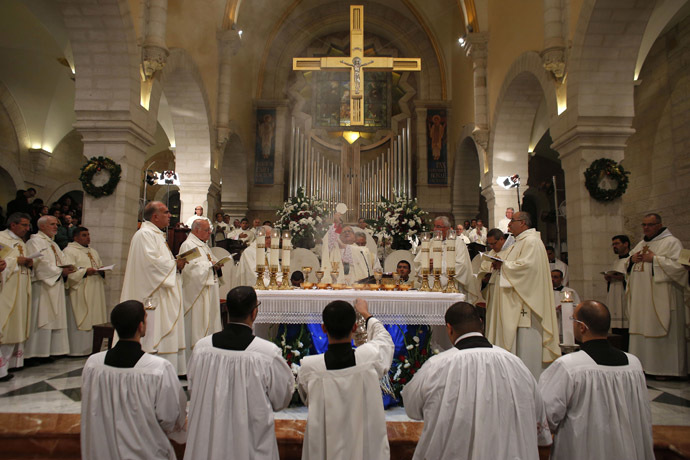
 We live at a time of "liturgical growth", to use Pope Benedict's words, where the post-Vatican II form of the Liturgy is becoming more and more part of the life of the Church; and, thanks to the Catholic faith of those who participate, the influence of Pope Benedict, and much good example from those who celebrate the now not so new Mass with reverence and dignity, and thanks to new music and much deep piety, the Mass is becoming more and more like it was intended to be.  You only have to look at the photo that introduces this article to see that the Mass is as beautiful as any that were celebrated before the changes, with the added advantage that we all know and understand and participate.

Of course, there are the fanatics among the bloggers who show hatred for the ordinary version and make comparisons between quite eccentric celebrations of the normal Mass and beautiful celebrations of the old Mass, but never between beautiful celebrations of the new Mass and beautiful celebrations of the old.  Fairness in presentation of their point of view is not one of their strong points.

Back in the seventies, I taught VIth Form Divinity, and a very bright group argued in favour of the old Mass, which they had never actually seen.   God sent us, as a monastic guest, an old Irish Franciscan priest.   The combination of "old", "Irish" and "Franciscan" was too good to miss.  I asked him if he would be willing to celebrate the old Mass for a group of boys.   He was willing, and so they attended it.  I met the boys afterwards.  "Priests didn't really celebrate Mass like that did they, Father!" exclaimed one boy, "He gabbled through the Latin!" "He rushed through it!" I said, "You compare a modern parish Mass with one sung in Latin by monks of Solesmes, and of course the monks of Solesmes win.   Now you can compare your normal parish Mass with what you have attended today: it is more realistic!"

(To the right of this blog there is a row of flipboard magazines.  One of them has the same title as this series, "Traditional liturgy in its post-Vatican II Form," and contains the whole series, plus a number of articles and documents that can help you to go further into this subject.)

please click on:


Thursday, 5 February 2015

THE HUNREDTH ANNIVERSARY OF THE BIRTH OF THOMAS MERTON by Father Robert Barron plus SOME QUOTES

I decided to become a monk after reading "The Seven Storey Mountain" and have never regretted it: Happy Birthday, Father Louis!! - Fr David

Merton, although flawed, was one of the greatest spiritual writers of the 20th century and a man who had a decisive influence on me and my vocation to the priesthood
February 03, 2015 02:54 EST
Fr. Robert Barron
Father Thomas Merton outside his hermitage

Trappist Father Thomas Merton, one of the most influential Catholic authors of the 20th century, is pictured in an undated photo. The 100th anniversary of his birth was on January 31. (CNS photo/Merton Legacy Trust and the Thomas Merton Center at Bellarmine University)
I write these words on the one hundredth anniversary of the birth of Thomas Merton, one of the greatest spiritual writers of the 20th century and a man who had a decisive influence on me and my vocation to the priesthood.  

I first encountered Merton’s writing in a peculiar way.  My brother and I were both working at a bookstore in the Chicago suburbs.  One afternoon, he tossed to me a tattered paperback with a torn cover that the manager had decided to discard.  My brother said, “You might like this; it’s written by a Trappist monk.”  I replied, with the blithe confidence of a sixteen year old, “I don’t want to read a book by some Buddhist.” With exquisite sensitivity, he responded, “Trappists are Catholics, you idiot.” 

The book in question was The Seven Storey Mountain, Thomas Merton’s passionate, articulate, smart, and deeply moving account of his journey from worldling to Trappist monk.  Though much of the philosophy and theology was, at that time, over my head, I became completely caught up in the drama and romance of Merton’s story, which is essentially the tale of how a man fell in love with God. The book is extraordinarily well written, funny, adventurous, and spiritually wise.  


Trappist Father Thomas Merton is pictured in an undated photo. (CNS photo/Merton Legacy Trust and the Thomas Merton Center at Bellarmine University)

In one of the blurbs written for the first edition, Fulton Sheen referred to it as a contemporary version of St. Augustine’s Confessions, and it was fulsomely praised by both Evelyn Waugh and Graham Greene.  Moreover, it contributed massively to the startling influx of young men into monasteries and religious communities across the United States in the postwar era.
I was so thrilled by my first encounter with Merton that I dove headlong into his body of writing.  The Sign of Jonas, a journal that Merton kept in the years leading up to his priestly ordination, became a particular favorite.  That work concludes with an essay called “Firewatch:  July 4, 1952,” which Jacques Maritain referred to as the greatest piece of spiritual writing in the twentieth century.  In this powerful meditation, Merton uses the mundane monastic task of walking through the monastery checking for fires as a metaphor for a Dantesque examination of the soul.  

The Sign of Jonas is marked by Merton’s playful and ironic sense of humor, but it also gives evidence of the enormous range of his reading and intellectual interests.  To devour that book as a nineteen-year old, as I did, was to receive an unparalleled cultural education.  For many people of my generation, Merton opened the door to the wealth of the Catholic spiritual tradition: I first learned about John of the Cross, Meister Eckhart, Teresa of Avila, Bernard of Clairvaux, Odo of Cluny, the Victorines, Origen, Thérèse of Lisieux, and Hans Urs von Balthasar from him.

Perhaps the central theme of all of Merton’s writings is contemplation.  What he stressed over and again in regard to this crucial practice is that it is not the exclusive preserve of spiritual athletes, but rather something that belongs to all the baptized and that stands at the heart of Christian life.  For contemplation is, in his language, “to find the place in you where you are here and now being created by God.”  It is consciously to discover a new center in God and hence at the same time to discover the point of connection to everyone and everything else in the cosmos.  

Following the French spiritual masters, Merton called this le point vierge, the virginal point, or to put it in the language of the fourth Gospel, “water bubbling up in you to eternal life.”  In his famous epiphanic experience at the corner of 4th and Walnut in downtown Louisville, Merton felt, through le point vierge, a connection to the ordinary passersby so powerful it compelled him to exclaim, “There is no way of telling people that they are all walking around shining like the sun.”
Sadly, for many younger Catholics today, Merton, if he is known at all, is viewed with a certain suspicion, and this for two reasons.  First, when he was a man of fifty-one, he fell in love with a young nurse who cared for him after back surgery.  Though it is almost certain that this was exclusively an affair of the heart, it was certainly, to say the very least, unseemly for a middle-aged monk and priest to have been so infatuated with a much younger woman.  At the same time, Merton worked through this confusing period and returned to his vowed monastic life.  And the journal that he kept during that year is so spiritually alert and illuminating that I often recommend it to brother priests who are wrestling with the promise of celibacy.  To dismiss Merton out of hand because of this admittedly inappropriate relationship strikes me as disproportionate.

The second reason that some younger Catholics are wary of Merton is his interest, in the last roughly ten years of his life, in Eastern religions, especially Buddhism.  They see this as an indication of a religious relativism or a vague syncretism.  Nothing could be further from the truth.  Merton was indeed fascinated by the Eastern religions and felt that Christians could benefit from a greater understanding of their theory and practice, but he never for a moment felt that all the religions were the same or that Christians should move to some space “beyond” Christianity.  

In order to verify this, all one has to do is read the prefaces to his major books on Zen and Buddhism.  About ten years ago, I had the privilege of giving a retreat to the monks at Merton’s monastery of Gethsemani in Kentucky.  Just after the retreat ended, Merton’s secretary, Br. Patrick Hart, took me in a jeep out to see the hermitage that Merton occupied the last few years of his life.  While we were sitting on the front porch of the small house, he looked at me intently and said, “Could you tell anyone that’s interested that Thomas Merton died a monk of Gethsemani Abbey and a priest of the Catholic Church?”  He was as bothered as I am by the silly suggestion that Merton, at the end of his life, was on the verge of leaving the priesthood or abandoning the Catholic faith.

Thomas Merton was not perfect, and he might not have been a saint.  But he was indeed a master of the spiritual life, and his life and work had a profound effect on me and an army of others around the world.  I offer this birthday tribute as a small token of gratitude.

SOME QUOTES
from BrainyQuotes
at  http://www.brainyquote.com/quotes/authors/t/thomas_merton.html#lPwqqbclcqiTDTUG.99

By reading the scriptures I am so renewed that all nature seems renewed around me and with me. The sky seems to be a pure, a cooler blue, the trees a deeper green. The whole world is charged with the glory of God and I feel fire and music under my feet.

Thomas Merton

The biggest human temptation is to settle for too little.

Thomas Merton


In the last analysis, the individual person is responsible for living his own life and for 'finding himself.' If he persists in shifting his responsibility to somebody else, he fails to find out the meaning of his own existence.

Thomas Merton

Pride makes us artificial and humility makes us real.

Thomas Merton


Just remaining quietly in the presence of God, listening to Him, being attentive to Him, requires a lot of courage and know-how.

Thomas Merton


A life is either all spiritual or not spiritual at all. No man can serve two masters. Your life is shaped by the end you live for. You are made in the image of what you desire.

Thomas Merton


We are not at peace with others because we are not at peace with ourselves, and we are not at peace with ourselves because we are not at peace with God.

Love is our true destiny. We do not find the meaning of life by ourselves alone - we find it with another.
Thomas Merton


The whole idea of compassion is based on a keen awareness of the interdependence of all these living beings, which are all part of one another, and all involved in one another.

Thomas Merton

Yet it is in this loneliness that the deepest activities begin. It is here that you discover act without motion, labor that is profound repose, vision in obscurity, and, beyond all desire, a fulfillment whose limits extend to infinity.

Thomas Merton


The beginning of love is to let those we love be perfectly themselves, and not to twist them to fit our own image. Otherwise we love only the reflection of ourselves we find in them.

Thomas Merton


“You do not need to know precisely what is happening, or exactly where it is all going. What you need is to recognize the possibilities and challenges offered by the present moment, and to embrace them with courage, faith and hope.”

“My Lord God, I have no idea where I am going. I do not see the road ahead of me. I cannot know for certain where it will end. Nor do I really know myself, and the fact that I think that I am following your will does not mean that I am actually doing so. But I believe that the desire to please you does in fact please you. And I hope I have that desire in all that I am doing. I hope that I will never do anything apart from that desire. And I know that if I do this you will lead me by the right road though I may know nothing about it. Therefore will I trust you always though I may seem to be lost and in the shadow of death. I will not fear, for you are ever with me, and you will never leave me to face my perils alone.” 
― Thomas Merton, Thoughts in Solitude

“To be grateful is to recognize the Love of God in everything He has given us - and He has given us everything. Every breath we draw is a gift of His love, every moment of existence is a grace, for it brings with it immense graces from Him. 
Gratitude therefore takes nothing for granted, is never unresponsive, is constantly awakening to new wonder and to praise of the goodness of God. For the grateful person knows that God is good, not by hearsay but by experience. And that is what makes all the difference.” 
― Thomas Merton

“Our job is to love others without stopping to inquire whether or not they are worthy. That is not our business and, in fact, it is nobody's business. What we are asked to do is to love, and this love itself will render both ourselves and our neighbors worthy.” 
― Thomas Merton

“Our idea of God tells us more about ourselves than about Him.” 
― Thomas Merton

“Only the man who has had to face despair is really convinced that he needs mercy. Those who do not want mercy never seek it. It is better to find God on the threshold of despair than to risk our lives in a complacency that has never felt the need of forgiveness. A life that is without problems may literally be more hopeless than one that always verges on despair.” 
― Thomas Merton, No Man Is an Island

What is the purpose of meditation in the sense of “the prayer of the heart?” In the “prayer of the heart” we seek first of all the deepest ground of our identity in God. We do not reason about dogmas of faith, or “the mysteries.” We seek rather to gain a direct existential grasp, a personal experience of the deepest truths of life and faith, finding ourselves in God’s truth. …Prayer then means yearning for the simple presence of God, for a personal understanding of [God’s] word, for knowledge of [God’s] will and for capacity to hear and obey him.–Thomas Merton


Search This Blog

La Virgen de Guadalupe

La Virgen de Guadalupe

Followers

My Blog List

Fr David Bird

Fr David Bird
Me on a good day

Blog Archive