EXPAND YOUR READING!!

"Today the concept of truth is viewed with suspicion, because truth is identified with violence. Over history there have, unfortunately, been episodes when people sought to defend the truth with violence. But they are two contrasting realities. Truth cannot be imposed with means other than itself! Truth can only come with its own light. Yet, we need truth. ... Without truth we are blind in the world, we have no path to follow. The great gift of Christ was that He enabled us to see the face of God".Pope Benedict xvi, February 24th, 2012

The Church is ecumenical, catholic, God-human, ageless, and it is therefore a blasphemy—an unpardonable blasphemy against Christ and against the Holy Ghost—to turn the Church into a national institution, to narrow her down to petty, transient, time-bound aspirations and ways of doing things. Her purpose is beyond nationality, ecumenical, all-embracing: to unite all men in Christ, all without exception to nation or race or social strata. - St Justin Popovitch

Friday, 2 March 2018

3rd SUNDAY OF LENT 2018 (YEAR B) : THE CLEANSING OF THE TEMPLE

Image result for jesus the cleansing of the temple

Oculi mei Semper: the Introit


THE CLEANSING OF THE TEMPLE IN
ST JOHN'S GOSPEL
One of the main themes in St John's Gospel is the story of how Jesus came to be the Temple as well as the sacrifice of the New Covenant.  It is there at the very beginning of the Prologue where it says, "And the Word became flesh and pitched its tent among us."   This is a reference to the Tent of Meeting that accompanied Moses and the Israelites; and this tent, with its basic plan and measurements that came from God, was replaced in the time of Soloman by the temple.  Then there is another reference at the start of Christ's public ministry with today's Gospel.  At the end of his ministry, there is the symbolism of  Christ's side being pierced by a lance out of which pours blood and water which, as we will see, is also a reference to the temple.

In order to understand the cleansing of the temple, we must understand what the temple was.   In a  nutshell, it was the meeting place between God and his people.
The purpose of the Temple is for God to dwell with man.
It was not to provide atonement for sin. That was not its function. Instead it is because we are unclean, and sinful, and God who is holy can not dwell with unclean and sinful man, that atonement for us is required as we “draw near” to G-d. In fact the Hebrew word for “drawing near” is the same as “making a sacrifice.”
The purpose for the sacrifices were so that we, as unclean, sinful man, could draw near to him without being vaporized. (Jerusalem Council)
The word "korban" which we translate as "sacrifice" has as its root the Hebrew verb which means "to draw near" or "to approach".

Before the Fall, Adam and Eve walked with God in the cool of the evening.  Sin made this impossible because sin has become part and parcel of our make-up. To root it out of us completely would require a radical transformation that would kill us.  The tares had to be left among the wheat till the Last Day. In God's great mercy, he established a way by which the Jews could approach him without dying in the process.  However, this approach was still associated with death, not the death of those who came near, but of animals as a substitute.  Of course, the death of animals could not solve the basic problem and only served to remind the Jews that the kind of union to which God has called human beings can only come about through death and that the union with God as the chosen people was only a shadow of the real thing.   The real thing could come only with Jesus and his death and transformation in the resurrection.

  Thus, the coming of Jesus would mean that the temple had fulfiled its purpose and its role would be taken over by Christ.  He is the true temple.    He is also the true paschal lamb.  Not that the temple and the paschal lamb were false, but they were shadows of the reality who is Christ.

We must see from this that salvation is nothing less than union with God, and sacrifice is a necessary means to that end.   However, in the New Covenant, the union with God is nothing less than sharing in his very life, in the life of the Holy Trinity, and this is only possible by our sharing in Christ's death and resurrection.   Hence, the old temple and the old sacrifices are not enough.

Jesus Christ is the true temple. 

The function of the temple was for God to dwell with man.   Jesus is the Word incarnate, both God and humanity are united in the single Divine Person of the Word.  The action of the Holy Spirit binds all of humanity, past, present and future, to Christ's own divinity and humanity so that we can all say, "Our Father." Thus it is true that


This primal unity is completely present in Christ. His death on the Cross is not His alone – He dies the death of every single human being – bearing the sins of all. The insight of the saints tells us that this same reality must be ours as well. Christ has not done something for us in our absence. The Cross He endured is the same Cross He invites us to take up. And that Cross is also a universal Cross (the Cross of the whole Adam). We do not go there only for our own death, but for the death of everyone (and thus the resurrection of all).  
(Glory to God for All Things)
Thus Christ more than makes up for the destruction of the temple.

Jesus is also the reality for which the Paschal Lamb is the shadow. ""Christ our Passover has been sacrificed; therefore let us keep the feast" (1 Cor 5:7)

The feast of the Pasch was, perhaps, the busiest time for the priests of the temple.   It was also big business!

Jesus is the true paschal sacrifice

 The population of Jerusalem was swelled by about three million pilgrims.  King Agrippa wanted to discover how many people came to the temple to sacrifice their lambs prior to cooking and eating them in their homes.  He asked for a small portion of each lamb that was slaughtered and, in that year, there were 600,000 lambs.  Each represented about ten people per family and friends.

Killing the animal was not an act of sacrifice.   The pouring of its blood on the base of the altar was the priestly act of sacrifice.  The family would buy the lamb from the priests with special temple money and most would ask a priest to kill the animal.   The pilgrims were divided into three and one group was allowed in, then another, and then the other.  There were two, each in turn.  There were two lines of priests who stood shoulder to shoulder between the place of slaughter and the altar.   The blood of the animal was poured into silver or gold basins which were then passed up the line to the altar where the blood was poured at the base of the altar - this was the act of sacrifice - from which it passed down a canal into a huge vat.   When, in the evening, all the lambs had been slaughtered and the blood poured out - at King Agrippa's census there were 600,000 of them - a bung was removed at the bottom of the vat and  the blood poured through a hole in the side of the temple, helped by hoses of water, into a canal which ran into the valley below where it was used by the farmers to enrich their land.  Of course, the farmers had paid the priests for the privilege.

If you want to guess how much the temple and its priests gained from this day's work, they made money on the exchange of secular money into temple money, in the cost of each lamb, and they received the skin of each animal, one shoulder from each animal, and the price of the blood from the farmers.  They also were involved in the sale of animal skins and meat.

For all the temple's religious significance, the temple priests were very unpopular with the ordinary Jewish population.   They were extremely rich and yet levied a temple tax on all Jews, and a large number of people were in their debt.  Their unpopularity received a huge boost when the Syrian dictator Antiochus Epiphanes placed a statue of the god Jupiter in the temple and sacrificed a sow on the altar.   The priests went on serving Jupiter as though nothing had happened.  This brought about the revolt of the Maccabees, but the damage to the priests' reputation had been done.

A belief among the common people that when the Messiah came, he would throw out the whole priestly caste and establish a new priesthood was very common.  Matthew, Mark and Luke place the cleansing of the temple at the beginning of Holy Week.   The crowds welcome Jesus as the Christ in his triumphant entry into Jerusalem.  Jesus then does what they all expected him to do: he cleanses the temple and throws out the money changers.  However, instead of taking over Jerusalem as they expected and overthrowing the priests, he went back to preaching as before.  Some days later, the same crowds who welcomed him are crying, "Crucify him!  Crucify him!!"

In St John' Gospel, this incident is placed at the beginning of Christ's public life to indicate that it is a clue to help us understand the whole story of his conflict with the Jews and also to understand his role.   God through him is going to establish a new sacrifice, a new temple and a new priesthood "according to the rite of Melchizedek," but not in the way the Jews expected.  His sacrifice on the Cross would more than compensate for the loss of the paschal lamb, and that he was the new temple is indicated by the fact that, when the sacrifice was over, blood and water flowed from his side as it did at the end of all sacrifices, especially the paschal sacrifice, from the side of the temple.

Now, Christ's sacrifice is not only perpetual as was the offering of the Tamid lamb, together with flour and wine, at 9am and 3pm every day in the temple, it is eternal because his blood is offered by Christ himself in the heavenly sanctuary to his Father.   In the Eucharist, we enter into this one eternal offering of his Cross being one body and, hence, one temple and one sacrifice with him. As a climax of our participation, we receive Christ, body, blood, soul and divinity into our very selves, and thus the liturgy of heaven becomes the liturgy of the Church making her Christ's body, and then - wonder of wonders - it becomes the liturgy within our heart, and we become, each one of us, the temple of God.

This brings us to Lent and why the cleansing of the temple is a Gospel for Lent.   Think a moment!   We are about to receive Christ within us at our invitation!   We are about to become his temple!  To what extent can his charge against the temple be levelled justly at me?   What do I have to do to make my heart a fitting abode for Christ?   Lent is the time for us to take this very seriously because, if we don't take it seriously during Lent, when will we take it seriously?

As one of the Cistercian saints said, we must live in order to love and die in order to rise again.  We must live in communion with Christ's life and die in communion with Christ's death.  We must become one with Christ because the Incarnation makes it possible.  Like the temple, we need a lot of cleansing, and Lent is the time to concentrate on this.


Lent in the fourth century
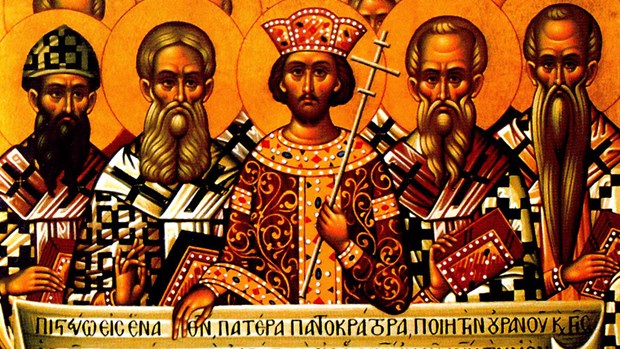

Lent has been around for ages, but have you ever wondered what the early Church Fathers say about Lent?

St. Augustine of Hippo (AD 354-430)

O Lord,
The house of my soul is narrow;
enlarge it that you may enter in.
It is ruinous, O repair it!
It displeases Your sight.
I confess it, I know.
But who shall cleanse it,
to whom shall I cry
but to you?
Cleanse me 
from my secret faults, O Lord,
and spare Your servant
from strange sins.


St. Ambrose of Milan (AD 339-397)
Image result for st ambrose
O Lord, who hast mercy upon all,
take away from me my sins,
and mercifully kindle in me
the fire of thy Holy Spirit.
Take away from me the heart of stone,
and give me a heart of flesh,
a heart to love and adore Thee,
a heart to delight in Thee,
to follow and enjoy Thee, for Christ's sake, Amen


St. Gregory Nazianzen (329 - 390)


"By our passions, let us imitate His Passion."

"Christ fasted a while before His temptation; we, before the Paschal feast - the matter of fasting is the same. This hath in us the force of mortifying us with Christ and is the purifying preparation to the feast. And He indeed fasted forty days; for He was God; but we proportionate this to our power, though zeal persuades some to leap even beyond their strength."


St. Basil the Great (330 - 379)

"Fasting is the beginning of penance or repentance, the continence of the tongue, the bridle of anger, the banishment of lust."

"Fasting is our assimilation unto the Angels, the temperament of life."


St. Ambrose (340 - 397)

"Not every hunger makes an acceptable fast, but that hunger which is undertaken from the fear of God."

"For so hath the Lord appointed, that as for His Passion we should mourn in the fasts of Lent, so for His Resurrection, we should rejoice in the fifty days following. Therefore, we fast not in this fifty days, because in these the Lord is with us. "


St. Jerome (347 - 420)
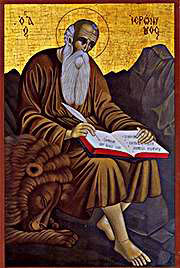
"The Lord hath taught us that the fiercer sort of devils cannot be overcome but by prayer and fasting."

"The Lord Himself, the true Jonah, sent to preach unto the world, fasted forty days, and leaving us the inheritance of the fast, under this number prepares our souls for the eating of His Body."


"The Lord fasted forty days in the wilderness, that He might leave unto us the solemn days of the fasts."


St. Chrysostom (349 - 407)
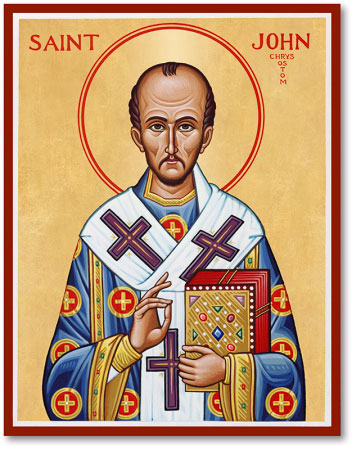

"And the ground and teacher of all these things, fasting will be unto us; fasting, I mean, not that of most men, but that which is the true fast, viz. the abstinence not from meats only, but from sins."


BISHOP R. BARRON ON LENT


Bishop Robert Barron on Lent & Temptation

The Practices of Lent

Lenten Relections


Bishop R. Barron on God's Mercy
A Lenten Reflection


A Celebration of Padre Pio

"Pray, hope and don't worry"


Get Real for Lent

February 24, 2018 · Fr. Stephen Freeman
my source: The Excellent Orthodox blog Glory to God for All Things


According to St. Basil, God is the “only truly Existing.” Our own existence is a gift from God who is our Creator. None of us has “self-existing” life. We exist because God sustains us in existence – in Him we live and move and have our being (Acts 17:28).


Sin is the rejection of this gift of God – a movement away from true existence.


+++


Much of our attention in the modern world is engaged seemingly with things that have no “true existence.” We engage with illusions, with digital constructs. Our economy allows us to escape the normal necessities such as seasonal scarcity or other mundane concerns. We are increasingly removed from the very environment in which we naturally live.


It is said that astronauts, after spending a prolonged time in space, have lingering effects of zero-gravity. Our bodies are made for gravity and require its constant pull for everything from muscle tone to bone density. But we now live in situations in which many forms of natural “gravity” have been reduced or removed. What effect does the long-term ability to have almost any food at any time of year have on the human body? As someone who has spent the better part of my life at a desk, I can attest to the effect of a sedentary existence. My lower back, my range of motion, the flexibility of my joints are all consistent with the modern white-collar worker.


What effect do such things have on the soul? For the soul requires “gravity” as well. Plato stated in his Republic, that all children should learn to play a musical instrument because music was required for the right development of the soul. We give far too little thought to such things, assuming that no matter what environment we live in, our inherent freedom of choice remains unscathed and we can always decide to do something different, or be something different.


I could decide to run a marathon tomorrow, but I know that the first quarter-mile would leave me gasping for breath and exhausted. You cannot go from 40 years at a desk to the demands of a marathon – just because you choose to do so.


And so we come to Great Lent.


Some see this season of the year as a spiritual marathon. They rise from their sedentary spiritual lives, set off in a sprint and fail before the first week is out. The failure comes in anger, self-recrimination, even despondency.


The first year that I “chose” to fast in the Orthodox manner (it was 4 years before I was received into the Church), the priest I discussed the fast with said, “You can’t keep the fast.” I argued with him until I realized his wisdom.


“Do something easier,” he told me. “Just give up red meat.”


“What about chicken?” I asked.


“Nope. Eat chicken. Eat everything except beef and pork. And pray a little more.”


And so I returned to my Anglican life, a little disappointed that my zeal had made such a poor impression. But my family accepted the proposal and we ate no red meat for Lent. It was, in hindsight, the best Lent my family had ever had. No longer were we musing over “what to give up for Lent,” and instead accepted a discipline that was given to us.


In subsequent years that same priest (who is now my godfather) increased the discipline. And we were ready for it. It is interesting to me, however, that my first experience of an Orthodox fast was being told not to be so strict. The “strict” part was learning to do what I was told. That is sometimes the most difficult fast of all.


Lent is a time to “get real.” Not eating some things is actually normal. In our modern world we have to embrace a natural “gravity” that we could easily leave behind – at least, we have to do this if we want to avoid an atrophy of the soul.


In 2000, the average American ate 180 pounds of meat a year (and 15 pounds of fish and shellfish). That was roughly a third more than in 1959. Scarcity is not an issue in our diet. Our abundance is simply “not real,” and the environment frequently shows the marks of the artificial nature of our food supply. But we have no way of studying what is going on with our souls. What I know to be true is that – as goes the body – so goes the soul. Those who engage the world as consumer are being consumed by the world to an equal measure.


And so we get real.


Getting real means accepting limits and boundaries. Our culture is a bubble of make-believe. It rests on an economy of over-consumption. The crash of 2008 came close to a much greater disaster and could have easily gone into free-fall. Many fail to understand just how fragile our lives truly are. In the season of Lent (and on all the fasting days of the year) we embrace the fragility of our lives. We allow the world to say “no” and take on extra burdens and duties. It is worth keeping in mind that such things do not make us spiritual heroes, first they have to make us human.

N.T. Wright on the significance of
the Cleansing of the Temple


Father Francis Martin s.j. on the same gospel


.St Thomas Aquinas on the Remission of sins

SATURDAY 3rd MARCH. THE PRODIGAL SON

LENT DAY 18

LUKE 15:1-3, 11-32

Friends, our Gospel today is Jesus’ best-known parable: the story of the prodigal son.

In considering this narrative, we are dealing with an icon of the Father told by the one who is himself the Icon of the Father. Thus we have Jesus indirectly crafting a subtle self-portrait. The gathering embrace of the father in the story mirrors that of the heavenly Father, which in turn is represented in that of Jesus. 

What happens when the father embraces his son and kisses him? The boy speaks: “Father, I have sinned against heaven and against you; I no longer deserve to be called your son.” Whenever characters in the Bible come close to the divine grace, they experience a heightened sense of their own unworthiness. This is the dynamic at work in the case of the prodigal son. 

But his father ignores his carefully rehearsed speech, and, with an eagerness bordering on impatience, instructs his servants to prepare a celebration. Our participation in the flow of the divine life is, necessarily, a gift. It cannot, in principle, be earned or merited, but only accepted. We can only be embraced by it.


Wednesday, 28 February 2018

A NEW STEP TOWARDS PAN-ORTHODOX UNITY: THE INTERNATIONAL ORTHODOX THEOLOGICAL ASSOCIATION by Alison Kolosova & MY COMMENT


The problems that exist between Catholics and Orthodox correspond directly to internal problems within our own churches.  Their solution not only helps to mend the schism, they can also help us to re-balance the life of our Catholic and Orthodox churches.  
For example, Catholic-Orthodox dialogue is showing us that, according to Tradition, primacy and synodality belong to one another and neither can be exercised in a balanced way without the other.  Also, as Zizioulas suggests, if synodality belongs to the essence of the Church as a reflection of the Blessed Trinity, then primacy does too.  This conviction is directly influencing recent popes and especially Pope Francis in the way they set up their relations with local and regional churches.   Pope Francis, like Pope Benedict before him, is very keen that Catholicism should be embedded in local culture and he clearly disagrees with the Vatican deciding all important matters from the centre.

Perhaps the greatest contribution of Catholic-Orthodox dialogue has been the acceptance by Catholic theologians of 'eucharistic ecclesiology' of Father Nicolai Afanassiev which became a key concept of Vatican II and in the theology of Pope Benedict XVI.

 I am sure that the Catholic Church will be watching Orthodox attempts to solve its problems of disunity because the solutions can have a direct bearing on Catholicism.  Perhaps, one day, Orthodoxy may wake up to the fact that the attempts of the Catholic Church to tackle its own problems may help them tackle theirs and that ecumenical dialogue can help us all become more truly ourselves.

Metropolitan Hilarion once said that, around a thousand years ago, the churches in East and West decided they could do without each other.  I am sure that this terrible mistake, born out of a lack of ecclesial love on both sides, has distorted Catholic attempts to be more Catholic and Orthodox attempts to be more Orthodox.  The more we know each other, the more we will know we need each other.


Jerusalem was an appropriate location for an international group of scholars to meet after the feast of Christ’s Nativity to present their vision of how Orthodox scholarship could engage more effectively with the issues of our contemporary world. A fifteen-minute walk from our hotel through the chic, modern shopping arcades of downtown Jerusalem brought us to the Old City where before breakfast one morning we found ourselves standing at the Church of the Holy Sepulcher alongside a Coptic bishop, priests and nuns. They gladly gave us their blessing and holy bread as crowds pressed in to take selfies of the exotically-clad clergy. In the courtyard before the nearby Western Wall we stood with Jewish women as they swayed and prayed with words of holy texts pressed to their faces.  An elevator ride into the tower above our hotel opened up vistas of the sprawl of modern buildings that today fill the steep hills and cliffs of the city. The Wall separating Palestinian and Jewish sectors was clearly visible in the distant haze. During the short bus ride that took us to join the throngs of pilgrims in Bethlehem we drove past the Walled-Off Hotel, Banksy’s evocative graffiti, and his wry words of comfort ‘Nothing lasts forever’.

This is a land and city where every stone speaks of the ancient tangled roots of three Abrahamic faiths, yet every step you take comes with a reminder of the tensions and divisions of modernity.  It was this, rather than simply the proximity of the holy places, that made Jerusalem an appropriate location for the first meeting of Chairs of the twenty-five Groups of the recently-formed International Orthodox Theological Association. They met in Jerusalem for planning, prayer and pilgrimage at the start of a year which will culminate in IOTA’s inaugural conference in Iasi, Romania from 9-12 January 2019. The Groups, each devoted to a different aspect of Orthodox theology and life, promise to provide a rich time of reflection as theologians, historians, political and natural scientists seek to give informed Orthodox perspectives on today’s burning issues. (For the Call for Papers, visit IOTA website).

What does it mean to be human? How can the wealth of Orthodox asceticism and spirituality found in the Philokalia speak today? What can we learn from Arabic-speaking Christians about an approach to Islam that goes beyond polemic? How can a balanced approach to the science-religion interface be found rather than making a false dichotomy between the two?  What contribution can analytic philosophers of religion make to the intellectual defense of Christianity? What is the role of women in the Church?  What is the theological basis for Christian environmental concern? How can Orthodoxy be authentically enculturated in Africa, Asia and the Americas? How should the Orthodox churches respond to migration and refugee crises?  These are but a few of the issues that IOTA scholars propose to engage with.

Catalin Jeckel, the link between IOTA leadership and His Eminence Teofan Archbishop of Iasi who leads the Committee organizing the conference in Iasi, spoke of theology needing to become the ‘Art of living’ the Revelation. Peter Bouteneff of St. Vladimir’s Seminary in New York spoke of the challenge of engaging with theology emanating from vastly different contexts than our own, familiarizing ourselves with the diversity of Orthodox theological approaches, priorities and languages. The meeting as a whole discussed the dual need to be both a think-tank providing resources for the church hierarchy in their deliberations, yet also to make the fruits of its work available in accessible language to local Orthodox parish and diocesan communities. It is to these many challenges that IOTA seeks to constructively respond as it journeys towards the Iasi conference in 2019.

In this journey, the Orthodox churches’ greatest wealth is perhaps also their greatest potential obstacle. At best, the deep identification of faith and culture in historically Orthodox countries is the legacy of an incarnational understanding that the Gospel can never be a disembodied, deculturated message. It can and must be enfleshed in cultural particularity, with profound implications for the corporate life of any community or society. At worst, the imprisonment of Orthodoxy in any one particular cultural or national form can lead to a nightmare of cultural bias, blindness and misunderstanding, an introverted concern for one nation’s faith and internal affairs. The vision of a Church which exists not for itself but, following Christ’s example, for the life of the world, is easily forgotten.

This picture becomes even more complicated in the myriad new contexts in which the Orthodox Church finds itself in the contemporary world, whether in Africa, Asia or the Americas, where Orthodox Christians usually find themselves in the position of a counter-culture. Émigré communities seeking to continue the traditions of distant homelands or convert communities seeking alternatives to other religious traditions are united at least in a common desire to avoid living according to the expectations of the surrounding cultural status quo.  Yet to reflect critically on Orthodoxy’s role in new contexts and realities is to challenge deeply-held convictions about cherishing and perpetuating the national faith, culture and language both of those from Orthodoxy’s historical homelands, and those for whom the new contexts are home. Is there a way to get beyond these obstacles to the unity and conciliarity of the Orthodox Church?

Disturbed by the legacy of two world wars and what he perceived as the idolatry of churches on both sides making an almost total identification of the cause of Christ with the cause of their own nation, the leading 20th-century Christian thinker, Lesslie Newbigin, offered the following remedy: ‘It is only by being faithful participants in a supranational, multicultural family of churches that we can find the resources to be at the same time faithful sustainers and cherishers of our respective cultures, and also faithful critics of them.’ He emphasized the need to listen to those with minds and hearts shaped by other cultures in a spirit of mutual responsibility toward one another, and with a willingness to receive mutual correction. Newbigin was not Orthodox and did not find ready-made around him that family of churches that he felt Christ’s Body should be.  He devoted much of his life to building such a family. Orthodox Christians can be grateful that they have an advantage, in theory, and in many ways in practice, over Newbigin’s situation. It is this ready-made foundation, this supranational, multicultural family of local churches that IOTA’s scholars hope to build on. In their deliberations together it is the unity and conciliarity of this family that they seek to serve.

Alison Kolosova is co-chair of the Missiology Group of the International Orthodox Theological Association.

Sunday, 25 February 2018

KILPECK CHURCH, HEREFORDSHIRE, UK.: A THEOLOGICAL LOOK AT THE CARVINGS

Image result for kilpeck church
As I am now back in England to stay, I shall, from time to time, tell you a little about Herefordshire, the very beautiful county in which Belmont Abbey is situated.  Besides being known for its Hereford beef cattle, it is simply drenched in history, being a place where Celt and Saxon meet and has a fine cathedral with a wonderful music tradition and a choir school that has its origins in the Middle Ages.  


At the Reformation, the new religion was met by the population with less than enthusiasm, which probably explains why so many carvings and stained glass have remained untouched to the present day.  The Catholic gentry and their employees provided ample work for Jesuit priests who had a "college" ( a community of priests) in Hereford, and the Catholic presence remained strong until the failure of the 1745 rebellion of Bonny Prince Charlie, after which the Catholic landowners gave up hope of any Catholic restoration and went with their servants to Maryland in the American colonies.   Even among the Anglican clergy, there were those in the early days who celebrated the Book of Common Prayer service in their parish churches and then went home, away from the spying eyes of the authorities, and celebrated the pre-Reformation Mass for those who were interested.  Nowadays, however, Herefordshire is a very Anglican county, and Hereford has one of the highest numbers of Anglican churches in proportion to the population in the country.


It is also said that one of the oldest witches covens in the country actually still meets in this area, which is why, they say, so many churches are dedicated to St Michael and his angels, including Belmont Abbey, and there is a chapel of St Michael built over the entrance of the cathedral to keep out unwelcome visitors!   Perhaps, just a rumour!


KILPECK CHURCH

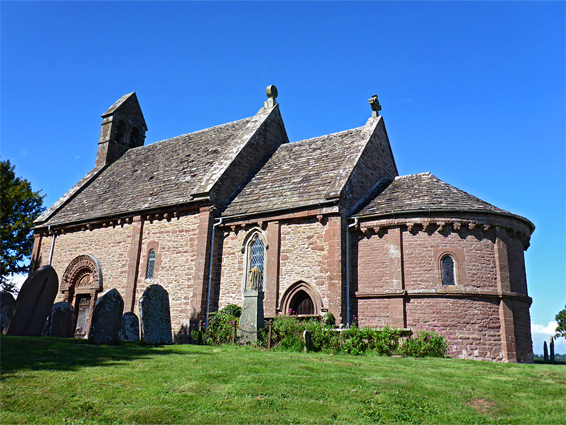
The name Kilpeck is derived from Kil or Cell and the name of the saint Pedic or Pedoric. The church is dedicated to St Mary and St David. This St David is not the patron saint of Wales but another local St David. 


The name "Kilpeck" clearly pre-dates the chapel and castle and is typical in Celtic Christianity.  It was the place where a local monk, St Pedic or Pedoric, had his cell or monastery.   These local saints, often monastic hermits, had immense influence, with even bishops seeking advice on spiritual matters and guidance on how to run the church.  Their memory lived on in the local Church and where they lived was often marked by a chapel bearing their name.  There are references to "Cilpedec" in the 7th century, dedicated to St David, probably a local saint rather than the patron of Wales.

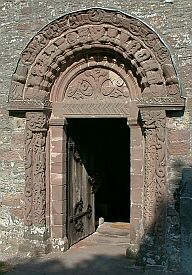
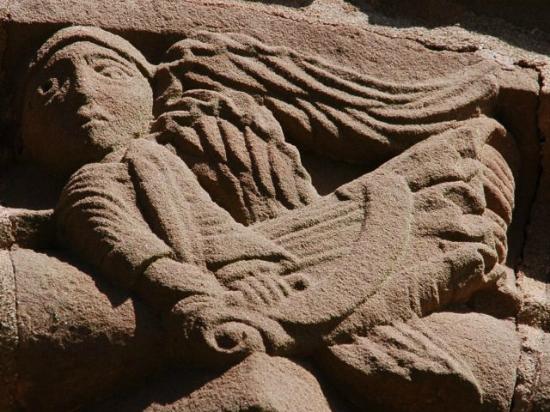
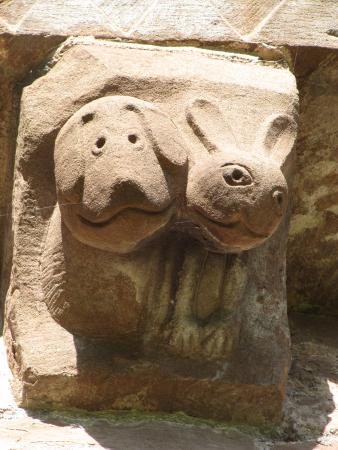
The church at Kilpeck is quite fascinating.  The ornately carved door contains elements of Celtic, Saxon and even Scandinavian (Viking) art and is seen as the epitome of the Herefordshire school of sculpture. It is built on a seven-sided or egg-shaped mound which may indicate the site was used in antiquity but this is open to debate. The church is ornately carved with no less than 89 corbels.


Before we go any further, please watch the following video, after which I am going to suggest an overall interpretation of the many carvings in the church which is based, not on what each carving means as an isolated artefact, but on an integrated pattern of symbols that tell us what a Catholic church is for.   We must remember that this is a church built by Catholics for Catholics, not Catholics during the Reformation which was caused by a clash of doctrinal definitions, but Catholics of a time when East and West were at least partially joined together and when the "age of the fathers" was still very much alive.  They read Scripture differently in those days, using the images and stories from the New Testament, especially the death and resurrection of Christ, as a key to understanding the images and stories of the Old Testament, the reality showing us the real meaning of its shadow.  This is also the way the Liturgy understands Scripture.  Please watch the video.


Some time ago, I visited the small church of Kilpeck and the first thing that struck me was what a wonderful setting it would be for the celebration of the Divine Liturgy of St John Chrysostom or, for that matter, the celebration of any
truly Catholic Eucharist.  Thus I came to look at the carvings both within and without in a liturgical frame of mind.

  Then it struck me that the Eucharist is the key to understanding the meaning of the carvings, not of each one taken individually, but the theme that binds them all together in a  coherent whole. The liturgy is "heaven on earth" and, therefore, the interior of the church represents heaven because it is where the liturgy is celebrated.  The chaotic juxtaposition of pagan and Christian symbols on the exterior represents the world in which the Christian lives, but the Spirit that descends on the Church in the Eucharist forms an undercurrent, uniting the created world with Christ in heaven.


If the Eucharist is the central theme, then we must begin with the sanctuary and the altar, the most sacred part of the church called the apse.   It is on the altar of any church that heaven and earth meet..


Related image


 Over this altar, there is a carving of water cascading down along the stone seams, onto and around the altar table, and from there, it flows down the centre of the chancel and nave. 

I quote from an Orthodox essay on water, but in this regard, the author is giving the Tradition common both to East and West:
For thousands of years water has been among the main religious symbols. This is indeed the case for the Orthodox Christian tradition where it is involved in liturgical mysteries from baptism and the Eucharist to the rites of the Blessing of the waters. Why is water so central to Christian religious life? Let us attempt to answer this question by turning to Biblical history and Christian tradition with particular reference to the office of Epiphany.
Water as a symbol of life as well as a means of cleansing, or purification, is of particular importance in Old Testament. It was created on the first day (Genesis 1:2, 6-8). The Spirit of God was hovering over the face of the waters (Genesis 1:2). The earth was founded upon the waters (Genesis 1:6-7, 9-10). God commanded the water to bring out an abundance of living souls (Genesis 1:20-21). In some sense the element is close to God (Psalms 17; 28:3; 76:17, 20; 103:3; 148:4). God is compared with the rain (Hosea 6:3). Water brings life (cf. Exodus 15:23-35; 17:2-7; Psalms 1:3; 22:2; 41:2; 64:10; 77:20; Isaiah 35:6-7; 58:11) and joy (Psalm 45:5). It is a powerful purifying element and can destroy evil and enemies as in the stories of the Flood and the flight of Israel from Egypt (Genesis 3:1-15; Exodus 14:1-15:21). According to Old Testament Law, it cleanses defilement (Leviticus 11:32; 13:58; 14:8, 9; 15-17; 22:6; cf. Isaiah 1:16) and is used in sacrifices (Leviticus 1:9, 13; 6:28; 1 Kings 18:30-39), in which context the Bible mentions the living water (Leviticus 14; Numbers 5; 19). Water heals, as can be seen from the stories of Naaman the Syrian cured from his leprosy in the waters of Jordan (2 Kings 5:1-14) and the annual miracles at Bethesda in Jerusalem (John 5:1-4). John the Baptist used the waters of the Jordan to cleanse people's sins which reminded typical Jewish custom (Matthew 3:1-6; Mark 1:4-5; Luke 3:2-16; John 1:26-33) - even Christ came to be baptized (Matthew 3:16; Mark 1:10). On the other hand, water is also the habitat of serpents whose heads God crushed (Psalm 73:13-14) and of the dragon (Job 41:25; Psalm 103:26).
We can see from this the belief common in the Old Testament that water is a mystically powerful element which, being connected with God in some way, can cleanse sins, inner and outer defilement, and regenerate the human body. It is even possible to assert that water has taken on the religious symbol of life.


In the sanctuary of Kilpeck church the reference, I think, is to the water that gave life to the Garden of Eden, but more especially to the water that flows from the heavenly temple in Jerusalem in Ezekiel 47, 1 - 12:
The man brought me back to the entrance of the temple, and I saw water coming out from under the threshold of the temple toward the east (for the temple faced east). The water was coming down from under the south side of the temple, south of the altar.... [3] As the man went eastward with a measuring line in his hand, he measured off a thousand cubits and then led me through water that was ankle-deep. [4] He measured off another thousand cubits and led me through water that was knee-deep. He measured off another thousand and led me through water that was up to the waist. [5] He measured off another thousand, but now it was a river that I could not cross because the water had risen and was deep enough to swim in — a river that no one could cross. [6] He asked me, “Son of man, do you see this?” Then he led me back to the bank of the river. [7] When I arrived there, I saw a great number of trees on each side of the river. [8] He said to me, “This water flows toward the eastern region and goes down into the Arabah, where it enters the Sea. When it empties into the Sea, the water there becomes fresh. [9] Swarms of living creatures will live wherever the river flows. There will be large numbers of fish because this water flows there and makes the salt water fresh; so where the river flows everything will live. [10] Fishermen will stand along the shore; from En Gedi to En Eglaim there will be places for spreading nets. The fish will be of many kinds — like the fish of the Great Sea. [11] But the swamps and marshes will not become fresh; they will be left for salt. [12] Fruit trees of all kinds will grow on both banks of the river. Their leaves will not wither, nor will their fruit fail. Every month they will bear because the water from the sanctuary flows to them. Their fruit will serve for food and their leaves for healing.”
In Catholic understanding, this river is the Holy Spirit, the source of life for the Church and the source of life for the Liturgy.  As it says in the passage. "Where the river flows, everything will live."

The water  descends on the bread and wine and on the community when the priest, in the name of Christ, presents a petition asking the Father to send his Spirit on the bread and wine to make them the body and blood of Christ and on the community so that it may become capable of sharing in the heavenly Liturgy (Hebrews 12, and the Book of Revelation as a whole). 

The Holy Spirit is seen as the force that unites the eucharistic community with the ascended Christ to become one body with him as it prays "Holy, holy, holy" with the angels and saints.  It joins them as Christ enters into the heavenly sanctuary, united with those from the whole of humanity, past, present, and future, who are saved by this intimate union with him as they become his captives of love.
The liturgy is “this unprecedented power that the river of life exercises in the humanity of the risen Christ”.
The liturgy is “eternal (inasmuch as the body of Christ remains incorruptible) and will not pass away; on the contrary, it is this liturgy that “causes” the present world “to pass” into the glory of the Father in an ever more efficacious great Pasch” (63).The liturgy essentially involves action and energy; the heavenly liturgy tells us of all the actors in the drama: Christ and the Father, the Holy Spirit, the angels and all living things, the people of God (whether already enjoying incorruptible life or still living through the great tribulation), the prince of this world, and the powers that worship him. The heavenly liturgy is “apocalyptic” in the original sense of the word: it “reveals” everything in the very moment in which it brings it to pass.
 When the event is present, prophecy becomes “apocalyptic”.

The liturgy is this vast reflux of love in which everything turns into life.

Jean Corbon "The Wellspring of Worship"


We have this theme of water, coming down from heaven, going through the middle of the church, rising up in the doorway and producing the tree of life in the timpanum.


The liturgy is "heaven on earth", and this is the theme of the Church's interior. Therefore, the local congregation is never alone when it has been brought into the presence of the Triune God in the Mass: as Hebrews and the Apocalypse indicate, they form one community with the "whole Adam" as the early Fathers would say, and they stand, shoulder to shoulder, with the saints and angels.  Thus no Catholic church is without statues or icons of the saints, and Kilpeck Church is no exception.  They are on the columns that separate the chancel from the nave.  Who the saints are I don't know, but the churchgoers would have known by what the saints are carrying.  Anyway, they indicate the close connection between heaven and earth which have become united by the Incarnation.             Image result for kilpeck church


 The outside carvings collectively stand for the world in which we live.  It is a mixed world in which there is both good and evil, love and lust, monsters and dangerous wild animals that eat human beings, but also rabbits and pigs, humour and human affection.  Perhaps the horse and cross represent the anonymous Templars who pass through this world bearing Christ's Cross and are buried in the church without names.   

Image result for kilpeck church images
Perhaps the foreign warriors in trousers carved on the doorpost stand for those who killed them, and at death's door, the Templars discovered the tree of life growing out of the very waters that flow into God's Church through the Eucharist, the Spirit that has aligned their death with that of Christ.  The gateway to death became the door to heaven, symbolised by the door through which the faithful enter for Mass.


A SELECTION OF CORBELS

Ordinary Folk

Image result for kilpeck church images
xxxxxxxxxxxxxxxxxxxxxxxxxxxxxxxxxxxxxxxxxxxxxxxxxxxxxxxxxxxxxxxxxxxxxxxxxxxxxxxxx
Image result for kilpeck church images
xxxxxxxxxxxxxxxxxxxxxxxxxxxxxxxxxxxxxxxxxxxxxxxxxxxxxxxxxxxxx

Human love and procreation


Image result for kilpeck church images
and work:
Image result for kilpeck church images
Domestic animals:
Image result for kilpeck church images
dangerous animals and monsters


Image result for kilpeck church images


the famous Sheela Na Gig:


The Kilpeck Sheela Na Gig
A pagan fertility goddess?   A depiction of lust?  This motif is found in other countries of western Europe, though this is the most famous and most photographed, and its origin is most probably Christian.  The sculptor seems to be telling us that the world is a chaotic mixture of good and bad.  If that is so, this may depict lust.

Finally, perhaps a symbol for the Templars or for all Crusaders who passed through this world serving the Cross:
Image result for kilpeck church images
Here are video to help you appreciate the church:


Search This Blog

La Virgen de Guadalupe

La Virgen de Guadalupe

Followers

My Blog List

Fr David Bird

Fr David Bird
Me on a good day

Blog Archive