EXPAND YOUR READING!!

"Today the concept of truth is viewed with suspicion, because truth is identified with violence. Over history there have, unfortunately, been episodes when people sought to defend the truth with violence. But they are two contrasting realities. Truth cannot be imposed with means other than itself! Truth can only come with its own light. Yet, we need truth. ... Without truth we are blind in the world, we have no path to follow. The great gift of Christ was that He enabled us to see the face of God".Pope Benedict xvi, February 24th, 2012

The Church is ecumenical, catholic, God-human, ageless, and it is therefore a blasphemy—an unpardonable blasphemy against Christ and against the Holy Ghost—to turn the Church into a national institution, to narrow her down to petty, transient, time-bound aspirations and ways of doing things. Her purpose is beyond nationality, ecumenical, all-embracing: to unite all men in Christ, all without exception to nation or race or social strata. - St Justin Popovitch

Friday, 10 April 2015

FATHER R. CANTALAMESSA'S "EAST AND WEST ON THE MYSTERY OF THE TRINITY"


Father Cantalamessa's 2nd Lent Homily 2015
"East and West on the Mystery of the Trinity"

Rome, March 06, 2015 (Zenit.org) 

Here is the second Lenten homily given this year by the preacher of the Pontifical Household, Capuchin Father Raniero Cantalamessa.

* * *

1. Bringing together what unites us

The recent visit of Pope Francis to Turkey, which concluded with his meeting with the Orthodox Patriarch Bartholomew, and in particular the pope’s exhortation to Eastern Christian and Western Christians to share fully their common faith have convinced me of the usefulness of devoting the Lenten meditations for this year to support this desire of the Holy Father, which is also the desire of all Christendom.

This desire for communion is not new. The Second Vatican Council, in Unitatis redintegratio, already urged a special consideration of the Eastern Churches and of their riches (UR 14). St. John Paul II, in his apostolic letter in 1995, Orientale lumen, wrote,

Since, in fact, we believe that the venerable and ancient tradition of the Eastern Churches is an integral part of the heritage of Christ’s Church, the first need for Catholics is to be familiar with that tradition, so as to be nourished by it and to encourage the process of unity in the best way possible for each.[1]

That same holy pontiff formulated a principle that I believe is fundamental for the path to unity: “I pray . . . for fruitful cooperation in the many areas which unite us; these are unquestionably more numerous than those which divide us.”[2] The Orthodox Church and the Catholic Church share the same faith in the Trinity, in the Incarnation of the Word, in Jesus Christ as true God and true man in one single person who died and was raised for our salvation and who has given us the Holy Spirit. We believe that the Church is animated by the Holy Spirit, that the Eucharist is “the source and summit of the Christian life,” that Mary is the Theotokos, the Mother of God, and that eternal life is our destination. What could be more important than this? The differences occur in our manners of understanding and explaining some of these mysteries, so they are secondary and not primary.

In the past, relations between Eastern theology and Latin theology were marked with an obvious apologetic and polemic coloring. They focused—in recent times, fortunately, with more irenic tones—on the distinctions and on what each side believed was different  and more correct than the other side. The time has come to reverse this tendency, leaving aside any obsessive insistence on the differences (which are often based on a forced interpretation, if not a distortion, of the other’s thought) and instead to bring together what we have in common and what unites us in one faith. This is necessitated peremptorily by the common duty of proclaiming the faith to a world that has profoundly changed and has different questions and interests than those during the time in which the disagreements arose—a world in which the vast majority no longer understands the meaning of so many of our subtle distinctions and is light- years away from them.

Until now, in the effort to promote unity among Christians, one approach has predominated that could be formulated this way: “First resolve the differences, and then share what we have in common.” The approach that is now increasingly being pursued in ecumenical circles is “Share what we have in common, and then resolve the differences with patience and reciprocal respect.”

The most surprising result of this change in perspective is that the same doctrinal differences, rather than appearing to us as an “error” or a “heresy” of the other side, are beginning to appear more and more often as compatible with one’s own position and at times even as a necessary corrective and an enrichment. We have a concrete example of this, on another front, with the agreement between the Catholic Church and the Lutheran World Federation in 1999 concerning justification by faith.

A wise pagan thinker in the fourth century, Quintus Aurelius Symmachus, noted a truth that acquires its full value if it is applied to the relations among the various theologies of East and West: “Uno itinere non potest perveniri ad tam grande secretum.”[3] (“It is not possible to arrive at such a great a mystery through one path.”) In these meditations we will try to demonstrate not only the necessity but also the beauty and joy of finding ourselves at the summit of a mountain, although we reached it by different slopes, to contemplate the same marvelous panorama of Christian faith.

The great mysteries of faith, whose fundamental agreement in the diversity of the two traditions we will seek to confirm, are the mystery of the Trinity, the person of Christ, the person of the Holy Spirit, and the doctrine of salvation. Two lungs but one breath. That will be the conviction that will guide us on our path of exploration. Pope Francis speaks in this sense of “reconciled differences”: they are not silenced or trivialized but reconciled. Since these are simple Lenten sermons, it is clear that I will touch on very complex problems without any claim to thoroughness, and with an intent that is practical and preliminary rather than speculative.

I approach this task with great humility and almost on tip-toes, knowing how difficult it is to strip oneself of one’s own categories to take on those of others. I am comforted by the fact that the Greek Fathers, along with the Latin Fathers, were for years the daily bread of my studies, and that many later Orthodox authors (Symeon the New Theologian, Nicholas Cabasilas, the Philokalia, Seraphim of 
Sarov) have been constant inspirations for me in my preaching ministry, not to mention the icons that are the only images before which I am able to pray.
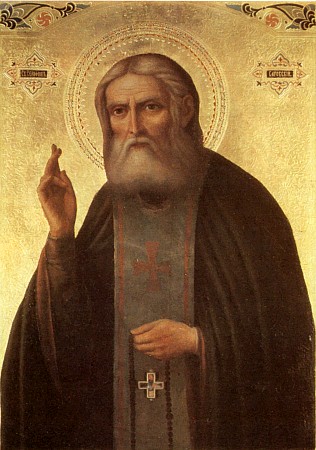
2. East and West on the mystery of the Trinity

Let us begin our ascent by treating the mystery of the Trinity, that is, the highest mountain, the Everest of faith. [4] In the first three centuries of the life of the Church, as the doctrine of the Trinity gradually became explicit, Christians saw themselves exposed to the same accusation they had always leveled against the pagans: that of believing in more than one God, of being polytheists themselves as well. This is why the credo for Christians in all its various formulations for three centuries that began with the words, “I believe in God” (Credo in Deum), is adjusted with a small but significant addition beginning in the fourth century that would never again be omitted afterwards: “I believe in one God” (Credo in unum Deum).

It is not necessary to go over the path that led to this result: we can move forward immediately to its conclusion. Toward the end of the fourth century the transformation of the monotheism of the Old Testament into the Trinitarian monotheism of Christians had been completed. The Latins expressed the two aspects of the mystery with the formula “one substance and three persons,” and the Greeks with the formula, “three hypostases, one single ousia.” After a heated meeting, the process apparently concluded with a total agreement between the two 
theologies. “Can anyone conceive,” asked Gregory Nazianzus, “of a more complete agreement and a more absolute expression about the same thing, even if it uses different words?”[5] 
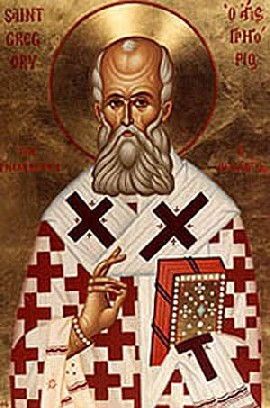
One difference actually did remain between the two modes of expressing the mystery. Today it is generally expressed this way: in their consideration of the Trinity, the Greeks and the Latins move from opposite poles: the Greeks move from the divine persons, that is from plurality, to reach the unity of nature, and the Latins, in contrast, move from the unity of the divine nature to reach the three persons. According to a French historian of dogma, “Latin theology considers personality as a mode of nature; Greek theology considers nature as that which is contained in the person.” [6]

I think this difference can also be expressed in another way. Both Latins and Greeks begin with the unity of God. Whether it is the Greek or Latin creed, it starts by saying, “I believe in one God.” But this unity for the Latins is conceived of as still impersonal or pre-personal. It is the essence of God that then becomes specified as Father, Son, and Holy Spirit, without of course being thought of as preexisting the persons. In Latin theology, the treatise “De Deo uno” (“On One God”) has always preceded the treatise “De Deo trino” (On the Triune God”).

For the Greeks, instead, the unity is already personalized, because for them, “the unity is the Father, from whom and in relation to whom the other persons are recognized”[7] The first article of the credo of the Greeks also says, “I believe in one God the Father almighty,” but “Father almighty” here is not separated from “one God,” as it is in the Latin creed, but makes one complete unit with it. The comma does not come after the word “God” but after the word “almighty.” The meaning is “I believe in one God who is the Father almighty.” The unity of the three divine persons for the Greeks comes from the fact that the Son is perfectly (substantially) “united” with the Father, just as the Holy Spirit is united to the Son.[8]

Either manner of approaching the mystery is legitimate, but today the tendency more and more is to prefer the Greek model in which the unity in God is inseparable from the Trinity but forms a unique mystery and flows from one single act. Using inadequate human words, we can say the following: The Father is the fountain, the absolute origin of the movement of love. The Son cannot exist as the Son if he does not first of all receive from the Father all that he is. John of Damascus writes, “It is because of the Father—because of the fact that the Father exists—that the Son and Holy Spirit also exist.”[9]

The Father is the only one, even within the Trinity, absolutely the only one, who does not need to be loved in order to love. Only in the Father is this perfect equation realized: to be is to love. For the other divine persons, to be is to be loved.

The Father is an eternal relationship of love and does not exist outside this relationship. We cannot, therefore, conceive of the Father primarily as the supreme being and then recognize an eternal relationship of love in him. One needs to speak of the Father as an eternal act of love. The unique God of Christians is therefore the Father; he is not, however, conceived as separate (how can someone be called “father” unless he has a “son”?) but as the Father who is always in the act of generating the Son and giving himself to him with an infinite love that unites both of them and is the Holy Spirit. The unity and Trinity of God flow forth eternally from one single act and constitute a unique mystery.

I said that many today, even in the West, tend to prefer the Greek model (and I myself am among these). We need to add at once, however, that this does not mean renouncing the contribution of Latin theology. If in fact Greek theology has furnished, so to speak, the correct outline and approach for speaking about the Trinity, Latin thought, through Augustine, has secured its fundamental content and soul, which is love. Augustine bases his discussion of the Trinity on the definition that “God is love” (1 Jn 4:16), seeing the Holy Spirit as the mutual love between the Father and Son according to the triad of lover, beloved, and love that his medieval followers would make explicit and almost canonical.[10] In this same line the theologian Heribert Mühlen has recently put forth a conception of the Holy Spirit as the divine “We,” the personified koinonia between the Father and the Son in the Trinity and, in a different way, among all those baptized in the Church.[11]

The first one among the eastern theologians to acknowledge this contribution of Latin theology was Gregory Palamas who, in the fourteenth century, finally became personally acquainted with St. Augustine’s treatise on the Trinity. He writes,

That Spirit of the supreme Word is like an ineffable love of the Begetter towards the ineffably begotten Word himself. The Beloved Word and Son of the Father also experiences this love towards the Begetter, but he does so inasmuch as he possesses this love as proceeding from the Father together with him and resting connaturally on him.[12]

The opening up of the issue by Palamas is being taken up today in another context by a noted Orthodox theologian when he writes, “ The expression “God is love’ means God ‘exists’ insofar as he is Trinity, that is to say, as a ‘person’ and not a substance. Love is not a consequence or a ‘property’ of the divine substance . . . but is what constitutes his substance.”[13] This seems to me an explanation that is compatible with the definition that St. Thomas Aquinas, in the wake of Augustine, gives of the divine persons as “subsistent relationships.”[14]

The difference and the complementarity of the two theologies are not limited, however, only to the manner of understanding the essence and the relationships internal to the Trinity. With certain significant exceptions on one side or the other, it is clear that the Greeks are more interested in the immanent Trinity, outside of time, while the Latins are more interested in the economic Trinity, that is, how the Trinity reveals itself in the history of salvation. The Greeks, in line with their own genius, are more interested in being and ontology, the Latins in its historical manifestations. In this light, one can understand the Latin habit of beginning the discussion about God with the treatise “On the One God” instead of “On the Triune God.” And we can also understand their reasons for wanting to maintain this tradition as a treasure for everyone. In the history of salvation in fact—as we will soon see—the revelation of the one God preceded that of the triune God.

The clearest sign of this difference in approach can be seen in the two different ways of representing the Trinity in Greek iconography and western art. The canonical icon of Orthodoxy, which has its high point in Andrei Rublev, represents the Trinity by the figures of three equal but distinct angels seated around a table. Everything about it makes a superhuman stillness and unity shine through. The history of salvation is not ignored as demonstrated by the allusion to the occasion when Abraham welcomes the three guests and by the eucharistic table around which the three are seated, but that all remains in the background.

In western art, from the Middle Ages on, the Trinity is represented in a completely different way. We see the Father with his arms extended, supporting the two arms of the cross, while a dove that represents the Holy Spirit hovers between the face of the Father and the Crucified One. The most famous examples are the Holy Trinity of Masaccio in Santa Maria Novella in Florence and of Albrecht Dürer in the Vienna Museum, but numerous examples can be found whether on the popular or artistic level. This is the Trinity as it is revealed to us in the history of salvation that has its apex in the cross of Christ.

3. Two paths still open

Let us take another step forward and attempt to see how the Christian faith needs to keep open and viable both paths to the Trinitarian mystery delineated here. To state it in terms of an outline: the Church needs to receive fully the Orthodox approach to the Trinity into its internal life, that is, in its prayer, contemplation, liturgy, and mysticism, and it also needs to maintain the Latin approach in its mission of evangelization to those outside.

There is no need to demonstrate the first point. In that regard, all we have to do is receive with joy and gratitude the very rich heritage of spirituality that comes from the Greek and Byzantine tradition and that various Orthodox theologians in recent times have defended and made accessible to the western public.[15] A text from St. Basil expresses well the fundamental orientation of the Orthodox vision:

The path to the knowledge of God proceeds from the one Spirit, through the one Son, and to the one Father. Conversely, natural goodness, inherent holiness, and royal dignity come forth from the Father through the Only-Begotten and to the Spirit.[16]

In other words, on the level of being and the coming forth of creatures from God, everything comes from the Father, goes through the Son, and reaches us through the Holy Spirit. In the order of knowledge, or of the return of creatures to God, everything begins with the Spirit, goes through the Son Jesus Christ and returns to the Father. The perspective in both cases is Trinitarian.

What I want to explain instead is why it is necessary today more than ever, be it in the East or the West, to know and to practice the Latin approach to the mystery of the one and triune God as well. St. Gregory Nazianzus, in a famous text, synthesized the process that led to faith in the Trinity this way:

The Old Testament proclaimed the existence of the Father in an explicit way, while the existence of the Son was proclaimed in a more obscure way. The New Testament manifested the existence of the Son while it suggested the divine nature of Holy Spirit. Now the Spirit is present in our midst and grants us a manifestation of himself more clearly. It would not have been appropriate, when the divinity of the Father had not yet been acknowledged, to proclaim openly the divinity of the Son, and it would not have been safe for the Son to lay on us the weight of the divinity of the Holy Spirit when the divinity of the Son had not yet been accepted. [17]

We see this same divine pedagogy practiced by Jesus. He told the apostles he was not able to reveal all the things that pertain to himself and his Father because “you cannot bear them now” (Jn 16:12).

It is true that we now live in a time in which the Trinity has been fully revealed, and therefore we ought to live constantly under this “trisolar light,” as some ancient Fathers call it, without losing ourselves in the contemplation of a “supreme being” God who is more like the God of the philosophers than the God revealed by Jesus. But what do we say about the non-believing, secularized world in need of re-evangelization that is all around us? Isn’t our world in the same condition as the world before the coming of Christ? Shouldn’t we, in facing that world, use the same pedagogy that God used to reveal himself to all of humanity?

We too should therefore help our contemporaries to discover above all that God exists, that he created us out of love, and that he is a good Father, who revealed himself to us in Jesus of Nazareth. Can we honestly begin our evangelization by speaking of the three divine persons? Wouldn’t this also be, to use St. Gregory’s image, putting a weight on people’s shoulders that they cannot carry?

One important thing needs to be noted. The Father who, according to Gregory Nazianzus revealed himself first in the Old Testament, is not yet the “the Father of our Lord Jesus Christ,” that is, a real father of a real son. He is not God the Father of the Trinity; that revelation only comes with Jesus. He is still a father in the metaphoric sense, in the sense of being “a father to his people Israel,” and for the pagans, the “father of the cosmos,” the “celestial father.” Even for St. Gregory, therefore, the revelation about God began with “the one God.”

There is a sense in which the word “God” can and should be used to designate what the three divine persons have in common, that is, the whole Trinity,[18] whether we mean, as Scripture does and the ancient fathers did, a common element like “nature,” substance, or essence (2 Pet 1:4: “partakers of the divine nature” theia physis), or whether we mean, as John Zizioulas proposes, “being as communion.”[19]

The Church needs to find a way of proclaiming the mystery of the one and triune God with appropriate categories that are understandable to the people of its time. This is what the Fathers of the Church and the ancient councils did, and it is in this above all that our fidelity to them consists. It is difficult to think of being able to present to people today the Trinitarian mystery with their same terms of “substance, hypostasis, properties, and subsistent relationships,” even if the Church can never abandon using those terms in its theological settings and in the places where the faith is studied.

If there is something that the experience of proclamation shows is still capable of helping people today—if not to explain, then at least to give them an idea of the Trinity—it is precisely what Augustine did in making love the centerpiece. Love is, in itself, communion and relationship. Love cannot exist without two or more persons. Every love is the movement of one being toward another being, accompanied by the desire for union. For human beings, that union always remains incomplete and transitory, even for the most ardent lovers. Only among the three divine persons is that union realized in such a total way that it eternally makes of the Three one single God. This is a language that people today are also able to understand.

4. United in worship of the Trinity

St. Augustine suggests to us the best way to conclude this reconstruction of the two paths of approaching the mystery of the Most Holy Trinity. If we want to cross over an inlet of the sea, he says, the most important thing is not to stay on the shore and strain our eyes to see what is on the opposite shore but to get into the boat that brings us to that shore. So too for us the most important thing is not to speculate about the Trinity but to remain in the faith of the Church, which is the boat that takes us there.[20] We cannot embrace the ocean but we can enter into it; no matter how hard we try, we cannot embrace the mystery of the Trinity with our minds, but we can do something even better  - enter into it!

There is an issue in which we find ourselves united and in agreement, with no differentiation at all between East and West: our duty and our need to worship the Trinity. Only in worship will we truly practice, not only with words but with deeds, the apophatism, that is, that rule of humble restraint in speaking about God, of saying without speaking. To worship the Trinity, according to a stupendous oxymoron from Gregory Nazianzus, is to raise up to God “a hymn of silence.”[21] To worship is to recognize God as God and ourselves as creatures of God. It is to recognize “the infinite qualitative difference” between the Creator and the creature,[22] to acknowledge it freely and joyfully, however, as sons and daughters and not as slaves. To adore, says the Apostle, is “to liberate the truth that is held captive by the unrighteousness of the world” (see Rom 1:18).

Let us conclude by reciting together the doxology that, from the most ancient times, rises up identically to the Trinity, both in the East and in the West: “Glory be to the Father and to the Son and to the Holy Spirit, as it was in the beginning, is now, and ever shall be world, without end. Amen.”

_________________

Translated from Italian by Marsha Daigle Williamson

[1] Orientale lumen, 1.

[2] Tertio millennio adveniente, 16.

[3] Quintus Aurelius Symmachus, Relatio de arae Victoriae, III, 10, in “Monumenta Germaniae Historica,” Auctores antiquissimi Bd.6/1,  rist. 1984.

[4] For a critical collection of various theologies of the Trinity operative today in different Christian Churches, see Veli-Matti Kärkkäinen, The Trinity: Global Perspectives (Louisville, KY: Westminster John Knox, 2007).

[5] Gregory Nazianzus, Discourses, 42, 15 (PG 36, 476).

[6] Théodore de Régnon, Études de théologie positive sur la Sainte Trinité, vol. I (Paris: Victor Retaux, 1892), 433.

[7] Gregory Nazianzus, Discourses 42, 16 (PG 36, 477).

[8] See Gregory of Nyssa, Contra Eunomium 1, 42 (PG 45, 464).

[9] John of Damascus, De fide orthodoxa, I, 8.

[10] Augustine, On the Trinity, VIII, 9, 14; XV, 17, 31; see Richard of St. Victor, De Trin. III, 2.18, and St: Bonaventure, I Sent. d. 13, q. 1.

[11] See Heribert Mühlen, Der Heilige Geist als Person: Ich - Du – Wir (Munster: Aschendorf, 1963).

[12] Gregory Palamas, The One Hundred and Fifty Chapters, trans. and ed. Robert E. Sinkewicz (Toronto: Pontifical Institute of Mediaeval Studies, 1988), 123; Capita physica, 36 (PG 150, 1145).

[13] Jean Zizioulas, Du personnage à la personne, in L’être ecclésial (Genève: Labor et Fides, 1981), p. 38.

[14] Thomas Aquinas, Summa Theologiae, I, q.29, a. 4.

[15] See Vladimir Lossky, La teologia mistica della Chiesa d’Oriente (Bologna: Mulino, 1967) [original ed., Théologie mystique de l’Eglise d’Orient, Paris: Editions Montaigne, 1944]; Paul Evdokimov, L’Ortodossia (Bologna: Mulino, 1965) [original ed., L’Orthodoxie (Paris: Neuchâtel, 1959)]; and John Meyendorff, Byzantine Theology: Historical Trends and Doctrinal Themes (New York: Fordham University Press, 1974).

[16] Basil of Cesarea, De Spiritu Sancto XVIII, 47 (PG 32, 153).

[17] Gregory Nazianzus, Discourses, 31 (Theologica II), 26; cf anche Discourses, 32, (Theologica III).

[18] Augustine, On the Trinity, I, 6, 10: “The name ‘God’ indicates the whole Trinity and not just the Father.”

[19] John Zizioulas, Being as Communion: Studies in Personhood and the Church (London: Darton, Longman, and Todd, 1985.)

[20] See Augustine, On the Trinity IV, 15, 20; Confessions, VII, 21.

[21] Gregory Nazianzus, Carmi, 29 (PG 37, 507) (sigomenon hymnon).

[22] A famous phrase by Søren Kierkegaard in Sickness unto Death.
please click on:


Wednesday, 8 April 2015

A CATHOLIC & ORTHODOX ECUMENICAL VOICE: A JOINT STATEMENT: THE NORTH AMERICAN ORTHODOX-CATHOLIC THEOLOGICAL CONSULTATION


The North American  Orthodox-Catholic Theological Consultation
Georgetown  University, Washington, DC
October 2, 2010

1.  Prologue. For almost forty-five years, the North American Orthodox-Catholic Theological Consultation has been meeting regularly to discuss some of the major pastoral and doctrinal issues that prevent our Churches from sharing a single life of faith, sacraments, and witness before the world.  Our goal has been to pave the way towards sharing fully in Eucharistic communion through recognizing and accepting each other as integral parts of the Church founded by Jesus Christ.

2. A Central Point of Disagreement.   In the course of our discussions, it has become increasingly clear to us that the most divisive element in our traditions has been a growing diversity, since the late patristic centuries, in the ways we understand the structure of the Church itself, particularly our understanding of the forms of headship that seem essential to the Church’s being at the local, regional and worldwide levels.  At the heart of our differences stands the way each of our traditions understands the proper exercise of primacy in the leadership of the Church, both within the various regions of the Christian world and within Christianity as a whole.  In order to be the Body of Christ in its fullness -- to be both “Orthodox” and “Catholic” -- does a local community, gathered to celebrate the Eucharist, have to be united with the other Churches that share the Apostolic faith, not only through Scripture, doctrine, and tradition, but also through common worldwide structures of authority -- particularly through the practice of a universal synodality in union with the bishop of Rome? 

It seems to be no exaggeration, in fact, to say that the root obstacle preventing the Orthodox and Catholic Churches from growing steadily towards sacramental and practical unity has been, and continues to be, the role that the bishop of Rome plays in the worldwide Catholic communion.  While for Catholics, maintaining communion in faith and sacraments with the bishop of Rome is considered a necessary criterion for being considered Church in the full sense, for Orthodox, as well as for Protestants, it is precisely the pope’s historic claims to authority in teaching and Church life that are most at variance with the image of the Church presented to us in the New Testament and in early Christian writings.  In the carefully understated words of Pope John Paul II, “the Catholic Church's conviction that in the ministry of the bishop of Rome she has preserved, in fidelity to the Apostolic Tradition and the faith of the Fathers, the visible sign and guarantor of unity, constitutes a difficulty for most other Christians, whose memory is marked by certain painful recollections” (Ut Unum Sint 88). 

3. Divergent Histories.  The historical roots of this difference in vision go back many centuries.  Episcopal and regional structures of leadership have developed in different ways in the Churches of Christ, and are to some extent based on social and political expectations that reach back to early Christianity.  In Christian antiquity, the primary reality of the local Church, centered in a city and bound by special concerns to the other Churches of the same province or region, served as the main model for Church unity.  The bishop of a province’s metropolitan or capital city came to be recognized early as the one who presided at that province’s regular synods of bishops (see Apostolic Canon 34).   Notwithstanding regional structural differences, a sense of shared faith and shared Apostolic origins, expressed in the shared Eucharist and in the mutual recognition of  bishops, bound these local communities together in the consciousness of being one Church, while the community in each place saw itself as a full embodiment of the Church of the apostles.

In the Latin Church, a sense of the distinctive importance of the bishop of Rome, as the leading although not the sole spokesman for the apostolic tradition, goes back at least to the second century, and was expressed in a variety of ways.  By the mid-fourth century, bishops of Rome began to intervene more explicitly in doctrinal and liturgical disputes in Italy and the Latin West, and through the seventh century took an increasingly influential, if geographically more distant, role in the Christological controversies that so sharply divided the Eastern Churches. It was only in the eleventh and twelfth centuries, during what is known as the Gregorian reforms, that the bishops of Rome, in response to centuries-old encroachments on the freedom and integrity of Church life by local secular rulers, began to assert the independence of a centrally-organized Catholic Church in a way that was to prove distinctive in Western society.  Gradually, a vision of the Church of Christ as a universal, socially independent single body -- parallel to the civil structure of the Empire, consisting of local or “particular” Churches, and held together by unity of faith and sacraments with the bishop of Rome -- developed in Latin Christianity, and became, for the West, the normative scheme for imagining the Church as a whole.

Even in the Middle Ages, however, this centralized vision of the universal Church was not shared by the Orthodox Churches.  In April, 1136, for instance, a Roman legate – the German bishop Anselm of Havelberg -- visited Constantinople and engaged in a series of learned and irenic dialogues on issues dividing the Churches with the Byzantine Emperor’s representative, Archbishop Nicetas of Nicomedia.   In the course of their conversations, Nicetas frequently expresses his love and respect for the Roman see, as having traditionally the “first place” among the three patriarchal sees – Rome, Alexandria and Antioch – that had been regarded, he says, since ancient times as “sisters.”  Nicetas argues that the main scope of Rome’s authority among the other Churches was its right to receive appeals from other sees “in disputed cases,” in which “matters which were not covered by sure rules should be submitted to its judgment for decision” (Dialogues 3.7:  PL 1217 D).  Decisions of Western synods, however, which were then being held under papal sponsorship, were not, in Nicetas’s view, binding on the Eastern Churches.  As Nicetas puts it, “Although we do not differ from the Roman Church in professing the same Catholic faith, still, because we do not attend councils with her in these times, how should we receive her decisions that have in fact been composed without our consent --  indeed, without our awareness?” (ibid. 1219 B).  For the Orthodox consciousness, even in the twelfth century, the particular authority traditionally attached to the see of Rome has to be contextualized in regular synodal practice that includes representatives of all the Churches.

By the mid-nineteenth century, the Western emphasis on the Church’s political and social autonomy had become a central feature of a distinctively Catholic ecclesiology.  Reformation disputes about the nature of the Church’s institutions and the importance of ecclesial traditions had led Catholic theology to emphasize the Church’s institutional self-sufficiency in a way unprecedented in patristic thinking, and unparalleled in the Christian East.  The challenges of the Western Enlightenment to religious faith, and the threats of the new secular, absolutist forms of civil government that developed in nineteenth-century Europe, challenged the competence and even the right of Catholic institutions to teach and care for their own people.  In this context, the emphasis of the First Vatican Council’s document Pastor Aeternus (1870) on the Catholic Church’s ability to speak the truth about God’s self-revelation in a free and unapologetic way, and to find the criteria for judging and formulating that truth within its own tradition, can be understood as a reaffirmation of the apostolic vision of a Church called by Christ to teach and judge through its own structures (see, e.g., Matt 16:18; 18.15-20; Lk 10.16).  Yet Vatican I’s way of formulating the authority of Catholic Church officials -- particularly its definition of the Pope’s “true and proper primacy of jurisdiction” over each local Church and every Christian bishop (DS 3055, 3063), and its insistence that the Pope, “when acting in the office of shepherd and teacher of all Christians... possesses… that infallibility with which the divine Redeemer willed his Church to be endowed in defining doctrine” -- shocked critics of the Catholic Church, and has remained since then a focus of debate and further interpretation within the Catholic world.  Despite the attempt of the Second Vatican Council (Lumen Gentium 23-25 [1964]) to contextualize and refine this portrait of papal authority and Church structure, the Catholic Church’s vision of a teaching authority and a practical decision-making power vested in the Pope, who faces few wider institutional checks, has been a principal cause of division between it and the Churches outside its communion. 

In the Eastern world, structures of authority and community in the Church developed in a somewhat different pattern from the fourth century onwards.  The bishop of Constantinople was recognized in 381 as “patriarch,” and second in order of precedence after the bishop of “the old Rome”; after the Council of Chalcedon  (451), he exercised supra-metropolitan authority in the northern part of the Eastern Empire, and was responsible for Christian missionary efforts outside the imperial borders.  His see, along with the patriarchates of Rome, Antioch, Alexandria and Jerusalem, was recognized in the legislation of the Emperor Justinian, in the sixth century, as forming a “pentarchy” of primatial leadership among all the Churches.  But while the Western Church went on to develop its own institutional independence in late antiquity and the early Middle Ages under the headship of the bishop of Rome, the Eastern Churches remained fully integrated into the religious and political fabric of the late Roman Empire, even as the Empire’s territory dwindled under the domination of Arab and Turkish peoples.  The Church’s main doctrinal definitions remained imperial law; maintaining Christian unity was an important imperial priority.  And when the Eastern Roman Empire finally fell before the Turkish invaders in 1453, the Churches of the eastern patriarchates shared the political and social role of unifying and protecting the Christian minorities in lands dominated by a variety of Muslim rulers.  In the Slavic territories to the north and east, new metropolitan sees and new patriarchates continued to develop after the fall of Constantinople, carrying out the mission of unifying newly converted Christian peoples, who largely shared the same geographical, linguistic and ethnic characteristics.   Primacy had a less supra-national character than it had acquired in the Latin Church; what we presently call autocephaly -- ecclesiastical independence correlative to the emerging nation-state -- had become the underlying pattern for ecclesiastical organization.
                                     
Custom and habit, in all human societies, tend to become law.  Structures that had come into being gradually, under the pressures of changing cultural and political conditions, came to be seen in both Eastern and Western Christianity as normative for the life of the Church.  Yet precisely in our times, when centralized power is increasingly felt to be oppressive, and national identities and traditions are increasingly overwhelmed by the complexities of migration, mass communication, and supranational forces, questions continue to be raised about the enduring value of these structures.  In our discussions, and indeed in discussions within our two Churches, such basic questions about the normativity of our current structures are inescapable. 

4.  What We Share.  Despite disagreement on the place of the bishop of Rome in the worldwide cohesion of Christianity, however, it seems to us obvious that what we share, as Orthodox and Catholic Christians, significantly overshadows our differences.  Both our Churches emphasize the continuity of apostolic teaching as the heart of our faith, received within the interpretive context of the historical Christian community.  Both believe our life as Churches to be centered on the Divine Liturgy, and to be formed and nourished in each individual by the Word of God and the Church’s sacraments:  baptism, the anointing with chrism, and the reception of the Eucharist mark, in each of our Churches, the entry of believers into the Body of Christ, while ordination by a bishop sets some of them apart for permanent sacramental ministry and leadership, and the marriage of a Christian man and woman within the liturgical community forms them into living signs of the union of Christ and the Church.  Both our Churches recognize that “the Church of God exists where there is a community gathered together in the Eucharist, presided over, directly or through his presbyters, by a bishop legitimately ordained into the apostolic succession, teaching the faith received from the apostles, in communion with the other bishops and their Churches” (Joint International Dialogue, Ravenna Statement [2007] 18).  Both our Churches, too, recognize the importance of various kinds of primacy, as the Ravenna statement further affirms: “Primacy at all levels is a practice firmly grounded in the canonical tradition of the Church,” even though “there are differences of understanding with regard to the manner in which it is to be exercised, and also with regard to its scriptural and theological foundations” (ibid. 43). Both our Churches venerate Mary, the Mother of God, as the foremost among those transformed by the grace of Christ’s redemption, and both also honor a whole range of holy men and women from every age, many of them common to our two traditions. Both our Churches cherish ancient practices that help the faithful grow in holiness, value personal asceticism and fasting, reverence sacred images, promote the monastic life, and set a high value on contemplative prayer.  In all of these ways, our lives as Churches are enriched by the same spiritual resources.  A significant degree of communion already exists between us.

5. A Matter of Urgency.  In light of the divine gifts that we share, then, it seems all the more urgent to us that our Churches grow closer together, in ways that the men and women of our time can see.  The fact that our two Christian families have been separated in some central points of theology and Church discipline for almost a thousand years, and as a result no longer share in the sacramental communion that bound us together during the first millennium, is not only a violation of the will of God, as expressed in the prayer of Jesus at the Last Supper that his disciples “may be one” (John 17.21), but is also a serious impediment to effective Christian engagement in the world, and to the effective realization of our common mission to preach the Gospel.  Marriages involving members of both our traditions are increasingly common, especially in ethnically pluralistic countries, creating serious problems in Christian education and practice for the families involved.   All of these factors urgently call our Churches to overcome their division.  As our largely secular world reaches constantly for new technical means of communication, and for mutual understanding within all its cultural and political diversity, it is urgent that Orthodox and Catholic Christians find an effective way to realize our common tradition of faith together, and to present the world with a unified testimony to the Lordship of Jesus. To be what we are called to be, we need each other.  In the words of the Second Vatican Council, “The divisions among Christians prevent the Church from realizing in practice the fullness of catholicity proper to her” (Unitatis Redintegratio 4). To become what we are, effectively and permanently, we cannot stop short of re-establishing full Eucharistic communion among ourselves.  Clearly, this cannot be achieved without new, better harmonized structures of leadership on both sides:  new conceptions of both synodality and primacy in the universal Church, new approaches to the way primacy and authority are exercised in both our communions.

6. The Shape of Communion.  It is difficult to predict what a structure of worldwide ecclesial communion, sacramental and spiritual, between our Churches, might look like. Some of its main features, however, would include the following:

a) Mutual Recognition:  the larger units of Orthodox and Catholic Christianity, including patriarchates and other autocephalous Churches, would explicitly recognize each other as authentic embodiments of the one Church of Christ, founded on the apostles. This would include the recognition of our fundamental agreement on central Christian dogmas, as revealed in Scripture and articulated in mutually recognized ecumenical Councils, despite variations in our theological and liturgical traditions.

b) A Common Confession of Faith:  both our Churches would confess the same basic Christian faith, as expressed in the Christian canon of Scripture and in the Churches’ traditional creeds.  The “faith of Nicaea,” professed by the ancient councils as the foundation of Christian faith and practice, is received most fully in the original form canonized at the Council of Constantinople in 381, as understood through the canons and prescriptions of the other ecumenical councils received by Orthodox and Catholic Christians.  As we have suggested in our 2003 statement “The Filioque:  a Church-Dividing Issue?” the original Greek form of the Creed of 381, because of its authority and antiquity, should be used as the common form of our confession in both our Churches. 

c) Accepted Diversity:  different parts of this single Body of Christ, drawing on their different histories and different cultural and spiritual traditions, would live in full ecclesial communion with each other without requiring any of the parts to forego its own traditions and practices (see Unitatis Redintegratio 16).

d) Liturgical Sharing:  members of all the Churches in communion would be able to receive the sacraments in the other Churches; priests and bishops would express their unity in concelebration, and the heads of the other Churches would be commemorated liturgically in the diptychs.  In addition, other forms of common liturgical prayer would be encouraged as a regular practice involving both our Churches.

e) Synodality/Conciliarity: the bishops of the reunited Churches would meet regularly in regional synods, which would regulate the common life and relationships of the Churches in a particular region and provide an occasion for mutual correction and support.  Bishops of all the Churches would be invited to participate fully in any ecumenical councils that might be summoned. Synodality would operate at various levels of ecclesial institutions:  local, regional and worldwide.  Aside from episcopal structures of synodality, the laity would be active participants in this dimension of Church life. 

f) Mission:  all the Churches would share a common concern for what directly affects their unity, as well as for their mission to non-Christians.  As sister Churches, they would also engage in common efforts to promote the realization of a Christian moral vision in the world.

g) Subsidiarity:  following the ancient principle recognized as normative for well-organized human structures, “higher” instances of episcopal authority would only be expected to act when “lower” instances were unable to make and implement the decisions necessary for continuing union in faith.  This would mean, among other things, that in the Orthodox and Eastern Catholic Churches, at least, bishops would be elected by local synods or by other traditional methods of selection.  Those elected to major episcopal or primatial offices would present themselves to other Church leaders at their level, to their own patriarch, and to the bishop of Rome as first among the patriarchs, by the exchange and reception of letters of communion, according to ancient Christian custom.  The bishop of Rome would also inform the Eastern patriarchs of his election. 

h) Renewal and Reform.  Ordered growth is essential to the health and well-being of the Church, and this means both continuity and change.  For the Church, an essential aspect of this growth is renewal:  the continual rediscovery of its fundamental identity as the Body of Christ, based on its experience of the Paschal Mystery, in the constant readiness to take on new forms of common life and witness and to adapt itself to new historical situations.  In the words of a late medieval aphorism, “The Church is always in need of reform (ecclesia semper reformanda).”  By making their catholicity concrete through full communion, the Catholic and Orthodox Churches would be realizing this life of reform in a new, undreamed-of way, and would be committing themselves to continuing renewal and growth – but now together.  Life in communion with each other would be a life lived in readiness for a new Pentecost, in which people of many nations and cultures are formed anew by the living Word of God.

7. The Role of the Papacy.  In such a communion of Churches, the role of the bishop of Rome would have to be carefully defined, both in continuity with the ancient structural principles of Christianity and in response to the need for a unified Christian message in the world of today.  Although the details of that role would have to be worked out in a synodal way, and would require a genuine willingness on both sides to accommodate one another’s concerns, a few likely characteristics of this renewed Roman primacy would be these:

a) The bishop of Rome would be, by ancient custom, the “first” of the world’s bishops and of the regional patriarchs. His “primacy of honor” would mean, as it meant in the early Church, not simply honorific precedence but the authority to make real decisions, appropriate to the contexts in which he is acting.  His relationship to the Eastern Churches and their bishops, however, would have to be substantially different from the relationship now accepted in the Latin Church.  The present Eastern Catholic Churches would relate to the bishop of Rome in the same way as the present Orthodox Churches would.  The leadership of the pope would always be realized by way of a serious and practical commitment to synodality and collegiality. 

b) In accord with the teaching of both Vatican councils, the bishop of Rome would be understood by all as having authority only within a synodal/collegial context: as member as well as head of the college of bishops, as senior patriarch among the primates of the Churches, and as servant of universal communion.  The “ordinary and immediate” jurisdiction of every bishop within his particular Church, would be “affirmed, strengthened and vindicated” by the exercise of the bishop of Rome’s ministry (Vatican II, Lumen Gentium 27; cf. Vatican I, Pastor Aeternus 3).  In a reunited Church, this understanding of papal and episcopal authority, as complementary and mutually enhancing, would have to be expanded to include the much more complex patterns of local, primatial, and patriarchal leadership that have developed in the Eastern Churches since patristic times.

c) The fundamental worldwide ministry of the bishop of Rome would be to promote the communion of all the local Churches:  to call on them to remain anchored in the unity of the Apostolic faith, and to observe the Church’s traditional canons.  He would do this as a witness to the faith of Peter and Paul, a role inherited from his early predecessors who presided over the Church in that city where Peter and Paul gave their final witness.

d) His universal role would also be expressed in convoking and presiding over regular synods of patriarchs of all the Churches, and over ecumenical councils, when they should occur.  In the Western Church, this same presiding function would include convoking and leading regular episcopal synods.  In harmony with the Pope’s universal ecumenical ministry, the Roman curia’s relationship to local bishops and episcopal conferences in the Latin Church would become less centralized:  bishops, for instance, would have more control over the agenda and the final documents of synods, and the selection of bishops would again normally become a local process.

e) In cases of conflict between bishops and their primates that cannot be resolved locally or regionally, the bishop of Rome would be expected to arrange for a juridical appeal process, perhaps to be implemented by local bishops, as provided for in canon 3 of the Synod of Sardica (343).  In cases of dispute among primates, the bishop of Rome would be expected to mediate and to bring the crisis to brotherly resolution. And in crises of doctrine that might occasionally concern the whole Christian family, bishops throughout the world would have the right to appeal to him also for doctrinal guidance, much as Theodoret of Cyrus did to Pope Leo I in 449, during the controversy over the person of Christ that preceded the Council of Chalcedon (Ep. 113).

8.  Preparatory Steps.  To prepare for an eventual restoration of full communion within a reunited Church formed from the Orthodox and Catholic traditions, a number of steps might be helpful.

a) Delegations of Orthodox and Catholic bishops in a nation or region could begin to gather regularly for consultation on pastoral issues.  Patriarchs and representatives of the autocephalous and autonomous Orthodox Churches could also meet with the Pope and leading Catholic bishops and curial officials on a regular basis for consultation and planning.

b) The Pope and the Orthodox primates could invite all the faithful under their jurisdiction to recognize each other’s Churches as “sister Churches” that fully realize the Apostolic faith in doctrine, sacraments and ecclesial life, despite the historically different forms in which our liturgy is celebrated, our doctrine taught, and our community life structured.

c) Special liturgical services and activities of common prayer and social ministry, involving lay people of both communions, could be organized as a way of drawing Orthodox and Catholic Christians into a deeper practical awareness of their common faith and dependence on God.

d) Ultimately, new structures of authority, in which the relationships of local and regional primates are concretely regulated, would need to be instituted by common consultation, perhaps by an ecumenical council.

9.  Outstanding Questions and Problems.  Confronted by these long-term prospects of growth towards ecclesial unity, we are aware that many serious theological, liturgical and structural questions remain unsolved, and need to be considered further.  For example:

a) To what extent is the distinctive role of the pope rooted in the New Testament? How far is the role of Peter in the New Testament to be taken as setting out a pattern of leadership “inherited” by the bishops of Rome, whose Church rests on the ancient site of Peter’s martyrdom?  While some of the Church Fathers present the Peter of Scripture as a model for all bishops, or even for the whole believing community, others – especially some fourth- and fifth-century bishops of Rome – have stressed the unique, even mystical connection between Peter and the later Popes who led Peter’s local Church.  To what extent do these Scriptural interpretations simply reflect differing ecclesiologies?  

b) What limits should be acknowledged, canonically and theologically, to the exercise of initiatives by the bishop of Rome in a universally reunited Church? What limits should be acknowledged to the authority and jurisdiction of the other patriarchs?  Who has the authority to define these limits?  To what extent can the formula of Apostolic Canon 34, from the late fourth century, serve as a model for the universal Church as well as for the local Churches:  “The bishops of each national group should recognize the one who has first place among them, and consider him as head, and do nothing out of the ordinary without his agreement;... but neither should he do anything without the agreement of all”?

c) What kind of accountability can be canonically demanded of the bishop of Rome in his primatial role?   What relevance does the ancient western principle used later by the defenders of papal authority, “the first see is to be judged by no one else,” have in today’s world of constitutionally regulated authority?  What does the synodal or collegial dimension of papal authority imply for the Pope’s concrete exercise of his proper jurisdiction?

d) Can the bishop of Rome, as the one responsible for convening synods and councils of the universal Church, compel attendance and participation by representatives of particular Churches?  Can he overrule those councils’ initiatives?  Can he lay down rules of procedure?

e) What limits should be set to the common Orthodox practice of recognizing the autocephaly or autonomy of particular churches on ethnic, linguistic and geographical grounds?  By what primatial and synodal authorities does such independence need to be recognized?  Should diversity of national background continue to determine the structures of church life in a world that is increasingly shaped by the migration of peoples?  What should the effect of today’s ethnic and cultural pluralism be on the unity and diversity of local Church organization, in countries representing the Orthodox “diaspora”?  What aspects of the ancient principle of “one bishop, one place” can be reclaimed in contemporary society? 

f) Beyond these technical questions, how much formal agreement on doctrine and Church structure is necessary before the Orthodox and Catholic Churches permit local communities to begin at least some degree of sacramental communion with each other?  If diversity within our own Churches on theological issues is usually not seen as a barrier to Eucharistic sharing, should we allow the differences between Orthodox and Catholic Christians to overrule the substantial agreement our Churches already enjoy on most of the fundamental issues of faith, and keep us from receiving each other at the Eucharistic table, at least on some occasions?  Would it be acceptable to both of our Churches to allow priests of one Church at least to care for the dying in the other, when no priest of their own is available?  The extraordinary practice of shared communion has been carried on, at various critical points of recent history, in some parts of the world, and is occasionally carried on today.  Can this serve as a precedent for wider Eucharistic sharing?  Can such occasional sharing of communion serve as a concrete step towards deeper and more lasting unity?

10.  One Body.  In his Commentaryon the 17th Chapter of St. John’s Gospel,St. Cyril of Alexandria argues that the unity of the Church, modeled on the unity of Father and Son and realized through the gift of the Spirit, is primarily formed in us through the Eucharist in which the disciples of Jesus share:  

For by liturgically blessing (eulogōn) those who believe in him into a single body – namely, his own – through sacramental participation, [Christ] has made them completely one body with himself and with each other.  Who, after all, could divide, or alienate from natural unity with one another, those who are bound through the one holy body into unity with Christ?  For if ‘all of us partake of the one loaf’ (1 Cor 10.17), all of us are formed into one body.  It is impossible to divide Christ.  That is the reason that the church is called the Body of Christ, and we are individually his members, as Paul understands it.  For since we are all united with Christ through his holy Body - which we take, one and undivided, into our own bodies - we owe our own limbs more to him than to ourselves…
How, then are we all not clearly one [Cyril goes on to ask] in each other and in Christ?  For Christ is himself the bond of unity, existing at the same time as God and as a human being…. And all of us who have received one and the same Spirit – I mean the Holy Spirit – are blended together, in a certain way, with each other and with God… For just as the power of his holy flesh forms those to whom it comes into a single body, in the same way, I believe, the one Spirit of God, who dwells in all of us undivided, brings us all to a spiritual unity (Comm. on John 11.11 [ed. Pusey 2.735-737]).


Conscience holds us back from celebrating our unity as complete in sacramental terms, until it is complete in faith, Church structure, and common action; but conscience also calls us to move beyond complacency in our divisions, in the power of the Spirit and in a longing for the fullness of Christ’s life-giving presence in our midst.  The challenge and the invitation to Orthodox and Catholic Christians, who understand themselves to be members of Christ’s Body precisely by sharing in the Eucharistic gifts and participating in the transforming life of the Holy Spirit, is now to see Christ authentically present in each other, and to find in those structures of leadership that have shaped our communities through the centuries a force to move us beyond disunity, mistrust, and competition, and towards that oneness in his Body, that obedience to his Spirit, that will reveal us as his disciples before the world.


Monday, 6 April 2015

EASTER SUNDAY


Easter Vigil in our Pachacamac monstery
We are getting a reputation for painting paschal candles
even though we have done no advertising.

Holy Saturday 2015: THE EASTER VIGIL
ABBOT PAUL'S HOMILY


            “So they went out and fled from the tomb, for terror and amazement had seized them; and they said nothing to anyone, for they were afraid.” Who knows why the compilers of the Lectionary omitted that final verse of St Mark Chapter 16 from tonight’s Gospel reading, ending as it does with those extraordinary and unexpected words, “for they were afraid.” How strange that the three women, who had been so brave until now and had even entered the tomb on seeing that the stone, which was very big, had been rolled away, should be filled with amazement and fear at hearing the message of the Easter angel, “There is no need for alarm. You are looking for Jesus of Nazareth, the crucified. He is risen, he is not here. See, here is the place where they laid him.”
           
Although the women eventually did tell the disciples and Peter what “the young man in the white robe seated on the right-hand side” had said, their initial reaction was one of fear and they fled for their lives. Just imagine if you saw a dead person on your way home tonight, alive and sitting on a tombstone. You’d be frightened out of your wits. How often had Jesus said to his disciples, “Do not be afraid”? Yet, they were still afraid, especially after the events of Good Friday. Why? There is only one thing more frightening than death and that is life, life after death. Things would be far simpler if this were it. We could romp through doing what we liked without a worry in the world. We could give into temptation, enjoy our sins instead of feeling guilty and break every rule in the book. If death were the end, then we could get away with anything. But the Resurrection warns us that there is life after death and that means having to account for everything. The Resurrection demands accountability and responsibility before God and before our neighbour, and that’s a very frightening thought.
           
But the women weren’t frightened for that reason. They were good souls, with nothing to fear. They were followers of Jesus and, unlike the apostles, had been faithful to him even when he was taken prisoner, condemned to death and crucified. They had stood by, looking on as he died on the cross and was buried in the tomb. It had been a rushed affair, that burial, so “when the Sabbath was over, Mary of Magdala, Mary the mother of James, and Salome, brought spices with which to anoint him.” So it was that, “very early in the morning on the first day of the week they went to the tomb, just as the sun was rising.” There they became the very first to learn of the Resurrection. They were amazed and frightened out of their wits. Without thinking, they fled. We, however, have had time to think and we have the great advantage of knowing what happened next. The Church, this community of believers, is still here 2000 years on, because of what happened that first Easter sometime after sunset on the Sabbath and before sunrise of the first day of the week. The Angel of the Resurrection tells us tonight, “He is risen; he is not here.” “He is risen” rather than “He has risen” because Jesus is alive and is with us now and always.

So, what does the Resurrection of Jesus mean to us? Has it really changed our lives and taken away our fears? In baptism we died with Christ in order to live with him. Do we recognise the living Christ within us? Do we see the living Christ in our neighbour? And is it possible for us to say with St Paul, “It is no longer I who live, but Christ who lives in me”? St Gregory of Nazianzus wrote these powerful words: “Yesterday I was crucified with Christ; today I am glorified with him. Yesterday I was dead with Christ; today I am sharing in his Resurrection. Yesterday I was buried with Christ; today I am waking with him from the sleep of death.”

On behalf of Fr Prior and the Monastic Community, I wish you all a very happy and holy Easter. Christ is risen, alleluia, alleluia. 


FATHER DAVID'S HOMILY AT THE VIGIL
the "Exultet" in Pachacamac Monastery

Evening came and morning came, the first day

We started to have the Easter Vigil at 4 o'clock in the morning because, when we lived in Tambogrande we were so close to the Equator that it only took half an hour to move from darkness to light and we were able to begin the Vigil in complete darkness and be sure that, by the time we came to sing the "Gloria", we were singing in the light of day.  The symbolism was striking.  Unfortunately, although we are in the same country, Lima is so far from the Equator that even though the "Gloria" has been sung and we have now reached the sermon, we are still in total darkness.   Back in Tambogrande, the Vigil was a perfect symbol of Holy Week: we move from darkness to light, from death to new life, from sin to grace, from evening to morning, which is the rhythm of the old creation as told in Genesis and of the new creation revealed in Christ's death and resurrection.

In Orthodox countries, like Greece and Russia, people do not use normal greetings when they meet; they do not say "Good morning" or "Good evening," during Easter tide: one says, "Christ is risen!" and the other answers, "He is risen indeed!"   This is said with joy because the Risen Christ is not a long way away: he is very near.  In this Mass you will receive him and he will dwell within you.  He said, "He who eats my flesh and drinks my blood, I will dwell in him and he in me."   He lives in Christians, and he is not lazy like us.  He will spend the time within you transforming you, so that you will, one day, be like he was at the Transfiguration.   I know that you are unaware of this great truth and we all too easily forget it.   

There are two dimensions to our spiritual life, what we try to do, which we are aware of, and what Christ does in us, which is much more important, but of which we are largely unaware.   Your blood flows in your veins.  Are you aware of it?  Can you feel it?  No?   Yet, if your blood stops flowing, you are dead. Important things can happen in us without our being aware of them.  Have you ever been discouraged because you always confess the same things in Confession, and you wonder if you will ever progress?   Actually, you probably won't progress very much.  If that were the only element in your Christian life, your discouragement would be justified; but it isn't.  All God asks is that you keep trying.   If you do that, keep trying, the risen Christ will be busy at work transforming you from the inside, and, one day, you will shine like the sun.   Do not put your trust in your own progress but in Christ who is Risen from the dead and who takes up his abode in you.  A happy Easter to you all!!
Easter Vigil Mass 2015
Pachacamac Monastery


MASS OF THE DAY
Pope Benedict celebrating Easter

HOMILY OF HIS HOLINESS POPE BENEDICT XVI

Saint Peter's Square
Easter Sunday, 12 April 2009


Dear Brothers and Sisters,

“Christ, our Paschal lamb, has been sacrificed!” (1 Cor 5:7). On this day, Saint Paul’s triumphant words ring forth, words that we have just heard in the second reading, taken from his First Letter to the Corinthians. It is a text which originated barely twenty years after the death and resurrection of Jesus, and yet – like many Pauline passages – it already contains, in an impressive synthesis, a full awareness of the newness of life in Christ. The central symbol of salvation history – the Paschal lamb – is here identified with Jesus, who is called “our Paschal lamb”. The Hebrew Passover, commemorating the liberation from slavery in Egypt, provided for the ritual sacrifice of a lamb every year, one for each family, as prescribed by the Mosaic Law. In his passion and death, Jesus reveals himself as the Lamb of God, “sacrificed” on the Cross, to take away the sins of the world. He was killed at the very hour when it was customary to sacrifice the lambs in the Temple of Jerusalem. The meaning of his sacrifice he himself had anticipated during the Last Supper, substituting himself – under the signs of bread and wine – for the ritual food of the Hebrew Passover meal. Thus we can truly say that Jesus brought to fulfilment the tradition of the ancient Passover, and transformed it into his Passover.
Easter Mass in St Peter's Square 2015

On the basis of this new meaning of the Paschal feast, we can also understand Saint Paul’s interpretation of the “leaven”. The Apostle is referring to an ancient Hebrew usage: according to which, on the occasion of the Passover, it was necessary to remove from the household every tiny scrap of leavened bread. On the one hand, this served to recall what had happened to their forefathers at the time of the flight from Egypt: leaving the country in haste, they had brought with them only unleavened bread. At the same time, though, the “unleavened bread” was a symbol of purification: removing the old to make space for the new. Now, Saint Paul explains, this ancient tradition likewise acquires a new meaning, once more derived from the new “Exodus”, which is Jesus’ passage from death to eternal life. And since Christ, as the true Lamb, sacrificed himself for us, we too, his disciples – thanks to him and through him – can and must be the “new dough”, the “unleavened bread”, liberated from every residual element of the old yeast of sin: no more evil and wickedness in our heart.

“Let us celebrate the feast … with the unleavened bread of sincerity and truth”. This exhortation from Saint Paul, which concludes the short reading that was proclaimed a few moments ago, resounds even more powerfully in the context of the Pauline Year. Dear brothers and sisters, let us accept the Apostle’s invitation; let us open our spirit to Christ, who has died and is risen in order to renew us, in order to remove from our hearts the poison of sin and death, and to pour in the life-blood of the Holy Spirit: divine and eternal life. In the Easter Sequence, in what seems almost like a response to the Apostle’s words, we sang: “Scimus Christum surrexisse a mortuis vere” – we know that Christ has truly risen from the dead. Yes, indeed! This is the fundamental core of our profession of faith; this is the cry of victory that unites us all today. And if Jesus is risen, and is therefore alive, who will ever be able to separate us from him? Who will ever be able to deprive us of the love of him who has conquered hatred and overcome death?

The Easter proclamation spreads throughout the world with the joyful song of the Alleluia. Let us sing it with our lips, and let us sing it above all with our hearts and our lives, with a manner of life that is “unleavened”, that is to say, simple, humble, and fruitful in good works. “Surrexit Christus spes mea: praecedet vos in Galileam” – Christ my hope is risen, and he goes before you into Galilee. The Risen One goes before us and he accompanies us along the paths of the world. He is our hope, He is the true peace of the world. Amen!

Our chapel, dressed for Easter

Easter Day Celebration
Pachacamac Monastery


© Copyright 2009 - Libreria Editrice Vaticana


HOMILY FOR EASTER DAY BY ABBOT PAUL
Abbot Paul with our community in Pachacamac, Lima, just before Easter

Easter Sunday 2015

                  “Now we are those witnesses – we have eaten and drunk with him after his resurrection from the dead.”

At the house of Cornelius, Peter, filled with the Holy Spirit, addressed those gathered there for this new Pentecost. What he had to tell them was something startling. It was about Jesus of Nazareth, whom most people presumed to be dead and buried. But Peter was saying something that took your breath away: Jesus, who had been put to death by crucifixion, had been raised to life by God three days later. Not only that, Peter was even suggesting that Jesus was God, for “all who believe in Jesus will have their sins forgiven through his name.” The Pharisees had been right, only God can forgive sin, yet Jesus often told people “your sins are forgiven”. Now here was Peter claiming that sins would be forgiven in Jesus’ name, if people believed in his resurrection. Jesus, then, is the Son of God, equal to the Father. “God had anointed him with the Holy Spirit and with power and because God was with him, Jesus went about doing good,” healing and forgiving all those who have faith.

                  But Peter was also claiming something else: “Now we are those witnesses – we have eaten and drunk with him after his resurrection from the dead.” Who was he talking about? The Apostles, Our Lady, Mary Magdalene and the other women, who formed part of the inner circle that met in the Upper Room. Then there were friends, such as Mary, Martha and Lazarus; finally those he had healed like Bartimaeus and the man born blind, the lepers and the paralytics, the woman with the haemorrhage, the widow of Nain and her son, the centurion and his daughter. What about the small boy who had provided the loaves and fishes to feed the five thousand? Then there were those who had been with him at the end: Veronica and Simon of Cyrene, Nicodemus and Joseph of Arimathaea, Cleopas of Emmaus and his companion.  

                  To all these you can add St Paul. Not only does he give us the earliest account of the Last Supper, he was able to write what we heard this morning. “Christ, our Passover, has been sacrificed; let us celebrate the feast, by casting away the old yeast of evil and wickedness, having only the unleavened bread of sincerity and truth.” We can say that all those, who throughout history have believed in Jesus and lived in him, those who have done in his memory what he told them to do, “have eaten and drunk with him after his resurrection from the dead”.

                  That is what we are doing this morning. We are celebrating the Eucharist, the Mass, in memory of his death and resurrection and, in the power of the Holy Spirit, we represent and make those saving events a present reality in the life of the Church. That, after all, is the meaning of the real presence of Christ in the Eucharist. At this Paschal Banquet, we are present with Jesus in the Upper Room, we are with him on Calvary and in the Easter Garden. Like Mary Magdalene we see the stone rolled away. Like Peter and the Beloved Disciple we look inside the empty tomb; we see and we believe. Like the two disciples on the road to Emmaus our hearts burn within us as Jesus walks with us and explains the scriptures to us and we recognise him in the breaking of bread. Like the disciples at Pentecost we too have received the gift of the Spirit, the fullness of grace, and now we too bear witness to Jesus. We proclaim him to be Lord and Saviour and that in his Church we find salvation. “Now we are those witnesses – we have eaten and drunk with him after his resurrection from the dead.”

In the Victimae Paschali we sing the words, “Dux vitae mortuus regnat vivus” – The Lord of life is dead yet lives and reigns.” Where there is death, there is life, where there is sorrow, joy, where there is darkness, light, where there is hatred, love, and where there is doubt, there is also faith. He is dead, yet he lives.


On behalf of Fr Prior and the Monastic Community I wish you and your loved ones a joyful and a holy Easter. Christ is truly risen, alleluia, alleluia.

to read a wonderful blog click on


Search This Blog

La Virgen de Guadalupe

La Virgen de Guadalupe

Followers

My Blog List

Fr David Bird

Fr David Bird
Me on a good day

Blog Archive