EXPAND YOUR READING!!

"Today the concept of truth is viewed with suspicion, because truth is identified with violence. Over history there have, unfortunately, been episodes when people sought to defend the truth with violence. But they are two contrasting realities. Truth cannot be imposed with means other than itself! Truth can only come with its own light. Yet, we need truth. ... Without truth we are blind in the world, we have no path to follow. The great gift of Christ was that He enabled us to see the face of God".Pope Benedict xvi, February 24th, 2012

The Church is ecumenical, catholic, God-human, ageless, and it is therefore a blasphemy—an unpardonable blasphemy against Christ and against the Holy Ghost—to turn the Church into a national institution, to narrow her down to petty, transient, time-bound aspirations and ways of doing things. Her purpose is beyond nationality, ecumenical, all-embracing: to unite all men in Christ, all without exception to nation or race or social strata. - St Justin Popovitch

Sunday, 4 January 2015

THEOSIS: THE REASON FOR THE SEASON by Carl plus ABBOT PAUL'S HOMILY FOR THE EPIPHANY


Note: This piece was originally posted on December 30, 2008. Because it has proven to be fairly popular, it is being reposted, with updated links. 

"The Cross of Christ on Calvary stands beside the path of that admirable commercium, of that wonderful self-communication of God to man, which also includes the call to man to share in the divine life by giving himself, and with himself the whole visible world, to God, and like an adopted son to become a sharer in the truth and love which is in God and proceeds from God. It is precisely besides the path of man's eternal election to the dignity of being an adopted child of God that there stands in history the Cross of Christ, the only-begotten Son..." — Pope John Paul II, Dives in Misericordia, 7.5.

"Love of God and love of neighbour are thus inseparable, they form a single commandment. But both live from the love of God who has loved us first. No longer is it a question, then, of a 'commandment' imposed from without and calling for the impossible, but rather of a freely-bestowed experience of love from within, a love which by its very nature must then be shared with others. Love grows through love. Love is 'divine' because it comes from God and unites us to God; through this unifying process it makes us a 'we' which transcends our divisions and makes us one, until in the end God is 'all in all' (1 Cor 15:28)." —Pope Benedict XVI, Deus Caritas Est, 18. 

I. 

What, really, is the point of Christmas? Why did God become man?

The Catechism of the Catholic Church, in a section titled, "Why did the Word become flesh?" (pars 456-460) provides several complimentary answers: to save us, to show us God's love, and to be a model of holiness. And then, in what I think must be, for many readers, the most surprising and puzzling paragraph in the entire Catechism, there is this:

The Word became flesh to make us "partakers of the divine nature": "For this is why the Word became man, and the Son of God became the Son of man: so that man, by entering into communion with the Word and thus receiving divine sonship, might become a son of God." "For the Son of God became man so that we might become God." "The only-begotten Son of God, wanting to make us sharers in his divinity, assumed our nature, so that he, made man, might make men gods." (par 460)
So that "we might become God"? Surely, a few might think, this is some sort of pantheistic slip of the theological pen, or perhaps a case of good-intentioned but poorly expressed hyperbole. But, of course, it is not. First, whatever problems there might have been in translating the Catechism into English, they had nothing to do with this paragraph. Secondly, the first sentence is from 2 Peter 1:4, and the three subsequent quotes are from, respectively, St. Irenaeus, St. Athanasius, and (gasp!) St. Thomas Aquinas. Finally, there is also the fact that this language of divine sonship—or theosis, also known as deification—is found through the entire Catechism. A couple more representative examples:

Justification consists in both victory over the death caused by sin and a new participation in grace. It brings about filial adoption so that men become Christ's brethren, as Jesus himself called his disciples after his Resurrection: "Go and tell my brethren." We are brethren not by nature, but by the gift of grace, because that adoptive filiation gains us a real share in the life of the only Son, which was fully revealed in his Resurrection. (par 654)

Our justification comes from the grace of God. Grace is favor, the free and undeserved help that God gives us to respond to his call to become children of God, adoptive sons, partakers of the divine nature and of eternal life. (par 1996) 

Filial adoption, in making us partakers by grace in the divine nature, can bestow true merit on us as a result of God's gratuitous justice. This is our right by grace, the full right of love, making us "co-heirs" with Christ and worthy of obtaining "the promised inheritance of eternal life." The merits of our good works are gifts of the divine goodness. "Grace has gone before us; now we are given what is due.... Our merits are God's gifts." (par 2009)
The very first paragraph of the Catechism, in fact, asserts that God sent his Son so that in him "and through him, he invites men to become, in the Holy Spirit, his adopted children and thus heirs of his blessed life." God did not become man, in other words, to just be our friend, but so that we could truly and really, by grace, become members of his family, the Church. Christmas is the celebration of God becoming man, but it is also the proclamation that man is now able to be filled with and to share in God's own Trinitarian life. 

II.

Several years ago I wrote a short article about theosis in which I stated the following:

This doctrine of divinization reverberated dramatically within my heart and mind. As an evangelical Protestant I had not questioned the doctrines of the Trinity or the Incarnation, but neither had I really seriously contemplated the dynamic between mankind and these two greatest mysteries of the Christian Faith. They were facts and truths, but were not, for me personally, the object of prolonged scrutiny. In a real sense, I had not grasped what this data meant for me beyond believing (rightly so) that God loved me and became man. My mental assent to these facts was undeniable, but there remained a rather static and frozen quality to my intellectual and spiritual life as a Christian.

About this same time I also began reading Karl Adam's classicThe Spirit of Catholicism, in which he writes that "the Church . . . cannot be contented with developing any mere humanity, or perfection of humanity. This is not the object of her work. On the contrary her ideal is to supernaturalize men, to make them like God." He also notes that "the central fact of the glad tidings of Christianity" is that man is called to "participation in the divine life itself." This was stunning language. It seemed so bold and grand, almost a bit arrogant––wasn't this giving too much credit to man? On the contrary, I soon realized that for so long I had giving far too little credit to the Triune God. But didn't it fly in the face of Scripture, which pointed to our unworthiness before the holiness of God? No, it showed how great of salvation we have been called to receive, "For by these He has granted to us His precious and magnificent promises, in order that by them you might become partakers of the divine nature, having escaped the corruption that is in the world by lust" (2 Peter 1:4)
What I soon discovered, in the course of entering the Catholic Church on Easter Vigil, 1997, is that this language and this manner of contemplating salvation is downright foreign to many Catholics. It is disturbing for some and puzzling to others. For me, it made sense of so many passages of Scripture that I had, as an Evangelical, either passed over uneasily or interpreted as being somehow metaphorical or poetic in nature:

See how great a love the Father has bestowed upon us, that we should be called children of God; and such we are. For this reason the world does not know us, because it did not know Him. (1 Jn 3:1)

For the anxious longing of the creation waits eagerly for the revealing of the sons of God. (Rom 8:19)
Well, yes, I thought: of course we are "called" children of God. After all, God loves us and he sent his Son to die for us; in addition, we know that "the one who abides in love abides in God, and God abides in him" (1 Jn 4:16). But it was all rather hazy. What I knew with most certainly was what I was saved from: sin and death. What I was saved for, strangely enough, was not nearly as clear. To be good, certainly. To do the right thing, yes. But, frankly, there was something missing in the rather standard Evangelical message of salvation I knew so well. 

III.

These somewhat random remarks are inspired, in part, by a November 9, 2008, article in Christianity Today. "Keeping the End in View" was written by James R. Payton, Jr., a professor of history at Redeemer University College in Ancaster, Ontario, and author of Light From the Christian East: An Introduction to the Orthodox Tradition (IVP, 2007). On one hand, Payton's article is an interesting and often helpful introduction for Evangelicals to "the strange yet familiar doctrine of theosis." He puts his finger squarely on the problem I grappled with many years ago:

Sometimes, though, the way we talk about salvation makes it sound like little more than a get-out-of-hell-free card. With our emphasis on what sinners like ourselves are saved from, do we know what we are saved for? Is salvation solely about us and our need to be forgiven and born again, or is there a deeper, God-ward purpose?
He then quotes from Against Heresies by St. Irenaeus—the same quote found in paragraph 460 of the Catechism of the Catholic Church. Later, he writes, "In his mercy, God promised salvation through a deliverer, but for Eastern Orthodoxy, salvation is less about rescue (though it is about that) and more about return. Christ rescues us from our enemies and redeems us to God, so that we get back on the right track to becoming like him." He quotes an Orthodox leader who sums up theosis succinctly: "We become by grace what God is by nature." 

This is all well and good. But it was curious to me that no mention was made of the Catholic Church. Nor of any sort of ecclesiology, or the nature of grace, or of the sacraments, all of which are essential to a full and balanced understanding of theosis. Perhaps brevity was the problem as Payton does take up those issues in his book. 

IV.

Unfortunately, although Light from the Christian East contains much good material, it suffers from a generalized and often unfairly negative view of "Western Christianity," which apparently refers to everything from "Roman Catholicism" to Calvinism to fundamentalism. Payton never acknowledges the existence of the many Eastern Catholic Churches and seems unfamiliar with substantial elements of Catholic theology. Sadly, it seems that for Payton nearly anything having to do with the West or Rome is lacking, deficient, or simply wrong. 

He claims that "for all their admitted differences from each other, especially the divide between Roman Catholicism and Protestantism ... [Western Christians] nevertheless approach issues from the same mindset, asking the same kinds of questions and coming up with the same kinds of answers." This is remarkable enough on its own, but he then adds: "In the first place, for all the differences between Roman Catholics and Protestants about how a person can be acceptable to God, both approach the question as basically a legal matter—that of a person standing before God in a divine court of law. Both Roman Catholicism and Protestantism look on this issue as the ultimate question with regard to a person's relationship with God."

If such were the case, however, it would be difficult to understand why the Council of Trent focused so intently on the nature and purpose of justification. In other words, put bluntly, if Luther, Calvin, and Co. were correct in saying that justification was indeed juridical and external in nature, why did the Catholic Church so strongly denounce their teachings? If the courtroom is the final model for a Catholic view of justification, why did the Council of Trent use the language of divine sonship and adoption?

By which words, a description of the Justification of the impious is indicated, as being a translation, from that state wherein man is born a child of the first Adam, to the state of grace, and of the adoption of the sons of God, through the second Adam, Jesus Christ, our Saviour. And this translation, since the promulgation of the Gospel, cannot be effected, without the laver of regeneration, or the desire thereof, as it is written; unless a man be born again of water and the Holy Ghost, he cannot enter into the Kingdom of God. (Canon 6, ch. IV).
Whereas classical Protestantism taught that justification is a legal, or forensic, term that indicates man is considered righteous in the eyes of God because of Christ's imputed righteousness, the Council of Trent asserted that justification is the actual translation of man from a state of sin to a state of grace, through the person of Jesus Christ and the sacrament of baptism. "In point of fact," wrote Robert W. Gleason, S.J., in his 1962 study, Grace, "it was this very idea of extrinsic justification that lay at the heart of all the Reformers' negations, and this the council decisively rejected, maintaining that man is justified by a justice which is proper and interior to each one, poured into his soul by the Holy Spirit. ... Justification is not only a genuine remission of sins but a profound interior transformation of man by which he is enriched with the presence of the indwelling God, becomes intrinsically just, a friend and son of God, and the heir to eternal life" (Sheed & Ward, pp. 214, 216). 

V. 

Differences in language, culture, philosophical influences, and theological emphases resulted in distinctions between Catholicism and Orthodoxy when it came to articulating and expressing beliefs about salvation. "This is a distinction not of opposition," Gleason observed, "but of emphasis only, based on a different philosophical orientation" (p. 223). The bottom line is that theosis was not ignored in the West, even if it was sometimes obscured, as A. N. Williams explained in an exceptional article, "Deification in the Summa theologiae: A Structural Interpretation of the Prima Pars", published in 1997 inThe Thomist:

As Western theology became more systematic in its structure, more propositional in its form, it tended to lose sight of earlier forms of theological exposition. Deification, even in its patristic form, has become virtually invisible to the eyes of modern Westerners because instead of defining deification, or providing a phenomenological description of the deified, the Fathers use a set of cognates for deification that forms a quasi-technical vocabulary. Three of these terms—participation, union, and adoption—function as virtual synonyms for deification. Others, like grace, virtue, and knowledge, denote means or loci of growth in sanctity that are common to all Christian doctrines of sanctification. Another group, light, contemplation, glory, and vision, are found in medieval and modern Western theologies, but tend to be appropriated either to sanctification (light and contemplation) or consummation (glory and vision), rather than denoting the unity of the two, as they do in a doctrine of deification. The status of this last group becomes further complicated by their use in the West primarily within the tradition of mystical and ascetical theology, a position that leaves them largely ignored by modern theologians.
Deification, Williams notes, was the "dominant model of salvation and sanctification in the patristic period, from Ignatius of Antioch to John Damascene, in the West (in the writings of Tertullian and Augustine) as well as in the East." While an interest in and emphasis on the doctrine of deification, or theosis, did decline in the West, Williams argues that the "conventional wisdom" that this decline took place in the Middle Age is mistaken:

Indeed, the doctrine of deification pervades the Summa. If Western readers have failed to notice it, we may conjecture they have done so for two reasons. The first is that it is precisely pervasive and not localized: one finds no question "Whether Human Persons Are Deified?" in the pages of the Summa. Second, Western readers may be unable to see the doctrine simply because they are unfamiliar with it. Because this model of sanctification has been absent from Western theology for so long, Western readers do not recognize either the paradigmatic structure of the doctrine or the language that traditionally conveys it.
Fast forward from St. Thomas a few centuries to the work of Fr. Matthias J. Scheeben (1835-1888), considered one of the finest German Catholic theologians of the nineteenth century. The Catholic Encyclopedia summarily states, "Scheeben was a mystic." It can fairly said that his book, The Mysteries of Christianity (B. Herder Book Co., 1946, 1964; originally published in German in 1865), originally written when Scheeben was only thirty years old, is a profound examination of the realities of deification, adoptive sonship, and grace, especially in relation to the Trinity, the Incarnation, the Church, and the sacraments. It reflects Scheeben's unique combination of prayerful prose, keen knowledge of patristics, and deep love for St. Thomas. In his chapter on "The Real Presence," Scheeben wrote:

Our substantial union with the God-man is an image of the substantial unity between the Son and the Father. Thus our participation in the divine nature and divine life becomes a reproduction of the fellowship in nature and life which the Son of God has with His Father, as their supreme, substantial oneness requires. ... We must be overwhelmed with the fullness of the Godhead; we must be deified. We must share in the glory that the Son has received from the Father; and this is what really takes place through sanctifying grace and the glory in which it culminates. And if the Fathers indicate the deification of man as the goal of the incarnation of God's Son, this must be true in fullest measure with regard to the Eucharist as the continuation of the Incarnation. (pp. 481, 487-88)
In a similar way, the French theologian Fr. Émile Mersch (1890-1940) situated the doctrine of adoptive sonship within the context of ecclesiology. In The Theology of the Mystical Body (B. Herder Book Co., 1952; originally published in French c. 1940), Fr. Mersch drew heavily upon the early Church Fathers, writing:

The Word is united to us in order to unite us to Him and to transform us into what He is, that is, to make us sons of God, not by nature, like Him, but by grace; to stamp us with His form and character of Son. Thus through One, He has taken up His abode in us all. ... This is the great Christian truth: the Son was made man that in Him and through Him, men might be adopted as sons. By our participation in the only-begotten Son we become adopted sons, truly and "physically." This shows clearly that He is the Son in the full sense of the term, that is, by nature. ... As the Fathers repeat so often, we become by grace what Christ is by nature. Christ is the Son by nature, and He is God because He is the Son. The grace we receive ought to make us sons, that is, adopted sons, who are divinized because we are adopted. Our divinization comes from our adoption, and our adoption is no less sublime than our divinization; the excellence of both is derived from that of the sonship of God the Son. ... Thus we men, who used to be afar off, have been made to come near; (172) (Cf. Eph. 2:13.) we who were strangers and outsiders have been brought inside and welcomed as members of the family. (173) (Cf. ibid., 2:19). Such is the superabundant riches of God's grace that is given to us in the bountiful generosity He has toward us in Christ Jesus. (174) (Ibid., 2:7.) He has made us His own beloved children (175) (Ibid., 5:1) by sanctifying us in His well-beloved Son. (176) (Ibid., 1:6.) (pp. 347-8, 372, 374)
Finally, the noted Swiss theologian, Cardinal Charles Journet (1891-1975), penned a popular-level book (with "study-club questions"!), The Meaning of Grace (Deus Books, 1962), in which he wrote:

Jesus is Son 'by nature,' he possesses necessarily the divine nature, by reason of the identity of his being and nature with the being and nature of the Father. We are sons of God 'by adoption,' we possess the divine nature by a free effect of the divine goodness, by a finite participation in the being and infinite nature of God. Jesus is Son of the Father by eternal generation; we are sons of the three Persons of the Trinity by creation and adoption.
VI.

Theosis, deification, and adoptive sonship have received much attention in recent decades from Catholic theologians and scholars. Ressourcement theologians such as Hans Urs von Balthasar, Yves Congar, Henri de Lubac, and Jean Daniélou addressed them in a variety of books and articles. Recent books such as Divine Light: The Theology of Denys the Areopagite, by Dr. William Riordan, and Deification and Grace by Daniel Keating are scholarly studies worthy of attention.

Pope John Paul II's Trinitarian encyclicals—Redemptor Hominis, Dives in Misericordia and Dominum et Vivificantem—often emphasized divine adoption:

For as Saint Paul teaches, "all who are led by the Spirit of God" are "children of God." The filiation of divine adoption is born in man on the basis of the mystery of the Incarnation, therefore through Christ the eternal Son. But the birth, or rebirth, happens when God the Father "sends the Spirit of his Son into our hearts." Then we receive a spirit of adopted sons by which we cry 'Abba, Father!'" Hence the divine filiation planted in the human soul through sanctifying grace is the work of the Holy Spirit. "It is the Spirit himself bearing witness with our spirit that we are children of God, and if children, then heirs, heirs of God and fellow heirs with Christ." Sanctifying grace is the principle and source of man's new life: divine, supernatural life. (Dives in Misericordia, 52.2).
Coming full circle, the Catechism of the Catholic Church refers time and time again to the reality of theosis. "God created the world for the sake of communion with his divine life," it states, "a communion brought about by the 'convocation' of men in Christ, and this 'convocation' is the Church" (par 760). Through the sacraments we are made "children of God, partakers of the divine nature" (par 1692). The foundation of the moral life, the living out of the Christian calling, is found in the theological virtues: faith, hope and love, infused by the Holy Spirit. Those theological virtues "adapt man's faculties for participation in the divine nature" (par 1812). Our prayer to and adoration of the Father is rooted in divine adoption, for "he has caused us to be reborn to his life by adopting us as his children in his only Son" (par 2782). 

It is fitting, in speaking of the Catechism and the "reason for the season," to end with this quote, which aptly and beautifully summarizes much of which has been haphazardly presented here:

To become a child in relation to God is the condition for entering the kingdom. For this, we must humble ourselves and become little. Even more: to become "children of God" we must be "born from above" or "born of God". Only when Christ is formed in us will the mystery of Christmas be fulfilled in us. Christmas is the mystery of this "marvellous exchange": "O marvellous exchange! Man's Creator has become man, born of the Virgin. We have been made sharers in the divinity of Christ who humbled himself to share our humanity." (par 526)


LITURGY LIVED: THE DIVINIZATION OF MAN by Jean Corbon

ABBOT PAUL'S HOMILY FOR
THE EPIPHANY
 EPIPHANY 2015        

            The Epiphany is the greatest of feasts and not an afterthought, the tail end of Christmas. In the early Church it ranked with Easter and Pentecost, hence the custom of solemnly reading today the proclamation of Easter. Although we now tend to emphasise the coming of the Wise Men and Christ’s manifestation to the Gentiles, the Epiphany celebrates the triple revelation of Christ to the world: his Birth as man at Bethlehem, his Baptism in the Jordan and the first Miracle at Cana in Galilee. Like Easter (and the Epiphany is called Easter in Winter) it was the day set apart for Christian Initiation through Baptism, Confirmation and Holy Communion.

Those closest to the events, who should have known better, those who belonged to the chosen people and had the Scriptures to guide them, King Herod, the chief priests, the scribes and the Pharisees, knew nothing about Jesus and cared even less. Caught up in their own selfish interests, they were ignorant of his birth and, when they found out from the Magi, they could think of nothing better than to massacre innocent children to rid themselves of the Christ Child. Those who came from afar, the Wise Men, who had nothing to guide them but a star, “were filled with great joy when they saw the light of the star” and they believed. “They saw the Child with Mary his mother and falling to their knees, they adored him.” By their gifts they showed the depth and generosity of their love, as well as their understanding of who the Child was: the Messiah King, God incarnate and Saviour of the world. When they talk about Jesus, the words they use are those that on Good Friday will be nailed to the Cross: “The King of the Jews”.

What about us? Are we like Herod and his cronies, so familiar with it all that we fail to recognise the Messiah, ignore and reject him, blot him out from our lives? To what does our knowledge of Scripture and Tradition avail, our calling and baptism, the very gift of faith? Would we cross deserts and mountains to follow a star? If it came to rest over a stable, would we stop and go in, or would we rush on, looking for something grander and more in keeping with our concept of God?  If we saw a poor child in a manger, would we kneel and adore or would we hide our expensive gifts and keep them for someone else? Do we accept John the Baptist’s testimony about the voice from heaven saying, “This is my beloved Son, listen to him”? Do we follow Our Lady’s advice at Cana, “Do whatever he tells you”? Do we listen and obey?

The Epiphany invites us to live the gift of faith with total conviction.  Now in the Ambrosian Sacramentary we find this prayer over the gifts for today’s Mass. “Receive, Lord, in your goodness this sacrifice of praise that we offer as we celebrate the beginnings of our vocation to salvation.” In Christ, God has called us to salvation. That is our vocation. By the light of a star the Magi discovered their vocation. They were called by God to follow his light, for which they had to forsake everything else. In obedience to his will, they fixed their gaze on the star, which led them to adore Him, who is the light of the world, God from God, Light from Light, true God from true God.

            We, too, have seen the star and have followed its light. In obedience to God’s call, we have embraced our own vocation to salvation. In the stable at Bethlehem, in the Babe lying in the manger, we too have recognised the Word made flesh and we kneel in adoration with Mary and Joseph, the shepherds, the angels and the Magi, John the Baptist and the disciples at Cana. The light of the star leads us to Christ, Christ who is the light. In Christ all has been revealed. In him we find more than we can ever ask for or desire. To Him alone be glory for ever. Amen. 

Saturday, 3 January 2015

TRADITIONAL LITURGY IN ITS POST-VATICAN II FORM - II: EUCHARISTIC PRAYER II by Father Louis Bouyer Cong. Orat


TRADITIONAL LITURGY IN ITS POST-VATICAN II FORM - I: INTRODUCTION by Louis Bouyer Father Louis Bouyer and Dom Bernard Botte OSB composed this prayer, and so the author of this commentary knows what he is talking about.   As with the first post, I shall write in white and Louis Bouyer's contribution will be in yellow.

We learned from the first article that the main concern of liturgists in presenting us with new eucharistic prayers was liturgical ecology.  Firstly, so much tradition had been swept into oblivion or strictly curtailed by the advance of the Roman Rite at the expense of the Gallican, Mozarabic and other rites, that they wanted to make the insights into the Eucharist of previous centuries available in the present in an understandable form. 

  Actually, this was an application to liturgy of the principles of ressourcement theology to whom Tradition was absolutely central.  They believed that Tradition is formed by the synergy of the Holy Spirit and the humble obedience of the Church, with its roots in the celebration of the liturgy.  They believed that there is a wonderful variety of spiritualities, understandings and expressions of the Catholic Faith down the ages and across the world, any one of which, from any century and any culture, can be brought into use in the present day if we discern that it is helpful.    

 Within this context, the Vatican version of the Catholic faith, both in theology and liturgy, is one among many and has been severely edited by history; and it needs to be refreshed by contact with the others.   Also, having become, more or less universal, it ought to be able to bring the Catholic faithful into living contact with a much wider version of Catholic Tradition than the traditions of the Roman region, especially an understanding of the role of the Holy Spirit as expressed in the Epiclesis.

The third reason was that the missal of Pius V, while admirable in many ways, was in need of reform.  Perhaps the most glaring mistake was that Pope Pius V used the priest's private mass as the basic model for all other masses.  What the priest said privately when he is without a congregation had to be said by the celebrant at all masses.   This was thoroughly untraditional and portrayed an understanding of the priest and of the Mass very foreign to the teaching of the Vatican II documents present us with a fuller Catholic Tradition.  It gives the impression that the real Mass is what the priest does, and everybody else's contribution is an optional extra.

We are now ready to sit at the feet of the great liturgist, Father Louis Bouyer.

[The 2nd Eucharistic Prayer] uses word for word the greatest part of the eucharist of the Apostolic Tradition.  Into it has been introduced the Sanctus and the intercessions and commemorations, even though the latter retain a very short form.   Actually, from the moment that the type of formulary preserved by St Hippolytus was to be used in a eucharistic meal immediately following the service of readings, it was necessary that the eucharistic prayers which come, as we have seen, from the service of readings and which always accompanied it with both Christians and Jews, be incorporated into it.


The great act of thanksgiving for creation and redemption has thus quite naturally become a preface of particular fulness.

It is truly right and just, our duty and our salvation, always and everywhere to give you thanks, Father most holy, through your beloved Son, Jesus Christ, your Word through whom you made all things, whom you sent as our Saviour and Redeemer, incarnate by the Holy Spirit and born of the Virgin.
Fulfilling your will and gaining for you a holy people, he stretched out his hands as he endured his Passion, so as to break the bonds of death and manifest the resurrection.
And so, with the Angels and all the Saints we declare your glory, as with one voice we acclaim:   Holy, Holy, Holy...
It is enough to go back to St Hippolytus' text to see that in this preface there has been brought together everything that it contained in regard to an evocation of the work of creation and redemption, while simply discarding a few archaic expressions that might for some reason astonish the congregation.

After this, the Sanctus-Benedictus leads up to the consecratory epiclesis through a Vere Sanctus in the Gallican tradition.   Its substance was taken from the Post-Sanctus of the Missale Gothicum for the Easter Vigil.   This text was chosen for the simplicity of its formula which harmonizes spontaneously with those of Hippolytus.   The institution narrative retains the introduction of the Apostolic Tradition, but for this prayer and for the following ones the Verba Christi are in the form of the Roman Canon with the addition of the mention of the body "which will be given for you" and the omission of mysterium fidei.   This latter expression is of uncertain origin and meaning and it complicates the task of the translators to the point of requiring hardly tolerable repetitions in most modern languages.

You are indeed holy, [vere sanctus], O Lord, the fount of all holiness.Make holy, therefore, these gifts, we pray, by sending down your Spirit upon them like the dewfall, so that they may become for us the Body and Blood of our Lord Jesus Christ.At the time he was betrayed and entered willingly into his Passion, he took bread and, giving thanks, broke it, and gave it to his disciples sayingTAKE THIS, ALL OF YOU, AND EAT OF IT, FOR THIS IS MY BODY, WHICH WILL BE GIVEN UP FOR YOU.In a similar way, when supper was ended, he took the chalice and, once more giving thanks, he gave it to his disciples, sayingTAKE THIS, ALL OF YOU, AND DRINK FROM IT, FOR THIS IS THE CHALICE OF MY BLOOD, THE BLOOD OF THE NEW AND ETERNAL COVENANT, WHICH WILL BE POURED OUT FOR YOU AND FOR MANY FOR THE FORGIVENESS OF SINS. DO THIS IN MEMORY OF ME
At this point an acclamation on the part of the people has been introduced, as in many Eastern liturgies, in the same terms, inspired by the Pauline narrative, as those found in the Anaphora of St James.   As we saw, from there it passed to the Ambrosian canon:
We proclaim your death, O Lord, until you come again.
Then follows the anamnesis which leads directly into the second epiclesis.   Again, it preserves the terms which seem best attested in the text of St Hippolytus and which are at the same time powerfully expressive in the most simple language of the work of the Spirit in the Church, the fruit of the eucharistic celebration of the holy sacrifice.
Therefore, as we celebrate the memorial of his Death and Resurrection, we offer you, Lord, the Bread of life and theChalice of salvation, giving thanks that you have held us worthy to be in your presence and minister to you.Humbly we pray that, partaking of the Body and Blood of Christ, we may be gathered into one by the Holy Spirit.
The intercession for the whole Church follows naturally, and is based upon the final allusion to the Church in the text of Hippolytus.
Remember, Lord, your Church, spread throughout the world, and bring her to the fullness of charity, together with N. our Pope and N. our Bishop and all the clergy.
After a short silent prayer for all the living, there is the commemoration of the dead:
Remember also our brothers and sisters who have fallen asleep in the hope of the resurrection, and all who have died in your mercy: welcome them into the light of your face.
After a second pause, the evocation of the saints is directly connected to the intercessions and brings us back to the eschatological perspective of the final doxology.
Have mercy on us all, we pray, that with the Blessed Virgin Mary, Mother of God, with the blessed Apostles and all the saints who have pleased you throughout the centuries, we may have part in eternal life and may glorify you through your Son Jesus Christ.Through him, and with him, and in him, O God almighty Father, in the unity of the Holy Spirit, all glory and honour is yours, for ever and ever. Amen.
The clarity and biblical simplicity of the wording in this prayer make it a genuine eucharistic catechesis, appropriate for every day celebrations as well as for masses directed toward children and neophytes.

I want to draw your attention to Louis Bouyer's introduction to the second epiclesis in which he says that "it preserves the terms which seem best attested in the text of St Hippolytus and which are at the same time powerfully expressive in the most simple language of the work of the Spirit in the Church, the fruit of the eucharistic celebration of the holy sacrifice."  The work of the Holy Spirit in the Church is the fruit of the eucharistic celebration.  The work of the Holy Spirit in the confection of the sacrifices is fruit of the eucharistic celebration. The work of the Holy Spirit making us the body of Christ is fruit of eucharistic celebration. The work of the Holy Spirit in making Scripture the Word of God is fruit of the eucharistic celebration.   The work of the Holy Spirit in turning traditions into Tradition is fruit of the eucharistic celebration.   All infallibility in the Church is fruit of eucharistic celebation: "The Eucharist makes the Church."
next week in series: Eucharistic Prayer III by Louis Bouyer

Thursday, 1 January 2015

JANUARY 1st 2015: FEAST OF MARY, MOTHER OF GOD

A HAPPY AND HOLY NEW YEAR TO ALL

my source: EWTN
THE BLESSED VIRGIN IN THE FAITH OF THE CHURCH
Jean Danielou

Everyone feels how important the problem of faith is today. We know that faith is being fought against externally by all agnostic and atheistic forces. We also know that it is being questioned internally. In many Christians uncertainty exists both as to what concerns the foundation of faith itself or one or other of its tenets.
Let us take one particular dogma of our faith, that regarding the Virgin Mary. We choose this one because the place of the Virgin Mary in Christian faith is actually one of the most difficult, most delicate and most discussed. On the other hand we feel sure, deep down in our hearts, that the place of the Madonna in the history of salvation and our love for her constitute a touchstone of our Catholic faith. Anything that would give offence in this matter would strike something essential in us. With the "Our Father", the Lord's Prayer, the "Hail Mary" is our daily Prayer. Possessing these we are heirs of all the Church's tradition. The Council of Ephesus proclaimed Mary the "Mother of God", thus attesting the reality of the Incarnation of the Word. We know how much the great Christian centuries exalted her; the cathedrals here in France that are dedicated to her, prove how much Our Lady was venerated in those ages. And without going back too far into the past, how many modern sanctuaries bear witness to the important place Mary occupies in the Church and in Christian life.

Justifying Mary's place today

If we were questioned today on the justification of Mary's place in our faith and devotions, or on the essential dogmas concerning her—the Immaculate Conception, her Assumption—we might often be disconcerted and lacking in arguments to justify what we believe. There is something disproportionate between the place Mary occupies in our Christian sentiments and the place she holds in our Christian convictions. We know whence our difficulty arises. In part it certainly comes from our Protestant brethren Whatever concerns Mary is one of the points that gives rise to the great difficulty in ecumenical dialogue. There is no difficulty at all with our Orthodox brethren who, on the contrary, give her an exalted place. Among their icons Mary is always seen near St. John Baptist at the sanctuary gate. But on the part of the Protestants, there is a fundamental dispute about both the Marian dogmas and the Marian devotions. On the other hand agnostic, atheistic circles connected with the sciences, would be much inclined these days to give a natural explanation to Mary's place both in Christian faith and devotion. They would willingly admit as true the uninterrupted. position held by certain figures in paganism. This is a universal fact in the history of religions. Or on the plane of psychology or psychoanalysis, the place given to Mary in Christian devotion would be the endowment of an ideal woman with the sublimated aspirations that a woman inspires.

Expressing devotion to Mary not sufficient

These difficulties and objections make us go to the very heart of things and ask ourselves what we mean by the various declarations of our faith regarding Mary. It would certainly be evading a duty to be content with merely expressing what the devotion to Mary is, if we do not declare the solid foundation on which it rests. And that, too, with such conviction that we could fully undertake its defense in this epoch of scientific development of technical progress and social change.

Do we still have the right these days to talk about the Immaculate Conception, the Assumption, the Divine Maternity, of Mary our Mediatrix? Are we fully able to affirm these declarations, today, with entire intellectual certainty? This is the question. A Marian devotion that would merely consist in a certain emotional loyalty to childhood memories and fond traditions would not survive for long when confronted with modern life and thought. Faith finds itself face-to-face with a challenge. I prefer the word "challenge" to "crisis" which seems to imply a loss of integrity. Nothing has been lost in the faith of the Church. But the world of today is launching a challenge against her, and the only thing that matters is to know whether we can accept this challenge of proclaiming our faith before the modern world with real conviction. It is not by defeatism, by timidity or by asking questions, that we can soothe the anguish of the modern world, but by carrying our faith once again to its source, to show that the answer it brings today is as valid as it was in the past and will still be in the future.

The person of Mary poses first problem.

Here I shall recall only one point, the fundamental point of all that concerns the Virgin: it is from her that Jesus, our Savior, was born. This provokes certain questions, and in the first place, the problem of the person of Mary. Through certain representations we make, Mary ends up by seeming to be such a celestial personage that we may well ask ourselves whether she really lived. Indeed, she has become a kind of myth.

It is necessary to say here that the very first declaration we have made about Mary is that she is really a daughter of Israel, a young Jewish girl, born of the Jewish race and whose historical existence is indisputable. The principal events that refer to her in the New Testament, namely, the fact she was engaged to Joseph, that she was the Mother of Jesus, that she presented Jesus in the Temple, that she searched for Him while on a pilgrimage to Jerusalem, that she accompanied Him in His public life, that she was present at the Descent of the Holy Spirit, are so many declarations which on the historical level, in the strictest sense of the word, have absolutely no reason to be doubted.

Establishing the historicity of events

Because it is well, today, to establish the historicity of the events of Christ's life, I should like to say three things: 1. All real progress in our knowledge of the Jewish conditions of the time—and I am thinking particularly of the discoveries around the Dead Sea—gives surprising proofs of all the Gospel tells us about the milieu it describes, for example, Joseph's adoption of Jesus will find a surprising verification in the customs of the time. 2. Likewise we discover today the extraordinary I place the family of Jesus, his cousins, his uncles occupied in that primitive community. Such a position recalls what the Semitic conditions are when a person becomes important. Mohammed's family took possession of the prophet's inheritance. Historically, one can say the same Of Jesus’ family in Palestinian Judaism. So it is quite natural that the Evangelists received information regarding the childhood of Jesus from the witnesses themselves who had been associated with those events. 3. Finally, we learn that the holy places in Palestine, the home of Mary in Nazareth, the cave at Bethlehem, have been venerated since the very beginnings of Christianity. So it is easily seen that the historical reminders connected with the existence of Jesus and Mary stem from the original environment.

Gospels agree on Virgin birth

Therefore Mary is, first of all, a historical personage who once lived in a definite place. However, the texts in the New Testament produce more evidence that puts real problems before us. In the first place, I allude to what constitutes one of the doctrines of our faith, about which many people today are inquiring, and that is the fact that Jesus was conceived by the Holy Spirit in the womb of a virgin Mother. This is the essential declaration of the Gospels on the infancy. In Saint Matthew's Gospel the question is asked: How can Jesus be the son of David and at the same time the Prince of David foretold in. the Old Testament, since he is not the son of Joseph? This means that for the Evangelist Matthew, it is something absolutely certain that Jesus is the son of Mary alone and that therefore he has been conceived by the Holy Spirit. But as Mary is not a descendant of David, it is necessary to raise another question: How can Jesus be the son of David? Matthew answers this question by showing how Joseph legally recognized Jesus as his son and that, according to Jewish law, he is considered to be the descendant of David. The Evangelist Luke, more directly, shows us Yahweh sending his messenger to announce to Mary that she is to be the Mother of the Messiah although she is not married to Joseph, and that the Holy One to be born of her will be called the Son of God. Whenever we recite the Apostles' Creed which has been a tradition of our faith from the beginning, we continue to say that Christ was conceived in the womb of the Virgin Mary by the power of the Holy Spirit.

Here we find ourselves with our backs to the wall, so we must get to the bottom of the difficulty. The virginal conception seems to us, perhaps, more or less legendary, or do we take it seriously in a way that we could defend it before anyone who might ask us to explain it? Unbelievers are beginning to be bored with Christians who slip away as soon as a serious question is put to them.

Christian traditions give further attestation

One day an unbeliever remarked that we will not succeed in convincing the men of today with the Canon in French and birth control pills. This looks like demagogy to them. They are waiting for the Church to say something that appears to be valid about the virginal conception, the Resurrection, Heaven, Hell and the Real Presence in the Eucharist. In other words, what we are being interrogated about is the very foundation of our Faith. To the people around us, the rest is secondary. They are waiting for us to tell them why we, normal people, men and women of this age, with the same education as they, can still believe in the virginal conception. One must look at the situation just as it is, for we are actually united on this point. Are we ready to pledge our honour, life itself on the virginal conception, granted that it is an essential element of our Faith, and that on this point every diminution of it touches the very substance of this Faith?

This fact is first of all attested by the total sum of the testimony of Holy Scripture and Christian Tradition without any exception: Catholic tradition, Orthodox tradition, Protestant tradition, and, I shall add, Moslem tradition, for Mohammed professed the virginal conception of Jesus. It would be strange indeed, if some day the Moslems still believed in the virginal conception while Christians no longer believed it. But is it enough to rely on these various kinds of testimony? Is it not necessary to understand what they mean? Are we living in a world of wonders? Perhaps belief in the virginal conception belongs to a pre-scientific period of the intellect, and cannot be accepted in a scientific age? If we should ask ourselves what is Faith, and what is the object of Faith, we must say that the object of Faith is that God intervenes in human existence. Jesus is not merely a lofty figure, a great example for us, a model of humility, charity and the interior life. If Jesus were nothing more than that, he would be a professor of morals, an exemplar. We have no need of a professor; we do need a Saviour.

The object of Sacred Scripture is sacred history, and sacred history is the history of tile great things God has accomplished among men. It teaches us that if men accomplish great things that are the outcome of culture, politics and science, there are other works, however, which are divine works and they are infinitely greater. Pascal once said: "All the acts of the intelligence do not make one act of charity". And Pascal who was an admirer of St. Augustine, knew that love is what God alone can accomplish in hearts. God works through all human history creating the first man, making a covenant with Abraham, liberating his people from Egypt and staying in the Temple. Now the coming of Jesus into the world takes its place in the long line of God's great works. And the accounts of the conception and birth of Jesus are set down to portray these events, not merely as the touching story of a baby boy, but as a marvelous work of God taking place among us.

Denial undermines our Faith

It is extraordinary that the first Word in the New Testament recalls the first book in the Old Testament. It is "the genealogy (genesis) of Jesus Christ, son of Abraham". Now this word is found only once in the rest of Sacred Scripture, in the Book of Genesis itself, incidentally, in the account of the creation of Adam. And when the great Doctor of Lyons, St. Irenaeus in the second century, tells us that it is the same Word of God, who had created the first Adam from the virgin earth, and who came in the fulness of time to raise up this other Adam from the womb of the Virgin, he shows us the incomparable and perfectly intelligible meaning of the virginal conception. It is, as it were, a new creation of man. The same Word who had created man in the beginning, when he did not exist, comes to search for this man who belongs to him by right of creation. Why? in order to create him anew, not by taking him from the slime of the earth, but from the race of Adam itself, forming in it a new creation and a perfectly new beginning. The fact that Jesus was born of Mary by the power of the Holy Spirit is itself the expression of such a radical recommencement. And in this moment the mystery of the virginal conception does not appear to us anymore as a ridiculous tale of some ancient folklore, but as one of those simply Divine acts that are the true object of our Faith. If the Divine character of the birth of Jesus is denied, the object of our Faith is undermined in its very substance, which consists in believing we are in a world where God intervenes, and that there are many things God alone can do. As Guardini says: "Love does these things...". And what right have we to limit this sovereign freedom of Love?


Jesus’ Prayer in the Womb of Mary
by Shane Kapler on December 29, 2014

Cardinal Ratzinger (later Pope Benedict XVI) said something – actually, tens of thousands of things – that it would do us a tremendous amount of good to meditate upon. In his book Behold the Pierced One, he wrote “[P]rayer was the central act of the person of Jesus…this person is constituted by the act of prayer, of unbroken communication with the one he calls ‘Father.’”[1] This was true at every point of our Lord’s human life, including the nine months he spent in the womb of our Blessed Mother. And because our Lord “enables us to live in him all that he himself lived” (CCC 521), Jesus’ embryonic prayer life is able to massively enrich our own – especially when we are at a loss for the words to pray!

Our Lord’s prayer throughout his first 40 weeks on earth was completely wordless. From the nanosecond his soul and body came into existence, our Lord’s entire humanity was oriented toward the Father. The writer of the Epistle to the  Hebrews heard the prayer of  Jesus’ heart in Psalm 40:

When Christ came into the world, he said,
“Sacrifices and offerings thou hast not desired,
but a body hast thou prepared for me;
in burnt offerings and sin offerings thou hast taken no pleasure. Then I said, ‘Lo, I have come to do thy will, O God,’as it is written of me in the roll of the book.”
(Heb 10:5-7; Ps 40:6-8)

Simply by being, by existing as a child, Jesus was at prayer. It was the prayer of surrender, entrustment. Words were not needed. In the heights of his soul, Jesus gazed upon the Father with all the clarity of the saints in heaven. He was “not engaged in the adult business of thinking at all.” Rather, “in the earthly paradise of his Mother’s body, he is resting and seeing and loving and praising the Father.”[2]  And his prayer is available to us in our moments of need.  No, we do not have his direct vision of the God the Father, but we can gaze upon the God-Man in the Eucharist.

At some point each of us finds ourselves at a loss for what to say to God. It is usually at a time of intense trial.  The pain of disease, agony of loss, or sting of betrayal leave us overwhelmed.  Our sadness and anger are so acute that we feel abandoned, as if God were a universe away.  How do we pray in those moments?  We look to Jesus, who desires to draw us into his own prayer.

No matter how deep our pain and confusion, nor how distant we may feel from God, when we visit Jesus in the tabernacle we objectively place ourselves in his presence.  When the Eucharist, the Lord’s Body, is reserved in a Tabernacle or exposed to our eyes in a monstrance, we are allowed to kneel and gaze upon our brother Jesus … as He gazes upon the Father. There he is – just as he has been from all of eternity – surrendered to the Father in the Holy Spirit, and offering himself completely to us

When you don’t have the words, put yourself in Jesus’ presence and fasten your eyes upon him.  Be with him.  In baptism he united you to his own conception by the Holy Spirit. Jesus made you a child of the Father. Open your arms to him and let his Spirit, dwelling within you, “intercede with sighs too deep for words” (Rom 8:26).  Begin there.  In a short time your ability to speak will return and you will be able to make Jesus’ prayer in Gethsamene your own (it’s there in the Our Father).  You will be able to open your Bible and pray the psalms he did upon the Cross (Ps 22, 31, and 69), psalms that praise the Father for the resurrection to come, even amidst the pain.  But begin like Jesus by gazing upon the Lord and resting in his presence… resting beneath the heart of the Blessed Mother.

[1] Joseph Ratzinger, Behold the Pierced One: An Approach to a Spiritual Christology (Ignatius Press: San Francisco, 1986).
[2] Saward, John, Redeemer in the Womb (San Francisco: Ignatius Press, 1993).


THE HISTORY OF THE ICON THE VLADIMIR MOTHER OF GOD
Fishnet Conference of OSC


This article is a bit out of date.   As Our Lady prophesied to the children of Fatima, her immaculate heart would eventually conquer, and Russia's persecution would come to an end.  Over twenty years ago, around the feast of the Assumption of Our Lady, Communism fell, and the Orthodox Church is free!!   In Moscow, this was attributed to the protection of Our Lady of Kazan.


I'm going to respond to a question many have tossed at me over the years. I'm going to attempt to "explain" an Icon to those whose culture sees icons as little more than pictures without the advantage of the modern techniques of perspective. To do so, I'm going to use one of the most famous icons in history, the icon of The Vladimir Mother Of God.
If you don't have a copy of one, do please try to acquire one. And keep it handy while I explain—it will be of great help in understanding what it is I'm saying.

First, of course, the "history" of the icon (what else? From "me"?)


The History Of The Icon The Vladimir Mother Of God


The city of Vladimir (from which the icon takes its name) is located on the Klyazma [two syllables] River, about 100 miles East of Moscow. It's one of Russia's most ancient cities. ("Vladi" means "He who possesses/owns"; "mir" (in this instance) means "the world." Hence, Owner/King/Ruler of The World. In very much the same that Vladivostok means "The Lord of the East.") Not so coincidentally, Vladimir is also the name of the first Grand Prince of Kiev, who embraced Christianity in the 10th century. Christianity spread to the other areas of what would eventually become The Russias "from" Kiev—at that time, however, everything outside Kiev's scope within the Slavic world was nothing but a backwater. Not even provincial backwaters. Just backwaters.

About 1250 or so, Southern Russia, now known as Ukraine (note the absence of "the"—Ukrainians "despise" the usage "The Ukraine"). was invaded by what the West termed "The Golden Horde," but which was, in fact, nothing more than a "reconnaissance in force" by some major elements of Genghis Khan's army, under the direction and generalship of Subodai, perhaps the greatest military mind in recorded history, though rarely accorded anything approaching that status. He accomplished what more famous generals like Alexander, Caesar, Napoleon and the like did not.

This "Golden Horde" was, of course, the Tatar race. (Be aware that there is a difference between "Tatar" and "Tartar.") The Tatars seized and burnt Kiev in 1240, and after that the city of Vladimir became for some period one of the main cultural centers of Russia, along with Novgorod, another of those ancient cities. In fact, it was the destruction of Ukraine by Subodai that made it "possible" for Russia to rise, else she would surely have been absorbed into the Ukrainian Grand Duchy.

The icon itself is Greek in origin, beyond any doubt whatever. A pious popular belief in Russia has attributed it to the brush of St. Luke the Evangelist, but it was n fact most probably "written" (one "writes" an icon, one does not "paint" it!) at the beginning of the 12th Century, patterned on a very traditional type of Marian Iconography. The pattern itself "is" considered (by historians and scholars, in fact) to have derived from an icon Tradition claims was painted by Luke Himself, who, as Paul's personal physician, had ample opportunity to spend time with Mary when Paul visited with John in Ephesus, from whence Mary was Assumed.

The name of the artist who "wrote" the Icon of Vladimir isn't known, but it clearly belongs to that period of Byzantine art known as "The Macedonian Renaissance." The icon was offered as a gift to the Russian Prince George Dolgoruky in 1155 by the Patriarch of Constantinople, Luke Chrysoberges; it was placed by the Prince in the Convent of Vyshgorod, near Kiev.

The Mother of God conceded many extraordinary favors to those of the faithful who came before her to pray at this icon, and it soon became an object of very intense devotion. From then on, the icon became so intimately connected with the life of the Russian people that the Chronicles faithfully recorded every time it was moved from one place to another. In fact, there is no single great event in the history of Russian from the 12th to the 17th Century in which the icon of the Mother of God of Vladimir did not play its vital part.

Later on, the icon was bequeathed by Prince George to his son, Andrew Bogoliubsky (Andrew, the God-Lover). Andrew carried it to Vladimir, and in 1160 placed it in the Cathedral of the Assumption which he had had built for that purpose. From then on this icon would be called "The Vladimir Icon of the Mother of God." In 1164 the same Prince Andrew carried it at the head of his armies when he marched against the Bulgari (Bulgarians) on the Volga (they were just then moving into Europe, ahead of the Tatars) while his soldiers sang "He who places his hope in you, Mother of God, will never perish." He also gave the icon its covering of gold, silver and precious stones.

On 13 April 1185 a raging fire destroyed the Cathedral, but the icon remained miraculously intact. When they occupied Vladimir, the Tatars stole the precious covering from the icon, but left the icon itself intact and unharmed.

In 1395 the Tatar chief, Tamerlane, who had already destroyed several towns in Southern Russia, was approaching Moscow with his forces. In a deep spirit of faith the Grand Duke Basil I had the icon transferred from Vladimir to Moscow on the Feast of the Assumption and placed in the Cathedral in the Kremlin built in honor of that feast. Tamerlane halted his armies, and Moscow was saved. Since that time the miraculous icon has been kept in Moscow, the new capital of Russia.

On three other occasions, in 1451, 1459 and 1480, the Tatars again menaced Moscow. But the citizenry besought the intercession of their blessed Mother, venerating her miraculous image. The city was preserved. As a sign of gratitude for their deliverance on three occasions, a feast in honor of the Vladimir Mother of God was designated to be celebrated on the days of May 21, June 23 and August 26. On these days the icon was carried in procession to the convent of the Presentation in Moscow.

During the processions the good and devout Christians of Moscow sang the following 'troparion' (a series of verses printed as a single prose sentence, but divided into rhythmic clauses):

"Today the glorious city of Moscow brightly shines because it receives, like the dawn of the sun, O Lady, your miraculous icon. And we, now coming before it in prayer, implore you, O wonderful Lady, Mother of God: Pray Christ Our God, who through you became Man, to keep this city, every city and all Christian lands safe from the attacks of their enemies, and to save our souls, for He is merciful."

During the succeeding centuries, each time the city was menaced by foreign armies the Muscovites again had recourse to their faithful Protectress.

On September 2, 1812, on the eve of the occupation of Moscow by Napoleon's troops, the icon was temporarily carried back to Vladimir. On October 20 it was returned to Moscow to its customary place at the left side (facing it) of the iconostasis (Greek. Lit.—"Icon Stand" "Icon Holder") in the Cathedral of the Assumption in the Kremlin. So prominent was the Vladimir icon in the religious lives of the Russian people that little by little it became customary for the Russian tsars to be crowned before the icon. And in the centuries when the Russian Church was ruled by a Metropolitan or a Patriarch (since 1452, the Fall of Constantinople, from which time dates the Russian doctrine of "The Third Rome," upgrading its Metropolitanate to a Patriarchate—pretty unilaterally, in fact; a condition which has been maintained since)—each time a new prelate was about to be elected the names of the candidates were inserted inside the frame within the icon was kept.

The original size of the icon was 30-3/4 inches high by 21-1/2 inches wide. In the course of time, however, by adding new wood to the margins on all four sides, the icon was enlarged by 10 inches in height and by 5-1/2 inches in width. At various times in its history it was altered also by the addition of fresh gesso and paint; this was done to protect against the elements an icon which was often carried in processions outside the church. Several Russian rulers engaged the services of the leading painters of their day to perform this delicate task. However, it is interesting to note that when in 1919 Professor G.O. Chirikov scraped off the different layers which had been added to refresh the original, he found that only one small area had remained quite untouched. The faces of Our Lady and the Holy Child, the greater part of his left hand and part of the right arm, almost entirely covered by the garment, were the only parts which were discovered to have reached us in almost perfect condition from the ancient Byzantine original. During the many restorations this part of the icon was never touched with new gesso, and had been only refreshed with new paint, laid lightly and immediately over the surface of the old olive oil, and fixed again with a fresh oiling. It is wonderful to think that while every century from the 13th to the 20th has left its traces on this icon the most sacred part and the center of the composition have been preserved from the original work of a devout by unknown Byzantine painter; the tender, loving expressions of the Mother and Child.

One substantial reason for "retouching" this icon was that through the centuries it was periodically overlaid with pure gold and precious stones. More than once the metal and stones were ripped off by plundering soldiers. Since the faces and the hands were never covered with metal, they were not exposed to the same rough treatment.

At the beginning of the 20th century the value of the icon's decorative cover of pure gold and precious gems was estimated to be about $50,000.

In 1917 came the Revolution. In 1919 the Communists then in control of the government stole the precious covering, took the Icon from the Cathedral of the Assumption and hung it in the Tretiakov Gallery, a museum of Russian painting, which is located quite close to the Kremlin. Shortly thereafter the Cathedral was closed; later it was itself turned into a museum.

This removal of the venerated icon announced the religious persecution which was to follow: profanation of churches; violence against the clergy; prohibition of any public expression of faith or manifestation of piety, especially teaching of religion to anyone under 18 years of age. This transfer of Russia's most beloved icon from a Church to a museum symbolizes the total secularization of public life and the atheistic propaganda which Russia was to know for more than 70 years.


Understanding An Icon


Paintings are sometimes divided into those that are "realistic" and those that are "idealistic." It is "realistic" if it attempts to reproduce nature as it is, even to the point that, seeing the portrait of the person, I believe I actually see "him", so much does the portrait resemble him. Opposed to this type of painting is the "idealistic", in which the painter tries to evoke a definite reaction by emphasizing certain characteristics within the subject. Some seek humorous reaction, some even try to provoke anger. The icon painter seeks to arouse in the beholder a spirit of "prayer" above all. It is neither a portrait nor a work of art. It is a prayer—and a way of presenting the Catechism of the Church.

Most of the icons have been painted in monasteries or in forest hermitages. Before painting ("writing") them, the monks prepared first of all a sufficiently thick piece of birch or pine, they indented the surface at the spot where the image would be placed, the edges themselves forming the frame. This board was then coated with a thick glue, mixed with plaster and alabaster dust. (Russians call this mixture, "Levka.")

When the material had been prepared, after fasting and prayer, the artist traced the outlines of the subject he was going to pain. For this purpose he not only followed the inspiration of his imagination, but he first of all used patterns fixed by the rigorous traditions of the Church. On a plain background, free of any ornamentation which could distract the attention of the pious beholder, and without trying to express a third dimension in depth, he presented a spiritualized being.

The finished icon was then solemnly blessed by the priest according to the ritual of the Byzantine Church. After that blessing it became for the faithful something quite different from what it was in the workshop of the painter—it became the object of special veneration because of its connection with the Saint it represented; it was extended a special respect which could be compared to the respect the faithful have had at all times for the relics of the saints.

Thus, while often in the Western world saccharine and sentimental works expressing sweet and human beauty with almost photographic exactitude have been too long in favor, artists (mostly monks and ascetics) in the Byzantine world developed a truly Christian art that really addresses the spirit through the senses.

The icon gives us a glimpse of the supersensible world which should be the goal of every Christian soul, making the eternal somewhat clearer and more definite. It helps us to approach in spirit the prototype which communicates its being to the icon. It reveals what it represents. For this reason an icon is considered not so much a "picture" as a "presence," a "window into heaven," through which the light of heaven can flood out upon a darksome world, and through which even the hungriest of sinners can grasp at the tassels of the cloak of the Lord and beg his healing.

The icon is really what Western theology calls a "sacramental," i.e., "a sign of which Mother church makes use in some partial imitation of the Sacraments, to raise the heart and mind to God, and enhance our awareness of His Eternal Presence and Eternal Caring and Healing Love."


Icons In Russian Life


Because of her desire to promote an idealistic and spiritualized art, the Eastern Church has always preferred paintings to statues. And not only "paintings" (in the sense of paint), but of pictures made with stones..."mosaics.")

In the Eighth Century the Iconoclast Heresy tried to deny Christians the right to venerate icons. The Iconoclasts were condemned at the Second Council of Nicaea in 787, the 7th Ecumenical Council, and after that period we witness a phenomenon which would become frequent in the life of the Church: the Christian people of the East began to express more vigorously in their life the truth which they had defended. In the Byzantine Christian world the churches were filled with icons. In all these churches a screen was built separating the sanctuary from the nave. It was covered with icons and called, therefore, the "iconostasis" (pronounced "ico-no-stasis"). At each main feast of the year an icon representing the mystery to be celebrated is placed, even now, in the "middle of the Church," i.e., on a small altar before the Iconostasis called the "Tetrapod"—i.e., "having four feet"—and surrounded with flowers and candles, and incensed many times during the services. The faithful then kiss it reverently. Besides their pectoral crosses, bishops of the Byzantine Church also wear a large medallion (called the "encolpion") with the icon of the Mother of God in the middle. In fact, it is not the pectoral cross which is the sign of the bishop in the East—since every priest is entitled to wear a pectoral cross—but the Encolpion, which no priest is permitted to wear without Episcopal Consecration. Not even a "Mitred Archpriest."

The icon even penetrated the intimacy of family life. It is a tradition in devout Russian families that before the marriage ceremony, the parents of the bride bless her with an icon, generally an icon of the Virgin. That icon, carried by a boy, precedes the bride in the procession which leads her to the church for the marriage ceremony. Afterwards, that icon is placed in a special place of honor in the home, usually in its "krasnyj oogol" (red/beautiful) corner, also called at times the "icon corner." I have one in my house—many here on Ecunet have seen it. It's not grandiose, just intimate.... A small vigil lamp, burning day and night, hangs before the icon. Other icons often surround the main icon, and every pious visitor entering the house would visit the icon corner, venerate the icons, bowing before them and proclaiming his faith in the Risen Lord by blessing Himself threefold, even before greeting the members of the family—for an icon corner in a Russian house means that Christ rules here and is head of the house. A visit to Mary "is" a visit to Christ, for where you find the Son, you will find also the Mother, as you did throughout her life.

With that "same" icon, the parents would one day bless their son as he left them to study at the university, perhaps, or to do his military service, or to take up arms in the frequent wars inflicted on Russia over the centuries.


The Icon Of Loving Kindness


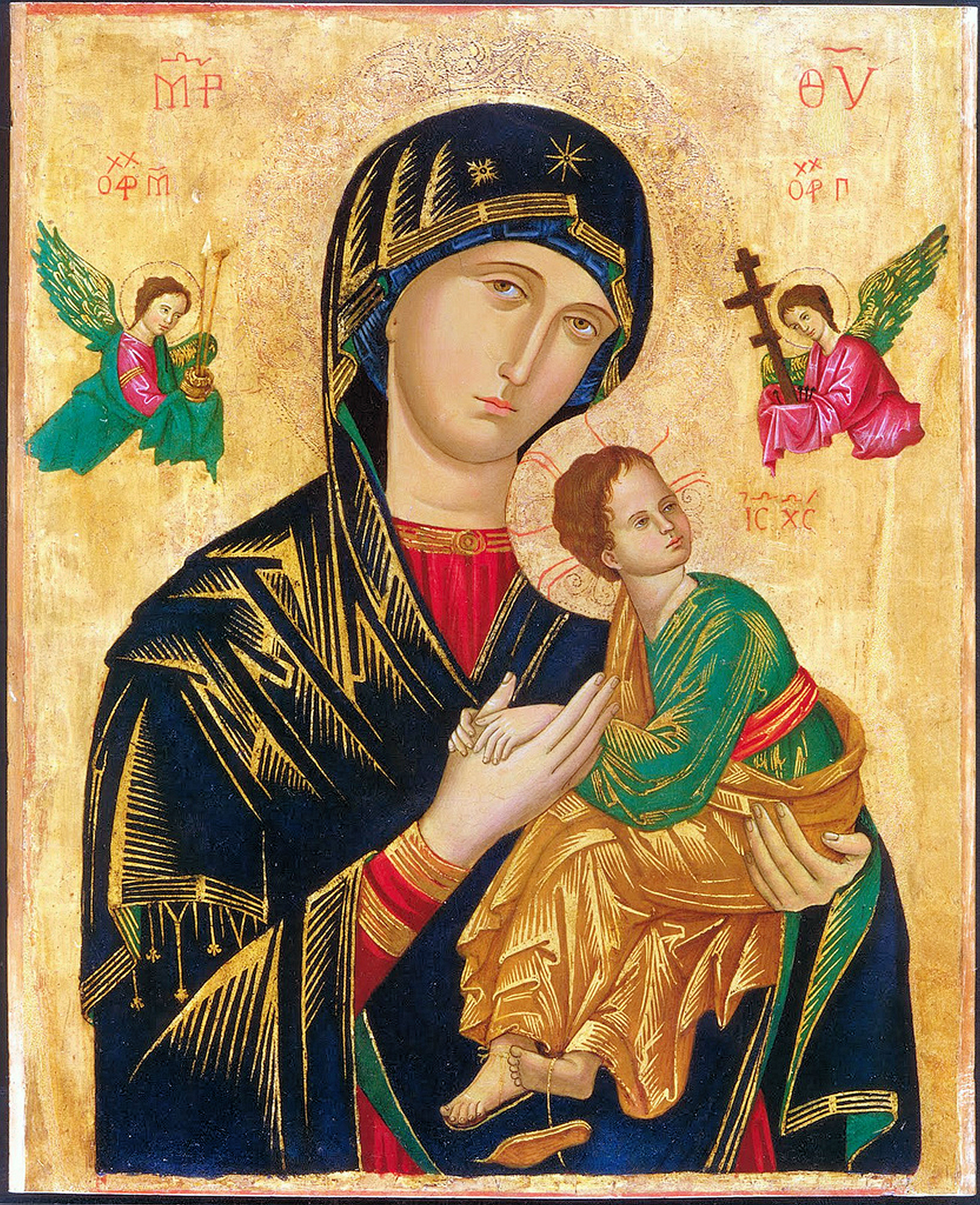
One of the reasons why the Vladimir Mother of God became so popular is, of course, its exceptional beauty. It belongs to that class of icons called "loving-kindness" because it depicts the mutual loving-kindness of the Mother and her Child. In contrast to other icons in which the divinity of the Child-God and the majesty of the Mother are primarily emphasized, I find this icon a particularly moving expression of human tenderness and feeling.

The Virgin has her head covered with a veil in the manner of Oriental women. This veil, dark in color (to signify her humility), by its contrasting hue, brings out the brightness of the Child's garment.

On her forehead is an exquisite star (suggesting nobility of thought), and that same star is shown again over her heart.

The black veil which is drawn down to her eyebrows covers her entire head, even her forehead. With its gold-edged border falling symmetrically on either side, it forms a kind of halo and, by contrast, brings out all the delicate features of her face.

The raised eyebrows, together with the curve of the nose and the motionless gaze of the dark eyes directed into space, lend to the face of Our Lady an expression of sorrowful concentration. It seems as if the corners of the mouth were slightly lowered, intensifying he impression of sorrow, whereas the shadow thrown by the lashes onto the eyes renders the pupils still darker and more misty, making them fall back into a depth inaccessible to direct contemplation.

Her hand scarcely touch the infant. They seem also to have been immobilized by the thought which absorbs her so completely, adding still more to the effect of intense concentration and sorrow.

The Divine Child, on the contrary, is represented with a lively, tender movement; in pressing His face against His Mother's cheek, He appears to be offering her solace, knowing, as He does, her hidden sorrow. His face is brighter than hers, showing that He wants to give her hope. But she, apparently paying little heed to her Child's caress, stares into the distance with deep human feeling. Her gaze is inwardly turned, not to the human child, but to the Maker of the World, born of her. She bends towards the infant, seeking within Him mercy for those who come to Him, and sheltering them with her intercourse.

There is no weakness in the figure of the Child but only the strength, the dignity and the majesty of the God-Made-Man. The upper part of His body is portrayed more slenderly than the lower, which may have been enlarged when the extra boards were added for extra width. (The same is true of the veil. While the face of Mary on this icon is certainly the original, the veil (or "maphori"), seems to be a little too large for the face; in the 13th century the veil was enlarged to fit in with a slight enlargement of the whole icon.)

The Holy Child, His left hand slipped behind His Mother's head, clasps her neck and presses His left cheek to her right cheek; nearing His lips to hers, He stretches His right hand to her left shoulder in order to embrace and to kiss His Mother. His right hand shows a certain strength and power. The purple and gold-colored garment of the Child indicates His Majesty and Royalty. The artistry of the shadows and the hatching (the inlaying with fine lines) all give the garment something very akin to a sheen.

It is impossible to discover all the richness of this icon at its first glance; one needs to contemplate it....long and "often". It possesses the characteristic of all true and beautiful icons....one never tires of it, so rich is the painting, so harmonious and delicate, so uplifting to the soul.


Meditation Before The Madonna


In their humility the icon painters never signed their works. The pious, anonymous monks, who, ten centuries ago in Greece painted this Madonna who would later become so intimately connected with the life of the Russian people, expressed in her face, a serene sorrow which no other painter would ever depict so sorrowfully again.

Of what was the Blessed Mother thinking, in the artist's mind? Whence comes her sorrow? To speak of the suffering Christ endured in Calvary would not be enough. The Risen Christ no longer suffers. Those sufferings which are past would not justify the painter in depicting Our Lady in the present. But, in His Mystical Body, which is the extension of His Being throughout space and time, Christ continues to suffer. She, who during the Passion was called upon to stand aside while His physical body was torn down through the centuries, has had to witness the tearing also of His Mystical Body too. Heresies and schisms, apostasies and betrayals, all have separated member from member. And those who have divided the Body of Christ have sinned and must repent. And those who would maintain the division have sinned. And must repent. And those who would seek to pretend to a unity that does not exist by sanctioning all divergences from the One Teaching of Christ have sinned, and continue to sin. And must repent. She is sad and sorrowful because the Body of Christ still suffers, still is torn, still is rent, like the Veil in the Temple, from top to bottom. And all have sinned.


The Silent Church


The Vladimir Mother of God, taken away by force from her devout faithful, enclosed in a museum in the middle of secular paintings, symbolizes first of all the immense suffering of the Silent Church—those Churches in all those countries which suffered under the Crosses laid upon them at the insistence and threat of the Soviet government.

A hundred years ago, the major problem for Christians was to send missionaries to the countries of Asia, Africa, the Sub-Continent of India, where Christ had never been known, or only by the few. Today the Gospel has been preached everywhere, but the problem now is to "keep" Christ and His church known and loved, not only in all those countries raped while under the Communist yoke, but those who, free of that yoke, sullied and soiled themselves in the excess of self-will and cowardly selfishness.

In Russia, where once there were thousands of churches, there now stand very few; and the few priests who remain are still not truly free to instruct. Minds are deceived in ways very different from the ways in which they are deceived here—and those in Russia are prevented from hearing the Voice of Christ; there prevented by force majeur, here by willing deafness. Until very recently all public defense or teaching of religion was banned in Russia, and even now no calumny or lie is spared to divert from Christ those who would heed the Word of the Church. While tens of "millions" of anti-religious books have been published, at the expense of the state, not a single catechism has been printed there for 75 years.

Could not Catholics from all over the world try to thwart the violence of those who battle to prevent the Voice of Christ being heard by taking, in some way, the place of those who are not able any longer to venerate the Vladimir Mother of God... "publicly"? Can fathers and mothers, teachers in our Catholic schools, find any more suitable religious art to educate the artistic and religious tastes of our children.

That icon, hung in all our churches, in all our Catholic homes, would remind us every day of the sufferings of believers everywhere, but particularly in Russia, many of whom still go to the Tretiakov Gallery, not so much to see the Icon of the Madonna, but to "venerate" discreetly their imprisoned Madonna....


Disunited Christianity


The liberation of Russia and the existence of religious freedom in that country would still not remove the great "second" sorrow of the Church so intensely expressed on the face of the Madonna of Vladimir. It is a fact that the Vladimir Mother of God is one of the most beautiful representations of the Virgin the world possesses. It is no less artistic than the paintings of Fra Angelico and Raphaello—and perhaps still greater. Yet, strange as it may seem, the Western world is largely oblivious of its presence, as it is of so very many other things.

Part of the ignorance has been that the Soviet Government literally imprisoned the icon. But the greatest sin is borne, not by Communists, nor their government, but by Christians, who have allowed themselves to grow estranged, estranged even to the point of hostility, and often of downright enmity.

Pope John XXIII, who lived for many years among us Eastern Christians, chose as the first aim of his pontificate, the reconciliation of the Churches of the East with the Church of Rome. And in the Council itself, that particular purpose became more intensively than ever before, the purpose of the "whole" Catholic Church, Eastern and Roman alike.

One of the most visible things which Eastern and Western Catholics and Orthodox still share is their love of Our Lady. John XXIII, speaking to the Armenian Catholic Church on February 1, 1959, said that the best assurance of reconciliation between Catholics and Orthodox "is" our common love of our common mother, uncommon in this, that in addition to being our Mother, she "is" the "Mother of God," the "Theotokos."


A Prayer To The Virgin Of Vladimir


Mary, Queen of Heaven

We honor your icon, before which the Russian people pray.
We beg of you, to look with favor and motherly care
On that great nation and to lead it to faith and friendship with us all.

We are blessed to have your Russian image

In a place of honor.
We pray to you, and work with you, for the full liberation of Russia
And for the peace of the whole world.

And for the forgiveness of the sins of all those of us


Who have so terribly riven the Body of Christ.


This article was adapted from Shane Kapler’s book, Through, With, and In Him: The Prayer Life of Jesus and How to Make It Our Own (Angelico Press, 2014)


OUR LADY OF GUADALUPE


Search This Blog

La Virgen de Guadalupe

La Virgen de Guadalupe

Followers

My Blog List

Fr David Bird

Fr David Bird
Me on a good day

Blog Archive