EXPAND YOUR READING!!

"Today the concept of truth is viewed with suspicion, because truth is identified with violence. Over history there have, unfortunately, been episodes when people sought to defend the truth with violence. But they are two contrasting realities. Truth cannot be imposed with means other than itself! Truth can only come with its own light. Yet, we need truth. ... Without truth we are blind in the world, we have no path to follow. The great gift of Christ was that He enabled us to see the face of God".Pope Benedict xvi, February 24th, 2012

The Church is ecumenical, catholic, God-human, ageless, and it is therefore a blasphemy—an unpardonable blasphemy against Christ and against the Holy Ghost—to turn the Church into a national institution, to narrow her down to petty, transient, time-bound aspirations and ways of doing things. Her purpose is beyond nationality, ecumenical, all-embracing: to unite all men in Christ, all without exception to nation or race or social strata. - St Justin Popovitch

Saturday, 28 December 2013

OLD MICAH by Natallia Klimova ( courtesy of St Elizabeth'e Convent in Minsk) & THE NATIVITY FAST by Archpriest Andrew Lemeshonok


Chapter 1 of The Stories by Natallia Klimova

It was a misty morning in the city of N. An elderly nun was getting nervous as she looked at the clock on the wall of the hotel hall. Guests were late. Her eyes were watering from strain but she could hardly see the road through the gray fog. 

- Mother Salomia, why are you so nervous? Your guests will come soon, what else would they do? – Andrew chuckled, as he was chewing his sandwich.

Lida looked at her husband and sighed,

- Why are you pestering Mother Salomia? She worries about others, unlike you. 

A bus came in view round the bend. Nun Salomia ran outside, and the newly-weds looked at the newcomers out of the window with interest. 

Pilgrims entered the hall of The Ancyra in just a couple of minutes. Lida figured out that there were eight of them: an elderly couple, two mums with kids, a dwarfish old man who looked as if he were 100, and a girl wearing a miniskirt and high-heeled shoes. Nun Salomia smiled cheerfully as she was telling the pilgrims about the life at the guesthouse. 

– We are like one big family. The Pilgrim's House has four floors. We almost never have spare rooms. This is understandable because so many people want to visit our convent. I have been on obedience here for five years already. Please feel free to contact me anytime with all your questions! We will find some work for everyone who wishes to take part in the daily life of the convent, so I hope that your stay here will be useful for your soul. Now let me introduce myself. I am Nun Salomia, and they – Nun Salomia pointed at the young couple – are Andrew and Lida. You will get to know the rest of our guests a little bit later.

The guests introduced themselves one by one. The old man was the only one who kept silent. Andrew looked at him closely with growing interest, and soon he was unable to contain his curiosity:

– Well, Grandpa, what's your name?

– Micah, - the pilgrim replied and frowned.

– So you are Michael? – Lida wondered.

- No, I am not Michael. My name is Micah! – the old man retorted, and everyone could see that the old man had a character!

There was a tradition at The Ancyra to read the morning and evening prayers in turn. There was a small iconostasis on every floor, and the pilgrims gathered for prayer at one and the same time. The newcomers joined in the prayer today. Only the old Micah and Ruslan were missing. Ruslan was a so called “deviant youth” who had been forced by his mother to come to the convent. The boy was brought up by the single mother, and by the time he was fourteen, he was absolutely out of control. It was evident that this pilgrimage was unlikely to be beneficial for him. Ruslan did not want to attend the services, he shunned work and skipped the prayer rule most of the time. Frankly speaking, there was only one place where the boy could sit for hours, not thinking about anything, just gazing at the beauty of the sky full of stars. One day, when he was wandering around the building of the guesthouse, he noticed that the door leading to the attic was unlocked. The windows were shut and fastened with planks, making it impossible for anyone to get out onto the roof, but the attic itself was much more interesting than the rest of the guesthouse. Ruslan found a small ramshackle stool in a pile of old stuff and began to use it as a table. He had used to take his dinner into his room, despite his mother’s protests, and then eat it secretly in the attic, gazing out of the window at the black sky, when everyone went to the prayer rule.

However, today the privacy of the youth was violated. The old Micah appeared at the door. He gave the boy a stern look, saw the empty plate and quickly got the grasp of the situation. He grumbled,

– Done?

Ruslan was embarrassed but soon pulled himself up. He rose up from the floor and perked up his head,

– Yeah. So what?

– If you’re done with your meal, get out of here, I’m going to pray.

The boy paused for a moment, searching for the most appropriate answer, and then snorted,

– No way! I was the first to come here.

The old man did not say anything. He approached the window, yanked the curtain and sighed when he figured out that it was closed. Ruslan smirked,

– You wanted to climb onto the roof, didn’t you?

– Yes, I always pray on the roof at home. Okay, dude, stop jabbering. If you don’t want to leave, don’t interrupt me, or else I’ll send you down the ladder.

Ruslan was somehow convinced that the old man wasn’t joking.

The old Micah made the sign of the cross and started mumbling the Our Father. He finished one prayer, took a short breath and started the same prayer all over again. At first, Ruslan thought that the old man forgot what he had prayed about but soon realised that he wouldn’t be hearing any other prayer from the old man. After about forty minutes, Micah stopped, made the sign of the cross and slowly dragged himself to the door. The boy was consumed with curiosity,

– Hey, wait! Why did you read just one prayer?

– I don’t know any other prayer.

– How can that be? Aren’t you Orthodox? 

He saw that he could not expect an explanation from the old man.

– Why do you pray on the roof?

– I am closer to God because of that, – the old man shrugged his shoulders and vanished in darkness.

Ruslan sat by the window for a while and went to his room.

Three days passed. The old man would pray in the attic every day, and the boy would sit in the corner and watch him. It seemed to Ruslan that there was a mystery of some sort. The old man was certainly unusual! A normal believer could never be seriously convinced that the higher you climb, the closer to God you get! Stranger yet was the fact that he did not know any prayers, except for the Our Father.

A sudden blow for the entire guesthouse happened on the fourth day. Someone stole Lida's purse. Not that there was a lot of money, but that was not the case... The woman saw her acquaintance and left the purse on the table in the hall. While they were having a chat, the purse disappeared. Who could have taken it? All the pilgrims were taken aback.

While everyone discussed the theft, the old Micah climbed the stairs to the attic as usual. Ruslan would always be waiting for him there. They did not talk with one another all that time. Each one did his own job — the old man prayed, and the youth watched. However, something was different this time. The old man suddenly ordered the youth:

– Get up, let's pray.

The youth did not raise his eyes.

– Can you hear me? Get up. 

Ruslan rose to his feet obediently, which was surprising even to himself. For some reason, he did not want to show his teeth or argue.

Micah read the Our Father once and was about to leave.

“Are you done with your prayers?” The boy wondered.

“Yes, I am. I have something to do downstairs.” 

Ruslan was curious what the weird and unsociable old man was going to do and followed him. 

The old Micah went to each of the four groups of praying people and said one and the same phrase to each group, “It was me who stole the purse. Forgive me a sinner.” People silently made the sign of the cross and started whispering to one another only after he left them. Ruslan witnessed all that from a distance, and acute pain pierced his heart. The boy could not sleep the following night. In the morning, he went to the church voluntarily for the first time since he came to the convent.

Micah was standing next to him in the queue for confession. They did not utter a single word to one another.

The boy stood in front of the analogion and whispered, “I stole the purse. Lord, forgive me!” Micah came for the confession right after him. The old man sighed heavily and articulated distinctly, “I repent of lying.”  The priest was waiting for the continuation but the old man said dismissively, “I cannot recognise any other sins in my heart.”

The old man would pray in the attic every day, and the boy would sit in the corner and watch him. It seemed to Ruslan that there was a mystery of some sort. The old man was certainly unusual! A normal believer could never be seriously convinced that the higher you climb, the closer to God you get! Stranger yet was the fact that he did not know any prayers, except for the Our Father.

December 21, 2013
  and I concelebrated
Christmas is 13 days after us because that is Decenber 25th in the Julian Calebdar.   We are still waiting for the Orthox Christmas.   When I was in England, I concelebrated with Abbot and community on December 25th, and I concelebrated in the Byzanting Liturgy on January 7th. - P. David.
THE NATIVITY FAST
by Father Andrew Lemeshonok
 Archpriest Andrew Lemeshonok

Orthodox Christians have the Nativity Fast from November 28 to January 6. Fasting is voluntary But people are terrified and think, “How can I read all prayers and abstain from food when my health is so poor?” The person does not trust God. We should be aware of the fact that we need God because without Him we will fall prey to the devil. This is for real. We start to sin without God. The holy life, the divine life appears to be an intolerable burden. The Lord tells us, “For my yoke is easy, and my burden is light” (Matthew 11:30). My soul shall be joyful in my God (Is.61:10). The Lord invites everyone to the feast of faith. The fast, the worship, and everything that is and will be going on in the church aims at uniting man with God, at helping man to find God and get to love Him so much, get drawn to him to such an extent that he would acknowledge that he cannot do anything without God. How much time do we have? Not much. Therefore, we should use it rationally. We cannot waste it on trifles. One can become holy in any place. Who makes it impossible for us? God is everywhere. Wherever there is God, there is goodness. We all are sinners but we all can become saints. We should get off the earth. It does not mean that we should stop paying attention to what happens to us and around us. No, but we should not pay attention to the temporary and vanishing things, and seek for the everlasting and authentic things instead. We should look for the only thing we need. The Lord says, “Seek ye first the kingdom of God, and his righteousness; and all these things shall be added unto you.” (Matthew 6:33). 
 November 27, 2013

Friday, 27 December 2013


22nd International Ecumenical Conference
on Orthodox Spirituality

BLESSED ARE THE PEACEMAKERS 
(Mt 5,9)

Bose, Wednesday 3 - Saturday 6 September 2014

in collaboration with the Orthodox Churches 

“Blessed are the peacemakers” (Mt 5,9). The announcement of this evangelical beatitude, so often repeated in the Divine Liturgy, unceasingly interrogates the conscience of every man and the practice of the Church.

The 22nd International Ecumenical Conference on Orthodox Spirituality desires to listen to the Gospel of peace, which asks the Churches to be a ferment of reconciliation and of peace among today’s men and women. The hope of peace announced in Christ is not a utopia extraneous to a world dominated by the logic of power and of conflict, but is an event in history, incarnated in every age in men and women of peace and reconciliation.

The conference, which takes its impulse from the theological dimension, that of Revelation, wishes to propose an itinerary through listening to and studying Scripture and liturgy, the words regarding peace in the fathers, the teaching of the monastic and spiritual experience of the Christian East, so as to discern the roots of violence and to offer reasons for an authentic education for peace in welcoming what is different, in sincere efforts towards reconciliation, in the struggle to forgive and to ask forgiveness.

For the believer, peace is a gift. The psalms sing of God’s gift of peace to his people, which is also a pressing appeal to conversion. If men deal justice and show mercy, peace inhabits the earth and “mercy and truth will meet, justice and peace will kiss” (Ps 85/84,11). In the New Testament peace is the gift of the risen Christ to his community (Jn 20,19–21), it is a fruit of the Holy Spirit (Gal 5,22), it is the seal of the new alliance between God and all humanity and the entire creation, reconciled through the life, passion, death, and resurrection of Christ (Rm 5,11).

The eastern and western fathers establish an essential tie between peace in the world and Christ, “our peace” (Eph 2,14). Commenting on Jesus’ words to his disciples in the fourth Gospel, (“I give you my peace”, Jn 14,27), St Cyril of Alexandria identifies the gift of peace with the sending of the Holy Spirit. “The peace that surpasses principalities, powers, thrones, dominations, and every intelligence (cf. Phil 4,7 and Eph 1,21) is the Spirit of Christ. Through him the Son has reconciled all creation with God the Father.”

The cosmic dimension of this reconciliation through Christ “of all things that are on earth and in the heavens” (Col 1,19–20) is forcefully perceived in the commentaries of the fathers. “They had already been reconciled,” writes John Chrysostom, “but a perfect reconciliation was necessary, without any trace of enmity.” This theological nucleus is the foundation of the Church’s unity and of reconciliation between the Churches, according to a current of thought that develops from St Clement of Rome to St Ireneus of Lyons, from St Basil to St Gregory of Nazianzus.

The fathers concentrate their attention on the spiritual aspect of peace rather than on its political and social dimension, which will be the preoccupation of modern theological and philosophical reflection. It is more difficult to acquire interior peace than exterior, John Chrysostom observes in his commentary on Psalm 4. A saying of Serafim of Sarov, the great nineteenth-century Russian monk, summarizes the teaching of the ascetic tradition on this point: “Acquire peace, and thousands will be saved around you”.

Christians in the world are called upon to live as reconciled persons, so as to translate the novelty of Christian peace into the today of history. The topic of peace remains an open challenge for contemporary theology. The tradition of Orthodox sanctity offers a response to this search in the beatitude lived by innumerable witnesses of peace. St Antony the Great “received from God the gift of reconciling those who were in disagreement”/ Like him, a path of reconciliation was shown by saints like Francis of Assisi in the West and the great spiritual figures of the Orthodox tradition wherever it exists, reaching the pioneers of dialogue among the Churches and the new martyrs of the twentieth century, who, like their Lord, lived love to the extreme, to forgiveness of their persecutors.

“Who will teach us the beauty of peace?” asks Basil the Great. “The artisan of peace himself. Through the blood of his cross he has established peace between the things of heaven and of earth” (Col 1,20). To become artisans of peace means to train oneself to see the beauty of peace and to live it, so as to rediscover its power of attraction and to diffuse the hope of peace in the world. 

SCIENTIFIC COMMITTEE

Enzo Bianchi (Bose), Lino Breda (Bose), Sabino Chialà (Bose), Lisa Cremaschi (Bose), Hervé Legrand (Parigi), Adalberto Mainardi (Bose), Antonio Rigo (Venezia), Luigi d'Ayala Valva (Bose), Michel Van Parys (Chevetogne)

Wednesday, 25 December 2013

DECEMBER 25th; CHRISTMAS DAY


URBI ET ORBI MESSAGE 
OF POPE FRANCIS

CHRISTMAS 2013

Wednesday, 25 December 2013


Glory to God in the highest heaven,
and on earth peace among those whom he favours (Lk 2:14)

Dear brothers and sisters in Rome and throughout the whole world, Greetings and Happy Christmas!

I take up the song of the angels who appeared to the shepherds in Bethlehem on the night when Jesus was born. It is a song which unites heaven and earth, giving praise and glory to heaven, and the promise of peace to earth and all its people.

I ask everyone to share in this song: it is a song for every man or woman who keeps watch through the night, who hopes for a better world, who cares for others while humbly seeking to do his or her duty.

Glory to God!

Above all else, this is what Christmas bids us to do: give glory to God, for he is good, he is faithful, he is merciful. Today I voice my hope that everyone will come to know the true face of God, the Father who has given us Jesus. My hope is that everyone will feel God’s closeness, live in his presence, love him and adore him.

May each of us give glory to God above all by our lives, by lives spent for love of him and of all our brothers and sisters.

Peace to mankind

True peace - we know this well - is not a balance of opposing forces. It is not a lovely “façade” which conceals conflicts and divisions. Peace calls for daily commitment, but making peace is an art, starting from God’s gift, from the grace which he has given us in Jesus Christ.

Looking at the Child in the manger, Child of peace, our thoughts turn to those children who are the most vulnerable victims of wars, but we think too of the elderly, to battered women, to the sick… Wars shatter and hurt so many lives!

Too many lives have been shattered in recent times by the conflict in Syria, fueling hatred and vengeance. Let us continue to ask the Lord to spare the beloved Syrian people further suffering, and to enable the parties in conflict to put an end to all violence and guarantee access to humanitarian aid. We have seen how powerful prayer is! And I am happy today too, that the followers of different religious confessions are joining us in our prayer for peace in Syria. Let us never lose the courage of prayer! The courage to say: Lord, grant your peace to Syria and to the whole world. And I also invite non-believers to desire peace with that yearning that makes the heart grow: all united, either by prayer or by desire. But all of us, for peace.

Grant peace, dear Child, to the Central African Republic, often forgotten and overlooked. Yet you, Lord, forget no one! And you also want to bring peace to that land, torn apart by a spiral of violence and poverty, where so many people are homeless, lacking water, food and the bare necessities of life. Foster social harmony in South Sudan, where current tensions have already caused too many victims and are threatening peaceful coexistence in that young state.

Prince of Peace, in every place turn hearts aside from violence and inspire them to lay down arms and undertake the path of dialogue. Look upon Nigeria, rent by constant attacks which do not spare the innocent and defenseless. Bless the land where you chose to come into the world, and grant a favourable outcome to the peace talks between Israelis and Palestinians. Heal the wounds of the beloved country of Iraq, once more struck by frequent acts of violence.

Lord of life, protect all who are persecuted for your name. Grant hope and consolation to the displaced and refugees, especially in the Horn of Africa and in the eastern part of the Democratic Republic of the Congo. Grant that migrants in search of a dignified life may find acceptance and assistance. May tragedies like those we have witnessed this year, with so many deaths at Lampedusa, never occur again!

Child of Bethlehem, touch the hearts of all those engaged in human trafficking, that they may realize the gravity of this crime against humanity. Look upon the many children who are kidnapped, wounded and killed in armed conflicts, and all those who are robbed of their childhood and forced to become soldiers.

Lord of heaven and earth, look upon our planet, frequently exploited by human greed and rapacity. Help and protect all the victims of natural disasters, especially the beloved people of the Philippines, gravely affected by the recent typhoon.

Dear brothers and sisters, today, in this world, in this humanity, is born the Saviour, who is Christ the Lord. Let us pause before the Child of Bethlehem. Let us allow our hearts to be touched, let us not fear this. Let us not fear that our hearts be moved. We need this! Let us allow ourselves to be warmed by the tenderness of God; we need his caress. God’s caresses do not harm us. They give us peace and strength. We need his caresses. God is full of love: to him be praise and glory forever! God is peace: let us ask him to help us to be peacemakers each day, in our life, in our families, in our cities and nations, in the whole world. Let us allow ourselves to be moved by God’s goodness.

Christmas greetings after the Urbi et Orbi Message:

To you, dear brothers and sisters, gathered from throughout the world in this Square, and to all those from different countries who join us through the communications media, I offer my cordial best wishes for a merry Christmas!

On this day illumined by the Gospel hope which springs from the humble stable of Bethlehem, I invoke the Christmas gift of joy and peace upon all: upon children and the elderly, upon young people and families, the poor and the marginalized. May Jesus, who was born for us, console all those afflicted by illness and suffering; may he sustain those who devote themselves to serving our brothers and sisters who are most in need. Happy Christmas to all!


© Copyright - Libreria Editrice Vaticana


Christmas Day 2013: Abbot Paul's homily

                                Abbot Paul                                

            “From his fullness we have all received grace in return for grace, for grace and truth have come through Jesus Christ. No one has ever seen God; it is the only Son, who is nearest the Father’s heart, who has made him known.” With this powerful image, St John ends the Prologue to his Gospel. But it is far more than an image: it is the reality that Christians live each day of their lives as, through grace, Jesus makes known to us his Father’s love and teaches us the truth which sets us free from the tyranny of sin, purifies our hearts and prepares us to see God face to face. This is the mystery of Christmas: this is the Christmas story.

            This morning we come together to thank God for the birth in human flesh of his Only Son, our Lord and Saviour Jesus Christ, begotten of the Father before time began, born of the Virgin Mary by the power of the Holy Spirit, a man like us in all things but sin. We have prepared for today by faithfully keeping Advent, the season of hope and consolation. We have heard the message of the prophets. We have prayed earnestly for his Second Coming at the end of time. We have longed to celebrate this memorial of his Nativity, praying that he prepare in our hearts a manger in which he can lie and there fill our hearts with grace and truth. Today, as the Letter to the Hebrews says, we see lying in the manger “the radiant light of God’s glory, the perfect copy of his nature,” he who “sustains the universe by his powerful command,” who having “destroyed sin, has gone to take his place in heaven at the Father’s right hand.”

The new-born babe we kneel before and adore, Mary’s son, is God incarnate, God made man, in the words of Charles Wesley’s famous hymn, “Veiled in flesh the Godhead see; hail the’incarnate Deity, pleased as Man with man to dwell, Jesus our Emmanuel.” In Jesus, God is with us as never before. He is not simply with us but in us. St Irenaeus wrote, "The Word of God, our Lord Jesus Christ, did, through His transcendent love, become what we are, that He might bring us to be even what He is Himself." God’s vocation for us is far greater than we can imagine or understand. What can we do but accept it with humility and thanksgiving, with awe and rapture, as an act of faith, love and surrender to his Divine will? That God should become what we are in order that we might become what he himself is, shows us the unfathomable riches of the poverty and humility of God. In the Incarnation God opens his heart to man and lays himself bare before us, for Jesus reveals to us the naked truth about God, that God is love and that God’s love for us is absolute and all-embracing.

Obviously, at Christmas, a lot is made of the details of the Christmas story, and that’s not surprising: they’re quite irresistible. What with Christmas cards, Nativity plays and carol services, it’s easy to get sidetracked into a romantic rereading of the events of Christmas without any real theological basis: well-intentioned, no doubt, but ignorant of the very truth that Christ came to teach us and of the faith which is the gift of grace. This is no criticism, because God works in a mysterious way and looks for those who truly seek him with a sincere heart. But the real poverty of the Child in the manger has little to do with the picturesque circumstances surrounding his birth. Rather it is the fact that this Child is God, God who lays aside his divinity to take upon himself the condition of sinful humanity, the Lord who becomes a servant, the Creator who enters fully into the fragility of creation, God who throughout his life on earth will know the vulnerability and precariousness of human life, from being a foetus in his mother’s womb and a new-born baby in swaddling bands to being taken prisoner, tried and scourged, condemned to death by crucifixion and buried in a tomb. All this he did for love of us, wretched and sinful as we are; all this to save us from hell and eternal damnation; all this to reconcile us with himself; all this to open for us the gates of the Kingdom of Heaven; all this to wrap us eternally in his embrace. In 2nd Corinthians St Paul writes, “Though he was rich, yet for your sakes he became poor, so that by his poverty you might become rich.”

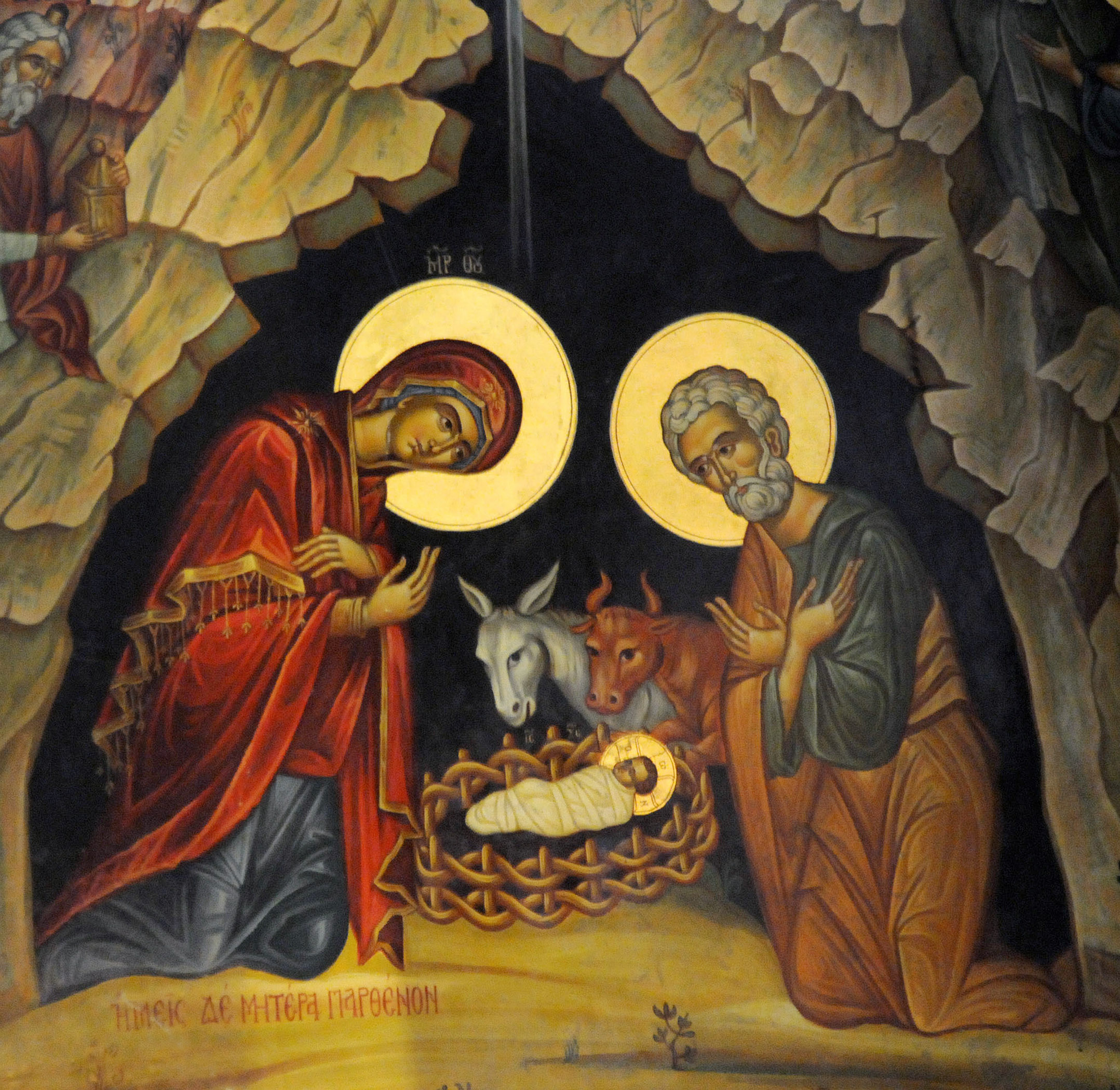
The truth of Christmas is not above and beyond us: Mary and Joseph, the shepherds and the angels, the ox and the ass, the Wise Men with their gifts, the star of Bethlehem, the sun and moon, indeed the whole of creation, worship and adore the Infant Jesus and recognize in him their Lord and God, their Saviour and their King, the Word through whom all things were made, the Light that darkness cannot overpower, the Source of grace and truth. Let us join with them as we celebrate our Christmas Mass this morning.

On behalf of Fr Prior and the Monastic Community, I wish you all a very happy and a holy Christmas.

The Byzantine Origins of the Christmas Tree

By John Sanidopoulos

The idea behind the Christmas tree and its decoration, does not have Northwest European roots, as many believe. In fact there was a similar ancient custom that began with the Greeks and adopted by the Romans of the East. Evidence suggests that this is the origin of the custom of the Christmas tree as we know it today.

While today we know a Christmas tree to be usually an evergreen conifer such as spruce, pine or fir, in ancient Greece it was something called "Eiresioni" (είρος = wool). Eiresioni was an olive branch or laurel decorated with garlands of red and white wool as well as early winter fruits (figs, walnuts, almonds, chestnuts, grains, etc. besides apples and pears). This was done as an expression of thanksgiving for the harvest and fertility of the past year and so that it would continue into the next. Usually they were dedicated to a pagan god such as Apollo, Athena, or the Horae (Eunomia, Diké, and Eirene).

Homer mentions the ancient Greek custom of Eiresioni, which he associated with caroling children. In Samos he put together several songs which a group of children would sing in the homes of the wealthy wishing them continued wealth, joy and peace. This was celebrated twice a year, once in spring in order for the people to request from the gods, especially from Apollo, sun and the seasons to protect the seed, and once in autumn, to thank the gods for the good harvesting of their fruits. Along with their thanks to the gods, they gave good wishes to their fellow brethren also.

During the period of September 22 - October 20 children would go from house to house, holding the Eirosioni, singing carols and receiving gifts from those pleased by their performance. Many of the children would bring home the laurel and olive twigs and hang them on their doors where they stayed the whole year (something which some Greeks still do to this day). The Eirosioni of the previous year would be taken down and burned. The entrance to the Temple of Apollo also had Eirosioni.

This is a traditional Eiresioni carol from the Homeric period:

To this house we came of the rich-landlord
May its doors open for the wealth to roll in
That wealth and happiness and desired peace should enter
And may its clay jugs fill with honey, wine and oil
And the kneading tub with rising dough.


The Christmas Tree in Byzantium

The ancient custom of Eirosioni was not forbidden in Byzantium, but it was Christianized to be a way to thank God for all the goods He provided. In fact, this custom was usually encouraged, as the ruler of each local city would order the local streets be cleaned and decorated at certain intervals with poles of rosemary, myrtle branches and blossoms of the season.1

The custom of decorating a pole with rosemary still survives in the memory of the Greek people, when they sing one of the most popular carols for the New Year: Αρχιμηνιά κι αρχιχρονιά ψηλή μου δενδρολιβανιά (Beginning of the Month and Beginning of the Year oh my dear tall Rosemary).

It is believed that the custom of Eirosioni together with the later custom of decorating the streets with poles of rosemary travelled to Northwest Europe, though there they adorned the trees and branches that were local to them, which are the evergreens we know today.

This transfer of customs may have been done by the Royal Cavalcade Battalion, who were the palace guards of Byzantium. Among others they played a ritual role in official imperial ceremonies - including that of Christmas. They were divided into three companies - the Small, the Medium and the Great Company. The Small Company consisted of those who were of another religion (eg. Pagans, Muslims, etc.), the Medium Company consisted of the heterodox and foreign Christians (eg. Scandinavians, Germans, Russians, British, etc.), and the Great Company consisted of Orthodox Christian Romans. Perhaps it was the foreigners among them who brought these Roman customs of Byzantium to their respective countries.


CHRISTMAS WITH THE  POOR
Quotes from Pope Francis

  I have a dogmatic certainty: God is in every person's life. God is in everyone's life. Even if the life of a person has been a disaster, even if it is destroyed by vices, drugs or anything else -- God is in this person's life." -- Interview with Jesuit Catholic journals around the world.   

Oh, how I would like a poor Church, and for the poor.


It is truly an article of faith that poverty is central to the theology of Christmas. The Catechism of the Catholic Church states it thus: “Jesus shares the life of the poor, from the cradle to the cross.” [Catechism of the Catholic Church 544.] Blessed John Paul II reiterated this doctrine, preaching that “Christ who was rich became freely poor, was born in a lowly manger, preached liberation to the poor, identified with the poor, made them his disciples and promised them his kingdom.” Benedict XVI has pointed to the fact that Jesus was born into a poor family surrounded by “the poor, and anonymous shepherds ... The little ones, the poor in spirit: they are the key figures of Christmas, in the past and in the present.”  Pope Francis explains the implications from this fact: “to be like Him we must not put ourselves above others, but rather lower ourselves, putting ourselves at the service, making ourselves little with the little and poor with the poor.”
Archbishop Óscar A. Romero of El Salvador was even more succinct in his formulation: “the Christ of Bethlehem is the divine summation of my entire Gospel preaching,” said Romero. [«Orientación» Weekly, December 25, 1977.] Explaining in more detail, Romero states that, “based on Bethlehem Christians can no longer invent another Christ or another liberating doctrine apart from the authentic Gospel: the Gospel of poverty and austerity, detachment and obedience to the will of the Father, of humility and of the path to the beatitudes and to the cross.”  Id. From poverty and humility to the cross, there is only one step, announced Ab. Romero: the rejection of a world not ready to accept the scandal of a lowly, humble Lord and God.  “Like Christ the Church grows during the darkness of night. The Gospel of Saint John says: ‘He came into the world but the world did not know him’,” preached Romero.
To avoid this ignorance, this lack of understanding, Romero announced the “good news” in the most concrete and urgent language of which he was capable and proclaimed, “Christ was not born twenty centuries ago; Christ is born today in the midst of our people.” He says this to give greater effect to his words not to “look for God among the opulence of the world, or among the idolatries of wealth or among those eager for power or among the intrigues of the powerful.”  To do so would be wasted effort: “God is not there. Let us look for God with the sign announced by the angels: resting in a manger and wrapped in swaddling clothes made by the humble peasant woman of Nazareth—poor swaddling clothes and a little hay on which this God-made-man rested, on which this King of the ages becomes accessible to humankind as a poor child.” In today’s world, we should “look for him among the children lacking proper nutrition who have gone to sleep this evening with nothing to eat. Let us look for him among the poor newspaper boys who sleep in the doorways wrapped in today’s paper. Let us look for him in the shoeshine boy who perhaps has earned enough to buy a small gift for his mother. Let us look for him in the newspaper boy who, because he did not sell enough papers, is severely reprimanded by his stepfather or stepmother.”
In a famous and widely quoted phrase, Romero said that “no one can celebrate an authentic Christmas unless they are truly poor.” Applying the social doctrine to what the Catechism says, the Martyr Bishop explained that, “The self-sufficient, the proud of heart, those who despise others because they do not possess the material goods of this earth, those who do not need or want God—for these people there is no Christmas. Only the poor, the hungry, and those who need someone to come to them because they have need of someone, someone who is God, someone who is Emmanuel, God-with-us—only these people are able to celebrate Christmas.” And in words astonishingly laden with common sense, he explained, “people have no desire to eat when they are not hungry. People also have no need for God when they are proud and/or self-sufficient. Only the poor, only those who are hungry can be satisfied.”  And he gives us this Christmas beatitude: “Blessed are those who see the coming of Christmas in the same way that those who are hungry see the gift of food. People cannot desire liberation or freedom unless they are conscious of being enslaved.”
When Benedict XVI inaugurated a 2009 Christmas lunch with the poor, recognizing this important note of the social doctrine at Christmas, he said, “I have come to you precisely on the Feast of the Holy Family because, in a certain way, you resemble it.” The Pope Emeritus’ words remind us of what Archbishop Romero had said thirty years earlier: “Tonight the people of El Salvador are very much like Jesus in Bethlehem, for we are a poor people and we present ourselves to God in the same way that Mary and Joseph and Jesus presented their poverty to God.”

Archbishop Romero reminds us that the poor draw us closer to Christmas and to God.

Posted by Carlos X 

Search This Blog

La Virgen de Guadalupe

La Virgen de Guadalupe

Followers

My Blog List

Fr David Bird

Fr David Bird
Me on a good day

Blog Archive