EXPAND YOUR READING!!

"Today the concept of truth is viewed with suspicion, because truth is identified with violence. Over history there have, unfortunately, been episodes when people sought to defend the truth with violence. But they are two contrasting realities. Truth cannot be imposed with means other than itself! Truth can only come with its own light. Yet, we need truth. ... Without truth we are blind in the world, we have no path to follow. The great gift of Christ was that He enabled us to see the face of God".Pope Benedict xvi, February 24th, 2012

The Church is ecumenical, catholic, God-human, ageless, and it is therefore a blasphemy—an unpardonable blasphemy against Christ and against the Holy Ghost—to turn the Church into a national institution, to narrow her down to petty, transient, time-bound aspirations and ways of doing things. Her purpose is beyond nationality, ecumenical, all-embracing: to unite all men in Christ, all without exception to nation or race or social strata. - St Justin Popovitch

Wednesday, 20 December 2017

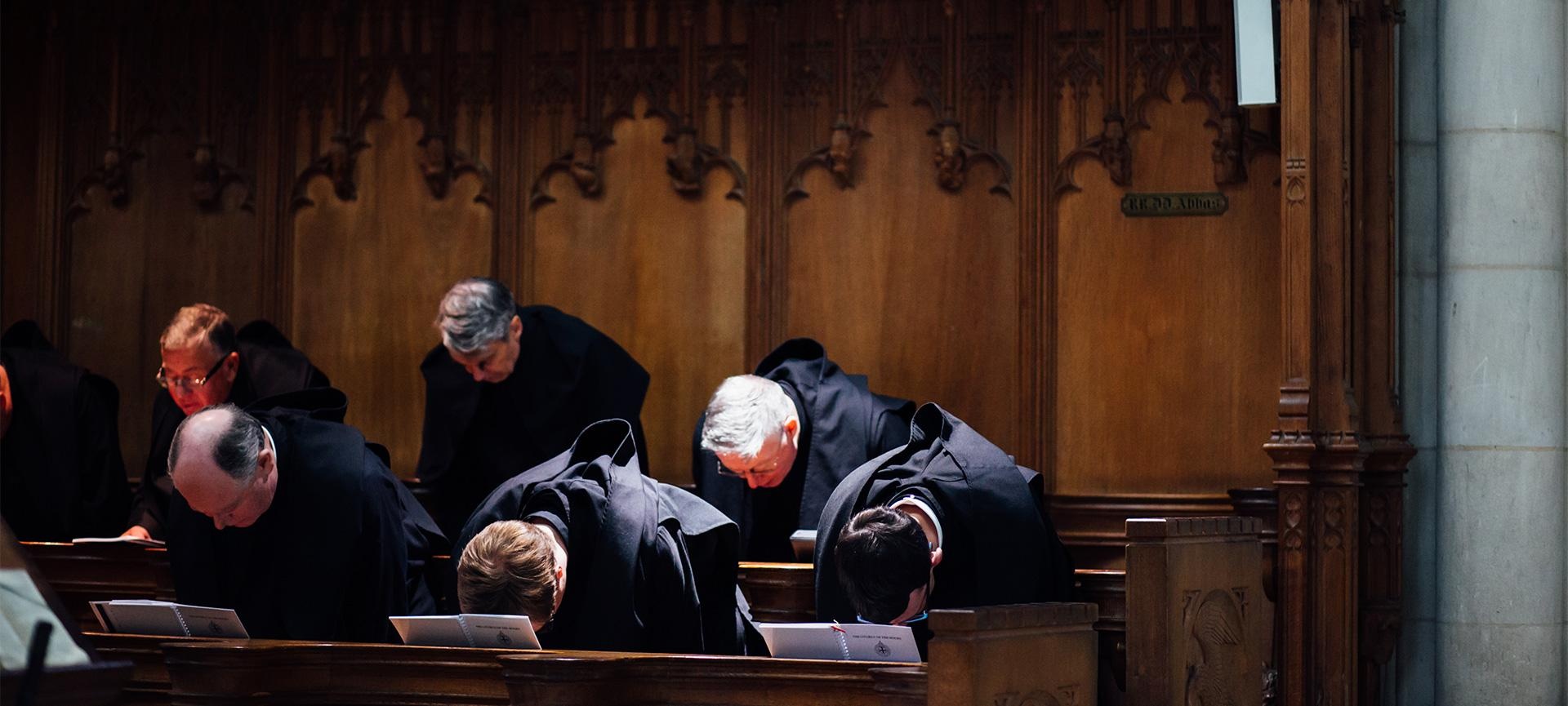
ADVENT FOR MONKS: A SHORT CONFERENCE BY ABBOT PAUL and DANIELOU ON ADVENT BY CARL OLSEN


We can see that this Word who seeks us and find us, that we may make response to him by seeking him in our turn, is the whole essence of the Gospel and the whole of Christianity. And in its turn monastic life is nothing else, no more and no less, than a Christian life whose Christianity has penetrated every part of it. It is a Christian life which is completely open, without refusal or delay, to the Word, which opens itself and abandons itself to it. This is the response that the Word expects--expects and elicits, for it is the creating and re-creating word. (Louis Bouyer)


Bouyer also iterates St. Augustine's image of the movement of the monastic life, as it is not a "state."

He comments that the monk is one who seeks God. 'To seek God,' to seek him as a person, as the Person par excellence, and not only as the 'Thou' to whom all our love should be addressed, but as the 'I' who has first approached us, whose word of love, addressed to the primeval chaos, drew us forth from it in the first place, and, spoken to us in our sin, draws us forth from it again: to be a monk is nothing else than this. To be a monk, then, is simply to be an integral Christian.
my source for the above quotations: The Complete Hermit 


St Benedict ends Chapter 73, which is really an Epilogue to the other 72 chapters that make up the Rule, by saying, “Are you hastening toward your heavenly home? Then with Christ’s help, keep this little rule that we have written for beginners. After that, you can set out for the loftier summits of the teaching and virtues we have mentioned above,” i.e. the works of St John Cassian and the Rule of St Basil, “and under God’s protection, you will reach them. Amen.” This question and the answer, which St Benedict proposes, lie at the very heart of our understanding and observance of Advent. As we know, there is no mention of Advent or Christmas in the Holy Rule, only of Lent and Easter. The fact is, it was early days in the development of the Liturgical Year in the West. Nevertheless, the quintessential spirit or character of the Rule, as of the monastic life as a whole, is that of Advent. Even though Chapter 49 tells us that “the life of a monk ought to be a continuous Lent,” we could say that our lives are, in fact, a continuous Advent, so important to us is the search for God, the constant longing, yearning, desire and expectancy that make our monastic journey a life-long vigil, for in truth we live “in joyful hope for the coming of our Saviour Jesus Christ”.


            Yesterday morning at Vigils, we read from Cardinal Jean Daniélou’s wonderful book The Mystery of Advent, first published in French in 1950. In it he writes, “The mystery which we are now living in the world is the mystery of Christ’s gradual coming to every soul and every nation. Christ has indeed come, but he remains always the one who is yet to come. We are forever in the season of Advent, awaiting the coming of the Messiah. Just as Jesus was born according to the flesh in Bethlehem of Judea, so he must be born according to the spirit in the soul of each one of us.” He then goes on to say, “The whole mystery of the spiritual life is the continual birth of Jesus within us. To be a Christian means to be gradually changed into Christ so as to be truly children of the Father.” This idea of the continual birth of Jesus within us gives meaning and sense to all we do as Benedictine monks, our prayer, our work, our living together as a community, our various ministries, our relationships, our sufferings and, ultimately, our diminishment and death, our lying in the grave. The search for God includes our patient waiting and loving desire for him and the confident knowledge that Christ is continually being born in us, that we are gradually changing into Christ and becoming ever more “sons of the Father.”


            Of course, it’s not all plain sailing and there are many obstacles and upsets on the road. We give in easily to temptation and we can acquiesce into sinful ways in thought, word and deed. We can become self-centred and so focus not on God but on ourselves, and this can lead to selfishness, thinking only of ourselves and of our own needs. We become irritable with others, complaining and criticising our brethren and those God has placed in authority in his Church. We put ourselves on a pedestal, considering ourselves to be wiser and more knowledgeable than others, even more virtuous, and so take liberties in judging and condemning those we should love and respect. You know what I’m talking about. I needn’t labour the point. St Benedict, on the contrary, invites us to aim for humility and moderation, for obedience and charity. If we are growing closer to God, gradually changing into Christ, then we should acquire the mind and heart of Christ. We should offer ourselves daily to the Father as a sacrifice for others, especially our brethren, whom we should love with a chaste love, indeed with the “love of God that surpasses all understanding,” that “love which casts out all fear.”


            Advent has been particularly short this year and Christmas is almost upon us. Let us never forget that Advent is what the Christian life, and so the monastic life, is all about. As we kneel in vigil before the crib and give thanks that “God became Man that we might become God,” in the words of St Irenaeus, let us pray that Christ may find a home in every human heart, even if we might not recognise that to be the case, and that the grace of his Holy Spirit might gradually change those souls into Christ. In praying for others, we will be praying for ourselves as well. Amen

Advent with Jean Daniélou
by Carl E. Olson 
Father Jean Daniélou's The Advent of Salvation, originally published simply as Advent in 1950, may be the best $3.00 purchase I've ever made. The out-of-print book is a classic work on the meaning of Advent. Here are a few of Daniélou's thoughts about this wonderful but often overlooked season.

Salvation and History: The Old Testament is the story of God's education of mankind, preparing man for the reception of supernatural gifts. God's covenant with Abraham marked the "opening of sacred history," just as creation had marked God's action upon the cosmos and the Incarnation marked the beginning of the world to come. The Abrahamic covenant promised salvation to the nations, to be realized in and through the God-man, Jesus Christ.

The first Advent was an outpouring of God's grace upon an unsuspecting world. Grace is "that bond between mankind and God which can never be broken, because it is founded on the manhood of Christ, in whom Godhead and manhood are henceforth joined together forever. . . . Christ has brought our humanity into the inmost life of God to stay." We enter that life through baptism, are nourished with the Eucharist, and become partakers of the divine nature: "The mystery of history is summed up in God's design of giving His spiritual creatures a share in the life of the Trinity."

John the Baptist: He prepared a way for his cousin, the Messiah, by proclaiming that the Kingdom was at hand. John, who brings grace by preparing the way for conversion, compliments Mary, who brings grace by being the Mother of God, "Since the coming of Christ goes on forever–He is always He who is to come in the world and in the Church–there is always an Advent going on, and this Advent is filled by John the Baptist. It is John the Baptist's peculiar grace that he prepares the way for what is about to happen." We can emulate John by calling for conversion, beginning with our own, and preparing the way for the world to meet the Messiah.

The Blessed Virgin: The Mother of God "did not imitate Solomon by asking for wisdom," he reflects, "She asked for grace because grace is the one thing we need." How simple and how amazing! Mary's example of faith should inform our thoughts and shape our actions during Advent. "She is the faithful virgin, who is never anything but faithful, whose fidelity was the perfect answer to the fidelity of God; she was always entirely consecrated to the one true God." Mary anticipated the birth of her Son for nine months and she now anticipates the birth of the New Creation when He returns in glory.

The Cross: It's unpopular, of course, but it is the way of Christ–and of His disciples. "The Christian, following Christ, must resemble Him wholly; and the only way to do this is by the Cross." We can only long for the coming of Christ and eternal life if we die to ourselves. We must know our place–in both this world and the world to come. God desires a unity of all men, in communion with the Father through the Son. The Cross leads to unity; pride leads to death: "The greatest obstacle anyone can put to unity is to want to make himself the centre of things."

The Return of the King: "We live always during Advent," writes Daniélou, "we are always waiting for the Messiah to come." Jesus came once and He will come again, but He is not yet fully made known. "He is not fully manifest in mankind as a whole: that is to say, that just as Christ was born according to the flesh in Bethlehem of Judah so much he be born according to the spirit in each of our souls." Advent is anticipation, preparation, and contemplation of the King.

To think I got all that–and much more–out of a $3 purchase. This is a well-focused Advent the pre-Christmas gift that keeps on giving all life long.

[NOTE: Although The Advent of Salvation is no longer in print, you might enjoy what is my all-time favourite Daniélou book, God and the Ways of Knowing.] 

Tuesday, 19 December 2017

ADVENT THOUGHTS: TO WATCH WITH CHRIST by JOHN HENRY NEWMAN, CARDINAL SCHONBORN & OTHERS

my source: Living Bulwark
Praising the Names of Jesus:  
The Antiphons of Advent 
by Jeanne Kun


It is especially in the final week of Advent that our attention is fixed on the messianic promises proclaimed by the ancient prophets of Israel. A distinctive feature of the Liturgy of the Hours in this week preceding the Christmas vigil is the antiphon sung at Vespers (evening prayer) before and after the recitation of the Magnificat. Originally incorporated into the monastic office in the Middle Ages, these antiphons, often called the "Greater Antiphons" or the "O Antiphons", are also echoed in the daily lectionary as the verse for the gospel acclamation during this week. They add a mood of eager expectation to the liturgy that builds throughout these seven days and climaxes at Christmas.

The O Antiphons have been described as "a unique work of art and a special ornament of the pre-Christmas liturgy, filled with the Spirit of the Word of God". They "create a poetry that fills the liturgy with its splendour", and their composer shows "a magnificent command of the Bible's wealth of motifs". The antiphons are, in fact, a collage of Old Testament types of Christ. Their predominant theme is messianic,  stressing the hope of the Savior's coming. Jesus is invoked by various titles, mainly taken from the prophet Isaiah. The sequence progresses historically, from the beginning, before creation, to the very gates of Bethlehem.

In their structure, each of the seven antiphons follows the same pattern, resembling a traditional liturgical prayer. Each O Antiphon begins with an invocation of the expected Messiah, followed by praise of him under one of his particular titles. Each ends with a petition for God's people, relevant to the title by which he is addressed, and the cry for him to "Come".

The seven titles attributed to Jesus in the antiphons are Wisdom (Sapientia in Latin), Ruler of the House of Israel (Adonai), Root of Jesse (Radix), Key of David (Clavis), Rising Dawn (Oriens), King of the Gentiles (Rex). and Emmanuel.  In Latin, the initials of the titles make an acrostic which, when reading backwards. means: "Tomorrow I will be there" ("Ero Cras").  To the medieval mind, this was clearly a reference to the approaching Christmas vigil.

Today the O Antiphons are most familiar to us in the hymn "O come, O come Emmanuel". Each verse of the hymn parallels one of the antiphons. In addition to their use in the Liturgy of the Hours and the gospel acclamation, they have been popularly incorporated into church devotions and family prayer. An Advent prayer service for use at home, in school, or in the events of parish life can be built around the singing or recitation of the antiphons, accompanied by the related Scripture readings and prayers. They can be prayed at family dinner times or with the lighting of the Advent wreath, with a short explanation of their biblical background. The titles can also be depicted by simple symbols - for example, on banners and posters or in bulletin illustrations - to help us to reflect on these Advent themes.

Advent Carol Service: St John’s College Cambridge 1983 
(George Guest) 


To watch with Christ. 
. by Blessed John Henry Newman

Rorate Caeli - Catholic Gregorian Chant Hymns
[Note: The following is excerpted from Newman's sermon "Watching," first published in 1838 (in Parochial and Plain Sermons, Volume 4). Minor changes, including capitalization style, were made to allow the text to be more accessible to modern readers. Sub-headings were also added. Editor]

Let us consider this most serious question – What is it to watch with Christ? I consider this word watching a remarkable word; remarkable because the idea is not so obvious as might appear at first sight, and next because our Lord and his disciples inculcate it. We are not simply to believe, but to watch; not simply to love, but to watch; not simply to obey, but to watch; to watch for what?  For that great event, Christ's coming... 

Now, what is watching?  

Do you know the feeling in matters of this life, of expecting a friend, expecting him to come, and he delays? Do you know what it is to be in unpleasant company, and to wish for the time to pass away, and the hour strike when you may be at liberty? Do you know what it is to be in anxiety lest something should happen which may happen or may not, or to be in suspense about some important event, which makes your heart beat when you are reminded of it, and of which you think the first thing in the morning? 

Do you know what it is to have a friend in a distant country, to expect news of him, and to wonder from day to day what he is now doing, and whether he is well? Do you know what it is so to live upon a person who is present with you, that your eyes follow his, that you read his soul, that you see all its changes in his countenance, that you anticipate his wishes, that you smile in his smile, and are sad in his sadness, and are downcast when he is vexed, and rejoice in his successes? To watch for Christ is a feeling such as all these; as far as feelings of this world are fit to shadow out those of another.

He watches for Christ who has a sensitive, eager, apprehensive mind; who is awake, alive, quick-sighted, zealous in seeking and honoring him; who looks out for him in all that happens, and who would not be surprised, who would not be over-agitated or overwhelmed, if he found that he was coming at once.

And he watches with Christ, who, while he looks on to the future, looks back on the past, and does not so contemplate what his Savior has purchased for him, as to forget what he has suffered for him. He watches with Christ, whoever commemorates and renews in his own person Christ's cross and agony, and gladly takes up that mantle of affliction which Christ wore here, and left behind him when he ascended. And hence in the Epistles, often as the inspired writers show their desire for his second coming, as often do they show their memory of His first, and never lose sight of his crucifixion in his resurrection. 

Thus if St. Paul reminds the Romans that they "wait for the redemption of the body" at the Last Day, he also says, "If so be that we suffer with him, that we may be also glorified together." If he speaks to the Corinthians of "waiting for the coming of our Lord Jesus Christ," he also speaks of "always bearing about in the body the dying of the Lord Jesus, that the life also of Jesus might be made manifest in our body." 

If he writes to the Philippians of "the power of [Christ's] resurrection," he adds at once "and the fellowship of his sufferings, being made conformable unto his death." If he consoles the Colossians with the hope "when Christ shall appear," of their "appearing with him in glory," he has already declared that he [Paul] "fills up that which remains of the afflictions of Christ in his flesh for his body's sake, which is the church." [Rom. 8:17-28; 1 Cor.1:7; 2 Cor. 4:10; Phil. 3:10; Col.3:4, and 1:24.] 

Thus the thought of what Christ is, must not obliterate from the mind the thought of what he was; and faith is always sorrowing with him while it rejoices. And the same union of opposite thoughts is impressed on us in holy communion, in which we see Christ's death and resurrection together, at one and the same time; we commemorate the one, we rejoice in the other; we make an offering, and we gain a blessing.

This then is to watch:
  
To be detached from what is present, and to live in what is unseen. To live in the thought of Christ as he came once, and as he will come again. To desire his second coming, from our affectionate and grateful remembrance of his first. And this it is, in which we shall find that men, in general, are wanting. They are indeed without faith and love also, but at least they profess to have these graces, nor is it easy to convince them that they have not. For they consider they have faith, if they do but own that the Bible came from God, or that they trust wholly in Christ for salvation; and they consider they have love if they obey some of the most obvious of God's commandments. Love and faith they think they have; but surely they do not even fancy that they watch. What is meant by watching, and how it is a duty, they have no definite idea; and thus it accidentally happens that watching is a suitable test of a Christian, in that it is that particular property of faith and love, which, essential as it is, men of this world do not even profess; that particular property, which is the life or energy of faith and love, the way in which faith and love, if genuine, show themselves...

...Year passes after year silently; Christ's coming is ever nearer than it was. O that, as he comes nearer earth, we may approach nearer heaven! O, my brethren, pray him to give you the heart to seek him in sincerity. Pray him to make you in earnest. You have one work only, to bear your cross after him. Resolve in his strength to do so. Resolve to be no longer beguiled by "shadows of religion," by words, or by disputings, or by notions, or by high professions, or by excuses, or by the world's promises or threats. 

Obey with the best heart you have 

Pray him to give you what Scripture calls "an honest and good heart," or "a perfect heart," and, without waiting, begin at once to obey him with the best heart you have. Any obedience is better than none. Any profession which is disjoined from obedience, is a mere pretence and deceit. Any religion which does not bring you nearer to God is of the world. You have to seek his face; obedience is the only way of seeking him. All your duties are obediences. 

If you are to believe the truths he has revealed, to regulate yourselves by his precepts, to be frequent in his ordinances, to adhere to his church and people, why is it, except because he has bid you? And to do what he bids is to obey him, and to obey him is to approach him. Every act of obedience is an approach – an approach to him who is not far off, though he seems so, but close behind this visible screen of things which hides him from us. He is behind this material framework. Earth and sky are but a veil going between him and us. The day will come when he will rend that veil, and show himself to us. And then, according as we have waited for him, will he recompense us. 

If we have forgotten him, he will not know us. But "blessed are those servants whom the Lord, when he comes, shall find watching... He shall gird himself, and make them sit down to eat, and will come forth and serve them. And if he shall come in the second watch, or come in the third watch, and find them so, blessed are those servants" (Luke 12:37, 38). May this be the portion of every one of us! It is hard to attain it, but it is woeful to fail. Life is short; death is certain, and the world to come is everlasting. 

Christians Have Lost Touch With Heaven! 

By Christoph Cardinal Schonborn

Something very strange has taken place in the last few years: Christians have lost touch with heaven! Of the desire for heaven, our heavenly home, we hear hardly a word. It is as if Christians have lost the orientation that for centuries defined the direction of their journey. We have forgotten that we are pilgrims and that the goal of our pilgrimage is heaven. Connected with this is another loss: we largely lack the awareness that we are on a dangerous pilgrim path and that it is possible for us to miss our goal, to fail to reach the goal of our life. To put it bluntly: we do not long for heaven; we take it for granted that we shall get there. This diagnosis may be exaggerated, over-stated. The trouble is, I am afraid it is essentially true.

Against this loss and neglect, the Church's Easter message proclaims: “If you have been raised with Christ, seek the things that are above, where Christ is, seated at the right hand of God” (Colossians 3:1). “My desire is to depart and be with Christ” (Philippians 1:23). This profound and pressing yearning does not strive for just any kind of  “life after death” but is the desire “to be with Christ,” to live with him, to be “at home with the Lord”: “So we are always of good courage; we know that while we are at home in the body, we are away from the Lord, for we walk by faith, not by sight. We are of good courage, and we would rather be away from the body and at home with the Lord” (2 Corinthians 5:6-8).

“At home!” For so many people, who have lost their homes or their homeland, the word home is a word of longing. The English word home (home town or homeland), like the German Heimat, has a strongly emotional, almost devotional resonance, which we do not find in the Latin patria or the French patrie. Home is not just a particular landscape, not just its language, its familiar landmarks, but above all the people who live there. When the people we were familiar with (friends, neighbors, acquaintances) no longer live there, then home has died, even if the landscape has remained. How often have the great artists and writers of our century expressed their pain at the loss of their homelands. So many people have eaten the bitter bread of exile.

 The Church is the promise of home. The man who has found the Church has found his way home. Paul speaks of this new home: “Our home [politeuma] is in heaven” (Philippians 3:20). Our home is in heaven, because it is in heaven that we find our true family. That is why Paul tells the faithful in Ephesus: “You are no longer strangers and sojourners, but you are fellow citizens with the saints and members of the household of God” (Ephesians 2:19). And we have found a Mother: “The Jerusalem above . . . is our mother” (Galatians 4:26). Home also means having a house to live in: “In my Father's house are many rooms . . . I go to prepare a place for you. And when I go and prepare a place for you, I will come again and will take you to myself, that where I am you may be also” (John 14:2-3).

 The Church is first of all, then, a heavenly reality. She has her origin in the life of God himself, in the unity of the Blessed Trinity, and so, in the words of Hans Urs von Balthasar, she is “first and foremost a reality established in time from heaven”. The foundations of the Church are above, which is why Saint Augustine says:

“Since our foundation [Christ] is in heaven, let us be built up toward heaven  . . for we are built spiritually, and our foundation lies above. Let us hasten, therefore, whither we are built.”
This look of longing toward the heavenly homeland is not an escape from our earthly responsibilities. On the contrary, hope for heaven, for full communion with Christ and all the angels and saints, is the very motor, the driving force, of Christian engagement in this world. Christian hope for the coming of God's Kingdom asks for both things from God: that his Kingdom may come in glory (or, as the Didache prays, “that grace may come and the world pass away”); and that his Kingdom may begin already here on earth.

[Excerpted from Loving the Church, by Christoph Schonborn, Archbishop of Vienna, Austria; translated by John Saward, © 1998, Ignatius Press, San Francisco. ]


Monday, 18 December 2017

AWAITING CHRISTMAS: THE O ANTIPHONS


Monday, 18th December 2017

The second O Antiphon sung in keeping watch for the Lord’s Nativity:

O ADONAI [God of the covenant] and Ruler of the house of Israel, You appeared to Moses in the fire of the burning bush, and on Mt. Sinai gave him Your Law: COME, and redeem us with an outstretched arm!

The following commentary adapted from The Church’s Year of Grace, Fr Pius Parsch (The Liturgical Press, Collegeville, 1959)

The Second Person of the Holy Trinity had an active part in creation, as was noted in yesterday’s “O.” Now the liturgy, seeing Christ in the perspective of divinity, finds Him active in the Old Testament. Christ was the “Covenant of God” of the Chosen People. He made a covenant with Noah, with Abraham, Isaac and Jacob, and with Moses; He was the ruler of the Jewish people through history; two of His many appearances are mentioned in tonight’s antiphon (the burning bush and the giving of the Law midst lightning and thunder). The petition associates the deliverance from Egypt with the world-wide redemption from the bondage of sin.

The “Exodus event” is one of the most important of all of salvation history. It began when God appeared to Moses in the burning bush, commissioning him to lead the Chosen People. This climaxed in the giving of the Law on Sinai. God showed Himself to His people as Defender and Redeemer, going before them “with an outstretched arm.”

This same “Exodus event” has always been regarded as a primary “type” of Christ’s work of redemption. Year after year we are brought back to these images and their fulfillment in the birth, life, death, and resurrection of Jesus Christ. And today Jesus wants to enter my soul, to be its Ruler and Lawgiver. Christian life means following Christ. Christ wants to be my Law; without Him, there is no Kingdom of God. He wants to redeem me “with an outstretched arm,” but can do so only on condition that I unite my will to His. Listen, O my soul, to His direction!

Tuesday, 19th December 2017
O Radix Jesse

O Root of Jesse, You stand as for an ensign of mankind; before You kings shall keep silence, and to You all nations shall have recourse. Come, save us, and do not delay!

The following commentary adapted from The Church’s Year of Grace, Fr Pius Parsch (The Liturgical Press, Collegeville, 1959):

The bulk of this text is taken from various sections of the book of the prophet Isaiah (cf 11:1; 11:10; 52:15). In spirit, the prophet say how Judah and the kingdom of David would be destroyed. But there would remain a holy root. From the stump of Jesse (the name of the father of King David) springs forth a twig (root), a twig that becomes a banner unto all the nations. In its presence, kings will become reverently silent, and the nations will bow down and worship. It is clear that the prophet is speaking of the Messiah. David’s royal line was dethroned with the exile, and thereafter remained shrouded in oblivion—Jesse’s stump. But with Christ, a new branch buds out of the old root; the throne of David is once more occupied. “And the angel said to Mary: The Lord God will give unto Him the throne of David His Father; and He will reign in the house of Jacob forever.” Christ is of the root of Jesse, both as a descendant of David and as occupant of the royal throne.

The antiphon sums up two aspects of the Messiah and His work. His origins may be humble and unimpressive; but His Kingdom will embrace the whole earth, drawing all nations into it, and placing high and low alike under its rule.


Now the petition: “Come, save us and do not delay!” Millions do not yet recognize the Savior’s saving insignia of the Cross; leaders, dictators, presidents, mayors do not stand in silent awe before Christ’s presence; indeed, it is still true what the psalmist sang: “the Gentiles rage and kings rise up while princes unite against God and against His Christ.” Even in my own soul—-is Christ perfect Sovereign of every quarter of my being? “Come, Lord, save us and please do not delay!”

Wednesday, 20th December 2017

O Clavis David


O KEY OF DAVID and Scepter of the house of Israel: You open, and no man closes; You close, and no man opens. COME,and deliver him from the chains of prison who sits in darkness and in the shadow of death!

The following commentary adapted from The Church’s Year of Grace, Fr Pius Parsch (The Liturgical Press, Collegeville, 1959):


Substantially, this passage is from Revelation 3:7, where Christ speaks of Himself as the “Key of David who opens and no one shuts; who shuts and no one opens.” But there is also a passage in Isaiah (22:22) which corresponds almost word-for-word with our antiphon. There the text is directed to the faithful civil ruler whom God supports: “I will lay the key of the house of David upon his shoulder. He will open and no one will shut; he will shut, and no one will open.” The symbol of handing over the keys denotes the conferral of supreme authority. Evidently St. John borrowed the passage from Isaiah and applied it to Christ, a precedent followed by the liturgy.


Being the son of David, Christ is heir and possessor of David’s keys (i.e., his kingdom). After His resurrection, He told His apostles, “All power is given to Me in heaven and on earth.” Lastly, the petition of this antiphon is somewhat more extended than on previous days. Christ holds the keys to the prison where humanity is enchained. Redemption is described graphically in this antiphon—captive mankind sits in darkness and in the black shadows of death. May Christ the Redeemer, we plead, come and unlock this prison.

Thursday, 21st December 2017 

O Oriens


O DAYSPRING, Radiance of the Light eternal and Sun of Justice: COME,and enlighten those who sit in darkness and in the shadow of death.

The following commentary adapted from The Church’s Year of Grace, Fr Pius Parsch (The Liturgical Press, Collegeville, 1959):

Not sacred history but nature inspires today’s “O.” The sun as a symbol of Christ is one of the finest figures in Sacred Scripture and in the liturgy. And never is the metaphor more beautifully worded or more expressive of an entire season’s liturgy than in our present antiphon.

Three metaphors link the Redeemer to the sun:

(1) He is the Rising Dawn;

(2) He is the Radiance of the Light Eternal;

(3) He is the Sun of Justice.


The expression “rising dawn” (aka “dayspring”) occurs in Zechariah 3:8 and 6:12. Perhaps more familiar to Christians from its daily use in the Benedictus at Morning Prayer is the expression “Oriens ex alto,” the “dayspring from on high.” In spirit, the aged priest Zechariah beheld Christ rising as the sun “to enlighten those who sit in darkness and in the shadow of death.” The verse is incorporated in today’s “O.” Christ is the Rising Sun that disperses spiritual darkness and death. From the sun in the sky comes light and life; from Christ the divine Sun likewise comes light and life. Remember how Jesus called Himself the light and the life of the world.

The title “Radiance of the Light eternal” is found in Hebrews 1:3. It is a reference to the Second Person of the Holy Trinity. “Light eternal” is a reference to God the Father; “Radiance of the Light eternal” describes the eternal and consubstantial origin of the Son from the Father. In the Creed, we say, “Lumen de Lumine,” light from light. Thus the antiphon’s first phrase brought out Christ’s relation to the world and to men, while this second one tells of the inner divine relationship of Christ to the Father.


“Sun of Justice!” These words depict the Messiah in Malachi 4:2. Christ is the Sun, emitting the rays of justice (i.e., holiness and grace). What the sun does for the realm of nature, that Christ as the Sun of Grace does for the kingdom of God.

In the closing petition, we ask Christ to enlighten us by His birth. Even in us, the faithful, there is still much darkness, much of death’s shadow. Open your soul and let the divine light shine in!


Friday, 22nd December 2017

O Rex Gentium


O Rex Gentium, et desideratus earum, lapisque angularis, qui facis utraque unum: veni, et salva hominem, quem de limoformasti.O King of the Gentiles and their desired One, the Cornerstone that makes both one: Come, and deliver man, whom You formed out of the dust of the earth (Is 9:7; 2;4; Ps 2:7-8, Eph 2:14-20).

Considering Pius Parsch’s reflections, “The antiphon should provoke enthusiasm for the conversion of pagans. Try to realize how ardently Christ desires that we carry the gospel to non-Catholics [and today even to Catholics poorly catechized]; to all of us, directly or indirectly, His apostolic commission is addressed. Each one of us can at least pray for the conversion of those still ignorant of Christ.”


In Jesus, the unity of believers, Jew and Gentile, is known. He’s spoken of as the cornerstone: the peacemaker where as Saint Paul said “There is neither Jew nor Greek; neither slave nor free person, there is neither male nor female. For you are all one in Christ Jesus” (Gal 3:29).


Saturday, 23rd December 2017

O Emmanuel, Rex et legifer noster, exspectatio Gentium, et Salvator earum: veni ad salvandum nos, Domine, Deus noster.
O Emmanuel, God with us, our King and Lawgiver, the expected of the nations and their Savior: Come to save us, O Lord our God (Is 7:14; 33:22).

All is fulfilled now in Jesus. In the previous days you would have noticed the Messiah as he was expected in the Scriptures. Today, we address Jesus with the title given by God, Emmanuel –“God with us.”


The promise of God the Father pitching His among us is known so clearly in the Incarnation of the Word. This antiphon is the climax of all expectations for a Savior who ushers in a new time in history where everything, everything is reversed (see the Prophet Isaiah). “The very term Emmanuel, God with us, reveals the kindly, human heart of Jesus –He wants to be one of us, a Child of man, with all our human weakness and suffering; He wants to experience how hard it is to be man. He wants to remain with us to the end, He wants to dwell within us, He wants to make us share His nature” (Pius Parsch). Come, Lord, Jesus.


Search This Blog

La Virgen de Guadalupe

La Virgen de Guadalupe

Followers

My Blog List

Fr David Bird

Fr David Bird
Me on a good day

Blog Archive