EXPAND YOUR READING!!

"Today the concept of truth is viewed with suspicion, because truth is identified with violence. Over history there have, unfortunately, been episodes when people sought to defend the truth with violence. But they are two contrasting realities. Truth cannot be imposed with means other than itself! Truth can only come with its own light. Yet, we need truth. ... Without truth we are blind in the world, we have no path to follow. The great gift of Christ was that He enabled us to see the face of God".Pope Benedict xvi, February 24th, 2012

The Church is ecumenical, catholic, God-human, ageless, and it is therefore a blasphemy—an unpardonable blasphemy against Christ and against the Holy Ghost—to turn the Church into a national institution, to narrow her down to petty, transient, time-bound aspirations and ways of doing things. Her purpose is beyond nationality, ecumenical, all-embracing: to unite all men in Christ, all without exception to nation or race or social strata. - St Justin Popovitch

Wednesday, 23 July 2014

FRANCIS'S SECRET FRIEND IN CASERTA & LUNCH WITH THE POPE by a representative of the Evangelical Alliance

He is not Catholic, but Pentecostal, a part of those Christian communities which are in breathtaking expansion all over the world. Little by little the pope is meeting with their leaders. From rivals he wants to become friends, to the point of asking their forgiveness 

by Sandro Magister


ROME, July 23, 2014 – When the news got out, and was confirmed by Fr. Federico Lombardi, that Pope Francis intended to make a private visit to Caserta to meet with a friend, the pastor of a local Evangelical community, the city's bishop, Giovanni D'Alise, was thunderstruck. He hadn't been told a thing.

Moreover, the pope had planned his visit to Caserta for the same day as the feast of Saint Anne, the city's patron. Seeing themselves snubbed, some of the faithful threatened an uprising. It took a good week to convince the pope to change his schedule and divide the trip into two phases: the first a public one with the faithful of Caserta on Saturday, July 26, and the second in private with his Evangelical friend on the following Monday.

Jorge Mario Bergoglio had made arrangements to meet with this person months in advance. He mentioned this to a group of faithful from Caserta on January 15, after a general audience in Saint Peter's Square. And he spoke of it again on June 19, during a meeting in Rome with some Evangelical pastors, including the very same friend from Caserta, Giovanni Traettino, whom he had met in Buenos Aires in 2006 for a debate when he was the archbishop of the Argentine capital. 

The meeting with Pastor Traettino in Caserta is not, in fact, an isolated episode, but part of a broader effort that Pope Francis is making to win the favor of the worldwide leaders of those "Evangelical" and Pentecostal movements which especially in Latin America are the most fearsome competitor of the Catholic Church, from which they are snatching enormous masses of faithful.

"Evangelical" and Pentecostal Christians, who emerged a century ago from Protestant circles, have seen spectacular expansion. It is estimated that today they are almost one third of the approximately two billion Christians present in the world, and three fourths of Protestants. But they are also found in the Catholic Church. Last June 1 Pope Francis met in the Olympic stadium of Rome with 50,000 members of Renewal in the Spirit, the most important Catholic Charismatic group in Italy.

Three days later, on June 4, the pope had a long meeting at his residence of Santa Marta with some “Evangelical” leaders of the United States, including the famous televangelist Joel Osteen, California pastor Tim Timmons, and the president of the Evangelical Westmont College, Gayle D. Beebe.

On June 24, another meeting. This time with Texas televangelists James Robinson and Kenneth Copeland, with Bishop Anthony Palmer of the Communion of Evangelical Episcopal Churches, with John and Carol Arnott of Toronto, and with other prominent leaders. There were also Geoff Tunnicliffe and Brian C. Stiller, respectively the secretary general and "ambassador" of the World Evangelical Alliance. The meeting lasted for three hours and continued through lunch, in the refectory of Santa Marta, where the pope, amid loud laughter, gave Pastor Robinson a high five (see photo).

Copeland and Osteen are proponents of "prosperity theology," according to which the more faith grows the more wealth grows. They themselves are very wealthy and live an extravagant lifestyle. But Francis spared them the sermon on poverty.

Instead - according to what “ambassador” Stiller reported - the pope assured them: "I’m not interested in converting Evangelicals to Catholicism. There are so many doctrines we will never agree on. Let’s be about showing the love of Jesus.”

But he also told them that he had learned from his friendship with Pastor Traettino that the Catholic Church, with its imposing presence, acts too much as an obstacle to the growth and witness of these communities. And for this reason as well he thought of visiting the Pentecostal community in Caserta: "to offer an apology for the difficulty brought to their congregation."

During the pontificates of John Paul II and even more with Benedict XVI, the American “Evangelicals,” generally rather conservative, attenuated their traditional anti-papism and found points of encounter with the Catholic Church in the shared battle for the defense of religious freedom, life, and the family.

Pope Francis did not dwell on these issues in his conversations in recent weeks.

But last March the pope also met briefly, in the Rome, with the highly religious and “Evangelical” Green family, owners of Hobby Lobby, with whom the United States Supreme Court sided in a landmark decision handed down at the end of June in the lawsuit they filed against the law backed by Barack Obama that required businesses to include coverage for contraception and abortion in their employee health care plans.

LUNCH WITH THE POPE

Posted by brianstiller on July 9, 2014
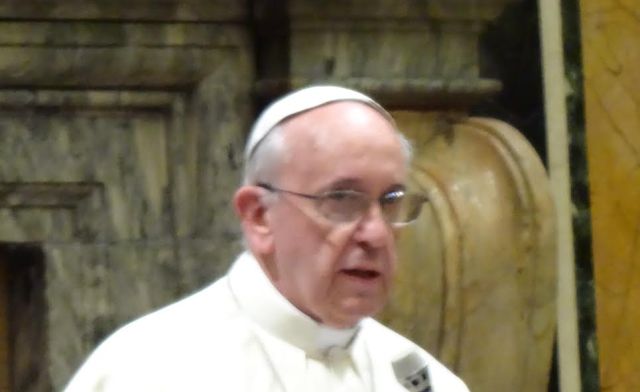


The inevitable question I’m asked when one knows I’ve been with the pope is, “And what is he like?” Here are some personal observations from a recent visit.
Impressions in the first moments so frame how we see an individual. This, my second meeting with Pope Francis, an almost three-hour conversation and lunch, allowed me to more carefully form impressions.
From the outset his charm set us all at ease. As we moved from the greeting hall to the conversation room, he stood by the door to turn out the lights. I noticed that gone were the papal slippers and instead shoes with dangling laces. At lunch, eaten in the cafeteria, it wasn’t the waiters who served us drinks; Pope Francis served Geoff Tunnicliffe, Secretary General of the WEA and me. His presence undermines pomp or circumstance. One has to remind themself that sitting across the lunch table, smiling through moments of joy is one of the most influential persons in the world. His celebrity is muted by his kindly ordinariness. His influence is corralled by his loving affection for people. His power leans towards the poor, those trampled underfoot.
Two dominant gifts showed. First his pastoral instincts and gifts are so evident. I asked, “When you were presented on the balcony in St Peter’s Square after your election, did you plan to ask those in the square to pray for you and then bow in silence?” He laughed. “No,” he said, “in that moment I sensed the Spirit leading me to do that.” So I asked, “When you did so, how did you feel?” He looked at me and smiled, “I was so at peace.”
We talked about Christians marginalized, pressed under the weight of government power or the majority presence of other faiths. He listened and then told a remarkable story. In his years in and out of Rome, he became friends with an Italian pastor. In time he came to learn that the church and pastor felt the power and presence of the Catholic Church, with its weighty presence, obstructing their desire to grow and be a witness. So he decided to visit the church and offer an apology for the difficulty brought to their congregation.
Offsetting his loving and endearing pastoral gift is the prophetic: not in foretelling the future but speaking forth the word of God.
Our lunch was just days after he had announced a shocking judgment in Calabria, south Italy, condemning the mafia for their “adoration of evil,” declaring all mobsters effectively excommunicated from the Catholic Church. Of earthquake proportion, this declaration will surely rattle communities where the Catholic Church and mobsters have for centuries lived along side each other. They are finding that Francis is more than just a cordial, pastoral priest from South America.
In the coming days we will hear of his determination to bring the administration of the Vatican under control, replacing leadership, cleaning up the Vatican Bank and speaking to the unspeakable matter of sexual abuse. His prophetic vision sees through haze and hears past chants, cutting open hypocrisy of religious self-interest.
I know some will wonder if we lack discernment, dining as we did with the head of a church many see as heretical. As an Evangelical, I’m clear in the importance of the Reformation and the role our community plays in announcing the Good News. I celebrate our understanding of the Scriptures as our only and final authority, the priesthood of every believer, the life-giving moment of rebirth and freedom for churches and ministries to spring up under the inspiration of the Spirit. No one is interested in rewinding the clock. Also to construct a united church isn’t doable and neither is it in our interest. Such plans do not lead us to fulfill Jesus’ prayer in John 17 that we be one in Christ.
My counter argument to those who might dismiss friendship with the pope is this. For Evangelicals and Protestants, of all shapes and sizes, the state and condition of the Roman Catholic Church matters. Of the over 2 billion Christians, one-half are linked to the Vatican. About 600 million are Evangelicals and another 550 million members of the World Council of Churches, (which includes the Orthodox Churches). As a world body, it is our calling to have contact with other major Christian communities and faiths. Conferencing with Rome no more compromises our doctrinal commitments than it would by meeting with the heads of other religions. We do that as a natural and important role of our calling. In places where Evangelicals are marginalized, having this official connection allows us to raise issues and ask for responses we would never otherwise get.
In a worldwide community of faith, the work and role of each Christian community matters. Given that 50 percent of those who call themselves Christian affiliate with Rome, when its spiritual and ethical authority is diminished it affects the entire world. When Rome loses her way, when corruption characterizes her financial dealings, when sexual scandals rob her of moral influence, when she fades from view in strongly declaring the nature of faith we all lose.
It’s fair to ask what kind of Catholic Church we as Evangelicals want to see. At lunch I asked Pope Francis what his heart was for evangelism. He smiled, knowing what was behind my question and comment was, “I’m not interested in converting Evangelicals to Catholicism. I want people to find Jesus in their own community.  There are so many doctrines we will never agree on. Let’s be about showing the love of Jesus.” (Of course Evangelicals do evangelize Catholics and Catholics do the same to us. However, that discussion we will raise another day.)
We spoke about how in our diversity we might find unity and strength. Borrowing from Swiss Protestant theologian Oscar Cullman, we reflected how “reconciled diversity” allows us to stand within our own understandings of how Christ effects salvation. And then we press on to deal with global issues like religious freedom and justice and other matters, which affect our wellbeing.
We are in the middle of a major religious shakeup worldwide. The Middle East is on the edge of what we know not. Islam is on the rise. The Gospel witness permeates much of the global south. So what of the future?
A vibrant pope, spiritually vital, tough in ethical leadership and competent in overseeing his world communion is critical. What he says and does has a profound affect on us all.
Evangelicals need not hide behind fear of engagement.  Working on human suffering and matters of injustice with Christians who have a different tradition and read the biblical text differently does not violate who we are or what we believe
Working on the world stage, it is evident there is respect for our distinctive evangelical message and regard for our responsibility and calling to represent our Christian community. International cooperation among Christians is built on that respect.

Brian C Stiller
Global Ambassador
World Evangelical Alliance
July 2014


Monday, 21 July 2014

DOM ODO CASEL and DOM ILDEFONS HERWEGEN: TWO GLORIES OF THE BENEDICTINE ORDER


Odo Casel: prophet and mystagogue
by Hugh Gilbert OSB 


Who was Odo Casel?

Odo Casel's is hardly a household name, nor is it ever likely to be. He was, after all, a monk and spent the greater part of his monastic life as chaplain to a community of Benedictine nuns - not usually a high-road to celebrity. And yet from this obscure monk issued what Cardinal Ratzinger called "perhaps the most fruitful theological idea of our century" (ie the 20th), while for the eminent French Dominican liturgist, Pierre-Marie Gy, it was Casel who gave the strongest impulse of anyone to the sacramental theology of the 20th century, and in the view of the English Dominican, Aidan Nichols, Casel should be accounted "a giant among theologians of the Liturgy and a figure raised up by Providence to salvage from perils the worship of the Church…one of the great fathers, I would say the great father of the 20th century liturgical movement". The following article is a small attempt to salvage Dom Odo Casel from his (relative) obscurity. Three questions naturally present themselves: Who was he? What did he say? Is it true?

Johannes Casel was born at Koblenz, in the German Rhineland, on the 27 September 1886. His father was a train-driver. His religion - this was the Catholic Rhineland - was Catholic through and through. After a local primary and secondary education, he went up to Bonn in 1905 to read classics. Among the students there was a young Benedictine, Ildefons Herwegen, who persuaded Johannes to put aside his studies and enter his own Benedictine monastery of Maria Laach, St Mary of the Lake. This was originally an 11th century Benedictine monastery, suppressed in 1802 and restored by Benedictines of the Beuronese Congregation as recently as 1892.

A Benedictine vocation

In 1913 the same Ildefons Herwegen was to become abbot of Laach, to remain such until his death in 1946, and to make of the abbey one of the intellectual and liturgical centers of German Catholicism between the two world wars. Entering the monastery in the autumn of 1905, Casel himself went through the usual stages of monastic initiation, receiving the name Odo, making profession in 1907 and being ordained in 1911. A little less usually (but this is Germany!) he gained, first, a theological doctorate from the Benedictine Athenaeum of Sant' Anselmo in Rome (with a thesis on the eucharistic theology of Justin Martyr, an early sign of his passion for the Fathers of the Church) and then, returning to Bonn, a second philosophical doctorate (with a thesis that revealed his parallel interest in Classical Antiquity, and especially its Mystery Religions).

In 1921, Abbot Herwegen asked Casel to become the editor of the projected Jahrbuch fur Liturgiewissenschaft (Yearbook for Liturgical Science), which task he acquitted through 15 imposing volumes until wartime shortage of paper precluded further publication in 1941. The editorship was an immense labour in itself. The Jahrbuch is, in fact, one of the great monuments to the intellectual revival of German Catholicism between the two world wars, and it was principally in its pages that Casel - through articles and reviews - was able to articulate, defend and consolidate his own vision of Christian worship. Casel was himself a quiet man, happiest working in his cell or singing in the monastic choir. His output was to be prodigious: one bibliography counts 309 major and minor works.

The obscure life of a convent chaplain

And it is doubtful if this would have been possible had not Abbot Herwegen, again discerningly, sent Dom Odo in 1922 as chaplain to what was then a small convent of nuns devoted to Perpetual Adoration at Herstelle, Westphalia. There he had the leisure to study and write. There, too, he had the spiritual and intellectual stimulus of a receptive community of women, which by the time of his death was a flourishing Benedictine house of the Beuronese Congregation, living a full liturgical life, as still today.

Here Casel was to remain, praying, celebrating, preaching, editing, writing, never going to conferences, even those devoted to his own thought. And here, in an astonishingly appropriate way, he was to die. On Holy Saturday 1948, he suffered a stroke after singing the Lumen Christi. He died in the early hours of Easter Sunday, 28 March. He was 61. It is a custom among monasteries to exchange notices of brethren who have died, including usually brief biographical details. That devoted to the passing of Odo Casel was a lyrical classic of the genre:

"Having just greeted the light of Christ in a clear voice and while preparing to celebrate the paschal praeconium, our beloved Father in Christ, liturgist of the sacred mystery and mystagogue, Odo Casel, monk of Maria Laach, having accomplished his holocaust and passing over with the Lord during the holy night, entered upon the beatific vision, being himself consummated in perfection by the mysteries of Easter which he had given to initiates. Thanks be to God."

Turbulent times for the pen and the sword

Casel's claim on our attention lies in his thoughts and writings, and above all in his vision of the "Christian thing" and, more specifically, of Christian worship. But before we turn to this, a word must be said about the wider context of his life and thought. This - to repeat - was Germany, the Germany that had lost a world war, an emperor and an empire, was passing through the humiliations of the Weimar Republic and then was to be swept up into the ultimately destructive fantasy-world of National Socialism.

In one sense, Casel lived apart from all this. He was certainly not a political animal; he kept "the even tenor" of his scholarly, monastic ways. Yet he was profoundly aware of the contemporary problematic. He was also aware of so much that was deficient in contemporary Catholicism: the inadequacies of neo-scholasticism, the excessively juridical view of Church and liturgy, and the individualism of so much piety. And his own work may be regarded as parallel to many of the attempts of the time to find a way forward in the world and in the Church.

One thinks of phenomenology and its "turn to the object", of the dialectical theology of Karl Barth reaffirming divine transcendence, of the desire for community and communion with nature in the Youth Movement, and more particularly of the tenderly bourgeoning patristic and liturgical movements within Catholicism and the concomitantly growing sense of the Church as the mystical Body of Christ. In 1922, Romano Guardini wrote his famous words: "A religious process of incalculable importance has begun - the Church is coming to life in souls."

Casel - like his own monastery of Maria Laach - has a distinctive place within this spectrum, one founded on Scripture, the Fathers and the Liturgy, on a deep appreciation for the ancient world and man's natural religiosity, for the objective and traditional and transcendent. For him, as he outlined in the arresting first chapter of his Das Christliche Kultmysterium [The Mystery of Christian Worship, 1st ed. 1932], it was the "Mystery" that needed to come to life in souls. Now was the providential moment, after the collapse of rationalist individualism, for a "turning to the Mystery". We can now turn ourselves to explore what he meant by this.

What did he say?

Mystery theology or the "doctrine/teaching of the Mystery" (Mysterientheologie, Mysterienlehre) are the names given to Casel's thought in German circles. "My first insight into the doctrine of the Mystery came to me in the course of a conventual Mass", Casel himself wrote. In sources and style, it may be categorized as "neo-patristic", a Catholic cousin to much of the theologizing of Orthodox émigrés of the same period, not to mention some equally adventurous Catholic contemporaries engaged in a similar ressourcement. Casel was decidedly not in the Scholastic tradition.

Rather he was a Benedictine monk, steeped body, mind and soul, in the Roman-Benedictine liturgy. It was out of this that his vision came. The "kernel" or content of this "theology" or "doctrine" was "the new appreciation (or restoration of the traditional appreciation) of the liturgical celebration as the concrete reality in which Christ's saving action in death and resurrection becomes present to us" (B. Neunheuser). More simply, one might call it a liturgy-centered vision of Christianity. ‘Ganzheitschau’ was one of Casel's favorite words: a view of the whole. And this is certainly what he bequeathed. What follows attempts to outline his thought under seven headings

Mystery: the core idea of Christianity

What is Christianity? What is its essence? This is the first question. Dom Odo, who was ever a philologist, began by turning to the word mystery (mysterion in Greek, mysterium in Latin). Hidden here, he saw, was the heart of Christianity. For the 18th century, Christianity might appear to be no more than a system of beliefs and a code of conduct; for the 19th century (as for many at the beginning of the 21st!) it might appear above all as a spirituality, as a way of relating to the Beyond.

For St Paul, however, and for the whole New Testament as well as for the authentic tradition of the Church, Christianity is the revelation of the Mystery. And the Mystery, in the predominantly Pauline sense, "means, first of all, a deed of God's, the working-out of an eternal divine plan through an act which proceeds from His eternity, is realized in time and the world, and returns once more to Him, its goal in eternity."

This Mystery can be expressed by the one word "Christ", meaning by it the Savior's person, together with His mystical body, "the Church". It is - initially - the Incarnation; it is - centrally - the sacred Pasch, the death and resurrection of the Lord; it is - consequently - the entry of the Church, the community of the redeemed, in the wake of the sacrificed and glorified Christ and by the power of His Spirit, into the presence of the Father.

"For Paul, Peter and John, the heart of faith is not the teachings of Christ, not the deeds of his ministry, but the acts by which he saves us". And our salvation, our liberation from sin and union with God, is brought about by participation in the saving acts of Christ. This, then, is Christianity "in its full and original meaning", the "gospel of God". Not a world-view with a religious backdrop, not a theological system or a moral law, "but the mysterium in the Pauline sense, that is God's revelation to mankind through theandric acts, full of life and power" and our saving participation in these.

Three-fold nature of Mystery

More amply, he explained, "mystery" denotes three things at once. It has a theological, a Christological and a sacramental-liturgical meaning, and these three can hardly be separated. First of all, the Mystery is God Himself, the thrice-holy, dwelling in inaccessible light and simultaneously mysteriously revealing Himself to the pure and humble. We can see ancient man's sense of this primal Mystery in his temples and pyramids, in his wisdom and worship, in the natural longing for union with the divine. To Israel, of course, God revealed Himself more fully, but this proved to be by way of preparation. And so we come to the second sense of Mystery, the Pauline and Christological. "Christ is the mysterium in person. He reveals the invisible God in the flesh". And His deeds are "mysteries" too.

"The deeds of His self-abasement, and above all His sacrificial death on the cross, are mysteries, because in them God reveals Himself in a way that goes beyond all human standards of measurement. Above all, though, His resurrection and exaltation are mysteries, because in them divine glory was revealed in the man Jesus, and this in a form that is hidden from the world and only open to believers".

This last is a point Casel insists on: mystery is by definition hidden as well as revealed; only faith can "see" it and only gnosis, Spirit-given knowledge, penetrate it; it is beyond the grasp of the "world"; it is given to the Church.

"The Apostles proclaimed the mysterium Christi to the Church, and the Church in turn hands it on to all generations. But just as the plan of salvation does not involve simply teaching but, above all, the salvific deed of Christ, so the Church leads mankind to salvation not merely through the word but also through holy actions or deeds".

And so we arrive at the third sense of mysterium, closely connected with the first two. "We find the person of Christ, His saving deeds and the working of His grace in the mysteries of worship". Mystery in this sense denotes "a sacred ritual action, in which a past redemptive deed is made present in the form of a specific rite; the worshipping community, by accomplishing this sacred rite, participates in the redemptive act and thus obtains salvation".

The Mystery and the mysteries

Two patristic quotations enter here. The first is from a sermon of St Leo's on the Ascension (Sermon 74:2): "what was visible in our Redeemer has passed over into the mysteries"; the second from St Ambrose (Apology for the Prophet David 58): "I find You in Your mysteries". In both cases, Casel understands "mysteries" not simply as those of the faith publicly proclaimed (though that too, of course, can be a liturgical event) but as the sacramental celebrations of the Church.

It is in these above all that the mystery of God in Christ is present. Therefore the liturgy itself deserves the appellation mystery, the mystery of worship (Kultmysterium) as Casel calls it. It is a mystery because in it "the divine saving act is present under the veil of symbols". It is the mystery of Christ present in a sacramental form, as Christ is the mystery of God present in the form of "flesh".

The essence of liturgy

Here we approach the heart of Casel's vision, his understanding of liturgy, his sense of its essence, his view of its place in the scheme of things. Liturgy is not ritual or pageantry nor, as some of Casel's contemporaries believed, merely a collection of rubrics governing the public worship of the Church. Nor, he might have said today, is it something we construct to express our group-psychology or something in the service of the "feel-good factor". It is the place and presence and power of the mystery of Christ. It is "the carrying out and realization of the new covenant's mystery of Christ in the whole Church through all the centuries, for her sanctification and glorification".

"God who revealed himself in the humanity of Jesus, continues to act after His glorification. Indeed, it is above all after this glorification that He acts through Christ the High Priest", and He acts "through the ordinary way of the economy of salvation", that is, the sacraments of the Church, thereby endowing liturgy with the force of the Mystery. This "mystery of worship" is "nothing other than the God-man continuing to act on earth. Hence this mystery, like that of Christ Himself, bears a twofold character: that of the divine majesty which is at work, and that of the veil of material and earthly symbols which simultaneously hide and disclose… The presence of the Lord in the divine mysteries occupies an intermediate position - a middle stage - between the earthly, historical life of Christ and his glorious life in heaven", between the Ascension and the Parousia.

The Church, the spouse and helpmate of Christ

None of this touches us simply as separate individuals. It is all for the Church and with the Church. The Church is at once the beneficiary of Christ's sacramental presence, and His helpmate. The presence of Christ in the sacramental mysteries is a "bridal gift" for the Church, and the sacraments, in turn, are a means for her to express her love for her Husband. Liturgy is nuptial. In the liturgy, the Church becomes the Bride of Christ and the Body of Christ. She receives from Him, is conformed to her crucified, glorified, Spirit-filled Lord, and at the same time is enabled to collaborate with Him in the furtherance of man's salvation, con-celebrating the mystery of worship with Him.

Without the mystery of Christ's liturgical presence, especially in the Eucharist, "the Church would be a priest without a sacrifice, an altar without an offering, a wife separated from her husband, unconsecrated, unable to come to the Father". She would not be the Church, in other words. But at the same time, it is through the same mystery of worship that Christ is fully Christ, the One who saves and glorifies His people. No wonder, then, that Casel - who never reduced the life of the Church to liturgy - should call it, nonetheless, "the central and essentially necessary activity of the Christian religion".

The real presence of Christ

At this point, it becomes vital to look more deeply at what it is that gives liturgy its salvific authority and its place in the history of salvation. It is, said Casel, the presence in the liturgical celebration, in the sacramental form, of the saving deed of Christ. This might seem unexceptional, even platitudinous. It is nothing of the sort, and in the theological context of his times it was revolutionary. Here we touch on Casel's dearest and deepest insight. In liturgy, he believed, the saving deed of Christ was objectively re-presented as an efficacious reality, thus enabling believers to enter into salvific contact with it. For him, as the German theologian Theodore Filthaut explained over 50 years ago:

"The saving acts which belong to the historical past are objectively and really re-presented in the liturgical mysteries. It is not a question of a merely "intentional" re-actualization being produced by a celebration; the saving acts are truly posited anew in the present. And these saving acts - the incarnation, death and resurrection, to restrict ourselves to the most important - are the proper content and object of the sacraments; they form the interior reality of the mysteries of worship".

In the Mass, for example, it is not simply the Christ who once suffered and is now in glory (Christus passus) who is sacramentally present, but the actual passion of Christ (passio Christi). It was precisely with such "ontology", such "realism", Casel believed, that the Church had always celebrated the liturgy. Wholly inadequate, therefore, and spiritually impoverishing, was the then current theory of a merely "effective re-presentation". Christ's "mysteries", in this view, belong to the historical past. It is metaphysically impossible for them to be present in liturgical celebrations. What is brought us by the liturgy is their effects.

Here St Thomas' well known Collect for Corpus Christi comes to mind: "May we so venerate the mysteries of your Body and Blood, that we may constantly experience in us the fruit of your redemption". It is this - the fruit, the grace(s), and the saving effects of Christ's once-for-all sacrifice - that, in a variety of ways, the sacraments bring us. Casel, naturally, did not deny what was being positively asserted here. The sacraments do indeed bring us grace! What he denied was the negation, the refusal to allow the presence, not just of the graces, but also of the source of those graces. "By liturgical worship", wrote his disciple Dom Jean Hild, "and especially by the sacraments, Christ becomes present with his saving acts, and not simply by means of the graces that He once merited for us on Calvary", or in Aidan Nichol's words, "the sacramental sign…is the ritual face of the redemptive act of Christ in its plenary reality, and not simply a communication of grace", and therefore, as Sr Theresa F. Koernke has expressed it, "the Christian ... really encounters Christ in his saving activity in and through the liturgical activity of the Church".

The sacramental economy

In Casel's own words, the "main intention" of the Mystery-teaching was "to set out clearly once again the Church's mysteries, above all the Eucharist, but the other sacraments as well, each according to its measure and place, as the "sacrament of the redemption"; that is to say, to show them as the presence of the economy (oikonomia) in the Church; not to reduce the sacraments to mere "means of grace". As a witness to what he regarded as the deeper and more ancient view, Casel invoked the then Prayer over the Gifts of the 9th Sunday after Pentecost:

"Grant us, we beg You Lord, that we may frequent these mysteries in a worthy way, for every time we celebrate the commemoration of this sacrifice, the work of our redemption is accomplished (opus nostrae redemptionis exercetur)".

What this prayer calls "the work of our redemption", Casel called "the saving Act (or Deed)", and the wave of controversy that this view aroused only led him to repeat and refine his conviction, never to renounce it. At the base of it lay an argument not unlike that by which the Fathers had defended the divinity of the Son and the Spirit: if we are deified by these Persons, these Persons must be divine.

So wrote Casel, "this real representation of the saving deed cannot not be, because the saving acts of Christ are so necessary to the Christian that he cannot be a true Christian if he doesn't live them after Him and with Him. It is not the teaching of Christ which makes the Christian. It is not even the simple application of his grace. It is total identification with the person of Christ obtained by re-living His life".

And it is precisely this "total identification", this communion with the life, death and resurrection of the Lord that the liturgy makes possible.

Presence-in-Mystery

At this point many, like Mary at the Annunciation, were inclined to ask, "how can this be?" or more brutally, "this sounds lovely, but what does it mean?" There was a fear that Casel was maintaining a literal reproduction in the liturgy of historical events, such as the birth and epiphany, baptism and transfiguration, death and resurrection, which, however much they might be an enduring part of the glorified Christ, did belong, as events, to the irretrievable past. Casel and his disciples, however, insisted they were not proposing any such reproduction or repetition of past events. Nor, on the other hand, did they think adequate the view that in the liturgy the heavenly Christ merely distributes the graces of his past meritorious acts. Rather, there is in every one of the saving deeds of the Lord a substantial element transcending time and space and capable of commemoration and re-presentation in a sacramental way (in sacramento, in mysterio). It is a question of a presence in mystery (Mysterien-gegenwart).

What happened in the past under the veil of historical events happens now under the veil of sacramental signs. Celebrations are indeed time-and-space bound, but they bring into time and space something that essentially transcends them. Once again Casel would have asked, if this is not the case, how can we have that necessary contact with the deeds of Christ, how can we - the Church - contact the "mysteries of his flesh", "be brought by his passion and death to the glory of his resurrection"?

The unity in Liturgy

Granting all this - the what and the how - we are brought back to the practical question of where? Or, in other words, does all liturgy involve this sacramental presence of the saving deeds? Are there not distinctions to be drawn between the Eucharist and the other sacraments, between sacraments and sacramentals? Here too Casel, without cavalierly ignoring the necessary differentiations, saw things as a whole.

The mystery of worship is found in the Eucharist supremely, in the other six sacraments, and also in such sacramentals as Christian burial, monastic profession and the consecration of churches, the Divine Office, the feasts and seasons of the liturgical year, especially Easter, and liturgies of the word. All of these, in their different ways, bring us the presence of the Mystery and enable us to enter into it. Casel did some lastingly valuable soundings in several specific liturgical areas.

Here we can only summarize his teaching on the sacraments of initiation. As regards baptism, we have the clear statement of St Paul: "Do you not know that all of us who have been baptized into Christ Jesus were baptized into his death? We were buried therefore with him by baptism into death, so that as Christ was raised from the dead by the glory of the Father, we too might walk in newness of life. For if we have been united to the likeness of his death, we shall be also to that of his resurrection" (Rom 6:3-5).

Baptism is the bridal bath in which the Church is washed and there, for the first time, "the Christian meets the mystery of worship". As he enters the water, he meets the dynamic presence of the Paschal Mystery in its sacramental "likeness" and is transformed by it. It is not enough to talk here of the forgiveness of sins and filial adoption; these effects arise from a prior assimilation to Christ.

In confirmation the Bride receives her anointing, and participation in the death and resurrection of the Lord is perfected. Just as the Lord became a life-giving Spirit through his Pasch, so believers are conformed, through the chrism, to the Spirit-filled Christ. "Peter, Paul and John regard the possession of the Spirit as the sign of the Christian".

The one baptized and confirmed, then, "is no longer a mere man, but is transformed into a deified man, newly generated by God into a child of God…Because he is a member of Christ, the High Priest, he is himself a Christ, that is an anointed man and a priest, who is allowed to offer God the Father a sacrifice which is uniquely acceptable and accepted through Christ".

The mystical meaning of ‘participation’

The sacrifice of Christ is made sacramentally present in the Mass, through the ministry of the ordained, and so it is possible for the "initiated" to offer this one true sacrifice and themselves with it. The Church "shares Christ's sacrifice, in a feminine, receptive way, though not less actively for that. She stands under the cross, offers her Bridegroom and herself with Him", and in Holy Communion becomes, ever more, what she receives, is ever more identified with the Lord. "These three mysteries, Casel says, are therefore the most important and the most necessary for the life of the Church and for each individual Christian".

Always it is a matter of participation in the mystery of Christ made sacramentally present for the life of the world. When contemporary liturgists speak, for example, of the Liturgy of the Hours as the Church's participation in the salvific praise and intercession of Christ, or of the liturgical year as a mystagogical induction into the one mystery of Christ annually unfolded, they are, wittingly or not, echoing Odo Casel.

The goal of liturgy

Finally, then, we are reminded again and again of the goal of liturgy. Through the liturgical "whole", through the celebration of its sacraments and sacramentals, the Church becomes what she is, the Body and Bride of Christ, and the individual Christian is conformed, by the Holy Spirit, to the crucified and risen One whom he meets in the liturgy. Out of this objective conformation flows a most demanding subjective imperative. "If the soul wishes to assimilate the content of worship, she must, by her subjective action, co-operate as closely as possible with the objective grace of the liturgy" (A. Gozier), conscious all the time that it is God's sanctifying action which is paramount. Dom Odo understood "participation" as a summons to holiness. In his homilies and conferences, he repeatedly presents the high ideal of a simultaneously crucified, risen and pneumatic life - something he saw the monk and nun called to in an ex professo way.

The Mystery naturally tends to mysticism. The mystery of Christian worship is the surest source and location of life lived in the mystery. By means of it, the mysteries of Christ's humanity become the mysteries of our own. By means of it, the Holy Spirit imparts to believers the true gnosis, an experiential knowledge of the mystery of Christ, taking them beyond the merely rational and into a life of God-like agape. The "end" of Casel's Mystery Theology points in the same direction as the end of the Rule of St Benedict by which he lived: to "the heights of wisdom [ie. gnosis] and virtue [ie. agape]".

How right was Casel?

And so to the final questions, how right was Casel? How have theologians and the Church responded to him? From as early as 1926, in fact, Casel's writings provoked controversy. In November 1947, a few months before his death, Pius XII's great liturgical encyclical Mediator Dei was published. Casel saw in it essentially a corroboration of his life's work. He was, at the deepest level, surely right. Others were quick to point out that one passage at least (n.176, on the Church's year) seemed to be an explicit critique of his and Maria Laach's approach. What did become clear was that clarifications were needed.

Casel was neither a philosopher nor a systematic thinker. His biblical and patristic exegesis was far from commanding universal assent, nor his appeal to the Mystery Religions. And yet the quotations with which this article began (Ratzinger, Gy, Nichols) are statements of sober fact, and the truth is that his central insights, after much sifting by theologians and liturgists throughout the 1950s and 1960s, have prevailed, even mightily - even when his authorship of them has been forgotten. Among theologians, for example, Edward Schillebeeckx in his classic Christ the Sacrament (1963) convincingly incorporated into sacramental theology Casel's understanding of the mysterious presence of the redemptive act (ch.2, s2), while the growing understanding of liturgy as the sacramental celebration of the Paschal Mystery has become the common teaching. Here I can only briefly point to the judgment of the Magisterium.

The legacy of Casel and Vatican II

In 1964, shortly after the promulgation of Vatican II's Constitution on the Sacred Liturgy, Louis Bouyer could write that "the heart of the teaching on the liturgy in the conciliar Constitution is also the heart of Dom Casel's teaching". This would hold particularly for articles 5 to 13, for the focus on the Paschal Mystery (art 5 and frequently elsewhere), the understanding of the apostolic mission in art.6, the teaching on the various modes of Christ's presence in the liturgy in art.7, the resounding affirmation in art.10 that the "liturgy is simultaneously the summit towards which the activity of the Church is directed and the source from which all her power flows".

Most symbolic perhaps is the five-fold use by the Council of the Prayer over the Gifts mentioned above and its vital phrase, opus nostrae redemptionis exercetur. Significantly, too, this prayer now features twice in the post-conciliar Missal. Thus has the teaching authority of the Church, without descending to controversies, incorporated the inner truth of Casel's vision.

The legacy of Casel and the new Catechism

A further step, in this writer's view, has been taken by the theology of the liturgy opening Part II of the Catechism of the Catholic Church. Even the titles suggest this: "The Celebration of the Christian Mystery", "The Sacramental Economy", "The Paschal Mystery in the Age of the Church", or a sentence such as:

"the gift of the Spirit ushers in a new era in the 'dispensation of the mystery' - the age of the Church, during which Christ manifests, makes present and communicates his work of salvation through the liturgy of his Church, until he comes” (n.1076).

Or, most remarkably, the profound and beautiful reflections of n.1085: "In the liturgy of the Church, it is principally his own Paschal mystery that Christ signifies and makes present…His Paschal mystery is a real event that occurred in our history, but it is unique: all other historical events happen once, and then they pass away, swallowed up in the past. The paschal mystery of Christ, by contrast, cannot remain only in the past, because by his death he destroyed death, and all that Christ is - all that he did and suffered for all men - participates in the divine eternity, and so transcends all times while being made present in them all. The event of the Cross and Resurrection abides and draws everything towards life". Such a vision is owed to no one so much as Odo Casel.

A vision for the future

As has been well said, Casel's essential bequest is an ontology of the liturgy. In many ways, his death in 1948 marked a turning-point in the history of the 20th century liturgical movement. Practical 'pastoral' concerns came to dominate: questions of language, of active participation, of the re-drafting of rites, and though Casel's prophetic (and patristic) vision of liturgy has found a place in theology and doctrine, its full potential as mystagogy, as guide to celebration, surely remains to be realized.

As the American Benedictine Aidan Kavanagh has well expressed it, "In true celebration of the Mystery there is nothing that is anthropocentric, rationalistic, subjective, or sentimental; rather, it finds expression in a rigorous theocentrism, objective contemplation, and a splendid transcendentalism".


For all that, now, may sound a little dated in his writings, for all the imperfections, for a certain "impracticality" even, a "turning" or returning to Odo Casel can aid in the ever-necessary and certainly liturgically necessary "turn" to the Mystery. No doubt, he never will be a household name, but he was one of the humble glories of 20th century Catholicism and remains a prophet and mystagogue as the new millennium begins, novo milliennio ineunt.

DOM ILDEFONS HERWEGEN

my source: Dom Oldefons, An I Introduction:
In a previous post I argued that Abbot Ildefons Herwegen’s introduction to Guardini’s famous book on the liturgy is an example of the pre-WWII Liturgical Movement reacting to liberal individualism. I argued that it–unlike the book that it introduces–goes too far in the opposite direction. I have now made a translation of Herwegen’s introduction:

Introduction to Romano Guardini’s Spirit of the Liturgy (1918)

In the Acts of the Apostles the praying Church stands at the threshold. She begs for the sending of the Holy Spirit; she strengthens herself in charismatic prayer for martyrdom; she watches praying at the prison of St. Peter; she surrounds the mysterious breaking of the bread with unceasing prayers, and thus forms her liturgy. At the dawn of of Christianity the Church appears as orans. In her the petition of the disciples is answered: Lord, teach us to pray. Like a little seed the Our Father grows into a mighty tree. The prayer of Christ has blossomed into the eternal prayer of the Church. Her liturgy is the breath of the praying Christ, the glorified high priest. This prayer of Christ – holy in its divinity, noble in its humanity— continues on earth a solis ortu usque ad occasum in the unceasing prayer of the Church.

The Church is the society of the true worshipers of God. Her prayer is never a mere cry for help forced by necessity. Even her petitions and lamentations are ennobled and restrained: trembling with loving adoration, illumined with faith in Christ’s victory, with selfless, childlike joy in the greatness and beatitude of the Father. The Church stands tranquil and confident in the midst of the turbulent world. What gives her the confidence to stand? Her prayer.

It is not assemblies, speeches, demonstrations, nor the favor of states and peoples, nor protective laws and subsidies that make the Church so strong. And while there can never be enough done in preaching, in the confessionals, in parish missions, in catechesis, and in works of mercy; yet all such things are merely the external achievements that flow from an internal power. It would be perverse indeed to be concerned principally for such achievements whilst neglecting the concern for the purity, intensity, and growth of the internal source. Wherever the Church truly, vitally prays there supernatural holiness springs up on all sides, there active peace, human understanding, and true love of neighbor blossom.

Our prayer decides the struggle of our life. He who prays well begins to comprehend the whole of life in its breadth and depth; he finds the balance between the infinite and the finite. To pray is to anchor our created wills in the will of God. The prayer of Christians finds already in the activity of prayer itself an infinite fulfillment through being united to the omnipotent will of God.

Prayer is the word of the searching human soul.

Here human ways end, and the human will is touched by the will of God, and is filled with awe and terror along with redeeming, quieting consolation and liberating strength.

Only in adoration do we find healing and salvation.

The prayer of the Church establishes a firm connection to the eternal. Eternal truth seizes us here, makes us real, makes us worthy for eternal being and life, worthy to see the eternal good and delight in it.

Participation in the adoring love of the Church, the bride of Christ, gives purity and strength.

We live in a time which has left rationalism behind, a time which is striving toward mysticism; today, more than in the recent past, people are inspired by the longing to approach God. Even the feverish obsession with work, which also marks our time, and which offers itself as a substitute for religion, is not able to strangle the mystical longings of the soul. This cry is too powerful, too universal: to God! But where is the path to Him?

The individual raised by the Renaissance and by liberalism has exhausted itself. It recognizes that it needs a connection to an entirely objective institution in order to mature into personality. It demands community [Gemeinschaft].

The age of socialism does have communities, but only such as form a collection of atoms, of individuals. But our desire is for organic, for vital community.

The Church is such an organic community in the highest sense. She unites persons more intimately than any other community; she gives them one spirit, indeed in a sense one body—corpus Christi mysticum. In this body every part is connected to every other and to the head by an intimate, life giving relation. The Church is the “communion of saints;” the saints struggling toward God amidst the trials and tribulations of this valley of tears, and those transfigured, sanctified members of Christ, who triumph in His glory.

An organic community that is is ordered to God must have public worship. The liturgy of the Church is public, but not only in the ancient sense of belonging; the liturgy does not only regard the whole, it also elevates the prayer of each individual. Thus the prayer of each individual soul becomes itself a liturgical. Christ relates to the Church in a way parallel to the way in which He relates to the soul. But the liturgy places the prayer of the individual on an objective foundation, it orders it to a greater, super-personal telos, transcending the narrowness of the individual and its random circumstances. The whole of creation praises the creator in liturgy, and the individual soul mirrors the whole universe.

The reforms of Pope Pius X concentrated our attention with on the liturgy with a new urgency. The Sacrifice, blessing, and prayer of the Church as expressed in her liturgy has won ever more importance in the devotional life of German Catholics in recent years. In theory and in practice, in research and in life, we are trying to learn and foster the authentic liturgy.

The liturgy has been called “the great catechism of the laity.” (J. Brögger) That is what it was in previous centuries. If it is to become such a catechism of the laity again then “we must put much more emphasis in formation within the family, the schools, and in sermons, on teaching the true values and sentiments of the Catholic liturgy, unfolding their educative power, and showing how well they harmonize with what is most noble in the German spirit.” (L. Baur)

Our series Ecclesia Orans is attempting to support such attempts by explaining liturgical terms, actions, and texts, and thus fostering deeper liturgical understanding among the clergy, the teachers, and the educated laity. A series will not follow a strict plan, but will be a loosely connected group of monographs that treat historical, dogmatic, ascetical-mystical, philosophical, pedagogical, and aesthetic questions on the liturgy with a rigorous scholarly foundation, but in a style accessible to the general reading public.

The prayer of the Church is an expression of what is objective and communal, and thus it has developed for itself an external form. Our task is to describe and explain this form; to trace its origins and development. But since the external form is the expression of the internal spirit, we will pay particular attention to the spirit of the liturgy. Thus the scope of our series is very wide. It will treat not only liturgical topics in the strict sense, but also everything which contributes to a better understanding of its spirit—as for example the prayer and ascetic discipline of the patristic Church, the theology of the Church Fathers, the and the influence of monasticism on the development of the liturgy.

We will be pleased if out series can contribute something to liturgical scholarship, but our goal is to open up the treasures of the liturgy and make them fruitful for the Christian life.

In this, the first little volume of our series, Guardini shows how the liturgy, properly understood contains a deep psychological wisdom—even from a natural point of view it fosters a healthy life of the soul. He examines the difficulties that modern man has with the liturgy, and shows how these difficulties arise both in a faulty understanding of the liturgy and in modernity’s unbalanced and exaggerated emphasis on certain aspects of life to the detriment of others. He shows how intimately that which the liturgy is and that which it gives are connected with true harmony in the soul. Without intending it the ancient rituals provide heal precisely the wounds that mark the modern psyche and untie precisely the knots in which contemporary man has tied himself. The liturgy lifts us out of the present moment, above the arbitrariness of individual circumstance. The liturgy trains us to be reverent worshipers of God, pure adorers of the Father.

In this work the author concentrates not so much on the scholarly explanation of the liturgy as on the personal conditions for fruitful participation in the liturgy. He tries to prepare the ground, to dispose the soul to receive what the liturgy offers.

Guardini’s essays are a fitting introduction to our series, since he is able to understand those who come to the liturgy from without, for the first time. He describes the collision of two spiritual worlds, and how their dissonance can be overcome. He unearths connections between the liturgy and the interior life that had become forgotten and buried. Thus he prepares the natural conditions for the liturgical experience. His work is thus admirably suited to lay the broad foundation upon which we mean to build.


Friday, 18 July 2014

TWO EXCELLENT POSTS BY FATHER DWIGHT LONGENECKER


It was April 19, 2005 and the world’s eyes were fixed on a small chimney jutting out from the roof of the Sistine Chapel. Within the dazzling walls of the Vatican’s Sistine Chapel, a papal conclave was convened and casting votes for a new Bishop of Rome. An international icon and beloved shepherd to the Catholic faithful, Pope John Paul II, had died after suffering the ravages of Parkinson’s disease. In his wake, Rome and the world witnessed a holy funeral of emotionally and spiritually-epic proportions. After twenty-six profound years, a deep chasm opened in the Seat of Peter. Now, untold millions worldwide sought to discern whether the smoke emitting from the chapel chimney was “fumata nera” (black smoke) indicating a failed vote or “fumata blanca” (white smoke) indicating a successful selection of a new Pope. Even the most hard-bitten atheist could not deny that there was something mesmerizing about this process. Perhaps the cynic could best characterize this spectacle as medieval showmanship at its finest, but to the believing Catholic (a title I resolutely claim) it was an ancient practice infiltrated with the Holy Spirit to arrive at a Successor of Peter, the Rock upon which the Church was and continues to be built. It was extraordinary. And it wouldn’t take long.

After merely four ballots, the masses saw what they eagerly anticipated: fumata blanca. Cheers erupted. Shortly thereafter, an anxious wait would ensue with fixed attention on the balcony of St. Peter’s Basilica. Cardinal Medina Estevez would emerge and announce to the world in numerous languages, “Dear Brothers and Sisters…” followed by the universal Latin, “Habemus Papum!”. Indeed, “We have a Pope.” And so we would meet for the first time, Pope Benedict XVI.

In 2005, I was still four years away from becoming a Catholic. Still a Lutheran at the time, my wife and I were alternating Sundays between Catholic and Lutheran churches. Admittedly, I had drawn closer to the Catholic Church in the nine years since my wife and I had been together, and my appreciation for the papacy (having once been, instead, a deep skepticism) had grown over years by watching, reading and comprehending the figure of Pope John Paul II (please see my previous post: 
“Man of the Year – Why the Pope Matters" http://www.patheos.com/blogs/acatholicthinker/2012/12/02/man-of-the-year-why-the-pope-matters/). However, in spite of the inexorable draw I felt toward Catholicism, it was very hard to ignore the relentless negative commentary offered by the media’s opinion-makers on who Joseph Cardinal Ratzinger, now Pope Benedict XVI, really was. “God’s Rottweiler”, “The Panzer Pope”, “The Inquisitor” were just a few of the derogatory names spilling out in the weeks in advance and following the selection of this new pope.  Being relatively new to the papal selection proceedings (and especially as a fledgling and prospective Catholic), I found this offensive and simultaneously unsettling. It was offensive that this holy and ancient practice was being tainted by such a careless casting of aspersions and epithets. And yet, it was unsettling because I wasn’t wholeheartedly immune to the influence of the “storied” media opinion-makers. After all, at one point, I myself carried unfounded biases against the Catholic Church. So it had to be asked – What was the world – what was I – to make of Pope Benedict XVI? It was from this point forward that Pope Benedict XVI would surprise me…again and again.
One of the first lessons I learned about the Catholic Church is that you have to experience it to understand it. As I’ve written in previous posts on this site, I carried a number of latent biases with me as a young Protestant. These latent biases became active when my wife and I first discussed our religious future together in the late 1990s. In spite of my proud and stubborn stances, it wasn’t until I attended Catholic Mass Sunday after Sunday, read the Catholic Catechism, explored the works of the saints and apologists, prayed, and spoke with wise and kind members of the Faith that I truly grasped the wonder and beauty of Catholicism. This process taught me a thing or two – most notably that you need to find out the truth for yourself. It isn’t easy. It requires time, energy, and devotion to finding answers that you may not like or may prove you wrong. But it is the most valuable and rewarding endeavor you could ever embark on. In a few words, it utterly humbles you. If this process served me well in exploring Catholicism (in spite of all the criticism surrounding it as a Faith), shouldn’t it serve me well in understanding the Church’s new leadership? Pope John Paul II surprised and impressed me once I had explored his biography and writings. Perhaps Pope Benedict XVI would as well. Indeed…he would.
Joseph Ratzinger would grow up under very difficult and trying circumstances. Raised in Hitler’s Germany by strong Catholic, anti-Nazi parents was quite difficult and led to great risk and moral dilemmas. Conscripted as a child to the Hitler Youth and ultimately to an anti-aircraft brigade (age 16) during the war, Joseph would ultimately desert (at great risk) toward the war’s end. Some of the accusations of Joseph as a complicit Nazi were scurrilous [an example being the doctoring of the picture of the young priest Ratzinger giving his first blessing (first picture) so as to make it look like a Nazi salute (second picture)].


Joseph would pursue the priesthood and demonstrate an early brilliance in theology. In short order, he would become a widely respected academic theologian and pivotal player at Vatican II.

His voice for reform in the wake of Vatican II would transform in the tumult of the 1960s where he perceived a cultural and religious untethering from church authority that risked rupture with the accumulated spirit and wisdom of two thousand years. In response to a more liberal, reform-minded journal, Concilium, Joseph would co-found a more conservative, traditional journal, Communio, with some of the brightest Catholic thinkers of the 20th century.

His writings were legion and would range from the liturgy to sacred art, from the cardinal virtues to the role of faith and reason. Through the end of his papacy, he would write at least 66 books, thousands of articles and hundreds of speeches. His work has been respected across religious, national, and cultural boundaries. He has been known for a willingness to thoughtfully and politely dialogue even with those whom he would most disagree. Given his devotion to his faith and his inquisitive, yet sensitive demeanor, Joseph would rise quickly to leadership positions within the Church. Joseph Ratzinger was an intellectual and spiritual giant.

As Pope, Benedict XVI would surprise with speeches and writings, projects and gestures that one may not have anticipated. His speech just prior to conclave (when, technically, still a Cardinal) on the “Dictatorship of Relativism” articulated the ideological dangers of moral relativism:
“How many winds of doctrine we have known in recent decades, how many ideological currents, how many ways of thinking… The small boat of thought of many Christians has often been tossed about by these waves – thrown from one extreme to the other: from Marxism to liberalism, even to libertinism; from collectivism to radical individualism; from atheism to a vague religious mysticism; from agnosticism to syncretism, and so forth. Every day new sects are created and what Saint Paul says about human trickery comes true, with cunning which tries to draw those into error (cf Eph 4, 14). Having a clear faith, based on the Creed of the Church, is often labeled today as a fundamentalism. Whereas, relativism, which is letting oneself be tossed and “swept along by every wind of teaching”, looks like the only attitude (acceptable) to today’s standards. We are moving towards a dictatorship of relativism which does not recognize anything as for certain and which has as its highest goal one’s own ego and one’s own desires.
However, we have a different goal: the Son of God, true man. He is the measure of true humanism. Being an “Adult” means having a faith which does not follow the waves of today’s fashions or the latest novelties. A faith which is deeply rooted in friendship with Christ is adult and mature. It is this friendship which opens us up to all that is good and gives us the knowledge to judge true from false, and deceit from truth. We must become mature in this adult faith; we must guide the flock of Christ to this faith.”
The famous Regensburg lecture was a brilliant dissertation on the inextricable link between faith and reason. The Pope would submit that irrational, damaging, and destructive acts performed in the name of God are, in fact, utterly contrary to God’s faithful and reasonable nature:
“[Here are the] reasons why spreading the faith through violence is something unreasonable. Violence is incompatible with the nature of God and the nature of the soul. “God”, [the emperor - in Pope Benedict's example] says, “is not pleased by blood — and not acting reasonably is contrary to God’s nature. Faith is born of the soul, not the body. Whoever would lead someone to faith needs the ability to speak well and to reason properly, without violence and threats… To convince a reasonable soul, one does not need a strong arm, or weapons of any kind, or any other means of threatening a person with death…
The decisive statement in this argument against violent conversion is this: not to act in accordance with reason is contrary to God’s nature.”
His encyclicals were devoted to the supernatural virtues of Love and Hope. Caritas in Veritate (Charity in Truth) is considered a masterpiece of reconciliation between Catholic ethics and business economy. He sought to reinforce Vatican II as continuous with and not a rupture from the pre-Conciliar Church by reinvigorating the practice of the Latin (Tridentine) Mass, reforming the Roman Missal to be more faithful to the original Latin, and inviting more traditional sacred music into the liturgy. The Pope sought to reach out to the disaffected such as Society of St. Pius X as well as extending reconciliation with priests/churches of the Anglican communion. At the same time, he held firmly that religious orders must avoid abuses and hold themselves faithful to Church teachings. He built further bridges in dialogues with the Orthodox, Jewish, and Muslim communities. Among many, the Pope beatified John Henry Newman and Pope John Paul II and canonized Native American Kateri Tekakwitha. He presided over the annual Youth Days with massive attendance, the publication of the first Youth Catechism, and offered up the first Papal “tweets”. He would also importantly and indispensably meet with, grieve with, and apologize for the horrors of the priest sex abuse scandals within the Church. For what was originally considered to be a short-lived, minimally consequential, caretaker papacy, Pope Benedict XVI dramatically surprised and delighted me.

Perhaps, however, what I have found most surprising and endearing is Pope Benedict XVI’s approachability. In the face of caustic and withering criticism that, upon further honest examination, was unfair and unjustified, the Pope has proved to be a very decent person. Journalist Vittorio Messori, author Peter Seewald, or atheist politician Marcello Pera, were all struck, contrary to their preconceived notions, at how kind, thoughtful, and approachable they found Joseph Ratzinger. I encountered this same man – Joseph Ratzinger, Pope Benedict XVI – when reading Peter Seewald’s trilogy of book-length interviews, God and the World, Salt of the Earth, and Light of the World. It is easy to become completely transfixed by the kind, clear, and thoughtful answers of an intellectual giant who sees himself as a humble servant of the Lord.
And so now it is the last day of Pope Benedict XVI’s papacy. Now we prepare for another conclave and watch again for fumata blanca. And as I reflect on the Pope who was presented to me by the opinion-makers while comparing him to the Pope I met for myself, the questions can be raised, “Are you surprised? Are you surprised by the Pope you found, you learned from, you prayed for, and you converted under?” And my answer would be: Yes and No. Yes, I thought I could trust the opinion-makers to be somewhat correct on who Pope Benedict XVI was and who he would become. They were wrong and so I was surprised. But, more importantly, No, because surprise is what this Faith is all about. It is a Faith where disciples ask to walk on water and multiply loaves and fishes, where lepers are healed and the condemned are released, where you love even though it is unreasonable and you believe even when it is unbelievable. It is a Faith of confounding, maddening, brilliant, glorious surprises. And Pope Benedict XVI has been another one of them. Why shouldn’t he be? Thank you, Holy Father, and God go with you.

Pope Benedict XVI, Pope Francis & the Greatest Friendship Imaginable
July 16, 2014 By Tod Worner 


I had never heard the term before. Opera Omnia. But, boy, did it sound impressive. It was in the Fall of 2008. Pope Benedict XVI was in the third year of his papacy and the first volume of his Opera Omnia was being presented at the Vatican. I would soon learn that Opera Omnia, literally translated, means “all (or complete) works”. And this Pope’s works go deep. Sixteen volumes deep to be exact. From his earliest formative years as a fledgling priest to his most recent seasoned years as a deeply respected theologian, Pope Benedict XVI could never be accused of being an intellectual lightweight. In fact, in penning volumes addressing topics such as ecclesiology, eschatology and the theology of the liturgy, Benedict has at times been labeled an aloof academic, a denizen of the theological ivory tower too far removed from the true concerns of his Catholic flock.
As a Catholic who converted under Pope Benedict in 2009, I remember too well the harsher monikers affixed to this Pope in 2005 when he (as Joseph Cardinal Ratzinger) was being considered “papabile” (or a papal candidate, literally “pope-able”) in the wake of Pope John Paul II’s death. Epithets such as The Panzer Pope, God’s Rottweiler, The German Shepherd became common parlance among the news media. Once elected, Pope Benedict XVI led the Church from 2005 to 2013 after which he humbly stepped aside for a “younger” Pope to step in with physical strength that he admitted he was lacking. That man would be Pope Francis. And while Pope Francis has warmly manifested a style of his own informed by a spirited and humble charity, inevitable comparisons would be made by naysayers who found in Pope Francis the virtue and in Pope Benedict XVI the vice (I write about this in my previous post, Loving Francis, Missing Benedict). Before long, an image began to emerge of a lovable, fatherly, saintly Francis contrasted against a shifty, sneering, punitive Benedict. Hmmm. How curious.
And it all made wonder, did these detractors ever read Benedict? Before I began my road to Catholicism, I would have joined in this exercise of criticism. After all, I originally felt that the papacy was little more than a Pharisee-like exercise in theological pomp and circumstance. Even more, I would likely have subscribed to the caricature of Pope Benedict XVI because those caustic representations would have deliciously satisfied my preconceived notions of just one more thing I didn’t want to like about the Catholic Church. But my journey (with my ever-respectful, faith-filled wife and my dear, insightful friend) through years of Mass, prayer, conversations with priests and friends, and reading the luminaries of the faith helped me discover the richness of the Catholic Faith and the deep and indispensable role of the Pope in the Church and the world, (for more on this, please read my previous post Man of the Year – Why the Pope Matters).
And so, having given Catholicism a second look and finding myself awestruck by what I found, it was important for me to honestly and fairly re-approach God’s Rottweiler, The German Shepherd, the author of this immense Opera Omnia. Generally, what I found was described in my previous post, Pope Benedict XVI and Surprise. But I felt a few words needed to be shared in light of the comparions being made between Pope Benedict XVI and Pope Francis.

Pope Francis has taken the world by storm. With an ever-present smile, affable demeanor and boundless energy, Pope Francis has waded deep into crushing crowds, ridden in tiny open-windowed cars through delirious throngs of the faithful, and (reportedly) embarked on clandestine late night outings to minister to the needy on dark Roman streets. He has given off-the-cuff interviews, engaged in thoughtful debates with his deepest critics, and shocked people simply by dialing them up on the phone. In his speeches and writings, he exudes love, faith and hope. He truly is a faith-filled shepherd.

And Pope Benedict XVI? If you were to read the broadest coverage of his pontificate, it was reputedly dominated by high-brow consideration of arcane theological esoterica, flush with intolerant condemnation of the jots and tittles of the Catholic Faith, and characterized by a pious remove from the real world problems of “the least of these”? If you were to believe these writers gleefully contrasting the current pope with the former, then, indeed, This. Is. Pope Benedict XVI. 
But, you see, this ISN’T Pope Benedict XVI. This Pope who penned the sixteen volumes’ worth of theological writings, also:
welcomed babies,
blessed the disabled,
and waded into crowds.

But to understand what this somewhat shy and deeply thoughtful Pope held dearly, we must turn to the prized works of the mind and spirit that make up his Opera Omnia. What will we find there? Minutiae pertaining to the liturgy? Some. Arcana on eschatology? Yes. Subtleties of ecclesiology? Quite likely. But there is a more overwhelming message that suffuses his work: Friendship with Christ.

“Christianity is not an intellectual system, a collection of dogmas, or a moralism. Christianity is an encounter, a love story; it is an event.”&“The person gains himself by losing himself in God.”&“Christianity is not a new philosophy or new morality. We are Christians only if we encounter Christ… Only in this personal relationship with Christ, only in this encounter with the Risen One do we really become Christians.”&“For each one of you, as for the apostles, the encounter with the divine Teacher who calls you friends may be the beginning of an extraordinary venture: that of becoming apostles among your contemporaries to lead them to live their own experience of friendship with God, made Man, with God who has made himself my friend.”&“Today, having a clear faith based on the Creed of the Church is often labeled as fundamentalism. Whereas relativism, that is, letting oneself be “tossed here and there, carried about by every wind of doctrine”, seems the only attitude that can cope with modern times. We are building a dictatorship of relativism that does not recognize anything as definitive and whose ultimate goal consists solely of one’s own ego and desires.We, however, have a different goal: the Son of God, the true man. He is the measure of true humanism. An “adult” faith is not a faith that follows the trends of fashion and the latest novelty; a mature adult faith is deeply rooted in friendship with Christ. It is this friendship that opens us up to all that is good and gives us a criterion by which to distinguish the true from the false, and deceipt from truth.”
Over and over again, you hear Pope Benedict XVI illustrate a warm, inviting, merciful theme of friendship with Christ. God is not an abstraction. He is here. And He is our friend, our guide, our advocate. It is difficult at times to live (and die) for a Creed, even though we do. It seems infinitely more sensible and tangible to do so for a Person. As Flannery O’Connor once observed about the the abstract vs. tangible experience of faith,
“Our response to life is different if we have been taught only a definition of faith than if we have trembled with Abraham as he held a knife over Isaac.”
Pope Benedict XVI sought to reintroduce us to the person of Christ – the person of Christ who came into history and then transcended it, the person of Christ who welled up with love and winced with pain, the person of Christ who peered with infinite love and mercy into the eager eyes of Peter, the treacherous eyes of Judas and the tearing eyes of Mary. And what did he say to all of them?
“No one has greater love than this, to lay down one’s life for one’s friends.”
- John 15:13
“I no longer call you slaves, because a slave does not know what his master is doing. I have called you friends…”
- John 15:15
Christ would lay his life down for us. But before doing so, he would befriend us. As friends of Christ, we are dignified and valuable, comforted and encouraged, taught and mentored. But we are also disciplined and held accountable. This friend – this Christ – never, ever turns away, but he bids us come and follow him.
Now isn’t that something? The Pope who is derided as the Rottweiler disciplinarian, the detached intellectual, the malevolent Hyde to Pope Francis’ earnest Jekyll…that same Pope, in his own style and deep substance, simply wanted us to cultivate the greatest friendship we could ever imagine. Perhaps, yes perhaps, that is what Pope Benedict XVI’s entire papacy was about. Friendship with Christ. 
Huh.
Pope Benedict XVI and Pope Francis are good men with deep substance and particular styles. They are both devoted and faithful disciples of Christ. And, together, they are his friends. Are we?
Now if you’ll excuse me. I have a bit of reading to do.


THE AFTERLIFE ACCORDING TO AN ORTHODOX SAINT

Search This Blog

La Virgen de Guadalupe

La Virgen de Guadalupe

Followers

My Blog List

Fr David Bird

Fr David Bird
Me on a good day

Blog Archive