EXPAND YOUR READING!!

"Today the concept of truth is viewed with suspicion, because truth is identified with violence. Over history there have, unfortunately, been episodes when people sought to defend the truth with violence. But they are two contrasting realities. Truth cannot be imposed with means other than itself! Truth can only come with its own light. Yet, we need truth. ... Without truth we are blind in the world, we have no path to follow. The great gift of Christ was that He enabled us to see the face of God".Pope Benedict xvi, February 24th, 2012

The Church is ecumenical, catholic, God-human, ageless, and it is therefore a blasphemy—an unpardonable blasphemy against Christ and against the Holy Ghost—to turn the Church into a national institution, to narrow her down to petty, transient, time-bound aspirations and ways of doing things. Her purpose is beyond nationality, ecumenical, all-embracing: to unite all men in Christ, all without exception to nation or race or social strata. - St Justin Popovitch

Thursday, 25 April 2013

BUT THE HEAVEN ABOVE IS GREATER by Father Tertullian Ioan Langa


In 1948 as a 24-year-old up and coming academic Tertullian Langa was told to join the communist run union or lose his job. Renouncing his university career, he went to work on a farm. Known as a committed Greek Catholic (in union with Rome since the eighteenth century) he was hunted down and arrested in Blaj at the office of Bishop Ioan Suciu – who was later martyred.


After the fall of Ceaucescu I had the privilege of meeting the late Cardinal Todea, then head of the Romanian Catholic Church. Neither he nor any of the Romanian Catholic bishops collaborated with the communists. Cardinal Todea spent years on the run – often hiding in barns and hay wricks -, and years in prison. The Greek Catholic church was outlawed and the hierarchy liquidated. Most, like Bishop Suciu were executed.


Tertullian Langa’s fate was prison. For two weeks he was beaten with a rod on the soles of his feet, suffering excruciating pain. When he still refused to provide information against the church, a wolf hound was brought to the cell and set upon him, badly mauling him. Later, he was beaten on the head, rhythmically, with a bag of sand:  “After approximately twenty blows, I began to apply the moral principle ‘age contra’, do the opposite, saying to myself at each blow: “I will not speak.”


He was moved to another prison, twenty five feet below the marshes of Jilava, where “men were packed like sardines – not in oil, but in their own juices, made of seat, urine and the water that seeped in, that tricked ceaselessly down the walls.” Sixty men fought for space and air, and humiliation was piled upon humiliation.


In his moving account, Father Langa (for he would later be ordained) said of the inmates, “We were animated by a people’s mysterious will to remain in history, and by the vocation of the Church to stay alive…When the sun abandoned me, I felt yet that I had not been abandoned by Grace.”  Redolent of Solzhenitsyn’s writings from his Soviet gulag, Tertullian Langa’s story, challenges each of us to take more seriously the continuing suffering of the church in many parts of the world. His story is replicated in China , North Korea and Vietnam today.


"But the Heaven Above Us Is Greater"

by Tertulian Ioan Langa

My name is Tertulian Langa, and eighty-two are the years of my life that I will not see again. Of these, sixteen were bestowed upon the communist prisons.

At the age of twenty-four, in 1946, I was a young assistant in the faculty of philosophy at the University of Bucharest. The Russian troops had occupied almost a third of Romania, and it was intimated to me, as a member of the faculty, that I should urgently become a member of the teachers´ union manipulated by the communist party thrust into power by the armor-clad Soviets.

I was already aware of the firm stance of the Catholic Church´s magisterium against communism, which it defined as inherently evil. So there was no place in my conscience for compromise. I renounced my university career and retreated to the countryside as a farm worker, but that was not sufficient, because I was already known among the faculty as a militant Catholic and anti-communist. An accusatory dossier was quickly improvised against me, and as the accusations were founded on circumstances not yet criminalized by the penal code (relationships with bishops and with the nunciature, lay apostolate), my dossier was grouped with those of the big industrialists. After interrogations accompanied by atrocious treatment, the procurator declared, with perfect communist logic: "There is no proof of the guilt of the accused in his dossier, but we nonetheless ask for the maximum penalty: fifteen years of forced labor. After all, if he were not guilty, he would not be here." I objected: "But it´s not possible for you to condemn me without proof!" And he: "It´s not possible? Here's how it´s possible: twenty years of forced labor for having protested against the justice of the people." And this was the sentence.

This happened before the Greek-Catholic Church of Romania had been outlawed. It was taken for granted that my arrest, and the tortures applied to me, would succeed in transforming me into an instrument for the future incrimination of bishops and priests of the Greek-Catholic Church and of the Vatican nunciature.

I will recount just a few of the moments from my interrogation and my imprisonment in the communist extermination camps.

I was arrested at Blaj, in the office of bishop Ioan Suciu, the apostolic administrator of the Greek-Catholic metropolitan see of Romania, and a future martyr. I had presented myself to him, the head of our Church, to ask for the enlightenment of Holy Providence, because my spiritual father, bishop Vladimir Ghika, another future martyr, had gone into hiding. Someone had offered me the possibility of leaving the country. As this was an important step, I did not want to take it without determining if it were the will of God. And the answer came: my arrest. I understood that I was to spend my life in the prisons created by the communist regime, but I was serene: I was following the path of Holy Providence.


THE IRON ROD


I remember Holy Thursday of 1948. For two weeks, every day, they had beaten me with a rod on the soles of my feet, through my shoes: it seemed that lightning coursed through my spine and exploded in my brain. But they didn´t ask me any questions. They were getting me ready, using the rod to soften me up for the interrogation. I was bound hand and foot and hung upside down, and my jailers stuffed into my mouth a sock that had already been long employed in the shoes and the mouths of other beneficiaries of socialist humanism. The sock had become the noise-reducer that prevented the sound from passing beyond the place of interrogation. But it was practically impossible to emit a single moan. Moreover, I had frozen psychologically: I was no longer capable of crying out or moving. My torturers interpreted this behavior as fanaticism on my part. And they continued with increasing fury, taking turns in torturing me. Night after night, day after day. They didn´t ask me anything, because they weren´t interested in answers, but in annihilating a person, something that was delayed in coming. And as the effort to annihilate my will and overshadow my mind was prolonged, so was the torture indefinitely prolonged. The battered shoes fell from my feet, piece by piece.

That Holy Thursday night, in a nearby church, they were celebrating the liturgical office, accompanied by bells that wept as if frightened. I started. Jesus must have heard my suffocated cry when, how I don´t know, I howled from within that hell: "Jesus! Jesus!" Coming out through the sock, my cry was incomprehensible to the jailers. As it was the first sound they had heard from me, they said they were satisfied, sure of having broken me. They dragged me on a blanket to the cell, where I fainted. When I awoke, the inquisitor was standing before me with a ream of paper in his hand. "You´ve been stubborn, criminal, but you´re not getting out of here until you´ve brought out everything you´re hiding inside. You have five hundred sheets of paper. Write about everything in your life: everything about your mother, your father, your sisters, brothers, in-laws, relatives, friends, acquaintances, bishops, priests, religious, politicians, professors, neighbors, and criminals like you. Don´t stop until you´ve finished the paper." But I didn´t write anything. Not out of some kind of fanaticism, but because I didn´t have the strength: even my mind seemed empty.


THE SHE-WOLF


After four days, the same individual: "Have you finished writing?" Seeing that the paper hadn´t been touched, he said, "If that´s how things are, strip! I want to see you like Adam in paradise." Days went by like this, days of bare skin on pavement, a comfort typical of humane socialism. Another individual appeared at the door after a while: "Let´s see, what do we have on the paper? Nothing? Still stubborn! You´ll see that we have other methods." Then he left. He returned with an enormous wolfhound, with its threatening fangs bared. "See her? She´s Diana, the heroic dog your criminal friends shot at in the mountains. She´ll teach you what you have to do. Start running!" And I: "What do you mean, run? In a room nine feet long?" In the room there was also a three-hundred watt bulb, too bright for a nine-by-six room, and fixed not on the ceiling, but on the wall, at eye level. "Run!" The wolf, growling, was ready to attack. I ran for six or seven hours, but I realized it only near dawn, seeing the light begin to creep into the cell and hearing movement in the building. Occasionally the man let the wolf out to take care of her needs. This was not allowed to me. When I began to lose my balance and showed signs of stopping, the vigilant wolf, as if by command, sank her teeth into my shoulder, neck, and arm.


I ran under her eyes and her fangs for thirty-nine hours without interruption. At the end I collapsed, and the wolf pounced upon me. She bit my neck, but without strangling me. Then I felt something hot and stinging on my forehead and in my eyes, and I understood that the beast was urinating on my face. And it is from the words of my butchers that I understood that I had run for thirty-nine hours. "We could send this one to the Rio marathon! What endurance, the fascist pig!" But seeing that not even the marathon had succeeded in convincing me to make a declaration on the bishops and the nunciature, or on some friend they were seeking, they thought it useful to pass to another form of persuasion: the bag of sand.


THE BAG OF SAND


The next day, in an office, they bound me hand and foot before a table with a small sack on it. Behind me there was a pale and speechless jailer. At a desk in the corner their was a bald man with a goatee, clearly trying to look like Lenin. He was also speechless, but made a sign by moving his head. My tormenter understood the command. He took the bag and beat me rhythmically on the head with it, accompanying each blow with the word: "Speak!" Dozens, hundreds of times; I don´t know, perhaps thousands: "Speak!". But no one asked me anything. There was only that cavernous, monotonous voice pounding into my brain the imperative to talk, to respond to any question put to my conscience by the inquisitor. It wasn´t hard for me to decipher the satanic idea of wanting to overmaster my will. After approximately twenty blows, I began to apply the moral principle "age contra," do the opposite, saying to myself at each blow: "I will not speak!" Dozens of times, hundreds of times. Through autosuggestion I had implanted within myself the response "I will not speak!", with the risk of becoming a slave to that way of expressing myself. And that´s what happened: from that time on, I responded automatically to any question put to me on any subject: "I will not speak!" It took me an entire year of mental effort to free myself from this sinister reflex.


TWELVE INCHES


As a subject devoid of value and interest to the interrogators, I was transferred to the prison twenty-five feet beneath the marshy ground of Jilava, constructed for the defense of the capital but unusable on account of serious water damage. Nothing survived there except for man, the greatest treasure of historical materialism. In the cells of Jilava, the poor men were packed like sardines - not in oil, but in their own juices, made of sweat, urine, and the water that seeped in, which trickled ceaselessly down the walls. The space was utilized in the most scientific way possible: a patch of six feet by one foot for each person, lying on his side on the ground. The oldest lay on wooden tables, without sheets or blankets. Their thigh bones and the outside of their knees and calves lay along the wood. We lay on the edges of our bones in order to occupy minimal space. Our hands could rest only upon the ankle or shoulder of a neighbor. We couldn´t endure this for more than half an hour; then everyone, at a command, turned onto the other side, because this would have been impossible to do separately. The stack of bodies arranged this way was in two levels, as in bunk beds. But beneath this there was a third level, where the detainees lay upon the bare cement. On the cement, the condensed vapor of the breath of sixty men, together with the water that seeped in and the urine that seeped out of the latrine, formed a viscous mixture in which the unfortunate basted. At the center of the cell-tomb was enthroned a metal container holding about fifteen to twenty gallons, for the urine and feces of sixty men. It had no cover, and the smell and the liquid flowed from it abundantly. To reach it, one had to pass through the "filter," a severe inspection applied to the bare skin, an inspection during which the entire body and all of its orifices were examined.


THE "FILTER"


They scraped our mouths, the area under our tongues, and our gums with a wooden baton, in case we criminals had hidden something there. The same baton penetrated nostrils, ears, anus, beneath the testicles; always the same baton, rigorously the same for all, as a sign of egalitarianism. The windows of Jilava were made not to give light, but to obstruct it, as they were all completely sealed by wooden planks fastened with nails. The lack of air was such that in order to breathe we went to the door in shifts, three at a time, belly up, with our mouths against the gap beneath the door, a position in which we counted sixty breaths, after which the other inmates would come to recover from fainting and from the lack of oxygen.

Thus we contributed, in our way, to the construction of the most humane system in the world. Did Churchill and Roosevelt know these things when, with a stroke of the pen at Tehran´s shameful table, they established that we Romanians should be ground by the jaws of the red Moloch of the East, that we should be made the cord to secure their comfort? And could the Holy See have had any idea of this?


NAKED IN THE COLD


From Jilava, after long years of the profanation of our humanity, we were transferred, with leg chains, to the prison of maximum isolation, called Zarka, the pavilion of terror of the prison of Aiud. The welcome followed the same sinister, diabolical ritual of the profanation of man, created by the love of God. Here was the same scraping and probing, the same heavy boots that sank into our ribs, stomachs, and kidneys. In spite of this, we noticed a difference: we were no longer subjected to the regime of preservation in urine, sweat, condensation, and lack of oxygen, but were subjected to an intensive treatment of oxygenation with bare skin and in the cold, criminal after criminal (meaning ministers, generals, university professors, scientists, poets), including me, who was nothing but a great "I will not speak!", a firm and humble trust in the Grace that would make me stand the test.

We all had to disappear, being enemies of the people. If not, how could the much-vaunted "New Soviet Man" have come forth? The cell into which I was placed contained nothing: no bed, blanket, sheet, pillow, table, chair, or mat - not even a window. There were only the iron bars, and I, like all the others, was alone in the cell. I wondered at myself, dressed only in my skin and blanketed by the cold.

It was the end of November. The cold became ever more penetrating, like an unpleasant cellmate. After about three days, the door was slammed open and they threw to me a ragged pair of pants, a short-sleeved shirt, underwear, a striped uniform, and a pair of worn out shoes with no laces, and no socks. There was nothing to cover my head. They also gave me a sort of latrine, a miserable container of about a gallon. I dressed myself hastily. On the fourth day, they counted the freezing inmates. They gave me a number in place of my name: K-1700, the year in which the Church of Transylvania united with Rome. In the public registry, I was already dead. I survived only as a number, a statistic. Then came the broth, four and a half ounces ladled out: it was a thin liquid made by boiling corn flour. For lunch they distributed to us a bean soup, in which I could count eight or nine full kernels. There were many empty husks. For supper, they brought us tea with a crust of burnt bread. After a week, they substituted for the beans a porridge of bran, in which I counted fourteen whole grains. From time to time they alternated the beans with the bran porridge. We lived on less than is given to a hen.


WALK OR DIE


To survive the cold, we had to move constantly, to do gymnastics. As soon as we fell down, overthrown by weariness and hunger, we plunged into sleep, but a very short sleep, as it was bitterly cold. A voice from the other side of the wall woke me one day from such a sleep: "I´m professor Tomescu, the former health minister. Who are you?" When he heard my name, he said: "I´ve heard about you. Listen to me carefully: we have been brought here to be exterminated. We will never collaborate with them. But whoever doesn´t walk, dies, and becomes a collaborator. Tell the others: whoever stops, dies. Walk without stopping!" The pavilion, immersed in the dismal silence of death, echoed with the sounds of our unlaced shoes. We were animated by a people´s mysterious will to remain in history, and by the vocation of the Church to stay alive. We stopped working only at about 12:30, for a half an hour, when the scant sunlight lingered for us in a corner of the room. There, hunched down with the sun on my face, I stole a bit of sleep and a ray of hope. When the sun abandoned me, I felt yet that I had not been abandoned by Grace.

I knew I had to survive. I walked, repeating to myself like a refrain, spelling out: "I don´t want to die! I don´t want to die!" And I didn´t die! With each step, I mentally recited prayers, composed litanies, recited psalms.

We continued walking this way, so as not to stumble into death, for seventeen weeks. Anyone who lost the strength or the will to move, died. Of the eighty men who entered Zarka, only thirty survived. The iron bars, little by little, put on coats of frost, formed from the exhalations of our living breath, a dazzling traveler´s garment for the road to heaven.


BUT ALL IS GRACE


I believed strongly, many times, that I had come to the very edge of darkness. But I still had a long way to go. Having arrived, years later, in what I imagined must be freedom, I realized that it was in reality nothing more than another way of living in darkness, that the coldness between the Greek-Catholic Church and the hierarchy of its Orthodox sister Church still would not thaw; that our churches continued to be confiscated, and our flock continued to dwindle, killed off by promises. But Christ the Lord also gained the victory only when he could pronounce, with his last breath, "Consummatum est"; it is finished.

I have not written very much about my dramatic experiences. Who can believe what seems unbelievable? Who can believe that the will can overcome the laws of nature? And what if I were to recount the miracles I have experienced? Wouldn´t they be considered mere fantasy? It would be harder for me to bear this disbelief than to undergo more years of imprisonment. But Jesus was not believed, either, by everyone who saw him: "After this, many of his disciples went back, and walked no more with him" (Jn. 6:66).

Nothing in life happens by chance. Every moment the Lord gives us is fraught with Grace - the benevolent impatience of God - and with our will to respond to it or refuse it. It is up to each one of us not to reduce everything to a hard, fierce, unbelievable tale, but to understand that the acceptance of Grace does not hinder man, but carries him beyond his expectations and powers. I sincerely hope that this testimony will open a window into Heaven. Because it is greater, the Heaven above us, than the earth beneath our feet.


 FOR THE LIFE OF THE WORLD (PARTS 3 & 4 OUT OF 14)
A commentary on Fr Alexander Schmemann's book on the Sacraments

CONCERNING FANATICISM, ORTHODOXY AND TRUTH by Nicolai Berdyaev


In my last post, the subject was G.K. Chesterton, a great Catholic layman who bore witness to Catholic Tradition in a world that was increasingly finding refuge in secularism and in various types of fanaticism.   Today, I introduce to you, once more, a great Orthodox layman who bore witness to the same Tradition, call it Orthodox Tradition if you like, in the same world: they were contemporaries.

Secularism and fanaticism belong to the same world, like Cowboys and Indians; and reaction against one always adds recruits for the other; and both sides have plenty to re-act against. 

Against both there stands Christian Tradition; and here are two highly intelligent, highly competent, witnesses to that Tradition.   I believe it was the suggestion of Patriarch Kiril to Pope Benedict that we should shelve our differences for the moment  and join together to win back Europe for Christ by our joint witness.   Perhaps by working together we will learn to love one another; and, by loving one another, we will learn to understand one another and then even agree with one another.   As the Liturgy of St John Chrysostom says at the "kiss of peace", just before the Creed, "Let us love one another, so that with one mind we may confess our faith."   Love comes first, then understanding, and then confessing our faith with one mind.   Where love is absent, schism is just round the corner.  In that spirit, let us learn from Nikolai Berdyaev. - Fr David


(1937 - #430)

       [translator note: Russian useage has two different words both which translate as “orthodoxy”. The word “ortodoksiya”, which we render throughout in uncapitalised form as “orthodox”, bears a generic and pejorative sense of a narrow-minded adherence to a “right-belief” of whatever the teaching, be it an orthodox Marxism or an orthodox atheism even. In contrast, the Russian word “pravoslavniya” (“right-glory” or “right-doxology”) refers to Orthodox Christianity, and is capitalised throughout as “Orthodoxy”, which as Berdyaev observes, properly precludes fanaticism].


       The theme of fanaticism, connected with an adherence to orthodox teachings, is very relevant. History is rhythmic, in it the shifting of psychical reactions plays an enormous role. And we are entering a cycle, when there is prevalent the inclination towards an obligatory orthodoxy for all, towards an arrangement, stifling for freedom. This is a reaction against the XIX Century, against its love of freedom and humanity. The mass psychology of intolerance and fanaticism is being perfected. Amidst this, the sense of balance is shattered and man allows himself a maniacal obsession. The individual man is rendered a sacrifice of collective psychoses. There then transpires a strange effect of consciousness, the smothering and erasing of many essential human features, within all the complex of the emotional and intellectual life of man. Unity is attained not through fullness, but through ever greater and greater an impairment. Intolerance has an affinity with zeal. Zealotry is a psychosis, amidst which there is lost the sense of realities. The inner emotional life becomes distorted and fixates itself upon a single point, but that point, upon which the fixation occurs, is perceived altogether in an unreal way.

      The man, in whom intolerance reaches the point of flaming up, of fanaticism, is like a jealous person, and he sees everywhere only one thing, only the treason, the betrayal, only the breaking of fidelity to this single thing, he becomes suspicious and mistrustful, he discovers everywhere conspiracies against his beloved idea, against the object of his faith and love. The man fanatically intolerant, just like the jealous person, is very difficult to bring back to reality. The fanatic, obsessed with a maniac pursuit, sees all around the snares of the devil, but he is always the one who himself persecutes, torments and executes. The man, in the grip of a persecution mania, and who senses enemies all around him, -- is a very dangerous being, he always becomes the persecutor, he it is that persecutes, rather than that they are persecuting him.

      Fanatics, acting with the greatest of malice, coercion and cruelty, always sense themselves surrounded by dangers, and always they are beset by fear. A man always reacts with force out of fear. The emotion of fear is deeply connected with fanaticism and intolerance. To the fanatic, the devil always seems terrible and strong, and he believes in him moreso, than he believes in God. Fanaticism possesses religious roots, but it readily passes over into the national and the political sphere. The national or the political fanatic likewise believes in the devil and his snares, though the religious category of the devil be completely alien herein. Against the powers of the devil there is always created an inquisition or a committee of the common salvation, an omnipotent secret police, a Cheka. These dreadful institutions are always created out of fear of the devil. But the devil has always proved himself to be the stronger, for he penetrates into these institutions and guides them.

      There is nothing stronger than fear. The spiritual healing from fear is necessary for every man. The intolerant fanatic acts with force, he always excommunicates, imprisons and executes, but in essence he is weak, and not strong, he is smothered by fear and his consciousness is terribly narrow, for he less believes in God than do the tolerant. In a certain sense it might be said, that a fanatic faith is a weakness of faith, a lack of faith. This is a negative faith. Archimandrite Photii in the epoch of Alexander I believed chiefly in the devil and the Anti-Christ. The power of God seemed to him as nothing in comparison to the power of the devil. There was as little a belief in the power of Christian truth within the Inquisition, as there is in the Communist truth within the Soviet GPU [State Political Department]. Fanatic intolerance involves always a profound lack of faith in man, in the Image of God within man, a lack of faith in the power of truth, i.e. in the final end, a lack of faith in God. Lenin indeed lacked faith in man and in the power of truth, just like Pobedonostsev did: they were of one and the same sort. The man, having allowed himself to come under the obsessive grip of the idea of a worldwide peril and worldwide conspiracy of Masons ,of Jews, of Jesuits, of Bolsheviks or of an occult society of killers, -- such a man ceases to believe in the power of God, in the power of truth, and he trusts only in his own coercions, cruelties and murderings. Such a man is, in essence, an object of psychopathology and for psychoanalysis.

       A maniacal idea, inspired by fear, also is quite extreme a danger. At the present time fanaticism, the pathos of an universally-obligatory orthodoxy of truth is to be seen in Fascism, in Communism, in extreme forms of religious dogmatism and traditionalism. Fanaticism always divides the world and mankind into two parts, into two hostile camps. This is a war setting. Fanaticism does not permit of the co-existence of various ideas and world-outlooks. There exists only the enemy. The hostile powers become blended together and present themselves as a single enemy. This is entirely like, as if a man were to make the division not into the I and a multiplicity of other I’s, but rather into the I and the not-I’s, wherein the not-I presents itself to him as a single being. This strange simplification facilitates the struggle.

       For the Communists there is at present [1937] only one enemy in the world -- Fascism. Every antagonist of Communism is thereby already a Fascist, and vice versa. For the Fascists every antagonist is thereby already a Communist. Amidst this setting the quantity of Fascists and Communists in the world has grown immeasurably. People hostile to Communism are placed on the side of Fascism and those hostile to Fascism -- are made out to be on the side of Communism. It is an union that transpires as regards one’s attitude of the devil, which is the other half of the world. They put before you an uneasy either/or choice, either Fascism or Communism. It is inconceivable, why I should have to choose between the two powers, both which deny the worth of the human person and freedom of spirit, both indeed practise making use of the lie and coercion, as methods suited to the struggle. It is clear, that I ought to be on the side of some sort of third power: as in France happens with the trend, connected with “Esprit” and “La Fleche”, simultaneously hostile to Capitalism, Fascism and Communism. Fanatic intolerance always presents one a false choice and produces a false line of division. But it is interesting, that the pathos of fanatic intolerance in our time is the result not of a passionate faith and conviction, but rather instead a contrived air of tension, often a stylisation, and it is the result of a collective agitation and demagoguery. There are, certainly, individual Communists and Fascists, believing and convinced to the point of fanaticism, particularly among the Russian Communists and the German Nazis, while rather less so amongst the Italian Fascists, who are more sceptical and susceptible to economic politics. But with the Communist and Fascist masses there are no sort of firm and thought-out beliefs and convictions. This is a mass, which is stylised under Fascism in consequence of agitation and imitation, but which also is interesting.

      The contemporary pathos of intolerance is very distinct from the Medieval; back then there was actually a deep faith. The average man of our time possesses not ideas, he possesses instincts and affections. His intolerance is bound up with military matters and a thirst for order. He knows only whatever the truth, useful for organisation. The twofold division of the world, evoked by demands for war, has its own inevitable consequences. Our epoch does not know critical and intellectual dispute nor does it know the struggle of ideas. It knows only exposing, expelling and chastisement. Those thinking differently are looked upon as transgressors. With the transgressor they do not dispute. In essence, there are no more intellectual enemies, there are only military enemies, belonging to mutually hostile domains. Dispute means tolerance, the most dangerous disputant -- is the tolerant man, he allows for the co-existence of ideas different than his own idea, he thinks, that from the colliding of ideas the truth can better be revealed. But at present in the world, there occurs no sort of struggle of ideas, there occurs rather the struggle of special interests and pugilists. The Communists, the Fascists, the fanatics of an “orthodox” be it Orthodoxy, Catholicism or Protestantism, dispute not with any sort of ideas, they rid themselves of the antagonist off into the opposing camp, upon which they then direct their polemic tirade.

        The pathos of having an orthodox doctrine, which renders itself useful for the struggle and for the organisation, leads to the complete lack of interest for thoughts and for ideas, for cognition, for intellectual culture, and a comparison with the Middle Ages is very hapless for our times. No sort of ideational creativity amidst all this is to be discerned. In this regard, our intolerant epoch is dramatically ungifted and wretched, in it creative thought has become placid, and it parasitically feeds on former epochs. The thinkers of the greatest influence in contemporary Europe, -- like Marx, Nietzsche, Kierkegaard, -- belong to that XIX Century, against which at present the reaction occurs. The sole area, in which is to be found a dizzying level of creativity, is the area of technical discoveries. We live under the banner of the social, and in this area transpires much that is positive, but there are no sort of social ideas, there is at present no creating of social theories, and they all belong to the XIX Century. Marxism, Proudhonism, Syndicalism, even Racism, -- all issue from the thought of the XIX Century. The chief advantage of our century is in this, that it is more oriented towards realities, it unmasks the reality. But, having unmasked the old idols, the new century then creates new idols.

      For the fanatic there does not exist a manifold world. This is a man, obsessed by one thing. He has a merciless and malevolent attitude towards all and everything except for this one thing. Psychologically, fanaticism is connected with the idea of either salvation or perishing. This idea in particular takes fanatic hold upon the soul. There is one thing, which saves, and all the rest causes to perish. It is therefore necessary to devote oneself completely to this one thing, and mercilessly to eradicate everything else, the whole manifold world, which threatens the perishing. With the perishing perdition, connected with the manifold multiplicity of the world, there is connected also the emotion of fear, which always lies at the root of fanaticism.

      The inquisitors of old were perfectly convinced, that the cruel things done by them, the beatings, the burnings on the bon-fires and other things, -- they were convinced that this was a manifestation of their love for mankind. They contended against perdition for the sake of salvation, they guarded souls from the allure of the heresies, which threatened with perdition. Better be it to subject one to the brief sufferings in the earthly life, than the perishing of many in eternity. Torquemada was a non-avaricious and unselfish man, he wanted nothing for himself, he devoted himself entirely to his idea, his faith; in torturing people, he made his service to God, he did everything exclusively for the glory of God, and in him there was even a soft spot, he felt malice and hostility towards no one, and he was of his kind a “fine” man. I am convinced, that such a “fine” man, convinced in his faith and unselfish, was also Dzerzhinsky, who indeed in his youth was a passionately believing Catholic and indeed wanted to be a monk. This is an interesting psychological problem.

         A believing, an unselfish, an intellectual man can become a fanatic, and commit the greatest of cruelties. To devote oneself without reservations to God or to an idea, substituting for God, whilst ignoring man, is to transform a man into a means and a weapon for the glory of God or for the realisation of the idea, and it means to become a fanatic -- wild-eyed and even a monster. The Gospel in particular revealed to people, that it is impossible to build one’s relationship to God without a relationship to man. If the Pharisees put the Sabbath higher than man and were denounced by Christ for this, then also every man, who puts an abstract idea as higher than man, in effect confesses a religion of the Sabbath, which was repudiated by Christ. It is all the same regarding this, whether this be an idea of churchly orthodoxy, or of the state and nationalism, or the idea of revolution and socialism.

          A man, mindful to the searching out and detection of heresies, intent upon the excommunicating and pursuing of heretics, is a man long since accused and judged by Christ, though he be not concerned over this. The pathological hatred for heresy is in the nature of an obsession by an “idea”, which is set higher than man. But all the orthodox doctrines of the world are nothing in comparison with that one least amongst mankind and his fate. Man is the Image and Likeness of God. Every system however of ideas is the product begotten of human thought or thoughtlessness. Man is not to be saved nor perish, by cleaving to some sort of system of ideas. The sole authentic heresy is an heresy of life.

          The unmaskers and persecutors of heresy therein at the same time become heretics of life, heretics in relation to the living man, to mercy and to love. All the inquisitors were heretics of life, they were traitors to the life-vital dogma about man. Cyril of Alexandria in this regard was moreso an heretic of life, than the heretics denounced by him. Behind the unmasking of heretics there is always concealed a sinful lust for domination, a will to might.

      The pathological obsession with ideas of salvation and perdition, which medically should be attended to, can also be transferred to the social sphere. And therein this panicky idea begets revolutionary fanaticism and creates political institutions of inquisition. Intolerance and inquisitions justify themselves by the threat of social ruin. And thus, the Moscow Trials of the Communists are very reminiscent of witchcraft trials. In both the one and the other, the accused confesses to having criminal dealings with the devil. The human psyche changes little. And essentially, fanaticism always bears a social character. Man cannot be a fanatic, when he is set before God, he renders himself a fanatic, only when he is set before other people.

            The fanatic always has need of an enemy, he always needs someone to execute. Dogmatic formulae that are “orthodox” are formed not in relation to God, but in relation to other people, they are formed because heretical opinions have arisen. Fanaticism always signifies social compulsion. Or one can  take into account the forms of Self-Immolation, as for example, in the extreme currents of the Russian schismatics, but in this instance it likewise signifies social coercion under the reverse standard. Fanaticism of an extreme “orthodoxy” in religion bears a sectarian character. The feeling of satisfaction from belonging to a circle of the chosen is a sectarian feeling. Fanaticism quite fires up the will and readies it for the struggle, for inflicting torture and for bearing torture. Even with the most meek and mild of fanatics, conscious of the love for mankind within himself, and concerned for the salvation of his soul and society, there is an element of sadism. Fanaticism is always connected with the manifestation of torture. Ideologically, fanaticism is always a frenzy of “orthodoxy”.

        The categories of “orthodoxy”, opposed to heresy, apply at present to types of thought, having nothing in common with religion, -- for example, to Marxism; but it is of a religious origin. Though it be of religious origin, all the same it is first of all a social manifestation and it signifies the domination of the collective over the person. “Orthodoxy” is a mental organisation of the collective and it signifies an exteriorisation of consciousness and conscience. “Orthodoxy” defines itself in opposition to an heresy. The heretic is a man, thinking not in accord with the mental organisation of the collective. People, preeminently esteeming themselves “orthodox” whilst denouncing heretics, i.e. those that think differently, love to declare that they are defending truth, and they set truth up higher than freedom. This is a very great mistake and self-deception by the “orthodox” mind-set.

      The pathos of an “orthodoxy”, fed by fanaticism, has nothing in common with the pathos of truth, being as it were actually contrary to it. Such an “orthodoxy” forms itself around themes of salvation and perdition, and such orthodox are themselves frightened and they frighten others. Truth however does not know fear. The guardians of “orthodoxy” are the ones that most of all distort the truth and are afraid of it. The guardians of various religious orthodoxies have distorted history. The guardians of a Marxist of Racist “orthodoxy” likewise distort history. These people always create vicious legends about a power hostile to them. Truth gets substituted for by what is useful, by the interests of the organisational order.

       The man, fanatical over some sort of idea, like a person who would save himself alone, cannot be said to seek the truth. The search for truth presupposes freedom. Truth is not external to freedom, truth is bestown only by freedom. Outside of freedom there is only that which is useful, but not truth, there is only the interests of power. The fanatic of some sort of orthodoxy seeks for power, and not for truth. Truth is not a ready given nor is it received passively by man, it is an endless task. Truth does not fall down from above upon man, like some sort of thing. And it is impossible to understand the revelation of truth in a naive-realistic sense. Truth is likewise both the pathway and life, it is the spiritual life of man. Spiritual life however is freedom and is not external to freedom.

      The fanatics of an “orthodoxy”, in essence, do not know truth, since they do not know freedom, they do not know spiritual life. Fanatics of a religious orthodoxy think, that they are humble people, since they are obedient to churchly truth, and they accuse others of pride. But this is a dreadful mistake and self-delusion. Granted, in the Church there is enclosed the fullness of truth. But wherefore does such a religiously orthodox person fancy, that he in particular is master of this truth of the Church, that he in particular knows it? Wherefore in particular is he bestown this gift of the ultimate distinction of churchly truth from heresy, where in particular is this chosenness rendered him? This is pride and self-conceit, and no people are more proud and self-conceited, than the guardians of a religious orthodoxy. They identify themselves with churchly truth. There does indeed exist an orthodox churchly truth. But herein perhaps, thou as an orthodox fanatic, knowest it not, thou knowest but fragments of it by virtue of narrow-mindedness, ossification of heart, attachment to form and legalism, the absence of giftedness and grace.

      A man, permitting himself to come into the grip of fanaticism, never presupposes such possible about himself. He, certainly, is prepared to acknowledge himself a sinner, but can never acknowledge himself as having fallen into error, into self-deception, into self-smugness. Which is why he considers it possible, amidst his own sinfulness, to torment and pursue others. The fanatic is conscious of himself as a believer. But perhaps, his faith may actually possess no sort of relationship to truth. Truth is first of all an egress from oneself, but the fanatic is unable to go out from himself. He goes out from himself only in malice against others, but this is not an egress to others nor to an other.

        The fanatic -- is an egocentric. The faith of the fanatic, his unrestrained and unselfish devotion to an idea helps him not in the least to overcome the egocentrism. The asceticism of the fanatic (and fanatics often are ascetics) does not at all conquer the absorption with himself, nor at all does it turn him to the realities. The fanatic of whatever the orthodoxy identifies his idea, identifies its truth with himself. And he is this idea, this truth. Orthodoxy -- this he is. And ultimately this is always rendered the sole criterion of orthodoxy.

         The fanatic of an orthodoxy can be an extreme adherent of the principle of authority. But he always imperceptibly identifies the authority with himself and is never subject to any sort of authority in disagreement with him. The inclination towards authority in our epoch bears in particular suchlike a character. The authoritatively disposed youth recognises no sort of authority over himself, and he is conscious of himself as the bearer of authority. The ultra-Orthodox youth, who disdains freedom and denounces heresies, esteems himself the bearer of Orthodoxy. This is an example of just how far the idea of authority is contradictory and inconsistent. Authority in practice never vexes its fanatical adherents, it vexes others, their opponents, and does violence to them. In essence, no one subjects themselves to authority, if they consider it not to be in accord with their understanding of truth. The faith-confession of some sort of extreme orthodoxy, of some sort of totalitarian system, always signifies the desire to belong to a circle of the elect, the bearers of a true teaching. This means the flattering of people with pride and self-conceit. In comparison with this, the love of freedom signifies modesty.

      It is very pleasant and flattering to esteem oneself as the solely knowing, of what such is the true Orthodoxy or the true Marxism-Leninism (the psychology is the same). Robespierre unrestrainedly loved the republican virtue, he was the most virtuous man in revolutionary France and even moreover the only virtuous one. He identified himself with the republican virtue, with the idea of revolution. This was a supreme type of the egocentric. Herein this was a lunacy built upon virtue, this was an identification of himself with it, and in him it was very hideous. The depraved Danton was a thousand times better and more human.

      The egocentrism of the fanatic of whatever the sort of idea, of whatever the sort of teaching, expresses itself in this, that he does not see the human person, he is inattentive to the human personal path, that he is unable to establish any sort of relationship to the world of persons, to the living, concrete human world. The fanatic knows only the idea, but he does not know the man, he does not know the man even then, when he struggles for the idea of man. But he does not accept the world of the ideas of others rather than his own, he is incapable of entering into the exchange of ideas. He usually understands nothing and is incapable of accepting anything; this egocentrism namely deprives him of the capacity to understand. He altogether is unwilling to induce the truthfulness of something, he is altogether uninterested in truth. The interest for truth would lead one out of the vicious circle of egocentrism. But egocentrism is not altogether the same thing, as egoism.

       The egoist in a vital sense of the word is quite able to egress outside himself, to turn his attention to other people, to be interested in a world of foreign ideas. But the fanatic-egocentric, unselfish, ascetic, unrestrainedly devoted to whatever the idea, -- is altogether unable to emerge, the idea centres him upon itself. For our troubled epoch not only are the flare-ups of fanaticism characteristic, but so too is the stylisation of fanaticism. Modern people are not altogether so fanatical and they are altogether not so attached to any orthodox teaching, as otherwise it might seem. They want to appear to be fanatics, they mimic at fanaticism, they pronounce the words of fanatics, they wreak the violent cruelties of fanatics. Yet all too clearly, this but veils over an inward empty void. The imitation and affected stylisation of fanaticism is but one of the ways of filling the empty void. This signifies likewise a creative impotence, an incapacity for thought. Pretensions to knowledge of an orthodox truth result in a condition of ignorance. The love for thought, for cognitive knowing, is likewise a love for criticism, for the developement of dialogue, a love for thoughts foreign to one, and not only one’s own.

         They set forth tolerance in contrast to fanatical intolerance. But tolerance is a complex phenomenon. Tolerance can be the result of an apathetic indifference to truth, a non-distinguishing of good and evil. This is the lukewarm, liberal sort of tolerance, and it lacks the wherewithal to oppose fanaticism. There is possible a passionate love for freedom and for truth, a fiery adherence to an idea, but -- it is all amidst a tremendous attention to man, to the human path, to the human search for truth. Freedom can be perceived, as an inseparable part of truth itself. And a man ought not to tolerate everything. Towards the modern intolerance, towards fanaticism, towards the modern mania for orthodoxy one mustneeds not at all relate tolerantly, on the contrary, one mustneeds relate non-tolerantly. And to the enemies of freedom one mustneeds not at all bestow limitless freedom. In a certain sense we need a dictator of real freedom. Modern dictators however in all their forms rely upon a formation of soul, which discloses likewise an impairment of soul. A course in spiritual healing is needed.

                                                                            Nikolai Berdyaev.

                                                                                    1937

©  2000  by translator Fr. S. Janos

FOR THE LIFE OF THE WORLD

After the next few posts I shall publish two audio videos each time giving a commentary on "For the Life of the World," by Father Alexander Schmemann.   This is one of the best books on the sacraments I have read; and I would never think of writing or speaking on this subject without referring to it in my preparation: and I am just an ordinary Roman Catholic priest.   This commentary is well worth listening to.


Wednesday, 24 April 2013

G.K. CHESTERTON by Lord David Alton


I have always been attracted to Chesterton, partly by his politics, partly by his faith, and partly by his ability to use methods of mass communication to alert his audience to hugely important questions. Above all, and beyond even the genius of Fr.Brown,  he was also a great prophet who foresaw the evil of eugenics and which has manifested itself in various forms during the 90 years since he first wrote about it.

First and foremost, G.K.Chesterton was a journalist of the Fleet Street tradition. He never made any claim to the ivory towers of academia but his intellect was deployed in ways which confounded many of his contemporaries. He was equally at home fashioning thunderbolts in the popular prints or debating the great moral issues. It was at the Oxford Union that one of those debating with him quipped that they felt caught between the devil and the GKC.

I believe that his conversion to Catholicism was as important as Cardinal Newman’s had been in the preceding century.

At one point, not long after Chesterton’s conversion some twelve thousand converts were joining the Church each year. Chesterton came to embody and personify this twentieth century movement. In 1935 he published The Well and Other Shallows, which included six essays entitled collectively My Six Conversions. Here he wryly observes that “At least six times during the last few years, I have found myself in a situation in which I should certainly have become a Catholic, if I had not been restrained from that rash step by the fortunate accident that I was one already.”

He continued: “I could not abandon the faith, without falling back on something more shallow than the faith. I could not cease to be a Catholic, except by becoming something more narrow than a Catholic. A man must narrow his mind in order to lose something of the universal philosophy; everything that has happened up to this day has confirmed this conviction; and whatever happens tomorrow will confirm it anew. We have come out of the shallows and the dry places to the deep well; and the Truth is at the bottom of it.”

Chesterton’s poem , “A Beaconsfield Ballad,” celebrated his love of the town where he lived for much of his life: “To us our town remains, to fling Wide as its roads and white, That all men may pronounce it good And some pronounce it right.”

Masie Ward, in Return To Chesterton, wrote of Beaconsfield: “We could almost draw a map of Beaconsfield by putting together the allusions in Gilbert’s verse and prose to the various “ends” of the town, to its pubs, its ponds and its tradesmen.”

When GKC died, on June 14th, 1936, his wife wrote that day to Fr.O’Connor – the old friend who had been the inspiration for the fictional Father Brown: “Our beloved Gilbert passed away this morning at 10.15 He was unconscious for some time but had received the Last sacraments and extreme Unction while he was still in possession of his understanding.”

On his memorial card appeared the words “The Lord became my protector and he brought me forth into a large place” (a joking reference to his girth). “He saved me because he was well pleased with me. I will love thee O Lord my strength. The Lord is my firmament and my refuge and my deliverer.” To the psalmist’s words were added Walter de la Mare’s tribute:
“Knight of the Holy Ghost, he goes his way wisdom his motley, truth his loving jest; The mills of Satan keep his lance in play, Pity and innocence his heart at rest.”
To these words might be added a stanza from Chesterton’s famous Ballad of the White Horse: 
“People if you have any prayers Say prayers for me: And lay me under a Christian stone In that lost land I call my own, To wait till the holy horn is blown, And all poor men are free.”
The mourners who came to Beaconsfield included Max Beerbohm, Eric Gill, D.B.Wyndham Lewis, Aldous Huxley, Douglas Woodruff, Frank Sheed, Masie Ward, Dr.Hinsley, the Archbishop of Westminster, Monsignors Fulton.J.Sheen and Ronald Knox, Fr.Vincent McNabb and Hilaire Belloc. The latter was to be found weeping as he drank a pint of beer outside the Railway Hotel.

A requiem Mass held at Westminster Cathedral on June 27th drew a congregation of 2,000 people. A message of condolence was read from Pope Pius XI and the Mass was sung by Father O’Connor. Chesterton and Fr.O’Connor had regularly had long discussions, while walking over the moors from Keighley. Their conversations were subsequently adapted in the Father Brown stories, often taking the form of the paradox so beloved of Chesterton:
“How can his life be in the right, if his whole view of life is wrong? That’s a modern muddle….Heresy always does affect morality, if it’s heretical enough. I suppose a man may honestly believe that thieving isn’t wrong. But what is the good of saying that he honestly believes in dishonesty?” (Fr.Brown in The Crime of the Communist 1935, reprinted by Penguin Books in 1987).
But Chesterton should be evaluated against a richer tapestry than the Fr.Brown stories. When many others were blind Chesterton stood at the gates of the twentieth century and saw where it was heading . In Chesterton we have the twentieth century’s prophet of life and the most trenchant early opponent of eugenics.

He saw, when others didn’t, how industrialisation was sapping the human spirit; he saw, when others didn’t, what happens when, through unfair distribution, people are dispossessed from their land and property; he saw, when other's didn’t, the profound dangers to democracy of state socialism, anarchism and unchecked monopoly capitalism; he saw, when others didn’t what happens when a society is secularised and orthodox Christianity jettisoned; and he saw, when others didn’t, the sinister and corrupting nature of eugenics and racial theories. Above all, Chesterton reminds us of what has been lost. Lost through the proclamation of eugenics, lost through the destruction of ‘Merrie England’, lost through our enslavement to capitalism, lost through the hermaphrodisation of women, and lost through the emasculation of the Catholic heritage and Catholic teaching.

In 1906 he wrote that “the earnest Freethinkers need not worry themselves so much about the persecutions of the past. Before the Liberal idea is dead or triumphant, we shall see wars and persecutions the like of which the world has never seen.” He foresaw with deadly accuracy what he called “the coming peril.” It would be “vast and vague” and “capitalism and collectivism are only economic by-products.”

The century was at its dawn when Chesterton identified these falling shadows. With the century’s setting sun we can now catalogue some of its terrifying infamies: the blood shed of more Christian martyrs than in all the centuries which preceded I; the evils of the holocaust, fascist and socialist totalitarianism; the corrupting of medical ethics and the consequential destruction of life on an unprecedented scale. Chesterton, rather than Shaw, Wells or the Webbs , saw the apocalypse towards which the century was heading..

In 1908 he put these words into the mouth of one of his anarchists crafted so well in The Man Who Was Thursday. In this, my favourite work of Chestertonian fiction, the anarchist proclaims that once government has been abolished they have an even bolder aim: To abolish God!….We dig deeper and we blow you higher. We wish to deny all these arbitrary distinctions of vice and virtue, honour and treachery, upon which mere rebels base themselves. The silly sentimentalists of the French revolution talked of the Rights of Man! We hate Rights as we hate Wrongs. We have abolished Right And Wrong.”

The subtitle of The Man Who Was Thursday is A Nightmare. Could there be any better description of the twentieth century? The abolition of God inevitably leads to the abolition of the man made in his image and Chesterton saw all this with clarity.

Joseph Pearce, in his biography of JRR Tolkien (Man And Myth, 1999) links Tolkien’s hobbits and the struggle in Lord of The Rings to Chesterton’s Merrie England, his rustic radicalism, his love of tradition and traditionalism, and his appreciation of how evil is omnipresent and is our everlasting foe. Tolkien’s faith was shared by Chesterton while Tolkien’s Shire would have been a happy home for the Distributists, Chesterton and Belloc, while the Lonely Mountain of The Hobbit and the later jousts with the forces controlled by Mordor would have been familiar foes for Chesterton.

The last book Chesterton published before converting to Catholicism was Eugenics and Other Evils (1923). Here he states that “Materialism is really our established Church” and he exposes the inevitable consequences of Darwinianism and the survival of the fittest: “the great but disputed system of thought which began with Evolution and has ended in Eugenics.”

Chesterton’s vigorous opposition to eugenics is often overlooked while we are intrigued by Distributism, engaged by his apologetics, or entertained by Fr.Brown.

In 1912 the then Liberal Government brought forward its Mental Deficiency Bill. Perhaps it was a combination of this, the Marconi Scandal, Chesterton’s subsequent dismissal from The Daily News and the Government’s betrayal of the poor (What’s Wrong with the World, 1910)which led him to reassess his Liberal politics and his religious beliefs..

The Committee to further the mental Deficiency Bill was headed by the two Anglican primates, the Archbishops of Canterbury and York. Among the supporting cast was Chesterton’s bete noire, the Dean of St.Paul’s, Dr.William Inge. In an essay entitled Eugenics (1917) Inge contrasted the Eton and Oxbridge educated males of his family with the “birth-rate of the feeble minded which is quite 50% higher than that of normal persons.”

The view of many bishops was summed up in the Galton Lecture by another of Chesterton’s adversaries, Bishop Barnes of Birmingham. Published in The Eugenics Review, the lecture was named for Francis Galton, Darwin’s cousin and principal advocate of selective breeding. The idea that every individual was made in the image of God and of equal worth before their Creator was an anathema for Barnes, who believed that:

“Christianity seeks to create the Kingdom of God, the community of the elect. It tries to make what we may call a spiritually eugenic society.” He added that by “preventing the survival of the socially unfit” Christians “are working in accordance with the plan by which God has brought humanity so far on its road.” Chesterton saw where this evil would lead:
“It is not only openly said, it is eagerly urged, that the main aim of the measure (the Mental Deficiency Bill) is to prevent any person whom these propagandists do not happen to think intelligent from having any wife or children. Every tramp who is sulky, every labourer who is shy, every rustic who is eccentric, can easily be brought under such conditions as were designed for homicidal maniacs. That is the situation; that is the point. (Eugenics & Other Evils, p 20).

  Eugenics was never a science of great precision. Galton simply identified two main categories – “the feeble-minded” and “degenerates” who would be incarcerated in asylums for life or forcibly sterilised. Eugenics, said Galton, “is the science of improving stock…to give the more suitable races or strains of blood a better chance of prevailing speedily over the less suitable.”

In an essay, The Fallacy of Eugenics, published in Avowals and Denials (1934), Chesterton said that 

“we betray our own feeble-mindedness by calling them Unfit.. For the very word Unfit reveals the weakness of the whole of this pseudo-scientific position. We should say that a cow is fit to provide us with milk; or that a pig is unfit to provide us with anything but pork. But nobody would call a cow fit without naturally adding what she was fit for. Nobody would call up the insanely isolated vision of the Unfit Pig in the abstract. But when we talk about human beings, we are bound to break of the sentence in the middle; we are bound to call them Unfit in the abstract. For we know how varied, how complex, and how controversial are the questions that arise about the functions for which they should be fitted.”
Chesterton identified the landless poor, incapable of sustaining themselves, as the logical next targets for the eugenicists. In mobilising public and political opinion against eugenics Chesterton stood against a rising tide.
The first issue of the Eugenics Review (April 1909) emphasized that the social legislation of the day was “penalising the fit for the sake of the unfit.” Six years earlier H.G.Wells argued that “If we could prevent or discourage the inferior sort of people from having children, and encourage the superior sorts to increase and multiply, we should raise the general standard of the race” (Mankind in The Making, 1903).

In 1912 over 750 delegates attended the first International Eugenics Conference, staged in London. Balfour, the former Conservative Prime Minister was there, so was the Liberal Home Secretary, Winston Churchill.. Five years earlier those scions of the radical Left, the Webbs, published a Fabian tract warning that 
“children are being born freely to Irish Roman Catholics and the Polish, Russian and German Jews, the thriftless and irresponsible…This can hardly result in anything but national deterioration…or this country falling to the Irish and the Jews.” (Tract 131, 1907).
This was nothing new. One hundred years earlier, Malthus, in a widely quoted comment to Ricardo, had urged the depopulation of Ireland: 
“…the land of Ireland is infinitely more peopled than in England; and to give full effect to the natural resources of the country, a great part of the population should be swept from the soil.” 
During the Irish famine which followed the British Government had a calculated policy of non intervention. Eight million people were reduced to four million. Three million emigrated and one million died.

Ever since Malthus predicted demographic disaster two centuries ago the hand wringers have been proved consistently wrong. Today, on average, people are better fed, with a higher life expectancy than ever before. Tackling poverty and cultivating prosperity has proved a more effective means of curbing exponential population growth than any Malthusian remedy. In 1803 Malthus had argued for coercive legislation targeted at poor families who reproduced. One hundred and ten years later Churchill told Asquith that “the multiplication of the feeble-minded” could not go on unchecked and he argued for compulsory sterilisation rather than the more expensive option of incarceration.

Fortunately, Churchill was moved on to the Admiralty and after Chesterton’s campaign and through the efforts of Josiah Wedgewood, the Independent MP, Parliament, in 1913, abandoned coercion. Chesterton rejoiced in his triumph but warned that despite “the stench” of the defeated Bill men’s memories were short: “these dazed dupes will gather again together and attempt to believe their dreams and disbelieve their eyes.”

Beyond our English shores the eugenic forces quickly regrouped and, without a Chesterton to oppose them, they were far more successful. In what Chesterton called “the curious commonwealth of Mr.Hitler” eugenics laws were passed in 1933 and by 1939 250,000 so-called “degenerates” had been sterilised, over half of whom were categorised as “feeble minded.” By 1939 euthanasia had been introduced for all severely disabled or mentally ill people. The way had been paved for Dachau, Auschwitz and Belsen. To what else could such a monstrous ideology lead?

Under the influence of Hegel, Nietzsche had dreamed of a higher sort of man. He claimed that Christianity, with its upholding of the weak – and erroneous belief in meekness, forgiveness or mercy – had constantly sought to undermine the creation of this perfect humanity. Hitler echoed this belief in his remark that Christianity, “taken to its logical extreme, would mean the systematic cultivation of human failure.” As for conscience, Hitler dismissed it as “a Jewish invention, a blemish like circumcision.” Chesterton saw this ideology for what it was. He knew that the idea of destroying a life which has lost its social usefulness springs from weakness, not from strength; that the right to life is entirely divorced from questions of social utility. Chesterton knew that what was truly feeble-minded was to base ethical decisions on something as vacuous as personal choice: “To admire mere choice, is to refuse to choose, he wrote (Orthodoxy).

He well understood that the defeat of a parliamentary Bill by no means ended the argument. Chesterton foresaw that the dazed dupes would gather again and these questions would be argued over from one generation to the next . In Eugenics And Other Evils he reflected that evil always wins through the stupidity of those it has duped – and that many of its adherents “intentions are entirely innocent and humane.”

Eighty year later, domestic eugenics is packaged with all the decorum which modern public relations can muster. Baroness Warnock in her “An Intelligent Person’s Guide To Ethics” (1998) wrote that “Unless it is held that all life is sacred” in one of the senses considered already, one must conclude that life itself is not intrinsically valuable. Its value depends on what it is like, its quality. Marie Stopes, one of the great luminaries of the International Planned Parenthood Federation (whose offices housed the Eugenics Society rent free), put it more directly still: No society should allow the diseased, the racially negligent, the careless, the feeble-minded, the very lowest and worst members of the community to produce innumerable tens of thousands of warped and inferior infants.

This agenda has led to 40 million abortions world wide annually; In China it has led to the one-child policy and in one year to 21 million sterilisations, the insertion of 18 million IUDs and 14 million abortions. In Britain it has led to 6 million abortions, the ending of one in five pregnancies; to between 300,000 and half a million human embryos being destroyed or experimented upon; to abortion up to birth on a disabled baby; to new laws permitting the creation and then destruction of human embryos for the purpose of human cloning; and attempts to introduce Dutch-style euthanasia laws..

Academics at prestigious institutions like the Nuffield Council go unchallenged when they announce that “species boundaries are not inviolable” and pave the way for scientists to dabble in the grotesque. The nightmare kingdoms of twentieth century eugenics give the state planners undreamed of and unparalleled power. Genetic tests claiming to reveal instability, illness, homosexuality or a low IQ all pave the way for eugenic abortions. Quality controls and perfection tests will see the emergence of a genetic underclass of the uninsurable, the unbreedable, the unwanted and the unmanned. In the caste system to come suitors, partners and predators will be encouraged to eye your genes with envy or contempt. We will become prisoners of heredity and slaves of a manipulated reproductive system. British birthright will be replaced by the right birth.

Eugenics leads to the suppression of variation and difference. From laws which create a genetic database for the whole population, it is only a small step to laws requiring the data to be lodged with the State, and to compulsion and the elimination of undesirables.

As the recent House of Lords debate on human cloning revealed, modern eugenics and the philosophy which under girds it is entrenched in the thinking of the political, and medical establishment. Official committees require just one qualification ” that those appointed are all of one mind? Baroness Warnock illustrated the daners of liberal totalitarianism when she explained the composition of her embryology Committee. She said: “There was one particular person who was supposed to be the Catholic and I said I would not have him. I just knew that I couldn’t work with him.” We might have an inkling of what Chesterton would have made of Lady Warnock and her committee from something he said in The Man Who Was Thursday: ” The dangerous criminal is the educated criminal. We say that the most dangerous criminal now is the lawless modern philosopher. Compared to him, burglars and bigamists are essentially moral men; my heart goes out to them.”

Chesterton also observed that “Tolerance is the virtue of the man without conviction.” In becoming too tolerant of modern eugenics perhaps we have taken to hiding in the clothes of a false tolerance and false liberalism.. Chesterton would instantly recognise our corrupted political system. Writing after the Marconi Scandal he said: “A Parliamentary Commission was appointed and reported that everything was very nice; a Minority Report was issued which reported that some things were not quite so nice; and political life (if you call it life) went on as before.” (Autobiography: The Case Against Corruption). Nothing much has changed.

Just before his death, in 1936, he said he had discovered that” in all that welter of inconsistent and incompatible heresies, the one and only really unpardonable heresy was orthodoxy…It was not until long afterwards that the full horror of the truth burst upon them; the disgraceful truth that I really though the thing (the Christian Creed) was true.” And who is the purveyor of that truth? In the last pages of his posthumously published Autobiography (1937), in a chapter entitled The God With The Golden Key, he described the source of his authority:

“From the very beginning, my instinct about justice, about liberty and equality, was somewhat different from that current in our age…it was my instinct to defend liberty in small nations and poor families…I did not really understand what I meant by Liberty until I heard it called by the new name of Human Dignity. it was a new name to me though it was part of a creed nearly two thousand years old. “…Already there hover on the horizon sweeping scourges of sterilisation or social hygiene, applied to everybody and imposed by nobody. At least I will not argue here with what are quaintly called the scientific authorities on the other side. I have found one authority on my side… “…And there starts up again before me, standing sharp and clear in shape as of old, the figure of a man who crosses a bridge and carries a key; as I saw him when I first looked into fairyland through the window of my father’s peepshow. But I know that he who is called Pontifex, the Builder of the Bridge, is also called Claviger, the Bearer of the Key; and that such keys were given him to bind and loose when he was a poor fisher in a far province, beside a small and almost secret sea.”

In an age of compromise, clubability and consensus; in an age befuddled by the language of political correctness; in an era which holds that truth is what you want it to be and authority something to be despised, here is a prophetic voice penetrating the insanity of our times.

Chesterton said of his hero, William Cobbett, that “he saw what we see, but he saw it when it was not there.” In so clearly describing the nature of eugenics and its consequences Chesterton was also aptly describing himself.
———————————————————————————————————

By The Babe Unborn (1897, Collected Works, vol II).

If trees were tall and grasses short As in some crazy tale, If here and there a sea were blue Beyond the breaking pale,
If a fixed fire hung in the air To warm me one day through If deep green hair grew on great hills, I know what I should do
In dark I lie: dreaming that there Are great eyes cold or kind, And twisted sheets and silent doors, And living men behind.
Let storm clouds come: better an hour, And leave to weep and fight, Than all the ages I have ruled The empires of the night.
I think that if they gave me leave Within the world to stand I would be good through all the day I spent in fairyland
They should not hear a word from me Of selfishness or scorn If only I could find the door If only I were born.


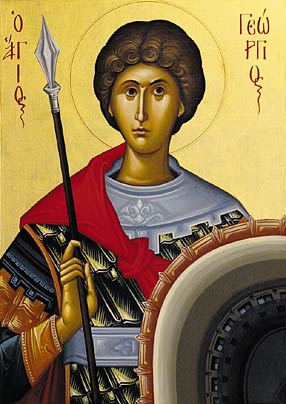
 THE FEAST OF ST GEORGE

Search This Blog

La Virgen de Guadalupe

La Virgen de Guadalupe

Followers

My Blog List

Fr David Bird

Fr David Bird
Me on a good day

Blog Archive