ABBOT PAUL'S HOMILY
Fr Abbot, Br Juan, Br Percy, Br Wilmer & Fr David (me)
Last week we witnessed the inauguration of Pope Francis and the enthronement of the Archbishop of Canterbury, the first a celebration of the universal Church, a great jamboree for all its simplicity, the second a more local and parochial affair, in spite of the native dancers and the bongos.
When Christ came into the world he became incarnate in the womb of a Virgin and was born in a stable and laid in a manger. When he came to die for our salvation, indeed to save the whole of creation, he chose a Cross for his throne, the shedding of his blood for his glorification. We should always remember that the way of Christ is the way of the Cross and that he has called each one of us to take up our cross every day and follow him.
“Jesus, remember me when you come into your kingdom.”
Only in St Luke do we find the conversation between the two criminals crucified with Jesus and his reply to the good thief, “I promise you, today you will be with me in paradise.” We call them thieves, but the Gospel simply says wrongdoers. Although most of us identify with the “good thief”, you might be surprised to learn that in many countries there is great devotion to the “bad thief”. In parts of Europe and Latin America there are even Holy Week processions in his honour and people vie with one another to carry his statue and pay for the band.
If we were honest, we would have to admit that there is as much of the bad as of the good thief in each one of us. I think of the number of times I have said or thought his very words, “If you are the Christ, save me.” It does help to acknowledge our anger and resentment, our doubt and even our hatred of God. The psalms do it all the time. God prefers us to tell him the truth when we pray, to say what we really feel and not to cover things up with pious words. Prayer is often a burden because it is false or make-believe. Yet at times, like the good thief, I have also cried out in anguish, “Jesus, remember me.”
Did you know that this is the only place in the Gospels where Jesus is addressed simply by his name? No one else calls him by his name, not even his mother. There is, of course, a special intimacy in suffering and death. That’s when we get closest to others, even to strangers.
Then again, and this is something we mistakenly take for granted, the good thief does not ask specifically to be forgiven; he only asks to be remembered.
We know that Christ came to forgive us our sins and to reconcile us with the Father by dying on a Cross. Even so, it can often be presumption to ask for forgiveness because we are not truly repentant. Yes, he does say, “We are paying for what we did,” but that is not the same as saying that he is sorry or being repentant. “Jesus, remember me when you come into your kingdom,” is one of the most perfect prayers there is. It expresses faith in Christ as Saviour, but it also leaves him completely free to do for us as he sees best. There should be no coercion in prayer, no telling God what to do, just the request to be remembered. “I promise you,” Jesus replies, “today you will be with me in paradise.”
But what did Jesus say to the bad thief? We won’t know the answer to that question until, through the merits of Christ’s Passion, we enter paradise ourselves. In the meantime we will have to take it as Gospel that there was but one answer, one promise, that day and that both wrongdoers, the good and the bad, crucified with Jesus, heard what Jesus said. There was to be no repetition of the blasphemy, only a shared agony and death. As the end came, Jesus prayed to his heavenly Father in the name of all three who died together that day, “Father, into your hands I commend my spirit,” a prayer of utter confidence and peace. On the Cross, he also prayed for you and me.

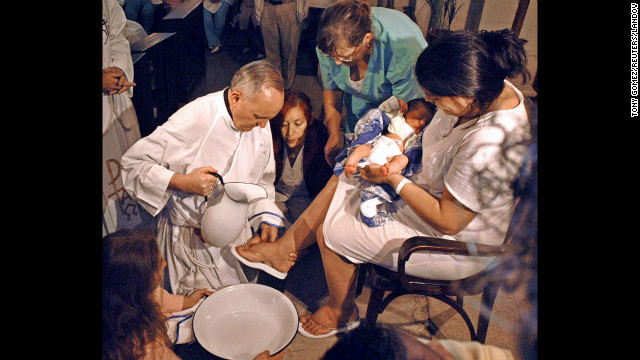
Pope Francis as Archbishop of Buenos Aires washing the feet on Maundy Thursday
From a Palm Sunday homily in 2008:
"Jesus goes out to meet people, instead of waiting for people to come looking for Him. He goes out to be encountered. Today is the day Jesus goes to be met and He enters the city. Many Christians today have also gone out, in the name of Jesus, to meet the sick in the hospitals[, etc.]…the Church spills into the street because today Jesus is the king of the street, as He was that Palm Sunday in Jerusalem. The place to worship Jesus on this day, more than a temple, is the street. There he was acclaimed, there He was blessed, there He was recognized as the Lord. Out in the street. Later, on Friday, in the corridors of power, among the groups of influence, He was bought and sold [i.e.,
His fate was debated and decided] But where the people are faithful, where the people are believing, out in the street, He was acclaimed."
For everything above, my source is [...] (photo credit:
http://catholicsensibility.wordpress.com/2013/03/14/pope-francis-on-liturgy-ii/) [...]
Palm Sunday - Liturgical Year
by Dom Prosper Gueranger
Early in the morning of this day, Jesus sets out for Jerusalem, leaving Mary His Mother, and the two sisters Martha and Mary Magdalene, and Lazarus, at Bethania. The Mother of sorrows trembles at seeing her Son thus expose Himself to danger, for His enemies are bent upon His destruction; but it is not death, it is triumph, that Jesus is to receive today in Jerusalem. The Messias, before being nailed to the gross, is to be proclaimed King by the people of the great city; the little children are to make her streets echo with their to the Son of David; and this in presence of the soldiers of Rome's emperor, and of the high priests and pharisees: the first standing under the banner of their eagles; the second, dumb with rage.
The prophet Zachary had foretold this triumph which the Son of Man was to receive a few days before His Passion, and which had been prepared for Him from all eternity. 'Rejoice greatly, O daughter of Sion! Shout for joy, O daughter of Jerusalem! Behold thy fling will come to thee; the Just and the Saviour. He is poor, and riding upon an ass, and upon a colt, the foal of an ass.'[1] Jesus, knowing that the hour has come for the fulfilment of this prophecy, singles out two from the rest of His disciples, and bids them lead to Him an ass and her colt, which they would find not far off. He has reached Bethphage, on Mount Olivet. The two disciples lose no time in executing the order given them by their divine Master; and the ass and the colt are soon brought to the place where He stands.
The holy fathers have explained to us the mystery of these two animals. The ass represents the Jewish people, which had been long under the yoke of the Law; the colt, upon which, as the evangelist says, no man yet hath sat.[2] is a figure of the Gentile world, which no one had ever yet brought into subjection. The future of these two peoples is to be decided a few days hence: the Jews will be rejected, for having refused to acknowledge Jesus as the Messias; the Gentiles will take their place, to be adopted as God's people, and become docile and faithful.
The disciples spread their garments upon the colt; and our Saviour, that the prophetic figure might be fulfilled, sits upon him,[3] and advances towards Jerusalem. As soon as it is known that Jesus is near the city, the holy Spirit works in the hearts of those Jews, who have come from all parts to celebrate the feast of the Passover. They go out to meet our Lord, holding palm branches in their hands, and fondly proclaiming Him to be King.[4] They that have accompanied Jesus from Bethania, join the enthusiastic crowd. Whilst some spread their garments on the way, others out down boughs from the palm-trees, and strew them along the road. Hosanna is the triumphant cry, proclaiming to the whole city that Jesus, the Son of David, has made His entrance as her King.
Thus did God, in His power over men's hearts, procure a triumph for His Son, and in the very city which, a few days later, was to glamour for His Blood. This day was one of glory to our Jesus, and the holy Church would have us renew, each year, the memory of this triumph of the Man-God. Shortly after the birth of our Emmanuel, we saw the Magi coming from the extreme east, and looking in Jerusalem for the King of the Jews, to whom they intended offering their gifts and their adorations: but it is Jerusalem herself that now goes forth to meet this King. Each of these events is an acknowledgment of the kingship of Jesus; the first, from the Gentiles; the second, from the Jews. Both were to pay Him this regal homage, before He suffered His Passion. The inscription to be put upon the gross, by Pilate's order, will express the kingly character of the Crucified: Jesus of Nazareth, King of the Jews. Pilate, the Roman governor, the pagan, the base coward, has been unwittingly the fulfiller of a prophecy; and when the enemies of Jesus insist on the inscription being altered, Pilate will not deign to give them any answer but this: 'What I have written, I have written.' Today, it is the Jews themselves that proclaim Jesus to be their King: they will soon be dispersed, in punishment for their revolt against the Son of David; but Jesus is King, and will be so for ever. Thus were literally verified the words spoken by the Archangel to Mary when he announced to her the glories of the Child that was to be born of her: 'The Lord God shall give unto Him the throng of David, His father; and He shall reign in the house of Jacob for ever.'[5] Jesus begins His reign upon the earth this very day; and though the first Israel is soon to disclaim His rule, a new Israel, formed from the faithful few of the old, shall rise up in every nation of the earth, and become the kingdom of Christ, a kingdom such as no mere earthly monarch ever coveted in his wildest fancies of ambition.
During the Blessing of the Palms, Pachacamac Monastery
This is the glorious mystery which ushers in the great week, the week of dolours. Holy Church would have us give this momentary consolation to our heart, and hail our Jesus as our King. She has so arranged the service of today, that it should express both joy and sorrow; joy, by uniting herself with the loyal of the city of David; and sorrow, by compassionating the Passion of her divine Spouse. The whole function is divided into three parts, which we will now proceed to explain.
The first is the blessing of the palms; and we may have an idea of its importance from the solemnity used by the Church in this saved rite. One would suppose that the holy Sacrifice has begun, and is going to be offered up in honour of Jesus' entry into Jerusalem. Introit, Collect, Epistle, Gradual, Gospel, even a Preface, are said, as though we were, as usual, preparing for the immolation of the spotless Lamb; but, after the triple the Church suspends these sacrificial formulas, and turns to the blessing of the palms. The prayers she uses for this blessing are eloquent and full of instruction and, together with the sprinkling with holy water and the incensation, impart a virtue to these branches which elevates them to the supernatural order, and makes them means for the sanctification of our souls and the protection of our persons and dwellings. The faithful should hold these palms in their hands during the procession, and during the reading of the Passion at Mass, and keep them in their homes as an outward expression of their faith, and as a pledge of God's watchful love.
It is scarcely necessary to tell our reader that the palms or olive branches, thus blessed, are carried in memory of those wherewith the people of Jerusalem strewed the road, as our Saviour made His triumphant entry; but a word on the antiquity of our ceremony will not be superfluous. It began very early in the east. It is probable that, as far as Jerusalem itself is concerned, the custom was estate. fished immediately after the ages of persecution St. Cyril, who was bishop of that city in the fourth century, tells us that the palm-tree, from which the people out the branches when they went out to meet our Saviour, was still to be seen in the vale of Cedron.[6] Such a circumstance would naturally suggest an annual commemoration of the great event. In the following century, we find this ceremony established, not only in the churches of the east, but also in the monasteries of Egypt and Syria. At the beginning of Lent, many of the holy monks obtained permission from their abbots to retire into the desert, that they might spend the saved season in strict seclusion; but they were obliged to return to their monasteries for Palm Sunday, as we learn from the life of Saint Euthymius, written by his disciple Cyril.[7] In the west, the introduction of this ceremony was more gradual; the first trace we find of it is in the sacramentary of St. Gregory, that is, at the end of the sixth, or the beginning of the seventh, century. When the faith had penetrated into the north, it was not possible to have palms or olive branches; they were supplied by branches from other trees. The beautiful prayers used in the blessing, and based on the mysteries expressed by the palm and olive trees, are still employed in the blessing of our willow, box, or other branches; and rightly, for these represent the symbolical ones which nature has denied us.
The second of today's ceremonies is the procession, which comes immediately after the blessing of the palms. It represents our Saviour's journey to Jerusalem, and His entry into the city. To make it the more expressive, the branches that have just been blessed are held in the hand during it. With the Jews, to hold a branch in one's hand was a sign of joy. The divine law had sanctioned this practice, as we read in the following passage from Leviticus, where God commands :His people to keep the feast of tabernacles: And you shall take to you, on the first day, the fruits of the fairest tree, and branches of palm-trees, and boughs of thick trees, and willows of the brook, and you shall rejoice before the Lord your God.[8] It was, therefore, to testify their delight at seeing Jesus enter within their walls, that the inhabitants, even the little children, of Jerusalem, went forth to meet Him with palms in their hands. Let us, also, go before our King, singing our to Him as the conqueror of death, and the liberator of His people.
Fr Luis and I during the procession
During the middle ages, it was the custom, in many churches, to carry the book of the holy Gospels in this procession. The Gospel contains the words of Jesus Christ, and was considered to represent Him. The procession halted at an appointed place, or station: the deacon then opened the sacred volume, and sang from it the passage which describes our Lord's entry into Jerusalem. This done, the cross which, up to this moment, was veiled, was uncovered; each of the clergy advanced towards it, venerated it, and placed at its foot a small portion of the palm he held in his hand. The procession then returned, preceded by the gross, which was left unveiled until all had re-entered the church. In England and Normandy, as far back as the eleventh century, there was practised a holy ceremony which represented, even more vividly than the one we have just been describing, the scene that was witnessed on this day at Jerusalem: the blessed Sacrament was carried in procession. The heresy of Berengarius, against the real presence of Jesus in the Eucharist, had been broached about that time; and the tribute of triumphant joy here shown to the sacred Host was a distant preparation for the feast and procession which were to be instituted at a later period.
Br Ascencio and Br Juan entering the church
A touching ceremony was also practised in Jerusalem during today's procession, and, like those just mentioned, was intended to commemorate the event related by the Gospel. The whole community of the Franciscans (to whose keeping the holy places are entrusted) went in the morning to Bethphage. There, the father guardian of the holy Land, being vested in pontifical robes, mounted upon an ass, on which garments were laid. Accompanied by the friars and the Catholics of Jerusalem, all holding palms in their hands, he entered the city, and alighted at the church of the holy sepulchre where Mass was celebrated with all possible solemnity.
We have mentioned these different usages, as we have done others on similar occasions, in order to aid the faithful to the better understanding of the several mysteries of the liturgy. In the present instance, they will learn that, in today's procession, the Church wishes us to honour Jesus Christ as though He were really among us, and were receiving the humble tribute of our loyalty. Let us lovingly go forth to meet this our King, our Saviour, who comes to visit the daughter of Sion, as the prophet has just told us. He is in our midst; it is to Him that we pay honour with our palms: let us give Him our hearts too. He comes that He may be our King; let us welcome Him as such, and fervently cry out to Him: Hosanna to the Son of David!'
At the close of the procession a ceremony takes place, which is full of the sublimes" symbolism. On returning to the church, the doors are found to be shut. The triumphant procession is stopped; but the songs of joy are continued. A hymn in honour of Christ our King is sung with its joyous chorus; and at length the subdeacon strikes the door with the staff of the cross; the door opens, and the people, preceded by the clergy, enter the church, proclaiming the praise of Him, who is our resurrection and our life.
The reading of the Passion from St Luke.
This ceremony is intended to represent the entry of Jesus into that Jerusalem of which the earthly one was but the figure-the Jerusalem of heaven, which has been opened for us by our Saviour. The sin of our first parents had shut it against us; but Jesus, the King of glory, opened its gates by His cross, to which every resistance yields. Let us, then, continue to follow in the footsteps of the Son of David, for He is also the Son of God, and He invites us to share His kingdom with Him. Thus, by the procession, which is commemorative of what happened on this day, the Church raises up our thoughts to the glorious mystery of the Ascension, whereby heaven was made the close of Jesus' mission on earth. Alas! the interval between these two triumphs of our Redeemer are not all days of joy; and no sooner is our procession over, than the Church, who had laid aside for a moment the weight of her grief, falls back into sorrow and mourning.
The third part of today's service is the offering of the holy Sacrifice. The portions that are sung by the choir are expressive of the deepest desolation; and the history of our Lord's Passion, which is now to be read by anticipation, gives to the rest of the day that character of saved gloom, which we all know so well. For the last five or six centuries, the Church has adopted a special chant for this narrative of the holy Gospel. The historian, or the evangelist, relates the events in a tone that is at once grave and pathetic; the words of our Saviour are sung to a solemn yet sweet melody, which strikingly contrasts with the high dominant of the several other interlocutors and the Jewish populace. During the singing of the Passion, the faithful should hold their palms in their hands, and, by this emblem of triumph, protest against the insults offered to Jesus by His enemies. As we listen to each humiliation and suffering, all of which were endured out of love for us, let us offer Him our palm as to our dearest Lord and King. When should we be more adoring, than when He is most suffering?
These are the leading features of this great day. According to our usual plan, we will add to the prayers and lessons any instructions that seem to be needed.
This Sunday, besides its liturgical and popular appellation of , has had several other Dames. Thus it was galled , in allusion to the acclamation wherewith the Jews greeted Jesus on His entry into Jerusalem. Our forefathers used also to gall; it , because the feast of the Pasch (or Easter), which is but eight days off, is today in bud, so to speak, and the faithful could begin from this Sunday to fulfil the precept of Easter Communion. It was in allusion to this name, that the Spaniards, having on the Palm Sunday of 1613, discovered the peninsula on the Gulf of Mexico, galled it We also find the name of given to this Sunday, because, during those times when it was the custom to defer till Holy Saturday the baptism of infants born during the preceding months (where such a delay entailed no danger), the parents used, on this day, to wash the heads of these children, out of respect to the holy chrism wherewith they were to be anointed. Later on, this Sunday was, at least in some churches, galled the , that is, of the catechumens, who were admitted to Baptism; they assembled today in the church, and received a special instruction on the symbol, which had been given to them in the previous scrutiny. In the Gothic Church of Spain, the symbol was not given till today.

The Saturday of Lazarus and Palm Sunday
my source: The Greek Orthodox Archidiocese of America
Rev. Alkiviadis C. Calivas, Th.D.
COMMENTS ON THE MAIN THEMES
The solemnities of Great Week are preceded by a two-day festival commemorating the resurrection of Lazaros and the triumphant entry of Christ into Jerusalem. These two events punctuate Christ's ministry in a most dramatic way (Jn 11. l- 12,19). By causing the final eruption of the unrelenting hostility of His enemies, who had been plotting to kill him, these two events precipitate Christ's death. At the very same time, however, these same events emphasize His divine authority. Through them Christ is revealed as the source of all life and the promised Messiah. For this reason, the interlude which separates Great Week from the Great Fast is Paschal in character. It is the harbinger of Christ's victory over death and of the inrush of His kingdom into the life of the world.
The Saturday of Lazaros is counted among the major feasts of the Church. It is celebrated with great reverence and joy. The event of the raising of Lazaros is recorded in the Gospel of John (11. 1-45). The hymnography of the feast interprets the theological significance of the event. Accordingly, the resurrection of Lazaros is viewed as a prophecy in action. It prefigures both the resurrection of Christ, as well as the general resurrection of all the dead in the end times. The hymns of the feast also emphasize the biblical truth that the resurrection as such, is more than an event. It is a person, Christ Himself, who bestows eternal life now upon all who believe in Him, and not at some obscure future time (Jn 11.25-26).
In addition, the resurrection of Lazaros occasioned the disclosure of Christ's two natures, the divine and the human. He manifested His divine power by His foreknowledge of the death of Lazaros and by the final outcome, the miracle of his resurrection. Also, in the course of the dramatic events Jesus displayed deep human emotions. The Gospel records His deep feelings of love, tenderness, sympathy and compassion, as well as distress and sadness. The narrative reports that He sighed from the heart and wept (Jn 11.5, 33, 35, 36, 38).
The Entry into Jerusalem. At the outset of His public ministry Jesus proclaimed the kingdom of God and announced that the powers of the age to come were already active in the present age (Lk 7.18-22). His words and mighty works were performed "to produce repentance as the response to His call, a call to an inward change of mind and heart which would result in concrete changes in one's life, a call to follow Him and accept His messianic destiny.
The triumphant entry of Jesus into Jerusalem is a messianic event, through which His divine authority was declared.
Palm Sunday summons us to behold our king: the Word of God made flesh. We are called to behold Him not simply as the One who came to us once riding on a colt, but as the One who is always present in His Church, coming ceaselessly to us in power and glory at every Eucharist, in every prayer and sacrament, and in every act of love, kindness and mercy. He comes to free us from all our fears and insecurities, "to take solemn possession of our soul, and to be enthroned in our heart," as someone has said. He comes not only to deliver us from our deaths by His death and resurrection, but also to make us capable of attaining the most perfect fellowship or union with Him. He is the king, who liberates us from the darkness of sin and the bondage of death. Palm Sunday summons us to behold our king: the vanquisher of death and the giver of life.
Palm Sunday summons us to accept both the rule and the kingdom of God as the goal and content of our Christian life. We draw our identity from Christ and His kingdom. The kingdom is Christ - His indescribable power, boundless mercy and incomprehensible abundance given freely to man. The kingdom does not lie at some point or place in the distant future. In the words of the Scripture, the kingdom of God is not only at hand (Mt 3.2; 4.17), it is within us (Lk 17.21). The kingdom is a present reality as well as a future realization (Mt 6.10). Theophan the Recluse wrote the following words about the inward rule of Christ the King:
The Kingdom of God is within us when God reigns in us, when the soul in its depths confesses God as its Master, and is obedient to Him in all its powers. Then God acts within it as master "both to will and to do of his good pleasure" (Phil 2.13). This reign begins as soon as we resolve to serve God in our Lord Jesus Christ, by the grace of the Holy Spirit. Then the Christian hands over to God his consciousness and freedom, which comprises the essential substance of our human life, and God accepts the sacrifice; and in this way the alliance of man with God and God with man is achieved, and the covenant with God, which was severed by the Fall and continues to be severed by our wilful sins, is re-established.
The kingdom of God is the life of the Holy Trinity in the world. It is the kingdom of holiness, goodness, truth, beauty, love, peace and joy. These qualities are not works of the human spirit. They proceed from the life of God and reveal God. Christ Himself is the kingdom. He is the God-Man, Who brought God down to earth (Jn 1.1,14). “He was in the world, and the world was made through Him, yet the world knew Him not. He came to His own home, and His own people received Him not” (Jn 1.10-11). He was reviled and hated.
Palm Sunday summons us to behold our king - the Suffering Servant. We cannot understand Jesus' kingship apart from the Passion. Filled with infinite love for the Father and the Holy Spirit, and for creation, in His inexpressible humility Jesus accepted the infinite abasement of the cross. He bore our griefs and carried our sorrows; He was wounded for our transgressions and made Himself an offering for sin (Is 53). His glorification which was accomplished by the resurrection and the ascension was achieved through the cross.
In the fleeting moments of exhuberance that marked Jesus' triumphal entry into Jerusalem, the world received its King. The king who was on His way to death. His passion, however, was no morbid desire for martyrdom. Jesus' purpose was to accomplish the mission for which the Father sent Him.
The Son and Word of the Father, like Him without beginning and eternal, has come today to the city of Jerusalem, seated on a dumb beast, on a foal. From fear the cherubim dare not gaze upon Him; yet the children honor Him with palms and branches, and mystically they sing a hymn of praise: "Hosanna in the highest, Hosanna to the Son of David, who has come to save from error all mankind." (A hymn of the Light.)
With our souls cleansed and in spirit carrying branches, with faith let us sing Christ's praises like the children, crying with a loud voice to the Master: Blessed art Thou, O Savior, who hast come into the world to save Adam from the ancient curse; and in Thy love for mankind Thou hast been pleased to become spiritually the new Adam. O Word, who hast ordered all things for our good, glory to Thee. (A Sessional hymn of the Orthros)
GENERAL OBSERVATIONS
Vestments - The Saturday of Lazaros and Palm Sunday are joyous festivals. Therefore, the priest wears festive vestments (white, gold, or green). The Holy Table is also adorned with a bright cover.
Palm Branches - The priest should make certain that a sufficient number of palm or some other suitable branches are available for the decoration of the Church and for distribution to the faithful, in accordance with local custom and tradition. It is customary to weave the palm branches into small crosses. The priest may assign this task to a group of parishioners. In some places, the faithful bring their own palms or some similar boughs or branches to the Church.
The priest may choose to have a few acolytes hold palm branches during the two Entrances of the Divine Liturgy. At one time the Church held a procession on Palm Sunday. This tradition has fallen into disuse, except in the churches of the Patriarchate of Antioch. In the Antiochene tradition a procession of the faithful takes place after the Divine Liturgy. An emphasis is placed on the participation of children. The roots of this tradition are to be found in the ancient rites of the Jerusalem Church.
The Blessing and Distribution of the Palms - A basket containing the woven palm crosses is placed on a table in front of the icon of the Lord which is on the Iconostasion.
The prayer for the blessing of the Palms is found in the 'Ieratikon or the Euxologion According to the rubrics of the Typikon, this prayer is read at the Orthros just before the Psalms of Praise (Ainoi). The palms are then distributed to the faithful.
In many places today, the prayer is said at the conclusion of the Divine Liturgy, before the apolysis. The text of the prayer, however, indicates clearly that it is less a prayer for the blessing of the palms, even though that is its title, and more a blessing upon those, who in imitation of the New Testament event hold palms in their hands as symbols of Christ's victory and as signs of a virtuous Christian life. It appears then, that it would be more correct to have the faithful hold the palms in their hands during the course of the Divine Liturgy when the Church celebrates both the presence and the coming of the Lord in the mystery of the Eucharist. The palms, therefore, should be distributed before the celebration of the Divine Liturgy.
The Icon - On each day we display the appropriate icon of the feast for veneration.
A Folk Tradition - An interesting sidelight is the folk tradition related to the Saturday of Lazaros. In many places groups of children visit neighboring homes to sing the Carols of Lazaros. In return, the people of the house give the children fresh eggs. The children bring the eggs to their homes. On Great Thursday the eggs are boiled in the traditional red dye for the Paschal celebration.
Fasting - By custom and tradition fish as well as oil and wine are permitted on the Saturday of Lazaros and Palm Sunday.
The Apodosis of Palm Sunday - takes place on the same day in the late afternoon with the celebration of the Vesper Service. The service is conducted in accordance with the order in the Triodion. In current usage, however, few parishes conduct this service. It has fallen into disuse.
Removal of the Palms - The palms are removed from the Church at the conclusion of the Vesper Service of the Apodosis of the Feast, or in the late afternoon Palm Sunday.
The Orthros of Great Monday - On Palm Sunday night we observe the beginning of the reversed order of the services, which was noted above. The Orthros of Great Monday is celebrated on Palm Sunday night.
POPE BENEDICT XVI AND POPE FRANCIS
We only have to look at the two popes ,to see how they behave, how they dress, to listen to what they say, to realise that they are very different. However, I am going to argue in a separate post, after Easter, that they are complementary.
I do believe that Pope Francis would be opposed to the the version of Pope Benedict that many conservatives formed for themselves. They put great emphasis on some of his actions and words, while ignoring others. As with Vatican II, the media have been no great help: they have looked at him through secular spectacles and usually cannot understand him themselves. Their categories really make no sense within a papal context. Moreover the words "conservative" and "liberal" are unhelpful to describe either pope. They both uphold Catholic Tradition, which is their job. There was not a cat's chance in hell of the cardinals electing anyone who had chosen secular values over Catholic ones, any more than they would have elected a Buddhist.
Of course, the two popes come from different backgrounds, had radically different experiences, and were formed by different cultures.
One comes from southern Germany where, before the Council, there were wonderful Masses on feastdays, with music by Mozart and other classical composers. The people knew the music and anticipated with pleasure every tune. He saw this idyllic scene being invaded by guitar-wielding visigoths and was horrified
Pope Francis, on the other hand, has celebrated among people living in extreme poverty, whose main instrument is the guitar, where the sacred and the secular mix and are at ease with each other, and where the people have taken the new Mass to themselves, and where it is celebrated with the same exuberance as Masses were celebrated among the ordinary folk in the Middle Ages.
In fact, the Mass that is celebrated in Latin, as exact a replica as possible of the old Mass, where the Epistle is read in Latin by someone with his back to the people, where the priests act exactly the same whether there are people present or not, where the people receive their spiritual food from anything but the texts of the Mass,- that kind of Mass is an expression of the manuel theology that people like Joseph Ratzinger, Yves Congar, Hans Urs Von Balthazar and de Lubac attacked. It reflects a view of the relationship between the sacred and the natural world as between two completely separate realities. They believe in what Father Stephen calls a "two-storey universe". The more cut off from ordinary life, the more sacred the Mass becomes. The more integrated with ordinary life, the more profane it becomes.
Actually, those who believed that Vatican II wanted to adapt to "modern man" by eliminating all transcendence from the liturgy, all awe at God's presence, and to emphasise relationships with each other in this world, belong to the same mental context as those who want to free the secular world from all religious influence, and as those who celebrate the Latin Mass described above. Both sides agree that the sacred cannot be discovered in the ordinary. One leaves the ordinary and celebrates Mass as though the ordinary does not exist. The other stays in the ordinary and celebrates the Mass as though the sacred does not exist. They take opposite positions within the same world view.
Neither Pope Benedict nor Pope Francis belong to these two positions,. Both believe in what Father Stephen calls a "one-storey universe", in which heaven and earth are one in Christ, and we rub shoulders with the angels.
Pope Benedict belonged to the group inspired by the French "theologie nouvelle" in the Council that played a major part in writing the Vatican II documents, and shows every sign that he still does. Archbishop Wojtyla also attached himself to it at the Council. One of its central tenets is that"Nature" is created by God to be divinised by Grace, and thus there is a human need of God and a natural sense of the sacred. Modern man is often secular because he is starved of this experience of the sacred which is a basis for supernatural religious experience. This sense of the sacred must be fostered in the Liturgy; but, in order for this to happen, liturgy must be opened up so that ordinary people can participate in it. This group believed in liturgical reform, as does Pope Benedict. However, to their horror, the new Mass was being celebrated with all sense of the sacred stripped from it. AS they believed the sense of the sacred to be absolutely central to any revival of faith in Europe, they were not surprised when people left the Church in droves and adopted secular attitudes. Pope Benedict strove to so celebrate the new Mass that people would realise they were in the presence of God. He knew that this is what the Council fathers wanted. .
Pope Francis comes from a country where the faith is still very much alive and people have a great sense of the sacred. His priorities have been social injustice and poverty. He is much more confident that a sense of the sacred can be fostered in the Mass as it is. As a traditional Jesuit who believes that every moment is filled with God, wherever you are, whatever you are doing, he does not agree that there is a separation between the sacred and the profane. In reality, the profane is an illusion: the only profanity is sin. Christ is the king of the street, secular state or not. Our job is to make Christ visible and to help people recognise his presence and to respond, by any means possible.
Fundamentally both Popes have the same vision of Christ's presence in the world. They have different tastes, different methods of responding to that presence which reflect their different backgrounds. Neither can replace the other: both have their special gifts; but both have been involved in the same basic task. They complement each other. This will not be evident to those who believe the sacred and the commonplace must be kept apart , whether they are conservatives who celebrate a "sacred" liturgy, or liberals who celebrate a "commonplace" one. Both these groups have forgotten that nature and supernature, grace and human effort, Christ and the Christian are distinct but are made for each other, the divine filling the human and enabling the human person to fulfil his or her destiny as a son or daughter of God in Christ. Thus their judgement is superficial, and see the differences between the two popes as opposition rather than a source of enrichment.

The Icon of Mary that Pope Francis Gave as a Gift to Emeritus Pope Benedict Today Was... a Russian Icon
my source: Irenikon
March 23, 2013, Saturday --
"We are brothers"... in humility
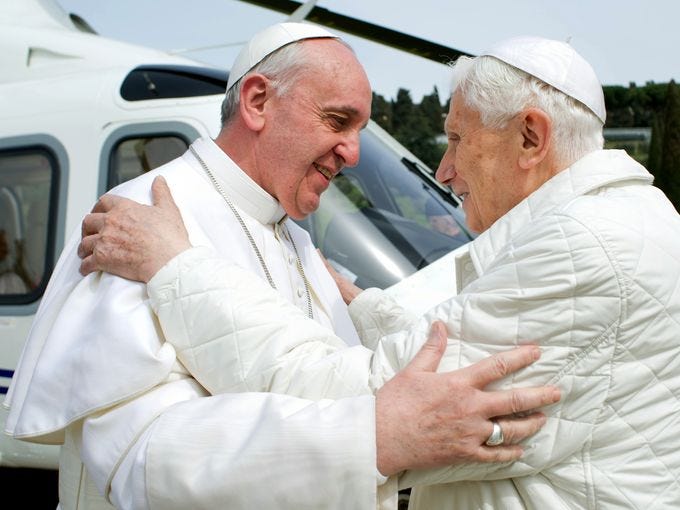
The present and former Pope met today, in a moment without precedent. And the words which remain are the ones spoken by Pope Francis to Benedict: "We are brothers."
As Nicole Winfield put it in her comprehensive Associated Press dispatch today: "The two men in white embraced and showed one another the deference owed a Pope in ways that surely turned Vatican protocol upside down: A reigning Pope telling a retired one, 'We are brothers,' and insisting that they pray side-by-side during a date to discuss the future of the Catholic Church."
In the same report, she noted: "Francis also brought a gift for Benedict, an icon of the Madonna. 'They told me it's the Madonna of Humility,' Francis told Benedict. 'Let me say one thing: When they told me that, I immediately thought of you, at the many marvelous examples of humility and gentleness that you gave us during your pontificate.' Benedict replied: 'Grazie, grazie.'"
But who were the "they" who told Francis that the icon was the Madonna of Humility?
"They" were... the people who gave the icon to him. But who were those people?
Well... they were representatives of the Patriarch of the Russian Orthodox Church, who sent the icon to Pope Francis as a gift, and who handed it to Francis three days ago, on March 20.
How do I know this?
Because a few minutes ago I received an unexpected email from Metropolitan Hilarion, 46, an old friend who is also the "Foreign Minister" (the term isn't quite accurate, but it suggests the importance of his work and position) of the Russian Orthodox Church's Moscow Patriarchate, so, the right-hand of Patriarch Kirill. He wrote:
"Pope Francis presented to Pope emeritus Benedict the icon which had been presented to Pope Francis by Metropolitan Hilarion on behalf of Patriarch Kirill [the head of the Russian Orthodox Church] after the private audience [with the new Pope] on 20 March. Watch this video: http://www.youtube.com/watch?v=9aylAmChAaY Отправлено с iPhone [Sent from iPhone]"
So the icon was the Russian icon Hilarion gave to Francis three days ago!
I wrote back: "Amazing. Are you pleased, or upset?"
I added: "It is reported here: 'They spent 45 minutes talking alone. Pope Francis gave Pope Benedict an icon of Our Lady of Humility, saying that when he received it, he immediately thought of giving it to Pope Benedict.'"
Hilarion wrote back: "Very pleased and touched."
Now, what does all this mean?
Well, it means that at the moment Pope Francis and Pope Benedict first met, at the first meeting ever of the "two Popes" of the Roman Catholic Church, there was a "Russian connection" and an "Orthodox connection" which was present, which was between them, joining them: an image of the Virgin Mary, the Madonna of Humility, brought from Russia and given to Pope Francis in Rome on March 20, an image which immediately struck Pope Francis when he received it as reminding him of Benedict, an image which he decided to bring with him today, to give to Emeritus Pope Benedict, on the occasion of the unprecedented, historic occasion, of their first meeting.
Others may find further elements in this bit of news to reflect upon. To me, it suggests that Mary, Mother of the Church, is watching over the Church, in these difficult and dangerous times, and acting as a mother even to these two men, Benedict and Francis, bringing them together.
I sense in this a mysterious design, yes, a mystical design, something transcending our ordinary understanding of cause and effect, a design, as I see it, for Christians, for the Christian Church, to return to greater communion, greater unity, East and West, Greek and Latin, Orthodox and Catholic -- with one of the great "hinge points" being... Russia.
The Madonna of Humility... it is precisely humility that brings these two Popes together. One very simple and humble, the other very simple and humble. One dedicated to a life of thought, to theology, the other dedicated to a life of action, to pastoral care of the poor.
And the way to proceed forward toward greater Christian unity is this same way, the way of Mary, the way of humility.
In the homily at the Mass on March 19 for his installation, Pope Francis concluded with these words, asking specifically for Mary's intercession:
"To protect Jesus with Mary, to protect the whole of creation, to protect each person, especially the poorest, to protect ourselves: this is a service that the Bishop of Rome is called to carry out, yet one to which all of us are called, so that the star of hope will shine brightly. Let us protect with love all that God has given us!
"I implore the intercession of the Virgin Mary, Saint Joseph, Saints Peter and Paul, and Saint Francis, that the Holy Spirit may accompany my ministry, and I ask all of you to pray for me! Amen."
"Think nothing else but that God ordains all, and where there is no love, put love, and you will draw love out." --St. John of the Cross
(More videos will be placed here as the opportunity permits)








 Posts
Posts

