EXPAND YOUR READING!!

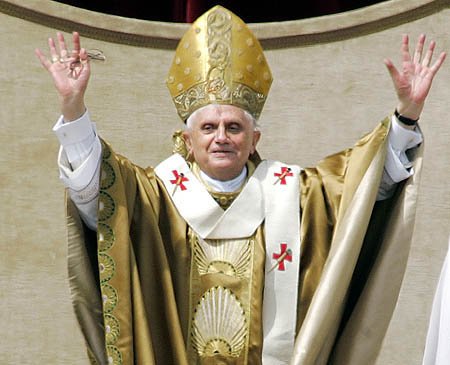
"Today the concept of truth is viewed with suspicion, because truth is identified with violence. Over history there have, unfortunately, been episodes when people sought to defend the truth with violence. But they are two contrasting realities. Truth cannot be imposed with means other than itself! Truth can only come with its own light. Yet, we need truth. ... Without truth we are blind in the world, we have no path to follow. The great gift of Christ was that He enabled us to see the face of God".Pope Benedict xvi, February 24th, 2012

The Church is ecumenical, catholic, God-human, ageless, and it is therefore a blasphemy—an unpardonable blasphemy against Christ and against the Holy Ghost—to turn the Church into a national institution, to narrow her down to petty, transient, time-bound aspirations and ways of doing things. Her purpose is beyond nationality, ecumenical, all-embracing: to unite all men in Christ, all without exception to nation or race or social strata. - St Justin Popovitch

Tuesday, 29 June 2010

Abbot Paul,s Homily for SS P?eter and Paul


Saints Peter and Paul 2010

“You are the Christ, the Son of the living God.” When Jesus asked his disciples who they thought he was, in other words, what they believed about him, this was the answer that Peter gave, speaking in the name of all twelve. For two thousand years this has been and has remained the very core of the apostolic faith, the faith of the Church. It was on the basis of this very first proclamation of the Christian faith that Jesus said to Peter, again speaking to all twelve apostles, “You are Peter and on this rock I will build my Church.” The Church, of course, is not a building but a community, a community of faith in communion with the faith of the apostles. Now St Paul tells us that the Church is the Body of Christ made up of living stones.

You, Br. Stanislaus and Br. Jonathan, are two of those living stones that make up the Body of Christ, and that is why the Lord Jesus has called you to become monks and to make your first monastic profession this morning, on the feast of Saints Peter and Paul. Only someone who really believes that Jesus is the Christ, the Son of the living God, can ask for God’s merciful love and to share in the monastic way of life as members of this Benedictine community. Just as faith gives meaning to the monastic life, so it is the living out of our monastic vocation that begins to give meaning and depth to our Christian faith.

From the very beginnings of the monastic way of life in the deserts of Egypt, Palestine and Syria, monks and nuns believed that they were following the example of Jesus’ disciples and of the early Church in Jerusalem. By focusing on a disciplined life of prayer and penance, meditating on the Scriptures, working with their hands to provide the few essentials needed to keep body and soul together, having all things in common and remaining faithful to the teaching of the apostles, they came to see themselves and their monasteries as rocks on which Christ could rebuild his Church in times of persecution or whenever Christians were tempted to become lax and easy-going in their following of Christ. In no way and at no time did they believe that they were founding some sort of alternative Church, but rather that they had been led by the Holy Spirit to discover a new and exciting way of life, the Angelic Way, the Apostolic Way, the Coenobitic Way, the monastic way, in which to follow Christ faithfully at the very heart of the Church. We see this to be St Benedict’s vision of the monastic life in the “little Rule for Beginners” that he wrote for our observance.

The three vows we take as Benedictines prove the point. Obedience is the first and fundamental Christian vow, the basis for everything else, and the vow all Christians hold in common. To obey is to listen, to listen with the ears of the heart and to open our hearts to the word of life, the word of God, which transforms and moulds us so that we conform ever more to Christ, “who was obedient even unto death, death on a cross.” We long to become more and more like Christ every day. Through obedience God’s “will is done on earth as it is in heaven.” Through obedience we are united with Christ and in the Holy Spirit to God and to each other. It is obedience that builds up the Body of Christ and keeps it whole, keeps it one.

Stability is not the promise to stay put in one place, but rather to become rooted in Christ, in the Gospel, in the Church and in the monastic community of our profession. It expresses the hope, the desire to become that rock upon which Christ can build his Church, not apart from or in competition to the hierarchic Church of Pope and bishops, but rather as a support and buttress, less institutional and more charismatic, but in the true, traditional sense of that much misused word. Monastic vows to do not shackle us to a legalistic maze of bygone restriction, that lead to a senseless enslavement to false tradition. No, the vow of stability, that binds us to Christ and to each other, should lead us to the freedom and happiness of the sons of God, who are both disciples of Jesus and temples of the Holy Spirit.

Conversatio morum, the third vow, is not easily translatable but means essentially “all that the monastic life entails” or “all that the Rule of St Benedict suggests”. Here you could throw in chastity, a very important aspect of our lives, and poverty, though we prefer to talk about austerity and simplicity. This is the vow which says, with St Peter and St Paul, I place all my hope and trust in God: he will see me through, he will look after me. St Paul, writing to Timothy, said, “The Lord will rescue me and bring me safely to his heavenly kingdom.” And St Peter in the Acts of the Apostles, confessed, “Now I know it is all true. The Lord really did send his angel and has saved me.” On another occasion St Peter said, “Lord, to whom shall we go? You alone have the message of eternal life,” thus expressing the fidelity and perseverance of the disciples. Conversatio morum keeps us faithful to Christ and to the magisterium of the Church and reminds us that humility and moderation, the mother of all virtues, are those human qualities as well as Christian virtues that we should be cultivating as we dedicate ourselves each day to the “ora et labora” of life at Belmont.

Br. Stanislaus and Br. Jonathan, as you make your First Profession, remember that you are supported by the prayers of your community and of your family and friends. We will always be there for you, with our love and affection, as you progress in the monastic life and as you become more and more what God has created and called you to be. May the intercession of Our Lady and St Benedict, as well as of St Peter and St Paul and your patron saints, keep you true to your vows and may you discover, as members of the Belmont Community, the indescribable joys that God gives us in the monastic life. Amen.

Sunday, 6 June 2010

CORPUS CHRISTI the Abbot.s Homily at Belmont 2010


“When we eat this bread and drink this cup, we proclaim your death, Lord Jesus, until you come in glory.” We often proclaim these words, based on the text we read this morning from First Corinthians, at the Elevation of the Mass, when we adore the Real Presence of Christ in the Blessed Sacrament and so recognise our Risen Lord in the Breaking of Bread. From the very beginnings of Christianity and the Christian Church, from the Upper Room where Jesus celebrated the Last Supper with his disciples to the Cenacle where, together with Our Lady, they received the gift of the Holy Spirit, our fathers and mothers in the faith have believed without doubting in the word spoken by the Lord and in its power, the power of grace, to bring about what it says, as in the beginning of creation God had said, “Let there be light”, and there was light. This is the faith of the Church today. This is our faith. When Jesus says during the Mass, “This is my body, which is given for you,” and “This is the cup of my blood, which is shed for you,” we know that his word is true and what he says he does.
But it is not only in the Real Presence that Christians believe, for Jesus asks us to “do this as a memorial of me”. The Mass, the Eucharist, is a memorial of the whole life of Christ from the moment of his coming from the Father by the working of the Holy Spirit to the moment of his return to the Father and the outpouring of the same Spirit. In other words, the Mass is a commemoration and a celebration of the Incarnation and of the fruits of the Sacrifice of the Word made flesh. What is more, we anticipate and pray for his Second Coming as Judge of the living and the dead.
When we talk about the Sacrifice of the Mass, we naturally think of Christ’s Passion, Crucifixion and Death, and, of course, in the Mass in a very powerful way we are totally immersed in the Cross of Jesus, in that aspect of his sacrifice, but the whole of his life is sacrificial, for in him all things are made new, all things are made holy. And so it is that in the Mass we celebrate the whole of the Mystery of the Incarnation, the whole Christ event: his Conception in the Virgin’s womb, his Nativity in the cave of Bethlehem and his lying in the manger, his Circumcision and first shedding of the Precious Blood for our redeeming, and so on. Every moment and aspect of the life of Jesus is Sacrifice, including his Resurrection. It is Christ in his fullness whom we celebrate and whom we receive at Mass for in the Son we celebrate and receive the Father and the Holy Spirit. God though three persons is but One and in communion with Christ we are united to the Holy Trinity.
These are mind-blowing thoughts, not easy to grasp, yet nothing could be simpler. God is pure and utter simplicity. It is human sinfulness that has complicated things often beyond our ability to believe and understand. But there is something more. In today’s Gospel we read St Luke’s paired down version of the feeding of the five thousand. For one thing there’s no small boy to bring forward the five loaves and two fish, one of the loveliest images in the Gospels. Even so, with this small offering, Jesus is able to feed the multitude and there is an abundance of scraps left over, enough to fill twelve baskets. Leaving aside any possible numerical symbolism, with the humblest of gifts Jesus is able to feed a vast number of people and there’s a lot left to share with others. Like the manna in the wilderness, the food with which Jesus feeds us just does not run out. He who created all that exists out of nothing can feed the hungry and nourish our souls. However, as with the widow’s mite, he does appreciate the little we can give, especially if it is given with a loving and generous heart. At Mass we give him bread and wine and receive in return his Body and Blood. What an extraordinary exchange of gifts!
Now, as we all know, it is not the amount of food you eat that matters, in fact overeating or eating the wrong things can kill you. With the smallest amount of wholesome and nourishing food you can lead a healthy life. Even the smallest crumb of Christ’s body and the tiniest drop of his blood suffice for us to receive the whole Christ and in the Son the Father and the Holy Spirit.
In his wonderful book “The Shape of the Liturgy”, written so many years ago, Dom Gregory Dix said, “Was ever another command so obeyed? For century after century, spreading slowly to every continent and country and among every race on earth, this action has been done, in every conceivable human circumstance, for every conceivable human need from infancy and before it to extreme old age and after it, from the pinnacles of earthly greatness to the refuge of fugitives in the caves and dens of the earth. Men have found no better thing than this to do for kings at their crowning and for criminals going to the scaffold; for armies in triumph or for a bride and groom in a little country church; for the proclamation of a dogma or for a good crop of wheat; for the wisdom of the parliament of a mighty nation or for a sick old woman afraid to die; for a schoolboy sitting an examination or for Columbus setting out to discover America; for the famine of whole provinces or for the soul of a dead loved one; - one could fill many pages with the reasons why men have done this, and not tell a hundredth part of them. And best of all, week by week and month by month, on a hundred thousand successive Sundays, faithfully, unfailingly, across all the parishes of Christendom, priests have done just this to make holy the people of God.”
Today we give thanks to God for the Sacrament that makes us holy and we thank him for the immense privilege of celebrating the holy sacrifice of the Mass together for our salvation and for the salvation of all those whose hearts we touch in prayer. Amen

Search This Blog

La Virgen de Guadalupe

La Virgen de Guadalupe

Followers

My Blog List

Fr David Bird

Fr David Bird
Me on a good day

Blog Archive