
How precious is the gift of the cross! See, how beautiful it is to behold!…It is a tree which brings forth life, not death. It is the source of light, not darkness. It offers you a home in Eden. It does not cast you out. It is the tree which Christ mounted as a king his chariot, and so destroyed the devil, the lord of death, and rescued the human race from slavery to the tyrant. It is the tree on which the Lord, like a great warrior with his hands and feet and his divine side pierced in battle, healed the wounds of our sins, healed our nature that had been wounded by the evil serpent. Of old we were poisoned by a tree; now we have found immortality through a tree.
…By the cross death was killed and Adam restored to life. In the cross every apostle has gloried; by it every martyr has been crowned and every saint made holy. We have put on the cross of Christ, and laid aside the old man. Through the cross, we have joined Christ’s flock, and are granted a place in the sheepfold of heaven.” (St Theodore the Studite)
The Way to Joy? Take Up Your Cross
by Fr. Ted
“The kingdom of God cannot be imposed; if it is to be brought about we must be born again, and that supposes complete freedom of spirit. Christianity is the religion of the Cross, and it sees a meaning in suffering. Christ asks us to take up our own cross and carry it, to shoulder the load of a sinful world. In Christian consciousness the notion of attaining happiness, justice, and the kingdom of God on earth without cross or suffering is a huge lie: it is the temptation that Christ rejected in the wilderness when he was shown the kingdoms of the world and invited to fall down and worship. Christianity does not promise its own necessary realization and victory here below; Christ even questioned whether he will find any faith on earth when he comes again at the end of time, and foretold that love itself will have grown cold.
Tolstoy believed that Christ’s commands could be easily fulfilled simply by recognizing their truth. But that was a mistake of his over-rationalizing consciousness; the mysteries of freedom and of grace were beyond him, his optimism contradicted the tragic depths of life. “The good which I will I do not,” says the apostle Paul, “but the evil which I will not, that I do. Now if I do that which I will not it is no more I that do it, but sin that dwelleth in me.” This testimony of one of the greatest of all Christians unveils the innermost part of the human heart, and it teaches us that the “failure of Christianity” is a human failure and not a divine defeat.”
(Nicholas Berdiaev, Tradition Alive, pp. 96-97)
Russian Orthodox Chant (bass)
Thy Cross
Patriarch of Moscow celebrates
Cross-Bowing Sunday
The Patriarch of Antioch on Cross
Adoration Sunday
HOMILY FOR LAETARE SUNDAY, YEAR B
by Father Brendan at Belmont Abbey, HerefordNicodemus & Michelangelo

In 1498 a French Benedictine Cardinal commissioned a young sculptor, to create “the most beautiful work of marble in Rome, one that no living artist could better.” That would be quite a challenge but not for the confident and brilliant 24-year-old Michelangelo. The people rushed to marvel at his masterpiece, the infinitely tender Pietà. How did he create such beauty? How could a man so young chisel hard stone into the soft and supple skin of Christ’s body held gently in his mother’s arms? A mother’s love to the end.
Michelangelo enjoyed a long and successful life. Fast forward 50 years and we find the devout 70-year-old artist working furiously through the night on one of his last great sculptures, with a just single candle to illuminate his work. But this was not a for a commission. This was an intensely personal work of faith and devotion. The old Michelangelo was working on another Pietà, that would stand over his own tomb.
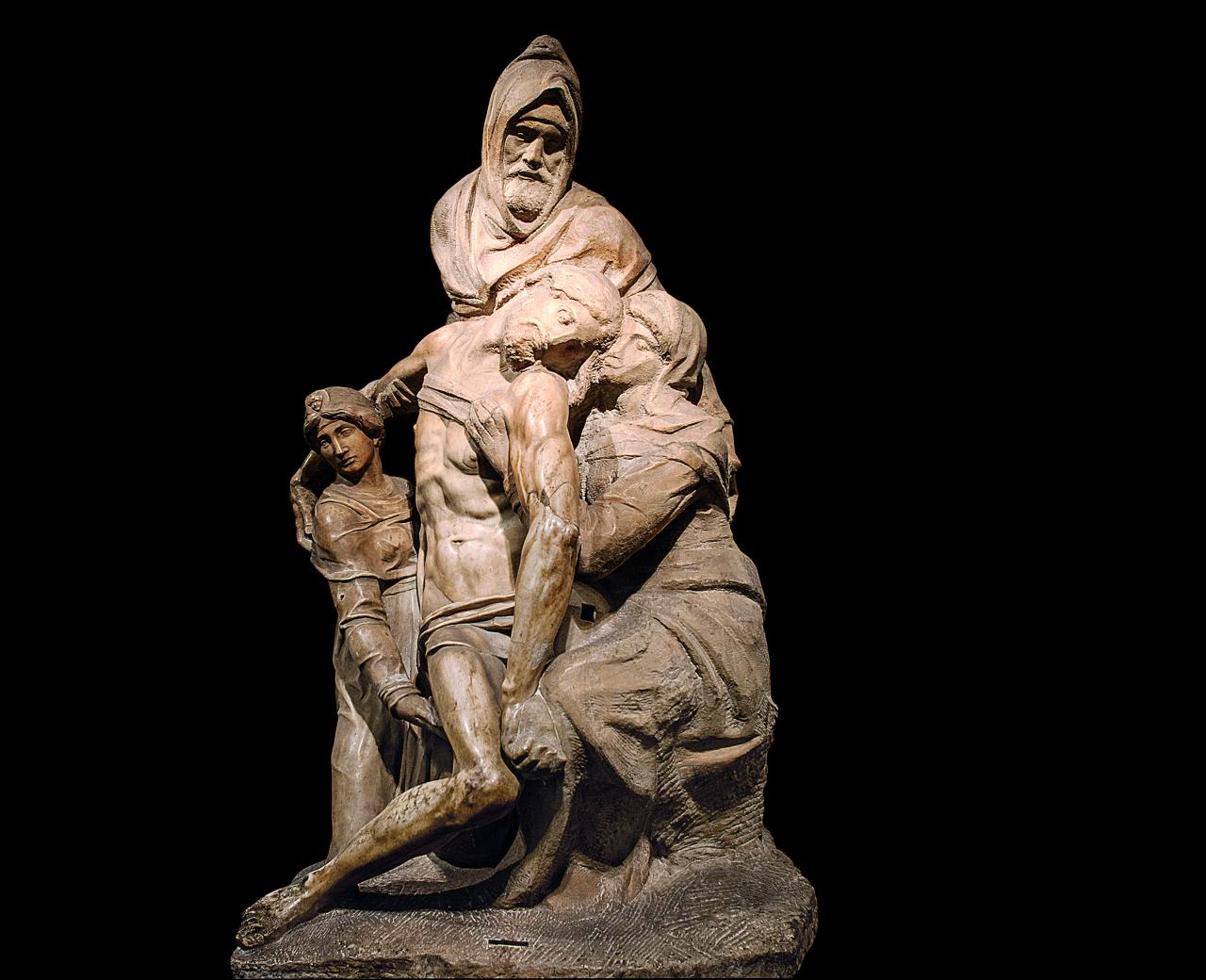
This Pietà (now in Florence) was different. Now it is not the Virgin Mary who holds up the body of the dead Christ. In her place is an old man, a tall hooded figure with a broken nose. Not Mary, but Nicodemus. What’s more, Michelangelo gives Nicodemus his own features. It is a moving self-portrait of Nicodemus-Michelangelo holding on to the Body of Christ.
Nicodemus is an intriguing man. We meet him first in the 3rd Chapter of John’s Gospel described as a Pharisee, a Jewish leader. Very tellingly the Gospel says he came to Jesus “by night.” Note those references to light and darkness in today’s Gospel. He came to Jesus on the sly, he wanted to play it safe, so he waited until his neighbours were tucked up in their beds before slipping over to question Jesus. An admirer, but a secret one, perhaps like many today who are cautious to admit their faith because in some quarters it is socially unacceptable. Perhaps that is why Michelangelo portrays Nicodemus as a hooded figure, a man who does not want to come out into the daylight with his faith.
Today we listen-in to the tail-end of their conversation. Jesus had said to him something rather perplexing. It boils down to this: unless you are born again, you might as well give up. That is all very well, says Nicodemus, but how are we supposed to manage that. How is an old man to be born again when it is something just to get out of bed in the morning? But Jesus tells him it is not something that we do, it is what the Spirit does. Like the wind rushing down the chimney that causes dying embers to burst into flame. Being born again is like that. And that is when Jesus says that the sign that is to be given, of the Son of Man lifted high on the cross, is a sign of love that is so creative that it brings to new life, to a new and imperishable eternity, those who believe.

Jesus speaks of the Son of Man being ‘lifted up.’ It is a clever play on words that points to Good Friday but also to Easter. The Greek verb means both to ‘lift up’ or ‘to raise’ as if raising the wood of the Cross (Good Friday, if you like); but it also means ‘to lift up’ in the sense of ‘to exalt’ or ‘to glorify. (Easter Sunday, if you like).’ Through the Cross, the power of death is overthrown. A symbol of shame becomes a revelation of divine love – that God so loved the world. IT is why we delight in marking ourselves with the sign of the cross, because we have come to believe in God’s love, revealed on that glorious tree. God so loved the world. I often quote Dame Julian of Norwich. “Love was his meaning before ever he made us, he loved us, and always will.”
This homily could stop there, because what more needs be said? But like Nicodemus we often linger in the shadows, fail to absorb this love, live lives that far from reflecting it, fail to live in the light. “Let everything be done in the light” says St Benedict (RB 41:9).
But it is beautiful to Nicodemus go on a journey of faith. In Chapter 3 his story seems to fizzle out, and the last words we hear from him is the question “How can it be?” He remains in the shadows. He reappears in Chapter 7, this time he speaks up for Jesus in public. And finally, we meet him at the Cross, where he takes the body of Jesus for burial. No longer a figure of the night, he now pays his respects in broad daylight. It is a crazy thing to do with the witch-hunt going on, but he decided that it was more than worth it. He must “live by the truth.”
He takes the body of Jesus and wraps it in linen cloths with myrrh and aloes. A hundred Roman pounds of myrrh and aloes. Mary of Bethany had shown her love with just a pound of costly perfume and the house was filled with fragrance. Nicodemus arrives with 33 kilograms! How the scent of myrrh and aloes must have met Mary Magdalene on the Easter Morning, a hundred pounds of love and affection lavished by Nicodemus. This is a royal burial. Nicodemus, the tentative believer, had come by night, but at the foot of the cross he is born from above and lavishes love on the body of Jesus and lays it in the grave ready for the light of Resurrection. Nicodemus had preferred the darkness but was drawn towards the light, and had that Easter faith.
Michelangelo too had been on a journey of faith. He had produced immortal works:- the David, Moses, the Pietà, the Sistine Chapel. He had left people amazed, breathless. Yet at the end of his life, he had come to see that even these masterpieces – in the light of eternity – were like incomplete words. “I am barely beginning to babble,” he said. And most of all he saw that the beauty of his art was but a pale reflection of the source of all beauty, “the fount of mercy whence we all exist,” God himself. While he was working on the Florentine Pietà (c. 1547–1555) he wrote: (Poem 285, 1552-54):
The voyage of my life, at last, has reached, across a stormy sea, in a fragile boat, the common port all must pass through…Neither painting nor sculpture will be able any longer to calm my soul, now turned toward that Divine Love that opened His arms on the cross to take us in.
There is an old Christian tradition that Nicodemus was himself a sculptor, just as St Luke was an artist. No surprise that Michelangelo would identify himself as Nicodemus in this Pietà of his old age. As he worked frantically at night by the light of just a single candle, this was not any old sculpture. He seems to be carving a prayer for his own grave that he too, this old man, this sometimes proud, arrogant, tetchy and difficult man, would be born again like Nicodemus. That he too would come into the light. Have that Easter faith.
He prays that the Nicodemus-Michelangelo, who holds the body of Christ in his hands will experience a rebirth. It is a prayer we can make our own today as we hold the Body of Christ in our hands, as we eat the bread of life, the food of rebirth, of renaissance, of Resurrection.

Until the end of time when God intervenes, Adam's sin continues in the war of flesh versus spirit, the darkness of the human intellect, the laziness of the will, and the evil inclination of the heart. Satan disavowed the difference between himself and God in a disobedient denial of truth. He rebels not only against God but against his own being, for in saying "no" to God, he destroys the harmony of his own being: love, joy, willing service. This denial of simultaneously becoming hatred — of self, of all others, and of God. Thus evil is a being contrary to its own nature and direction, a perverted being . . . And for the person vacillating between good and evil there is the possibility of conversion, of cooperation with God's call to justification and grace. God can see the repentant sinner in Christ and accept Christ's expiation for the sins. For Christ is the only proxy for all sin before God; through His merit, the sinner attains contrition and grace. This is God's compassion for the sinner, that He justifies the sinner through redemption worked by Christ. The mystery of the cross makes possible a restoration of the original order of grace as the "highest good." And the fullness of humanity leads to God's ultimate goodness — eternal life.
Theosis
The soul in which God dwells by grace is no impersonal scene of the divine life but is itself drawn into this life. The divine life is three-personal life: it is overflowing love, in which the Father generates the Son and gives him his Being, while the Son embraces this Being and returns it to the Father; it is the love in which the Father and Son are one, both breathing the Holy Spirit. By grace, this Spirit is shed abroad in men's hearts. Thus the soul lives its life of grace through the Holy Spirit, in Him, it loves the Father with the love of the Son and the Son with the love of the Father.
The Christian Mystery:
The Christian mysteries are an indivisible whole . . . Thus the way from Bethlehem leads inevitably to Golgotha, from the crib to the Cross. (Simon's) prophecy announced the Passion, the fight between light and darkness that already showed itself before the crib . . . The star of Bethlehem shines in the night of sin. The shadow of the Cross falls on the light that shines from the crib. This light is extinguished in the darkness of Good Friday, but it rises all the more brilliantly in the sun of grace on the morning of the Resurrection. The way of the incarnate Son of God leads through the Cross and Passion to the glory of the Resurrection. In His company, the way of every one of us, indeed of all humanity, leads through suffering and death to this same glorious goal.

Exactly one thousand, seven hundred years ago yesterday, the Battle of Milivian Bridge took place on the northern outskirts of Rome. Constantine was the victor of the battle and soon became the undisputed Emperor of Rome. We now know that he eventually became the first Christian Emperor and, with his favor of the Church, completely changed the course of history.
But before the famed battle, there was a vision. Or a dream -- the sources aren't quite clear. But something seems to have happened to Constantine. Something which inspired him to credit the one true God for his victor over his rival Maxentius. And something that transformed the image of the Cross from a ignominious sign of state-sponsored execution into a symbol of hope and an image of victory.
The Time Before Constantine
Imagine a Christianity without the Cross--at least without the visual symbol of the Cross. Believe it or not, the Cross was not widely used by the earliest Christians. In fact, for the first few decades of her history, the Church and her members operated largely without any artwork or graphic symbology, except that which was borrowed from the pagan Roman culture and re-constituted for Christian use.
So what designs and themes were popular among the earliest Christians? Well, the image of a shepherd tending his sheep is one good example.

The shepherd was a popular motif among pagans in Rome and throughout the Empire. For them, it could hold secular or sacred meaning. But by the second century, Christians began decorating their baptistries and tombs with this image in fresco (pictured at left), mosaic and sculpture. For Christians, the image symbolized Christ as the Good Shepherd (in reference to John 10:1-21). Both plant and animal imagery was also popular among both pagans and Christians in the earliest centuries of the Church, but Christians soon attached sacred meaning to many of the popular classical motifs of the time: grapevines had Eucharistic meaning for Christians while peacocks became symbols of heavenly paradise. Christians also developed use of their own symbols not found in pagan artwork of the time: extensive use of the fish (a symbol of Christ), the symbol of Jonah and the fish (taken from the story found in Genesis) and depictions of a ritual meal with loaves and fish on the table (early symbols of the Eucharist).
What you don't find often in these early centuries, however, are artistic representations of the Cross. We know from the writings of the early Church Fathers that early Christians used the Sign of the Cross (i.e. the gesture of signing one's forehead, body and/or objects with the symbol of the Cross). But the symbol of the Cross is very rare from the earliest-known examples of Christian artwork. That all changed on the after the Battle of Milivan Bridge.
The Night Before the Battle
On the evening of October 27th, 312, the forces of Constantine and Maxentius--both claimants to Roman imperial title--had converged on either side of the Tiber River, just north of the city of Rome.
Maxentius had accepted the imperial purple six years earlier, in 306. Now, six years later, he had become a leader barely tolerated among the people of Rome. Constantine had also been acclaimed emperor in 306, at York (in present-day England) at the death of his father. He had moved slowly towards Italy, shoring up his support first in Roman Britain and then in western Europe, over the course of six years. But now he had arrived at the doorstep of Rome, challenging Maxentius's claim as Emperor of the West.
Maxentius had prepared Rome for a long siege by shoring up supplies and removing most of the bridges across the Tiber River that provided access to the ancient city. In addition to this, despite his unpopularity, Maxentius had amassed an army twice the size of Constantine's. But on the evening of October 27th, both men's armies were converged at the one point of access across the Tiber: the Pons Milvius or Milvian Bridge; poised for battle the next day.
As the sun set on the gathered armies of the opposing leaders on the banks of the Tiber, a mysterious event occurred which has both inspired and baffled every generation since: Constantine, encamped along the Tiber with his men, experienced some sort of vision or dream which inspired him, a non-Christian, to adopt a symbol of the Christians as his battle standard.
The Christians--a persecuted minority in the Roman Empire of 312; the scorned followers of a crucified Jewish messiah from the backwaters of the Empire; the group who was distrusted and disdained by their fellow Romans. This was the group whose symbol Constantine was inspired to adopt on that fateful evening. And the next day, Constantine's troops marched into battle, outnumbered two-to-one and against tremendous odds, against the army of Maxentius. Less than a decade after the start of the Empire's most fierce and most widespread persecution of Christians, a Roman army marched into battle under the symbol of the Christians... and they were victorious.
Which Christian symbol was it, anyway?
In the popular mind and in pop history, Constantine has become associated with the Cross. Romantic paintings, centuries removed from the actual event, show Constantine gazing towards the heavens, focused on a blazing cross. Constantine's association with the symbol of the Cross has become part of accepted lore in both Eastern and Western culture and, has inspired countless works of art through the centuries. In an odd twist of history, Constantine's cross even became a popular inspirational theme of Protestant fraternal groups in eighteenth and nineteenth century England and America
But the facts aren't quite that clear.
Actually, there are two accounts of the event which differ slightly in details. According to Lactanius, a contemporary of Constantine and Christian who later became the tutor of Constantine's son, Constantine experienced a vivid dream on the night of October 27th. Here is Lactinius' record of the what happened, which he penned in about the year 321:
"Constantine was directed in a dream to cause the heavenly sign to be delineated on the shields of his soldiers, and so to proceed to battle. He did as he had been commanded, and he marked on their shields the letter X, with a perpendicular line drawn through it and turned round thus at the top, being the cipher of Christ. Having this sign, his troops stood to arms." (Lactanius, On the Deaths of the Persecutors, Ch. 44, Vs. 5)
So, according to Lactanius, who presumably heard this account from the lips of Constantine himself, Constantine experienced a dream wherein he was commanded (by an angel? by Christ himself?) to have the "Chi-Rho"painted on the shields of his soldiers before the battle.
The Chi-Rho
The "Chi-Rho" (pictured at right) was a very ancient symbol of the Christians. In Greek, the language in which the New Testament was written and the most common language of the Church until the third century, the letters Chi and Rho were the first two letters of the Greek title Christos, or Christ. Early Christians adopted these two letters, interlocked in a unique symbol, as a sign of their Savior and as a symbol of their faith. In fact, the "Chi-Rho" was a widespread Christian symbol by the time of Constantine. According to Lactanius, it was this symbol which was shown to Constantine in a dream and which he had his soldiers paint on their shields the following morning before their battle. Conspicuously absent from Lactanius' account is any mention of the Cross. In its place, Lactanius stresses the use of the "Chi-Rho" by Constantine and his soldiers as the "symbol of victory."
The Cross
The other account of the events was recorded by Eusebius, the bishop of Caesarea and another contemporary of (and later advisor to) Constantine, who emphasizes Constantine's adoption of the Cross. In his Ecclesiastical History, which he completed around the year 323, Eusebius recounts the event just as Constantine told him. They start a few days before the Battle of Milvian Bridge, in an unrecorded location where the following occurred:
After this initial vision, according to Eusebius, Constantine did not understand its meaning. Later, in his sleep, Constantine had a dream in which Christ himself appeared to him "with the same sign which he had seen in the heavens, and commanded him to make a likeness of that sign which he had seen in the heavens, and to use it as a safeguard in all engagements with his enemies."
Eusebius continues in his account:


So, according to Eusebius, Constantine responded to an appeal from Christ himself, who commanded Constantine to construct "the same sign which he had seen in the heavens," i.e., the Cross. In response, Constantine had his workers construct a cross of gold (made with a wooden spear as the vertical shaft, onto which was affixed another, horizontal shaft of wood, all covered in gold) and, at the top of this, the Chi-Rho symbol surrounded by a wreath. To this, Constantine had affixed an embroidered tapestry.
Both Lactanius and Eusebius were contemporaries of Constantine and were in his consort. Both of them were certainly familiar with the story of his marvelous visions and dreams. Both men also, as Christians, were familiar with how the fortunes of Christians had changed 180 degrees under Constantine's leadership. And whether it was the Cross or the "Chi-Rho" which inspired Constantine to victory over Lactanius at the Milvian Bridge on that October day, it's obvious that we modern Catholic Christians should recognize the power and importance of our Christian symbol.
EDITH STEIN (ST TERESA BENEDICTA OF THE CROSS)
Until the end of time when God intervenes, Adam's sin continues in the war of flesh versus spirit, the darkness of the human intellect, the laziness of the will, and the evil inclination of the heart. Satan disavowed the difference between himself and God in a disobedient denial of truth. He rebels not only against God but against his own being, for in saying "no" to God, he destroys the harmony of his own being: love, joy, willing service. This denial of simultaneously becoming hatred — of self, of all others, and of God. Thus evil is a being contrary to its own nature and direction, a perverted being . . . And for the person vacillating between good and evil there is the possibility of conversion, of cooperation with God's call to justification and grace. God can see the repentant sinner in Christ and accept Christ's expiation for the sins. For Christ is the only proxy for all sin before God; through His merit, the sinner attains contrition and grace. This is God's compassion for the sinner, that He justifies the sinner through redemption worked by Christ. The mystery of the cross makes possible a restoration of the original order of grace as the "highest good." And the fullness of humanity leads to God's ultimate goodness — eternal life.
Theosis
The soul in which God dwells by grace is no impersonal scene of the divine life but is itself drawn into this life. The divine life is three-personal life: it is overflowing love, in which the Father generates the Son and gives him his Being, while the Son embraces this Being and returns it to the Father; it is the love in which the Father and Son are one, both breathing the Holy Spirit. By grace, this Spirit is shed abroad in men's hearts. Thus the soul lives its life of grace through the Holy Spirit, in Him, it loves the Father with the love of the Son and the Son with the love of the Father.
The Christian Mystery:
The Christian mysteries are an indivisible whole . . . Thus the way from Bethlehem leads inevitably to Golgotha, from the crib to the Cross. (Simon's) prophecy announced the Passion, the fight between light and darkness that already showed itself before the crib . . . The star of Bethlehem shines in the night of sin. The shadow of the Cross falls on the light that shines from the crib. This light is extinguished in the darkness of Good Friday, but it rises all the more brilliantly in the sun of grace on the morning of the Resurrection. The way of the incarnate Son of God leads through the Cross and Passion to the glory of the Resurrection. In His company, the way of every one of us, indeed of all humanity, leads through suffering and death to this same glorious goal.
By this sign, Conquer

Exactly one thousand, seven hundred years ago yesterday, the Battle of Milivian Bridge took place on the northern outskirts of Rome. Constantine was the victor of the battle and soon became the undisputed Emperor of Rome. We now know that he eventually became the first Christian Emperor and, with his favor of the Church, completely changed the course of history.
But before the famed battle, there was a vision. Or a dream -- the sources aren't quite clear. But something seems to have happened to Constantine. Something which inspired him to credit the one true God for his victor over his rival Maxentius. And something that transformed the image of the Cross from a ignominious sign of state-sponsored execution into a symbol of hope and an image of victory.
The Time Before Constantine
Imagine a Christianity without the Cross--at least without the visual symbol of the Cross. Believe it or not, the Cross was not widely used by the earliest Christians. In fact, for the first few decades of her history, the Church and her members operated largely without any artwork or graphic symbology, except that which was borrowed from the pagan Roman culture and re-constituted for Christian use.
So what designs and themes were popular among the earliest Christians? Well, the image of a shepherd tending his sheep is one good example.

The Good Shepherd, fresco from the
Catacombs of St. Callixtus in Rome.
The shepherd was a popular motif among pagans in Rome and throughout the Empire. For them, it could hold secular or sacred meaning. But by the second century, Christians began decorating their baptistries and tombs with this image in fresco (pictured at left), mosaic and sculpture. For Christians, the image symbolized Christ as the Good Shepherd (in reference to John 10:1-21). Both plant and animal imagery was also popular among both pagans and Christians in the earliest centuries of the Church, but Christians soon attached sacred meaning to many of the popular classical motifs of the time: grapevines had Eucharistic meaning for Christians while peacocks became symbols of heavenly paradise. Christians also developed use of their own symbols not found in pagan artwork of the time: extensive use of the fish (a symbol of Christ), the symbol of Jonah and the fish (taken from the story found in Genesis) and depictions of a ritual meal with loaves and fish on the table (early symbols of the Eucharist).
What you don't find often in these early centuries, however, are artistic representations of the Cross. We know from the writings of the early Church Fathers that early Christians used the Sign of the Cross (i.e. the gesture of signing one's forehead, body and/or objects with the symbol of the Cross). But the symbol of the Cross is very rare from the earliest-known examples of Christian artwork. That all changed on the after the Battle of Milivan Bridge.
The Night Before the Battle
On the evening of October 27th, 312, the forces of Constantine and Maxentius--both claimants to Roman imperial title--had converged on either side of the Tiber River, just north of the city of Rome.
Maxentius had accepted the imperial purple six years earlier, in 306. Now, six years later, he had become a leader barely tolerated among the people of Rome. Constantine had also been acclaimed emperor in 306, at York (in present-day England) at the death of his father. He had moved slowly towards Italy, shoring up his support first in Roman Britain and then in western Europe, over the course of six years. But now he had arrived at the doorstep of Rome, challenging Maxentius's claim as Emperor of the West.
Maxentius had prepared Rome for a long siege by shoring up supplies and removing most of the bridges across the Tiber River that provided access to the ancient city. In addition to this, despite his unpopularity, Maxentius had amassed an army twice the size of Constantine's. But on the evening of October 27th, both men's armies were converged at the one point of access across the Tiber: the Pons Milvius or Milvian Bridge; poised for battle the next day.
As the sun set on the gathered armies of the opposing leaders on the banks of the Tiber, a mysterious event occurred which has both inspired and baffled every generation since: Constantine, encamped along the Tiber with his men, experienced some sort of vision or dream which inspired him, a non-Christian, to adopt a symbol of the Christians as his battle standard.
The Christians--a persecuted minority in the Roman Empire of 312; the scorned followers of a crucified Jewish messiah from the backwaters of the Empire; the group who was distrusted and disdained by their fellow Romans. This was the group whose symbol Constantine was inspired to adopt on that fateful evening. And the next day, Constantine's troops marched into battle, outnumbered two-to-one and against tremendous odds, against the army of Maxentius. Less than a decade after the start of the Empire's most fierce and most widespread persecution of Christians, a Roman army marched into battle under the symbol of the Christians... and they were victorious.
Which Christian symbol was it, anyway?
In the popular mind and in pop history, Constantine has become associated with the Cross. Romantic paintings, centuries removed from the actual event, show Constantine gazing towards the heavens, focused on a blazing cross. Constantine's association with the symbol of the Cross has become part of accepted lore in both Eastern and Western culture and, has inspired countless works of art through the centuries. In an odd twist of history, Constantine's cross even became a popular inspirational theme of Protestant fraternal groups in eighteenth and nineteenth century England and America
But the facts aren't quite that clear.
Actually, there are two accounts of the event which differ slightly in details. According to Lactanius, a contemporary of Constantine and Christian who later became the tutor of Constantine's son, Constantine experienced a vivid dream on the night of October 27th. Here is Lactinius' record of the what happened, which he penned in about the year 321:
"Constantine was directed in a dream to cause the heavenly sign to be delineated on the shields of his soldiers, and so to proceed to battle. He did as he had been commanded, and he marked on their shields the letter X, with a perpendicular line drawn through it and turned round thus at the top, being the cipher of Christ. Having this sign, his troops stood to arms." (Lactanius, On the Deaths of the Persecutors, Ch. 44, Vs. 5)
So, according to Lactanius, who presumably heard this account from the lips of Constantine himself, Constantine experienced a dream wherein he was commanded (by an angel? by Christ himself?) to have the "Chi-Rho"painted on the shields of his soldiers before the battle.
The Chi-Rho
The "Chi-Rho" (pictured at right) was a very ancient symbol of the Christians. In Greek, the language in which the New Testament was written and the most common language of the Church until the third century, the letters Chi and Rho were the first two letters of the Greek title Christos, or Christ. Early Christians adopted these two letters, interlocked in a unique symbol, as a sign of their Savior and as a symbol of their faith. In fact, the "Chi-Rho" was a widespread Christian symbol by the time of Constantine. According to Lactanius, it was this symbol which was shown to Constantine in a dream and which he had his soldiers paint on their shields the following morning before their battle. Conspicuously absent from Lactanius' account is any mention of the Cross. In its place, Lactanius stresses the use of the "Chi-Rho" by Constantine and his soldiers as the "symbol of victory."
The Cross
The other account of the events was recorded by Eusebius, the bishop of Caesarea and another contemporary of (and later advisor to) Constantine, who emphasizes Constantine's adoption of the Cross. In his Ecclesiastical History, which he completed around the year 323, Eusebius recounts the event just as Constantine told him. They start a few days before the Battle of Milvian Bridge, in an unrecorded location where the following occurred:
"He [i.e. Constantine] said that about noon, when the day was already beginning to decline, he saw with his own eyes the trophy of a cross of light in the heavens, above the sun, and bearing the inscription, EN TOUTO NIKA ["In this, conquer"]. At this sight he himself was struck with amazement, and his whole army also, which followed him on this expedition, and witnessed the miracle." (Eusebius, Ecclesiastical History, Ch. 28, Vss. 4-5)
After this initial vision, according to Eusebius, Constantine did not understand its meaning. Later, in his sleep, Constantine had a dream in which Christ himself appeared to him "with the same sign which he had seen in the heavens, and commanded him to make a likeness of that sign which he had seen in the heavens, and to use it as a safeguard in all engagements with his enemies."
Eusebius continues in his account:

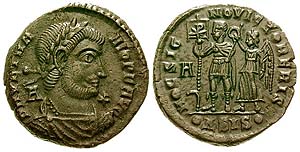
A depiction of Constantine's labarum,
as found on a silver medal from
the period
."At dawn of day [Constantine] arose, and communicated the marvel to his friends: and then, calling together the workers in gold and precious stones, he sat in the midst of them, and described to them the figure of the sign he had seen, bidding them represent it in gold and precious stones. ... [I]t was made in the following manner: A long spear, overlaid with gold, formed the figure of the cross by means of a transverse bar laid over it. On the top of the whole was fixed a wreath of gold and precious stones; and within this, the symbol of the Savior's name, two letters indicating the name of Christ by means of its initial characters, the letter P being intersected by X in its centre... From the cross-bar of the spear was suspended a cloth, a royal piece, covered with a profuse embroidery of most brilliant precious stones; and which, being also richly interlaced with gold, presented an indescribable degree of beauty to the beholder. This banner was of a square form, and the upright staff, whose lower section was of great length, bore a golden half-length portrait of the pious emperor and his children on its upper part, beneath the trophy of the cross, and immediately above the embroidered banner." (Ibid, Ch. 31)
So, according to Eusebius, Constantine responded to an appeal from Christ himself, who commanded Constantine to construct "the same sign which he had seen in the heavens," i.e., the Cross. In response, Constantine had his workers construct a cross of gold (made with a wooden spear as the vertical shaft, onto which was affixed another, horizontal shaft of wood, all covered in gold) and, at the top of this, the Chi-Rho symbol surrounded by a wreath. To this, Constantine had affixed an embroidered tapestry.
Both Lactanius and Eusebius were contemporaries of Constantine and were in his consort. Both of them were certainly familiar with the story of his marvelous visions and dreams. Both men also, as Christians, were familiar with how the fortunes of Christians had changed 180 degrees under Constantine's leadership. And whether it was the Cross or the "Chi-Rho" which inspired Constantine to victory over Lactanius at the Milvian Bridge on that October day, it's obvious that we modern Catholic Christians should recognize the power and importance of our Christian symbol.
By this sign you will conquer!







 Posts

