EXPAND YOUR READING!!

"Today the concept of truth is viewed with suspicion, because truth is identified with violence. Over history there have, unfortunately, been episodes when people sought to defend the truth with violence. But they are two contrasting realities. Truth cannot be imposed with means other than itself! Truth can only come with its own light. Yet, we need truth. ... Without truth we are blind in the world, we have no path to follow. The great gift of Christ was that He enabled us to see the face of God".Pope Benedict xvi, February 24th, 2012

The Church is ecumenical, catholic, God-human, ageless, and it is therefore a blasphemy—an unpardonable blasphemy against Christ and against the Holy Ghost—to turn the Church into a national institution, to narrow her down to petty, transient, time-bound aspirations and ways of doing things. Her purpose is beyond nationality, ecumenical, all-embracing: to unite all men in Christ, all without exception to nation or race or social strata. - St Justin Popovitch

Thursday, 25 January 2018

THE IMMACULATE CONCEPTION AND THE ORTHODOX CHURCH by Father Lev Gillet

The Immaculate Conception and the Orthodox Church
Posted on 1 September 2015 by Fr Aidan Kimel in Eclectic Orthodoxy

by Father Lev Gillet


I. It is generally agreed, I think, that the dogma of the Immaculate Conception is one of the questions which make a clear and profound division between the Roman Catholic and Orthodox Churches. Is this really the case? We shall try to examine quite objectively what Orthodox theological history has to teach us on this matter. Leaving aside the patristic period we shall start on our quest in the time of the Patriarch Photius.

II. It seems to me that three preliminary observations have to be made.

First, it is an undeniable fact that the great majority of the members of the Orthodox Church did not admit the dogma of the Immaculate Conception as it was defined by Pius IX in 1854.

Secondly, throughout the history of Orthodox theology, we find an unbroken line of theologians, of quite considerable authority, who have explicitly denied the Immaculate Conception of the Blessed Virgin Mary. Among them I shall refer to Nicephorus Gallistus in the fourteenth century and Alexander Lebedev in the nineteenth, these two representing the extremities of a chain with many intermediary links. There is even an official document written against the Immaculate Conception: the letter of the Patriarch Anthimus VII, written in 1895; we shall come later to a discussion of its doctrinal value.

Thirdly, we recognize the fact that Latin theologians very often used inadequate arguments in their desire to prove that the Immaculate Conception belonged to the Byzantine theological tradition. They sometimes forced the sense of the poetic expressions to be found in the liturgy of Byzantium; at times they misinterpreted what were merely common Byzantine terms to describe Mary’s incomparable holiness, as a sign of belief in the Immaculate Conception; on other occasions they disregarded the fact that certain Byzantines had only a very vague idea of original sin. Speaking of the Theotokos, Orthodox writers multiplied expressions such as “all holy”, “all pure”, “immaculate”. This does not always mean that these writers believed in the Immaculate Conception. The vast majority – but not all – Orthodox theologians agreed that Mary was purified from original sin before the birth of Our Lord. By this, they usually mean that she was purified in her mother’s womb like John the Baptist. This “sanctification” is not the Immaculate Conception.

The question must be framed in precise theological terms. We do not want to know if Mary’s holiness surpasses all other holiness, or if Mary was sanctified in her mother’s womb. The question is: Was Mary, in the words of Pius IX, “preserved from all stain of original sin at the first moment of her conception” (in primo instanti suae conceptionis)? Is this doctrine foreign to the Orthodox tradition? Is it contrary to that tradition?

III. I shall begin by quoting several phrases which cannot be said with absolute certainty to imply a belief in the Immaculate Conception but in which it is quite possible to find traces of such a belief.

First of all – the patriarch Photius. In his first homily on the Annunciation, he says that Mary was sanctified ek Brephous. This is not an easy term to translate; the primary meaning of Brephos is that of a child in the embryonic state. Ek means origin or starting point. The phrase seems to me to mean not that Mary was sanctified in the embryonic state, that is to say, during her existence in her mother’s womb, but that she was sanctified from the moment of her existence as an embryo, from the very first moment of her formation – therefore – from the moment of her conception. (1)

A contemporary and opponent of Photius, the monk Theognostes, wrote in a homily for the feast of the Dormition, that Mary was conceived by “a sanctifying action”, ex arches – from the beginning. It seems to me that this ex arches exactly corresponds to the “in primo instanti“ of Roman theology. (2)

St Euthymes, patriarch of Constantinople (+917), in the course of a homily on the conception of St Anne (that is to say, on Mary’s conception by Anne and Joachim) said that it was on this very day (touto semerou) that the Father fashioned a tabernacle (Mary) for his Son, and that this tabernacle was “fully sanctified” (kathagiazei). There again we find the idea of Mary’s sanctification in primo instanti conceptionis. (3)

Let us now turn to more explicit evidence.

(St) Gregory Palamas, archbishop of Thessalonica and doctor of the hesychasm (+1360) in his 65 published Mariological homilies, developed an entirely original theory about her sanctification. On the one hand, Palamas does not use the formula “immaculate conception” because he believes that Mary was sanctified long before the “primus instans conceptionis“, and on the other, he states quite as categorically as any Roman theologian that Mary was never at any moment sullied by the stain of original sin. Palamas’ solution to the problem, of which as far as we know, he has been the sole supporter, is that God progressively purified all Mary’s ancestors, one after the other and each to a greater degree than his predecessor so that at the end, eis telos, Mary was able to grow, from a completely purified root, like a spotless stem “on the limits between created and uncreated”. (4)

The Emperor Manuel II Paleologus (+1425) also pronounced a homily on the Dormition. In it, he affirms in precise terms Mary’s sanctification in primo instanti. He says that Mary was full of grace “from the moment of her conception” and that as soon as she began to exist … there was no time when Jesus was not united to her”. We must note that Manuel was no mere amateur in theology. He had written at great length on the procession of the Holy Spirit and had taken part in doctrinal debates during his journeys in the West. One can, therefore, consider him as a qualified representative of the Byzantine theology of his time. (5)

George Scholarios (+1456), the last Patriarch of the Byzantine Empire, has also left us a homily on the Dormition and an explicit affirmation of the Immaculate Conception. He says that Mary was “all pure from the first moment of her existence” (gegne theion euthus). (6)

It is rather strange that the most precise Greek affirmation of the Immaculate Conception should come from the most anti-Latin, the most “Protestantizing” of the patriarchs of Constantinople, Cyril Lukaris (+1638). He too gave a sermon on the Dormition of Our Lady. He said that Mary “was wholly sanctified from the very first moment of her conception (ole egiasmene en aute te sullepsei) when her body was formed and when her soul was united to her body”; and further on he writes: “As for the Panaghia, who is there who does not know that she is pure and immaculate, that she was a spotless instrument, sanctified in her conception and her birth, as befits one who is to contain the One whom nothing can contain?” (7)

Gerasimo, patriarch of Alexandria (+1636), taught at the same time. according to the Chronicle of the Greek, Hypsilantis, that the Theotokos “was not subject to the sin of our first father” (ouk npekeito to propatopiko hamarte mati); and a manual of dogmatic theology of the same century, written by Nicholas Coursoulas (+1652) declared that “the soul of the Holy Virgin was made exempt from the stain of original sin from the first moment of its creation by God and union with the body.” (8)

I am not unaware that other voices were raised against the Immaculate Conception. Damascene the Studite, in the sixteenth century, Mitrophanes Cristopoulos, patriarch of Alexandria and Dosithes, patriarch of Jerusalem in the seventeenth century, all taught that Mary was sanctified only in her mother’s womb. Nicephorus Gallistus in the fourteenth century and the Hagiorite in the eighteenth century taught that Mary was purified from original sin on the day of the Annunciation. But the opinions that we have heard in favour of the Immaculate Conception are not less eminent or less well qualified.

It was after the Bull of Pius IX, Ineffabilis Deus, of 8 December, 1854, that the greater part of the Greek Church seems to have turned against belief in the Immaculate Conception. Yet, in 1855, the Athenian professor, Christopher Damalas, was able to declare: “We have always held and always taught this doctrine. This point is too sacred to give rise to quarrels and it has no need of a deputation from Rome”. (9)

But it was not until 1896 that we find an official text classing the Immaculate Conception among the differences between Rome and the Orthodox East. This text is the synodal letter written by the Oecumenical Patriarch, Anthimes VII, in reply to the encyclical Piaeclara Gratulationis addressed by Leo XIII to the people of the Eastern Churches. Moreover, from the Orthodox point of view, the Constantinopolitan document has only a very limited doctrinal importance. Although it should be read with respect and attention, yet it possesses none of the marks of infallibility, nor does ecclesiastical discipline impose belief in its teachings as a matter of conscience, and it leaves the ground quite clear for theological and historical discussions on this point.

IV. Let us now consider more closely the attitude of the Russian Church towards the question of the Immaculate Conception.

Every Russian theological student knows that St Dmitri, metropolitan of Rostov (17th century), supported the Latin ”theory of the epiklesis” (10); but young Russians are inclined to consider the case of Dmitri as a regrettable exception, an anomaly. If they knew the history of Russian theology a little better they would know that from the middle ages to the seventeenth century the Russian Church has, as a whole, accepted belief in the Immaculate Conception. (11)

The Academy of Kiev, with Peter Moghila, Stephen Gavorsky and many others, taught the Immaculate Conception in terms of Latin theology. A confraternity of the Immaculate Conception was established at Polotsk in 1651. The Orthodox members of the confraternity promised to honour the Immaculate Conception of Mary all the days of their life. The Council of Moscow of 1666 approved Simeon Polotsky’s book called The Rod of Direction, in which he said: “Mary was exempt from original sin from the moment of her conception”. (12)

All this cannot be explained as the work of Polish Latinising influence. We have seen that much was written on the same lines in the Greek East. When as a result of other Greek influences, attacks were launched in Moscow against the doctrine of the Immaculate Conception, a protest was made by the Old Believers – a sect separated from the official Church by reason of its faithfulness to certain ancient rites. Again in 1841, the Old Believers said in an official declaration that “Mary has had no share in original sin”. (13) To all those who know how deeply the Old Believers are attached to the most ancient beliefs and traditions, their testimony has a very special significance. In 1848, the “Dogmatic Theology” of the Archimandrite Antony Amphitheatroff, approved by the Holy Synod as a manual for seminaries, reproduced Palamas’ curious theory of the progressive purification of the Virgin’s ancestors, a theory which has already been mentioned and which proclaims Mary’s exemption from original sin. Finally, we should notice that the Roman definition of 1854 was not attacked by the most representative theologians of the time, Metropolitan Philaretes of Moscow and Macarius Boulgakov.

It was in 1881 that the first important writing appeared in Russian literature in opposition to the dogma of the Immaculate Conception. It was written by Professor A. Lebedev of Moscow who held the view that the Virgin was completely purified from original sin at Golgotha. (14) In 1884, the Holy Synod included the question of the Immaculate Conception in the programme of “polemical”, that is to say, anti-Latin theology. Ever since then, official Russian theology has been unanimously opposed to the Immaculate Conception.

This attitude of the Russians has been strengthened by a frequent confusion of Mary’s immaculate conception with the virgin birth of Christ. This confusion is to be found not only among ignorant people, but also among many theologians and bishops. In 1898, Bishop Augustine, author of a “Fundamental Theology”, translated “immaculate conception” by “conception sine semine“. More recently still, Metropolitan Anthony then Archbishop of Volkynia, wrote against the “impious heresy of the immaculate and virginal conception of the Most Holy Mother of God by Joachim and Anne.” It was a theologian of the Old Believers, A. Morozov, who had to point out to the archbishop that he did not know what he was talking about. (15)

V. There are three principal causes which provide an explanation for the opposition with which the doctrine of the Immaculate Conception has been met in the Orthodox Church.

First and foremost, there is the mistrust felt a priori by many Orthodox about any doctrine defined by Rome since the separation of East and West. That, of course, is primarily a psychological reason.

There is also the fear of formulating a doctrine which might not seem to have sufficient foundation in Holy Scripture and the patristic tradition. We have left the patristic age outside the bounds of our discussion, limiting ourselves to the Orthodox theology of Byzantium: but it seems that (from St Andrew of Crete to St Theodore the Studite) much evidence can be produced from Greek sources in favour of the Immaculate Conception.

Finally there is the fear of restricting the redemptive work of Christ. Once you have exempted Mary from original sin, have you not exempted her from the effects of her Son’s redemption? Is it not possible for a single exception to destroy the whole economy of salvation? The Orthodox theologians who think on these lines have not given careful enough consideration, or indeed any at all, to the fact that according to Pius IX’s definition, Mary was only exempt from original sin in view of the merits of Christ: ”intuitu meritorum Christi Jesu Salvatoris humani generis“. Therefore, Christ’s redemptive action was operative in Mary’s case although in a quite different way from that of the rest of mankind.

We will add this, too. Orthodox theology has always insisted on the beauty of human nature in its integrity before the fall. Now it is the doctrine of the Immaculate Conception which alone can justify this ‘humanism’. It is only in Mary conceived without sin, that human nature has reached its fulfilment and actualized all its possibilities. Mary is the one and only success of the human race. It is through her and in her that humanity has escaped total failure and has offered to the divine a point of entry into the human. Mary, said Metropolitan George of Nicomedia (19th century) “was the magnificent first fruit offered by human nature to the Creator.” (16) “She is”, said Nicholas Cabasilas (14th century), “truly the first man, the first and only being to have manifested in herself the fullness of human nature.” (17)

VI. Let us draw our conclusions:

1. The Immaculate Conception of Mary is not a defined dogma in the Orthodox Church.

2. One can say that since the first part of the nineteenth century the majority of Orthodox believers and theologians have taken their stand against this doctrine.

3. Nevertheless. it is impossible to say that from the Orthodox point of view the doctrine of the Immaculate Conception constitutes a heresy; for canonically it has never been defined as such by an oecumenical council and in fact, it has never met with the disapproval of a universal and unchanging consensus of opinion.

4. There does exist a continuous line of eminent Orthodox authorities who have taught the Immaculate Conception.

5. Therefore the doctrine of the Immaculate Conception has every right to its existence in the Orthodox Church as an opinion of a school or as a personal theologoumenon based on a tradition worthy of respect.

6. It follows therefore that the Roman definition of 1854 does not constitute an obstacle to the reunion of the Eastern and Western Churches.

7. It is my own view that not only does the Immaculate Conception not contradict any Orthodox dogma but that it is a necessary and logical development of the whole of Orthodox belief. (18)

Regina sine labe concepta, ora pro nobis.


Footnotes

1. Photius, homil. I in Annunt., in the collection of St. Aristarchis, Photiou logoi kai homiliai, Constantinople 1901, t. II, p. 236.

2. Theognostes, hom. in fest. Dormitionis, Greek Cod. 763 of the Bibliotheque Nationale of Paris, fol. 8. v.

3. Euthemius, hom. in concept. S. Annae, Cod. laudianus 69 of the Bodleian Library, fol. 122-126.

4. Photius, In Praesentat. Deiparae, in the collection of Sophoclis Grigoriou tou Palama homiliai kb’, Athens 1861.

5. Manuel Paleologus, orat. in Dormit., Vatic. graecus 1619. A Latin translation is to be found in Migne P.G. t. CLVI, 91-108.

6. Scholarios, hom. in Dormit., Greek Cod. 1294 of the Bibliotheque Nationale of Paris, fol. 139 v.

7. Lukaris, hom. in Dormit., Cod. 263 of the Metochion of the Holy Sepulchre in Constantinople, fol. 612-613, and hom. in Nativ., Cod. 39 of the Metochion, fol. 93.

8. Hypsilantis, Ta meta ten alosin, Constantinople, 1870, p. 131. Coursoulas, Sunopsis ten ieras Theologias, Zante, 1862, vol. I, pp. 336-342.

9. Quoted by Frederic George Lee, in The Sinless Conception of the Mother of God, London 1891, p. 58.

10. See Chiliapkin, St Dmitri of Rostov and his times (Russian), in the Zapiski of the Faculty of history and philology of the University of St. Petersberg, t. XXIV, 1891, especially pp. 190-193.

11. See J. Gagarin, L’Eglise russe et L’immaculee conception, Paris 1876.

12. See Makary Bulgakov, History of the Russian Church (Russian) 1890, t. XII, p. 681. On the Polotsk brotherhood, see the article by Golubiev, in the Trudv of the Academy of Kiev, November 1904, pp. 164-167.

13. See N. Subbotin, History of the hierarchy of Bielo-Krinitza (Russian), Moscow, 1874, t. I, p. xlii of the Preface.

14. An article by M. Jugie, “Le dogme de l’immaculee conception d’apres un theologien russe,” in Echos d’Orient, 1920, t. XX, p. 22, gives an analysis of Lebedev’s monography.

15. Letter of Archbishop Anthony of Volhynia to the Old Believers, in the organ of the Russian Holy Synod, The Ecclesiastical News of 10 March 1912, p. 399. Morozov’s reply is contained in the same periodical on 14 July 1912, pp. 1142-1150.

16. Hom. III in Praesentat., Migne P.G. t. C, col. 1444.

17. Hom. in Nativ. B. Mariae, Greek Cod. 1213 of the Bibliotheque Nationale of Paris, fol. 3, r.

18. On the whole subject see M. Jugie, “De immaculata Deiparae conceptione a byzantinis scriptoribus post schisma consummatum edocta”, in Acta II conventus Velehradensis, Prague 1910; and article “Immaculee Conception,” in Dictionnaire de theologie catholique, Paris 1922, t. VII, col. 894-975. This last article by Jugie gives a complete bibliography of the subject. Much will also be found in P. de Meester, “Le dogme de l’immaculee conception et la doctrine de l’Eglise grecque”: 5 articles published in the Revue de l’Orient chretien, Paris, 1904-1905.

(From Chrysostom, Vol. VI, No. 5 [Spring 1983]: 151-159)


Bishop Robert Barron: The Incarnation

"On the Incarnation" by St Athanasius: 
a lecture by Father John Behr

2nd Lecture by Father John Behr

Feast of the Conversion of St Paul
January 25th, 2018 

Ecumenical Vespers


Wednesday, 24 January 2018

POPE FRANCIS VISITS THE CONTEMPLATIVE SISTERS

Image of Lord of the Miracles in the church of the "Nazarenas"
typically, it is a depiction of the crucifixion, the visible dimension 
of the  Christian Mystery, while the title infers the 
resurrection of Christ which is the invisible dimension.

The Church of the Nazarene was packed with contemplative nuns of every shape and size, in a colourful variety of habits, following numerous rules and observances, and they came from all over Peru to see the Pope.  We are the only community of cloistered monks in the whole of Peru, so we were invited too.  The Spanish kings wouldn't allow monasteries of men who worked within the confines of their cloister to settle in Hispanic America, so there is no real monastic tradition here; which means that few men look on a cloistered vocation as an option when they are considering following Our Lord more closely.  We are the fifth of five attempts to establish a Peruvian monastery and all the other attempts were unsuccessful.  It was very clear at this meeting with the Pope that the prejudice still exists that the contemplative vocation should be reserved only to women.  One priest tried to kick us out until we showed him our invitations, and a bishop ordered us to get to the back behind the nuns because this meeting with the Pope was for women only, as though we somehow were invited under false pretensions.


We had started out from our monastery after 3.00am and arrived a couple of hours later at the Salesian College where we swapped our car for a ride on a specially authorised bus.  Only these buses were allowed into the streets surrounding the Church of the Nazarenes where the pope was going to meet us. 

The church has an image of Christ Crucified painted on its east wall, originally the wall of an adobe house. The image was painted during the 17th century by an unnamed African taken from what is now Angola to Peru as a slave who  drew the image of a black Christ on the walls of a wretched hut at the Pachacamilla plantation, near Lima. The image stayed on the wall despite several attempts to erase it.

The image survived intact on the wall despite an earthquake in 1746 which leveled all surrounding buildings. As a result of this event, worship of the image rose to new heights, until it became the most widely venerated image in the city of Lima. The principal day of the celebration of the Lord of the Miracles is 28th October, the anniversary of the 1746 earthquake.  Its feast is the main Catholic celebration in Peru and one of the largest processions in the world.

Christ is shown enduring the pain of crucifixion. Above the cross is the Holy Spirit and God the Father. Below and to the right of Jesus is his mother, the Virgin Mary with her heart pierced by a metaphorical sword of sorrow. Kneeling and weeping at the foot of the cross is St. Mary Magdalene.


Every year in October, hundreds of thousands of devotees from all races and economic backgrounds participate in a religious procession honouring the image through the streets of Lima. Boulevards are decorated in purple on October 18, 19, and 28 to celebrate the Lord of Miracles.

The procession in Lima is one of the largest annual processions in all of the Americas, where tens of thousands of the faithful dress in purple tunics, sing hymns and pray as they accompany the image. The litter which bears the painting weighs two tons and is borne on the shoulders of believers who set out on the traditional 24-hour procession from the church of Las Nazarenas, crossing downtown Lima until it reaches the church of La Merced in Barrios Altos. Around this time of year, the streets fill with vendors of a wide variety of typical dishes and sweets, such as the famous Turrón de Doña Pepa.

The image is a copy of the one painted by the Angolan slave on the wall.


Female followers of the Lord of the Miracles often wear purple for the entire month of October, and are easily identifiable by a purple dress, sashed with a white cord.  The church of the Nazarenas is attached to a convent of Discalced Carmelite Nuns whose habit is also purple with a white cord in honour of the Lord of Miracles.
filming the procession by using a drone

Eventually, we found ourselves outside an entrance to the convent with crowds of nuns; and we were all let in one by one as our credentials were examined.

The subprior Brother Mario in the queue with a number of Poor Clares.


some Augustinian nuns from their most historic convent in Lima.  The one pushing the wheelchair on our left is an old friend of our monastery wo visited us many times as a young lay person.

We were placed in the nun's choir,
 away from the main body of nuns
Pope Francis' visit to the contemplative sisters
When the Pope arrived, we all sang Terce., and he gave his homily after the short reading:
For you did not receive the spirit of slavery to fall back into fear, but you have received the Spirit of adoption as sons, by whom we cry, “Abba! Father!”
Quite often, the contemplative life is not understood, even by clergy.   Contemplative nuns should not only be tolerated: they are essential to the life of the Church.  As St Therese de Lisieux said, their vocation is to be that of Love in the heart of the Church.  They are missionaries of contemplation and their love fuels all the Church's apostolic activity.Such is their importance that the devil does his best to disrupt their life.  One of his main weapons is gossip.  Gossip can have a terrible effect on community life.  Nuns who indulge in gossip are like terrorists who throw bombs.He then emphasised the importance place that contemplative have in the Church and he blessed us all.


a brief summary of Pope Francis' talk

the final mass at Las Palmas

Friday, 19 January 2018

ATHENAGORAS, ORTHODOXY'S BERGOGLIO by Sandro Magister, plus DAVID BENTLEY HART and ME.


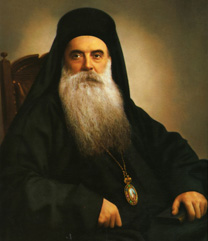
Patriarch Athenagoras


The day on which Pope Francis moved on from Chile to Peru marked the beginning all around the world of the annual week of prayer for Christian unity, which culminates on January 25 with the feast of the conversion of Saint Paul.

Half a century ago, on July 25, 1967, in Istanbul, the ecumenical journey passed a historic milestone: the second meeting between Paul VI and the ecumenical patriarch of Constantinople, Athenagoras. And on the occasion of this anniversary, Eliana Versace, a Church historian, has published in the “Notiziario” of the Paul VI Institute in Brescia two documents of exceptional interest.

These are two reports sent by the Italian ambassador to Turkey at the time, Mario Mondello, to the Italian foreign minister, Senator Amintore Fanfani.

The first report is a detailed account of that voyage of Pope Giovanni Battista Montini to Turkey.

While the second, a dozen pages or so in length, reports the long conversation that the ambassador had with Athenagoras around ten days after the meeting with Paul VI.

A conversation that the ambassador himself was the first to find “surprising” and “troubling,” beginning with the character he found before him: “picturesque,” “ardent and affable,” “perhaps a bit awkward and perhaps a bit histrionic.”

And this character profile itself leads one to associate the figure of Athenagoras with that of pope Jorge Mario Bergoglio.

But there’s more, much more. We now know that there is an extraordinary proximity between the two precisely in their manner of conceiving of the ecumenical journey.

To grasp this proximity it is enough to read this passage from the ambassador’s report:

“To the question from the Italian diplomat on the importance of the theological differences among the various Churches, the patriarch responded vigorously, and said: ‘And how could I attribute importance to them, if there are none?’ To explain the meaning of his words to his surprised interlocutor, he compared himself to a diplomat: ‘You know, theologians are like jurists. Do you diplomats listen to the jurists when you feel that you must carry out some gesture or some important act of international politics? Of course not. Well then, I am a diplomat. Besides, out of scruples of conscience, I asked a few theologians to study in what these differences would consist. Well then, you know what they found? That there are none. That’s it. On the contrary, they realized that our Churches separated without any motives for conflict, without any reason, but only because of a succession of actions carried out by one side and the other, imperceptibly. In short, a ‘querelle d’évêques’.”

And further on:

“So there was only path for the patriarch of Constantinople to follow: ‘There is only one Blessed Mother, the same for all. Just as there is only one Christ, the same for all. And we all use the same baptism, which makes us all Christians. Enough with the differences: let us draw near to each other with ‘acts.’ The only path to follow is that of love and of charity, and love and charity impose the way of union.”
And now compare this with what Pope Francis said on February 26, 2017 in a question-and-answer session at the “All Saints” Anglican Church in Rome:

This was the question:

"Your Predecessor, Pope Benedict XVI, warned against the risk, in ecumenical dialogue, of giving priority to cooperation in social initiatives rather than following the more demanding path of theological agreement. It appears that you prefer the contrary, that is, to 'walk and work' together in order to reach the goal of Christian unity. Is this true?"

And this was Francis’s response:

"I do not know the context in which Pope Benedict said this. I don’t know, and so it is a little difficult for me. I cannot really answer this.... Whether he meant to say this or not?... Perhaps it was during a conversation with theologians.... But I am sure that both aspects are important. This is certain. Which of the two has priority?... And on the other hand, Patriarch Athenagoras’ famous comment – which is true because I asked Patriarch Bartholomew and he said: 'This is true' – when he said to Blessed Pope Paul VI: 'Let us make unity together and leave the theologians on an island to think about it'. It was a joke, but historically, it is accurate. I had doubts but Patriarch Bartholomew told me that it was true. But what is the heart of the matter, because I believe that what Pope Benedict said is true: we must seek a theological dialogue in order to also seek the roots... of the Sacraments .. of many issues on which we are still not in agreement. But this cannot be done in a laboratory: it must be done as we advance, along the way. We are on a journey, and as we journey, we also have these discussions. Theologians do this. But in the meantime, we help each other, we, one with the other, with our needs, in our lives; also spiritually we help each other. For example, in the ‘twinning’ [of the parishes] there was the fact of studying Scripture together, and we help each other in our charitable service, in service to the poor, in hospitals, in wars.... It is very important. This is very important. It is not possible to have ecumenical dialogue while standing still. No. Ecumenical dialogue is carried out as we walk, because ecumenical dialogue is a journey, and theological matters are discussed along the way. I believe this betrays neither the thought of Pope Benedict, nor the reality of ecumenical dialogue. This is my interpretation. If I knew the context in which that thought was expressed, I might say something different, but this is what comes to mind to say."

Or again, compare it with what Pope Francis said on November 30, 2014, on the flight back from Turkey:

"I believe we are moving forward in our relations with the Orthodox; they have the sacraments and apostolic succession... we are moving forward. What are we waiting for? For theologians to reach an agreement? That day will never come, I assure you, I'm sceptical. Theologians work well but remember what Athenagoras said to Paul VI: 'Let's put the theologians on an island to discuss among themselves and we’ll just get on with things!' I thought that this might not have been true, but Bartholomew told me: 'No, it's true, he said that'. We mustn't wait.  Unity is a journey we have to take, but we need to do it together. This is spiritual ecumenism: praying together, working together. There are so many works of charity, so much work.... Teaching together.... Moving forward together.  This is spiritual ecumenism. Then there is an ecumenism of blood: when they kill Christians, we have so many martyrs.... starting with those in Uganda, canonized 50 years ago: half were Anglican, half Catholic, but the ones [who killed them] didn't say: 'You're Catholic.... you're Anglican….' No: 'You are Christian', and so their blood mixed. This is the ecumenism of blood. Our martyrs are crying out: 'We are one! We already have unity, in spirit and in blood'. […] This is ecumenism of blood, which helps us so much, which tells us so much. And I think we have to take this journey courageously. Yes, share university chairs, it's being done, but go forward, continue to do so....  I’ll say something that a few, perhaps, are not able to understand: the Eastern Catholic Churches have a right to exist, but uniatism is a dated word. We cannot speak in these terms today. We need to find another way."

It is not known for sure where and when Athenagoras is thought to have made his quip about the theologians to be marooned on an island. Certainly not during his first historic encounter with Paul VI in Jerusalem on January 5, 1964, the entire audio recording of which has been made public:


The fact is, however, that the quip has entered the oral tradition, and Francis has resorted to it a number of times for confirmation of his own vision of ecumenism.

Returning to the report of Ambassador Mondello, Eliana Versace has also published a summary of it in "L'Osservatore Romano":


And it is a letter that has other surprises in store, for example where Athenagoras tells the ambassador that he is in the habit of calling pope Montini by the name of “Paul II,” because he is the true “successor of Saint Paul, updated for the present time,” or better yet, by the name of “Paul II the Victorious,” “imitating with his hand the gesture that Churchill used to indicate victory.”

In the run-up to the present week of ecumenical prayer, Cardinal Kurt Koch, president of the pontifical council for Christian unity, recalled in “L'Osservatore Romano” that there are two paths that feed into the ecumenical way, from its origin until today.

The first, begun in 1910, took the name of “Faith and Order,” and has “as its primary objective the search for unity in faith,” on the terrain of doctrine and theology.

The second, opened in 1914, took the name of “Life and Work,” and is intended to unify the various Christian denominations, regardless of their doctrinal divisions, in a shared “effort on behalf of understanding and peace among peoples.”

It is patently clear that of these two paths only the second interests Pope Francis. Just as, we now know, it did Patriarch Athenagoras before him.

(English translation by Matthew Sherry, Ballwin, Missouri, U.S.A.)


David Bentley Hart: Francis Is Just Alright With Me


While the Douthats, Doughertys and Drehers of this world continue to accuse Pope Francis of everything from heresy to conspiracy to provoking schism, who should come to the pope’s defense (and at First Things, no less) but the formidable Orthodox theologian David Bentley Hart?

In “Habetis Papam” (roughly, “You’ve got yourself a pope”), Hart first expresses “a wholly unqualified admiration for Francis,” adding that “nothing he has done, said, or written since assuming office has had any effect on me but to deepen that esteem.”  But, controversialist that he is, Mr Hart does not leave it at that; instead, he goes on to say:

“I am utterly baffled by the anxiety, disappointment, or hostility he clearly inspires in certain American Catholics of a conservative bent (using “conservative” in its distinctly American acceptation). And frankly, I find it no more inexplicable in its most extreme expressions—which at their worst verge on sheer ­hysteria—than in its mildest—an almost morbid oversensitivity to every faint hint of hidden meanings in every word, however innocuous, that escapes the pope’s lips or pen.”

Hart says nothing about either the recent Synod on the Family or the even more recent “Lutheran communion” imbroglio. His bafflement here is focused on the conservative Catholic reaction to the papal encyclical Laudato Si, and (characteristically) he minces no words in saying so:

My perplexity achieved a kind of critical mass after the promulgation of the most recent papal encyclical. For myself, I can quite literally find not a single sentence or sentiment in Laudato Si to which it seems to me possible for any Christian coherently to object…I simply cannot find an assertion anywhere in its pages that strikes me as anything other than either a plain statement of fact or a reasonable statement of Christian principle.

Hart also insists that Laudato Si is very much in the Catholic tradition and that, critics to the contrary notwithstanding, Pope Francis has clearly been influenced by a variety of respectably Catholic sources:

Laudato Si positively trembles from all the echoes it contains of G. K. Chesterton, Vincent McNabb, Hilaire Belloc, Elizabeth Anscombe, Dorothy Day, E. F. Schumacher, Leo XIII, John XXIII, John Paul II, Benedict XVI, and (above all) Romano Guardini; its native social and political atmosphere is that rich combination of Christian socialism, social democratism, subsidiarism, distributism, and anti-materialism that constitutes the best of the modern Catholic intellectual tradition’s humane alternative to all the technologisms, libertarianisms, corporatisms, and totalitarianisms that in their different ways reduce humanity to nothing more than appetent machines and creation to nothing more than industrial resources.

A word to the wise, Messrs. Douthat, Dougherty and Dreher: you do not want to get into the rhetorical ring against an opponent who comes up with phrases such as “appetent machines”. 

As for Laudato Si’s emphasis on the environment and on climate change, Hart observes:

Francis has the temerity to take the science of climate change ­seriously, which is the sort of thing that can send a Wall Street ­Journal conservative frantically groping for his smelling salts, but which I cannot help thinking is slightly saner than clinging to the politically inflected obfuscations of the data that so many in the developed world use to calm their digestions and consciences. But, leaving that aside, I again have to ask what the encyclical says that could possibly offend against reason. That the incessant pollution of soil and water by the heavy metals and other toxins produced by the monstrous consumerist voracity of our way of life is a devastating reality? That local ecologies despoiled and poisoned are impossible to recover, and that the poor of the developing world constitute the vast majority of its immediate victims? That stewardship of creation is a long-acknowledged moral requirement of Catholic Christians? That creation declares God’s glory and is an intrinsic good, and that only a depraved moral imagination allied to a petrified heart could fail to see the moral claim made on us by other creatures?

David Bentley Hart acknowledges that he is not a member of the Roman Catholic Church (he belongs to the Eastern Orthodox Church), and so his comments may be taken as unwarranted intrusions; in fact, he begins “Habetis Papam” by declaring “Far be it from me—not being a Roman Catholic—to tell Catholics what they should think of their pontiff.”  That caveat aside, Mr. Hart’s “amicus curiae” for Pope Francis is a direct challenge to those Catholics who find, in Laudato Si and in almost every word this pope utters, either naiveté, heresy, or a sort of implicit apostasy from Catholic teachings.

It is, as I have said elsewhere, a fearful thing to fall into the hands of David Bentley Hart.  If Messrs. Douthat, Dougherty and Dreher care to respond to Hart, they had best bring their “A” games—and even that may not be enough.


http://www.firstthings.com/article/2015/12/habetis-papam

MY OWN COMMENTARY

In order to understand Patriarch Athenagoras or Pope Francis, you have to bear in mind the fundamentally apophatic nature of our understanding of God.   As St Thomas Aquinas wrote, 
God is greater than all we can say, greater than all that we can know; and not merely does he transcend our language and our knowledge, but he is beyond the comprehension of every mind whatsoever, even of angelic minds, and beyond the being of every substance. (De Div. Nom. I.3.77; quoted in Fran O’Rourke, Pseudo-Dionysius and the Metaphysics of Aquinas, p. 49)

 Thus there is an inherent paradox in any attempt to formulate doctrine.  From our point of view, there is the necessity for clarity of thought and of precise formulation.  The only alternative is wishy-washy thought leading to the formulation of pious platitudes.  However, precise formulation inevitably leads to a clear distinction between what we believe and that is believed by others: it leads to frontiers and borderlines and, hence, to divisions.

On the other hand, God's truth transcends particular truths, is not one truth over against another: it is Truth itself, and our truths are only true in so far as they inadequately and hesitatingly participate in that Truth.

According to  the late Bernard Lonergan S.J., "Faith is the knowledge born of religious love," not just any love, but God's love for us revealed in Christ on the Cross, a love which crosses every barrier and meets the human race at its worst, at its most destructive, when human beings are intent on killing the God who created them and holds them in being.  This is not a theology: it is the reality about which theology is written.  We can respond to it because it happened in our visible world; but because it is a theophany, it leads us into a Truth and a Love that are beyond our comprehension.  This Mystery of Christ is what the Greeks call the "economia"  Our positive response to it, our answering "yes" is faith and our participation in it leads to our understanding.

   Every Good Friday, we put everything else aside to confront the Church with the naked Cross, God's supreme revelation of his nature as self-giving Love, a love which is beyond our comprehension but which is made visible so that we can respond.

Christianity can only be understood within the context of that Love which breaks down every barrier and reaches out to every soul.  When this is forgotten, then we forget the limitations of our own success.  For those of us who do theology, God becomes the Great Theologian in the sky who always acts in line with our theology.  For canonists like Cardinal Burke, our salvation becomes God's solution to a legal problem of how human beings can give adequate recompense for sin against an infinite God and who believe that, among others things, Christ came to give us a revised edition of the Mosaic Law, especially on marriage.  Liberals see God as the Great Liberal in the sky who ignores the concerns of the theologians and the lawyers in favour of white western values. The inescapable apophatic nature of our understanding of God and the things of God has been lost.

 The media seems to hold that because the late Patriarch Athenagoras and our Pope Francis believe that neither theologians nor lawyers can have the last word, they are really liberals, and nothing could be further from the truth.  Liberals urge tolerance because theological truth is not all that important.   True ecumenical agreement among Catholics and Orthodox is realised when they joyfully discover that their different formulations, in spite of their limitations, arise out of a real participation in the same ecclesial reality and basically express the same faith.

I would like to add, not only Patriarch Bartholomew to Athenagoras and Pope Francis suggested by Sandro Magister, but also Patriarch Kirill of Moscow.  He seems quite rightly terrified by the possibility of a doctrinal agreement by the theologians engaged in ecumenical dialogue before links of ecclesial charity can be established within the ordinary community life of our separated churches.  This would mean that the ecumenical agreement would be understood outside the context of ecclesial love which reflects the presence of the incomprehensible Love of God that challenges us to think outside out intellectual boxes.  In other words, the ecumenical agreement would not be understood at all.

There is a real possibility that a substantial agreement could be reached very soon between Greek Orthodox and Catholic theologians, but they live and work within an academic environment that has little to do with the lives of the ordinary Orthodox and the Catholic faithful.

  What would happen if they were to present to their respective churches a full doctrinal agreement?   In many places, the faithful of both churches would erupt and reject the agreement that has been made, and other theologians would rush in to support the popular will, finding in the agreements all kinds of errors.   Years of work would be trashed and unity between Catholicism and Orthodoxy would be put off for another few centuries.

Patriarch Athenagoras and Pope Francis share the same faith but different ecclesial allegiance.  They know that what separates them isn't a difference of belief, only years of living as though the other side doesn't exist.  They know that this unity of faith will only become apparent, not when the theologians come to a reluctant agreement, but when  Catholics and Orthodox love one another.   When this happens, their common faith will hit them with all the force of revelation, and both sides will bow the knee in humble acceptance. 

First, we need to love one, which is why the Byzantine rite puts the kiss of peace before the common recitation of the Creed so that they can say it "with one heart and one mind."  To love one another we must know one another, which is why Patriarch Athenagoras and Pope Francis and the present Archbishop of Canterbury put sharing before a theological agreement.  As Pope Francis said to the Anglicans:
Ecumenical dialogue is carried out as we walk, because ecumenical dialogue is a journey, and theological matters are discussed along the way.

Search This Blog

La Virgen de Guadalupe

La Virgen de Guadalupe

Followers

My Blog List

Fr David Bird

Fr David Bird
Me on a good day

Blog Archive