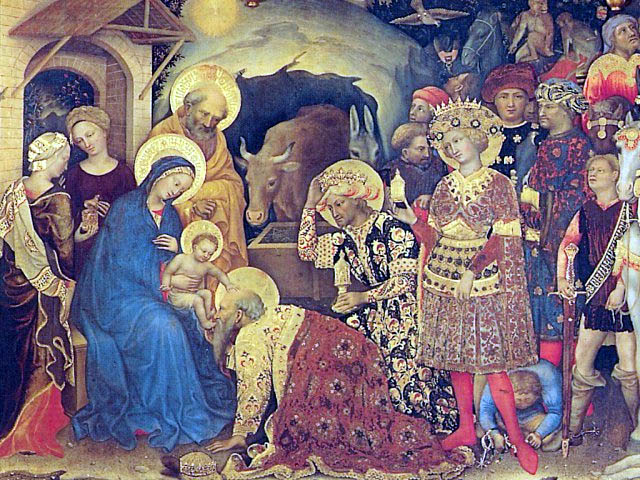
The Christmas season is a wonderful example of unity in diversity. One year I had the joy of celebrating Christmas twice, once at Belmont on December 25th, and then with the Ukrainians in Gloucester on January 7th which is December 25th in the Julian Calendar. This year, we celebrate the Epiphany on January 6th or 7th, while most Eastern churches are celebrating Christmas. Yet it is the same mystery of the Incarnation'
Although the Baptism of Our Lord is a major theme of the Epiphany, I shall postpone any detailed treatment of it until the Orthodox Epiphany where it is the dominant theme.
"Epiphany" means "manifestation", and the feast celebrates the manifestation of God in the flesh. It is also called in the East "Theophany" and it included, all in one, the Birth of Christ, the Adoration by the Magi which symbolised Incarnation as God's supreme revelation to all humankind, the Baptism of Christ in which the three Persons of the Blessed Trinity were made manifest, and, last of all, there was the Marriage Feast of Cana which showed Christ's divine power over nature. Originally, there was only one feast that encompassed all these themes, as it is practised up to the present day by the Armenian Orthodox Church (Oriental Orthodox) in which an all-inclusive Christmas Day is celebrated on January 6th.
(Շնորհավոր Ամանոր և Սուրբ Ծնունդ)
The Armenian Christmas
Feast of the Theophany
Armenians with others at Christmas
Christmas Eve Mass (Armenian) Jan. 5th 2018
THE FEAST OF THE EPIPHANY
YEAR B
Introit and Gradual
sung by the monks of Solesmes

GOSPEL Matthew 2:1-12
When Jesus was born in Bethlehem of Judea, in the days of King Herod, behold, magi from the east arrived in Jerusalem, saying, “Where is the newborn king of the Jews? We saw his star at its rising and have come to do him homage.” When King Herod heard this, he was greatly troubled, and all Jerusalem with him. Assembling all the chief priests and the scribes of the people, He inquired of them where the Christ was to be born. They said to him, “In Bethlehem of Judea, for thus it has been written through the prophet: And you, Bethlehem, land of Judah, are by no means least among the rulers of Judah; since from you shall come a ruler, who is to shepherd my people Israel.” Then Herod called the magi secretly and ascertained from them the time of the star’s appearance. He sent them to Bethlehem and said, “Go and search diligently for the child. When you have found him, bring me word, that I too may go and do him homage.” After their audience with the king they set out. And behold, the star that they had seen at its rising preceded them, until it came and stopped over the place where the child was. They were overjoyed at seeing the star, and on entering the house they saw the child with Mary his mother. They prostrated themselves and did him homage. Then they opened their treasures and offered him gifts of gold, frankincense, and myrrh. And having been warned in a dream not to return to Herod, they departed for their country by another way.
My sisters and brothers in Christ Jesus,
God has sent us His Son, Jesus Christ. The Son is given for all of us, not just for a chosen group—for all of us. So we chant in the Christmas Season: Christ is born for us! At the time of Epiphany: Christ has appeared to us. Christ is for all even as Christ is also for me personally. The challenge is to see God in the many ways in which God appears and to reflect God in all that I do.
The first reading today is taken from the Prophet Isaiah. This Prophet tells us: “Upon you, the Lord shines, and over you appears his glory. Nations shall walk by your light…” These words are written about Israel but apply to every nation and group of people because the Lord loves us all. Even this great Prophet Isaiah could not convince everyone that God would act and that God would be present. The challenge for us is personal belief and also belief as a Church and a community. If we believe, that our lives begin to reflect that light of His glory and gives witness to the loving presence of our God.
The second reading is from the Letter to the Ephesians. Saint Paul, a devout Jew, tells us how he became aware that God’s love was for even the Gentiles, the non-Jewish people. God’s love is for everyone. The challenge for us today is to recognize that God’s love is for all peoples, and especially for those peoples and nations and persons who seem most impossible to accept. God wants us all and God is working in all, even when we cannot see it. Once we begin to accept that God is present in all, we will find that speaking of the Lord is not so difficult after all. Instead, we might find that we naturally speak of God to others and that our own love and faithfulness could draw others to God and to our Lord Jesus.
The Gospel today is the story of the Magi from the East, the story of the Three Kings of the Orient, the story of the star drawing and guiding wise men to the Lord. We don’t have a lot of details about how this happened, but our Gospels tell us that God Himself chooses to reveal Himself to all peoples and that God Himself uses various ways to do that. Yes, our witness is important, but so also are the unexplained ways in which God makes Himself known.
For many, the challenge is to believe that God is calling all of us to the Catholic Church. We live in a time when many think that all religion is the same. Yet revelation keeps telling us that not everything is the same, that there are roads that lead to destruction, that there are ways that do not lead to light.
What is implied is that in each of us is a drawing to God, an attraction to the Lord, which will eventually bring us to Him. If we are to see Him, our hearts must be open to Him. If we are to live in Him, our hearts must be able to embrace Him.
God is revealing Himself to you and to me right now. Let us open our eyes to His light and open our hearts to His love.
Your brother in the Lord,
Abbot Philip
Reges Tharsis: Offertory
monks of Monserrat
The Mystery of God
Who is God
Bishop R. Barron
The Epiphany feast explained by Dom Gueranger
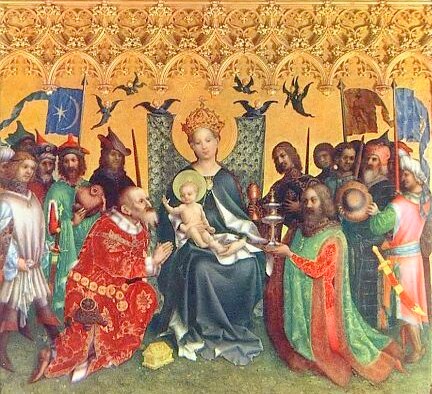
The great liturgist, Dom Prosper Gueranger, gives some thoughts about the significance of the Feast of the Epiphany for the Christian soul.
The Feast of the Epiphany is the continuation of the mystery of Christmas, but it appears on the Calendar of the Church with its own special character. Its very name, which signifies Manifestation, implies that it celebrates the apparition of God to His creatures.
For several centuries the Nativity of Our Lord was kept on this day; and when, in the year 376 the decree of the Holy See obliged all Christians to keep the Nativity on the 25th of December, as Rome did, the 6th of January was not robbed of all its ancient glory. It was still to be called the Epiphany, and the Baptism of Our Lord Jesus Christ was also commemorated on this same Feast, which Tradition had marked as the day on which that Baptism took place.
The Greek Church gives this Feast the venerable and mysterious name of Theophania, which is of such frequent reference in the early Fathers, as signifying a divine Apparition. We find this name applied to this Feast by Eusebius, St. Gregory Nazianzen, and St. Isidore of Pelusium. In the liturgical books of the Melchite Church the Feast goes under no other name.
The Orientals call this solemnity also the Holy Lights, on account of its being the day on which Baptism was administered; for, as we have just mentioned, Our Lord was baptized on this same day. Baptism is called by the holy Fathers "Illumination", and they who received it Illuminated.
Lastly, this Feast is called in many countries the King's Feast; it is, of course, an allusion to the Magi, whose journey to Bethlehem is so continually mentioned in the Divine Office.
The Epiphany shares with the Feasts of Christmas, Easter, Ascension, and Pentecost the honour of being called, in the Canon of the Mass, a Day most holy. It is also one of the cardinal feasts, that is, one of those on which the arrangement of the Liturgical Year is based; for, as we have Sundays after Easter, and Sundays after Pentecost, so also we count as many as six Sundays after Epiphany.
The Epiphany is indeed a great Feast, and the joy caused us by the Birth of Our Lord Jesus must be renewed on it, for as though it were a second Christmas Day, it shows us our Incarnate God in a new light. It leaves us all the sweetness of the dear Babe of Bethlehem, who hath appeared to us already in love; but to this, it adds its own grand manifestation of the divinity of our Jesus. At Christmas it was a few Shepherds that were invited by the Angels to go and recognize the Word Made Flesh; but now, at the Epiphany, the voice of God Himself calls the whole world to adore this Jesus, and hear Him.
The mystery of the Epiphany brings upon us three magnificent rays of the Sun of Justice, our Savior. In the calendar of pagan Rome, this 6th day of January was devoted to the celebration of a triple triumph of Augustus, the founder of the Roman Empire; but when Jesus, our Prince of Peace, Whose empire knows no limits, had secured victory to His Church by the blood of the Martyrs, then did this His Church decree that a triple triumph of the Immortal King should be substituted, in the Christian Calendar, for those other three triumphs which had been won by the adopted son of Caesar.
The 6th of January, therefore, restored the celebration of Our Lord's Birth to the 25th of December; but in return, there were united in the one same Epiphany three manifestations of Jesus' glory: the mystery of the Magi coming from the East, under the guidance of a star, and adoring the Infant of Bethlehem as the Divine King; the mystery of the Baptism of Christ, Who, whilst standing in the waters of the Jordan, was proclaimed by the Eternal Father as Son of God; and thirdly, the mystery of the divine power of this same Jesus, when He changed the water into wine at the marriage-feast of Cana.
But did these three Mysteries really take place on this day? Is the 6th of January the real anniversary of these events? We think it enough to state that Baronius, Suarez, Raynaldus, Pope Benedict XIV, and an almost endless list of other writers, assert that the Adoration of the Magi happened on this very day. That the Baptism of Our Lord also happened on the 6th of January is admitted by the severest critics. The precise day of the miracle at the marriage-feast of Cana is far from being as certain as the other two mysteries, though it is impossible to prove that the 6th of January was not the day. For us the children of the Church, it is sufficient that our Holy Mother has assigned the commemoration of these three manifestations for this Feast; we need nothing more to make us rejoice in the triple triumph of the Son of Mary.
If we now come to consider these three mysteries of our Feast separately, we shall find that the Church of Rome, in Her Office and Mass of today, is more intent on the Adoration of the Magi than on the other two. That the mystery of the Vocation of the Gentiles should be made thus prominent by the Church of Rome is not to be wondered at; for, by that heavenly vocation which, in the Magi, called all nations to the admirable light of Faith, Rome, which till then had been the head of the Gentile world, was made the head of the Christian Church and of the whole human race.
The Greek Church makes no special mention, in her Office of today, of the Adoration of the Magi, for she unites it with the mystery of our Savior's Birth in her celebration of Christmas Day. The Baptism of Christ absorbs all her thoughts and praises on the solemnity of the Epiphany.
In the Latin Church, this second mystery of our Feast is celebrated, together with the other two, on the 6th of January, and mention is made of it several times in the Office. But as the coming of the Magi to the crib of our new-born King absorbs the attention of the Roman Church this day, the mystery of the sanctification of the waters was to be commemorated on a day apart – the Octave Day, January 13th.
The third mystery of the Epiphany is also somewhat kept in the shade by the prominence given to the first (though allusion is several times made to it in the Office of the Feast), a special day has been appointed for its due celebration, and that day is the Second Sunday after the Epiphany.
The great Day, which now brings us to the crib of our Prince of Peace in company with the Three Kings, has been marked by two great events of the first ages of the Church. It was on the 6th of January in the year 361, that Julian, who in heart was already an apostate, happened to be at Vienne in Gaul. He was soon to ascend the imperial throne, which would be left vacant by the death of Constantius, and he felt the need he had of the support of the Christian Church, in which it is said he had received the order of Lector, and which, nevertheless, he was preparing to attack with all the cunning and cruelty of a tiger. Like Herod, he too would fain go on this Feast of the Epiphany and adore the new-born King. His panegyrist Ammianus tells us that this crowned philosopher, who had been seen just before coming out of the pagan temple, where he had been consulting the soothsayers, made his way through the porticoes of the church, and standing in the midst of the faithful people, offered to the God of the Christians his sacrilegious homage.
Eleven years later, in the year 372, another Emperor found his way into the church, on the same Feast of the Epiphany. It was Valens; a Christian, like Julian, by baptism; but a persecutor, in the name of Arianism, of that same Church which Julian persecuted in the name of his vain philosophy and still vainer false gods. As Julian felt necessitated by motives of worldly policy to bow down, on this day, before the divinity of the Galilean; so on this same day, the holy courage of a saintly Bishop made Valens prostrate himself at the feet of Jesus.
St. Basil had just then had his famous interview with the Prefect Modestus, in which his episcopal intrepidity had defeated all the might of earthly power. Valens had come to Caesarea, and with his soul defiled with the Arian heresy, he entered the Basilica, when the Bishop was celebrating, with his people, the glorious Theophany. Let us listen to St. Gregory Nazianzen, thus describing the scene with his usual eloquence: "The Emperor entered the church. The chanting of the psalms echoed through the holy place like the rumbling of thunder. The people, like a waving sea, filled the house of God. Such was the order and pomp in and about the sanctuary, that it looked more like Heaven than earth. Basil himself stood erect before the people, as the Scripture describes Samuel – his body and eyes and soul motionless, as though nothing strange had taken place, and, if I may say so, his whole being was fastened to his God and the Holy Altar.
"The sacred ministers, who surrounded the Pontiff, were in deep recollection and reverence. The Emperor heard and saw all this. He had never before witnessed a spectacle so imposing. He was overpowered. His head grew dizzy, and darkness veiled his eyes."
Jesus, the King of ages, the Son of God and the Son of Mary, had conquered. Valens was disarmed; his resolution of using violence against the holy Bishop was gone; and if heresy kept him from at once adoring the Word consubstantial with the Father, he at least united his exterior worship with that which Basil's flock was paying to the Incarnate God. When the Offertory came, he advanced towards the Sanctuary and presented his gifts to Christ in the person of his holy priest. The fear lest Basil might refuse to accept them took such possession of the Emperor, that had not the sacred ministers supported him, he would have fallen at the foot of the Altar.
Thus has the Kingship of our new-born Savior been acknowledged by the great ones of this world. The Royal Psalmist had sung this prophecy – the kings of the earth shall serve Him, and His enemies shall lick the ground under His feet (Ps. 71: 9, 11).
The race of the Emperors like Julian and Valens was to be followed by Monarchs who would bend their knee before this Babe of Bethlehem, and offer Him the homage of true faith and devoted hearts. Theodosius, St. Karl the Great, Alfred the Great, St. Edward the Confessor, St. Stephen of Hungary, the Emperor St. Heinrich II, St. Ferdinand of Castille, St. Louis IX of France are examples of kings who had a special devotion to the Feast of the Epiphany. Their ambition was to go in company with the Magi to the feet of the Divine Infant and offer Him their gifts. At the English Court, the custom was long retained that the reigning sovereign offered an ingot of gold as a tribute of homage to Jesus the King of kings.
But this custom of imitating the Three Kings in their mystic gifts was not confined to Courts. In the Middle Ages, the faithful used to present on the Epiphany gold, frankincense and myrrh to be blessed by the priest. These tokens of their devotedness to Jesus were kept as pledges of God's blessing upon their houses and families. The practice is still observed in Germany and other parts of the Christian world.
There was another custom which originated in the Ages of Faith, which is still observed in some countries. In honour of the Three Kings, who came from the East to adore the Babe of Bethlehem, each family chose one of its members to be king. The choice was thus made: the family kept a feast, which was an allusion to the third of the Epiphany Mysteries – the Feast of Cana in Galilee – a cake was served, and he who took the piece which had a certain secret mark (inside or underneath) was proclaimed the king of the day. Two portions of the cake were reserved for the poor, in whom honour was thus paid to the Infant Jesus and His Blessed Mother; for on this Day of the triumph of Him, Who though King, was humble and poor, it was fitting that the poor should have a share in the general joy. The happiness of home was there, as in so many other instances, blended with the sacredness of Religion. This custom of the King's Feast brought relations and friends together, and encouraged feelings of kindness and charity. Human weakness would sometimes, perhaps, show itself during these hours of holiday-making; but the idea and sentiment and spirit of the whole feast was profoundly Catholic, and that was sufficient to guarantee its innocence.
For the last several centuries, a puritanical zeal has decried these simple customs, wherein the seriousness of Religion and the home enjoyments of certain Festivals were blended together. The traditions of Christian family rejoicing have been blamed under pretexts of abuse; as though a recreation, in which Religion had no share and no influence, were less open to intemperance and sin! Others have pretended (though with little or no foundation) that such Epiphany customs are mere imitations of the ancient pagan Saturnalia. Even if this were true (which it is not), we would answer that many of the old pagan customs have undergone a Christian transformation, and no reasonable person thinks of refusing to accept them thus purified. All this mistaken zeal has produced the sad effect of divorcing the Church from family life and customs, or excluding every religious manifestation from our traditions, and of bringing about what is so pompously called (though the word is expressive enough) the secularization of society.
But let us return to the triumph of our sweet Savior and King. His magnificence is manifested to us so brightly on this Feast! Our Mother, the Church, is going to initiate us into the mysteries we are to celebrate. Let us imitate the faith and obedience of the Magi; let us adore, with the Holy Baptist, the Divine Lamb, over Whom the Heavens are open; let us take our place at the mystic feast of Cana, where our dear King is present, thrice manifested, thrice glorified. In the last two mysteries, let us not lose sight of the Babe of Bethlehem; and in the Babe of Bethlehem let us cease not to recognize the Great God, in Whom the Father was well pleased, and the Supreme Ruler and Creator of all things.
EASTERN CHRISTMAS

The Significance of Christmas
By Fr. Michael Baroudy
my source: Antiochian Orthodox Christian Archdiocese
The Christian world is about to commemorate the birth of Jesus Christ, our Lord, a celebration in which we all indulge every year. People celebrate this memorable day in various ways, depending upon their own concept of the significance of the day. We have to admit that even here in Christian America, many celebrate the day in a manner that is foreign and even contradictory to the spirit of Christmas. It is becoming increasingly horrifying to any person who does any thinking at all that we are commercializing and paganizing the great Holy Day and have changed it to a holiday. Read, if you will, the paper the “day after Christmas and discover the number of drunkards and those who were hailed to court because the occasion was to them a period for dissipation and indulgence.
I want us to meditate upon the Christmas spirit and the significance of the day. Were we to reflect seriously upon the underlying purpose of Christmas, we would be awed to know that it involves some tremendous facts of world shaking significance. Let us concern ourselves with the facts surrounding the birth of the Savior so that we might become more appreciative and reverent.
Reverting to the Bible to discover the basis for the proper approach to a right understanding of the day’s significance, we find this statement in St. Paul’s letter to the Galatians 4: 4-6 with which the Epistle for this day begins, “When the fullness of time was come, God sent forth His Son, made of a woman, made under the law, to redeem them that were under the law that we might receive the adoption of sons.”
When we analyze this statement, we discover that it sets forth three basic truths dealing with this most significant subject. Incarnation, Redemption, Adoption. Taking them in their respective order, we have first of all the birth of the Savior from the blessed Virgin Mary, which is called the “Incarnation”, that is, Jesus taking upon Him our form. This is one of the most staggering mysteries of all time—Jesus, the Son of God, assuming our form and our nature. “When the fullness of time was come, God sent His Son, make of a woman.” Is not that a pauser for all of us to reflect upon? Have you ever actually tried to think how great, deep, and immeasurable God’s love must have been, to consent to dwell in human flesh?
God, in time past, before the coming of Christ, revealed Himself to holy men by inspiring their thoughts to record something of this greatness. Righteousness, mercy, justice and redemption were some of the beautiful attributes of God. Some of the prophets had a foregleam of the birth of the Savior. Micah, the Prophet, predicted the place — Bethlehem. Isaiah predicted that a Virgin would be the recipient of the high honor, bearing this wonderful Child. Inspired men throughout history had foregleams of some great revelations of God relative to His advent to humanity in a way we would understand, a way which we could not misunderstand. So “when the fullness of time was come,” when God’s clock struck the hour, He reached down to man, by being born as the rest of us, having human nature and flesh. As St. John the Divine aptly put it, “And the Word became flesh and dwelt among us and we saw His glory, the glory as of the only begotten of the Father, full of grace and truth.”
Looking back upon what transpired at Christ’s birth, how many of the people living then knew the great significance of the Babe’s birth? How many knew that history will be divided in two, changed from before Christ to after Christ? How many knew that millions of people around the world would chant music and sing joyous hymns to commemorate the great event?
Usually people don’t take stock in realizing the potentialities invested in a child. Whoever thought that the events transpiring on that “Holy Night” would be enshrined in music and art, and that millions of cards would be used by people as a means to wish one another a “Merry Christmas” on His birth and that ministers, the world over, would preach and reach the story of the Holy birth, and choirs would sing his praises?
What is the purpose of His coming into the world? Well, the purpose is two-fold: Redemption and Adoption. Christ’s coming into the world was not accidental but rather purposeful. To the Blessed Virgin Mary, the angel said. “Thou shalt call His name Jesus, for He shall save His people from their sins.” He Himself said of His own mission upon one occasion, “The Son of Man came to seek and to save that which was lost.” God’s redeeming love was at the very heart, and the main reason for His coming. “God so loved the world that He gave His only begotten Son for its redemption.” This is the reason we call the story of Christ’s life the gospel, that is, good news. God’s tenderest love revealed itself in such a marvelous way to save humanity. Before Christ’s coming to human life, the world of human beings knew God as a terrible Judge, One on the receiving end to be appeased with gifts, a just God, who would exact from men the very last debit owed Him. They had then some foregleams of Him as a Redeemer, one who would show pity on men, but never as a God whose love knew no limitations to redeem fallen humanity.
Then, there was another reason—Adoption, to adopt believers into the family of God, making them sons and daughters of His. All human beings who would be willing to appropriate and appreciate the gift of God, and by faith receive Him into their lives, would become, by virtue of that fact, members of God’s family, having special attachments and privileges, inducted into the society of the Blessed, belonging to one Eternal Father, becoming one with the Elder Brother, and one with all believers of all colors, races and nationalities the world over.
“To as many as received Him, to them gave He the power to become the sons of God,” was the way the Evangelist put it. As redeemed sons and daughters of God, who are empowered to live as becomes God’s children, may we seriously reflect upon God’s matchless gift to us, and be concerned to declare by our lives, no less than by our lips, the redeeming love of God to all men, of all colors and creeds. May this hour be one of new vision and dedication to a life of service and newness, of hope, faith and love.
Christmas is unique among all the holidays, holy days, and birthdays that we observe. The story of the first Christmas is so simple that a little three-year-old caught its spirit when she said, “I know what Baby Jesus wants for his birthday—a cradle.” In love, she wanted to give him what he did not have when he was born. Yet the Christmas story is so profound that it can be fully expressed only in the deep thoughts of the prologue of John’s Gospel.
The unique truth of Christmas is that the Word was made flesh and dwelt among us. The unique outcome was that this marked the beginning of a new creation, a possible rebirth of humanity. God, through His Son, entered into our human life that we, believing in Him, might receive power to become “sons of God.” The Baby who had no cradle but a manger became the one Lord and Savior of mankind! Christianity is not a creed to be recited but a new life to be lived in Christ.
"Thy Nativity, O Christ our God, hath given rise to the light of knowledge in the world: for they that worshipped the stars did learn therefrom to worship thee, O Sun of justice, and to know that from the east of the Highest thou didst come O Lord, glory to thee.”
Patriarch Kirill serves the Celebration of Christmas,
the night of January 6th
Счастливого рождества
Orthodox Christmas Mass in Lebanon
عيد ميلاد مجيد
Syrian Orthodox Christmas Mass
Coptic Christmas Mass in Cairo
To Father Panteleimon and Father Manuil and to all my friends in Ukraine


Христос Рождається' Khrystos Rozhdayetsia

Que el buen Dios les bendiga abundantemente
en la gran fiesta de la Epifania,
la Pascua del Invierno (en el Peru Verano!!).
Un fuerte abrazo, con el amor del Dios Encarnado,
P Pablo y la Comunidad de Belmont
Sister Vassa: The Forefeast
Byzantine Christmas
The Magi
Sister Vassa, Jan 6th, 2018
CELEBRATION OF CHRISTMAS IN MOSCOW
2018
HOMILY BY ABBOT PAUL FOR THE EPIPHANY

Byzantine Christmas
The Magi
Sister Vassa, Jan 6th, 2018
CELEBRATION OF CHRISTMAS IN MOSCOW
2018
HOMILY BY ABBOT PAUL FOR THE EPIPHANY
Epiphany 2018
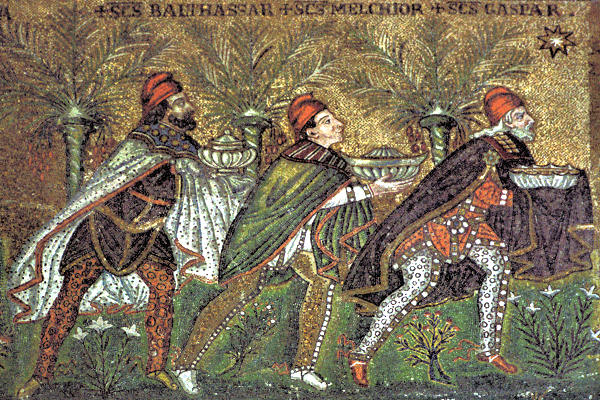
“It was by a revelation that I was given the knowledge of the mystery.” So Paul describes the gift of faith to the Ephesians. In Matthew’s Gospel that same gift of faith is explained like this: “We saw his star as it rose and have come to do him homage.” That is what the Wise Men say to Herod, when they come to Jerusalem looking for the infant king. Isaiah spoke of the gift of faith in these terms, “Above you the Lord now rises and above you his glory appears, though night still covers the earth and darkness the peoples.” The Magi followed a star, whereas Isaiah had foretold that the Lord himself would rise and shine, bringing light to his people and to all those who “lift up their eyes and see.” “It means” writes Paul, “that the pagans now share the same inheritance, that they are parts of the same body.”
“The sight of the star filled them with delight.” The journey of the Magi is really the Exodus of the Gentiles, an exodus from the darkness of separation, ignorance, idolatry and paganism to the light of revelation and the knowledge of God. The gift of faith demands a journey, a pilgrimage: from Ur of the Chaldeans to Canaan, from Egypt to the Promised Land, from Nazareth to Bethlehem, from distant lands to Jerusalem. This physical journey accompanies a spiritual journey of grace and conversion, a difficult journey from the worship of self to the worship of God. “Falling to their knees they did him homage.” The Wise Men could have come all the way to Jerusalem only to listen to Herod and follow his example. The shepherds could have stayed in the fields with their sheep. Mary and Joseph could have said, “No,” to the bidding of the angel. Paul could have rejected that revelation on the road to Damascus. It was only the experience of Easter that ultimately convinced the disciples that Jesus was the Christ, thus opening their hearts to receive the Holy Spirit.
The Epiphany, traditionally known as Easter in Winter, celebrates the Paschal Mystery. The star above the manger is a light that shines in the darkness, pointing to a greater light, Christ himself, the Light of the World. The wood of the manger will become the wood of the cross and the cave at Bethlehem, an empty tomb. The title given to Jesus by the Magi, “King of the Jews,” will be nailed to the cross by Pontius Pilate. The star leading the Wise Men will give way to the dawning light of Easter and their question, “Where is he who is born?” echoed by that of Mary Magdalene, “Where have you put him?” Just as the Magi kneel down and do homage, so Thomas, falling to his knees before the Risen Christ, will say, “My Lord and my God.”
Today we celebrate the threefold revelation of the Mystery of Salvation. The Kings present their prophetic gifts to the Christ-child; Jesus is baptised by John in the waters of the Jordan and, at the Wedding Feast of Cana, water is transformed into wine. When St Leo the Great preached on this day over 1,500 years’ ago, he said. “The gifts the Magi first brought to Bethlehem are still being offered by all who come to Christ in faith. When we acclaim Christ as King of the universe, we bring him gold from the treasury of our hearts; when we believe that the only-begotten Son of God has become one with our human nature, we are offering myrrh for his embalming; and when we declare him to be equal in majesty to the Father, we are burning the incense of our worship before him.”
Our prayer today is that we listen to Jesus and do what he tells us, that the water of our humanity be changed into the wine of his divinity, that we see God, not lying in a manger, but face to face in the glory of the Kingdom, for that is where the star is leading us.
On behalf of the monastic community, I wish you all a happy Epiphany.


 Posts
Posts

