EXPAND YOUR READING!!

"Today the concept of truth is viewed with suspicion, because truth is identified with violence. Over history there have, unfortunately, been episodes when people sought to defend the truth with violence. But they are two contrasting realities. Truth cannot be imposed with means other than itself! Truth can only come with its own light. Yet, we need truth. ... Without truth we are blind in the world, we have no path to follow. The great gift of Christ was that He enabled us to see the face of God".Pope Benedict xvi, February 24th, 2012

The Church is ecumenical, catholic, God-human, ageless, and it is therefore a blasphemy—an unpardonable blasphemy against Christ and against the Holy Ghost—to turn the Church into a national institution, to narrow her down to petty, transient, time-bound aspirations and ways of doing things. Her purpose is beyond nationality, ecumenical, all-embracing: to unite all men in Christ, all without exception to nation or race or social strata. - St Justin Popovitch

Thursday, 5 October 2017

"IMAGE AND ICON, BAPTISM AND EUCHARIST" BY DOM ALEX ECHEANDIA plus ORTHODOX QUOTATIONS & VIDEOS ON THESE SACRAMENTS

WELCOME BACK, FATHER ALEX!

                                   
a)    Baptism
b)   Eucharist


Baptism


 Early XIV century, Ohrid, Serbia


Composition of the icons for the Baptism of Christ developed between the third and sixth centuries and they have remained mainly consistent since then. Icons show the Lord Jesus appearing and revealing himself in public in a special way. Not just the Son, but the two other persons of the Trinity are manifested: one in a form of a dove and the other the voice that calls upon his son. Here the Holy Trinity is revealed, Christ is baptized and the origins of Christian baptism are discerned.


The Epiphany for the West is mainly focused on the visit of the Magi; while in the East, what is called “Theophany” or “Epiphany” relates to the Baptism of Christ. This separate celebration of Christ’s Baptism feast dates from the fourth century.[1] Before that it was united to the Nativity. This separate celebration was a reflection of the situation in the Church at the time.  In the fourth century, the Church was prepared to answer questions about the divinity of Christ raised by Arius from Alexandria (250-336 AC). Is Jesus divine?  Does this mean that he is God? “Of course”, we may say, but it was not certain in the first centuries of Christianity. Icons of Baptism reflect the teaching of the Church at the Council of Nicea in 325. 


Jesus is the Second Person of the Trinity, God the Son Incarnate from the Virgin Mary. Thus, icons manifest in colours, lines and other elements the teaching of the Church at the councils, the central truth of our faith, like the Divine Maternity of Mary, Her Virginity and that Christ is the incarnate Son of God, truly God and truly Man united in one person.


The icon of the Baptism of Christ reproduces the gospel account. It also contains other elements taken from the liturgy and from other biblical texts. The implication of the Trinity, for example, at the beginning of Genesis: “Let there be light” is implied in the symbol of the ray of light at the centre of the icon.[2] It also recalls the column of light in the desert as God’s presence.  The Trinity is manifested in the icon without divisions. It is a unity.


Christ in the Jordan blessed the water in order that we may enter into a renewed life, a new creation. Christ immersed in the Jordan symbolized our own immersion in the waters of Baptism. Christian baptism follows Christ in the Jordan. Liturgical text and liturgical actions in the East accompany this event. Texts refer to Christ saving Adam by cleansing and enlightenment. He comes to slay the enemy hidden in the waters in order to deliver the world from his snares and give eternal life to mankind.[3] Dragons are frequently represented in this icon and in hymns derived from the Psalm 74:13 “You divided the sea by your might; you broke the heads of the sea monsters on the waters.” Other texts show a sense of paradox like: The master baptized by the servant, the Source of joy baptized in the streams of the Jordan, the Invisible becoming visible at the Jordan.


In practice, the liturgical act is an extension of what Christ did at the Jordan. The waters were blessed and the life of his creation renewed. So, the day before Theophany, called Forefeast, the first blessing of the water is for the sacrament of Baptism and other uses in the Church. It takes place at the centre of the church. The second blessing of water takes place outside in the environment such as rivers and seas because they are related to nature for the use of everyday’s life.


Water as a key element of material creation becomes instrument of renewal, healing and sanctification administered by the Church. In the icon the dark central area representing the waters of the Jordan looks very much like a mouth of a cave. It may recall to similar features to the icons of Nativity and Anastasis (Easter). He is portrayed standing naked in the Jordan symbolizing the nakedness of Adam. His right hand is always blessing the waters. Above Christ is John the Baptist with his right hand on Jesus’s head and with the other pointing out either the one who is been baptized or to the one who send him, all in the light of the Trinity. He is in a higher level representing the humility of Christ, the Servant of God


On the right there are angels attending this mystery. They show that heavens are participating in this cosmic event at the Baptism of him who is Human and Divine, God and Man at the same time. Their hands covered and their bowed position show a sign of veneration.  At the top of the icon we see the dark blue shape representing the divine reality from which comes a ray that contains in it the dove descending on Christ. It also is seen in icons of the Annunciation and Nativity manifesting the Trinity in a mysterious way bringing about in different events God’s plan of salvation. The dove also is related to the story of the flood in the Old Testament in the figure of Noah. It involves destruction and a new beginning.


The sacrament of Baptism takes us into Christ work of redemption achieved by his death and resurrection. It is signified in his baptism, because here the Holy Trinity has been manifested as it was manifested at the Transfiguration of Christ. The words of the Father are very similar, and the cloud that covered Jesus and the shape of dove upon Jesus reveal the link between these two events.  The image of the Baptism of Christ is interpreted as the opening of a  path to a new life. 


The movement from death to life reminds us that his death and his resurrection opens the door to our own resurrection in Him. John Chrysostom said: "Going down into the water and coming up again in baptism are the image of the descent of Christ into Hades and of his resurrection."[4] Thus, the icon of the Baptism of Christ, like all other true icons, is embedded in Scripture and the Tradition of the Church. They exist in order to invigorate the spiritual and theological life of the faithful. Through these icons we can approach God and God can approach us in a more familiar way. We can meet the Lord in his mysteries as we prepare our hearts to be responsive to God in the ordinary circumstances of our lives.

Orthodox Quotations on Baptism
St. John Chrysosotom: [W]hen you are about to pass over the threshold of the gateway . . .
[W]hen you are about to pass over the threshold of the gateway, say this word first: I leave your ranks, Satan, and your pomp, and your service, and I join the ranks of Christ. And never go forth without this word. This shall be a staff to you, this your armor, this an impregnable fortress, and accompany this word with the sign of the cross on your forehead. For thus not only a man who meets you, but even the devil himself, will be unable to hurt you at all, when he sees you everywhere appearing with these weapons; and discipline yourself by these means henceforth, in order that when you receive the seal you may be a well-equipped soldier, and planting your trophy against the devil, may receive the crown of righteousness, which may it be the lot of us all to obtain, through the grace and lovingkindness of our Lord Jesus Christ, with whom be glory to the Father and to the Holy Spirit for ever and ever— Amen.

+ St. John Chrysostom, Instructions to Catechumens

St. Nikodemos of the Holy Mountain: The grace of the Holy Spirit which is given mystically to every Christian . . .

“The grace of the Holy Spirit which is given mystically to every Christian when he is baptized acts and is manifested in proportion to our obedience to the commandments of the Lord. That is, if a Christian obeys the commandments of the Lord more, grace acts with him more, while if he obeys them less, grace acts within him less. Just as a spark, when covered in the ashes of fire becomes increasingly manifest as one removes the ashes, and the more fire wood you put the more the fire burns, so the grace that has been given to every Christian through Holy Baptism is hidden in the heart and covered up by the passions and sins, and the more a man acts in accordance with the commandments of Christ, the more he is cleansed of the passions and the more the fire of Divine grace lights in his heart, illumines and deifies him.”

+ St. Nikodemos of the Holy Mountain, Christian Morality


St. John of Kronstadt: Sermon on the Nativity of Jesus Christ (Part 4)


Nativity of Jesus“Let us glorify God! With the coming of the Son of God in the flesh upon the earth, with His offering Himself up as a sacrifice for the sinful human race, there is given to those who believe the blessing of the Heavenly Father, replacing that curse which had been uttered by God in the beginning; they are adopted and receive the promise of an eternal inheritance of life. To a humanity orphaned by reason of sin, the Heavenly Father returns anew through the mystery of re-birth, that is, through baptism and repentance. People are freed of the tormenting, death-bearing authority of the devil, of the afflictions of sin and of various passions.”

+ St. John of Kronstadt, Sermon on the Nativity of Jesus Christ

St. Nektarios: Christians, have we understood the great responsibility that we have taken . . .

Christians, have we understood the great responsibility that we have taken on before God through baptism? Have we come to know that we must conduct ourselves as children of God, that we must align our will with the will of God, that we must remain free from sin, that we must love God with all our hearts and always patiently await union with Him? Have we thought about the fact that our heart should be so filled with love that it should overflow to our neighbor? Do we have the feeling that we must become holy and perfect, children of God and heirs of the Kingdom of Heaven? We must struggle for this, so that we may not be shown unworthy and rejected. Let none of us lose our boldness, nor neglect our duties, nor be afraid of the difficulties of spiritual struggle. For we have God as a helper, who strengthens us in the difficult path of virtue.”

+ St. Nektarius of Aegina, The Path to Happiness, 2


Eucharist


    A good icon that refers to the Eucharist is the Famous Trinity icon of Andrei Rublev. It is based on the Old Testament account of the hospitality of Abraham under the oak of Mamre.[5] The three mysterious pilgrims which the bible called angels announced the miraculous birth of Isaac, an announcement that fulfilled what God had promised to Abraham. This event became a source of patristic interpretations, but it was in the East of the ninth and tenth centuries that used it in liturgical and theological works.[6] They saw in this event the symbolic apparition to Abraham of the Holy Trinity.


The three angels, grouped together in a conversation round the table, outline the shape of a circle, a perfect figure. Symbols of the bread and the chalice contain a calf’s head. It is the symbol of the lamb of sacrifice which becomes the centre of the circle.  It refers to the passion, death and Resurrection of Christ, the love manifested in the sacrifice of the cross. So, the Icon of the Trinity as Eucharist shows us that God’s love for man which results in the Incarnation has its origin in the very Nature of the Triune God as Eternal Love and Communion.


The lines that make up the image are replete with theological implications.. We can also concentrate on the “back to front” perspective. It is not a natural, temporal and realistic perspective.   The point in the picture where all lines meet is not, as in other pictures, behind the figures: they meet in the heart of the person looking at the icon!! It is as though the persons are looking at us, that we are the picture, rather than the other way round. It is not man who contemplates God but God who contemplates man. In the same way, Christ offered Himself in his body and blood to us without any merits from our part.  The icon draws us into the dimension of the eternal.


There are various interpretations of the individual persons. The Father may be on the right because this would put Christ on his right, which is his normal position.  On the other hand, He may be represented by the angel on the left because the other two persons wear stoles, and he does not.  A stole means that a person has been sent. Both the Son and the Spirit were sent; the Father was the One who sent the Son and the Spirit. What most people who interpret this icon agree, is that the Son is in the middle. He is blessing the cup and the the gifts, as he did in the last Supper and on the Road to Emmaus. He is also the one the People of God saw face to face when he became man.  


So, the meal prepared by Abraham and Sarah prefigures the Last Supper. It was during the Last Supper that Christ founded the Church and instituted the Sacrament of the Eucharist. In addition, a liturgical Eucharistic act is seen here. The two angels at each side stand for the priests saying the prayers over the Eucharistic gifts.  It is a reflection of the Liturgy of Heaven. Thus, to share the table the Trinity also recalls the Eucharist banquet of the Kingdom of Heaven.


The Holy Eucharist Icon


Following what we mentioned about the Eucharist banquet in heaven, this icon does not depict an event from the life of Christ or His apostles. Rather, it represents the timeless, eternal, and mystical event being celebrated celestially. The Eucharist is not restricted to a particular time or place.


The Eucharist was already described by St. Paul[7] as the “proclamation” of Christ’s death and Second Coming. As the purpose of Scripture is essentially the proclamation of the Kingdom and the announcement of eschatological realities, the Eucharist is a foretaste of the Kingdom.


The icon frequently has the Scriptures on the altar with the words: I am the Living Bread which came down from heaven. It comes from John’s Gospel 6:32. Christ is presented as bread, and sometimes icons place Christ in a chalice symbolizing his own body and blood. In other icons Mary is behind Christ in the shape of a chalice representing the container, the one who bears the Lamb of God in her womb.


[1] John Chrisostom says: “It is not the day when Christ was born that should be called epiphany, but the day when he was baptised because before the day of his baptism he was not known to the people”. Cf. Festival of Icons for the Christian year by John Baggley, p. 49.


[2] Cf. The Art of the Icon by Paul Evdokimov, p. 295.
[3] Cf. Cf. Festival of Icons for the Christian year by John Baggley, p. 49. Text taken from  the Sixth Hour on the Eve of the Theophany.
[4] Homily 1 Cor. 40; PG 61,34 B.
[5] Genesis 18
[6] Taken from Dionisij Worshop 2000,  p.12.
[7] I Cor. 11

THE INNER MEANING OF THE DIVINE LITURGY
"Heaven on Earth"
by Met. Kallistos Ware


QUOTATIONS ON THE EUCHARIST
ON TRANSUBSTANTIATION

During the iconoclasm controversy (eighth–ninth centuries), the change in the Eucharist was used to refute the arguments of iconoclasts who claimed the Eucharist was the only true icon of Christ. In these debates, the iconodule St. Theodore the Studite wrote, “We confess that the faithful receive the very body and blood of Christ, according to the voice of God himself.” The reality of transubstantiation was a refutation of iconoclasm. The Eucharist was not an icon of Christ, but was the real and true presence of the person Jesus Christ in the bread and wine of the Eucharist; or rather, a true symbol.

 340. How are we to understand the word transubstantiation?

In the exposition of the faith by the Eastern Patriarchs, it is said that the word transubstantiation is not to be taken to define the manner in which the bread and wine are changed into the Body and Blood of the Lord; for this none can understand but God; but only thus much is signified, that the bread truly, really, and substantially becomes the very true Body of the Lord, and the wine the very Blood of the Lord. In like manner John Damascene, treating of the Holy and Immaculate Mysteries of the Lord, writes thus: “It is truly that Body, united with Godhead, which had its origin from the Holy Virgin; not as though that Body which ascended came down from heaven, but because the bread and wine themselves are changed into the Body and Blood of God. But if thou seekest after the manner how this is, let it suffice thee to be told that it is by the Holy Ghost; in like manner as, by the same Holy Ghost, the Lord formed flesh to himself, and in himself, from the Mother of God; nor know I aught more than this, that the Word of God is true, powerful, and almighty, but its manner of operation unsearchable.” (J. Damasc. Theol. lib. iv. cap. 13, § 7.)

Longer Catechism of the Orthodox, Catholic, Eastern Church by St. Philaret (Drozdov) of Moscow (1830)

He is not present typically, nor figuratively, nor by superabundant grace, as in the other Mysteries, nor by a bare presence, as some of the Fathers have said concerning Baptism, or by impanation, so that the Divinity of the Word is united to the set forth bread of the Eucharist hypostatically, as the followers of Luther most ignorantly and wretchedly suppose.
But truly and really, so that after the consecration of the bread and of the wine, the bread is transmuted, transubstantiated, converted and transformed into the true Body itself of the Lord, Which was born in Bethlehem of the ever-Virgin, was baptized in the Jordan, suffered, was buried, rose again, was received up, sits at the right hand of the God and Father, and is to come again in the clouds of Heaven; and the wine is converted and transubstantiated into the true Blood itself of the Lord, Which as He hung upon the Cross, was poured out for the life of the world.

Orthodox Confession of Dositheus, Patriarch of Jerusalem (1672)


Fourthly, attention must be paid that the priest have, at the time of consecration, the intention that the real substance of the bread and the substance of wine be transubstantiated into the real body and blood of Christ through the operation of the Holy Spirit.
He makes this invocation when he confects this mystery by praying and saying: “Send your Holy Spirit upon us and upon these gifts here offered and make this bread the precious body of your Christ, and that which is in this chalice the precious blood of your Christ, changing them by your Holy Spirit.”
Transubstantiation occurs immediately with these words, and the bread is transubstantiated into the real body of Christ and the wine into the real blood of Christ, with the visible appearances alone remaining.

Orthodox Confession of Faith, Peter Mogila, Metropolitan of Kiev (1633-1647)

THE EUCHARIST AS SACRIFICE
"offered by whom to whom"
by Met. Kallistos Ware


Tuesday, 3 October 2017

POPE FRANCIS AND 'AMORIS LAETITIA': WHAT IS BEHIND THE DISPUTE IN WHICH LEADING CATHOLICS, INCLUDING FOUR CARDINALS, PUBLICLY DISAGREE WITH THE POPE.


THE MYSTERY OF THE MOON
The "mystery of the moon” is a formula that the Fathers of the Church repeatedly used beginning in the second century to suggest what might be the true nature of the Church and the action that is appropriate to it: like the moon, “the Church shines not with its own light, but with that of Christ” ("fulget Ecclesia non suo sed Christi lumine"), St. Ambrose says. While for Cyril of Alexandria, “the Church is enveloped in the divine light of Christ, which is the only light in the kingdom of souls. There is therefore a single light: in this one light nonetheless shines also the Church, which is not however Christ himself.” 
The Church does not have its own light: as the moon reflects the light of the sun, so the Church reflects the light of Christ.   

To understand what Pope Francis is doing, we shall start with his address to the cardinals that so impressed them that they elected him.  Typically, it is short and to the point:


EVANGELIZING THE PERIPHERIES
by  Jorge Mario Bergoglio

Reference has been made to evangelization. This is the Church's reason for being. “The sweet and comforting joy of evangelizing” (Paul VI). It is Jesus Christ himself who, from within, impels us.
1) Evangelizing implies apostolic zeal. Evangelizing presupposes in the Church the “parresia" of coming out from itself. The Church is called to come out from itself and to go to the peripheries, not only geographical, but also existential: those of the mystery of sin, of suffering, of injustice, those of ignorance and of the absence of faith, those of thought, those of every form of misery.
2) When the Church does not come out from itself to evangelize it becomes self-referential and gets sick (one thinks of the woman hunched over upon herself in the Gospel). The evils that, in the passing of time, afflict the ecclesiastical institutions have a root in self-referentiality, in a sort of theological narcissism. In Revelation, Jesus says that he is standing at the threshold and calling. Evidently the text refers to the fact that he stands outside the door and knocks to enter. . . But at times I think that Jesus may be knocking from the inside, that we may let him out. The self-referential Church presumes to keep Jesus Christ within itself and not let him out.
3) The Church, when it is self-referential, without realizing it thinks that it has its own light; it stops being the “mysterium lunae" and gives rise to that evil which is so grave, that of spiritual worldliness (according to De Lubac, the worst evil into which the Church can fall): that of living to give glory to one another. To simplify, there are two images of the Church: the evangelizing Church that goes out from itself; that of the “Dei Verbum religiose audiens et fidenter proclamans" [the Church that devoutly listens to and faithfully proclaims the Word of God - editor's note], or the worldly Church that lives in itself, of itself, for itself. This should illuminate the possible changes and reforms to be realized for the salvation of souls.
4) Thinking of the next Pope: a man who, through the contemplation of Jesus Christ and the adoration of Jesus Christ, may help the Church to go out from itself toward the existential peripheries, that may help it to be the fecund mother who lives “by the sweet and comforting joy of evangelizing.”
Pope  Francis repeats this theme on the Feast of St John the Baptist.  He says:


We must pray “for the grace not to become an ideological church”, Pope Francis said at Mass this morning.
Reflecting on the life of St John the Baptist, whose solemnity is observed today, the Pope said the Church’s duty was to hear the Word of Jesus and proclaim it boldly.


“That,” he said, “is the Church without ideologies, without a life of its own: the Church which is the mysterium lunae, which has light from her Bridegroom and diminish herself so that He may grow.”
According to Vatican Radio, he added: “This is the model that John offers us today, for us and for the Church. A Church that is always at the service of the Word. A Church that never takes anything for herself. Today in prayer we asked for the grace of joy, we asked the Lord to cheer this Church in her service to the Word, to be the voice of this Word, preach this Word. We ask for the grace, the dignity of John, with no ideas of their own, without a Gospel taken as property, only one Church that indicates the Word, and this even to martyrdom. So be it!”

Thus the Church has two choices: it must either go out from itself towards the peripheries, reflecting the light of Christ in its activity or it can become spiritually worldly and concerned with its own glory, indulging in self-assertion.   This thinking reflects the theology of Hans Urs von Baltazar for whom the love of God is essentially kenotic (self-emptying), with its roots in the very life of the Trinity.  The kenotic love of the Father  gives his whole Being to the Son by the  breathing out of the Holy Spirit who thus becomes the kenotic love of them Both.  The Church must reflect this kenotic love as the moon's light reflects the sun.    All its activity must reflect the prayer of St Francis whose name has been adopted by the pope:

Lord make me an instrument of your peace:Where there is hatred let me sow love,Where there is injury, pardon,Where there is doubt, faith,Where there is despair, hope,Where there is darkness, light,And where there is sadness, joy.

O divine master grant that I maynot so much seek to be consoled as to console,to be understood as to understand,To be loved as to love.For it is in giving that we receive,it is in pardoning that we are pardoned,And it's in dying that we are born to eternal life,Amen

This is the key to understanding Pope Francis' policy.   The basic truths of Catholicism that remain the same from one generation to the next do not stand alone, in abstract, outside any context: in each age and in each place, they must be re-shaped so that they are seen as Gospel to those who live on the margins.  This does not mean that their fundamental content is changed, but their emphasis and the rules by which the Church puts them into practice must be adapted to fit into the context of that prayer.  Of course, we must come to know and love those who live on the margin as well as have a prayerful insight into the truths themselves before this can be done effectively.

There is a fundamental difference between law in the civil society and law exercised in the Church; and confusion between them has often led us into unnecessary difficulties.   Civil law is based on the power to enforce it; and, in history, this was often brought about by conquest: when Roman troops were withdrawn from Britain, Roman power collapsed. On the other hand,  in the words of Pope Francis, the only authority that the Church has is service and the only power it has is the Cross, but this authority and this power embrace the whole of humanity.  Church Law and its exercise must express the kenotic love of God in Christ for his creation, or it is nothing.

In St Luke's Gospel, Jesus sums up his mission in this quotation from Isaiah


The spirit of the Lord has been given to me, for he has anointed me.He has sent me to bring the good news to the poor, to proclaim liberty to captives and to the blind new sight, to set the downtrodden free, to proclaim the Lord's year of favour.

  The force behind those who shape the laws, those who administer the laws and those who obey them is ecclesial love that reflects the active presence of Trinitarian love.  Like the moon, the Church has no power in itself: its only authority is that of Christ who put himself at the service of his disciples and works in and through the humble obedience of the Church .

If this be so, where is the centre of the Church, that through which the Church remains united?   The answer is, Where the glory of God is united in "synergia" to the activity of the Church, so that what the Church does is also where God is acting.  Vatican II indicates precisely where thiis must be, in the celebration of the liturgy.   Sacrosanctum Consilium is the very first document of the Council:


From this it follows that every liturgical celebration, because it is an action of Christ the Priest and of his Body, which is the Church, is a sacred action surpassing all others. No other action of the Church can equal its efficacy by the same title and to the same degree. 
8. In the earthly liturgy we take part in a foretaste of that heavenly liturgy which is celebrated in the Holy City of Jerusalem toward which we journey as pilgrims, where Christ is sitting at the right hand of God, Minister of the holies and of the true tabernacle.[22] With all the warriors of the heavenly army we sing a hymn of glory to the Lord; venerating the memory of the saints, we hope for some part and fellowship with them; we eagerly await the Saviour, Our Lord Jesus Christ, until he our life shall appear and we too will appear with him in glory

10. Nevertheless the liturgy is the summit toward which the activity of the Church is directed; it is also the fount from which all her power flows. for the goal of apostolic endeavour is that all who are made sons of God by faith and baptism should come together to praise God in the midst of his Church, to take part in the Sacrifice and to eat the Lord's Supper. 


Because the liturgy is both an activity of Christ the Priest and of the Church, it is from the celebration of the liturgy where Christ and Church are in synergy that all the Church's power flows: Tradition has its roots in the celebration of the liturgy in local churches throughout the Christian world from the time of the Apostles to the present day.

By its very nature, Tradition is embedded in the traditions of the local churches in all their variety of culture and concrete circumstances.  The bishops in each set of circumstances are charged to so adapt their form of proclaiming the Gospel that is appears as Good News to their listeners.  They also bear witness of their church's catholicity to the universal Church.

If the bishops bear witness to the diversity in Tradition, it belongs to the pope, with his petrine ministry, to bring out and foment its unity.   Unity in diversity is a favourite theme for Pope Francis.  


VATICAN CITY (CNS) -- The Holy Spirit continues to give Christians different gifts and to call them to share those gifts with each other in a community marked by forgiveness and "unity in diversity," Pope Francis said on Pentecost."In a way both creative and unexpected," the pope said, the Holy Spirit "generates diversity, for in every age he causes new and varied charisms to blossom. Then he brings about unity: he joins together, gathers and restores harmony."
In his homily at the Mass, the pope said Christians can block the unity in diversity desired by the Holy Spirit by focusing on their differences rather than on what they share."This happens when we want to separate, when we take sides and form parties, when we adopt rigid and airtight positions, when we become locked into our own ideas and ways of doing things, perhaps even thinking that we are better than others," he said."When this happens," the pope said, "we choose the part over the whole, belonging to this or that group before belonging to the church" and taking pride in being "Christians of the 'right' or the 'left' before being on the side of Jesus."The other temptation, he said, is to seek unity without tolerating diversity. "Here, unity becomes uniformity, where everyone has to do everything together and in the same way, always thinking alike."When the Holy Spirit descended on the disciples at Pentecost, he said, the first gift the Spirit brought was forgiveness for their sins and the grace to forgive others."Here we see the beginning of the church, the glue that holds us together, the cement that binds the bricks of the house: forgiveness," he said.Forgiveness "preserves unity despite everything, prevents collapse and consolidates and strengthens," he said. "Forgiveness sets our hearts free and enables us to start afresh."

 This process of unification while allowing differences of approach is at local, regional and universal levels is the work of synods and of the petrine ministry.


  A synodal Church is a Church which listens, which realizes that listening “is more than simply hearing”.(12) It is a mutual listening in which everyone has something to learn. The faithful people, the college of bishops, the Bishop of Rome: all listening to each other, and all listening to the Holy Spirit, the “Spirit of truth” (Jn 14:17), in order to know what he “says to the Churches” (Rev 2:7).
The Synod of Bishops is the point of convergence of this listening process conducted at every level of the Church’s life. The Synod process begins by listening to the people of God, which “shares also in Christ’s prophetic office”,(13) according to a principle dear to the Church of the first millennium: “Quod omnes tangit ab omnibus tractari debet”. The Synod process then continues by listening to the pastors. Through the Synod Fathers, the bishops act as authentic guardians, interpreters and witnesses of the faith of the whole Church, which they need to discern carefully from the changing currents of public opinion. On the eve of last year’s Synod I stated: “For the Synod Fathers we ask the Holy Spirit first of all for the gift of listening: to listen to God, so that with him we may hear the cry of his people; to listen to his people until we are in harmony with the will to which God calls us”.(14) The Synod process culminates in listening to the Bishop of Rome, who is called to speak as “pastor and teacher of all Christians”,(15) not on the basis of his personal convictions but as the supreme witness to the fides totius Ecclesiae, “the guarantor of the obedience and the conformity of the Church to the will of God, to the Gospel of Christ, and to the Tradition of the Church”.(16)
The fact that the Synod always acts cum Petro et sub Petro — indeed, not only cum Petro, but also sub Petro — is not a limitation of freedom, but a guarantee of unity. For the Pope is, by will of the Lord, “the perpetual and visible source and foundation of the unity both of the bishops and of the whole company of the faithful”.(17) Closely related to this is the concept of “hierarchica communio” as employed by the Second Vatican Council: the Bishops are linked to the Bishop of Rome by the bond of episcopal communion (cum Petro) while, at the same time, hierarchically subject to him as head of the college (sub Petro).(18)

Thus, when Pope Francis talks of the Tradition of the Church, he is speaking of a unity in diversity in which both are important in so far as they both reflect the activity of the Holy Spirit.  Like Vatican II he looks for solutions to modern problems in the manifold Tradition of East and West.   He also looks for pastoral insights and understandings from the bishops from all over the world.  He does not centre the magisterium in the Vatican alone but also in regional centres: for example, he has spoken of the magisterium of the South American Church with its CELAM conferences.   He revels in the variety of movements in the Church and is cautious in his criticism of them. He is cautious even to unchurch Bishop Fellay and the Society of St Pius X: everybody who is moved by grace has a place in the Church He says we should not be left wing or right wing, but Catholic.   

It seems that the traditional Vatican stance is that while diversity is human, the movement towards unity is the work of the Spirit.   For Pope Francis, both diversity and unity belong to each other and are the work of the Spirit and get over their inevitable limitations by paying heed to each other.  For example, if the Vatican were to value its own tradition over all the others - it has been known - and ignores what is happening in the rest of the Church, it becomes less than Catholic, excluding aspects of Catholicism that should be included.  If a movement within the Church neglects the importance of its teaching to be recognised as Catholic by the rest of the Church, then it is on the way to schism.


TWO SIGNIFICANT EVENTS IN VATICAN II

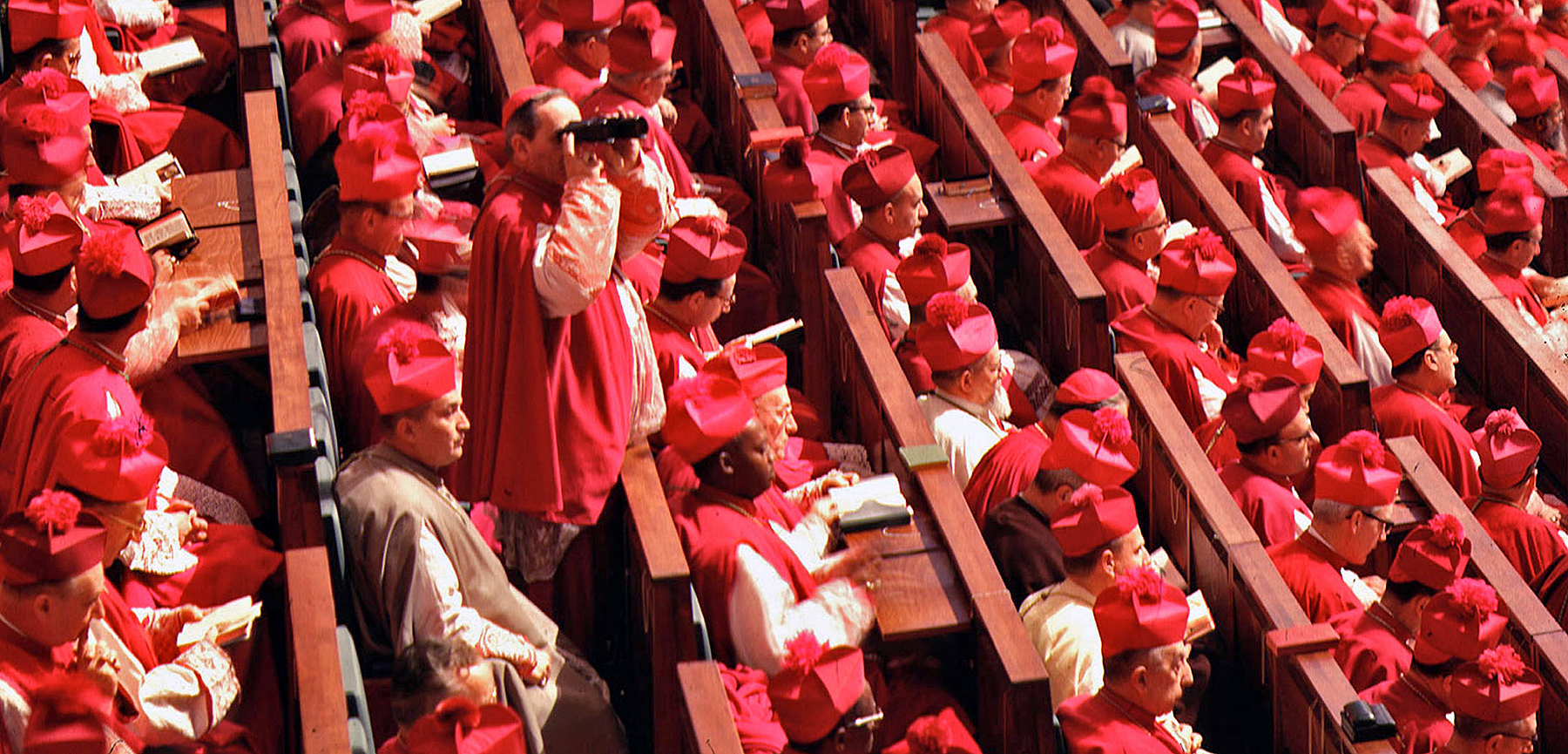
Two events happened at the beginning of the 2nd Vatican Council which changed the council from being a council organised, guided and controled by the Vatican Curia to one which put the college of bishops firmly in the driving seat.  They were the intervenions of two very ancient cardinals who, together, altered the whole course of the council.

The first working session of the council, on 13 October, 1962, began with the election of members of the ten conciliar commissions on whose shoulders the main work of the council would fall.   The list had been prepared before the council and was so constituted that the curia bishops would have had the majority.  (I had this from someone who was there.)  Up strode Cardinal Achille Leanart to the podium and told the cardinal presiding that he wished to address the bishops and was told that he couldn't because it wasn't in the programme.   He replied that he was going to speak to them anyway; and, taking the microphone from the president, he turned and spoke.  He told the bishops that it was not very intelligent to elect people they didn't know to the commissions which were so very  important for the success of the council; and he suggested that they suspend the session until they had time to know whom they would elect.   This was carried by acclamation.   The session lasted fifteen minutes.   The curia lost control to the assembled bishops of the ten conciliar commissions.

The second event was the intervention of Cardinal Frings of Cologne, old, going blind and in bad health.   He acted through his young secretary, Father Joseph Ratzinger who composed his speeches.   The Curia presented a draft document on "de Revelatione, with quotations from Vatican I and from various popes, but with little from Scripture and the Fathers.   Cardinal Frings said it was not fit for purpose as a council document and should be scrapped.  An attempt by the Curia to supply a theological document of importance without any input from la theologie nouvelle failed, and the direction of the council once more went to the bishops.

It is ironic that, by the time Popes John Paul II and Benedict XVI hit the scene, the Curia had re-established control over the synods.  Many were waiting for someone like Cardinal Bergoglio to bring back the importance of concilarity, and this Pope Francis is doing, but it involves something more than changing rules: it means showing up the inadequacies of the theology that underpins the curial tradition.

We have now come to the synods on the family and the post-synodal apostolic exhortation "Amoris Laetitia".

We have seen that, for Pope Francis, Tradition is a dynamic process with two major movements, that of diversity and unity.   The activity of the Holy Spirit can be found, both in the creation of diversity and in the discovery of coherence within the diverse positions and the revelation of unity.   Thus, there are four Gospels, and it would be an act of violence to our Faith to reduce them to one, and there is the one Gospel revealed in the four.   There were two major schools of Antioch and Alexandria, very much opposed to one another, but their unity was revealed in the definition of the Council of Chalcedon.  (It was an imperfect unity because the definition in Greek did not make adequate sense in the Syriac of the Nestorian Assyrians nor in the Ge'ez of the Miaphysite Copts.  The tragedy is that it has taken until now to realise there was no heresy in either case.)  However, this movement towards diversity, represented by the bishops of the the local churches, and the concern for unity, represented by the petrine ministry, are continuing characteristics of Catholic Tradition.

Until Pope Francis, the Vatican Curia was convinced that Catholic Tradition exists in a pure form in the Vatican itself and that the bishops of the world could only manifest that Tradition if  the Vatican controled them and shepherded them, and avoided any questions by censorship that would separate them.  Thus they tried to control Vatican II, and were permitted to control the synods that continued the work of Vatican II.  However, many in the Church remembered that the 2nd Vatican Council would not have become what it became if the hold on it by the Vatican Curia had not been broken; which is why Pope Francis was elected.

In the synods, the pope did not allow the membership of the episcopal body to be vetted, nor did he tell them that certain topics were to be avoided.  The real differences emerged.  They were not invented by the pope but had been hidden from sight, on purpose, by the Curia.  Pope Francis  let the differences out in the open for all to see.   For years, even before Vatican II, bishops and priests used the "internal forum", permitting certain people to go to communion - I did - and confession secrecy not only protected the penitent, but the priest as well.  I have even fought to preserve the unity of families which were illegitimate by Catholic standards, for the good of everyone involved.   Cardinal Burke would never understand this. However, those who believe that Catholic truth is identical to curial truth, Catholic Tradition is identical to curial tradition, have had a shock: and it is a long time coming. 

 Here are two videos that show their incomprehension, their resulting suffering and their zeal for souls.   They are not enemies: they are our companions in the fight against the devil, the world and the flesh; but they cannot recognise the validity of any other Catholic theology but their own, any other tradition that that of the Curia.  

Actually, it is the same Tradition, but looked at from another perspective and in another context.   In reality, Catholic Tradition is when all the traditions, formed in all the contexts throught the world, come together to become one; and it is the popes function, when opportunity arises, to help bring this about.

AMORIS LAETITIA


There is a Catholic truth that binds all the disagreeing factions together.  In the words of Pope Francis:


Some are called to holiness through family life in the sacrament of Marriage. Today, there are those who say that marriage is out of fashion. Is it out of fashion?
In a culture of relativism and the ephemeral, many preach the importance of "enjoying" the moment. They say that it is not worth making a life-long commitment, making a definitive decision, "forever", because we do not know what tomorrow will bring.
I ask you, instead, to be revolutionaries, I ask you to swim against the tide; yes, I am asking you to rebel against this culture that sees everything as temporary and that ultimately believes you are incapable of responsibility - that believes you are incapable of true love. I have confidence in you and I pray for you. Have the courage to swim against the tide. And also have the courage to be happy.

From Amoris Laetitia itself:

“The indissolubility of marriage — ‘what God has joined together, let no man put asunder’ (Matthew 19:6) — should not be viewed as a ‘yoke’ imposed on humanity, but as a ‘gift’ granted to those who are joined in marriage…” (62)

“‘Only in contemplating Christ does a person come to know the deepest truth about human relationships. ‘Only in the mystery of the Incarnate Word does the mystery of man take on light... Christ, the new Adam, by the revelation of the mystery of the Father and his love, fully reveals man to himself and makes his supreme calling clear’ (Gaudium et Spes, 22). It is particularly helpful to understand in a Christocentric key... the good of the spouses (bonum coniugum) which includes unity, openness to life, fidelity, indissolubility and, within Christian marriage, mutual support on the path towards complete friendship with the Lord.’”

This is the Catholic teaching which the different parties in dispute agree on.  Anyone who believes that, somehow or other, Pope Francis is calling into question the ordinary teaching of the Church on marriage is gravely mistaken and unjust to Pope Francis.

That being the case, what are the differences between Pope Francis and his critics?

Cardinal Burke seems to teach that canon law on marriage, its indissolubility and on adulterous unions adequately reflect Christ's teaching, and any change in the rules would be unfaithful to Christ and to Tradition.

Pope Francis, on the other hand, holds that there are other aspects to the problem of two people coming together, not only the legal one, and these justify approaching the problem from different angles, without consigning the rules to the dustbin, but gaining new insights.  Pope Francis claims to be following the moral theology of St Thomas Aquinas:

“St. Thomas and St. Bonaventure affirm that the general principle holds for all but — they say it explicitly — as one moves to the particular, the question becomes diversified and many nuances arise without changing the principle,” he had said. It is a method that was used for the Catechism of the Catholic Church and “Amoris Laetitia,” he added.
“It is evident that, in the field of morality, one must proceed with scientific rigour and with love for the church and discernment. There are certain points of morality on which only in prayer can one have sufficient light to continue reflecting theologically. And on this, allow me to repeat it, one must do ‘theology on one’s knees.’ You cannot do theology without prayer. This is a key point and it must be done this way,” he had told the Jesuits in Rome.(Quotation of Pope Francis from the Catholic Herald).


It is also true that Cardinal Burke's use of the word "Tradition" shows that he identifies this word with the curial version of the tradition of the Latin West. Pope Francis, on the other hand, and following the principles of the ressourcement theologians of the council and the example of the revisers of the liturgy who introduced the epiclesis into the eucharistic prayer, looks to the tradition of the Orthodox East whose history from early times tells a very different story.   It is note worthy that the differences between East and West on marriage and divorce were never a reason to charge each other with heresy nor to break communion with each other in the first millenium, so there is a good argument that this is also true now.

Here Pope Francis sums up the common teaching of the Church on marriage while admitting that unions between a man and a woman that do not fulfill all the conditions for a Catholic sacramental marriage can have enough of the characteristics to show that grace is working in the union: it is not all black and white, as his critics make out. 

292.  Christian marriage, as a reflection of the union between Christ and his Church, is fully realized in the union between a man and a woman who give themselves to each other in a free, faithful and exclusive love, who belong to each other until death and are open to the transmission of life, and are consecrated by the sacrament, which grants them the grace to become a domestic church and a leaven of new life for society. Some forms of union radically contradict this ideal, while others realise it in at least a partial and analogous way. The Synod Fathers stated that the Church does not disregard the constructive elements in those situations which do not yet or no longer correspond to her teaching on marriage.314


Why has the pope not responded to the four cardinals or to the theologians who are challenging what he is doing?  We must remember that he is killing two birds with one stone: he is trying to support marriage and to approach people in irregular unions with a message of God's love; and, at the same time, he is attempting to change the system by which Tradition is determined at the centre in Rome, to a system where Tradition is determined by the world's bishops in dialogue with the pope, in which neither the authority of the pope nor the authority of the bishops is allowed to swamp or cancel out the other.  Knowing that the Holy Spirit is active wherever the Eucharist is celebrated, so that Tradition has its roots in the local church, he is waiting and listening because a synodal church requires all to listen, even the pope!  Francis has made the conclusions of Orthodox-Catholic dialogue his own. You will find these words which have been applied to the papal ministry as well echoed in the words of Pope Francis:

4. Synodality/conciliarity and primacies are essentially related to one another. This inter-relatedness is well expressed in the common tradition of the Church, for example by the 34th Apostolic Canon: “The bishops of each province should know the first among them (protos) and recognize him as the head, and do nothing that exceeds their authority without his consideration. Each should carry out only that which relates to his own diocese and to areas belonging to it. But the first among them should also do nothing without the consideration of all, for so there will be unanimity and God will be glorified through the Lord in the Holy Spirit”.[16] This canon indicates both the collegial and hierarchical interrelation between the bishops of a region and the one who is the “first” (protos) among them. Canon 6 of the Council of Nicaea illustrates this interrelation.[17]  (NATURE, CONSTITUTION AND MISSION OF THE CHURCH - Orthodox- Catholic Joint Commission, Rome  January 29, 2009)


It all depends on what is meant by Catholic Tradition.   If it is limited to the Latin, western tradition, and only in so far as this tradition is reflected in official documents and past popes, then Cardinal Burke & Company are right.  If it includes, besides all that, the solutions of the bishops to pastoral problems, like presenting Catholic teaching as Good News to people living on the periphery of the Church, solutions sought in communion with the other bishops and with active collaboration of the Bishop of Rome, and found in the in the traditions of East and West, then the pope is right.  If Vatican II has entered the dynamic process of Catholic Tradition, then what is now going on under the pope's guidance will do the same because it is a continuation of the same movement of the Spirit.

This method is longer and less satisfactory for those who are used to hearing everything coming from the top down; but it is better than a tradition that is sub-Catholic because it feeds on itself and does not try to learn from other parts of the Church.

Amoris Laetitia does not envisage divorced couples riding roughshod over the rules.  It wants the clergy to walk with them and to discern when is the right time.  Pope Francis has suggested that the Orthodox distinction between acribia (insistence on strict observance of the rule) and economia (invoking the salvific purpose of the Christian Mystery to overlook a rule for the good of souls.  This can only be done by bishops with the pastoral situation in mind.
299.  I am in agreement with the many Synod Fathers who observed that “the baptized who are divorced and civilly remarried need to be more fully integrated into Christian communities in the variety of ways possible, while avoiding any occasion of scandal. The logic of integration is the key to their pastoral care, a care which would allow them not only to realize that they belong to the Church as the body of Christ, but also to know that they can have a joyful and fruitful experience in it. They are baptized; they are brothers and sisters; the Holy Spirit pours into their hearts gifts and talents for the good of all. Their participation can be expressed in different ecclesial services, which necessarily requires discerning which of the various forms of exclusion currently practised in the liturgical, pastoral, educational and institutional framework, can be surmounted. Such persons need to feel not as excommunicated members of the Church, but instead as living members, able to live and grow in the Church and experience her as a mother who welcomes them always, who takes care of them with affection and encourages them along the path of life and the Gospel. This integration is also needed in the care and Christian upbringing of their children, who ought to be considered most important”.334 (Amoris Laetitia)


Whichever side of the argument is right, it must be remembered that, in the first millenium, East and West had different teaching and different pastoral practice, yet neither side accused the other of heresy or made it an excuse for schism. The four cardinals, Bishop Schneider and the sixty or so theologians on one side, the pope, other cardinals, bishops, theologians etc on the other (including me): all are Catholics and receive the same body of Christ; and our differences enrich the Church through the activity of the Holy Spirit unless we listen to Satan, the great divider, and yell, "Heresy!!" and "Schism!!"

There is much more to write, but I think I shall leave it here.   God Bless!!


Search This Blog

La Virgen de Guadalupe

La Virgen de Guadalupe

Followers

My Blog List

Fr David Bird

Fr David Bird
Me on a good day

Blog Archive