
By Andrea Gagliarducci
Minya, Egypt, Jul 19, 2016 / 12:08 am (CNA/EWTN News).- For Christians in Egypt, the possibility of martyrdom is not a remote one.
“It is something they concretely feel, it is part of their Christian life,” Father Paolo Asolan, an Italian priest who recently visited Egypt, told CNA. “And for a mother and a father, the fact that one of their sons can become a martyr is always a great gift.”
The Islamic State’s beheading of 20 Coptic Christians and another man shocked the world in February 2015 when video of the murders on a Mediterranean beach became public. The other man was a non-Christian who reportedly professed belief in the Christian God before his death.
During a recent trip to Egypt, Fr. Asolan met the family of one of the Coptic Christians. He visited the village of al-Our in the north-central Egyptian province of Minya. From this province came 13 of the 21 people beheaded.
Al-Our is a small farming community of some 6,000 Muslims and Christians, located about 90 miles from Cairo.
There the priest met the family of Milad Makeen Zaky, who was the first martyr seen praying in the video.
“I was struck by the fact that, before he died, he was praying the name of Jesus,” Fr. Asolan said. “He died speaking the name of Jesus, and that was the very last act of a life that witnessed Jesus in every moment.”
This faithfulness to Christ, Fr. Asolan added, is proved by many details in his life.
“When the Islamic State militants came to seize him, Milad had just finished his daily one-hour meditation over the Sacred Scriptures… at the beginning of the day, he always spent at least one hour reading the Gospel,” the priest recounted.
Fr. Asolan heard from Milad’s mother several anecdotes about his life. She said that it was “as if her son was preparing her for his martyrdom.”
The Coptic Orthodox Church has proclaimed the 21 men to be martyrs. Their beheading shocked Egyptian society.
Fr. Asolan said that “a church for the martyrs” is being built in al-Our. It is completely funded by the Egyptian president, a noteworthy fact because the construction of a new church is highly restricted. It requires specific authorization from the president’s office, which the priest said is “often difficult to obtain.”
Egypt’s Coptic Christians represent between 10 and 20 percent of Egypt’s population of 80 million.
Fr. Asolan is a professor of pastoral theology at the Pontifical Lateran University. He said that the faith of Coptic Christians is based on the twin pillars of monasticism and martyrdom.
“Travelling through Egypt, there are many burials of martyrs. These same Christians used to tattoo a cross on their wrist,” he said.
I felt peace knowing that they died as martyrs in the name of Christ,” says Bashir Estefanous Kamel, 32, whose two younger brothers and one cousin were among the victims. Kamel says he watched the video depicting the men’s execution as soon as it was available. “Of course, the first reaction was sadness at being separated from family.”
Like tens of thousands of other Egyptians, Kamel’s brothers, Bishoi Estefanous Kamel, 25, and Samuel Estefanous Kamel, 22, had gone to Libya in search of work they could not find at home. Even in recent years of turmoil, Libya’s oil-based economy continued to draw workers, especially from Egypt’s poorer regions. In al-Our, average residents earn between $3 and $4 a day. “It’s a hard life,” says Bashir Kamel. “If you don’t work all day, you don’t eat at night.”
Both brothers had completed two years of university, earning diplomas in industry and agriculture respectively, but could not find gainful employment in Minya. A few months after completing his mandatory military service, Samuel followed his older brother to Libya, where they worked as laborers in the city of Sirt, living among other Egyptian workers.
The night of the release of the execution video, the village priest, Father Makar Issa went from house to house in an attempt to comfort the families. “There was wailing in every street, every alleyway,” he says. “People were shocked.”
According to Issa, his congregants’ sorrow gave way, within days, to a kind of joy expressed at the men’s martyrdom. On the third day after the video, people gathered in the church. “The women were congratulating each other,” he says. As they left the church, women ululated.
“I am certain it had a positive effect, not a negative effect,” says Issa. “In the month and a half when the people were kidnapped, the whole congregation was coming to the church to pray for their return, but in their prayers later on, they asked that if they died, they die for their faith, and that’s what happened. The congregation is actually growing, psychologically and spiritually.”
7 of the martyrs had been "garbage children", spiritual children of Mama Maggie Cabron
I felt peace knowing that they died as martyrs in the name of Christ,” says Bashir Estefanous Kamel, 32, whose two younger brothers and one cousin were among the victims. Kamel says he watched the video depicting the men’s execution as soon as it was available. “Of course, the first reaction was sadness at being separated from family.”
Like tens of thousands of other Egyptians, Kamel’s brothers, Bishoi Estefanous Kamel, 25, and Samuel Estefanous Kamel, 22, had gone to Libya in search of work they could not find at home. Even in recent years of turmoil, Libya’s oil-based economy continued to draw workers, especially from Egypt’s poorer regions. In al-Our, average residents earn between $3 and $4 a day. “It’s a hard life,” says Bashir Kamel. “If you don’t work all day, you don’t eat at night.”
Both brothers had completed two years of university, earning diplomas in industry and agriculture respectively, but could not find gainful employment in Minya. A few months after completing his mandatory military service, Samuel followed his older brother to Libya, where they worked as laborers in the city of Sirt, living among other Egyptian workers.
The night of the release of the execution video, the village priest, Father Makar Issa went from house to house in an attempt to comfort the families. “There was wailing in every street, every alleyway,” he says. “People were shocked.”
According to Issa, his congregants’ sorrow gave way, within days, to a kind of joy expressed at the men’s martyrdom. On the third day after the video, people gathered in the church. “The women were congratulating each other,” he says. As they left the church, women ululated.
“I am certain it had a positive effect, not a negative effect,” says Issa. “In the month and a half when the people were kidnapped, the whole congregation was coming to the church to pray for their return, but in their prayers later on, they asked that if they died, they die for their faith, and that’s what happened. The congregation is actually growing, psychologically and spiritually.”
7 of the martyrs had been "garbage children", spiritual children of Mama Maggie Cabron
MAMA MAGGIE, THE MOTHER TERESA OF CAIRO
The brutal beheadings of 21 Coptic Christians at the hands of ISIS terrorists shocked the world. But almost as worldview shattering was the strong faith of the victims, even in the face of certain death. Now we know where their faith may have came from.
Her name is Mama Maggie. She's a Coptic Christian who, though she has never taken formal vows, is known as the Mother Teresa of Cairo. For two decades she has served the children in Egypt's slums through her organization, Stephen's Children, named after the first century Christian martyr.
Seven of the men who were beheaded came out of her schools. Five of them she knew by name.
BACKGROUND TO MIRIAM
As far as I can tell, Miriam begins her youtube life as a 10 year old Assyrian Christian girl from Qiraqosh in Iraq, a refugee from ISIS, a Catholic of the Chaldean Church, involved, I suspect, with the Charismatic Renewal.
The mass flight and expulsion of ethnic Assyrians from Iraq is a process which initiated from the beginning of Iraq War in 2003 and continues to this day. Leaders of Iraq's Assyrian community estimate that over two-thirds of the Iraqi Assyrian population may have fled the country or been internally displaced since the U.S.-led invasion in 2003 until 2011. Reports suggest that whole neighborhoods of Assyrians have cleared out in the cities of Baghdad and Basra, and that both Sunni and Shiite insurgent groups and militias have threatened Assyrian Christians.[23] Following the campaign of the Islamic State of Iraq and the Levant in northern Iraq in August 2014, one quarter of the remaining Iraqi Assyrians fled the Jihadists, finding refuge in Turkey and Iraqi Kurdistan.[24]
Fall of Mosul and the Ninewa Plain[edit]
Main articles: Fall of Mosul, Northern Iraq offensive (August 2014), and Assyrians in Iraq
After the fall of Mosul, ISIS demanded Assyrian Christians in the city to convert to Islam, pay tribute, or face execution, by July 19, 2014.[25][26][27][28][29] ISIL leader Abu Bakr al-Baghdadi further noted that Christians who do not agree with those terms must "leave the borders of the Islamic Caliphate" within a specified deadline.[28][29] This resulted in a complete Assyrian Christian exodus from Mosul, marking the end of 1600 years of continuous Christian presence.[30] A church mass was not held in Mosul for the first time in 1,800 years.[31]
ISIL has already set similar rules for Christians for other cities and towns, including its de facto capital Al-Raqqah.[13][32] However, on 29 March 2016, ISIL issued a decree preventing Christians from leaving one of its cities, Al-Raqqah.[33]
ISIS had also been seen marking Christian homes with the letter nūn for Nassarah ("Christian").[34][35] Several religious buildings were seized and subsequently demolished, most notably Mar Behnam Monastery.[36]
By August 7, ISIS captured the primarily Assyrian towns of Qaraqosh, Tel Keppe, Bartella, and Karamlish, prompting the residents to flee.[37][38] More than 100,000 Iraqi Christians were forced to flee their homes and leave all their property behind after ISIS invaded Qaraqosh and surrounding towns in the Nineveh Plains Province of Iraq.[39]
In early November 2014, a horrifying "price list" for Yazidi and Christian females surfaced online. While human rights NGO Defend International immediately verified the document's authenticity,[40] UN official Zainab Bangura didn't confirm it to be genuine before August 2015.[41]
On 23 February 2015, in response to a major Kurdish offensive in the Al-Hasakah Governorate, ISIL abducted 150 Assyrians from villages near Tell Tamer in northeastern Syria, after launching a large offensive in the region.[45][46]
According to US diplomat Alberto M. Fernandez, of the 232 of the Assyrians kidnapped in the ISIS attack on the Assyrian Christian farming villages on the banks of the Khabur River in Northeast Syria, 51 were children and 84 women. "Most of them remain in captivity with one account claiming that ISIS is demanding $22 million (or roughly $100,000 per person) for their release."[14]
On 8 October, ISIL released a video showing three of the Assyrian men kidnapped in Khabur being executed. It was reported that 202 of the 253 kidnapped Assyrians were still in captivity, each one with a demanded ransom of $100,000.[47]
Miriam forgives her enemies
Besides belonging to the Middle East, what have the 21 martyrs, Mama Maggie and the little girl Miriam have in common?
Firstly, they are all "Oriental Christians". There are basically three traditions which go back to the time of the apostles, each with its own Christian culture, its own theological characteristics, and each with its own historic relationship with the Byzantine Empire. There is the Greek Church which is really the Church of the Eastern Empire with its capital in Istanbul. There is the Latin West over which the Byzantine Emperor ruled theoretically but which he was unable to control and had thus to depend on its own resources to function. Finally, there is Oriental Christianity, with its main centre in Antioch, speaking Aramaic, Christ's own language, rather than Greek, and which preferred from the beginning to express its theology in poetry and hymns rather than concepts.
A large part of Syria belonged to the Persian Empire rather than to the Greek, and its bishops tended to be overlooked when invitations to ecumenical councils were concerned, nor did they share a theological vocabulary with the Greeks. Because of the large number of Jewish converts to Christianity in Alexandria and Ethiopia, and because Egypt saw itself on the peryphery of the Empire and eventually separated from it civilly and ecclesiastically, the Christianity of Egypt and Ethiopia is also part of Oriental Christianity. All the Christians in this post are Oriental Christians. Even though Miriam belongs to a church that is in communion with Rome, it retains its semitic spirituality and liturgy, and persecution has formed strong practical links of mutual support between it and the church that isn't in communion with Rome.
A large part of Syria belonged to the Persian Empire rather than to the Greek, and its bishops tended to be overlooked when invitations to ecumenical councils were concerned, nor did they share a theological vocabulary with the Greeks. Because of the large number of Jewish converts to Christianity in Alexandria and Ethiopia, and because Egypt saw itself on the peryphery of the Empire and eventually separated from it civilly and ecclesiastically, the Christianity of Egypt and Ethiopia is also part of Oriental Christianity. All the Christians in this post are Oriental Christians. Even though Miriam belongs to a church that is in communion with Rome, it retains its semitic spirituality and liturgy, and persecution has formed strong practical links of mutual support between it and the church that isn't in communion with Rome.
In each of these cases, the radical and authentic nature of their Christian commitment shines through their actions and words. It is for this reason that all are bearing witness to the living Christ in a powerful way.
It is also worthy of note the extent to which their authentic spirituality is sustained by a regular reading of Scripture; and all are conscious that the Holy Spirit speaks to them through this lectio divina. They have learned to listen to God on a regular basis before they speak to us by their words of actions. This gives a freshness and authority to their words.
If only we British were generous enough, Christian enough, human enough, to welcome more victims of ISIL to our shores. How much richer would be our own spirituality if the likes of the 21 martyrs, Mama Maggie and Miriam came to Britain!

Nevertheless, God is Good, and thousands of Oriental Christians have managed to come to Britain before Virginia May could slam the door. It is true that they are not from the Middle East but from Kerala in Southern India and are descendents of people converted to Christianity by the Apostle Thomas. They are spiritual cousins of Miriam and the Chaldean Patriarchate; they are of the Assyrian rite in communion with Rome. They tend to show the same characteristics as their Middle Eastern brethren:
Their radical commitment to Christ shines out in their words and their actions.They sustain their faith with a regular reading of Scripture so that, like Mama Maggie, like Miriam, they know they are taught by the Holy Spirit: they learn to listen before they speak.Like the 21 martyrs, they know they are where they are to bear witness; which is why they do what what they do.
THE SECOND SATURDAY BIBLICAL CONVENTION
WEST BROMWICH, B'HAM, U.K.
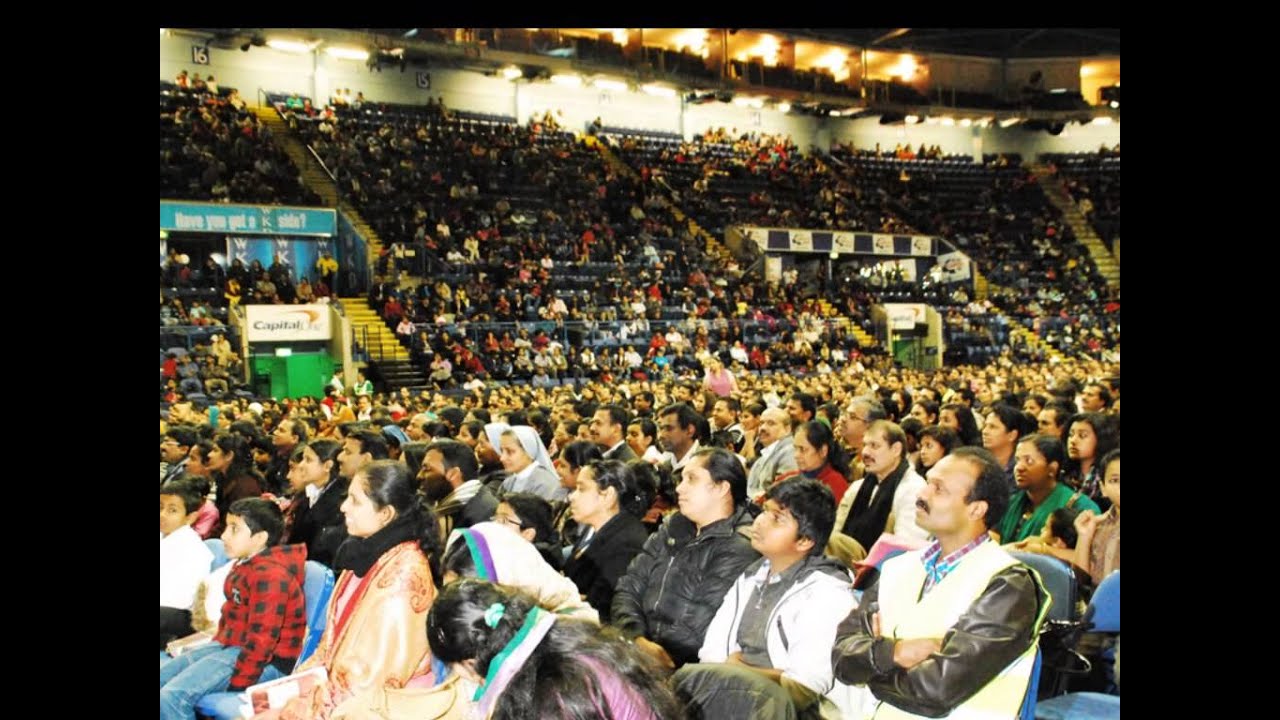
The Bethel Convention Centre in West Bromwich has been echoing with prayer and praise every second Saturday of the month, as some 3,000 Catholics gather to pray, celebrate Mass and glorify God together.
The Second Saturday Conventions started two years ago when the charismatic Fr Soji Olikkal, who came to the UK in 2009 to minister to Syro-Malabar Catholics, started running retreats in his parish at Balsall Common. Initially these attracted some 50 – 80 Catholics. However, the numbers dramatically increased, so the venue was changed first to St Catherine’s in Birmingham, and then to the Bethel Convention Centre in West Bromwich as thousands of Catholics from the Syro-Malabar community all over the country started to attend on a regular basis. The Convention is designed to be attractive to all the family and there can be up to 1,000 children. The Children’s ministries are a very important part of the day.
There is a very full programme of events starting with the rosary at 8 am although most people arrive around 9 o’clock for the lively praise and worship session, well before the start of Mass at 9.45. Children’s groups are run from 11.15, when the main conference listens to inspiring teaching and testimonies. In the afternoon there are further testimonies and talks plus a time of adoration and procession of the Blessed Sacrament. Although the day finishes officially at 4pm, many people stay on to receive prayer ministry. It is wonderful to see people who have been involved for over 8 hours still giving thanks and praise to God, especially as there are no set breaks and although tea and biscuits are available, participants are encouraged to fast during the day.
In recent months Fr Soji and the team felt inspired to use the conventions more widely to assist in the evangelisation of the UK and decided that the days should be in English, rather than Malayalam, the native language of Kerala. As a result many more people are joining in, from all over the UK. To allow as many people as possible to attend there is no charge, although a collection is made to cover the costs.
second_sat2Deacon David Palmer, one of the members of the Diocesan Year of Faith Committee, who attended for the first time in April commented, ‘It was a wonderful experience to be part of this vibrant worshipping community. The strong faith and witness that has been built up in these conventions is very evident and a real blessing to all who attend. One highlight for me was to hear a group of teenagers giving their testimonies of how their faith had come alive through various retreats and the Sacrament of Reconciliation and to hear how this new living faith in Jesus had changed their lives. Their enthusiasm was infectious, as they talked openly and honestly about how they seek to share their faith. A group had even engaged in street evangelisation, with great results. In this Year of Faith these Conventions are an opportunity to deepen our faith in a spirit of love and joy. They nourish us and encourage us to share our faith with others. Everyone here is living out their faith and they are obviously ‘Proud to profess it’ as we say after the creed each Sunday. It is also a wonderful witness to the universality of the Catholic Church to see people from so many nations coming together to praise God, just as it is described in so many of the psalms.’
Fr Soji and his ministry team (Sehion UK) based at Balsall Common, who are supported by the Kerala Community, work tirelessly in spreading the good news of the Gospel. In addition to the second Saturday Conventions in Birmingham, similar sessions are run in Bradford, Manchester and London to cater for the numbers wanting to attend nationwide. They also run various ministries for children and young adults, retreats, schools of evangelisation and organise prayer vigils and perpetual adoration of the Blessed Sacrament.
Sehion UK’s motto is ‘For Christ and His Church’ and its vision is to encourage Catholic families to be more involved in the work of telling others about Christianity and the love of God. In this they are fulfilling the exhortation in the Pastoral Guidelines issued by the Vatican for the Year of Faith that: ‘All of the faithful, called to renew the gift of faith, should try to communicate their own experience of faith and charity to their brothers and sisters of other religions, with those who do not believe, and with those who are just indifferent. In this way, it is hoped that the entire Christian people will begin a kind of mission toward those with whom they live and work, knowing that they have welcomed the news of salvation which is meant for everyone.’ The new evangelisation is for all of us.




 Posts
Posts

