EXPAND YOUR READING!!

"Today the concept of truth is viewed with suspicion, because truth is identified with violence. Over history there have, unfortunately, been episodes when people sought to defend the truth with violence. But they are two contrasting realities. Truth cannot be imposed with means other than itself! Truth can only come with its own light. Yet, we need truth. ... Without truth we are blind in the world, we have no path to follow. The great gift of Christ was that He enabled us to see the face of God".Pope Benedict xvi, February 24th, 2012

The Church is ecumenical, catholic, God-human, ageless, and it is therefore a blasphemy—an unpardonable blasphemy against Christ and against the Holy Ghost—to turn the Church into a national institution, to narrow her down to petty, transient, time-bound aspirations and ways of doing things. Her purpose is beyond nationality, ecumenical, all-embracing: to unite all men in Christ, all without exception to nation or race or social strata. - St Justin Popovitch

Thursday, 15 October 2015

WHAT ORTHODOX CHRISTIANS CAN LEARN FROM POPE FRANCIS by Andrew F Estocin (plus) A SHORT COMMENTARY.

 source: Orthodox Christian Network
                                                             Both of these are excellent                                                                            publications
my source: Pravmir.com
Power in the Church is not about who kisses one’s hand but how many feet one can wash in the service of Christ.

Pope Francis made this clear when he visited a youth prison in 2013 and chose to wash the feet of the offenders including one who is an Orthodox Christian. “Real power is service.
ANDREW F. ESTOCIN | 30 APRIL 2014
What Orthodox Christians Can Learn from Pope Francis

Pope Francis’ Thoughts on Pastoring in the 21st Century
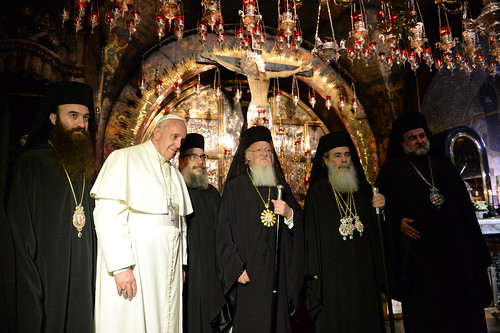
The Meeting of Ecumenical Patriarch Bartholomew and Pope Francis in the City of Jerusalem

The world will be watching from May 24-25, 2014 as Ecumenical Patriarch Bartholomew of Constantinople and Pope Francis welcome each other in Jerusalem to observe the anniversary of the historic encounter between Pope Paul VI and Ecumenical Patriarch Athenagoras and the subsequent lifting of mutual anathemas. The main focus of the many scholars and reporters who will cover this event will be the elusive question of “Old Rome and New Rome” that is the question of unity between Roman Catholic and Orthodox Christians. However, hidden amidst all this media coverage will be a unique opportunity for Orthodox Christians to follow the example of Ecumenical Patriarch Athenagoras of blessed memory and to meet the Pope of Rome again as if for the first time.

At first glance, the idea of Orthodox Christians being able to learn from the Pope of Rome appears out of place if not altogether wrong. However, Orthodox Christians should pause before rushing to judgment about such matters and remember that prior to the Great Schism of 1054, the Pope of Rome was honored with reverence and respect throughout the Orthodox World. Today, Orthodox Christians honor many Popes of Rome as saints including St. Leo the Great, St. Gregory the Dialogist and St. Martin the Confessor. Orthodox Tradition celebrates the lives of many Popes throughout the liturgical year.

Despite these facts, one of the present realities that is most disappointing is how some of our brothers and sisters have portrayed the Pope of Rome. “Dictator” and “anti-christ” are just some of the clichés that have been sadly used. While there have certainly been corrupt Popes throughout history (as there have been corrupt Patriarchs), Orthodox Christians must ask themselves whether or not the last 35 years have greatly challenged such stereotypes, especially when it comes to Popes such as John Paul II, Benedict XVI, and the current Pope of Rome, Francis. Orthodox Christians should especially pause and take notice of the unique witness of Pope Francis. He is in many ways a bishop who reflects the Christianity of the first millennium when the Church was undivided. Pope Francis also models a form of leadership that is greatly needed in Orthodox Christianity today.

Here are a few lessons that Orthodox Christians can learn from Pope Francis:

Authentic Power is Service: One of the great tragedies of modern times is that Orthodox Christians constantly argue over power and status rather than service to the weakest among us. Church leaders debate about who is first and who is last. Clergy argue about the physical boundaries of Churches, who is entitled to govern them as well as about ancient titles that have their place in an ancient world that has long since disappeared. Amidst these arguments, Orthodox Christians need to pause and remember that power in the Church is a paradox. It is also neither a title nor a jurisdiction. Power in the Church is not about who kisses one’s hand but how many feet one can wash in the service of Christ. Pope Francis made this clear when he visited a youth prison in 2013 and chose to wash the feet of the offenders including one who is an Orthodox Christian. 
“Real power is service. As He did, He who came not to be served but to serve, and His service was the service of the Cross. He humbled Himself unto death, even death on a cross for us, to serve us, to save us. And there is no other way in the Church to move forward. For the Christian, getting ahead, progress, means humbling oneself. If we do not learn this Christian rule, we will never, ever be able to understand Jesus’ true message on power.” 
St. John Chrysostom echoes this belief from ancient times: 
“To love Christ means not to be a hireling, not to look upon a noble life as an enterprise or trade, but to be a true benefactor and to do everything only for the sake of love for God.”

The Church Lives On the Frontiers of Society: The greatest triumphs of Orthodox Christianity have taken place when the Church has lived as a missionary Church and not as an institutional Church. Pope Francis challenges Orthodox Christians with the following words: 
“I prefer a Church which is bruised, hurting and dirty because it has been out on the streets, rather than a Church which is unhealthy from being confined and from clinging to its own security. I do not want a Church concerned with being at the center and then ends by being caught up in a web of obsessions and procedures. If something should rightly disturb us and trouble our consciences, it is the fact that so many of our brothers and sisters are living without the strength, light and consolation born of friendship with Jesus Christ, without a community of faith to support them, without meaning and a goal in life.” 
Sts. Cyril and Methodios, St. Patrick of Ireland, and Metropolitan Philip Saliba are all examples of Orthodox Christians who took incredible risks and in the process grew the Church and spread the Gospel. There is no doubt that each of these men experienced their share of bruises in their work. Pope Francis reminds Orthodox Christians that a risk-taking Church-–a church that is not afraid to fail–is much healthier than a Church that is focused on institutional security and closed in on itself. St. Tikhon of Moscow could not say it better when he writes that 
“The light of the Orthodox Faith has not been lit to shine only for a small circle of people. No, the Orthodox Church is catholic; she remembers the commandment of her Founder, ‘Go ye into all the world and preach the Gospel to every creature and teach all nations’ (Mark 16.15; Matt. 28.19). We must share our spiritual richness, truth, light, and joy with others who do not have these blessings.”

Make Some Noise: The idea of Orthodox Christians making noise would seem contrary to our inheritance. Yet, a look at history shows that the Orthodox Church has been making a noisy mess of things since Apostolic times when the first disciples were labeled “Those people who have been turning the world upside down”(Acts 17:6). Such noise means rowing upstream against the world and challenging the world inside and outside of the Church to be faithful to the Gospel. Holiness always has a component that upsets the status quo. Pope Francis provided this bold exhortation to young people in Rio de Janeiro: 
“Let me tell you what I hope will be the outcome of World Youth Day: I hope there will be noise. … I want you to make yourselves heard in your dioceses, I want the noise to go out, I want the Church to go out onto the streets, I want us to resist everything worldly, everything static, everything comfortable, everything to do with clericalism, everything that might make us closed in on ourselves.” 
In order for the Orthodox Church to be faithful to Her Tradition, she must step outside of Her comfort zone and proclaim the Gospel in its fullness with compassion and without apology. Evangelism is by its very nature a “noisy” business.

There is no doubt that countless words will be written in the following weeks about Roman Catholic and Orthodox unity. In truth, it is highly doubtful that such unity will take place any time soon. Common sense reveals that there are serious doctrinal and cultural issues that make unity extremely difficult if not impossible. Any serious Catholic and Orthodox Christian would confess as much. Orthodoxy matters and should never be compromised for the purpose of ecumenical convenience or social acceptance. That being said, the Church has always looked to the horizon outside of itself and has at times found truth in the most surprising of places. Fr. Thomas Hopko is correct: “God is not a prisoner of His own Church!” In this light, Orthodox Christians would do well to follow the present-day example of our father Ecumenical Patriarch Bartholomew and give Pope Francis our kindness, consideration, and our prayers. After all, if the Pope of Rome can humble himself and wash the feet of an Orthodox Christian, then the Holy Spirit can indeed work in ways that we never before thought possible.


A SHORT COMMENTARY

Ever since he first became Pope, there is much evidence that Pope Francis has been impressed with Orthodox arguments about the nature of the Church.  He normally refers to himself as "Bishop of Rome," and he says that synodality is an essential characteristic of the Church: it could be John Zizioulas talking.   He also intends to set in motion the process of de-centralising the Catholic Church, with regional and national episcopal conferences having decision making powers.  I have read somewhere that he will begin the process in 2016, which is the year of the Great and Holy Synod of the Orthodox Church.  Let us pray for one another.


PREVIOUS

THE ATONEMENT OF IRENAEUS by MATTHEW BRYAN plus THE CRUCIFORM VIEW

THE SYNOD AND CATHOLIC TEACHING: LOOKING AT THE SYNOD AS A LESSON IN ECCLESIOLOGY

NEXT

The present post is Orthodox
and suggests what Orthodox
can learn from Pope Francis

The next post is Catholic and says
what Pope Francis wants to learn 
from the Orthodox.

THE REAL SYNOD HAS YET TO ARRIVE

Wednesday, 14 October 2015

THE SYNOD AND CATHOLIC TEACHING: LOOKING AT THE SYNOD AS A LESSON IN ECCLESIOLOGY


Conciliarity in the Church

In an article about Archbishop Welby and the Anglican Church, I wrote about the difference between the Anglican Church and the Catholic Church.   It could have been an article about the difference between the Catholic Church and any version of Christianity that considers the individual believer as the ultimate authority on faith and morals. This is what I wrote:
Yet it has happened at a time when the Anglican Church is showing itself to be a church so very different from the Catholic Church and from the other apostolic churches, like the Orthodox and Oriental Orthodox, that unity appears a distant dream. 

All these Apostolic churches, like the Catholic Church, believe themselves to be bound by Tradition.  Tradition is how the Gospel has been understood, lived and passed down from the time of the Apostles.   This understanding, living and passing down is the result of the synergy between the Holy Spirit and the Church as body of Christ, and is intimately bound up with the epiclesis and the corresponding Spirit's activity in the Mass. In fact, the liturgy is the main expression of what Catholics normally call the ordinary magisterium: lex orandi, lex credendi. The sacramental nature of the Church means that the Church's understanding of the Gospel is more than the sum total of the opinions of the individuals who make up the Church.  It is the communal mind of those who share in the liturgy.  When a new question arises, it cannot be simply answered by a majority vote: it has to be shown that the answer is faithful to Tradition.  
 The problem with women bishops and priests is that they have been unknown in Christianity for two thousand years, even though there were women who were witnesses to the resurrected Christ, and even though priestesses existed in pagan religions and must have been available as models to the early Christians.   For this reason, both Pope John Paul II and Benedict XVI simply said that they had no authority to make such a change.  The patriarchs of the Orthodox and Oriental Orthodox churches would say the same. It is not because they are misogynist or conservative and don't want to: to do so would inevitably mean that we would have to revise our understanding of the relationship between the Holy Spirit and Tradition.  To accept women priests and bishops (but not women deacons) we would have to change our theology of the Church. For churches with their roots in apostolic times, Tradition is above law because Tradition is a work of the Holy Spirit as well as a work of the Church, while law requires only human prudence.
 Father Stephen Freeman, an Orthodox priest and theologian, author of the "Glory be to God for All Things" blog, puts it beautifully:
The deepest meaning of conciliarity is trinitarian. “Each person of the Holy Trinity lives not for himself but for the other.” Because the Trinity is council, a communion of persons, the Church is also council; the church reproduces on earth the Trinitarian mystery of unity. The conciliar Church is “an orderly communion of persons freely united in the Holy Trinity in truth and in love.” This is not due to any authoritative command that the Church “ought” to be conciliar, but because, by participation in the divine life, the Church takes on the qualities of the Trinity. “The very act of organizing the life of the Church becomes an act of worship and in this worship we participate in the very life of God: Father, Son and Holy Spirit.”

Conciliarity is the experience of divinely restored human life. It describes an experience of synergy between God and humans, in which humans participate with God through the Holy Spirit in the formulation of Truth. “Through conciliarity, the nature of the Church as theanthropic communion in Christ is expressed.” By participating in the conciliar life of the community — unity in diversity through mutual-indwelling — we participate in the divine life, and vice versa. Thus conciliarity is found “in every act of communion among all members of the Church’s body.” Rooted in Matthew 18:20, it represents an understanding of Christian life lived in mutually accountable community.”
By believing, we participate in a community of meaning, an organism called the body of Christ, forged by our participating in the Catholic liturgy in the power of the Holy Spirit, a communal mind that reflects our participation in the life of our Trinitarian God, in which truth and love, understanding and worship, are not separated but illumine each other, being dimensions of the relationship between the Church and God.

Conciliarity and what the Synod is not.

All that being said, we can see what a synod is not.   It isn't a kind of parliament, like the General Assembly of the Church of England, where things are decided by majority vote.   Voting takes place as part of the interaction between the bishops, but it is not the be-all and end-all of everything.   The object, as far as truth is concerned, is to discern the common mind, in this case, on Christian marriage. This common mind is not merely the common mind of the pope and bishops who are present - that can be discovered by a show of hands - but the common mind of the Church of all places and times; and this needs the Holy Spirit who bridges time and space.   G. K. Chesterton wrote:
“Tradition means giving votes to the most obscure of all classes, our ancestors. It is the democracy of the dead. Tradition refuses to submit to the small and arrogant oligarchy of those who merely happen to be walking about."
Conciliarity and Primacy

We must remember that, for the early Fathers, each diocese is the body of Christ.   It is not simply a similarity that binds the different dioceses together.  If they are being true to their inner reality, each diocese is not only similar to others, all are identical as one eucharistic host is identical to another, because each is body of Christ. It follows that, when St Irenaeus writes that all churches should agree with the Church of Rome, he is not imposing on them an authority from outside, but an agreement that any local church will recognise when it examines itself.   Thus, Pope Benedict XVI wrote that his job was not to impose beliefs, but to remind people of beliefs that they had, perhaps, forgotten.  

The sub-apostolic father who gives us the most developed understanding of the pope's role in relation to the bishops
is St Cyprian of Carthage who was bishop from 249 till 258.   Here are two passages that give us his teaching:
If any one consider and examine these things, there is no need for lengthened discussion and arguments. There is easy proof for faith in a short summary of the truth. The Lord speaks to Peter, saying, I say unto you, that you are Peter; and upon this rock I will build my Church, and the gates of hell shall not prevail against it. And I will give unto you the keys of the kingdom of heaven; and whatsoever you shall bind on earth shall be bound also in heaven, and whatsoever you shall loose on earth shall be loosed in heaven. And again to the same He says, after His resurrection, Feed my sheep. And although to all the apostles, after His resurrection, He gives an equal power, and says, As the Father has sent me, even so send I you: Receive the Holy Ghost: Whose soever sins you remit, they shall be remitted unto him; and whose soever sins you retain, they shall be retained; (John 20:21) yet, that He might set forth unity, He arranged by His authority the origin of that unity, as beginning from one. Assuredly the rest of the apostles were also the same as was Peter, endowed with a like partnership both of honour and power; but the beginning proceeds from unity. (De catholicae ecclesiae unitate, 4)

After such things as these, moreover, they still dare — a false bishop having been appointed for them by heretics — to set sail and to bear letters from schismatic and profane persons to the throne of Peter, and to the chief Church whence priestly unity takes its source; and not to consider that these were the Romans whose faith was praised in the preaching of the apostle, to whom faithlessness could have no access. (Epistle 54, 14 )
St Peter was first among equals in that the apostles had the same honour and power as St Peter had, but the fact that he had personally what they had collectively; hence, the beginning proceeds from unity.   Likewise, the episcopate is held together by the chief church, from which priestly unity takes its source. In fact, conciliarity can only be in good health if there is a protos, a primacy that permits the many to act as a single organism. 

As John Zizioulas, Bishop of Pergamon has pointed out, conciliarity and primacy are not opposed to one another On the contrary, you cannot have conciliarity without primacy.  The proof can be found in the Orthodox Church itself which has a beautiful understanding of  Church conciliarity both in theory and in practise: where primacy exists, in parish, diocese and patriarchate, there is also conciliarity; but, at a universal level, where there is no primacy accepted by all, they are at sixes and sevens, the situation is a mess: in place of real conciliarity at a universal level, there are patriarchates jostling for power in a most worldly fashion, Moscow sneers at Constantinople, Antioch excommunicates Jerusalem etc.  They are sure that we Catholics are wrong in having the pope, but they have no convincing alternative.   We shall see how the Great Synod works out in 2016.  Many still believe that it will never take place.   If it does, it will only do so at the cost of recognising the primacy of the Patriarch of Constantinople who has called it together, something that Moscow doesn't want to do.
In trying to formulate the role of the Patriarch of Constantinople in world-wide Orthodoxy, believe it or not, the Greeks are helping us to understand the role of the pope in the Catholic Church.

The reason why a protos is necessary is the great variety of churches represented by a great variety of bishops, which needs to be balanced with the participation of each local church in the common understanding of the whole Church.  To achieve this is not only important to stop schism between local churches: it also affects the authenticity and interior unity of each and all of the local churches that make up the worldwide Church.

Diversity in the Synod

There are bishops from every continent, different language groups, nationalities, histories, cultures,experiences,  and priorities. .    There are bishops living in the secular world of Europe and the USA, bishops of the persecuted churches in the Middle East, bishops from Africa where the Church is growing at an incredible rate, bishops who live among Hindus and Muslims, bishops of small dioceses in Italy, an Australian bishop whose diocese is three times the size of France, patriarchs and bishops of different Eastern rites etc.  Thus they approach the common understanding of marriage they have all received in Tradition with different cultural pre-suppositions, different thought patterns, different interests, different priorities, different difficulties, different answers to pastoral problems.

Until fairly recently, everything was the same in the Catholic Church and the same Catholic answer fitted all circumstances.   Differences of pastoral context made no difference to pastoral policy.   No recognition was ever given to the fact that some pastoral policies made no sense to anybody but the clergy..   An example: what do we do if, because of the pervasive secular culture, half the couples that come to marriage simply don't understand the level of Christian commitment required to celebrate a Catholic marriage validly?   Any instruction passes through one ear and out of the other.   It means the marriage is invalid, but there is nothing out there as evidence when the marriage inevitably collapses, only the non-Catholic culture.  Do  the priests take this into their calculations?   The answer is not obvious. Do we sacrifice the welfare of the individual for the sake of the general? 

THe doctrine on marriage may well be the same in all parts of the Church, but its application to the lives of individual persons demands a sensitivity to the context in which each matrimony is celebrated; and this can only be known by the local church. 

In fact, there is much in the Christian life that takes its shape from the context that Providence has decreed that this life is to be lived. The "sacrament of the present moment" demands close attention to local conditions, even when the general principles we employ are the same all over the world. 


In the synods before Francis, there was much control from the centre which suppressed too much concern for local conditions and the insights that they caused, so that the general teaching of the Catholic Church could be highlighted.   This was because, whatever the understanding of the local church that arose in Vatican II, they still thought in universal categories.    This led to a delay in implementing several key recommendations of Vatican II, namely collegiality and decentralisation.

  These two synods are an attempt to begin the process by which papal primacy is complemented by collegiality, and centralisation by adaptation to the local scene. Inevitably, the fathers of the Synod are now discussing whether pastoral policy should be decided on a regional or national level, once the common mind of the Church has been agreed on at a synodal level.

In fact, the diversity among the bishops reflects the diversity of the churches they represent.   The African bishops represent churches that are growing fast and are in no mood to meet modernity, paganism or any other non-Catholic set of values halfway.  European and American bishops, on the other hand, have their backs against the wall, and are directing the "new evangelisation" at post-Christians who, quite often have post-Christian sexual lives.   Their pastoral problem is how to attract them and how to integrate them into the Catholic community if they are divorced and remarried.

Pope Francis, as preserver of "priestly unity" (St Cyprian's words), has two tasks.  He must be the centre of unity for different episcopates with different agendas, whose agendas are different only because they are being good shepherds of their flocks, enabling them and encouraging them to do what they have to do in their different circumstances.  At the same time, he must foment a relationship of mutual love between bishops whom he has encouraged to express their points of view freely. Mutual love is the only sign that reflects the presence of the Holy Spirit within the Synod; and it is the Holy Spirit that gives the Synod its catholicity.   

He also has the third task already mentioned which comes up whenever there are ecumenical conversations with the Orthodox, that of de-centralising and establishing regional centres of authority to correspond to the patriarchates, as well as balancing primacy with collegiality.   As Archbishop of Buenos Aires and one of the chief organizers of CELAM, the Latin American Bishops' Conference which is probably the most advanced regional conference in the Catholic Church, he spoke of the document released at the end of its meeting in Aparecida in Brazil as the expression of the magisterium of the Latin American bishops.  The word "magisterium", up till then, had only been used for the teaching authority of the pope and the universal episcopate within the context of the universal Church.  That the Latin American bishops have teaching authority within their own region.   When Pope Benedict insisted that the English speaking bishops should change the language of their liturgy, it was reported, rightly or wrongly, that Archbishop Bergoglio said in conversation that he believed that this was their own affair, and not something for the pope to decide.

Since becoming pope, Francis has shown that he believes decentralization must go hand in hand with a "pastoral conversion" to evangelisation.  This is an excerpt from "Vatican Insider":
“It is my duty, as the Bishop of Rome, to be open to suggestions which can help make the exercise of my ministry more faithful to the meaning which Jesus Christ wished to give it and to the present needs of evangelization,” Francis adds. In the document, the Pope recalls that in the encyclical “Ut unum sint” (1995), John Paul II asked for help in finding “a way of exercising the primacy which, while in no way renouncing what is essential to its mission, is nonetheless open to a new situation.” But, Francis remarks, “we have made little progress in this regard.” “The papacy and the central structures of the universal Church also need to hear the call to pastoral conversion. The Second Vatican Council stated that, like the ancient patriarchal Churches, Episcopal conferences are in a position “to contribute in many and fruitful ways to the concrete realization of the collegial spirit.” “Yet this desire has not been fully realized, since a juridical status of Episcopal Conferences which would see them as subjects of specific attributions, including genuine doctrinal authority, has not yet been sufficiently elaborated. Excessive centralization, rather than proving helpful, complicates the Church’s life and her missionary outreach,” the Pope remarks. So one of the areas of reform that should be examined by the Pope’s eight-member advisory Council of Cardinals is the desire for Episcopal Conferences to play a greater role in Church decision-making. The 1985 Synod of Bishops had recommended a wider and more in depth examination of the theological and juridical status of the Bishops’ Conferences, particularly the issue  of their doctrinal authority. The Code of Canon Law currently attributes certain doctrinal responsibilities to the Episcopal Conferences, like publishing catechisms for their respective territories with the prior approval of the Apostolic See and the approval of various editions and versions of Holy Scripture texts. In the Motu Proprio “Apostolos suos” issued in 1998, John Paul II recalled that Episcopal Conferences should be considered within the framework of the entire College of Bishops and that they are not a collegial body of the government of particular Churches, neither do they act as intermediaries between individual bishops and the whole College of Bishops. Now Francis says he wants to take one more step towards decentralization. He had alluded to this in his interview with Italian Jesuit magazine Civiltà Cattolica: “The dicasteries of the Roman Curia are at the service of the pope and the bishops,” he says. “They must help both the particular churches and the bishops’ conferences. They are instruments of help. In some cases, however, when they are not functioning well, they run the risk of becoming institutions of censorship. It is amazing to see the denunciations for lack of orthodoxy that come to Rome. I think the cases should be investigated by the local bishops’ conferences, which can get valuable assistance from Rome. These cases, in fact, are much better dealt with locally. The Roman congregations are mediators; they are not middlemen or managers.”
He has kicked off with the two synods on the family, knowing full well that the pastoral needs of post-Christian Europe are entirely different from those of Africa, showing the necessity for decentralisation of authority if the Church is to become centred on its evangelisation role. 

The Pope and the Bishops

The unity of the Church is expressed in the doxology at the end of every eucharistic prayer in the Latin rite:
Through him, with him, and in him, in the unity of the Holy Spirit, all glory and honour is yours, Almighty Father, for ever and ever.  Amen
The "unity of the Holy Spirit", according to St Augustine, is at two levels.  The first is our participation of the word and sacraments, and the second is our participation in Christ through the power of the Holy Spirit, by whom we share in God's love.  THrough the sacraments we share in the Holy Spirit who binds us together in Christ, and we become one organism with him as his body.   Father R. Cantalamessa puts it in this way:
The Eucharistic bread is obtained from the dough of many grains of wheat and the wine from a multitude of grapes; in the same way, the Church is formed by many people, united and blended together by the charity which is the Holy Spirit. Just as wheat spread over the hills is first harvested, then milled, and then kneaded with water and cooked in the oven, so the faithful spread throughout the world are brought together by the word of God, milled by the penances and the exorcisms preceding baptism, immersed in the water of baptism, and put through the fire of the Spirit. Also in relation to the Church one must say that the sacrament significando causat, the sacrament “causes by signifying”. By signifying the union of many persons in one the Eucharist brings it about and causes it. In this sense, we can say that “The Eucharist makes the Church.”

According to the Fathers of the Church, it is love, not law that binds us together. What has been said about Tradition has enormous implication for the exercise  of authority in the Church. Pope Francis has said that the whole Church, including the papacy must undergo a "pastoral conversion".  There must be a clear understanding that words like "authority", "jurisdiction", "power", "law", have a radical change of meaning once they are used within the context of Christ's Church.   A papacy whose authority in the Church is no different from that of authorities in the world must be rejected as non-Christian, just as the jostling for power and quarrels among Orthodox patriarchs must also be rejected for the same reason.   In contrast, the way the pope functions must be a reflection of the work of the Holy Spirit who distributes functions and charisms throughout the Church.   Vatican I states:
This power of the supreme pontiff by no means detracts from that ordinary and immediate power of episcopal jurisdiction, by which bishops, who have succeeded to the place of the apostles by appointment of the holy Spirit, tend and govern individually the particular flocks which have been assigned to them. On the contrary, this power of theirs is asserted, supported and defended by the supreme and universal pastor; for St Gregory the Great says: "My honour is the honour of the whole church. My honour is the steadfast strength of my brethren. Then do I receive true honour, when it is denied to none of those to whom honour is due."   
It can be said that papal authority is only authentic when it reflects the work of the Holy Spirit in the Church, in a way that shows love  as well as enabling his brother bishops to fulfil their functions within the wider context of the whole Church worldwide. If, instead of asserting, supporting and defending the functions of his subordinates, he absorbs their functions into his own, turning the Church into one huge diocese, then he is acting out of synergy with the Holy Spirit, not taking into account the nature of the Church.   In fact, following the teaching of St Gregory the Great, anyone who exercises authority in the Church must do so in humble obedience.   Humility is the characteristic of any authentic Christian authority, but most of all, of the Servant of the Servants of God.

THE POPE, THE SYNOD AND DE-CENTRALISATION

This aspect of the synod will be treated in greater detail a little later; but it seems that Pope Francis is trying to kill two birds with one stone.  He wants a Church completely organised for mission - and thus he is beginning with the Family; and he aims to radically de-centralise the Church so that it can be adapted to the culture and conditions where people live.

Here we see him functioning in his classical role in the petrine ministry.  His power, which is the power of love, works in synergy with that of the bishops.  Because each bishop fulfils his ministry within particular circumstances, the bishops represent proper diversity within the Church; but, because of the central role of the Roman See, as St Irenaeus taught, the successor of St Peter makes sure that they are exercising there roles within a Catholic horizon which will be wider than their own.

To use an example from Orthodoxy: the Patriarch of Moscow fulfils his ministry in a very different context from the Patriarch of Costantinople.  This means that they have different horizons, different problems, different points of view.  Within the Catholic set-up, the Pope would be using his papal power, not to limit the power of the two patriarchs but to broaden the horizon of each, in the interests of unity.

Thus, for many generations, the mediaeval popes refused to put the "filioque" in the Creed, against much pressure from the Franks.  They did so because it is their job to put petitions like this within an ecumenical context.  Unfortunately, in the 11th century, the pope gave up that papal role in favour of joing the West against the East; and this is one of the causes of the Schism.  Pope Benedict XVI fulfilled his petrine ministry, while respecting the majoroty position in Vatican II, by motu propio, permitted the minority to continue to use the old version of the Latin Rite: the majority view is not always sufficiently Catholic: our Catholicism is as wide as our charity.

In the Synod, the pope is making sure that all sides have an opportunity to talk; but he is guiding the Synod towards acknowledgement of the wider picture.   If the bishops represent diversity, the pope represents unity in the context of diversity.

The next article is from an Orthodox source about what the Orthodox can learn from Francis.  In the article following that, we will find out what Pope Francis wants to learn from the Orthodox, especially about how synods work in Orthodoxy


NEXT

from Pravmir.com


WHAT ORTHODOX CHRISTIANS CAN LEARN FROM POPE FRANCIS


Friday, 9 October 2015

THE ATONEMENT OF IRENAEUS by MATTHEW BRYAN plus THE CRUCIFORM VIEW

Imagine if one of the twelve disciples of Jesus had personally discipled a man whose pupil had written a short book for us, a book that explains the barest essentials of the apostles’ teaching. What a treasure it would be if we found such a book! In 1904, a priest of the Oriental Orthodox Church of Armenia uncovered exactly such a book, the Demonstration of the Preaching of the Apostles. Its author, Bishop Irenaeus of Lugdunum (modern Lyons, France) had learned under Bishop Polycarp of Smyrna, a disciple of the Apostle John. Irenaeus wrote this short book of roughly fifty pages to his beloved friend Marcianus. Just one generation removed from the Apostle John, Irenaeus gifted Marcianus (and us) with an early “manual of essentials” so that Marcianus (and we) could learn “in a short space all the members of the body of truth.”1 

This book by Irenaeus surprised me in three ways:

By quoting almost exclusively from the Old Testament Scriptures rather than from the Apostles.
By framing most of his topics through the overarching theme of authority, beginning with that of God, then moving consecutively through the authority Adam, then Satan, and finally Jesus.
By resolving the problem of sin, not through justice or a substitutionary death, but through the transformation of humanity. It is this surprise which I present for consideration today, the resolution of the problem sin according to Irenaeus.


THREE IRENAEIC PROBLEMS

Just a few sentences into Demonstration, Irenaeus encouraged his beloved Marcianus to stay on the “one way” which leads to the kingdom of heaven. Then he warned him, “Other ways bring down to death, separating man from God.”2 At the outset, Irenaeus was concerned not about the torments of hell, but of death’s chief power: “separating man from God.” He then framed the purpose of the incarnation of Jesus, not for justice nor for satisfying divine wrath, but, “in order to abolish death and show forth life and produce a community of union between God and man.”3

A little further on, Irenaeus recounted the fall of humanity at Eden. Surprisingly, he laid the blame for humanity’s fall at the feet of Satan rather than Adam: “But man was a child, not yet having his understanding perfected; wherefore also he was easily led astray by the deceiver.”4 When describing Satan’s persuasion, Irenaeus credited him with the transformation of humanity, saying he “made man sinful.”5 So Irenaeus added a second problem for Jesus to solve. Not only was humanity separated from God, but humanity had also been transformed from innocence into sinfulness.

Finally, Irenaeus wrote about human bondage. He said God appointed humanity to rule over all the earth, even over the angels and the archangel Satan who Irenaeus said dwelled here.6 Yet after summarizing the Old Testament, Irenaeus said that Satan had enslaved us instead: “in the original formation of Adam all of us were tied and bound up with death . . . death reigned over the flesh . . . flesh which sin had ruled and dominated . . .”7 The pupil of the Apostle John’s disciple presented three human problems: separation, transformation, and bondage. He did not emphasize God’s wrath, nor damnation, nor justice, nor any debt owed toward God.


IRENAEIC INCARNATION

As noted above, Irenaeus first framed the incarnation of our Lord for the purpose of “establishing a community of union between God and man.” Having laid out the problems of our transformation into sin and bondage to Satan, he then returned to that first thought in chapter 31: “So then He united man with God, and established a community of union between God and man . . .”

The word “atonement” has become heavy-laden with theology over the years, but it simply means “unity” or “reconciliation.” The Oxford English Dictionary defines atonement as, “The condition of being at one with others.” We might expect Irenaeus to tell us that Jesus atoned us unto God by suffering His wrath in our place, but he made no such claim. For Irenaeus, atonement occurred through Jesus’ becoming “the last Adam,” and through our being “born again.”

In the West, we tend to consider the incarnation as simply the preparation for suffering. We view Christmas primarily as equipping Jesus to experience human suffering by giving Him a human body. In contrast, Irenaeus claimed the apostles presented the incarnation as the equivalent of Adam’s work:

Jesus summed up humanity: “God took dust of the earth and formed the man, the beginning of mankind. So then the Lord, summing up afresh this man, took the same dispensation of entry into flesh, being born from the Virgin by the Will and the Wisdom of God; that He also should show forth the likeness of Adam’s entry into flesh and there should be that which was written in the beginning: man after the image and likeness of God.”8
Jesus counteracted Adam: “And just as through a disobedient virgin, man was stricken down and fell into death; so through the Virgin who was obedient to the Word of God, man was reanimated and received life.”9
Jesus swallowed death: “For it was necessary that Adam should be summed up in Christ, that mortality might be swallowed up and overwhelmed by immortality.”10
Jesus killed rebellion: “And the trespass which came by the tree was undone by the tree of obedience, when, hearkening unto God, the Son of man was nailed to the tree; thereby putting away the knowledge of evil and bringing in and establishing the knowledge of good: now evil it is to disobey God . . .”11
Obeying destroyed disobeying: “So then by the obedience wherewith He obeyed even unto death, hanging on the tree, He put away the old disobedience which was wrought in the tree.”12
Jesus formed a better humanity: “He manifested the resurrection, Himself becoming the first begotten of the dead, and in Himself raising up man that was fallen, lifting him up far above the heaven to the right hand of the glory of the Father.”13
According to the pupil of John’s disciple, the apostles preached an atonement quite foreign to many modern Christians. Irenaeus did not learn from the apostles that Jesus satisfied God’s wrath, nor that he had satisfied our legal penalties which divine justice had required. The pupil of John’s disciple said that the apostles taught our Lord’s atonement as the summing up of humanity in the last Adam and the reversal of Adam’s rebellion. Jesus swallowed Adamic rebellion and destroyed it, raising up an obedient form of humanity, in the image and likeness of God. Thus it was written to the Hebrews, “Inasmuch then as the children have partaken of flesh and blood, He Himself likewise shared in the same, that through death He might destroy him who had the power of death, that is, the devil, and release those who through fear of death were all their lifetime subject to bondage” (Heb 2:14-15 NKJV).


ENTERING THE ATONEMENT

We would ask Irenaeus then, how someone can benefit from the atonement of the Lord Jesus. He taught us that there are two forms of humanity, the fallen lineage of Adam and the risen lineage of Jesus. How then, does one manage to move from the old to the new, from dead humanity to living humanity? Irenaeus would reply that we enter the living humanity in the same way we entered dead humanity, by being born:

“And that this baptism is the seal of eternal life, and is the new birth unto God, that we should no longer be the sons of mortal men, but of the eternal and perpetual God.”14
“And for this reason the baptism of our regeneration proceeds through these three points: God the Father bestowing on us regeneration through His Son by the Holy Spirit.”15


RESULT OF ATONEMENT

Irenaeus filled most of his little book for Marcianus with Old Testament prophecies of Jesus (including some from the books of Baruch and Sirach), but he ended with the claim that the second birth renders us completely new persons:

“those inflict no hurt at all who in the former time were, through their rapacity, like wild beasts in manners and disposition.”16
“Coming together in one name, they have acquired righteous habits by the grace of God, changing their wild and untamed nature.”17
“. . . so great is the transformation which faith in Christ the Son of God effects for those who believe on Him.”18
“Behold, with the Father we speak, and in His presence we stand, being children in malice, and grown strong in all righteousness and soberness.”19
“For no longer shall the Law say, “Do not commit adultery,” to him who has no desire at all for another’s wife; and “Thou shalt not kill,” to him who has put away from himself all anger and enmity; and “Thou shalt not covet thy neighbor’s field or ox or ass,” to those who have no care at all for earthly things . . .”20
This atonement will sound strange to many modern ears, but all Christians taught it in similar terms as Irenaeus until the 12th century. Today, Eastern Orthodoxy, Oriental Orthodoxy, and the Assyrian Church of the East still present the atonement in this way. It is often called “Christus Victor” by those who are more accustomed to a justice-and-wrath view of atonement. Paul thoroughly explained our atonement in Romans 5:12-21, climaxing in verse nineteen: “For as through the disobedience of the one man, the many were constituted sinners: so also through the obedience of the One, shall the many be constituted righteous” (YLT).

Finally, what we believe about atonement strongly shapes how we live our lives. Did Jesus only get me off of the hook from my punishment, or did he utterly transform me? If I believe that He rescued me from punishment, then I might find righteous living optional since unrighteousness no longer bears consequences. If I try to reflect righteous living, then my motive will be gratitude rather than absolute necessity.

If atonement actually transforms us though, then my unrighteous deeds will rightly cause me to question whether I have truly been atoned. I must necessarily forsake unrighteousness or realize that I am not in fact atoned to God. If I believe that atonement completely transformed me, then I do not try to reflect righteous living since such is the natural outcome of atonement. Rather, I must ask the scriptures and Christian traditions how it is that I am hindering the Holy Spirit from displaying the righteousness which is now natural to me. This latter question I have found best answered thus far by the Eastern Orthodox tradition. For those interested in an outsider’s investigation of Eastern Orthodox spirituality, I recommend The Spirituality of the Christian East by Roman Catholic Cardinal Tomas Spidlik.

SOURCES

Irenaeus, The Demonstration of the Apostolic Preaching, (The MacMillen Co, New York, 1920), paragraph 1
ibid, 1
ibid, 6
ibid, 12
ibid, 16
ibid, 11-13
ibid, 31
ibid, 32
ibid, 33
ibid, 33
ibid, 34
ibid, 34
ibid, 38
ibid, 3
ibid, 7
ibid, 61
ibid, 61
ibid, 61
ibid, 96
ibid, 96
More recent translations of Demonstration include that of John Behr and that of Iain McKenzie.

David Bentley Hart and the Cosmic Rebellion of Christianity


Orthodox theologian David Bentley Hart explains the cosmic rebellion of Christianity:

We today are probably somewhat prone to forget that, though the early Christians did indeed regard the gods of the pagan order as false gods, they did not necessarily understand this to mean simply that these gods were unreal; they understood it to mean that the gods were deceivers. Behind the pieties of the pagan world, Christians believed, lurked forces of great cruelty and guile: demons, malign elemental spirits, occult agencies masquerading as divinities, exploiting the human yearning for God, and working to thwart the designs of God, in order to bind humanity in slavery to darkness, ignorance, and death. And to renounce one’s bonds to these beings was an act of cosmic rebellion, a declaration that one had been emancipated from (in the language of John’s Gospel) “the prince of this world” or (in the somewhat more disturbing language of 2 Corinthians) “the god of this world.” In its fallen state, the cosmos lies under the reign of evil (1 John 5:19), but Christ came to save the world, to lead “captivity captive” (Ephesians 4:8), and to overthrow the empire of those “thrones, dominions, principalities, and powers” (Colossians 1:16, 1 Corinthians 2:8, Ephesians 1:21, 3:10) and “rulers on high” (Ephesians 6:12) that have imprisoned creation in corruption and evil.

Again, given the perspective of our age, we can scarcely avoid reading such language as mythological, thus reducing its import from cosmic to more personal or political dimensions. In so doing, however, we fail to grasp the scandal and exhilaration of early Christianity. These thrones and powers and principalities and so forth were not merely earthly princes or empires (though princes and empires served their ends); much less were they vague abstractions; they were according to Jewish Apocalyptic tradition, the angelic governors of the nations, the celestial “archons,” the often mutinous legions of the air, who—though they might be worshipped as gods, and might in themselves be both mighty and dreadful—were only creatures of the one true God. It was from the tyranny of these powers on high that Christ had come to set creation free. And so the life of faith was, for the early church, before else, spiritual warfare, waged between the Kingdom of God and the kingdom of this fallen world, and every Christian on the day of his or her baptism had been conscripted into that struggle on the side of Christ.

-Atheist Delusions: The Christian Revolution and Its Fashionable Enemies, 113-114

Hart vividly describes why the fundamental view we should take with the atonement is not a (relatively young) “penal substitution” view, but rather the view that primary purposes of Jesus’ death and resurrection was to deal the deathblow to the devil; to complete the “cosmic D-Day” invasion of a creation enslaved to death and Satan.

In short, Christus Victor.

Viva la Revolution.


 Just a short commentary by me:

There are two scenes in the Gospels that belong together, two feasts in the Church's calendar that are a pair with forty days between them. The two scenes are the Transfiguration and the Garden of Gethsemane; the two feast are the Transfiguration and the Exaltation of the Holy Cross: each scene and each feast explains the other.  Peter, James and John sleep in both scenes, in one out of wonder and in the other out of sadness. Yet it is the very desperate struggle of Christ, intent on being obedient unto death in the most extreme circumstances that is the vehicle of God's uncreated light so evident in the Transfiguration.   The darkness of almost non-existence, brought about by radical disobedience to the Source of Light, is being dispersed by the light of Christ's obedience.   By death on the Cross, Christ is conquering death. The obliteration of darkness and the spreading of light throughout the world is the principal theme of the Easter Vigil.


Some western theologians stand out, way above their companions, in the twentieth century.  One of these is the Swedish Lutheran bishop called Gustaf Aulen in his book Christus Victor
Together with Dom Odo Casel and Romano Guardini in liturgy, the Orthodox Nicholas N. Afanassiev in ecclesiology, Hans urs von Balthazar and Henri de Lubac a host of others, including Brother Roger Schutz and the monastery of Taize, and, of course, the Charismatic Renewal in their approach to theology and the modern world, Aulen marks the end of the Middle Ages and of the Reformation and its Counter-reformation, and the beginning of a Catholicism renewed, with much input from Orthodox and Protestant sources. 


Search This Blog

La Virgen de Guadalupe

La Virgen de Guadalupe

Followers

My Blog List

Fr David Bird

Fr David Bird
Me on a good day

Blog Archive