EXPAND YOUR READING!!

"Today the concept of truth is viewed with suspicion, because truth is identified with violence. Over history there have, unfortunately, been episodes when people sought to defend the truth with violence. But they are two contrasting realities. Truth cannot be imposed with means other than itself! Truth can only come with its own light. Yet, we need truth. ... Without truth we are blind in the world, we have no path to follow. The great gift of Christ was that He enabled us to see the face of God".Pope Benedict xvi, February 24th, 2012

The Church is ecumenical, catholic, God-human, ageless, and it is therefore a blasphemy—an unpardonable blasphemy against Christ and against the Holy Ghost—to turn the Church into a national institution, to narrow her down to petty, transient, time-bound aspirations and ways of doing things. Her purpose is beyond nationality, ecumenical, all-embracing: to unite all men in Christ, all without exception to nation or race or social strata. - St Justin Popovitch

Wednesday, 3 June 2015

CORPUS CHRISTI : ADORATION AND THE NEW EVANGELISATION -1


INTRODUCTION:

The Word did not become words: he became flesh; and thus he was available to ALL the senses for those whom he met. The revelation of Christ has all the dimensions of the world around us.  Of course, it took the gift of faith, given by the Holy Spirit, for Simeon to "see" God`s salvation in the little baby he held in his arms, or for St John to be able to say with certainty, "It is the Lord," as looked at Christ from the boat.   Nevertheless, they were expressing more than an opinion when they said what they believed: they were seeing beyond the evidence of their eyes to the reality behind the evidence; and this ability to see beyond was an immediate contact with that reality, brought about by the Holy Spirit.    It is the same today; which is why the  the Scriptures alone are an insufficient vehicle for Christian revelation: they need to become flesh, to take on the dimensions of the world around them, to appeal to all the senses. 

 As with the Incarnation, this process of turning the words that reveal the Word into flesh is the work of the Holy Spirit; and his tools are Word and Sacrament.  In doing so, he turns people into Church, transforming them from within so that they become Body of Christ together.


The Gospel message is transformed into liturgy which, in the words of Pius XI, is "the chief organ of the ordinary magisterium of the Church," and is understood to the degree that it is lived and celebrated. This understanding by members of the Church who live it and celebrate it, in so far as it is guided by the Holy Spirit, is one with the understanding of   those who first listened to Christ and with his disciples down the ages and and one with all across the world who are moved by the same Spirit. 

The name for this is Tradition: not the passing down of dead credal formulas, but the sharing across time and space of an understanding always enlightened by the Holy Spirit who is particularly active in the Liturgy.   It is  in keeping with new paradigms, new insights,  ideas and devotions, as long as they are all coherent with one another,  reflecting the unity that is a characteristic of all that eminates from the same Holy Spirit. 


   Only then does Scripture reach its full potential as Christian revelation. Only then does it achieve its purpose, when it is understood and lived by the Church.  Revelation takes concrete form in the Church and, in this form appeals to all the senses.   Hence, the First Letter of St John could say, long after Christ had ascended into heaven:
We declare to you what was from the beginning, what we have heard, what we have seen with our eyes, what we have looked at and touched with our hands, concerning the word of life - this life was revealed, and we have seen it and testify to it, and declare to you the eternal life that was with the Father and was revealed to us - we declare to you what we have seen and heard so that you also may have fellowship with us.  

That is why the New Evangelisation is as much about seeing as hearing.   The world will not just hear that God is love: it will see that love at work in the love of the Christian community; it may be challenged by this love through the actions of a St Maximilian Kolbe; it may be touched by this love in the caresses of a Mother Teresa of Calcutta;  it may even taste this love in food banks through the generosity of ordinary Christians.   The revelation is reflected in the lives of a multitude of Christians with different but coherent vocations, like light reflected from the many facets of a diamond and receiving the source of their unity in the liturgy.

 However, and  above all, this happens when the Church is really united in love, in a love that transcends all human divisions because its source is from within the life of the Holy Trinity, then the Gospel will be proclaimed by our lives, and the world will understand enough to be challenged by the revelation contained in Scripture.  

The people who wander confused without a shepherd will see that there is a valid alternative to a secularism that leaves the world devoid of meaning and to Islam which appears to many as an alternative for ex-Christians who have lost their way..   

Hence the first step in any New Evangelisation is to be evangelised ourselves, so that we freely love one another.   Jesus says in his priestly prayer to the Father: 
I ask not only on behalf of these, but also on behalf  of those who will believe in me through their word, that they may all be one.    As you, Father, are in me and I am in you, may they also be in us, so that the world may believe that you have sent me.   The glory that you have given me I have given them, so that they may be one as we are one, I in them and you in me, that they may become completely one, so that the world may know that you have sent me and have loved them even as you have loved me.
THE EUCHARIST:

In between our becoming Christians and being maturely Christian enough to bear testimony to the world as members of Christ's body, there are the sacraments and, above all else, the Eucharist.   As St Paul says, "Because there is one bread, we who are many are one body, for we all partake of the one bread" (1 Cor. 10: 17)    

In every Mass, the unity of the Church across time and space and between heaven and earth is made manifest in the community celebrating: they are like the visible top of an iceberg because, in being united to Christ, they are united by the Holy Spirit to all who are united to Christ, both human beings and angels, and with them they are brought up into the presence of God the Father (Hebrews 12). 

To understand this we must concentrate our attention on the death, resurrection and ascension of Jesus Christ.   His death was an historic event which took place two thousand years ago.   However, he was connected in the Incarnation by the Holy Spirit both to his Father and to the whole human race across time and space, and, indeed to the whole cosmos.   By his death, resurrection and ascension, his death, a temporal event, was brought into eternity.   It was not only a temporal event: it was a personal event that lived on in the resurrection.   Thus the lamb in the Apocalypse as though slain but standing (Revelation 5: 6).  The death, resurrection and ascension of Christ have become, through the activity of the Holy Spirit, a kind of black hole through which the human race must pass from time to eternity: we must die with Christ and rise with him and ascend with him; and, on the Last Day, the whole cosmos will be so transformed, heaven and earth will become a single whole.  The process of approaching the Father is called by St Paul dying and rising with Christ.   In the Eucharist, the Church already anticipates, celebrates and shares in this event of time entering eternity through Christ`s sacrifice, and in the unity between heaven and earth.  In the Holy Sacrifice of the altar, we offer Christ's death as our sacrifice so that we may share in his resurrection-ascension.

However, there is another aspect of the Eucharist  that is absolutely invaluable both in our personal lives and as an evangelisation tool.   The Spanish discovered this in the conversion of Latin America.   On a certain date very close to Corpus Christi, the Inca king publicly manifested his presence to his people in Cusco.   After the Conquista, this procession was replaced by the Corpus Christi procession, and it was a major element in the conversion of the Peruvian native population.

I have come across many people who became convinced of the presence of Christ in the tabernacle.   One was my own father who was a practising Anglican.   He fell in love with my mother, and she took him into a Catholic church for the first time.  He was totally surprised by the sense of Christ's presence, a sense he never lost when entering a Catholic Church.  

 A young officer who survived the First World War, having experienced the horror of the worst battles, was wounded and invalided back to England.   He belonged to the Southern Irish Protestant aristocracy; and, although their servants were Catholic, he knew absolutely nothing about their religion.  Having come out of hospital, still in uniform, he was walking aimlessly down an English street when he came across a Catholic church.  He had never been in one.   Out of sudden curiosity, he entered and was immediately bowled over with a sense of Christ's presence; something he had never experienced before.   There was a priest kneeling and praying in the church, so he went over and asked him how he could explain it.   The priest pointed to the tabernacle and told him what it contained.   The officer became a Catholic, a monk, and a priest.

I know other examples.   I remember Archbishop Anthony Bloom, a well known Orthodox metropolitan, who spoke of his conversion after experiencing the presence of Christ while reading the Gospel of St Mark from cover to cover.   He later became a scientist, but could never even doubt the authenticity of this experience.   I have met many converts to Catholicism whose experience of Christ was every bit as convincing, an experience they connected with the Blessed Sacrament.

There are Orthodox who deny any Catholic practice that is not found in Orthodoxy.  I believe that this is because they are on the defensive: they feel threatened by the Catholic presence.   However, there have been happier times when, in places like Cyprus where Orthodox and Catholics rubbed shoulders, Orthodox priests joined Catholic processions of Corpus Christi with lighted candles.


THE THEOLOGICAL JUSTIFICATION FOR ADORATION OF THE BLESSED SACRAMENT
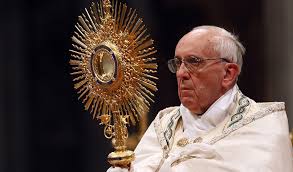
     It was given by the Holy Spirit to the Catholic West, not because of its strength, but because of its weaknesses.   It is proof that the Church is Catholic, not because of our merits, but because of God`s merciful love.   It would probably never have come to light if the tradition of receiving communion at Mass had been faithfully observed or if the Church in the West had faithfully and enthusiastically accepted the whole doctrine of the Seventh Ecumenical Council, the Council of Nicaea on icons.   Both the falling away of frequent communion - only rectified by Pope Pius X - and the lack of enthusiasm for icons, due to anti-Greek feeling and suspicion, left a vacuum in Catholic devotion which was filled by Adoration of the Blessed Sacrament.

20th century liturgists, even revered ones like Jungmann, could not see how the liturgical piety that they were advocating could have any room for "individualistic" devotion to the Blessed Sacrament.   They could not have been more wrong. Hardly anybody is in favour of the "old" Mass, now called the extraordinary rite, in Lima where I live; but the number of chapels is growing  dedicated to Exposition of the Blessed Sacrament all day and every day, and some even have twenty four hour adoration organised by the parishioners  The most successful new religious families are also advocates of Eucharistic devotion, even if they are formed in the "new" post-Vatican II liturgy. & This needs an explanation.

   Where did Jungmann &Co. go wrong?   I am talking about my own heroes whose understanding of theology and liturgy I greatly admire and accept.  However, I must admit they had a blind spot.   I think they were victims of their own skills.   It was enough for them to show that adoration of the Blessed Sacrament was a substitute for receiving communion for them to believe that the practice would wither away once holy communion was given its rightful place. They over-estimated the study of texts to reveal the fulness of Catholicism and under-estimated the activity of the Holy Spirit which cannot be a direct object of scholarly enquiry.

Let us start by quoting from the epiclesis of the Liturgy of St Basil.


That thy Holy Spirit may come upon us and upon these gifts here set forth, and bless them and hallow them and show this bread to be itself the precious Body of our Lord, God and Savior Jesus Christ, and this cup to be itself the precious Blood of Lord, God and Savior Jesus Christ… 

I choose this text because it is Eastern Orthodox, but also a Catholic liturgy which is, according to Pius XIth, "the chief organ of the ordinary magisterium of the Church": it is an expression of the universal Catholic/Orthodox Tradition.  It is as succinct and as accurate as any doctrinal definition, and comes directly from the Church of the Fathers.


This epiclesis is a part of a prayer expressing the humble obedience of the Church, obeying in faith the command of Christ at the Last Supper.   Christ, in making intercession to the Father, makes this prayer his own.


He and the Church ask for the Holy Spirit to come down on us and on the gifts in order the show the bread to be the body of Christ and the cup to be the precious blood of Christ.   In the Liturgy of St Basil, the consecration is a theophany.


For Symeon to have seen the salvation of Israel in a little baby, he needed an insight which goes beyond what he saw with his eyes, an ability to "see" that comes from the Holy Spirit.  For Peter, James and John to see Christ transfigured in light on Mount Tabor, they needed to have their eyes opened by the Holy Spirit to see the effect of the divine Presence which, in fact, was always there, but was invisible to eyes unaided.

For the consecration to be a theophany, the Holy Spirit needs to change the bread and wine into Christ's body and blood; but he also needs to allow us to see the bread and wine, so consecrated, with the eyes of faith, and to recognise them to be vehicles of Christ's divine /human presence.   That is exactly what the epiclesis prays for.

Hence,:  just as the continual presence of Christ as body and blood is the direct result of the continual activity of the Holy Spirit,  every time we recognise the consecrated elements to be the body and blood of Christ, the Holy Spirit is at work. It is a pentecostal moment to simply adore Christ in the host!  All types of Eucharistic devotion outside the Mass are nothing else than the extension of that moment between consecration and communion to different times and places, so that we may grow to appreciate all that we receive at Mass.   We have also discovered it to be a wonderful way to project Christ's presence among people who do not know him.   The Mass, besides being Sacrifice and Communion, is also  Theophany; and we have been taught by the Holy Spirit to extend that aspect of the Eucharist to all kinds of situations, wherever the Spirit may lead.


THE BLESSED SACRAMENT AS AN EVANGELISTIC TOOL.

,
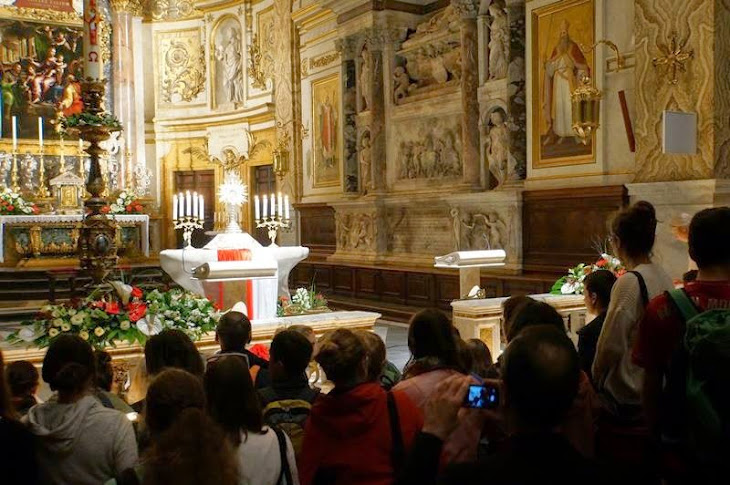

New monastic communities and ecclesial movements are prominent in their devotion to the Blessed Sacrament, especially those who also use icons: they show how compatible they are because both the Eucharistic monstrance and the icon make grace VISIBLE without threatening anyone, or requiring a certain status or the observance of any rules or conditions: it does not even require even that the person is a Christian.   That is why the Blessed Sacrament is such a wonderful evangelistic tool.   Watch this video:


De Lubac explained the loss of faith in the city on there being no opportunity in the lives of a great number of city dwellers to encounter the sacred.   It was for this that the ressourcement theologians wanted liturgical reform, but were terribly disappointed when togetherness took the place of a sense of the holy in the way so many celebrated Mass.  They saw the drop-out from the practice of the faith to be a direct result of this.  The New Evangelisation aims to give people just this sense of the holy; and, in this video you see it being done.

Another example is "Nightfever".


Idea

The idea behind Nightfever is simple and brilliant at the same time: we want to open the church during the night and invite everyone to a moment of tranquility to find their inner peace.

First church, then dance club? Or rather the other way around?

Nightfever particularly invites Teenagers and Young Adults to encounter with God. Young people nowadays usually don’t relate to the Christian faith and even less with the Catholic Church. Therefore we would like to try out a new way of approach to hand out invitations to them in the pedestrian zone.

Whoever goes out on a Friday or Saturday night usually have other destinations like pubs, dance clubs or cinemas on their mind. For this reason we want to address these people to pause for a moment, to put aside their initial plan and to come into the church. We offer the guests a candle and invite them to light it up in the church.    

Feel free to come and leave as you want!

Whoever enters the church is usually surprised by the nice atmosphere, since the church is illuminated almost exclusively by candles, and there is quiet Live Music that goes on throughout the night. Inside the church you are welcome to light up a candle, to receive a paper with a quote from the bible or simply just take a seat and write down a prayer intention or to speak with a priest.

It is entirely up to you what you feel you are comfortable with. You can either take a long walk through the church or simply just stay at one spot where you want to be. You are also free to stay as long as you want: for a few minutes, half an hour or even the whole evening.      

How did we come up with the idea of Nightfever?


The idea of the Nightfever evenings was born right after the World Youth day 2005 that took place in Cologne, Germany. In the beginning, there were only two students from Bonn who initially planned a one off evening on the 29th of October 2005. However it has become an international initiative today.

Nightfever includes many different elements. Those elements can help you to grow closer to God and to reach a good level and basis for communicating with Him.

Prayer

Prayer is the center of Nightfever. We come together in front of the altar in order to adore Jesus in the form of the bread. Adoration means talking to and with Jesus, to enter into a relationship with Him.
We do not have to pretend and disguise ourselves for Jesus, we do not need a special technique in order to pray properly and we certainly do not need to be accomplished individuals.

We may talk to Jesus just as we are, about everything that makes us happy or depresses us. Even if our thoughts are chaotic and unstructured, this time of silence can help us to gain a clear and peaceful mind again.

Enkindling candles

We invite passerby, young and old, to come into the church for a few minutes, to light a candle and to put it in front of the altar, in front of the Blessed Sacrament. Even when these people leave, their candles burn on as a symbol of their concerns and thoughts.


Within the dark church those candles bring light and spread/shine forth hope and faith in God. They also create the special atmosphere of Nightfever.

Biblical sayings


On the steps in front of the altar you can find baskets with biblical sayings. You are invited to take one for yourself. Often the drawn saying fits perfectly to our life, almost like it was meant especially for us. They can give us impulses for our prayer, for our conversation with God.

Conversation and reconciliation

Many things concern and occupy us in our lives. Oftentimes a conversation can help us to find an orientation again. During the Nightfever-evenings, priests sit at the sides of the church. They are there for these conversations. They listen, give advice and are absolutely closemouthed and discreet.


You also have the possibility of receiving the sacrament of penance (confession) and thus to experience the liberation from many burdens. In the sacrament of penance, Jesus gives us his love and mercy. The liberation from the burden of sin enables us to happily start anew and to continue on our path to God.

Blessings


The priest can also give you a blessing. For these blessings the priest puts his hands on the head of the faithful/visitor. This action can be an amazing opportunity to feel God's presence. In the blessing we can experience God as the one who is present in the lives of us humans. God himself is the originator and guarantor of this blessing

Prayer Request

Besides praying for oneself, there also is the possibility of letting someone pray for you and for certain concerns and requests. These requests one can write on a piece of paper and put it into a red box which is also placed near the Blessed Sacrament. Nuns of a monastery are then going to pray for your concerns.


Workshops and talks

Sometimes Nightfever also offers workshops or talks about some interesting topics on faith in everyday life. These talks are offered because even though Christian mysteries of the faith cannot be proven, faith needs to answer to our reason, needs to live up to our reason.

In those talks we think about how our faith and the teachings of the Church can be lived and practised in our everyday life.

This post is a repetition of last year's. I have repeated it because I don't think I can do better. However, the second that will be published on Saturday is new.
HERE IS ONE VERY GOOD WAY TO CELEBRATE THE CORPUS CHRISTI MASS

Monday, 1 June 2015

FROM LORRAINE TO BURGUNDY BY WAY OF CHINA: The life of Mother Elizabeth, Foundress of the Byzantine Carmelite Monastery in France.


         On the Feast of Our Lady of Mount Carmel, July 16, 1926, a young woman from the Vosges entered the Carmelite Monastery of the Annunciation in Nancy.  Born on November 18, 1903, in Remiremont, Marie was the eldest of four children, three girls and a boy, in a deeply religious family.  Her mother died young and Marie took over the running of the household, being involved at the same time in the Noelist Movement [a form of Catholic Action].  The three sisters felt a call to the religious life.  Marguerite (1905 – 1979) would become a Benedictine Oblate, since her state of health prevented her from entering a religious order; Madeleine (1908 – 1990), who wrote novels under the pseudonym “Nane”, would enter the Visitation Monastery in Nancy in 1944, whilst their brother Paul, the youngest child, (1914 – 2004) would become engaged.  His marriage to Jeanne in 1945 would give the sisters two nieces and a nephew: Genevieve, Marie Christine and Jean Paul.

         The eldest girl began her ascent of Mount Carmel behind the high walls of the monastery in Nancy, drawing water from St. Teresa of Avila’s well and climbing the secret staircase with St. John of the Cross.  She had no idea at the time that the ways of the Lord were going to lead her to a far-off country.  The Carmel was still under construction in 1926, but the chapel had already been dedicated, the previous year, to St. Therese of the Child Jesus.  The postulant was taught St. Therese’s “little way”, ascesis through love and for the sake of love.  It was in this chapel that she was clothed on January 20, 1927, taking the name Marie Elisabeth of the Trinity.  She made her temporary profession on June 7, 1928, in the presence of Mere Elisee (1) then three years later she took her final vows in the presence of Mere St. Paul.  The first years of her religious life were spent while the new monastery building was being constructed.  It was completed on July 16, 1933.

         When Monsignor Jantzen, the Bishop of Chongqing, appealed for help for the Carmel in Sechuan, his words found an echo in the heart of the young, temporarily professed nun; but at that point in time the Carmel in Nancy was able to give only a negative reply.  The appeal was reiterated, however, in 1933, and given publicity by Pere Louis of the Trinity (Admiral d’Argenlieu), Provincial of the Paris Province of the Carmelite Friars at the time.  Mere Elisee, who was beginning a new term of office as Prioress, consequently opened the doors of the Carmel in Nancy to allow Soeur Marie Elisabeth and Soeur Cecile to continue their contemplative life in China.  Soeur Marie Elisabeth wrote an account of the first part of their journey, which lasted longer than a month, for her Uncle Paul’s parish newsletter.  (He was the parish priest of  Saint-Michel-sur-Meurthe).  On arrival in Chongqing, they bravely embarked on the study of the Chinese language.  Postulants arrived in quick succession, but deaths came just as quickly.  Scarcely three years after their arrival in China, “Easter morning” dawned for Soeur Cecile, struck down by a form of yellow fever.  The Sino-Japanese war broke out in 1937 and there was constant bombardment.  This was followed by the “Communist liberation” in 1949.  The whole missionary endeavour collapsed: the college, the hospital, the Archbishop’s House and parishes.  In  1951 came the day when the Sisters were expelled.

          In 1952, in response to a request from the community of the Carmel in Nancy, who had elected her Prioress in absentia, Mere Marie Elisabeth returned to the monastery where she had been professed.  She would continue as Prioress for eighteen years.  Although community life was invigorated during the Sixties by the presence of many white-veiled novices, it was affected in the Seventies by the vocations crisis that followed the Second Vatican Council.  Several of the Sisters asked for laicisation, exclaustration or transfer to other monasteries.  While acceding to these requests, with no hint of criticism and the greatest respect for each individual Sister, Mere Elisabeth was anxious to know if they were happy and fulfilled in their new situations.  She felt called to redouble her expressions of loving concern:

          Everything is going well for Sister X in Rheims.  She is blooming…As for Sister Z, she has found a post as a secretary…She is in better spirits, but feels that she’s in the right place outside the enclosure.  God’s ways and our response are mysterious.  We must love one another!

          The word “love” occurs time and again in her letters and counsels.

          Poverty, austerity and pain are not good in themselves, but because they make us receptive to love.  It is love alone that counts, so you must have a great love for the God Who is utterly tender; love Him with a love that is chaste and strong, as a contemplative virgin should. Don’t look at yourself in a moment of weakness; keep your gaze turned in the direction of the Infinite God, for the simple fact is that He becomes incarnate in all the events of your daily life, whether great or small; and in so doing, you will go cheerfully along the road of “unconsidered trifles.”(4).

          The recollection of one of her novices shows how practical Mere Elisabeth’s love was:

          Amongst all the precious gifts I received from her during my novitiate, my most treasured memory, one that sustains me to this day, is of her completely down to earth advice regarding the practice of fraternal charity.

          If someone appears to be at fault in what they have done, I must avoid judging them; for at the same moment that I am giving the Sister a stern or forbidding look, God sees that she is already regretting her action and He takes delight in purifying her and drawing her closer to Himself, so that she is far more deserving of my love than of my condemnation!

          When I offer to help someone, instead of doing something that interests me personally, I should find out what that person would like me to do and how she would like me to do it.  It probably won’t be what I would have chosen!  We must always have this tactful concern for the other person and the forgetfulness of self which enables us to render real service.

          When someone has made a hurtful remark about me, I should behave in a way that leads her to think that I never heard it.  I should give her a smile at the first opportunity, just as if I hadn’t been offended, and look happy, so that she will be able to say, “Thank goodness! She never noticed!” and is not upset and put out by the wrong she has done me. (5).

          Involvement in missionary work is an integral part of the Carmelite vocation.   When she was in China, Mere Marie Elisabeth realized the urgent need for Christians confronted with a Buddhist society to be united.  Pamphlets and booklets by Abbe Paul Couturier were sent regularly to the Carmel in Chongqing.  The Week of Prayer for Christian Unity was observed in the Carmel with great fervour, as a religious festival.  On the bridge of the English packet-boat bringing her back to France, Mere Marie Elisabeth, who was practically the only Catholic on board, engaged in cordial discussions with Anglicans, members of the Salvation Army and Methodists.  She experienced the power of prayer in common, transcending their divisions.

          The Decree on ecumenism, issued by the Second Vatican Council in 1964, confirmed her approach.  “It is earnestly recommended that Catholics avail themselves more often of the spiritual riches of the Eastern Fathers, which lift up the whole man to the contemplation of divine mysteries…It is of  supreme importance to understand, venerate, preserve and foster the rich liturgical and spiritual heritage of the Eastern Churches in order faithfully to preserve the fullness of  Christian tradition and to bring about reconciliation between Eastern and Western Christians.” (6) In addition, the Decree on the renewal of religious life asked religious for a continual return to the primitive inspiration of their Institutes. (7) 

          In the history of the Carmelite Order, there are close links between East and West.  Originating in the caves of Palestine and moulded by centuries of Eastern tradition, the Order was  able to combine this in its saints with the riches of the West  Since it has become a spiritual crossroads, as it were, a pool where the waters of two rivers are mingled, does it not have a unifying role?…Prayer according to the tradition of our Orthodox brethren, a return to our common sources, do these not already constitute the rediscovery of a fundamental unity between Eastern and Western Christians? (8)

          In 1965 the community in Nancy, already sensitive to the problem of unity, agreed that a Byzantine-rite Carmel should eventually be founded.  After friendly discussions, several eminent French Orthodox Christians indicated that they were in favour of the project and gave it their encouragement.  An Oriental Section was established in the Carmel in Nancy.

          In 1973, Mere Elisabeth (9) left the Carmel in Nancy once again in order to rejoin the Oriental Section, who had left at the end of 1971 for the Carmel in Nogent-sur-Marne, which was within easy reach of Paris, thus simplifying the task of formation.  It was a painful separation for all the Sisters, and a tearful one, but Mere Elisabeth wanted the joy of responding to the Lord’s invitation to be paramount and, embracing her Sisters for the last time, she asked them to sing one of her favourite hymns, Vierge de lumiere (“Virgin of light”).

          The six months spent in the Carmel in Nogent were devoted to preparations for the founding of a Byzantine- rite Carmel dedicated to unity; Mere Elisabeth took special care, nevertheless, to be available and helpful to the community who had offered hospitality to the group from Nancy.  She contacted Bishop Albert Decourtray, the new Bishop of Dijon, and on May 11, 1974, all the boxes which had been packed up several months previously were despatched to Saint Remy on the Cote d’Or.  The house which formerly belonged to Edith Royer was put at their disposal by her descendants and it was transformed into a monastery dedicated to St. Elijah.  She led the community for the next three years, after which she asked to be replaced by a younger person.  The woman who had been a Prioress for twenty-five years now became a model of prompt and cheerful obedience.  Another long period of preparation was necessary before the official recognition ad experimentum, for five years, in 1981, then the canonical establishment of the Carmel in 1986, making it the fourth Byzantine-rite Carmel in existence, after Sofia (Bulgaria), Harissa (Lebanon) and Sugarloaf (Pennsylvania).

          On February 2, 1980, a sliver of peach-stone perforated her intestine.  She suffered an occlusion which was not diagnosed until three days later.  The operation on the necrotic tissue in her intestine, carried out in the hospital in Montbard, had to be followed by a second operation, which took place in the Holy Childhood Clinic in Nancy.  She was in a serious condition.  She received the Sacrament of the Sick and, contrary to all expectations, was able to return to Saint Remy and chant the Office on Easter Sunday morning, as she had wished!  On three other occasions (in 1984, 1994 and 1996) she again received the Sacrament of the Sick, when it seemed that her earthly life was drawing to a close; but on each occasion, she received the grace of a physical cure, her life being prolonged so that she could fulfil her mission on earth.

         In 1994, the project to found a skete in Romania was taking shape.  Mere Elisabeth was all set to become personally involved.

         You can imagine how happy I am, Father!  Of course there are things that will have to be left behind, but I believe that my vocation, Jesus has made this clear to me, is to live in a small and relatively poor Carmel, in a country where prayer for Christian unity must of necessity be more fervent and perhaps more difficult, on account of the existence of two separate hierarchies…  In the meantime, help me to be more faithful and more abandoned to the Will of God, to immerse myself more and more deeply, with Mary, in the heart of Jesus, who is the Radiant Morning Star. “Deification will mean that we are united with the glorified Body of Jesus”; and because this deification begins on earth, in the joyful light of that Flame- both Burning Bush and Star – of the eternal Fire in the bosom of the Blessed Trinity, radiating everlasting Light and Warmth, I ask you to bless me in His Name.  I count so much on your prayers as a Bishop!

         She had set out for China; she had set out for the foundation of the Carmel in Saint Remy; was she about to set out for Romania?  She longed for this with all her heart, but her community were not in agreement, in view of her state of health and the difficulties associated with the foundation.  The Lord was calling her now to set out on a different journey.

          On June 15, 1996, in her cell, at a quarter to midnight, Mere Elisabeth breathed her last, after spending seventy years in Carmel.  The foundress of the Russian Byzantine Monastery in Saint Remy entered the Light which had been the theme-song of her whole life, It was the Sunday when the feast of All the Russian Saints is celebrated. Monsignor Daucourt, who was currently Bishop of Troyes and President of the French Bishops’ Commission for Christian Unity, presided at her funeral.  The Easter Troparion that she loved so much was sung as she was laid to rest in the little cemetery of the Carmel in Saint Remy.  “Christ has risen from the dead, by death defeating Death; He frees us from the tomb, to give us life.”

MORNING BY MORNING…HE WAKENS MY EAR. (11)

          The Bible was her principal reading matter and meditation on the Psalms her daily bread.  With the Book of the Psalms open on her lap, she would weave rosaries for the Jesus Prayer.  When she was Prioress in China, she made an effort to deliver her reflections on the Bible in Chinese and she invited Chinese and European priests to preach the community retreats.  As Prioress of the Carmel in Nancy, she saw to it that all the Sisters received a solid grounding in Biblical studies, through weekly conferences given by Canon Jean Curot, (12) an expert in Biblical exegesis; as a consequence, the Psalms, the Song of Songs, the Gospel of St. John, St. Paul’s Epistles and the Book of Revelation were studied in depth.  Her writings are studded with quotations from Scripture.  The Word dwelt within her.

          The Word of God!  The Word calls us to a life that is both contemplative and missionary.  It illumines, guides and nourishes that life, as it illumined and protected Israel.  We are required to listen to it; “Shema Israel!”  It is bestowed on us each day in our communion with the Bread of Life, with the risen and glorified Body of the Word made Flesh; it is mediated through the texts of Scripture and the Liturgy, transmitted and explained by the Fathers of the Church, bearers and messengers of the Good News. (13)

          She was extremely well read. When she was in China, Bishop Charles Freppel’s books enabled her to begin the study of the Fathers of the Church.  In the Carmel in Nancy, she introduced the community to Eastern spirituality by setting up an Oriental library and reflecting during community meetings on the book Les ages de la vie spirituelle (“The ages of the spiritual life”), by the Orthodox theologian Paul Evdokimov.  Certain books were her bedside reading and she would return to them again and again.  The writings of Oliver Clement and Daniel-Ange spoke to her heart…The books she was reading at the end of her life indicated her open-mindedness.  Alongside Biblical commentaries (Blaise Arminjon’s Sur la lyre a deux cordes, A l’ecoute des psaumes and Nous voudrions voir Jesus; avec saint Jean, 1 – 11) were The way of the Buddha, passages from Dostoievsky published in Eglises russes, and L’evangile d’Isaie by Paul Claudel.

          Her love of the liturgy enabled her to appreciate in a special way Maurice Zundel’s Le poeme de la sainte liturgie (“The splendour of the liturgy”) and Jean Corbon’s Liturgie de source  (“Wellsprings of worship”); the latter author preached one of their community retreats.

          We must stay close to the spring of living water that is unsealed for us each morning in the Divine Liturgy.  We must respond to the invitation of its closing words, “Let us go in the peace of Christ,” and follow the advice of St. Seraphim of Sarov, “Learn to be peaceful, and thousands of souls around you will find salvation.” (14)

          The book of nature spoke to her in many ways.  From her walks through the pine forests of her native Vosges, in search of bilberries, Mere Elisabeth retained a great love of the natural world, a world clothed in the Beauty of the Lord.

  I REJOICE IN THE LORD  (15)

          When those who had never known her saw the photograph taken just before she died, they were impressed by her sparkling eyes and the marvellous smile lighting up her face. For those who did know her, that smile was “unforgettable, sincere, joyful, full of warmth.” (16)

          Mere Elisabeth had a great fondness for light.  She shared the following recollection:

          When I was a little girl, I liked to catch the sun’s rays in a mirror and project them all round me, so that the earth and the sky seemed to be covered with stars.  Everything looked different, all beautiful and sparkling.  I used to tease people, by making them guess where the light was coming from.  Later on, I read that “ Placed as they are under the powerful lens of contemplation, Carmelites must be so consumed by love that their contact with others will set their hearts on fire with “the love that makes the world go round.” (17)

          Her spirituality consisted entirely of light and joy and she found it hard, in consequence, to understand Adam’s lament, by Starets Silouan. (18)

          She kept the Jesus Prayer, (“Lord Jesus, Son of God, have mercy on me, a sinner”) always in her heart.   Trusting in God’s mercy, she thought of herself as the prodigal child in its Father’s arms, rather than the young man in tears and far from home.

          She had probably arrived at the state described by St. John Climacus: “ God does not demand or desire that someone should mourn out of sorrow of heart, but rather out of love for Him he should rejoice with the laughter of the soul.” (19)

          Is the monastic cloak that austere shadow

          Hiding the light of Baptism in order to preserve it,

          Like a veil of mourning, absorbing bitter tears?

          Oh, no!  Beneath it, a wedding garment is being woven.”  (20)

          She loved to highlight and copy out all the quotations in the Psalms referring to joy.  When she was instructing the novices in China or Nancy, she would give a commentary on The spiritual canticle or The living flame before introducing The ascent of Mount Carmel or The dark night, because she wanted them to understand at the very start where it was all leading.  Conscious of the totality of Christ’s saving action on her behalf, she lived in the joyful awareness of salvation, her gaze fixed on God, her sorrow turned into joy.  (21)

          She appealed to one of the Sisters who was having problems never to let go of the joy of the Holy Spirit, which is God’s own joy, transcending all human joy.  You must become more and more open to it, with hope and love; it will give you abiding serenity and courage. (22)

          During her final years, deafness and speech difficulties did not diminish Mere Elisabeth’s profound joy, a joy she had a need to express to all those she met.  Her broad smile and loving expression compensated for her infirmities and were like a song in praise of the “Joyful Light.”  When she knew her end was near, she asked her Sisters to be joyful:

          Don’t be sad; be happy, because I am leaving you.

Her dying words confirmed all she had stood for throughout her life:

It seems as if I am in a great company, keeping watch.  I am falling asleep in the Light.

FULLY ALERT AND FULL OF FAITH
          The Rule of Carmel prescribes vigilance, in accordance with the recommendations in the First Letter of St. Peter, “Be sober and vigilant.” (1 Peter, Ch. 5, v. 8).  Her ability to give her total attention to others was astonishing.  Even when she was in her hospital bed, caught up in the struggle between life and death, a powerful sense of her presence emanated from her exhausted body, because the Holy Spirit had taken permanent possession of her.  As her deafness increased, she was unable to hear us knocking at her door, so we had to go in without her being aware of it.  We always found her fully awake and full of faith, ready to welcome us and be at our service, because she was completely one with Mary in her “Yes” to infinite, self-giving Love and to the spring of living water ready to gush forth.  She loved to invoke the Mother of God as “the Virgin of the Welcome.”  The Eucharistic assembly was for her the Church’s “Yes” of welcome to the gift of God. (23)

          What the Eastern Fathers called nepsis – the attitude of a soul that is fully alert, fully aware of itself and God, sober and watchful – found in her a living embodiment.  This was, of course, a charism, a grace granted by her Lord, but it was also the fruit of her continual meditation on the Bible, in accordance with the teaching of St. Maximus the Confessor (d. 662): “If, then as has been said, you attend soberly and uninterruptedly to the foregoing, you can know the Lord’s and His Apostles’ purpose, to love men and to have sympathy with them when they fall, but by love to war constantly against the wicked demons.” (24)

          A Benedictine monk from the Abbey of la Pierre- qui - vire, who was her confessor for fifteen years, disclosed, to the assembly gathered in Saint Remy for the celebration of the centenary of her birth, how much he had been impressed by Mere Elisabeth’s evangelical simplicity.  “She asked me one day to pray for her, so that the Holy Spirit would come down upon her more powerfully.   She was about eighty years old at the time.  Acting very simply, she knelt down in front of me and I stretched out my hands and prayed aloud to the Lord for two or three minutes, asking Him to send His Spirit down upon her.  When I had finished, there was silence for two or three minutes, then she said to me with great emotion, “ Oh, Father, how good God is!  I thank you with all my heart!  But I could not have stood it for very much longer; your hands were weighing so heavily on my head.”  So I said to her, “Mere Elisabeth, my hands were at least fifty centimetres above your head!”  This spiritual experience remained a secret between us, but I feel now that I am able to reveal it.  My own part was negligible, but I think that the Spirit of Jesus, which is the strength of God, came down with power on Mere Elisabeth, in her complete simplicity.  For the Spirit of God was her driving force.” (25)

 THAT THEY ALL MAY BE ONE…SO THAT THE WORLD MAY BELIEVE (26)

          Mere Elisabeth’s significance in the ecumenical movement rests firmly on her membership of the Carmelite Order.  The words of Archbishop Chabbert of Rabat found a powerful echo in her heart.  She copied them into one of the notebooks that it was her pleasure to give to her close friends before she died, in order to present them with the message she wished to hand on to them.  As she wrote, she vigorously underlined any words that were crucial to her, or wrote them in capitals, so making them her own:

          We do not give sufficient thought to the fact that Unity is a GIFT of God, and that we have to pray, beseech and intercede for that gift to be bestowed on us.  It is a cry to God, a cry that every Church should utter. It is the cry of a shipwrecked man…We put too much faith in the efficacy of our human efforts and not enough in the power of the Spirit of God.  An immense wave of prayer must flow across all Christian peoples to call down this grace from God. May  that day come when we can no longer pray as separate groups.  (27)

          Passionately devoted to the cause of Christian unity, Mere Elisabeth failed to understand how those who call on the Name of Jesus, the Name of the One who freed and saved them and gathered them from among the pagans, could remain separated.

          How can this be? For me, this has been a burning question for more than fifty years!.. And a long time later, I heard the same agonizing question on the lips of Monsignor Meletios, one Good Friday, in the Greek Orthodox Cathedral in Paris, where he was Bishop.  He had just placed the Book of the Gospels on the epitaphios, with its floral decorations.  We had approached him in order to discuss Christian unity. He took my hand in both of his, pressed it, and said with a sigh, “How can we Christians remain apart?” (28)

          She was delighted to learn of the establishment of the Catholic-Orthodox Theological Commission.  Its first meeting in Patmos/Rhodes in 1980 electrified her!  She followed its deliberations with keen interest, was astonished at the limited press coverage it received and got us all to pray while it was in session.  Some if its members ( Jean Corbon, Emmanuel Lanne) were invited to Saint Remy to give a report on their meetings to the Carmelite Sisters.  The annual exchange visits between the Holy See in Rome and the Patriarchy in Constantinople, on June 29 for the feast of SS. Peter and Paul, and November 30, for the feast of St. Andrew, were for her the subject of fervent intercessory prayer.

          In the Holy Spirit’s own good time, “when He wills,” in the sight of believers and non-believers, seekers and intercessors alike, Christian Unity will rend the clouds asunder and… the world will believe; then Jerusalem (the undivided Church) “will be able to put aside her garment of sadness and don her festive robe, because she will see her children coming together from East to West, at the command of the Holy One; they will be jubilant, because God has been mindful of His people.” (29)

          Prayer for Unity is not primarily intercession, but communion with the Trinitarian mystery with which she was associated through the name she received at her clothing, “Marie Elisabeth of the Trinity.”  Such contemplation gives rise to suffering on account of the divisions between Christians, repentance for such distressing divisions, thanksgiving for the efforts being made to bring people closer together, transcending racial, national or denominational prejudices, and humble, confident supplication “that all may be one.”

          Carmel cannot be prophetic without at the same time being missionary, in the sense of “bearing witness.”  One’s situation does not matter; loving availability is all that counts.  Yes, all this demands great fidelity on our part, and continual change of heart.  (30)

          Mere Elisabeth’s prayer was not only ecumenical, but also open to dialogue with other faiths.  She took an interest in the Eastern religions she had come across when in China and in the descendants of Abraham, Jews and Muslims.  She wrote a long poem for the Jewish poet from Marseilles, Emmanuel Eydoux, who came to give a talk in Saint Remy on the feast of St. Elijah in 1982.  The poem speaks of the fact that religion takes many forms, and ends:

               The hope is certain and invincible
               That we one day together
               Sons and daughters of Abraham
               Children of every race
               Children of every colour
               As messengers of the new Unity
               Will be able with full voice
               To utter this prophetic invitation:
               “Jerusalem, turn your gaze towards the East,
               See the joy coming to you from God.
               Look, they are coming back to you,
               The sons and daughters whom you saw departing,
               They have gathered and are returning,
               Returning from the East and from the West
               On the orders of the Holy One,
               Rejoicing in the glory of their God…”
               …”For God will lead Israel rejoicing
               To the radiance of His glory,”
               Where “Love is not possible” will be no more. (31)
          “Mere Elisabeth’s life was, and always will be, a journey undertaken, as we say at every Mass, “for the glory of God and the salvation of the world.” (32).  Her legacy to us is a message full of light and joy, a message of faith, hope and love.

Mere Eliane

(Translated from Mikhtav, No. 41, December 2004, pp. 5 – 16)

 Notes

See Mere Elisabeth: Reverende Mere Elisee- de- Saint-Joseph, 1867 –1954.  (Nancy, 1957).

Mere Elisabeth wrote a lively account of the whole epic adventure in China, in six exercise books which were published after her death as Partir, (1998), 174pp.  The title she had given them was  Pars! Vers la Chine, En Chine, A Dieu la Chine.  The book is available from the Monastere Saint-Elie, 21500, Saint-Remy, France, price 15 euros.

Private correspondence, 1973.

Address given at the temporary profession of Soeur Marie Madeleine in the Carmel in Nancy, October 1956.

Reported by Soeur Marie de la Trinite, in Mikhtav, No. 15 (Saint-Remy, 1996), p. 30.

VATICAN II, Unitatis reintegratio, 15.

VATICAN II, Perfectae caritatis, 2.

See “Dirige-toi vers l’Orient”, in Vives flammes, No. 115 (Venasque, 1978), p. 246.

Out of respect for the Eastern tradition, whereby monks have only one name in religion, the name “Marie Elisabeth” was simplified to “Elisabeth.”

Letter to Bishop Gerard Daucourt, dated August 15, 1994.

Isaiah, Ch. 50, v.4 (RSV translation).

See his obituary in Mikhtav, No. 40 (Saint Remy, 2004) p. 23.

Partir, p. 56.

1987. See Zander, Valentin: St. Seraphim of Sarov, p.24.

Psalm 103, v.34 (RSV translation).

Reported by her doctor. See  Mikhtav, No. 38 (Saint Remy/Stanceni, 2003), p.21.

La priere de Jesus: contemplative, missionnaire et oecumenique, in Tychique, No. 7 (Lyons, 1977): reprinted in Mikhtav, No. 15 (Saint Remy, 1996), p. 16.

SILOUAN, Starets: Wisdom from Mount Athos, p. 47.

JOHN CLIMACUS, Saint: The ladder of divine ascent, p. 141.

Poem by Mere Elisabeth, written for the anniversary of the Baptism of one of the Sisters (April 29, 1976).  See JOHN CLIMACUS, op.cit., p. 140: “The man wearing blessed, God-given mourning like a wedding garment gets to know the spiritual laughter of the soul.”

See Psalm 50, v. 14: “Deliver me… and my tongue will sing aloud of thy deliverance”; John, Ch. 16, v. 20: “You will be sorrowful, but your sorrow will turn into joy.”

Private correspondence, 1973.

Meditation on the Eucharist, written in 1987.

MAXIMUS the Confessor: The ascetic life, para. 17.

LEBLOND, Dom Germain: Homily preached on November 16, 2003. In Mikhtav, No. 38 (Saint Remy/Stanceni, 2003), pp. 18-19.

John, Ch. 17, v. 21.

Le lien, Nos. 4-5, 1978, p. 54.

La priere de Jesus: contemplative, missionaire et oecumenique, in Tychique, No. 7 (Lyons, 1977); reprinted in Mikhtav, No. 15, (Saint Remy., 1996), p. 19.

See “Dirige-toi vers l’Orient” in  Vives flammes, No. 115 (VENASQUE, 1978), p. 249; Baruch, Ch. 5, v. 5: “Take off the garment of your sorrow and affliction, O Jerusalem… Put on the robe of righteousness…See your children gathered from west and east, at the Word of the Holy One, rejoicing that God has remembered them.”

Private correspondence, 1973.

Chemins de priere, in Mikhtav, No. 15, (Saint Remy, 1996), p. 12.

Letter from Father Camilo Maccise, Father General of the Discalced Carmelites, to the Prioress of the Carmel in Saint Remy, written in Rome, June 28, 1996. “Pour la gloire de Dieu  et le salut du monde” is the response in the French Missal to the Orate fratres… The response given in the English Missal is different: “For the praise and glory of His Holy Name, for our good and for the good of all His Church.”

               Bibliography

English translations of works mentioned in the text.

CORBON, Jean.  Wellsprings of worship.  (Ignatius P., 2005).
                (Liturgie de source).
EVDOKIMOV, Paul.  The ages of the spiritual life.  (St. Vladimir’s Seminary P., 1998).      (Les ages de la vie spirituelle).
JOHN CLIMACUS, Saint.  The ladder of divine ascent. (Paulist P., 1982).  Many alternative translations are available.  (L’echelle sainte).
MAXIMUS the Confessor.  The ascetic life.  (Longmans, 1955).
                  (La vie ascetique).
SILOUAN, Starets.  Wisdom from Mount Athos, ed. Archimandrite Sophrony.  (Mowbray, 1974).
VATICAN II.  The conciliar and post-conciliar documents, ed. Austin Flannery.  (Costello, 1975).
ZUNDEL, Maurice.  The splendour of the liturgy.  (Sheed and Ward, 1939).
           (Le poeme de la sainte liturgie).    
Monastère Saint-Élie
5, rue du Floquet
F-21500 SAINT-RÉMY

Tél.- Fax : 0(0 33)3 80 92 07 40

THE CARMELITE SKETE IN ROMANIA


In response to an invitation from the Greek Catholic Metropolitan in Romania, Monsignor Lucian Muresan, on September 14, 1994, the feast of the Triumph of the Cross, the Monastery of St. Elijah laid the foundations of a skete in Stanceni, a village set in the Carpathian Mountains. The Skete is dedicated to the Holy Cross which unites all Christians as they await the resurrection.

Situated on the outskirts of a village whose inhabitants are Orthodox, Catholic or Protestant, it is a place of prayer for Unity. It is about 15 km from the Orthodox Monastery in Toplita, a monastery dedicated to St. Elijah.

The Sisters live in separate hermitages, in accordance with the primitive Rule of Carmel. They assemble for prayer in a little wooden chapel dedicated to the Transfiguration. Meals and community activities take place in the main house. A guesthouse is available for a small number of retreatants.

Schutul Sfânta Cruce
str. Gudea nr. 281
547575 STÂNCENI (Mures)

Tél.-Fax : 0040 265 719 914 ; 0040 740 880 125


Search This Blog

La Virgen de Guadalupe

La Virgen de Guadalupe

Followers

My Blog List

Fr David Bird

Fr David Bird
Me on a good day

Blog Archive