EXPAND YOUR READING!!

"Today the concept of truth is viewed with suspicion, because truth is identified with violence. Over history there have, unfortunately, been episodes when people sought to defend the truth with violence. But they are two contrasting realities. Truth cannot be imposed with means other than itself! Truth can only come with its own light. Yet, we need truth. ... Without truth we are blind in the world, we have no path to follow. The great gift of Christ was that He enabled us to see the face of God".Pope Benedict xvi, February 24th, 2012

The Church is ecumenical, catholic, God-human, ageless, and it is therefore a blasphemy—an unpardonable blasphemy against Christ and against the Holy Ghost—to turn the Church into a national institution, to narrow her down to petty, transient, time-bound aspirations and ways of doing things. Her purpose is beyond nationality, ecumenical, all-embracing: to unite all men in Christ, all without exception to nation or race or social strata. - St Justin Popovitch

Friday, 3 April 2015

HOLY SATURDAY 2015 - POPE BENEDICT XVI, VON BALTHASAR & AIDAN NICHOLS & ALEXANDR SCHMEMANN

Let us return once more to the night of Holy Saturday. In the Creed we say about Christ’s journey that he “descended into hell.” What happened then? Since we have no knowledge of the world of death, we can only imagine his triumph over death with the help of images which remain very inadequate. Yet, inadequate as they are, they can help us to understand something of the mystery. The liturgy applies to Jesus’ descent into the night of death the words of Psalm 23[24]: “Lift up your heads, O gates; be lifted up, O ancient doors!” The gates of death are closed, no one can return from there. There is no key for those iron doors. But Christ has the key. His Cross opens wide the gates of death, the stern doors. They are barred no longer. His Cross, his radical love, is the key that opens them. The love of the One who, though God, became man in order to die – this love has the power to open those doors. This love is stronger than death. The Easter icons of the Oriental Church show how Christ enters the world of the dead. He is clothed with light, for God is light. “The night is bright as the day, the darkness is as light” (cf. Ps 138[139]12). (HH Pope Benedict XVI, Holy Saturday, 2007)

 Pope Benedict XVI, General Audience 19-03-2008


Holy Saturday is marked by a deep silence. The Churches are left undecorated and there are no
particular liturgies set aside for this day. While waiting for the Resurrection, the faithful persevere in the wait with Mary by praying and meditating. A day
of silence is necessary to ponder the reality of human life, the forces of evil and the enormous power of good
unleashed by the passion and resurrection of Christ. Great importance is given during this time to participation in the sacrament of reconciliation,
indispensable for the purification of the heart and to prepare for the celebration of Easter completely renewed. We need to undertake this inner purification and renewal of ourselves at least once a year. This Saturday of silence, of meditation, of forgiveness, of reconciliation leads into the Easter Vigil, which introduces the most important Sunday in history, the Sunday that marks the Passover of Christ. The Church holds vigil next to the newly blessed fire and meditates on the great promise contained in the Old and New Testaments, of the conclusive liberation
from the ancient slavery to sin and death. In the darkness of the night, the Easter candle is lit from the new fire as a symbol of Christ who rises again in glory. Christ, the light of humanity, dispels any shadows in the heart and the spirit and illuminates all men who
come into the world. Together with the lighting of the Easter candle, the great Easter announcement reverberates throughout the Church: Christ has truly
risen, death no longer has any power over him. With his death he defeats evil forever and makes man a gift of God’s own life.
www.zenit.org 19-03-2008

VON BALTHASAR’S TEACHING ON THE DESCENT INTO HELL by Aidan Nichols O.P.

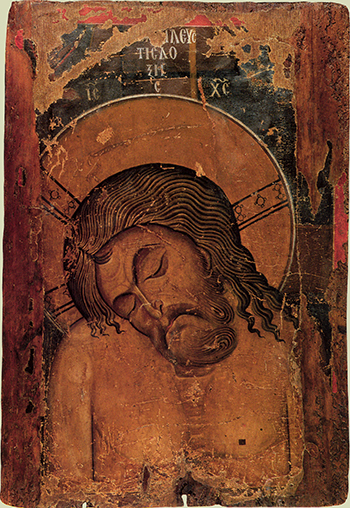
The importance of the concept of contemplation for Balthasar’s approach to Christ can be seen by comparing his view of perceiving God in Christ with the notion of looking at a painting and seeing what the artist has been doing in it. In Christian faith, the captivating force (the ‘subjective evidence’) of the artwork which is Christ takes hold of our imaginative powers; we enter into the ‘painterly world’ which this discloses and, entranced by what we see, come to contemplate the glory of sovereign love of God in Christ (the ‘objective evidence’) as manifested in the concrete events of his life, death and resurrection.  So entering his glory, we become absorbed by it, but this very absorption sends us out into the world in sacrificial love like that of Jesus.

This is the foundation of Balthasar’s Christology, but its content is a series of meditations on the mysteries of the life of Jesus. His Christology is highly concrete and has been compared, suggestively, to the iconography of Andrei Rublev and Georges Roualt.  Balthasar is not especially concerned with the ontological make-up of Christ, with the hypostatic union and its implications, except insofar as these are directly involved in an account of the mysteries of the life.  In each major moment (‘mystery’) of the life, we see some aspect of the total Gestalt Christi, and through this the Gestalt Gottes itself. Although Balthasar stresses the narrative unity of these episodes, which is founded on the obedience that takes the divine Son from incarnation to passion, an obedience which translates his inner-Trinitarian being as the Logos, filial responsiveness to the Father,  his principal interest — nowhere more eloquently expressed than in the present work — is located very firmly in an unusual place. This place is the mystery of Christ’s Descent into Hell, which Balthasar explicitly calls the centre of all Christology.  Because the Descent is the final point reached by the Kenosis, and the Kenosis is the supreme expression of the inner-Trinitarian love, the Christ of Holy Saturday is the consummate icon of what God is like.  While not relegating the Crucifixion to a mere prelude — far from it! — Balthasar sees the One who was raised at Easter as not primarily the Crucified, but rather the One who for us went down into Hell. The ‘active’ Passion of Good Friday is not, at any rate, complete without the ‘passive’ Passion of Holy Saturday which was its sequel.

Balthasar’s account of the Descent is indebted to the visionary experiences of Adrienne von Speyr, and is a world away from the concept of a triumphant preaching to the just which nearly all traditional accounts of the going down to Hell come under.  Balthasar stresses Christ’s solidarity with the dead, his passivity, his finding himself in a situation of total self-estrangement and alienation from the Father. For Balthasar, the Descent ‘solves’ the problem of theodicy, by showing us the conditions on which God accepted our foreknown abuse of freedom: namely, his own plan to take to himself our self-damnation in Hell. It also demonstrates the costliness of our redemption: the divine Son underwent the experience of Godlessness. Finally, it shows that the God revealed by the Redeemer is a Trinity. Only if the Spirit, as vinculum amoris between the Father and the Son, can re-relate Father and Son in their estrangement in the Descent, can the unity of the Revealed and Revealer be maintained. In this final humiliation of the "forma servi", the glorious "forma Dei" shines forth via its lowest pitch of self-giving love.

Mysterium Paschale could not, however, be an account of the paschal mystery, the mystery of Easter, unless it moved on, following the fate of the Crucified himself, to the Father’s acceptance of his sacrifice, which we call the Resurrection. Whilst not over-playing the role of the empty tomb — which is, after all, a sign, with the limitations which that word implies, Balthasar insists, in a fashion highly pertinent to a recurrent debate in England, as well as in Continental Europe, that the Father in raising the Son does not go back on the Incarnation: that is, he raises the Son into visibility, rather than returns him to the pre-incarnate condition of the invisible Word. The Resurrection appearances are not visionary experiences but personal encounters, even though the Resurrection itself cannot be adequately thought by means of any concept, any comparison.

COMMENTARY ON HOLY SATURDAY
by
Protopresbyter Alexander Schmemann


This is the Blessed Sabbath

The "Great and Holy Sabbath" is the day which connects Good Friday, the commemoration of the Cross, with the day of Christ’s Resurrection. To many the real nature and meaning of this "connection," the very necessity of this "middle day," remains obscure. For a good majority of churchgoers, the "important" days of Holy Week are Friday and Sunday, the Cross and the Resurrection. These two days, however, remain somehow "disconnected." There is a day of sorrow, and then, there is the day of joy. In this sequence, sorrow is simply replaced by joy . . . But according to the teaching of the Church, expressed in her liturgical tradition, the nature of this sequence is not that of a simple replacement. The Church proclaims that Christ has "trampled death by death." It means that even before the Resurrection, an event takes place in which the sorrow is not simply replaced by joy, but is itself transformed into joy. Great Saturday is precisely this day of transformation, the day when victory grows from inside the defeat, when before the Resurrection, we are given to contemplate the death of death itself... all this is expressed, and even more, all this really takes place every year in this marvellous morning service, in this liturgical commemoration which becomes for us a saving and transforming present.

Psalm 119 — Love for the Law of God

On coming to Church for the Matins of Holy Saturday, Friday has just been liturgically completed. The sorrow of Friday is, therefore, the initial theme, the starting point of Matins of Saturday. It begins as a funeral service, as a lamentation over a dead body. After the singing of the funeral troparia and a slow censing of the church, the celebrants approach the Epitaphion. We stand at the grave of our Lord, we contemplate His death, His defeat. Psalm 119 is sung and to each verse we add a special "praise," which expresses the horror of men and of the whole creation before the death of Jesus:

O hills and valleys,
the multitude of men,
and all creation, weep and lament with me,
the Mother of your God. (I:69)

And yet, from the very beginning, along with this initial theme of sorrow and lamentation, a new theme makes its appearance and will become more and more apparent. We find it, first of all, in Psalm 119 — "Blessed are those whose way is blameless, who walk in the law of the Lord." In our liturgical practice today this psalm is used only at the funeral services, hence its "funeral" connotation for the average believer. But in early liturgical tradition this psalm was one of the essential parts of the Sunday vigil, the weekly commemoration of Christ’s Resurrection. Its content is not "funeral" at all. This psalm is the purest and the fullest expression of love for the law of God, i.e., for the Divine design of man and of his life. The real life, the one which man lost through sin, consists in keeping, in fulfilling the Divine law, that life with God, in God and for God, for which man was created.

In the ways of Thy testimonies, I delight as much as in all riches. . . (v. 14)
I will delight in Thy statutes. . . (v. 16)

And since Christ is the image of the perfect fulfillment of this law, since His whole life had no other "content" but the fulfillment of His Father’s will, the Church interprets this psalm as the words of Christ Himself, spoken to His Father from the grave.

Consider how I love Thy precepts! Give me life, according to Thy mercy. . . (v. 159)

The death of Christ is the ultimate proof of His love for the will of God, of His obedience to His Father. It is an act of pure obedience, of full trust in the Father’s will; and for the Church it is precisely this obedience to the end, this perfect humility of the Son that constitutes the foundation, the beginning of His victory. The Father desires this death, the Son accepts it, revealing an unconditional faith in the perfection of the Father’s will, in the necessity of this sacrifice of the Son by the Father. Psalm 119 is the psalm of that obedience, and therefore the announcement that in obedience the triumph has begun.

The Encounter with Death

But why does the Father desire this death? Why is it necessary? The answer to this question constitutes the third theme of our service, and it appears first in the "praises," which follow each verse of Psalm 119. They describe the death of Christ as His descent into Hades. "Hades" in the concrete biblical language means the realm of death, which God has not created and which He did not want; it also signifies that the Prince of this world is all-powerful in the world. Satan, Sin, Death — these are the "dimensions" of Hades, its content. For sin comes from Satan and Death is the result of sin — "sin entered into the world, and death by sin" (Romans 5:12), "Death reigned from Adam to Moses" (Romans 5:14), the entire universe has become a cosmic cemetery, was condemned to destruction and despair. And this is why death is "the last enemy," (I Corinthians 15:20) and its destruction constitutes the ultimate goal of the Incarnation. This encounter with death is the "hour" of Christ of which He said that "for this hour have I come. (John 12:27)

Now this hour has come and the Son of God enters into Death. The Fathers usually describe this moment as a duel between Christ and Death, Christ and Satan. For this death was to be either the last triumph of Satan, or his decisive defeat. The duel develops in several stages. At first, the forces of evil seem to triumph. The Righteous One is crucified, abandoned by all, and endures a shameful death. He also becomes the partaker of "Hades," of this place of darkness and despair . . . but at this very moment, the real meaning of this death is revealed. The One who dies on the Cross has Life in Himself, i.e., He has life not as a gift from outside, a gift which therefore can be taken away from Him, but as His own essence. For He is the Life and the Source of all life. "In Him was Life and Life was the light of man." The man Jesus dies, but this Man is the Son of God. As man, He can really die, but in Him, God Himself enters the realm of death, partakes of death. This is the unique, the incomparable meaning of Christ’s death. In it, the man who dies is God, or to be more exact, the God-Man. God is the Holy Immortal; and only in the unity "without confusion, without change, without division, without separation" of God and Man in Christ can human death be "assumed" by God and be overcome and destroyed from within, be "trampled down by death."

Death is Overcome by Life

Now we understand why God desires that death, why the Father gives His Only-Begotten Son to it. He desires the salvation of man, i.e., that the destruction of death shall not be an act of His power ("Thinkest thou that I cannot now pray to My Father, and He shall presently give Me more than twelve legions of angels?" Matthew 26:53), not a violence, be it even a saving one, but an act of that love, freedom and free dedication to God for which He created man. For any other salvation would have been in opposition to the nature of man, and, therefore, not a real salvation. Hence the necessity of the Incarnation and the necessity of that Divine death. In Christ, man restores obedience and love. In Him, man overcomes sin and evil. It was essential that death be not only destroyed by God, but overcome and trampled down in human nature itself, by man and through man. "For since by man came death, by man came also the resurrection of the dead." (I Corinthians 15:21)

Christ freely accepts death; of His life He says that "no man taketh it from Me, but I lay it down of Myself." (John 10:18) He does it not without a fight: "and He began to be sorrowful and very heavy." (Matthew 26:27) Here is fulfilled the measure of His obedience and, therefore, here is the destruction of the moral root of death, of death as the ransom for sin. The whole life of Jesus is in God as every human life ought to be, and it is this fullness of Life, this life full of meaning and content, full of God, that overcomes death, destroys its power. For death is, above all, a lack of life, a destruction of life that has cut itself from its only source. And because Christ’s death is a movement of love towards God, an act of obedience and trust, of faith and perfection — it is an act of life ("Father! Into Thy hands I commend My spirit," Luke 23:46) which destroys death. It is the death of death itself.

Such is the meaning of Christ’s descent into Hades, of His death becoming His victory. And the light of this victory now illumines our vigil before the Grave.

O Life, how canst Thou die?
How canst Thou dwell in a tomb?
Yet by Thy death Thou hast destroyed the reign of death, and raised all the dead from hell. (1:2)
In a tomb they laid Thee, O Christ the Life. By Thy death Thou hast cast down the might of death and become the font of life for all the world. (1:7)
O, how great the joy, how full the gladness, that Thou hast brought to Hades’ prisoners, like lightning flashing in its gloomy depths. (1:49)
Life enters the Kingdom of death. The Divine Light shines in its terrible darkness. It shines to all who are there, because Christ is the life of all, the only source of every life. Therefore He also dies for all, for whatever happens to His life — happens in Life itself ... This descent into Hades is the encounter of the Life of all with the death of all:

Wishing to save Adam,
Thou didst come down to earth.
Not finding him on earth, O Master,
Thou didst descend to Hades seeking him. (1:25)

Sorrow and joy are fighting each other and now joy is about to win. The "praises" are over. The dialogue, the duel between Life and Death comes to its end. And, for the first time, the song of victory and triumph, the song of joy resounds. It resounds in the "troparia on Psalm 119," sung at each Sunday vigil, at the approach of the Resurrection day:

The angelic host was filled with awe when it saw Thee among the dead! By destroying the power of death, O Savior, Thou didst raise Adam and save all men from hell!
In the tomb the radiant angel cried to the myrrhbearers, "Why do you women mingle myrrh with your tears? Look at the tomb and understand: the Savior has risen from the dead!"

The Life-giving Tomb

Then comes the beautiful Canon of Great Saturday, in which once more all the themes of this service — from the funeral lamentation to the victory over death are resumed and deepened, and which ends with this order:

Let creation rejoice! Let all born on earth be glad! For hateful hell has been despoiled. Let the women with myrrh come to meet me; for I am redeeming Adam and Eve and all their descendants, and on the third day shall I arise!

"And on the third day shall I arise!" From now on paschal joy illumines the service. We are still standing before the Tomb, but it has been revealed to us as the life-giving Tomb. Life rests in it, a new creation is being born, and once more, on the Seventh Day, the day of rest the Creator rests from all His work. "The Life sleeps and Hell trembles" — and we contemplate, this blessed Sabbath, the solemn quiet of the One who brings life back to us: "Come, let us see our life lying in the tomb. . ." The full meaning, the mystical depth of the Seventh Day, as the day of fulfillment, the day of achievement is now revealed, for

The great Moses mystically foreshadowed this day, when he said,

God blessed the seventh day.
This is the Blessed Sabbath;
this is the day of rest,
on which the Only-Begotten Son of God rested from all His works.
By suffering death to fulfill the plan of salvation,
He kept the Sabbath in the flesh;
by returning again to what He was,
He has granted us eternal life through His resurrection,
for He alone is good, and the Lover of man.

We now go around the Church in a solemn procession with the Epitaphion, but it is not a funeral procession. It is the Son of God, the Holy immortal, who proceeds through the darkness of Hades, announcing to "Adam of all generation" the joy of forthcoming resurrection. "Rising early from the night," He proclaims, "The dead shall arise, those in the tombs shall awake, and all those on earth shall greatly rejoice."

Expectation of Life

We return to the Church. We know already the mystery of Christ’s life-giving death. Hades is destroyed. Hades trembles. And now the last theme appears — the theme of Resurrection.

Sabbath, the seventh day, achieves and completes the history of salvation, its last act being the overcoming of death. But after the Sabbath comes the first day of a new creation, of a new life born from the grave.

The theme of Resurrection is inaugurated in the Prokeimenon:

Arise, O Lord, and help us! Deliver us for Thy Name’s sake. We have heard with our ears, O God...

It is continued in the first lesson: the prophecy of Ezekiel on the dry bones (ch. 37). ". . . There were very many in the open valley, and, behold, they were very dry." It is death triumphing in the world, the darkness, the hopelessness of this universal sentence to death. But God speaks to the prophet. He announces that this sentence is not the ultimate destiny of man. The dry bones will hear the words of the Lord. The dead will live again. "Behold, My people, I will open your graves and cause you to come up out of the graves, and bring you up into the land of Israel ..." Following this prophecy comes the second prokeimenon — with the same appeal, the same prayer:

Arise, O Lord my God, lift up Thy Hand! . . .

How will it happen, how is this universal resurrection possible? The second lesson (I Corinthians 5:6, Galatians 3:13-14) gives the answer: "a little leaven leveneth the whole lump…" Christ, our Pascha, is this leaven of the resurrection of all. As His death destroys the very principle of death, His Resurrection is the token of the resurrection of all, for His life is the source of every life. And the verses of the "Alleluia," the same verses which will inaugurate the Easter service, sanction this final answer, the certitude that the time of the new creation, of the day without evening, has begun:

Alleluia! Let God arise! Let His enemies be scattered! Let those who hate Him flee from before His face ... Alleluia! As smoke vanishes, so let them vanish, as wax melts before the fire!

The reading of the prophecies is over. Yet, we have heard but prophecies. We are still in Great Saturday before Christ’s tomb, and we have to live through this long day, before we hear at midnight: "Christ is risen," before we enter into the celebration of His Resurrection. Thus, the third lesson — Matthew 27:62-66 — which completes the service, tells us once more about the Tomb — "which was made secure by sealing the stone and setting a guard."

But it is probably here, at the very end of Matins, that the ultimate meaning of this "middle day" is made manifest. Christ rose again from the dead, His Resurrection we will celebrate on Easter Day. This celebration, however, commemorates a unique event of the past, and anticipates a mystery of the future. It is already His Resurrection, but not yet ours. We will have to die, to accept the dying, the separation, the destruction. Our reality in this world, in this "aeon," is the reality of the Great Saturday; this day is the real image of our human condition. We believe in the Resurrection, because Christ has risen from the dead. We expect the Resurrection. We know that Christ’s death is no longer the hopeless, the ultimate end of everything. Baptized into His death, we partake already of His life that came out of the grave. We receive His Body and Blood which are the food of immortality. We have in ourselves the token, the anticipation of the eternal life. All our Christian existence is measured by these acts of communion to the life of the "new eon" of the Kingdom, and yet we are here, and death is our inescapable share.

But this life between the Resurrection of Christ and the day of the common resurrection, is it not precisely the life in the Great Saturday? Is not expectation the basic and essential category of Christian experience? We wait in love, hope and faith. And this waiting for "the resurrection and the life of the world to come," this life which is "hidden with Christ in God" (Colossians 3:34), this growth of expectation in love, in certitude; all this is our own "Great Saturday." Little by little everything in this world becomes transparent to the light that comes from there, the "image of this world" passes by and this indestructible life with Christ becomes our supreme and ultimate value.

Every year, on Great Saturday, after this morning service, we wait for the Easter night and the fullness of Paschal joy. We know that they are approaching — and yet, how slow is this approach, how long is this day! But is not the wonderful quiet of Great Saturday the symbol of our very life in this world? Are we not always in this "middle day," waiting for the Pascha of Christ, preparing ourselves for the day without evening of His Kingdom?

.....

TRAMPLING DOWN DEATH BY DEATH

We sing that Christ is ". . . trampling down death by death" in the troparion of Easter. This phrase gives great meaning to Holy Saturday. Christ’s repose in the tomb is an "active" repose. He comes in search of His fallen friend, Adam, who represents all men. Not finding him on earth, He descends to the realm of death, known as Hades in the Old Testament. There He finds him and brings him life once again. This is the victory: the dead are given life. The tomb is no longer a forsaken, lifeless place. By His death Christ tramples down death.

THE ICON OF THE DESCENT INTO HADES

The traditional icon used by the Church on the feast of Easter is an icon of Holy Saturday: the descent of Christ into Hades. It is a painting of theology, for no one has ever seen this event. It depicts Christ, radiant in hues of white and blue, standing on the shattered gates of Hades. With arms outstretched He is joining hands with Adam and all the other Old Testament righteous whom He has found there. He leads them from the kingdom of death. By His death He tramples death.

Today Hades cries out groaning:
"I should not have accepted the Man born of Mary.
"He came and destroyed my power.
"He shattered the gates of brass.
"As God, He raised the souls I had held captive."
Glory to Thy cross and resurrection, O Lord!
(Vesperal Liturgy of Holy Saturday)


THE VESPERAL LITURGY

The Vespers of Holy Saturday inaugurates the Paschal celebration, for the liturgical cycle of the day always begins in the evening. In the past, this service constituted the first part of the great Paschal vigil during which the catechumens were baptized in the "baptisterion" and led in procession back into the church for participation in their first Divine Liturgy, the Paschal Eucharist. Later, with the number of catechumens increasing, the first baptismal part of the Paschal celebration was disconnected from the liturgy of the Paschal night and formed our pre-paschal service: Vespers and the Divine Liturgy of St. Basil the Great which follows it. It still keeps all the marks of the early celebration of Pascha as baptismal feast and that of Baptism as Paschal sacrament (death and resurrection with Jesus Christ — Romans 6).

On "Lord I call" the Sunday Resurrectional stichira of tone 1 are sung, followed by the special stichiras of Holy Saturday, which stress the death of Christ as descent into Hades, the region of death, for its destruction. But the pivotal point of the service occurs after the Entrance, when fifteen lessons from the Old Testament are read, all centered on the promise of the Resurrection, all glorifying the ultimate Victory of God, prophesied in the victorious Song of Moses after the crossing of the Red Sea ("Let us sing to the Lord for gloriously has He been glorified"), the salvation of Jonah, and that of the three youths in the furnace.

Then the epistle is read, the same epistle that is still read at Baptism (Romans 6:3-11), in which Christ’s death and resurrection become the source of the death in us of the "old man," the resurrection of the new, whose life is in the Risen Lord. During the special verses sung after the epistle, "Arise O God and judge the earth," the dark Lenten vestments are put aside and the clergy vest in the bright white ones, so that when the celebrant appears with the Gospel the light of Resurrection is truly made visible to us, the "Rejoice" with which the Risen Christ greeted the women at the grave is experienced as being directed to us.

The Liturgy of St. Basil continues in this white and joyful light, revealing the Tomb of Christ as the Life-giving Tomb, introducing us into the ultimate reality of Christ’s Resurrection, communicating His life to us, the children of fallen Adam.

One can and must say that of all services of the Church that are inspiring, meaningful, revealing, this one — the Vespers and Liturgy of St. Basil the Great on the Great and Holy Saturday — is truly the liturgical climax of the Church. If one opens one’s heart and mind to it and accepts its meaning and its light, the very truth of Orthodoxy is given by it, the taste and the joy of that new life which shown forth from the grave.

Rev. Alexander Schmemann

GOOD FRIDAY 2015


ABBOT PAUL'S HOMILY FOR GOOD FRIDAY

Good Friday 2015
                  “Pilate answered, “What I have written, I have written.” This was Pilate’s last stand. He had written the notice himself and fixed it to the cross; it ran: “Jesus the Nazarene, King of the Jews.” For St Paul the Cross and Christ crucified were the answer to all his questions. He needed to know nothing else and so could glory in the Cross of his Lord and Saviour, accepting all manner of suffering and hardship, a living martyrdom, in the joy and confidence of being reconciled to God in Christ Jesus.
The Cross is the work of the Father, who so loved the world that he gave his only Son. It is the work of the Son, who did not cling to equality with God but humbled himself, accepting death on a cross. It is the work of the Holy Spirit, in whom the Son offers himself to the Father and who is poured out by the Son, for “bowing his head, he gave up the spirit.” In the Cross, we come to know the love of God, which passes all understanding.
                  Adam fell at a tree, yet by a tree he was saved. Eve was seduced at a tree, yet through a tree the bride was restored to her spouse. At a tree Satan defeated Adam: on a tree Jesus destroyed the works of the devil. At a tree God cursed man and through a tree that curse gave way to blessing. God exiled Adam from the tree of life: on a tree the New Adam endured exile that we might inherit the earth and know the joys of heaven. The Cross is the tree of knowledge, the tree of judgement and the tree of life. The Cross is the staff of Moses which divides the waters and leads us dry-shod through the sea of life. The Cross is the wood thrown into the bitter waters of Marah to make them sweet and life-giving. The Cross is the standard on which Moses lifted up the serpent in the wilderness, on which Jesus is now lifted up to draw all people to himself.
                  The Cross is planted on Calvary, and Golgotha is the new Eden, the new Ararat and the new Moriah. It is greater than Sinai, for the new and greater Covenant is sealed in the Blood of Christ. On the Hill of Calvary God reveals his Glory and speaks his final Word. It is greater than Mount Zion, the mountain of the Great King. It is the true Tabor, for the Transfiguration prefigured this moment when Christ is glorified and in him God is glorified and Man is deified. Calvary is the new Carmel, where the fire of God falls from heaven to consume with its living flame the twelve-stone altar of the new Israel of God, the Church, which is the Body of Christ made up of living stones. The Cross is the new ladder of Jacob, by which we climb to heaven, while Jesus is the new Bethel, the house of God, in which there are many mansions and in whom we shall live forever.
                  The Cross lies at the heart and at the crossroads of history, “the twisted knot at the centre of reality”, to which all previous history leads and from which all subsequent history flows. The Cross reveals the ultimate meaning of life, where the love of God embraces the whole universe and redeems it in the sacrifice of Jesus Christ, our High Priest, who takes upon his shoulders, indeed, into his very being our sufferings, our failures and our sins, the tragedy of our fallen nature. In the Letter to the Hebrews we heard.  “Although he was Son, he learnt to obey through suffering, but having been made perfect, he became for all who obey him the source of eternal salvation.” The whole Bible contained in a single verse.
Pilate was a stubborn man. “What I have written, I have written,” he said. St Paul, too, was a stubborn man, calling all things so much rubbish when compared to knowing Jesus, and him crucified. In fact, he was determined to know nothing but Christ crucified, for the Jews a stumbling block, for the Gentiles sheer lunacy, but for those who believe the very wisdom and salvation of God. We need to be more stubborn in our faith, for nothing and no one can take the Cross of Jesus from us. We adore thee, O Christ, and we bless thee, for by thy Holy Cross thou hast redeemed the world. Amen.


HOMILY OF FATHER RANIERO CANTALAMESSA, O.F.M. Cap.

St. Peter's Basilica 
Good Friday, 10 April 2009


“Suffering draws us into the power of the Cross”

"Christus factus est pro nobis oboediens usque ad mortem, mortem autem crucis" - "For us Christ became obedient unto death, even death on a cross". On the 2,000th anniversary of the birth of the Apostle Paul, let us listen to some of his fiery words on the mystery of Christ's death which we are celebrating. No one can help us understand its significance and importance better than he can.

His words to the Corinthians are a sort of manifesto: "For Jews demand signs and Greeks seek wisdom, but we preach Christ Crucified, a stumbling block to Jews and folly to Gentiles, but to those who are called, both Jews and Greeks, Christ the power of God and the wisdom of God" (1 Cor 1: 22-24). Christ's death bears universal importance. "One has died for all: therefore all have died" (2 Cor 5: 14). His death has given new meaning to the death of every man and every woman.
Christ's Cross, the Tree of Life

In Paul's eyes the Cross assumes cosmic significance. With it Christ knocked down the wall of separation, he reconciled men with God and with one another, destroying hatred (cf. Eph 2: 14-16). Based on this the primitive tradition was to develop the theme of the Cross as a cosmic tree that joins heaven and earth with the vertical branch and unites the different peoples of the world with the horizontal branch. It is at the same time both a cosmic and a very personal event: He "loved me and gave himself for me" (Gal 2: 20). Every human, the Apostle writes, is "one for whom Christ died" (Rom 14: 15).

From all of this arises the meaning of the Cross, no longer as a punishment, admonishment or reason for affliction but, rather, as the glory and boast of a Christian, that is, a jubilant certainty, accompanied by heartfelt gratitude, to which man rises in faith: "But far be it from me to glory except in the Cross of our Lord Jesus Christ" (Gal 6: 14). Paul has planted the Cross at the centre of the Church like the main mast at the centre of a ship. He has made it the foundation and centre of gravity of everything. He has established the permanent framework of the Christian message. The Gospels, written after him, follow his framework, making the story of Christ's Passion and death the fulcrum to which everything is oriented.

It is amazing to see all the work the Apostle carried out. It is relatively easy for us today to see things in this light, since, as Augustine said, Christ's Cross has filled the earth and now shines on the crowns of kings [1]. When Paul wrote, the Cross was still synonymous with the greatest possible dishonour, something that well-brought up people should not even mention.

The goal of the Year of St Paul is not so much to know the Apostle's thinking better (researchers are always doing this, quite apart from the fact that scientific research takes more than a year); rather, as the Holy Father has recalled on a number of occasions, it is to learn from Paul how to respond to the current challenges to the faith. One of these challenges, perhaps the most open one known yet, has become a publicity slogan plastered on public transport vehicles in London and other European cities: "There's probably no God. Now stop worrying and enjoy your life".

The most striking element about this slogan is not the premise, "God does not exist", but rather the conclusion: "Enjoy your life"! The underlying message is that faith in God is an obstacle to enjoying life, that it is an enemy of happiness. Without it there would be more happiness in the world! Paul helps us to respond to this challenge, explaining the origin and meaning of all suffering, starting with the suffering of Christ.

Why "was it... necessary that the Christ should suffer these things and enter into his glory?" (cf. Lk 24: 26) This question sometimes receives what might be termed a "weak", and in a certain sense, reassuring answer. Christ, in revealing the truth of God, necessarily provokes the opposition of the forces of evil and darkness, and these forces, as happened with the prophets, will lead to his rejection and elimination. "It was necessary that Christ suffer" would then be understood in the sense of "it was inevitable that Christ suffer".

Paul gives a very "strong" answer to that question. The need is not of the natural order but rather of the supernatural. In countries where the Christian faith has existed since antiquity the idea of suffering and the cross is almost always associated with sacrifice and expiation. Suffering, it is thought, is necessary to atone for sins and to placate God's justice. This is what has provoked, in the modern epoch, the rejection of every idea of sacrifice offered to God, and in the end, the very idea of God.

It cannot be denied that we Christians have possibly exposed ourselves to this accusation. But we are dealing with a ambiguity that a better understanding of St Paul's thought has already definitively clarified. He writes that God has preordained Christ "whom God put forward as an expiation" (Rom 3: 25). However, this expiation does not act on God to placate him, but on sin to eliminate it. "It can be said that it is God himself, not man, who expiates sin... the image is that of removing a corrosive stain or neutralizing a lethal virus rather than anger placated by punishment" [2].

Christ has given a radically new meaning to the idea of sacrifice. In it, "it is no longer man who exerts an influence on God in order to placate him. Rather it is God who acts to make man stop hating him and his neighbour. Salvation does not start with man asking for reconciliation; it begins with God's request: "Be reconciled to God" (2 Cor 5: 20ff.) [3].

The fact is that Paul takes sin seriously, he does not make light of it. For him, sin is the principal cause of man's unhappiness, the rejection of God, not God himself! Sin encloses the human creature in "lies" and "injustice" (Rom 1: 18; 3: 23), condemns the cosmic material itself to "vanity" and "corruption" (Rom 8: 19ff.) and it is also the principal cause of the social evils that afflict humanity.

Unending analyses of the economic crisis are underway in today's world and its causes, but who dares take an axe to the roots and speak about sin? The global financial and economic elite resembled a runaway train steaming recklessly ahead without brakes, without stopping to think about the rest of the train that had come to a standstill on the tracks some way back. We were heading in completely the wrong direction.

The Apostle defines insatiable avarice as "idolatry" (Col 3: 5) and points to the unbridled desire for money as "the root of all evils" (1 Tim 6: 10). Can we say he is wrong? Why are there so many families on the streets, masses of workers who have lost their jobs, if not because of some people's insatiable thirst for profit?

And why, in the recent earthquake in the Abruzzi, did so many recently built buildings collapse? What led the builders to use sea sand instead of cement?

Through his death, Christ not only denounced and conquered sin, he also gave new meaning to suffering, even to that which does not depend on anyone's sin, like the suffering of the many victims of the earthquake that recently devastated the nearby Abruzzo region. He made it a means of salvation, a path to resurrection and life. The new meaning that Christ gave to suffering was not so much made manifest in his death but rather in his victory over death, that is, the Resurrection. He "was put to death for our trespasses and raised for our justification" (Rom 4: 25): the two events are inseparable in the thought of Paul and of the Church.

It is a universal human experience: in this life pleasure and pain follow one another with the same regularity with which, when a wave swells in the ocean, a trough follows a crest and sucks in the shipwrecked sailor. "Full from the fount of Joy's delicious springs, some bitter o'er the flowers its bubbling venom springs", the pagan poet Lucretius wrote [4]. Drug use, the abuse of sex and homicidal violence all provide momentary intoxicating pleasure but lead to the person's moral dissolution and often also to his physical ruin.

Christ, with his Passion and death, inverted the relationship between pleasure and pain: "for the joy that was set before him [he] endured the Cross" (Heb 12: 2). No longer is it pleasure which ends in suffering, but suffering that leads to life and joy. It is not only a different order of events; in this way it is joy, not suffering, that has the last word, a joy that will last for eternity. "Christ being raised from the dead will never die again; death no longer has dominion over him" (Rom 6: 9). Nor will it have any power over us.

This new relationship between suffering and pleasure is reflected in the way in which time marches on in the Bible. According to human calculations, day starts with the morning and ends with the night; in the Bible day starts with night and ends with daytime: "And there was evening and there was morning, one day", says the story of creation (Gn 1: 5). It is not meaningless that Jesus died in the evening and rose in the morning. Without God, life is a day that ends in night; with God it is a night that ends in day, a day without sunset.

So Christ did not come to increase human suffering or to preach resignation to it; he came to give meaning to suffering and to announce its end and defeat. That slogan on the buses in London and in other cities may also be read by parents who have a sick child, by lonely people or the unemployed, by refugees from war zones, by people who have suffered grave injustices in life.... I try to imagine their reaction to reading the words: "There's probably no God. Now enjoy your life"! How?

Suffering is certainly a mystery for everyone, especially the suffering of the innocent, but without faith in God it becomes much more senseless. Even the last hope of redemption is taken away. Atheism is a luxury that only the privileged can afford; those who have had everything, including the possibility of dedicating themselves to study and research. This is not the only incongruity of that publicity gimmick. "God probably does not exist": so he might exist, the possibility of it cannot be totally excluded. But, dear non-believing brother or sister, if God does not exist I have not lost anything; if on the other hand he does exist, you have lost everything! We should almost thank those who promoted that advertising campaign; it has served God's cause better than so many of our apologetic arguments. It has shown up the poverty of their reasoning and helped to jolt so many sleeping consciences.

Yet God's measure of justice is different from ours and if he sees good faith or blameless ignorance he saves even those who had been anxious to fight him in their lives. We believers should prepare ourselves for surprises in this regard. "Quam multae oves foris, quam multi lupi intus!" [How many sheep are outside of the flock and how many wolves inside it!], Augustine exclaims [5].

God is capable of turning those who most persistently deny him into his most impassioned apostles. Paul is an example. What had Saul of Tarsus done to deserve that extraordinary encounter with Christ? What had he believed, hoped or suffered? What Augustine said about every divine choice can be applied to him: "Look for merit, look for justice, reflect and see whether you find anything other than grace" [6]. This is how he explains his calling: "I am the least of the Apostles, unfit to be called an Apostle, because I persecuted the Church of God. But by the grace of God I am what I am" (1 Cor 15: 9-10).

The Cross of Christ is a cause of hope for all and the Year of St Paul is an opportunity of grace also for those who do not believe and are seeking the truth. One thing speaks in their favour before God: suffering! Like the rest of humanity even atheists suffer in life and suffering, since the Son of God took it on himself, has redemptive and almost sacramental power.

In Salvifici Doloris John Paul II wrote that suffering is a channel through which the saving powers of the Cross of Christ are offered to humanity [7].

In a moment, after we are invited to pray "for those who do not believe in God", a moving prayer by the Holy Father in Latin will follow; translated it says: "Everlasting and eternal God, you have instilled in the hearts of men a deep longing for you, so that only once they find you will they have peace: grant that, overcoming every obstacle, all may recognize the signs of your goodness and, moved by the witness of our life, they may have the joy of believing in you, the one true God and Father of all mankind. Through Christ our Lord".

Notes

[1] St Augustine, Enarr. in Psalmos, 54, 12 (PL 36, 637).

[2] J. Dunn, La teologia dell’apostolo Paolo, Paideia, Brescia 1999, p. 227.

[3] G. Theissen A. Merz, Il Gesù storico. A manual, Queriniana, Brescia 2003, p. 573.

[4] Lucrezio, De rerum natura, IV, 1129 s.

[5] St Augustine, In Ioh. Evang. 45,12.

[6] St Augustine, On the Predestination of the Saints, 15, 30 (PL 44, 981).

[7] Cf. Apostolic Letter Salvifici doloris, n. 23.

GREAT AND HOLY FRIDAY
By: Father Alexander Schmemann
Friday: The Cross 
From the light of Holy Thursday we enter into the darkness of Friday, the day of Christ's Passion, Death and Burial. In the early Church this day was called "Pascha of the Cross," for it is indeed the beginning of that Passover or Passage whose whole meaning will be gradually revealed to us, first, in the wonderful quiet of the Great and Blessed Sabbath, and, then, in the joy of the Resurrection day. 
But, first, the Darkness. If only we could realize that on Good Friday darkness is not merely symbolical and commemorative. So often we watch the beautiful and solemn sadness of these services in the spirit of self-righteousness and self-justification. Two thousand years ago bad men killed Christ, but today we -- the good Christian people -- erect sumptuous Tombs in our Churches -- is this not the sign of our goodness? Yet, Good Friday deals not with past alone. It is the day of Sin, the day of Evil, the day on which the Church invites us to realize their awful reality and power in "this world." For Sin and Evil have not disappeared, but, on the contrary, still constitute the basic law of the world and of our life. And we who call ourselves Christians, do we not so often make ours that logic of evil which led the Jewish Sanhedrin and Pontius Pilate, the Roman soldiers and the whole crowd to hate, torture and kill Christ? On what side, with whom would we have been, had we lived in Jerusalem under Pilate? This is the question addressed to us in every word of Holy Friday services. It is, indeed, the day of this world, its real and not symbolical, condemnation and the real and not ritual, judgment on our life... It is the revelation of the true nature of the world which preferred then, and still prefers, darkness to light, evil to good, death to life. Having condemned Christ to death, "this world" has condemned itself to death and inasmuch as we accept its spirit, its sin, its betrayal of God -- we are also condemned... Such is the first and dreadfully realistic meaning of Good Friday -- a condemnation to death... 
The Day of Redemption 
But this day of Evil, of its ultimate manifestation and triumph, is also the day of Redemption. The death of Christ is revealed to us as the saving death for us and for our salvation. 
It is a saving Death because it is the full, perfect and supreme Sacrifice. Christ gives His Death to His Father and He gives His Death to us. To His Father because, as we shall see, there is no other way to destroy death, to save men from it and it is the will of the Father that men be saved from death. To us because in very truth Christ dies instead of us. Death is the natural fruit of sin, an immanent punishment. Man chose to be alienated from God, but having no life in himself and by himself, he dies. Yet there is no sin and, therefore, no death in Christ. He accepts to die only by love for us. He wants to assume and to share our human condition to the end. He accepts the punishment of our nature, as He assumed the whole burden of human predicament. He dies because He has truly identified Himself with us, has indeed taken upon Himself the tragedy of man's life. His death is the ultimate revelation of His compassion and love. And because His dying is love, compassion and co-suffering, in His death the very nature of death is changed. From punishment it becomes the radiant act of love and forgiveness, the end of alienation and solitude. Condemnation is transformed into forgiveness... 
The Destruction of Death 
And, finally, His death is a saving death because it destroys the very source of death: evil. By accepting it in love, by giving Himself to His murderers and permitting their apparent victory, Christ reveals that, in reality, this victory is the total and decisive defeat of Evil. To be victorious Evil must annihilate the Good, must prove itself to be the ultimate truth about life, discredit the Good and, in one word, show its own superiority. But throughout the whole Passion it is Christ and He alone who triumphs. The Evil can do nothing against Him, for it cannot make Christ accept Evil as truth. Hypocrisy is revealed as Hypocrisy, Murder as Murder, Fear as Fear, and as Christ silently moves towards the Cross and the End, as the human tragedy reaches its climax, His triumph, His victory over the Evil, His glorification become more and more obvious. And at each step this victory is acknowledged, confessed, proclaimed -- by the wife of Pilate, by Joseph, by the crucified thief, by the centurion. And as He dies on the Cross having accepted the ultimate horror of death: absolute solitude (My God, My God, why hast Thou forsaken me!?), nothing remains but to confess that "truly this was the Son of God!..." And, thus, it is this Death, this Love, this obedience, this fullness of Life that destroy what made Death the universal destiny. "And the graves were opened..." (Matthew 27:52) Already the rays of resurrection appear. 
Such is the double mystery of Holy Friday, and its services reveal it and make us participate in it. On the one hand, there is the constant emphasis on the Passion of Christ as the sin of all sins, the crime of all crimes. Throughout Orthros during which the twelve Passion readings make us follow step by step the sufferings of Christ, at the Hours (which replace the Divine Liturgy: for the interdiction to celebrate Eucharist on this day means that the sacrament of Christ's Presence does not belong to "this world" of sin and darkness, but is the sacrament of the "world to come") and finally, at Vespers, the service of Christ's burial the hymns and readings are full of solemn accusations of those, who willingly and freely decided to kill Christ, justifying this murder by their religion, their political loyalty, their practical considerations and their professional obedience. 
But, on the other hand, the sacrifice of love which prepares the final victory is also present from the very beginning. From the first Gospel reading (John 13:31) which begins with the solemn announcement of Christ: "Now is the Son of Man glorified and in Him God is glorified" to the stichera at the end of Vespers -- there is the increase of light, the slow growth of hope and certitude that "death will trample down death..."
 "Hell shuddered when it beheld Thee, the Redeemer of all Who was laid in a tomb. Its bonds were broken; its gates were smashed! The tombs were opened; the dead arose. Then Adam cried in joy and thanksgiving: Glory to Thy condescension, O Lover of man!”

And when, at the end of Vespers, we place in the center of the Church the image of Christ in the tomb, when this long day comes to its end, we know that we are at the end of the long history of salvation and redemption. The Seventh Day, the day of rest, the blessed Sabbath comes and with it -- the revelation of the Life-giving Tomb. 

Thursday, 2 April 2015

MAUNDY THURSDAY plus: TWO COMPLEMENTARY APPROACHES TO THE CHRISTIAN MYSTERY IN EAST AND WEST by Father R. Cantalamessa


MAUNDY THIRSDAY

Holy Week began on Palm Sunday, what the Orthodox call Lazarus Sunday.  Here are a few photos from the Sunday that began it all:
Father Alex, our newly ordained priest and an iconographer, is celebrating:
Blessing of palms:


The procession:
Afterwards, I went to a home for abandoned children run by "Cenaculo", a community of ex-drug addicts, alcoholics etc who do a wonderful job and follow the teachings of Our Lady of Medjugorje.  Although my role was no different from Fr Alex, the music was very different.   In the monastery we used Latin plainchant with the excruciatingly beautiful "Christus factus est pro nobis", while they were charismatic, with guitars and what they call dynamics.   That was beautiful too because the children took part with gusto and it expressed the faith of a beautiful community.
Afterwards, they took another photo:
THE CHRISM MASS
Today, we celebrated a normal Holy Week conventual Mass:
THE CHRISM MASS ON MAUNDY THURSDAY
One of my favourite Masses in the whole year is the Chrism Mass because here are the bishop, the priests and deacons and the laity, all in one place round the Eucharistic table.   Here is the Church at its most visible, in its fullness.  It is here, out of the fullnesss of its liturgical life, that all the Church's powers arise, and it is within the context of the Church united to Christ by the Holy Spirit that the oils are blessed.   If you wish to discover the full meaning of the sacramental use of oils, the individual rites where they are used are not enough: you need to come here where they are blessed for use.  Look, for instance at the Blessing of Chrism.   Here is part of one version.  After the anamnesis, when olives and the use of olive oil are remembered, the blessing becomes an epiclesis:

And so, Father, we ask you to bless + this oil you have created.   Fill it with the power of your Holy Spirit through Christ your Son...Make this chrism a sign of life and salvation for those who are born again in the waters of baptism...and when they are anointed with this holy oil, make them temples of your glory, radiant with the goodness of life that has its source in you.
Either this is an empty prayer, or something tremendous is happening.  If God is doing what the bishop asks, this is intimately bound up with the sacraments and blessings for which the chrism will be used.  There must be much more to the sacraments that "matter and form", and their efficacy have their roots in the Chrism Mass, in the liturgical life of the local Church.  That does not call into question exceptional circumstances when oils not blessed in this Mass - for instance, the oil of the sick is sometimes blessed by the priest.  Nevertheless, if we really want to understand a sacrament or sacramental which uses these oils, we should begin with the blessing of the oils in this Mass.   Our theology of sacraments  should include a wider theology of the transformation of the material world to become a means of sanctification.


HOMILY BY ABBOT PAUL
Maundy Thursday 2015 

“At the moment you do not know what I am doing, but later you will understand.” We have just heard Jesus say these words to Simon Peter, who had questioned what Jesus was about to do. “Lord, are you going to wash my feet?” The Bible is full of people who ask God why and how. Think of Mary at the Annunciation, “How can this be?” and of Moses before the burning bush, “What shall I say?”

            Throughout the Exodus, the Israelites kept complaining against Aaron and Moses and asking why. Why did you bring us out of Egypt to this place, where there is neither food nor water? At the time they did not know what God was doing, but later, in the Promised Land, they were able to look back and understand. They celebrated the Passover to show that they understood God’s plan and understanding brought with it repentance and thanksgiving.

            At the Last Supper, the disciples couldn’t follow what Jesus was doing. What did he mean when he said, “This is my body; this cup is the new covenant in my blood,” when all they could see and taste was bread and wine? And all this talk about a Paraclete, who would remind them of all that he had told them, who would lead them into all truth and give them power from on high? Now, at the end of the meal, here he was, washing their feet and telling them to follow his example. What could this mean?

            Caiaphas and Pilate, the High Priests and the Pharisees, the Jewish and Roman authorities, the soldiers and the crowds, even Simon Peter and Judas and the other disciples, all those involved in the Passion, Crucifixion and Death of Jesus, what could they possibly have understood at the time? Jesus alone knew that his hour had come. Only later did they understand, beginning surprisingly enough with the good thief, who said, “Remember me when you come into your kingdom,” and the soldier, a Gentile, who first declared, “Truly, this was the Son of God”.

            Only after the Resurrection did the disciples begin to understand, and they weren’t easily convinced. At Pentecost their eyes were opened at last to the meaning of Jesus’ life. Finally, they understood that he was Lord and Christ, the Saviour of the world. And this understanding led them to repentance and thanksgiving. That is why we still celebrate Holy Week and Easter, why we celebrate the sacraments and come to church. Christians have come to understand, as far as we are able, the mystery of the Incarnation and God’s ineffable love for Man.

            Tonight’s celebration starkly reminds us that Christ wants us to follow his example. He now wants us to show how perfect our love is. He wants us to serve others with humility and charity. He wants us to sacrifice our lives for others and not count the cost. We, of course, understand all this, but do we have the faith and the courage to do what Jesus asks of us? Have you ever thought what the world would be like if we Christians were simply to follow the example of Jesus? Mind you, if you take up your cross every day and follow him, don’t be surprised if in the end they crucify you. “I have given you an example so that you may copy what I have done to you.”

In the Ambrosian Rite, celebrated in Milan, there is a beautiful chant that is sung after the proclamation of the Gospel this evening. It says, “Today, Son of the Eternal God, you receive me as a friend at your wondrous banquet. I will not hand over your mystery to the unworthy nor will I kiss and betray you like Judas, but I implore you, like the thief on the cross, to receive me, Lord, into your kingdom.” Let us make that our prayer.


Fr. Cantalamessa’s 3rd Lenten Homily 2015

March 20, 2015 at 6:18 pm Leave a comment
East and West Before the Mystery of Christ
VATICAN CITY, March 13, 2015 (Zenit.org) – Here is the third Lenten homily given this year by the preacher of the Pontifical Household, Capuchin Father Raniero Cantalamessa. The homily did not take place due to the Vatican holiday celebrating the 2nd anniversary of Pope Francis’ election.
* * *
1. Paul and John: Christ seen from two angles
In our effort to bring together the spiritual treasures of the Christian East and West, let us reflect today on our common faith in Jesus Christ. Let us seek to do that as people who know we are speaking about someone who is present and not absent. If it were not for our human dullness that impedes us, every time we pronounce the name of Jesus we should think that there is someone who hears himself called by name and that he turns around to look. He is here with us even this morning and is listening, let us hope with indulgence, to what we will say about him.

We begin with the biblical data about Jesus. In the New Testament we already see outlined two different ways of expressing the mystery of Christ. The first is St. Paul’s. Let us summarize the specific characteristics of this path that make it become a model and archetype of Christology in the development of Christian thought:
–First, this path starts from Christ’s humanity to arrive at his divinity, from history to arrive at his pre-existence. It is thus an ascending path. It follows the order of Christ’s manifesting of himself, the order by which people have come to know him rather than the order of being.
–Second, it starts from Christ’s duality (flesh and Spirit) to arrive at the unity of the subject “Jesus Christ our Lord.”
–Third, it has the paschal mystery at its center, that is, Christ’s work before the person of Christ. The great turning point between the two phases of Christ’s existence is the resurrection from the dead.
To be convinced of the accuracy of this characterization, we only need to reread the very dense passage—a kind of embryonic credo—with which the Apostle begins the Letter to the Romans. The mystery of Christ is summarized this way:
Descended from David according to the flesh
Designated the Son of God with power according to the Spirit of holiness
By means of his resurrection from the dead,
Jesus Christ our Lord (see Rom 1:3-4)
The Christological hymn in Philippians 2 also speaks first of Christ in his status as a servant and then, after the resurrection, of Christ who is exalted as Lord. The concrete subject for Paul, even when he defines Christ as “the image of the invisible God” (Col 1:15), is always the Christ of history even though the idea of his preexistence is anything but absent in him.
A quick look ahead allows us to see how these Pauline traits of Jesus will be combined and developed in the sub-apostolic generation. Flesh and Spirit, which originally indicated the two phases of the life of Christ—before and after the resurrection—will come to indicate, already in St. Ignatius of Antioch, the two births of Jesus, “from Mary and from God” and finally the two natures of Christ. Tertullian writes,
Here the apostle teaches the two natures of Christ. With the words “descended from David according to the flesh,” he indicates his humanity; with the words “designated the Son of God with power according to the Spirit” he indicates his divinity.[1]
Alongside this ascending path of the mystery of Christ, a descending path is added by St. John. We can summarize the characteristics of the second path this way:
–First, this path starts from Christ’s divinity to reach his humanity. The pattern is reversed. It is no longer “flesh—Spirit” but “Logos—flesh.” It is no longer first the human and visible and then the divine and invisible, but the opposite. John begins from the vantage point of Christ’s being, rather than from his manifestation to us, and according to Christ’s being, it is clear that his divinity precedes his humanity.
–Second, it is a path that starts from unity and arrives at a duality of elements: Logos and flesh, divinity and humanity; if we use later terminology, we would say it starts from the person to arrive at the natures.
–Third, the great divide, the pivot point around which everything else revolves, is the Incarnation, not the resurrection or the paschal mystery.
Concerning Christ, John is more interested in the person than the work, Christ’s being more than his acting, which includes the paschal mystery of his death and resurrection. The paschal mystery essentially serves to reveal who Jesus is: “When you have lifted up the Son of man, then you will know that I am he” (Jn 8:28). His existence with the Father is consistently placed before his coming into the world. Recalling the two great affirmations at the beginning of the Fourth Gospel is enough to demonstrate the validity of this brief reconstruction:
In the beginning was the Word,
And the Word was with God,
And the Word was God. . . .
And the Word became flesh
And dwelt among us. (Jn 1:1, 14)
This briefly outlines the two tracks along which all the subsequent thinking of the Church about Christ will proceed. Despite the differences, there is a profound affinity and a reciprocal connection between the two paths, and so one can proceed in either direction. For both Paul and John there is a divine component and a human component in Christ even though he is one single subject. For both, he is the revealer and the redeemer for the whole world, even if John emphasizes him as revealer and Paul emphasizes him as redeemer. For both of them, our relationship with Christ is mediated and made possible by the Holy Spirit. It is by believing in Christ, they both say, that one receives the Spirit (see Gal 3:2; Jn 7:39) and by receiving the Spirit that one is able to believe in Christ (see 1 Cor 12:3; Jn 6:63).
Very soon, these two paths tend to become solidified, leading to two models or archetypes, and finally, in the fourth and fifth centuries, to two Christological schools. The first school I refer to is called Alexandrian, because of its major center in Alexandria in Egypt, and the other Antiochene because of the city of Antioch in Syria. The principal reason for their differences is not, as it was sometimes thought, that the Alexandrians were inspired by Plato and the Antiochenes by Aristotle but because the first are more inspired by John and the second by Paul.
None of the followers of either path is consciously choosing between Paul and John. Everyone is sure of having them both, and that is of course true. The fact remains, however, that the two currents remain quite visible and distinguishable, like two rivers merging together that remain distinguishable because of the different color of their respective waters. The difference between the two schools doesn’t consist in the fact that some follow Paul and others  follow John, but rather that some interpret John in the light of Paul and others interpret Paul in light of John. The difference is in the overall approach or in the fundamental perspective that is chosen to elucidate the mystery of Christ.
Together these two schools shaped the fundamental outlines of the Church’s Christological dogma. The synthesis between the two positions, as we know, occurred in the ecumenical Council of Chalcedon in 451, with the decisive contribution of the West represented by St. Leo the Great. Here the fundamental truth concerning the oneness of the person of Christ, developed at Alexandria and recognized by the Council of Ephesus, was joined with the fundamental insistence of the Antiochenes on the intact human nature of Christ. The two traditional paths were both recognized as valid, provided that they remained open to each other and connected to each other.
The way in which the definition of Chalcedon was formulated put this very principle into practice. The same mystery of Christ was in fact formulated there twice, in two different ways: first, in the Johannine and Alexandrian way, starting from the affirmation of unity and arriving at the affirmation of the distinction (“one and the same Lord Jesus Christ, the only begotten Son must be acknowledged in two natures”), then in the Pauline and Antiochene manner, starting from the distinction of the natures and arriving at the affirmation of the unity (“the character proper to each of the two natures was preserved as they came together in one Person and one hypostasis”).[2] They arrived at the same conclusion from two different starting points.
2. The Image of Christ in East and West
We can ask ourselves, what happened after Chalcedon to the two paths or the two fundamental Christological models elaborated by these traditions? Did they disappear, leveled out by the dogmatic definition? On the theological level, from that time on there was certainly one faith in Christ common to East and West. St. John Damascus in the East[3] and St. Thomas Aquinas in the West both based their Christological syntheses on Chalcedon. In contrast to the differences that arose concerning the Trinity and the Holy Spirit, there were no significant doctrinal disagreements between Orthodoxy and the Latin Church about the doctrine of Christ.
If, however, we look beyond theology and dogmatic theology to other aspects of the life of the Church, we note that the two Christological models or archetypes did not in fact disappear. They were preserved and left their imprint, the first in Orthodox spirituality and the second in Latin spirituality. In other words, the Eastern Church has favored the Johannine and Alexandrian Christ and with it the centrality of the Incarnation, the divinity of Christ, and the idea of divinization. The Western Church has favored the Pauline and Antiochene Christ and with it the humanity of Christ and the paschal mystery.
There is no question here of a rigid separation. The influences are interwoven and vary from author to author, from era to era, and from place to place. Both churches believed—and rightly so—that they valued John and Paul together. Nevertheless, everyone admits that the Christ of the Byzantine tradition has different characteristics than the Christ of the Latin tradition.
Let us note certain facts that highlight this difference, beginning with the Eastern Christ. In art, the most characteristic image of the Orthodox Christ is the Pantocrator, the glorified Christ. This is the image the congregation contemplates in front of them in the apse of the great basilicas. It is clear that Byzantine art is familiar with the crucified Christ, but here the crucified Christ also has glorious, royal traits in which the realism of the passion is already transfigured in light of the resurrection. He is, in a word, the Johannine Christ, for whom the cross represents the moment of his being “exalted” (see Jn 12:32).
In the mystery of Christ, the event of the Incarnation continues to hold first place. Consistent with this emphasis, salvation is conceived of as a divinization of the human being through contact with the life-giving flesh of the Word. St. Symeon the New Theologian, for example, says in one of his prayers to Christ,
By descending from your lofty sanctuary without separating yourself from the bosom of the Father, and by being incarnated and born of the holy Virgin Mary, you already remolded and vivified me, freed me from the guilt of my forefathers, and prepared me to ascend into heaven.[4]
The essential event has already occurred with the Incarnation of the Word. The idea of divinization returns to the forefront through Gregory Palamas and will characterize “Christology in late Byzantium.”[5] So then, is the paschal mystery thereby somehow neglected? On the contrary, everyone knows the extraordinary importance that the celebration of Easter has for the Orthodox. But here again, there is a revealing sign:
the most valued aspect of the paschal mystery is not so much Christ’s self-abasement as his glory, the resurrection. It is not Good Friday but the Sunday of the resurrection that is more highly valued. From all points of view, the attention is on the glorified Christ, on Christ as “God.”
These characteristics are also found in the ideal of holiness that predominates in Eastern spirituality. The apex of holiness is seen here in the transformation of the saint into the image of the glorified Christ. In the lives of two of the more typical saints of Orthodoxy, St. Symeon the New Theologian and St. Seraphim of Sarov, we find the mystical phenomenon of conformity to the luminous Christ of Tabor and of the resurrection. The saint appears almost transformed into light.
Now let us take a look at some aspects of Western spirituality. St. Augustine writes that of the three days that constitute the paschal Triduum, “The cross symbolizes our present life while we hold by faith and hope what is symbolized by the tomb and the resurrection.”[6]In other words, while we are in this life the crucified Christ is closer and more immediate to us than the risen Christ.
In art, the characteristic image of Christ in the West is in fact the crucified Christ. This is what towers over or hangs above the altar in churches. The representation of the Crucified One, at a certain point, departs from the glorious and royal model and takes on the realistic traits of real pain and even agony. He is the Pauline crucified Christ who on the cross became “sin” and a “curse” for us.
Starting with St. Bernard and then with St. Francis, devotion and attention to the humanity of Christ and to the different “mysteries” of his life take on great importance. The kenosis, or abasement of Christ, occupies first place and with it the paschal mystery. In this context the principle of “the imitation of Christ,” which had been at the center of Antiochene theology, finds its practical application. It is not surprising that the most famous book of spirituality produced by the Latin Middle Ages will be The Imitation of Christ. Contrary to any attempt to bypass Christ’s humanity and strive directly for union with God, St. Teresa of Avila will affirm that there is no stage of spiritual life in which we can disregard the humanity of Christ.[7]
The saints furnish a kind of practical comparison here as well. What is the sign of having reached the apex of holiness? It is not conformity to the glorious Christ of the Transfiguration but conformity to the crucified Christ. The Orthodox tradition does not have any examples of saints with the stigmata, like St Francis of  Assisi and others, while they have examples, as we have seen, of transfigured saints.
The Protestant Reformation, in some respects, took certain characteristics of this Western Pauline Christ and of the paschal mystery to extremes. It elevated the “theology of the cross” as the criterion for every theology, at times polemically against the “theology of glory.” Søren Kierkegaard will end up affirming that we can know Christ in this life only in his abasement.[8]
It is true that Luther and the Protestants, in polemic with medieval excesses of the imitation of Christ, affirmed that Christ is above all a gift to receive by faith rather than a model to imitate. But here again, which Christ is seen as the “gift” for us to receive by faith? Not the Logos who came down and became incarnate but the Pauline paschal Christ, the Christ “for me,” not the Christ “as he is in himself.”
I repeat: there will be trouble if we make these distinctions rigid; they will become false and anti-historical. For example, Byzantine spirituality includes a tradition of holiness whose followers are called “Fools for Christ” in which the assimilation to Christ in his kenosis is strongly emphasized. With these qualifications, there nevertheless remains an undeniable difference of emphasis. The East has preferred to follow the path outlined by John, the West the one outlined by Paul. But both, faithful to Chalcedon, have been able to embrace the other pole of the mystery in their vision, keeping the two paths connected.
The grace of the present moment is that this diversity is beginning to be seen as an enrichment and no longer as a threat. An Orthodox theologian has expressed the following opinion: If the Latin Christ is taken in isolation, there comes a conception of the Church that is too historical, earthly, and human; if the Orthodox Christ is taken in isolation, there comes a conception of the Church that is too eschatological, disincarnate, and not attentive enough to its historical duties. Because of this, he concludes, “In order for the catholicity of the Church to be authentic, it has to include East and West.”[9]
It is not necessary, then, to eliminate or to level out the differences that we have noted. Once the legitimacy and the biblical character of the two different approaches are recognized, what is needed instead is an exchange of gifts, a respect and esteem for each other’s tradition. It is as if God had made two keys for us to attain the fullness of the Christian mystery and has given one to Eastern Christianity and the other to Western Christianity, so that neither can open and attain that fullness without the other.
In the city of Colmar in Alsace, there is a famous polyptych by Matthias Grünewald. When the two side panels are closed we see the crucifixion, but when they are open we see the resurrection on the opposite side. The crucifixion is impressively realistic; we see a Christ in agony with his fingers and toes contorted, jutting out like the twigs of a dried up tree; the body seems as if it has thorns and nails thrust into every part of it. It is one of those paintings of Christ about which Dostoevsky said that if someone looks at it for too long, it “might make some people lose their faith.”[10]
On the other hand, the Risen One appears on the other side immersed in such brilliant light that it hardly allows us to see the features of a human face. If we stay in front of this one too long, there is a risk, if not of “losing our faith,” of certainly losing our trust because this Christ appears distant from our experience of suffering. It leads to trouble, then, to divide this polyptych or observe only one side of it. It is an effective symbol of what should take place, on a greater scale, with the Orthodox Christ and the Western Christ. They must be held together.
3. United in love for Christ
Up until now we have proceeded under the guidance of the Fathers and testimonies from the past. More than anything else, we have outlined the history of the respective positions concerning the person of Christ. But this is not what will truly make us advance on the road to unity. It is not, in other words, the substantial doctrinal unity of faith, no matter how indispensable that is, that will achieve this. It will be unity achieved in love for Christ!
What deeply unites the Orthodox and the Catholics and that can make every difference become secondary is a shared, renewed love for the person of Jesus of Nazareth. Not, however, the Jesus of dogma, of theology, of the respective traditions, but the risen Jesus who is alive today. A Jesus who is for us a “you” and not a “he.” To use a distinction dear to a contemporary Orthodox theologian, it is not the personnage of Jesus but the person of Jesus that is significant here.[11]
There are two lungs in the human body, two eyes, two feet, two hands—these are all metaphors often used to describe the synergetic relation between East and West. But there is only one heart! The body that is the Church also has only one heart, and this heart must be love for Christ. Nicholas Cabasilas, one of the most beloved spiritual authors—and beloved not only by the Orthodox—writes,
From the beginning, human love, almost like a jewel case large and wide enough to receive God, was preordained for the Redeemer as its model and goal. . . .The desire of the soul leads uniquely to Christ. He is the place of its rest, since he alone is the Good, the Truth, and everything that inspires love (eros).[12]
Likewise, St. Benedict’s maxim has resonated in all of western monastic spirituality: “Put absolutely nothing before the love of Christ.”[13]This is not meant to restrict the horizon of Christian love from God to Christ. It means loving God in the way that he wants to be loved. This is not a mediated love, as if by proxy, such that for the one who loves Jesus it “is as if” he loved the Father. Jesus is an immediate mediator; in loving him, one ipso facto also loves the Father because he “and the Father are one” (Jn 10:30).
Since this is the Year of Consecrated Life, I would like to offer a particular thought about it. Allow me to repeat some reflections in this regard that I made a while ago in this very same venue, when I commented on the encyclical of Benedict XVI, Deus caritas est. In it the pontiff at that time affirms that love as gift and love as pursuit—agape and eros (this latter word is understood in its noble and not its vulgar sense)—are two inseparable components in the love of God for us and in our love for God. In recognizing this, the East has preceded the West,[14] which remained captive for a long time to the opposite thesis of the incompatibility of agape and eros.[15]
Love still suffers in this regard because of a harmful separation of agape and eros not only in the mind of the secularized world but also on the opposite side by believers and in particular by consecrated souls. In the world we often find eros without agape, and among believers we often find agape without eros. Eros without agape is a romantic love that is very often passionate to the point of violence. It is a love involving conquest that fatally reduces the other to being an object for one’s own pleasure and that ignores every dimension of sacrifice, fidelity, and gift of self, in other words, agape.
Agape without eros comes across to us a “cold love,” a love that comes “out of one’s head” more by an imposition of will than by an inner movement of the heart; it seems like a love that has been dropped down into a pre-established mold rather than a love that is developed by an individual that is unrepeatable, the way every human being is repeatable in God’s eyes. Acts of love toward God seem in this case like love letters to the beloved, written by certain inexperienced lovers, that are copied out of a special handbook.
True and whole-hearted love is a pearl enclosed between the two shells of eros and agape.  We cannot separate these two dimensions of love without destroying it. This is how the love of God for us is revealed in the Bible. It is not only forgiveness, mercy and gift of himself; it is also passion, desire, and jealousy. It is not only a paternal and maternal love but also a spousal love. He desires us; it almost seems that he cannot live without us. This is how Christ wants the love of his consecrated souls for him to be.
The beauty and the fullness of consecrated life depend on the quality of our love for Christ. Only that love is capable of defending us from the wanderings of the heart. Jesus is the perfect man; in him are found, to a vastly superior degree, all the qualities and attention that a man looks for in a woman or that a woman looks for in a man. The vow of chastity does not consist in a renunciation of marriage but in a preference for a different kind of wedding, in marrying “the most beautiful among the sons of men.” St. John Climacus writes, “The chaste man is someone who has driven out eros with Eros”[16]— that is, love for a man or a woman with love for Christ.
Let us conclude by listening to the most ancient hymn to Christ that is known outside of the Bible, which is still in use in the vespers of the Orthodox liturgy, as well as in Catholic, Anglican, and Lutheran liturgies. It is still used when the lights are lit for vespers and is therefore called “the lamp-lighting hymn.”
O Gentle Light of the holy glory of the immortal,
heavenly, holy, blessed Father, O Jesus Christ:
Having come to the setting of the sun, having beheld the evening light,
we praise the Father, the Son, and the Holy Spirit: God.
Meet it is for Thee at all times to be hymned with reverent voices,
O Son of God, Giver of life.
Wherefore, the world doth glorify Thee.[17]
__________________
Translated from Italian by Marsha Daigle Williamson
[1] Tertullian, Against Praxeas, 27, 11 (CCL 2, p. 1199).
[2] See Denzinger, English ed., #302, p. 109.
[3] See John of Damascus, An Exact Exposition of the Orthodox Faith (N. p.: Veritatis Splendor, 2012), 150-228.
[4] Symeon the New Theologian, Hymns and Prayers (SCh 196, p. 332).
[5] See John Meyendorff, Christ in Eastern Christian Thought (Crestwood, NY: St. Vladimir’s Seminary Press, 1974), 193-207. This phrase is the title of chapter 10 of his book.
[6] Augustine, Letters, 55, 14, 24 (CSEL 34, 1, p. 195).
[7] Teresa of Avila, Autobiography, 22, 1ff.
[8] See Søren Kierkegaard, Practice in Christianity, trans. Howard and Edna Wong (Princeton: Princeton University Press, 1991), 172ff.
[9] Petros B. Vassiliadis, in Vedere Dio: Incontro tra Oriente e Occident (Bologna: Dehoniane, 1994), 97.
[10] Fyodor Dostoevsky, The Idiot, II, 4, trans. Henry and Olga Carlisle (New York: New English Library, 1969), 238.
[11] John Zizioulas, Du personnage à la personne, in L’être ecclésial (Genève: Labor et Fides, 1981), pp. 23-56.
[12] Nicholas Cabasilas, Life in Christ, II, 9 (PG 88, 560-561).
[13] Rule of St. Benedict, 4, prologue.
[14] See Paul Evdokimov, Orthodoxy (Hyde Park, NY: New City Press, 2011), (original ed., L’Orthodoxie [Paris: Neuchâtel, 1959]).
[15] See Anders Nygren, Agape and Eros (English ed., 1932; repr., Chicago: University Press of Chicago, 1982).
[16] St. John Climacus, The Ladder of Divine Ascent, XV (PG 88, 880).
[17] The Unabbreviated Horologion (Jordanville, NY: Holy Trinity Monastery, 1992), 192–193.


please click HERE for Maundy Thurday 2012 for much more


http://fatherdavidbirdosb.blogspot.com/2012/04/maundy-thursday.html

Search This Blog

La Virgen de Guadalupe

La Virgen de Guadalupe

Followers

My Blog List

Fr David Bird

Fr David Bird
Me on a good day

Blog Archive