EXPAND YOUR READING!!

"Today the concept of truth is viewed with suspicion, because truth is identified with violence. Over history there have, unfortunately, been episodes when people sought to defend the truth with violence. But they are two contrasting realities. Truth cannot be imposed with means other than itself! Truth can only come with its own light. Yet, we need truth. ... Without truth we are blind in the world, we have no path to follow. The great gift of Christ was that He enabled us to see the face of God".Pope Benedict xvi, February 24th, 2012

The Church is ecumenical, catholic, God-human, ageless, and it is therefore a blasphemy—an unpardonable blasphemy against Christ and against the Holy Ghost—to turn the Church into a national institution, to narrow her down to petty, transient, time-bound aspirations and ways of doing things. Her purpose is beyond nationality, ecumenical, all-embracing: to unite all men in Christ, all without exception to nation or race or social strata. - St Justin Popovitch

Friday, 6 March 2015

3rd SUNDAY OF LENT 2015

Reading 1 Ex 20:1-17
In those days,

God delivered all these commandments:
"I, the LORD, am your God,
who brought you out of the land of Egypt, that place of slavery.
You shall not have other gods besides me.
You shall not carve idols for yourselves
in the shape of anything in the sky above
or on the earth below or in the waters beneath the earth;
you shall not bow down before them or worship them.
For I, the LORD, your God, am a jealous God,
inflicting punishment for their fathers' wickedness
on the children of those who hate me,
down to the third and fourth generation;
but bestowing mercy down to the thousandth generation
on the children of those who love me and keep my commandments.

"You shall not take the name of the LORD, your God, in vain.
For the LORD will not leave unpunished
the one who takes his name in vain.

"Remember to keep holy the sabbath day.
Six days you may labor and do all your work,
but the seventh day is the sabbath of the LORD, your God.
No work may be done then either by you, or your son or daughter,
or your male or female slave, or your beast,
or by the alien who lives with you.
In six days the Lord made the heavens and the earth,
the sea and all that is in them;
but on the seventh day he rested.
That is why the LORD has blessed the sabbath day and made it holy.

"Honor your father and your mother,
that you may have a long life in the land
which the LORD, your God, is giving you.
You shall not kill.
You shall not commit adultery.
You shall not steal.
You shall not bear false witness against your neighbor.
You shall not covet your neighbor's house.
You shall not covet your neighbor's wife,
nor his male or female slave, nor his ox or ass,
nor anything else that belongs to him."
Or Ex 20:1-3, 7-8, 12-17

In those days, God delivered all these commandments:
"I, the LORD am your God,
who brought you out of the land of Egypt, that place of slavery.
You shall not have other gods besides me.

"You shall not take the name of the LORD, your God, in vain.
For the LORD will not leave unpunished
the one who takes his name in vain.

"Remember to keep holy the sabbath day.
Honor your father and your mother,
that you may have a long life in the land
which the Lord, your God, is giving you.
You shall not kill.
You shall not commit adultery.
You shall not steal.
You shall not bear false witness against your neighbor.
You shall not covet your neighbor's house.
You shall not covet your neighbor's wife,
nor his male or female slave, nor his ox or ass,
nor anything else that belongs to him."
Responsorial Psalm Ps 19:8, 9, 10, 11

R. (John 6:68c)Lord, you have the words of everlasting life.
The law of the LORD is perfect,
refreshing the soul;
The decree of the LORD is trustworthy,
giving wisdom to the simple.
R. Lord, you have the words of everlasting life.
The precepts of the LORD are right,
rejoicing the heart;
the command of the LORD is clear,
enlightening the eye.
R. Lord, you have the words of everlasting life.
The fear of the LORD is pure,
enduring forever;
the ordinances of the LORD are true,
all of them just.
R. Lord, you have the words of everlasting life.
They are more precious than gold,
than a heap of purest gold;
sweeter also than syrup
or honey from the comb.
R. Lord, you have the words of everlasting life.

Reading 2 1 Cor 1:22-25

Brothers and sisters:
Jews demand signs and Greeks look for wisdom,
but we proclaim Christ crucified,
a stumbling block to Jews and foolishness to Gentiles,
but to those who are called, Jews and Greeks alike,
Christ the power of God and the wisdom of God.
For the foolishness of God is wiser than human wisdom,
and the weakness of God is stronger than human strength.
Gospel Jn 2:13-25
Since the Passover of the Jews was near,
Jesus went up to Jerusalem.
He found in the temple area those who sold oxen, sheep, and doves,
as well as the money changers seated there.
He made a whip out of cords
and drove them all out of the temple area, with the sheep and oxen,
and spilled the coins of the money changers
and overturned their tables,
and to those who sold doves he said,
"Take these out of here,
and stop making my Father's house a marketplace."
His disciples recalled the words of Scripture,
Zeal for your house will consume me.
At this the Jews answered and said to him,
"What sign can you show us for doing this?"
Jesus answered and said to them,
"Destroy this temple and in three days I will raise it up."
The Jews said,
"This temple has been under construction for forty-six years,
and you will raise it up in three days?"
But he was speaking about the temple of his body.
Therefore, when he was raised from the dead,
his disciples remembered that he had said this,
and they came to believe the Scripture
and the word Jesus had spoken.

While he was in Jerusalem for the feast of Passover,
many began to believe in his name
when they saw the signs he was doing.
But Jesus would not trust himself to them because he knew them all,
and did not need anyone to testify about human nature.
He himself understood it well.

please click on  THE CLEANSING OF THE TEMPLE

Cleansing the Temple in John
Fr. Stephen Freeman (Orthodox)


A rather oddly placed story – always a problem for those who need to harmonize the gospels (and many of the Fathers tended to desire this themselves) – is the story of the “cleansing of the temple” found in the second chapter. In other gospel accounts it is always part of the story of Holy Week. But here in John it follows immediately after the miracle at the wedding in Cana (another water miracle). What is going on?

No one can say with certainty – though my own sense is to part with whatever literal streaks may be found among some of the Fathers – a lay aside concerns for “when did this event take place.” St. John makes it quite clear in his final chapter that “these things are written so that in believing them you may have eternal life.” Salvation is literary scheme for St. John’s gospel.

This story falls amid “water stories.” It is preceded by the Wedding at Cana, where Christ turns water into wine and it is followed His conversation with Nicodemus where He speaks of “water and the Spirit.” But here, rather than water, we see the “cleansing” (though this word is not itself used) of the Temple. It is a story of repentance, the setting of things in their correct order, along with reference to Christ’s own resurrection (vs. 19).

Unlike the cleansing of the Temple in the other gospel accounts, this one does not have the Holy Week drama in which the Temple action takes on a certain “political” overtone. It occurs in the very “beginning” of Christ’s ministry (although John has little interest in historical order).

But it says much to us of our Baptism. The temple (and in this account “temple” and “body” are quite synonymous as indeed they are in the other accounts) is to be for God and not for theives and robbers. Our bodies become the Temple of the Lord, not the home of evil things.

I’m sure it is possible to make other approaches to the Temple story in this location. But I offer these thoughts for your consideration.

Baptism is a complete reorientation of our lives. We are not only born of the Spirit and Water – we are Baptized into Christ’s death and resurrection. Destroy these temples (our bodies) and God will raise them up as well. But the body is to be for God and not for theives and robbers. We are not to lay up treasures for ourselves on earth, but treasure in heaven.


For the newly illumined, there is a caution (as for all Christians): everything we are now belongs to God. We should live in such a manner that this is shown forth to the world.

THE FATHER'S HOUSE
Patricia Datchuck Sánchez  |  Mar. 7, 2015 Spiritual Reflections
my source: National Catholic Reporter


On this Third Sunday of Lent, the ancient authors set before the praying assembly two of the most important institutions in Jewish life, the law (Exodus) and the temple (John). By their faithful observance of the law, the Jews were sincerely surrendering themselves to God's will, which, they believed, was expressed in the law. By their reverence for the temple, its liturgy, its feasts and sacrificial system, the Jews were expressing their gratitude for the presence of God among them.
But by the time of Jesus, both of these institutions had accrued certain embellishments.

Third Sunday of Lent
Exodus 20:1-17
Psalm 19
1 Corinthians 1:22-25
John 2:13-25
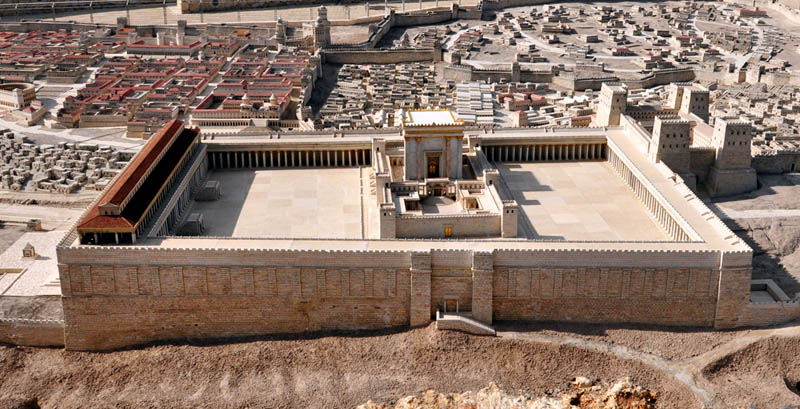
Added to the essential Decalogue was a multiplicity of laws, written and oral, so precise and detailed that most ordinary people required an expert to interpret the law for them. The temple, which was in its third construction during Jesus' ministry, was a far cry from the Tent of Meeting in Israel's desert days.

Described in great detail by Flavius Josephus (War of the Jews, Book 5, Chapter 5), the temple was ascended by 12 steps. Its first gate was 70 cubits high and 25 cubits broad (a cubit is 18 inches). The outward face of the temple was covered with plates of gold of great weight, and, at sunrise, it reflected a fiery splendor and made those who to looked upon it avert their eyes.

Jesus went to the beautiful-to-behold temple that day and made a clear, unmistakable statement: "Stop making my Father's house a marketplace." He was not against the temple per se; Jesus objected to the desecration of the holy place by a marketplace mentality, one that took advantage of the poor. As Carol Cavin of Brentwood United Methodist Church in Nashville, Tenn., has pointed out, examples of this marketplace mentality are not difficult to come by; all around us, we see moneymaking schemes in the name of Jesus. Just as Jesus was angry and acted radically to eliminate injustice and greed, so also must the church guard against practices that shut out or even discriminate against the poor.

Pat's Francis cartoon book.jpg 
Check out the eBook collection of Pat Marrin's "Francis" cartoons. Learn more.
When we plan our programs and community celebrations, are we assuming that everyone has the resources to participate? Can everyone pay the fees and buy the books for religion classes for their children? Is tuition for the parish school affordable for all? The care of the poor is to be the primary responsibility of those who belong to Jesus, rather than an afterthought.

Luke Timothy Johnson has posited one way of getting our priorities straight and alleviating the marketplace mentality (Religious Experience in Earliest Christianity, Fortress Press, 1998). Johnson suggests that we compare the back of a typical Catholic church in America to the front of the church. In the front, all is orderly and correct. Both furniture and art create an ambience of solemnity and reverence. The choirs of angels are placed below God the creator, just as the priest's presiding chair and the stools of the lesser ministers express a more obvious arrangement of power.

In the vestibule of the church, another world thrives. There we find the parish book of intercession, where people request prayers for their difficulties and sufferings, great and small. There, we find signup sheets for various trips, for donating flowers and volunteering for liturgical ministries. There, too, we find pamphlets on a variety of topics, and religious items for sale.

While the front of the church is concerned with the divine presence, morality, authority, proper procedure and liturgy, the back is given over to the nitty-gritty exigencies of life. In order to maintain the whole church as the Father's house and the place where the body of Christ meets to pray, it is necessary to unite the front and back of the church in a creative tension.

When Jesus appeared in the temple area that long-ago day, his words and his presence were transformative. Moneychangers and sellers with their animals had no place within the confines of the Father's house. But he also used that moment to speak of another temple, the temple of his body. "Destroy this temple and in three days, I will raise it up."

As one in whom the very presence of God dwelled, Jesus could readily call himself a temple. Earlier in his Gospel, the evangelist told his readers that Jesus, the Word of God, became flesh and pitched his tent among us (1:14). Tent, or shakein, shares the same root as the word shekinah, the term used for the divine presence in the Hebrew Scriptures.

Jesus' words also remind us that we, too, are temples, holy places where God has chosen to take up residence. Just as the Jerusalem temple was cleansed of a marketplace mentality, so do we have to focus not on the transient but on the transcendent, not on ourselves but on God and on those God puts on our way to love and serve.


[Patricia Sánchez holds a master's degree in literature and religion of the Bible from a joint degree program at Columbia University and Union Theological Seminary in New York.]

DEATH EXPLAINED BY A 11 YEAR OLD

WITH TERMINAL CANCER


my source: Aleteia
As an oncologist with 29 years of professional experience, I can say that I’ve grown and changed as a result of the tragedies my patients have endured. We don’t know our real measure until, amid adversity, we discover that we are capable of going far beyond what we imagined.

I have fond memories of the Oncological Hospital of Pernambuco, where I took my first steps as a professional. I started going to the children’s ward, and there I fell in love with pediatric oncology.

I witnessed the tragedies my patients endured, as innocent little victims of cancer. With the birth of my first daughter, I started to feel uncomfortable seeing children suffer. Until the day an angel passed by!

I saw that angel in the semblance of an 11-year-old girl, exhausted by two years of different treatments, handling, injections and all the problems that chemical treatment programs and radiation involve. But I never saw that little angel give up. I saw her cry many times. I also saw the fear in her eyes, but that is only human!

One day I arrived at the hospital, early and I found my little angel alone in her room. I asked her where her mother was. To this day I cannot recount her response without becoming very emotional.

“Sometimes my mother leaves the room to cry in the hallway in secret. When I’m dead, I think my mother will miss me, but I’m not afraid to die. I wasn’t born for this life!”

“What does death represent for you, my dear?,” I asked her.

“When we’re little, sometimes we go to sleep in our parents’ bed, and the day after we wake up in our own bed, isn’t that right? (I thought about my own daughters, who at the time were 6 and 2, and this is exactly what happened with them)”.

“That’s what it’s like. One day I will go to sleep and my Father will come for me. I will wake up in His house, in my true life!”

I was stunned, and didn’t know what to say. I was shocked by the maturity which suffering had brought about in the spirit of that child.

“And my mama will miss me,” she added.

Moved, I held back the tears and asked: “And what does missing someone mean to you, my dear?”

“Missing someone is the love that remains.”

Today, at 53, I challenge anyone to give a better, more direct and simpler definition for the word “longing”: it is the love that remains.

My little angel left many us years ago, but she left me with a great lesson that helped me to improve my life, to try to be more human and affectionate with my patients, to rethink my values. When night falls, if the sky is clear and I see a star, I call it “my angel”, who sparkles and shines in heaven.

I think that in her new and eternal home, she is a shining star.

Thank you, little angel, for the life you had, for the lessons you taught me, for the help you gave me. How beautiful longing is. 

— Dr. Rogério Brandão, Oncologist


Translation from Italian by Diane Montagna of Aleteia's English edition.

Monday, 2 March 2015

THE POSITION OF THE POPE IN THE CATHOLIC CHURCH

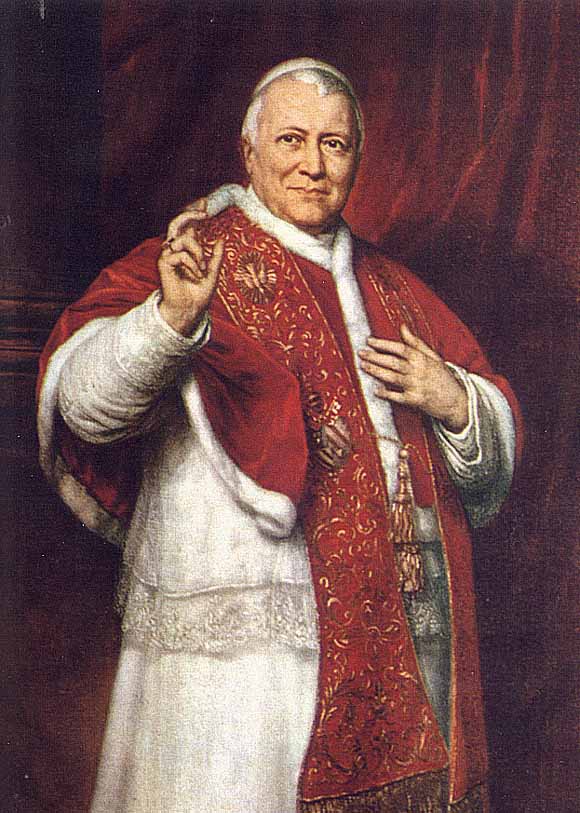
Pope Pius IX

Definitions of the First Vatican Council, 1870:

5. Therefore, if anyone says that it is not by the institution of Christ the lord himself (that is to say, by divine law) that blessed Peter should have perpetual successors in the primacy over the whole Church; or that the Roman Pontiff is not the successor of blessed Peter in this primacy: let him be anathema2. Wherefore we teach and declare that, by divine ordinance, the Roman Church possesses a pre-eminence of ordinary power over every other Church, and that this jurisdictional power of the Roman Pontiff is both episcopal and immediate. Both clergy and faithful, of whatever rite and dignity, both singly and collectively, are bound to submit to this power by the duty of hierarchical subordination and true obedience, and this not only in matters concerning faith and morals, but also in those which regard the discipline and government of the Church throughout the world. In this way, by unity with the Roman Pontiff in communion and in profession of the same faith , the Church of Christ becomes one flock under one Supreme Shepherd 5.

According to Vatican I, the Pope has ordinary and episcopal power over all the faithful, both clerical and lay, throughout the world, a power that transcends borders, from which nobody is exempt, and which covers all dimensions of church life.   Even so:
This power of the Supreme Pontiff by no means detracts from that ordinary and immediate power of episcopal jurisdiction, by which bishops, who have succeeded to the place of the apostles by appointment of the Holy Spirit, tend and govern individually the particular flocks which have been assigned to them. On the contrary, this power of theirs is asserted, supported and defended by the Supreme and Universal Pastor; for St. Gregory the Great says: "My honor is the honor of the whole Church. My honor is the steadfast strength of my brethren. Then do I receive true honor, when it is denied to none of those to whom honor is due." [51]
All bishops must obey him in everything that concerns faith, morals, discipline, as much as any lay person; yet this does not detract from the power of the bishops over their flocks; but, on the contrary, the pope's authority asserts, supports and defends episcopal authority which they wield as successors of the apostles, not merely as the pope's lieutenants .  

 A question arises: how can the bishops not be mere papal representatives if he can freely order them to obey him as much as he can order the laypeople to do the same?  If he has full and supreme power, the absolute fullness of supreme power over all and each of the bishops and laypeople alike to teach them and guide them in the way of salvation, how do the bishops have a role that is distinct from his?  What is the difference between the pope and diocesan bishops on the one hand and the pope with his assistant bishops on the other if the whole Catholic Church were one universal diocese?

9. So, then, if anyone says that the Roman Pontiff has merely an office of supervision and guidance, and not the full and supreme power of jurisdiction over the whole Church, and this not only in matters of faith and morals, but also in those which concern the discipline and government of the Church dispersed throughout the whole world; or that he has only the principal part, but not the absolute fullness, of this supreme power; or that this power of his is not ordinary and immediate both over all and each of the Churches and over all and each of the pastors and faithful: let him be anathema.
It is also defined that when the pope, in his role as shepherd and teacher of all Christians, he speaks ex cathedra, with supreme apostolic authority, by the divine assistance promised to Christ to blessed Peter, with the infallibility which God has endowed his Church, the dogmas defined, must be accepted by all, and are irreformable in themselves, without the consent of the Church.
9. Therefore, faithfully adhering to the tradition received from the beginning of the Christian faith, to the glory of God our savior, for the exaltation of the Catholic religion and for the salvation of the Christian people, with the approval of the Sacred Council, we teach and define as a divinely revealed dogma that when the Roman Pontiff speaks EX CATHEDRA, that is, when, in the exercise of his office as shepherd and teacher of all Christians, in virtue of his supreme apostolic authority, he defines a doctrine concerning faith or morals to be held by the whole Church, he possesses, by the divine assistance promised to him in blessed Peter, that infallibility which the divine Redeemer willed his Church to enjoy in defining doctrine concerning faith or morals. Therefore, such definitions of the Roman Pontiff are of themselves, and not by the consent of the Church, irreformable.

This definition has caused much discussion.   There are those who have held that every encyclical, every proclamation that a pope makes as pope to the whole Church, is ex cathedra and, therefore, is protected from error by the Holy Spirit, and this includes canonizations.   Others have said that infallibility is invoked only when its denial will lead to excommunication - the "may he be anathema" formula is used - because, only then, are we dealing with something of sufficient importance to use papal infallibility.   Theologians have differed about the number of papal statements since 1870 where infallibility has been used: some say only the two "marian" dogmas, while others add to the list.   It is clear that the phrase "ex cathedra" is too vague as it stands.  It begs too many questions.

Can a pope define a dogma whenever he wants to?   Are there no restraints on the exercise of the pope's power, either in his exercise of jurisdiction or of his teaching authority?

Many non-Catholics have been more keen to contest the truth of these definitions than to understand them; but it is true that they are not easy to understand for outsiders, because the Franco-Prussian War interrupted the Council.

One thing is certain.  The definitions are in  legal language and are pre-occupied with law, and when it is said about papally proclaimed dogmas that, "... such definitions of the Roman Pontiff are of themselves, and not by the consent of the Church, irreformable," this does not mean that the consent of the Church is irrelevant.   Both before the definition on the Immaculate Conception and before that of the Assumption, there was a painstaking investigation into what Catholics believe; and a monk told me that my monastery actually voted on the Assumption as part of this investigation.   No, the definition is talking about a further legal procedure after the proclamation before a dogma is officially recognised as being infallibly taught. If it is agreed that the Holy Spirit has aided the pope in formulating the definition, then it would be illogical to require another legal step before accepting it.  Secondly, a papal dogma is not a belief imposed by the pope from outside, but a belief already held; hence, under normal circumstances, it will be  spontaneously recognized by most Catholics as their own faith, and the others will realise that they have to get into line: any further step would be superfluous. 

The main characteristic of Vatican I is its "universalist ecclesiology". in which the word "church"  means the church spread throughout the world, in which local churches are parts, and which is held together by the universal acceptance by bishops and people of papal authority.


Continuation of the theme in the 2nd Vatican Council, "Lumen Gentium", 1964:


This Sacred Council, following closely in the footsteps of the First Vatican Council, with that Council teaches and declares that Jesus Christ, the eternal Shepherd, established His holy Church, having sent forth the apostles as He Himself had been sent by the Father;(136) and He willed that their successors, namely the bishops, should be shepherds in His Church even to the consummation of the world. And in order that the episcopate itself might be one and undivided, He placed Blessed Peter over the other apostles, and instituted in him a permanent and visible source and foundation of unity of faith and communion.(1*) And all this teaching about the institution, the perpetuity, the meaning and reason for the sacred primacy of the Roman Pontiff and of his infallible magisterium, this Sacred Council again proposes to be firmly believed by all the faithful. Continuing in that same undertaking, this Council is resolved to declare and proclaim before all men the doctrine concerning bishops, the successors of the apostles, who together with the successor of Peter, the Vicar of Christ,(2*) the visible Head of the whole Church, govern the house of the living God.
In this passage of "Lumen Gentium" on the hierarchic structure of the Church, the 2nd Vatican Council starts with the apostles and their successors, with the bishops first, and then places the "sacred primacy and infallible magisterium of the Roman Pontiff" in that context.  The meaning and reason for the Petrine ministry is seen as ""a permanent and visible source and foundation of unity of faith and communion."   Hence, the teaching of Vatican I is repeated but put in a context in which the apostolic mission of the episcopate is fully recognised.

This being the case, it follows that any behaviour on the part of the papacy that would swamp the authority of the bishops as successors of the apostles or would not "assert, support and defend" the authority of bishops better than if the papacy was not there, would be inappropriate and contrary to the proper hierachical nature of the Church.  This raises many questions, but we can glean much more from Vatican II to help us have a clearer picture.

Vatican II: Eucharistic Ecclesiology

The most explosive teaching that was introduced into Vatican II is called Eucharistic Ecclesiology, not as an alternative to universalist ecclesiology, but as a corrective. It is found in the letters of St Ignatius of Antioch for whom the "Catholic Church" is the local church.  He wrote:


See that you all follow the bishop, even as Jesus Christ does the Father, and the presbytery as you would the apostles; and reverence the deacons, as being the institution of God. Let no man do anything connected with the Church without the bishop. Let that be deemed a proper Eucharist, which is administered either by the bishop, or by one to whom he has entrusted it. Wherever the bishop shall appear, there let the multitude of the people also be; even as wherever Jesus Christ is, there is the Catholic Church. —Letter to the Smyrnaeans, Ch 8
 Eucharistic Ecclesiology is clearly expressed in the Constitution "Sacrosanctum Concilium" and, even though it is about the liturgy, has enormous implications for the study of the Church:
10. Nevertheless the liturgy is the summit toward which the activity of the Church is directed; at the same time it is the font from which all her power flows. For the aim and object of apostolic works is that all who are made sons of God by faith and baptism should come together to praise God in the midst of His Church, to take part in the sacrifice, and to eat the Lord's supper.

It says that the liturgy is  the summit toward which the activity of the Church is directed and the font from which all its power flows.  As the celebration of the liturgy is an activity of the local Church rather than the universal Church, this invites us to look at the Church from a completely different angle.   One who has developed our understanding of the eucharistic dimension of the Church is Joseph Ratzinger, as theologian, as cardinal and as pope.  He wrote:
 the Eucharist binds all men together, and not just with one another, but with Christ; in this way it makes them "Church". At the same time the formula describes the fundamental constitution of the Church: the Church exists in Eucharistic communities. The Church's Mass is her constitution, because the Church is, in essence, a Mass (sent out: "missa"), a service of God, and therefore a service of man and a service for the transformation of the world. The Mass is the Church's form, that means that through it she develops an entirely original relationship that exists nowhere else, a relationship of multiplicity and of unity. In each celebration of the Eucharist, the Lord is really present. He is risen and dies no more. He can no longer be divided into different parts. He always gives Himself completely and entirely. This is why the Council states: "This Church of Christ is truly present in all legitimate local communities of the faithful which, united with their pastors, are themselves called Churches in the New Testament. For in their locality these are the new People called by God, in the Holy Spirit and with great trust (cf. 1 Thes. 1,5).... In these communities, though frequently small and poor, or living in the diaspora, Christ is present, and in virtue of His power there is brought together one, holy, catholic and apostolic Church" (Lumen Gentium, n. 26). This means that the ecclesiology of local Churches derives from the formulation of the Eucharistic ecclesiology. This is a typical feature of Vatican II that presents the internal and sacramental foundation of the doctrine of collegiality about which we will speak later."


Let us look as some of the implications of eucharistic ecclesiology.


1)   The unity of the Church is such that the whole Church is sacramentally manifested in each and every eucharistic assembly, especially when the local bishop celebrates with his priests and people.
2)  When St Paul says to the Corinthians, "You are the body of Christ" (1. Cor. 12, 27), he is talking to a local church.   Each church is the body of Christ and all churches together are the body of Christ, just as each consecrated host is the body of Christ, and a ciborium full of hosts is nothing more or less than the body of Christ. Thus, at the profoundest level, each church is identical to each of the others and to all the others put together.


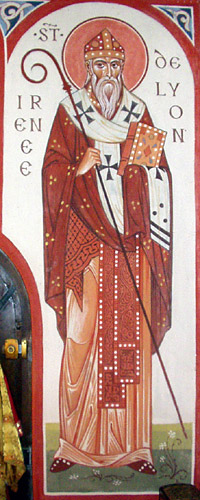
3)  This is in keeping with Roman authority as understood by St Irenaeus near the end of the second century.  He wrote:
Now it is within the power of anyone who cares to find out the truth, to know the tradition of the Apostles, professed throughout the world in every church. We can name those too who were appointed bishops by the Apostles in the churches and their successors down to our own time.... But inasmuch as it would be very tedious in a book like this to rehearse the lines of succession in every church, we will put to confusion all those who, either from waywardness or conceit or blindness or obstinacy combine together against the truth, by pointing to the tradition, derived from the Apostles, of that great and illustrious Church founded and organized at Rome by the two glorious Apostles, Peter and Paul, and to the faith declared to mankind and handed down to our own time through its bishops in their succession. For with this Church, because of its more powerful leadership, every church, that is to say, the faithful from everywhere, must needs agree, and in it the tradition that springs from the Apostles has been continuously preserved by men from everywhere.    (Adversus Haereses)

As each local church is identical to all others, the fact that St Irenaeus says that all churches, and the faithful everywhere, must agree with the Church in Rome does not imply that the Holy Spirit gives the charisma veritatis to the church of Rome alone: they agree with that church because what the church of Rome believes, is their faith too: the same Holy Spirit working in synergy with each Church in a living Tradition stretching from the time of the Apostles to the present day and is classically expressed in the liturgy.   However, if they disagree with the bishop of Rome on fundamentals, then they should be worried because "With this church, every church...must needs agree."

4) if, in a profound sense, each local church is identical with all others, then, in the same sense, all essential episcopal functions  are likewise one, being functions of the head who is Christ.  This is the teaching of St Cyprian of Carthage who says:

"[After quoting Matthew 16:18f; John 21:15ff]...On him [Peter] He builds the Church, and to him He gives the command to feed the sheep; and although He assigned a like power to all the Apostles, yet he founded a single Chair, and He established by His own authority a source and an intrinsic reason for that unity. Indeed, the others were that also which Peter was; but a primacy is given to Peter, whereby it is made clear that there is but one Church and one Chair. So too, all are shepherds, and the flock is shown to be one, fed by all the Apostles in single-minded accord. If someone does not hold fast to this unity of Peter, can he imagine that he still holds the faith? If he desert the chair of Peter upon whom the Church was built, can he still be confident that he is in the Church?" 
This unity we ought to hold firmly and defend, especially we bishops who watch over the Church, that we may prove that also the episcopate itself is one and undivided. Let no one deceive the brotherhood by lying; let no one corrupt the faith by a perfidious prevarication of the truth. The episcopate is one, the parts of which are held together by the individual bishops. The Church is one which with increasing fecundity extend far and wide into the multitude, just as the rays of the sun are many but the light is one, and the branches of the tree are many but the strength is one founded in its tenacious root, and, when many streams flow from one source, although a multiplicity of waters seems to have been diffused from the abundance of the overflowing supply nevertheless unity is preserved in their origin.
For St Cyprian, all bishops sit on the same identical chair, that of Peter, and it is up to the individual bishops to carefully guard that unity, since it is Christ who has united them.

5)  However, there is nothing in his understanding of the Church to stop us drawing a lesson from St Irenaeus.  If the episcopal function is one, then there is absolutely nothing to stop one bishop speaking for all; and, since what makes them one is their sacramental reflection of the one Christ in the Spirit, then there is no reason to deny that he can speak for the rest with the aid of the same Spirit.   If that were the case, two things would follow: a) they would not be accepting the statement as coming from the outside, because it would be their statement too, even if they hadn't physically made it themselves; and b) their recognition of its truth would be spontaneous, once they understood it, for the same reason.   However, if they rejected it, they should be worried because they would be out of step with the rest of the Episcopate. 

When the Council says, "The liturgy is the font from which all [the Church's] power flows," what are the implications?

Tradition is the Christian life, our sharing in the life of the Trinity, as it has been lived in the Church since the time of the apostles to the present day, and the understanding of our faith that flows from it.   It is rooted in the Scriptures and is a living process, formed by the synergy between the Holy Spirit and the Church and is expressed especially in the liturgy.

For this reason, as Pope Pius XI put it, "the liturgy is the chief organ of the ordinary magisterium of the Church." What the bishops realised when they came together in council was that, as Tradition is embedded in the liturgy, and liturgy is a living reality that belongs, by its very nature, to the local church, then Tradition takes many forms and has been shaped, and is being shaped, by the Christian history of many Christian peoples, reflecting their culture and their Christian experience during the course of their history.   Thus, as the Eucharist takes many forms, so does Tradition; and as the Eucharist is one and each celebration is an act of the whole, universal Church, Tradition is one, and its many forms are coherent one with all the others.  It follows that
1)  The Holy Spirit is actively involved in the local Church, as is expressed in the second epiclesis, after the words of institution in the "new" eucharistic prayers.
2)  Tradition takes different forms by its very nature, and this is why there are different "rites", each with its own insights into the Truth, its own ways of doing things which have been sanctioned by the Holy Spirit by bearing fruit of ecclesial love and holiness.
3)  Because these differences arise from the very nature of the Church living in a multi-cultural world, no rite may impose its own insights or ways of doing things on another.   Thus Rome was wrong to try to impose its own version of the papacy on the Orthodox East, because it was an answer to western problems and Eastern problems were different, the West having to keep the Church united in a chaotic, warring civilisation.  Thus the present Pope, echoing his two predecessors, has no intention of making the same error.
4)  At the same time, our insights must be coherent with other traditions, and theirs with ours, which is why we have ecumenical dialogue.  
My own opinion is that we must take seriously, not only our doctrine on the papacy, but Orthodox objections to it because they too represent a form of Tradition and invoke the Holy Spirit in their understanding of the faith.   Thus, they may learn something about primacy, and we may learn something about synodality.  
Both in Vatican II and in the extraordinary synod of 2014, bishops could say what they wanted without any  significant danger to the unity of the Church, because each knew that he did not have the last word which belonged to the Pope who is, for the most part, silent.   In contrast, in an Orthodox synod, there is nothing to stop an Orthodox patriarch from not attending or from walking out if things aren't going his way. He couldn't do that in imperial times: for sobornost to work, there is a need for an ecclesial substitute for the emperor, as the West realised early on.  In a Catholic synod, they have to stay and thrash out their differences so that a common mind be formed.   "O, Fr David," sighed an Orthodox archimandrite wearily, many years ago, "We are the church that speaks most about sobornost (synodality), but practise it least!"   On the other hand, we Catholics are coming to appreciate sobornost, largely through the theology of the Orthodox. 
.
Of all the ecumenical dialogues, those with the Orthodox are the most beneficial to both parties, even if the Russian patriarchate does throw a spanner in the works and we don't become one, the dialogue will help us because the division between us is artificial, and insights, given by the Holy Spirit, illuminate both sides of the divide, even when they appear to favour one side rather than the other: we are united whether we like it or not in that both sides celebrate the identical Eucharist and thus participate in the Liturgy of heaven.   If the Russians manage to stop the whole process because they wish to continue to play power politics, the process will will not die: the theology of both sides demands it, and the sight of patriarchate jostling for power at the top of Orthodoxy is not a particularly edifying sight, either to the Orthodox themselves, or to Christian bystanders.

5)  If the liturgy "is the font from which all her [the Church's] power flows," and liturgy is the main activity of the local church, then diversity in Christ is as much a characteristic as unity in Christ.  Thus, if as Vatican I says, by unity with the Roman Pontiff in communion and in profession of the same faith , the Church of Christ becomes one flock under one Supreme Shepherd,  so there is the need to cultivate and protect the diversity, and to allow local churches to bear witness to the Truth in their own way.   Hence, synodality is as important as papal primacy, and without it the Catholic Church is unbalanced, as is Orthodoxy without a proper universal primacy.


For the whole document, please click on the title.

This decree, however, flows from the "fount - like love" or charity of God the Father who, being the "principle without principle" from whom the Son is begotten and Holy Spirit proceeds through the Son, freely creating us on account of His surpassing and merciful kindness and graciously calling us moreover to share with Him His life and His cry, has generously poured out, and does not cease to pour out still, His divine goodness. Thus He who created all things may at last be "all in all" (1 Cor. 15:28), bringing about at one and the same time His own glory and our happiness. But it pleased God to call men to share His life, not just singly, apart from any mutual bond, but rather to mould them into a people in which His sons, once scattered abroad might be gathered together (cf. John 11:52).
Thus begins the first chapter of this wonderful document, one of the principle authors of which was the young Father Joseph Ratzinger.   We are going to look at its underlying understanding of the particular Church.  If you haven't read it, it would be a good lenten task to read the whole decree prayerfully.

As a young theologian, Fr Joseph Ratzinger was enthusiastic about collegiality and held that episcopal conferences and synods that the pope would call were exercises in collegiality. He even advocated that they be given teeth - real authority to make decisions. In the decree Ad Gentes it is assumed that local missionary churches would have much more freedom to adapt than they actually have.   Unfortunately, after seeing widespread liturgical abuse and the summary rejection of Humanae Vitae, he retracted these views and took refuge in Vatican I.  We saw a pope bringing about Vatican II things by Vatican I methods; hence the need for Pope Francis.  However, sometimes the conciliar theologian showed himself, as when he permitted the "old Mass" and established it as the extraordinary version.  He said that the Church has never suppressed an orthodox liturgy and considered it outside the competence of pope and bishops to do so.   The pope's duty is to guard Tradition, not to suppress it.  This is good eucharistic ecclesiology because liturgy is the product of the synergy between the Holy Spirit and the Church working at a local or regional level, and once recognised as liturgy, it must be treated with the respect it deserves and be protected rather than abolished while there are communities to celebrate it. Eucharistic ecclesiology sees the basis of ecclesiastic law in the sacramental/liturgical life of the Church and in the ecclesial love that is engendered by our participation in the liturgy, rather than the other way round: law has its limits.

   However, to be coherent, the pope should also allow particular churches to adapt their liturgy to local customs because they too will do this with the aid of the Holy Spirit.  Of course, they will make mistakes, but the Holy Spirit will get his way in the end as long as they keep Catholic communion - he always does, because that is the nature of the Church

In Ad Gentes, the Church is missionary by nature, and all, clergy, religious and laity alike, are called to bear witness to Christ by their lives and to take any opportunity to give the Christian message and to support missionaries. Local bishops must foster awareness of this missionary dimension of the Christian life.

The object of missionary activity is to form local churches which truly belong to the place where they are.
Thus it will be more clearly seen in what ways faith may seek for understanding, with due regard for the philosophy and wisdom of these peoples; it will be seen in what ways their customs, views on life, and social order, can be reconciled with the manner of living taught by divine revelation. From here the way will be opened to a more profound adaptation in the whole area of Christian life. By this manner of acting, every appearance of syncretism and of false particularism will be excluded, and Christian life will be accommodated to the genius and the dispositions of each culture.(6) Particular traditions, together with the peculiar patrimony of each family of nations, illumined by the light of the Gospel, can then be taken up into Catholic unity. Finally, the young particular churches, adorned with their own traditions, will have their own place in the ecclesiastical communion, saving always the primacy of Peter's See, which presides over the entire assembly of charity.
Attention has been drawn to how the liberty of "young" churches to be themselves makes them similar to sui juris churches, Catholic Ukrainians, Catholic Copts etc.  Certainly, the emphasis of Ad Gentes on adaptation, if generally followed, is all of a piece with eucharistic ecclesiology and a multi-formed Tradition.  Perhaps sui juris churches should be much more widespread as a way of protecting diversity in unity which, according to Pope Francis, is the mark of the Holy Spirit.


POPE FRANCIS IN ISTANBUL
HIS HOMILY IN THE CATHOLIC CATHEDRAL
my source: Aleteia
In the Gospel, Jesus shows himself to be the font from which those who thirst for salvation draw upon, as the Rock from whom the Father brings forth living waters for all who believe in him (cf. Jn 7:38).  In openly proclaiming this prophecy in Jerusalem, Jesus heralds the gift of the Holy Spirit whom the disciples will receive after his glorification, that is, after his death and resurrection (cf. v. 39).
The Holy Spirit is the soul of the Church.  He gives life, he brings forth different charisms which enrich the people of God and, above all, he creates unity among believers: from the many he makes one body, the Body of Christ.  The Church’s whole life and mission depend on the Holy Spirit; he fulfils all things.
The profession of faith itself, as Saint Paul reminds us in today’s first reading, is only possible because it is prompted by the Holy Spirit: “No one can say ‘Jesus is Lord’ except by the Holy Spirit” (1 Cor 12:3b).  When we pray, it is because the Holy Spirit inspires prayer in our heart.  When we break the cycle of our self-centredness, and move beyond ourselves and go out to encounter others, to listen to them and help them; it is the Spirit of God who impels us to do so.  When we find within a hitherto unknown ability to forgive, to love someone who doesn’t love us in return, it is the Spirit who has taken hold of us.  When we move beyond mere self-serving words and turn to our brothers and sisters with that tenderness which warms the heart, we have indeed been touched by the Holy Spirit.
It is true that the Holy Spirit brings forth different charisms in the Church, which at first glance, may seem to create disorder.  Under his guidance, however, they constitute an immense richness, because the Holy Spirit is the Spirit of unity, which is not the same thing as uniformity.  Only the Holy Spirit is able to kindle diversity, multiplicity and, at the same time, bring about unity.  When we try to create diversity, but are closed within our own particular and exclusive ways of seeing things, we create division.  When we try to create unity through our own human designs, we end up with uniformity and homogenization.  If we let ourselves be led by the Spirit, however, richness, variety and diversity will never create conflict, because the Spirit spurs us to experience variety in the communion of the Church. The diversity of members and charisms is harmonized in the Spirit of Christ, whom the Father sent and whom he continues to send, in order to achieve unity among believers.  The Holy Spirit brings unity to the Church: unity in faith, unity in love, unity in interior life.  The Church and other Churches and ecclesial communities are called to let themselves be guided by the Holy Spirit, and to remain always open, docile and obedient.
Ours is a hopeful perspective, but one which is also demanding.  The temptation is always within us to resist the Holy Spirit, because he takes us out of our comfort zone and unsettles us; he makes us get up and drives the Church forward.  It is always easier and more comfortable to settle in our sedentary and unchanging ways.  In truth, the Church shows her fidelity to the Holy Spirit inasmuch as she does not try to control or tame him.  We Christians become true missionary disciples, able to challenge consciences, when we throw off our defensiveness and allow ourselves to be led by the Spirit.  He is freshness, imagination and newness. 

UNIVERSALIST & EUCHARISTIC
ECCLESIOLOGIES. 


Back in the early sixties, when I first read, as a student of Fribourg University, an essay by Nicholas Afanassieff called "The Church which Presides in Love."   In it Afanassieff talked about "eucharistic ecclesiology."  It is where I read about it for the first time.  I was struck by its brilliance, its Truth jumped out of the page and hit me, and my theological perspective was changed for ever.   For all this, it became apparent to me, even a I enthusiastically accepted it, that it suffered from one flaw: it opposed St Ignatius with St Cyprian; and my own reading of the two church fathers made me believe that they were fundamentally in agreement.  I re-read them, only to find my conviction re-enforced. I also thought that the picture of the Church found in the Acts of the Apostles was more in keeping with a universalist view, and that the "church" in Ephesians and Colossians is also universalist. I think he tried to prove too much. While Afanassieff saw eucharistic ecclesiology and universalist ecclesiology as opposed, I can only see them as complemenary.  I suppose that is why I am  Catholic and he remained Orthodox.  Even when, at the end of my studies, at the suggestion of my professor of patristics, I went to the "Semaine Liturgique," at the Institut Saint Serge in Paris,  and he was actually there - I was too much in awe to approach him directly - I could not find an answer to my disquiet.  So, here it is, my position as it has remained for fifty years.

Though Nicholas Afanassieff illumined my reading of the documents of Vatican II like no other theologian, even Joseph Ratzinger, and this convinced me that, at the deepest level, we share the same faith, he assumes and in no way proves that St Ignatius of Antioch and St Cyprian are incompatible.   Both are Catholic (and Orthodox) saints; both uses of the word "church", for the local church and for the church throughout the world are sanctioned by Tradition; and each use is compatible with the other.   Afanassieff writes:
The Church in its empiric esse, the one and only Church, appeared to exist in the form of a multitude of churches. How could the unity of the Church be preserved despite the multiplicity of churches?   Cyprian answered the question by applying St Paul's doctrine to these many churches...all the local churches together are the one and only Body of Christ, but the empirical church is to some extent the sum of its separate parts....A single body must be crowned by a single head, showing in his own person the unity of the whole system.  If we take the universal theory of the Church, we cannot refute the doctrine of universal primacy just by saying that the Church has Christ as Head; that is an indisputable truth.   The question is..why can a local church have a single head while the entire universal Church is deprived of one?  (The Church Which Presides In Love by N. Afanassieff)


If  universalist ecclesiology and eucharistic ecclesiology are two approaches to the same mystery, then there must be a way to justify a universal primacy in eucharistic ecclesiology: it cannot be required by one theology and be ruled out by the other.

In the words of Pope Benedict, the Mass is the Church's constitution:
 The Mass is the Church's form, that means that through it she develops an entirely original relationship that exists nowhere else, a relationship of multiplicity and of unity.

Each Eucharist is a participation in the heavenly liturgy which is common to the whole Church throughout the world, and the whole church on earth was connected to the heavenly liturgy  by the descent of the Holy Spirit at Pentecost.
According to the Constitution on the liturgy:
8. In the earthly liturgy we take part in a foretaste of that heavenly liturgy which is celebrated in the Holy City of Jerusalem toward which we journey as pilgrims, where Christ is sitting at the right hand of God, Minister of the holies and of the true tabernacle.[22] With all the warriors of the heavenly army we sing a hymn of glory to the Lord; venerating the memory of the saints, we hope for some part and fellowship with them; we eagerly await the Saviour, Our Lord Jesus Christ, until he our life shall appear and we too will appear with him in glory.
Through our participation in the Mass, we are taken up into Catholic unity by the Holy Spirit with all others who celebrate the same Eucharist and become one with the angels and the saints in heaven, as we approach the Holy of Holies, together with Christ, passing through the veil that is his flesh, into his Father's presence, as the Letter to the Hebrews says.   We are lifted out of our own local community and become one with all the rest.   This unity also needs sacramental expression and to be a really human reality as well as a divine one: hence, the Pope.

LOOKING AT THE DECREES OF VATICAN I THROUGH THE PRISM OF EUCHARISTIC ECCLESIOLOGY 
click "Presiding flows from Charity" - Pope Francis


In the Church, all “presiding” flows from charity, must be exercised in charity, and is ordered towards charity.     (Pope Francis)


One distinction that should be very obvious, but has been hidden from us by the fact that, for centuries, popes have been secular rulers as well as popes, is the enormous difference between jurisdiction in the "world" and jurisdiction in the Church.  In the world, the law reigns, and love observes the law: in the Church, God's Love reigns, and the law follows this Love. 

In the world, the ability to make laws and to see that they are obeyed has to be backed by force.  When Rome no longer had the ability to protect England and enforce its laws, they withdrew their forces, law broke down and the Arthurian legend was born.   Thanks to the weakness of the Byzantine Empire over centuries Western civilisation could not  rely on the emperor and, in part, the western church stepped in to fill the vacuum.   Even in the most civilised countries, up to the present time, even when the hand of physical power is hidden in a velvet glove, if someone wants to leave his place half way through a trial, he will be restrained by force.  In the world, law only works when it is backed by physical power.

Jesus, in giving authority to Peter and the apostles, said nothing about establishing a police force or an army to enforce that authority. Jesus did not justify the use of physical force; but, at the same time, the Church cannot operate as a single body without law.

For this reason, a system of law has developed in the Church called Canon Law which operates like any other legal system, but it differs from other systems in that, left to itself, it has no physical force to back it up.  The difference was hidden in Christendom because the Church could always call on the civilian power to enforce its decisions if need be.   Now, however, it stands alone.

We can now ask by what authority does the Church operate.   The answer is obvious, by divine authority, by Christ's authority.   If we leave the answer there, we will not uncover what is unique about church law as a system.  Let us look at it through the spectacles of eucharistic ecclesiology: what does the Eucharist say about Christ's authority?   What does Christ's sacrifice on Calvary say about Christ's authority, the authority of him who reigned from the Cross?   To cut it short, it says that Christ's authority was a function of his divine/human love.   That is not any kind of love: it is the love of the Blessed Trinity by which the universe was created and by which we have been redeemed.  It is the love for which we have been created to share.

Let us look at papal jurisdiction eucharistically as a function of Christ's love working at the level of human law. I believe that, using this perspective, everything becomes clear.  Papal jurisdiction is as wide and universal as Christian charity and is restricted in its application by the duty to respect and serve other members of the Church as love demands.   Thus, the pope's jurisdiction over his brother bishops cannot be separated or distinguished from his duty to respect and serve them, because his jurisdiction over them and their obedience to him are functions of ecclesial love.  Thus a synergy is possible between the pope's authority over the faithful as successor of St Peter and their bishop's authority over the same faithful as successor of the apostles when ecclesial love is present.

There is a balance to be sought between unity and diversity, and the ideal balance may vary from century to century or from one set of circumstances to another.   There was a time when bishops tried to  obtain the privilege for their sees to have the bishop chosen by the pope as a better alternative to having the local prince appoint his youngest son or as a cheap way to reward a servant, but that situation has passed.   Neither do we need to find strength against our enemies in centralization.   There is a strong case for giving particular churches more freedom and for actively seeking diversification.   It  makes sense for what Pope St John Paul II did in asking in Ut Omnes Unum Sint for ecumenical help to design the papacy of the future so that the various forms of Tradition that are expressed in the liturgy of local churches may be transcended by being taken up into Catholic Unity that is formed by the fact that there is only one baptism and one Eucharist even though celebrated in different ways, and only one body in Christ.
This universal Church is unique in that each of its many parts manifests the whole, especially in the Eucharist.   Each priest who presides at the Mass presides in the principle act of the universal Church, the bishop in his own name as successor of the apostles and the priest in the name of the bishop.  The Bishop of Rome also presides at this act, and from it flows his universal ministry as successor of St Peter whose relics lie under his altar: he is thus sacramentally first among equals.

Father John Behr has something interesting to say about the pope, but the whole talk is excellent.

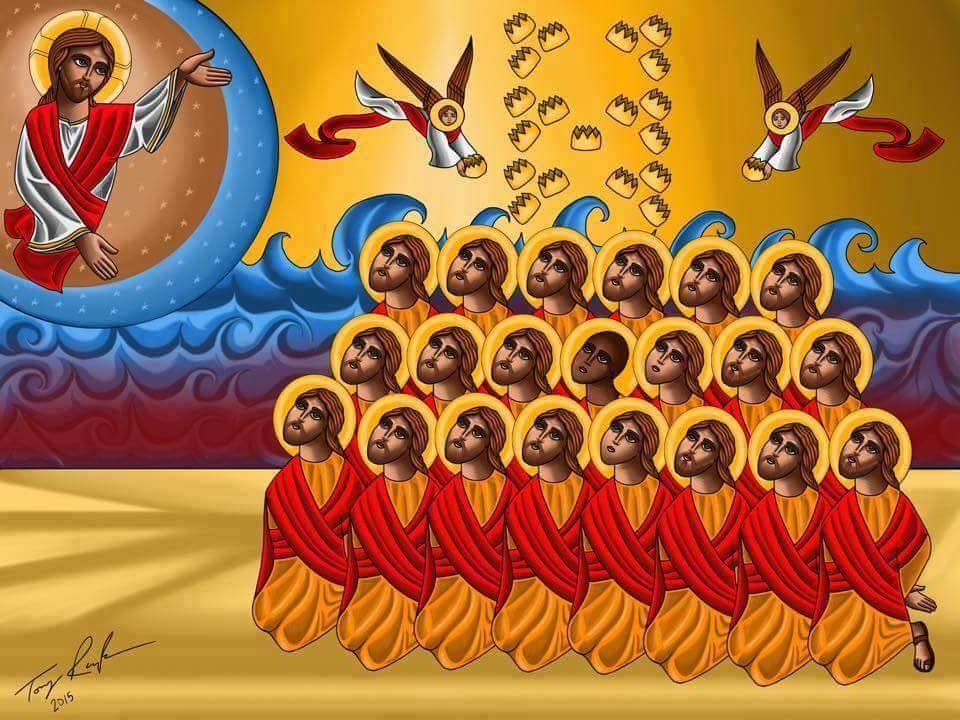
SAINT MILAD SABER AND HIS TWENTY COMPANIONS


Their story is the same as the Acts of the Martyrs of the first centuries. Killed by the sword of Islam out of pure hatred for their Christian faith 


ROME, March 2, 2015 – They refused to worship false gods, they remained strong in the faith of their baptism, they were decapitated while calling upon the name of Jesus.

The twenty-one Egyptian Christians killed in Libya by the militias of the Islamic caliphate have entered immediately into the ranks of the saints. The patriarch of the Coptic Church, Tawadros II, has had their memory inscribed in the Synaxarium, the martyrology of the Coptic Church, with a feast on the eighth day of the month of Amshir, which corresponds to February 15 of the Gregorian calendar.

It is the day on which the caliphate issued the video of their killing. And on the Coptic liturgical calendar it coincides with the feast of the presentation of Jesus at the temple.

In the video, everyone has been able to note that at the moment of decapitation, some of them were calling upon the name of Jesus in Arabic and whispering prayers. The most distinct words were from Milad Saber, the son of farmers from a village in central Egypt. He was unmarried, while most of his companions were married, with one or more small children. Fifteen came from Al-Our and six from other villages of the same region, around the town of Samalut. More than eighty of their companions are still in Libya, originating from these same villages.

It is a region with a strong Christian presence and with a very ancient church that is a pilgrimage destination, high on a bank of the Nile, where tradition says that Mary, Joseph, and Jesus stayed during their flight into Egypt.

And it is also a region, with its local capital in Minya, in which the Copts have often been the target, even in recent times, of hostility and aggression from Muslims, with little or no protection from the security forces.

But many things have changed in the days since their martyrdom. The Egyptian prime minister, together with six other ministers, visited one by one the homes of the parents, wives, and children of those killed, and said that he is "proud that Egypt has these martyrs in paradise." He pledged to the Christians: "All of you are a great value for the nation. We are ready to sacrifice ourselves for all the sons of Egypt." He has announced that he will have a church built at state expense in memory of the martyrs in the village of Al-Our.

Egyptian president Abdel Fattah Al-Sisi wasn’t far behind. He has announced the construction of a church in honor of the martyrs in Minya itself, the capital of central Egypt in which numerous Coptic churches still bear the signs of the latest attacks carried out by Muslim fanatics.

But this is only the most recent of the surprises produced by general Al-Sisi, who rose to power after overturning the regime of the Muslim Brotherhood, which is very hostile toward the Copts.

Al-Sisi is not an expression of the military “secularism” represented by the previous “rais” of Egypt, from Nasser to Sadat to Mubarak.

He too comes from the highest ranks of the military. But he has always been and still is a fervent Muslim, and precisely for this - it appears – was placed at the head of the army during the ephemeral presidency of Mohammed Morsi, by that same Muslim Brotherhood which now has him under its thumb.

He knows the Quran by heart and quotes it in every speech, prays, fasts at the appointed times, has a wife who wears the veil and a daughter who wears the complete niqab.

But he was also the model student who in the United States in 2006, at the US Army War College in Pennsylvania, wrote a doctoral thesis on democracy and the Islamic world, judging them as compatible. 

“We went to the same mosque and he was the most informed of anyone on Islamic history,” Sherifa Zuhur, one of his American professors, told Giulio Meotti of “il Foglio.” “Al-Sisi opposed Islamic extremism not only because this clashes with the West, but also because it has divided Muslims and has done great harm to their capacity to reinterpret the faith in line with modern humanitarian principles. And instead of assisting the development of the Arab region it has led to its disintegration.”

And in fact against Al-Sisi, pragmatic and pious, a fatwa has already gone out from those who want him dead, after the explosive historic speech he gave at the end of December at the major Islamic university of Al-Azhar and after his attendance at Christmas Mass in the Coptic cathedral of Cairo, an unprecedented action.

A “revolution in Islam” is how his actions have been described by the Islamologist Samir Khalil Samir, an Egyptian Jesuit who teaches at the Université Saint-Joseph in Beirut and at the Pontifical Institute of Arab and Islamic Studies in Rome.

But here are the names of the twenty-one Coptic martyrs killed in Libya by the caliphate’s executioners:

Milad Saber Mounir Adly Saad, bachelor from Menbal village;
Sameh Salah Farouq, married, one child, from Manqarius village;
Ezzat Boshra Nassif, married, with one son of 4 years, from Dafash village;
Mina Shehata Awad, from Al-Farouqeyya village;
Louqa Nagati Anis Abdou, 27 years, married, with a baby of 10 months;
Essam Baddar Samir Ishaq, bachelor; both from al-Gabaly village.

And from Al-Our village:

Hany Abdal-Massih Salib, married, three daughters and one son;
Guergues Milad Sanyut, bachelor;
Tawadraus Youssef Tawadraus, married, three children from 7 to 13 years old;
Kyrillos Boschra Fawzy, bachelor;
Magued Soliman Shehata, married, two daughters and a son;
Mina Fayez Aziz, bachelor;
Samouïl Alham Wilson, married, three children, 6, 4 and 2 years old;
Bishoï Stephanos Kamel, bachelor;
Samouïl Stephanos Kamel, brother of the latter, bachelor;
Malak Abram Sanyut, married, three children;
Milad Makin Zaky, married, one daughter;
Abanub Ayyad Ateyya Shehata, bachelor;
Guergues Samir Megally Zakher, bachelor;
Youssef Shukry Younan, bachelor;
Malak Farag Ibrahim, married, a baby daughter.

Naturally, these are not the only Christians to have fallen victim to the hatred that many Muslims nurture towards the "apostates" from true Islam, equated with the form that they profess.

The latest in the series are the Armenian, Syriac, and especially Assyrian Christians of thirty-five villages in the far northeast of Syria along the Khabur river, occupied in recent days by the army of the caliphate.

Dozens killed, hundreds taken hostage, thousands who have fled abandoning everything.

The irony of history is that the grandparents of these Christians took refuge there in the 1930’s to escape the massacres of which they were victims in the newly formed Iraq.

“Abandoned by all, this is their sentiment,” the Vatican nuncio in Damascus, Archbishop Mario Zenari, has said.

In effect, these Christians do not have their armed men, they do not have Kurds, Sunnis, or Shiites to defend them, they have no support from the international anti-caliphate coalition. They are truly the least of the least, with the sole comfort of Christians in other countries - for example, through Aid to the Church in Need - who offer them basic assistance in the places where they find refuge.

TYPICAL SECULARIST INTOLERANCE
OF THE TRUTH

The White House released a statement yesterday to condemn the beheadings of the 21-Egyptian Coptic Christians by ISIS in Libya but refused to refer to the victims as Coptic Christians or even just Christians. The statement, released by Press Secretary Josh Earnest, only referred to them as ‘Egyptian citizens’.

Here’s the full statement:

Statement by the Press Secretary on the Murder of Egyptian Citizens

The United States condemns the despicable and cowardly murder of twenty-one Egyptian citizens in Libya by ISIL-affiliated terrorists. We offer our condolences to the families of the victims and our support to the Egyptian government and people as they grieve for their fellow citizens. ISIL’s barbarity knows no bounds. It is unconstrained by faith, sect, or ethnicity. This wanton killing of innocents is just the most recent of the many vicious acts perpetrated by ISIL-affiliated terrorists against the people of the region, including the murders of dozens of Egyptian soldiers in the Sinai, which only further galvanizes the international community to unite against ISIL.

This heinous act once again underscores the urgent need for a political resolution to the conflict in Libya, the continuation of which only benefits terrorist groups, including ISIL. We call on all Libyans to strongly reject this and all acts of terrorism and to unite in the face of this shared and growing threat. We continue to strongly support the efforts of the United Nations Special Representative of the Secretary-General Bernardino Leon to facilitate formation of a national unity government and help foster a political solution in Libya.

As a Christian this is pretty insulting and I’m sure it is even more so to the American Coptic community. But apparently insulting the faiths of others is par for the course with this administration, just as they did when the president referred to the Jewish shooting victims in France as a random shooting of ‘bunch of folks’.

In contrast, here is the statement by Canadian Prime Minister Stephen Harper:

“I am outraged and saddened by the beheadings of Egyptian Coptic Orthodox Christians in Libya by groups linked to ISIL. Coming soon after the savage burning of Royal Jordanian Air Force pilot Moaz al-Kasasbeh, the threat posed by ISIL could not be clearer.

On behalf of all Canadians, I offer my deepest condolences to the families and friends of those killed and to the Coptic community here in Canada, who will feel the loss especially grievously.

Canada is proud to stand with its coalition partners in the fight against ISIL. We will continue to stand firmly together against these terrorists who threaten the peace and freedom we hold so dear at home and that we wish for those abroad.

Barbaric acts such as this do not shake our resolve but, rather, confirm the rightness of our cause and the vital necessity of our mission against ISIL. We will not be intimidated.”

The differences are striking. Harper even offers his condolences to the Coptic community in Canada. The White House didn’t even bother to mention the Coptic community here in the U.S. But then they would have had to acknowledge that these were Christians, something they clearly refused to do even though our president is supposed to be ‘Christian’.


A little while ago, I heard on the BBC an account of a persecution of Christians by Islamists in Africa.   It didn't say that the victims were Christians, nor that they would have been spared if they had become Muslims.  Rather it said that they had been put to death "for religion", thus attacking their religion as much as that of the terrorists.  The most intolerant people in Britain are not Muslims: they are secularists.   Hearing Richard Dawkins and Stephen Fry say how evil religion is, it makes me wonder when we shall have a secularist caliphate in England.   In fact, in the twentieth century, more Christians were killed by atheists than by Muslims.  The only protection we have is that their case is not very persuasive.

Search This Blog

La Virgen de Guadalupe

La Virgen de Guadalupe

Followers

My Blog List

Fr David Bird

Fr David Bird
Me on a good day

Blog Archive