"Today the concept of truth is viewed with suspicion, because truth is identified with violence. Over history there have, unfortunately, been episodes when people sought to defend the truth with violence. But they are two contrasting realities. Truth cannot be imposed with means other than itself! Truth can only come with its own light. Yet, we need truth. ... Without truth we are blind in the world, we have no path to follow. The great gift of Christ was that He enabled us to see the face of God".Pope Benedict xvi, February 24th, 2012
The Church is ecumenical, catholic, God-human, ageless, and it is therefore a blasphemy—an unpardonable blasphemy against Christ and against the Holy Ghost—to turn the Church into a national institution, to narrow her down to petty, transient, time-bound aspirations and ways of doing things. Her purpose is beyond nationality, ecumenical, all-embracing: to unite all men in Christ, all without exception to nation or race or social strata. - St Justin Popovitch
In the Church, all “presiding” flows from charity, must be exercised in charity, and is ordered towards charity. (Pope Francis)
I had another article lined up for today; but then I came across this address by Pope Francis to the Cardinals and that changed everything. I am preparing an article on "Eucharistic Ecclesiology and Jurisdiction: Where They Connect" which looks at the Vatican I definition on papal jurisdiction with its peculiarities and problems, which I aim to clarify and make more understandable in the light of eucharistic ecclesiology and the statement of Pope Benedict that "the Mass is the constitution of the Church." I am saying that there is a fundamental difference between jurisdiction as exercised by the "world", and jurisdiction exercised in the Church: in the world, it depends on the power to enforce it, while jurisdiction in the Church must be, in order to be recognisable as a Church activity, a way by which ecclesial love functions. Ecclesial love is the physical evidence of the presence of the Holy Spirit; it is by the love of God that the universe came into being; and our participation in the life of the Holy Spirit is shown by the way we are bound together by ecclesial love in union with Christ in the Eucharist. The Pope has beaten me to it. If love is the source, the motive and the goal of all presiding in the Church, then all kinds of problems become easier to understand. There are no legal restrictions on the pope's authority, yet it is claimed that this does not smother or absorb the authority of patriarchs and bishops under him, but, on the contrary strengthens them: this because it is of the essence of love to respect, support and allow fully to be themselves all those who are loved. It places itself at their service, so that they can better fulfil their functions; and it requires that the pope gives them space to operate, to confer among themselves, and to reach their own conclusions about how best to proceed, without having to continually look over their shoulders to see how the Vatican is going to react to their decisions. There may not be legal restrictions on papal authority because the papacy is not primarily a legal entity: love imposes its own limits because the papacy is primarily the central organ of ecclesial charity that binds the whole Church together in a single organism. In the world, we must love within the boundaries of the law: in the Church, our law can act only within the boundaries set by ecclesial love.
(Vatican Radio) Pope Francis presided over an ordinary Public Consistory for the Creation of New Cardinals on Saturday morning, in St. Peter’s Basilica. 20 new members of the Clergy of Rome were created, the Pope’s closest partners in mission. Addressing the membership of the College of Cardinals gathered for the occasion, Pope Francis spoke of the nature of ecclesial service, explaining that the higher one is in honor, the more perfect and absolute must be his spirit and dedication to Christ and the upbuilding of His Kingdom. “In the Church,” said Pope Francis, “all ‘presiding’ flows from charity, must be exercised in charity, and is ordered towards charity.” Below, please find the full text, in English, of the Holy Father’s prepared remarks.
*************************************
Dear Brother Cardinals,
The cardinalate is certainly an honour, but it is not honorific. This we already know from its name – “cardinal” – from the word “cardo”, a hinge. As such it is not a kind of accessory, a decoration, like an honorary title. Rather, it is a pivot, a point of support and movement essential for the life of the community. You are “hinges” and are “incardinated” in the Church of Rome, which “presides over the entire assembly of charity” (Lumen Gentium, 13; cf. IGN. ANT., Ad Rom., Prologue).
In the Church, all “presiding” flows from charity, must be exercised in charity, and is ordered towards charity. Here too the Church of Rome exercises an exemplary role. Just as she presides in charity, so too each particular Church is called, within its own sphere, to preside in charity.
For this reason, I believe that the “hymn to charity” in Saint Paul’s first letter to the Corinthians can be taken as a guiding theme for this celebration and for your ministry, especially for those of you who today enter the College of Cardinals. All of us, myself first and each of you with me, would do well to let ourselves be guided by the inspired words of the apostle Paul, especially in the passage where he lists the marks of charity. May our Mother Mary help us to listen. She gave the world Jesus, charity incarnate, who is “the more excellent Way” (cf. 1 Cor 12:31); may she help us to receive this Word and always to advance on this Way. May she assist us by her humility and maternal tenderness, because charity, as God’s gift, grows wherever humility and tenderness are found.
Saint Paul tells us that charity is, above all, “patient” and “kind”. The greater our responsibility in serving the Church, the more our hearts must expand according to the measure of the heart of Christ. “Patience” – “forbearance” – is in some sense synonymous with catholicity. It means being able to love without limits, but also to be faithful in particular situations and with practical gestures. It means loving what is great without neglecting what is small; loving the little things within the horizon of the great things, since “non coerceri a maximo, contineri tamen a minimo divinum est”. To know how to love through acts of kindness. “Kindness” – benevolence –means the firm and persevering intention to always will the good of others, even those unfriendly to us.
The Apostle goes on to say that charity “is not jealous or boastful, it is not puffed up with pride”. This is surely a miracle of love, since we humans – all of us, at every stage of our lives – are inclined to jealousy and pride, since our nature is wounded by sin. Nor are Church dignitaries immune from this temptation. But for this very reason, dear brothers, the divine power of love, which transforms hearts, can be all the more evident in us, so that it is no longer you who live, but rather Christ who lives in you. And Jesus is love to the fullest.
Saint Paul then tells us that charity “is not arrogant or rude, it does not insist on its own way”. These two characteristics show that those who abide in charity are not self-centred. The self-centred inevitably become disrespectful; very often they do not even notice this, since “respect” is precisely the ability to acknowledge others, to acknowledge their dignity, their condition, their needs. The self-centred person inevitably seeks his own interests; he thinks this is normal, even necessary. Those “interests” can even be cloaked in noble appearances, but underlying them all is always “self-interest”. Charity, however, makes us draw back from the centre in order to set ourselves in the real centre, which is Christ alone. Then, and only then, can we be persons who are respectful and attentive to the good of others.
Charity, Saint Paul says, “is not irritable, it is not resentful”. Pastors close to their people have plenty of opportunities to be irritable, to feel anger. Perhaps we risk being all the more irritable in relationships with our confreres, since in effect we have less excuses. Even here, charity, and charity alone, frees us. It frees us from the risk of reacting impulsively, of saying or doing the wrong thing; above all it frees us from the mortal danger of pent-up anger, of that smouldering anger which makes us brood over wrongs we have received. No. This is unacceptable in a man of the Church. Even if a momentary outburst is forgivable, this is not the case with rancour. God save us from that!
Charity – Saint Paul adds – “does not rejoice at the wrong, but rejoices in the right”. Those called to the service of governance in the Church need to have a strong sense of justice, so that any form of injustice becomes unacceptable, even those which might bring gain to himself or to the Church. At the same time, he must “rejoice in the right”. What a beautiful phrase! The man of God is someone captivated by truth, one who encounters it fully in the word and flesh of Jesus Christ, the inexhaustible source of our joy. May the people of God always see in us a firm condemnation of injustice and joyful service to the truth.
Finally, “love bears all things, believes all things, hopes all things, endures all things”. Here, in four words, is a spiritual and pastoral programme of life. The love of Christ, poured into our hearts by the Holy Spirit, enables us to live like this, to be like this: as persons always ready to forgive; always ready to trust, because we are full of faith in God; always ready to inspire hope, because we ourselves are full of hope in God; persons ready to bear patiently every situation and each of our brothers and sisters, in union with Christ, who bore with love the burden of our sins.
Dear brothers, this comes to us not from ourselves, but from God. God is love and he accomplishes all this in us if only we prove docile to the working of his Holy Spirit. This, then, is how we are to be: “incardinated” and docile. The more we are “incardinated” in the Church of Rome, the more we should become docile to the Spirit, so that charity can give form and meaning to all that we are and all that we do. Incardinated in the Church which presides in charity, docile to the Holy Spirit who pours into our hearts the love of God (cf. Rom 5:5). Amen.
(Vatican Radio) Pope Francis on Friday received the participants in a meeting - this week - of the Joint International Commission for Theological Dialogue between the Catholic Church and the Oriental Orthodox Churches. Below, please find the official English text of the Holy Father's remarks.
Dear Brothers in Christ,
With great joy I welcome you, the members of the Joint International Commission for Theological Dialogue between the Catholic Church and the Oriental Orthodox Churches. Through you, I offer fraternal greetings to my venerable brothers, the heads of the Oriental Orthodox Churches. I thank His Eminence Anba Bishoy, Co-President of the Commission, for his kind words.
It is gratifying to reflect on the work of your Commission, which began in January 2003 as a joint initiative of the ecclesiastical authorities of the family of the Oriental Orthodox Churches and the Pontifical Council for Promoting Christian Unity. In the last ten years the Commission has examined from an historical perspective the ways in which the Churches expressed their communion in the early centuries, and what this can mean for our pursuit of communion today. In the course of this week’s meeting you have also embarked upon a deeper examination of your work on the nature of the sacraments, and of baptism in particular. I express my hope that this work will bear rich fruit for our common theological research and help us to experience ever more fully our fraternal friendship.
With deep appreciation I recall the inspiring commitment to dialogue shown by His Holiness Ignatius Zakka Iwas, Patriarch of the Syrian Orthodox Church of Antioch and All the East, who died this past year. Together with you and his own clergy and faithful, I pray for the eternal rest of this dedicated servant of God.
At this time we especially feel dismay and deep sadness at what is happening in the Middle East, especially in Iraq and Syria. I think of all those living in the region, including our Christian brothers and sisters, and many minorities, who are experiencing the effects of a prolonged and painful conflict. I join you in praying for a negotiated solution and in imploring God’s goodness and mercy upon all those affected by this immense tragedy.
All Christians are called to work together, in mutual acceptance and trust, in order to serve the cause of peace and justice. May the intercession and example of the many martyrs and saints who have borne courageous witness to Christ in all our Churches sustain and strengthen you and your Christian communities.
Dear brothers, I thank you for your visit. Upon you and your ministry I invoke the Lord’s blessing and the maternal protection of Mary Most Holy. Please pray for me.
Oriental Orthodox and Catholics work to conclude joint document
A woman prays in the Armenian Orthodox Church in Damascus, Syria
(Vatican Radio) Representatives of all the Oriental Orthodox Churches are here in Rome this week for a meeting of their International Joint Commission for Theological Dialogue with the Catholic Church. During the five day encounter, which began on Monday, participants hope to finalise a joint document on Communion and Communication in the first five centuries of Christianity.The Oriental Orthodox Churches are amongst the most ancient Christian communities in the world, founded according to tradition by the first apostles in Egypt, Armenia, Syria, India and Ethiopia in the decades following Christ’s death and Resurrection. They have not been in communion with either the Roman Catholic Church or the Orthodox world since they officially severed ties in the 5th century.To find out more, Philippa Hitchen spoke with Fr Gabriel Quicke, who’s in charge of relations with these Oriental Orthodox Churches at the Pontifical Council for Promoting Christian Unity….
Listen:
Fr Gabriel says the new document is significant for Christians today as it highlights the rich heritage the Churches shared in the first five centuries before the divisions took place…
He says the Commission will go on to a new round of discussions on the sacraments, especially the question of Baptism which is still not recognised by some of the Oriental Orthodox Churches…
Fr Gabriel says many of the Oriental Orthodox Church leaders are witnessing an emptying out of their communities because of the lack of security in the Middle East region. He says the solidarity of the Catholic world and the appeals of Pope Francis on behalf of persecuted Christians are very important and much appreciated by the people there….
Francis: spirit of fraternity with Oriental Orthodox
(Vatican Radio) Pope Francis on Friday received the participants in a meeting -this week - of the Joint International Commission for Theological Dialogue between the Catholic Church and the Oriental Orthodox Churches.
The Oriental Orthodox Churches those Orthodox Eastern Christian churches which recognize only the first three ecumenical councils, and rejected the formulae of the Council of Chalcedon, at which certain central Christological doctrines were dogmatically defined, most especially the dual nature – fully divine and fully human, perfectly united though without mixing, blending or alteration – of Christ.
In remarks prepared for the occasion and delivered during the noon audience in the Apostolic Palace at the Vatican, Pope Francis praised the progress of the Commission in its dozen years of work, and called on all participants to continue their journey in a spirit of brotherhood. “I express my hope that this work will bear rich fruit for our common theological research and help us to experience ever more fully our fraternal friendship,” the Holy Father said.
Pope Francis went on to note, with, “dismay and deep sadness,” the ongoing conflicts and crises in the Middle East, especially in Iraq and Syria. “I join you,” he said, “in praying for a negotiated solution and in imploring God’s goodness and mercy upon all those affected by this immense tragedy.” The Holy Father continued, saying, “All Christians are called to work together, in mutual acceptance and trust, in order to serve the cause of peace and justice. May the intercession and example of the many martyrs and saints who have borne courageous witness to Christ in all our Churches sustain and strengthen you and your Christian communities.”
Pope Francis concluded his remarks by thanking the participants for their visit, invoking the Lord’s blessings and the maternal protection of Mary on their ministry, and asking in turn for their continued prayers for him.
PREVIOUS RELATIONS WITH THE CHURCHES OF THE EAST
1. Syrian Orthodox Church
From October 25th to 27th, 1971, His Holiness Mar Ignatius Jacob III, Syrian Orthodox Patriarch of Antioch and all the East, paid an official visit to Rome. During this time he was the guest of the Holy Father. The Pope and the Patriarch met for a long private meeting on October 25th. At the end of this meeting they participated together in a Celebration of Prayer in the Matilda Chapel. During this celebration the following addresses were exchanged:
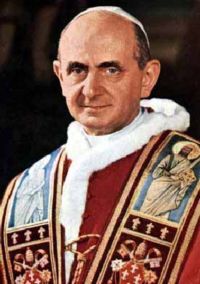
ADDRESS OF POPE PAUL VI
Your Holiness,
With joy we extend our fraternal greeting as we welcome you to our home. In your person we salute a Church which sees in the faith and devotion of the apostolic community of Antioch the roots and foundation of its own Christian witness. We are particularly happy to welcome an exalted visitor from Damascus, where, in receiving the holy waters of baptism, the Apostle of the Nations, whose name we bear, began that life of total commitment to the Lord Jesus Christ which was to lead him to this city of Rome and the supreme sacrifice of his life out of love for that Lord.
Nine years ago, Your Holiness accepted the invitation of our predecessor of venerated memory, John XXIII, to be represented at the Second Vatican Council by a delegated observer. Since that time the exchange of letters between us and the visit of qualified members of our Church to Your Holiness have helped strengthen the relations between our Churches. Now we have the joy of meeting in person so that we may share the thoughts and desires which animate us as we strive to fulfil God's wish for His Church and for the world redeemed by the precious Blood of His Son.
The history of the relations between our Churches shows many lights and shadows. We recognize that difficulties which have been created over centuries are not always easily overcome. Each of us is motivated by a sincere desire to be faithful to our Fathers in the faith and to the tradition they have handed down to us. Yet this very desire to be faithful to them impels us to search with ever greater zeal for the realization of full communion with each other.
We share a common sacramental life and a common Apostolic tradition, particularly as affirmed in what is popularly called the Nicene Creed. The dogmatic definitions of the first three Ecumenical Councils form part of our common heritage. Thus we confess together the mystery of the Word of God, become one of us to save us and to permit us to become in Him sons of God and brothers of each other.
It is in total submission to this Lord and Saviour, God the Son Incarnate, that we will be able to find the way towards that reconciliation which will bring us to perfect communion. The Syrian Orthodox Church in union with her sister Oriental Orthodox Churches, meeting in Addis Ababa in 1965, has already determined to press forward for a dialogue which will help overcome the misunderstandings of the past. Already theologians are working with renewed effort to throw new light on the mystery of the one Lord Jesus Christ. If they recognize that there are still differences in the theological interpretation of this mystery of Christ because of different ecclesiastical and theological traditions, they are convinced, however, that these various formulations can be understood along the lines of the faith of the early councils, which is the faith we also profess (cf. Pope Pius XII, in Encyclical Sempiternus Rex, A.A.S. 1951, pp. 636-637).
We, as pastors, can encourage the common efforts being made for a deeper and more comprehensive understanding of this mystery which, far from raising doubts about our two different ecclesiastical traditions, can reinforce them and show the basic harmony which exists between them.
The task is the more urgent because of the demands which are being made upon the Churches today. In a world which is struggling to give birth to new ideas, to new developments which can enable all men to share in the gifts of God's creation, to new relationships between men and nations which will ensure peace with justice, we are called to proclaim the "one Lord, one faith, one baptism and one God who is Father of all, over all, through all and within all" (Ephesians 4:5-6).
If we can carry on this task in fraternal communion we will contribute in an even more perfect way to that service of the world which is an essential part of the mission of the Church. We will be fulfilling our vocation to see the mystery of the compassion of God translated into Christian compassion between men and for men.
In the visit of Your Holiness we see a new testimony to our common desire to carry out this mission and fulfil this vocation. As we welcome you, we pray that God may guide our steps for the glory of His name and the peace and reconciliation of all those who are called to be His sons.
ADDRESS OF HIS HOLINESS MAR IGNATIUS JACOB III, SYRIAN ORTHODOX PATRIARCH OF ANTIOCH AND ALL THE EAST
Your Holiness,
In these joyous moments, we deem it our earnest duty, in our capacity as the Patriarch of Antioch and all the East and the Supreme Head of the Universal Syrian Orthodox Church, to hail Your Holiness and to greet Your Holy See in Your notable person, since today is a very unique and important day in the history of our two Apostolic Churches.
After 1520 years of break, mutual anathemas and the like, the heads of these two most ancient Churches in Christendom meet each other as brothers in an atmosphere of love and fraternity. Time is a healer of all wounds. It was at Chalcedon in 451 that the break took place. But now both Churches recognize that what took place there was, unfortunately, a stab to the heart of Christendom.
Thank God, those days of unhappy relations are now a thing of the past; and today there is real love and cooperation between our two Apostolic Sees, and Christian communion in general.
In the 20th century there has never been a movement more fruitful than the ecumenical movement, and we recognize with appreciation the constructive role Your Holiness's illustrious predecessor and your good self have played in this field. We on our part look forward to the day when we will have even a greater visible unity and that too without sacrificing our individuality and the cultural contribution each of our Churches can make towards the speedy speeding of the Kingdom of God on earth.
Your Holiness, please accept our sincere gratitude for your brotherly love and hospitality. May God protect Your good self and bless the great Church which, in the Providence of God, Your Holiness heads.
For two days the Patriarch and the archbishops who accompanied him visited the principal holy places of Rome and made contacts with various personalities of the Holy See. In the larger Synod Hall near the Court of Saint Damasus on the morning of 27 October, there took place the farewell visit of the Pope and the Syrian-Orthodox Patriarch of Antioch. A large number of the Synod Fathers were also present. The Pope spoke as follows:
ADDRESS OF POPE PAUL VI
Your Holiness:
Before this assembly of chosen representatives of the Roman Catholic Church, we would like to express once more our joy and our gratitude to God that we have had the opportunity to meet with the spiritual head of the Syrian Orthodox Church in an atmosphere of prayer, openness of spirit and fraternal respect and comprehension.
Throughout the centuries, in times of glory and in times of great suffering, your Church has given witness to Our Lord Jesus Christ, the only-begotten Son of God made man for our salvation. Preachers, scholars and pastors have all contributed to deepening the understanding of the Incarnation of the Son of God and to making the significance of God's condescension towards man a living reality for your people. Many of them bore witness to their faith by the supreme sacrifice of their lives.
We are happy that Your Holiness has personally been able to visit the Church of Rome which, under God's grace, has also struggled to fulfil its mission through the devoted actions of its own teachers, pastors and witnesses to her faith.
These Fathers in the faith and these saints and martyrs call out to us to apply ourselves with renewed dedication to that mission, under the inspiration of the Holy Spirit, who is ever ready to offer us new light and strength. We ourself and our brothers in the episcopate, with humility but also with great confidence, are determined to listen to these promptings of the Spirit and to strive to carry them out to the best of our ability. That is the underlying principle of the work of this Synod of Bishops which is gathered here and which extends today its heartfelt greeting to Your Holiness.
All of us are encouraged by the fact that your own Church, in union with your sister Oriental Orthodox Churches, is also actively engaged in searching for new ways to carry on her mission in a spirit of unity and docility to what the Spirit is saying to the Churches. Your visit to us makes us even more confident that our Churches will find means for greater cooperation in our common task and, at the same time, will open up the road to that full communion so ardently desired by all of us.
As we pray that the Lord of the Church may lead us to full reconciliation, we are mindful also of the particular needs of the Middle East where so many of your faithful are to be found. May this meeting with Your Holiness be a new stimulus to all Christians, especially to those of that area, to work for reconciliation in Christ among themselves and to search out, with imagination and tenacity, a durable peace with justice for all who dwell in those lands so dear to us.
Your Holiness, again we express our heartfelt thanks for your visit. As we take leave of you now, we do so with gratitude to God for what he has permitted us to accomplish up to now, with renewed confidence that the Holy Spirit will continue to show us the ways to accomplish the divine will, and with our prayers that almighty God will abundantly bless Your Holiness and all the clergy and faithful of your Church.
The following is the address of the Patriarch to the Holy Father:
ADDRESS OF HIS HOLINESS MAR IGNATIUS JACOB III
Your Holiness:
We wish to express our gratitude to Your Holiness, to His Eminence, the President Delegate, and to the representatives of the Synod of Bishops, for this opportunity to reveal what lies in our heart as we prepare to leave the city of Rome.
We and our brothers the metropolitans who have accompanied us on this historic visit are deeply grateful for the love and respect Your Holiness and your collaborators have shown us. We are also thankful to have been able to visit this city blessed by the blood of so many martyrs, among them the great and holy Apostles, Peter and Paul. The faith they preached in Antioch, in Rome and in so many others parts of the world is the faith we too are trying to bring to men today. We are happy to be able to address these few words before bishops of the Roman Catholic Church who are meeting to study the ways by which this proclamation of the faith may be done most effectively so as to meet the needs of men today. May almighty God guide your efforts and bless them with success.
The joy of this occasion encourages us to look forward to the great day on which our common Lord will bring us together into the one visible Church that will manifest His own unique glory. Towards that end we and our clergy and people will work by our prayers, our studies and our action. It is our hope that this can be done in common with the members of your own Church wherever possible.
As we return from here, we carry with us profound memories of Your Holiness and your great Church, to be cherished forever in the annals of the Apostolic See of Antioch. May almighty God continue to sustain Your Holiness in good health and strength of spirit to carry on the great work of the Church in the world, to the glory of God, the Father, the Son and the Holy Spirit. Amen.
After the discourses, Cardinal Willebrands, President of the Secretariat for Promoting Christian Unity, read the text of the "Common Declaration" given below, which was signed by the Holy Father and by His Holiness Patriarch Mar Ignatius Iacob III.
COMMON DECLARATION BY POPE PAUL VI
AND HIS HOLINESS MAR IGNATIUS IACOB III
As they conclude their solemn meeting which marks a new step in the relations between the Roman Catholic Church and the Syrian Orthodox Church, His Holiness Pope Paul VI and His Holiness Mar Ignatius Jacob III humbly render thanks to Almighty God, for having made possible this historic opportunity to pray together, to engage in a fraternal exchange of views concerning the needs of the Church of God and to witness to their common desire that all Christians may intensify their service to the world with humility and complete dedication.
The Pope and the Patriarch have recognized the deep spiritual communion, which already exists between their Churches. The celebration of the sacraments of the Lord, the common profession of faith in the Lord Jesus Christ, the Word of God made man for man's salvation, the apostolic traditions which form part of the common heritage of both Churches, the great Fathers and Doctors, including Saint Cyril of Alexandria, who are their common masters in the faith all these testify to the action of the Holy Spirit who has continued to work in their Churches even when there have been human weakness and failings. The period of mutual recrimination and condemnation has given place to a willingness to meet together in sincere efforts to lighten and eventually remove the burden of history which still weighs heavily upon Christians.
Progress has already been made and Pope Paul VI and the Patriarch Mar Ignatius Jacob III are in agreement that there is no difference in the faith they profess concerning the mystery of the Word of God made flesh and become really man, even if over the centuries difficulties have arisen out of the different theological expressions by which this faith was expressed. They therefore encourage the clergy and faithful of their Churches to even greater endeavours at removing the obstacles which still prevent complete communion among them. This should be done with love, with openness to the promptings of the Holy Spirit, and with mutual respect for each other and each other's Church. They particularly exhort the scholars of their Churches, and of all Christian communities, to penetrate more deeply into the mystery of Christ with humility and fidelity to the Apostolic traditions so that the fruits of their reflections may help the Church in her service to the world which the Incarnate Son of God has redeemed.
This world, which God so loved as to send His only begotten Son, is torn by strife, by injustice and by the inhumanity of man towards man. As Christian Pastors, the Pope and the Patriarch raise their common appeal to the leaders of the peoples to increase the efforts towards achieving lasting peace among nations and towards removing the obstacles which prevent so many men from enjoying the fruits of justice and religious freedom. Their appeal is directed to all areas of the world and in particular to that land hallowed by the preaching, the death and the resurrection of our Lord and Saviour Jesus Christ.
MAY, 1973
COMMON DECLARATION
OF POPE PAUL VI AND OF
THE POPE OF ALEXANDRIA SHENOUDA III
Tower of St. John in the Vatican gardens
Paul VI, bishop of Rome and Pope of the Catholic Church, and Shenouda III, Pope of Alexandria and patriarch of the See of St. Mark, give thanks in the Holy Spirit to God that, after the great event of the return of relics of St. Mark to Egypt, relations have further developed between the Churches of Rome and Alexandria so that they have now been able to meet personally together. At the end of their meetings and conversations they wish to state together the following:
We have met in the desire to deepen the relations between our Churches and to find concrete ways to overcome the obstacles in the way of our real cooperation in the service of our Lord Jesus Christ who has given us the ministry of reconciliation, to reconcile the world to Himself (2 Cor 5:18-20).
In accordance with our apostolic traditions transmitted to our Churches and preserved therein, and in conformity with the early three ecumenical councils, we confess one faith in the One Triune God, the divinity of the Only Begotten Son of God, the Second Person of the Holy Trinity, the Word of God, the effulgence of His glory and the express image of His substance, who for us was incarnate, assuming for Himself a real body with a rational soul, and who shared with us our humanity but without sin. We confess that our Lord and God and Saviour and King of us all, Jesus Christ, is perfect God with respect to His Divinity, perfect man with respect to His humanity. In Him His divinity is united with His humanity in a real, perfect union without mingling, without commixtion, without confusion, without alteration, without division, without separation. His divinity did not separate from His humanity for an instant, not for the twinkling of an eye. He who is God eternal and invisible became visible in the flesh, and took upon Himself the form of a servant. In Him are preserved all the properties of the divinity and all the properties of the humanity, together in a real, perfect, indivisible and inseparable union.
The divine life is given to us and is nourished in us through the seven sacraments of Christ in His Church: Baptism, Chrism (Confirmation), Holy Eucharist, Penance, Anointing of the Sick, Matrimony and Holy Orders.
We venerate the Virgin Mary, Mother of the True Light, and we confess that she is ever Virgin, the God- bearer. She intercedes for us, and, as the Theotokos, excels in her dignity all angelic hosts.
We have, to a large degree, the same understanding of the Church, founded upon the Apostles, and of the important role of ecumenical and local councils. Our spirituality is well and profoundly expressed in our rituals and in the Liturgy of the Mass which comprises the centre of our public prayer and the culmination of our in corporation into Christ in His Church. We keep the fasts and feasts of our faith. We venerate the relics of the saints and ask the intercession of the angels and of the saints, the living and the departed. These compose a cloud of witnesses in the Church. They and we look in hope for the Second Coming of our Lord when His glory will be revealed to judge the living and the dead.
We humbly recognize that our Churches are not able to give more perfect witness to this new life in Christ because of existing divisions which have behind them centuries of difficult history. In fact, since the year 451 A.D., theological differences, nourished and widened by non-theological factors, have sprung up. These differences cannot be ignored. In spite of them, however, weare rediscovering ourselves as Churches witha common inheritance and are reaching out with determination and confidence in the Lord to achieve the fullness and perfection of that unity which is His gift.
As an aid to accomplishing this task, we are setting up a joint commission representing our Churches, whose function will be to guide common study in the fields of Church tradition, patristics, liturgy, theology, history and practical problems, so that by cooperation in common we may seek to resolve, in a spirit of mutual respect, the differences existing between our Churches and be able to proclaim together the Gospel in ways which correspond to the authentic message of the Lord and to the needs and hopes of todayss world. Atthe same time we express our gratitude and encouragement to other groups of Catholic and Orthodox scholars and pastors who devote their efforts to common activity in these and related fields.
With sincerity and urgency we recall that true charity, rooted in total fidelity to the one Lord Jesus Christ and in mutual respect for each oness traditions, is an essential element of this search for perfect communion.
In the name of this charity, we reject all forms of proselytism, in the sense of acts by which persons seek to disturb each other's communities by recruiting new members from each other through methods, or because of attitudes of mind, which are opposed to the exigencies of Christian love or to what should characterize the relationships between Churches. Let it cease, where it may exist. Catholics and Orthodox should strive to deepen charity and cultivate mutual consultation, reflection and cooperation in the social and intellectual fields and should humble themselves before God, supplicating Him who, as He has begun this work in us, will bring it to fruition.
As we rejoice in the Lord who has granted us the blessings of this meeting, our thoughts reach out to the thousands of suffering and homeless Palestinian people. We deplore any misuse of religious arguments for political purposes in this area. We earnestly desire and look for a just solution for the Middle East crisis so that true peace with justice should prevail, especially in that land which was hallowed by the preaching, death and resurrection of our Lord and Saviour Jusus Christ, and by the life of the Blessed Virgin Mary, whom we venerate together as the Theotokos. May God, the giver of all god gifts, hear our prayers and bless our endeavours.
As his spiritual diary reveals, Cardinal Jean Daniélou took upon himself the sins of his beloved brother Alain, so that his soul might be saved. The life lesson of one of the greatest theologians of the twentieth century
by Sandro Magister
ROME, February 12, 2015 - While at the Vatican the cardinals in consistory are laboring over the reform of the curia, an expert group of scholars is grappling with an issue that is certainly more compelling for the present and future of the Church and of humanity: the riddle of history.
To be precise: the riddle of history as seen by Jean Daniélou and Joseph Ratzinger.
Sponsored by the Vatican foundation Joseph Ratzinger-Benedict XVI and hosted by the Pontifical University of the Holy Cross, the study sessions open in the afternoon today, February 12, and will conclude on the evening of the 13th:
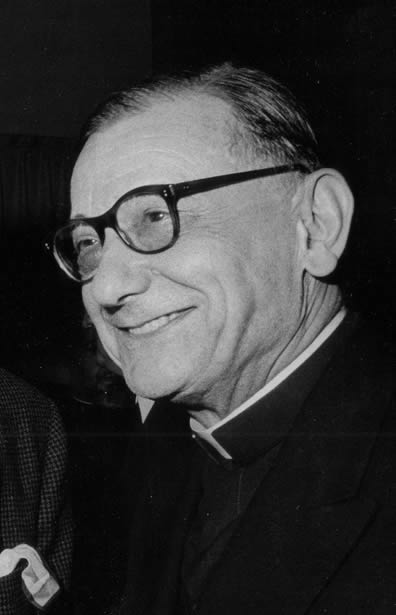
It is the second time that the Roman university of Opus Dei has shed light on that great theologian, patrologist, and liturgist who was Daniélou, Jesuit and cardinal, unjustly pushed into the shadows after his death in 1974 at the home of a Parisian prostitute to whom he was secretly bringing assistance.
The previous occasion was in May of 2012, and www.chiesa covered it in this article:
This time, Daniélou finds himself beside Ratzinger. And with good reason. Because both were among the very few great theologians of the twentieth century who elaborated an authentically biblical and Christian vision of history: a history not governed by chaos, but filled with the “magnalia Dei,” the grandiose actions of God, each more astonishing than the one before. In order to be won over by these it should be enough to read that masterpiece which Daniélou expressly dedicated to this issue: “An essay on the mystery of history.”
Both Ratzinger and Daniélou have their original characteristics. The former reads history in the footsteps of the “City of God” by Augustine and then of Saint Bonaventure, while the latter is more attuned to that brilliant Father of the Church who was Gregory of Nyssa.
Both, however, also have a vital element that links them together. “While being great intellectuals and university men, they knew how to expend themselves, in obedience to Christ, for the Church and for the least,” conference promoter Giulio Maspero, a professor of dogmatic theology at Holy Cross, told Zenit:
The veil has been lifted on the spirit and unknown activity of Daniélou by “Carnets spirituels,” his spiritual diary, published twenty years after his death, and also by “Le chemin du labyrinthe,” the autobiography of his brother Alain, a homosexual and convert to an eroticized form of Hinduism, the partner of Swiss photographer Raymond Burnier.
Jonah Lynch of the Pontifical Gregorian University, another promoter and speaker at the conference, says in this regard:
“In the diary there are touching pages in which Jean Daniélou offers up his own life for the salvation of his homosexual brother Alain, while this latter, in the ‘Chemin du labyrinthe,’ pays homage to Jean and his sincere love while not sharing his viewpoints. The cardinal’s life shines with a delicate ‘pastoral’ approach, with a genuine evangelical love that is all the rage now, but along with the high price that this love demands. In Jean Daniélou love for the estranged was not cosmetic, but a reality that was worth even martyrdom.”
Beginning in 1943, together with the great scholar of Islam Louis Massignon, Daniélou celebrated every month, with the greatest discretion, a Mass for the sake of homosexuals, “for their salvation.” This is confirmed by his great niece Emmanuelle de Boysson, in her book dedicated to the two brothers, “Le Cardinal et l’Hindouiste.”
But his brother Alain writes about it himself in his autobiography, in a page that is worth rereading:
“Jean was always perfectly kind toward me. All throughout his life he held remorse over the way in which the family had treated me and left me without support. He said this often to friends we had in common. When my friend Raymond died, he confided to Pierre Gaxotte, in the hallways of the French Academy, that he was very sad, thinking that I would be deeply wounded by this.
“Being appointed to the rank of cardinal was a liberation for Jean. He was finally free of the Jesuitical constraint under which he had certainly suffered. The last years of his life were the happiest.
“His death and the scandal provoked by it, when he had become one of the leading figures of the Church, was a sort of posthumous vendetta, one of those favors that the gods bestow on those whom they love. If he had died just a little while sooner or later, or if he had been visiting a lady of the sixteenth arrondissement under the pretext of works of charity, instead of bringing the revenue of his theological writings to a poor and needy woman, there would have been no scandal.
“Jean had always dedicated himself to disregarded people. For a certain period he had celebrated a Mass for the sake of homosexuals. He tried to help prisoners, criminals, troubled young people, prostitutes. I deeply admired this ending of life similar to that of the martyrs, whose fragrance rises to heaven amid the opprobrium and sarcasm of the crowd.
“He died as true saints die, in ignominy, in mockery, in the disdain of a spiteful and vile society. During the last years of my brother’s life I was living near Rome and was, in the opinion of the clergy, an apostate of a certain stature. There were some who mistook us for each other and some critics had even attributed to my brother my book ‘L'Érotisme divinisé,’ saying: ‘It smacks of the spirit of the Jesuits, however.…’ My brother saw to demonstrating that scandal is not given by our beliefs or actions but by the irony of the gods, who laugh at this jumble of rules for living and so-called ‘truths that must be believed,’ the paternity of which men attribute to them.”
The spiritual diary of the theologian and cardinal Jean Daniélou also displays his anxiety for the salvation of the soul of his homosexual brother, who was very dear to him. As for example when he recalls his desire to go on mission to China:
“The reasons for my desire to go to China stem from zeal for the salvation of souls that is the object of my vocation. Life as a Jesuit is complete only if it participates in the passion of Our Lord as well as in his public life. I know that nowhere does Our Lord refuse this participation to those who ask him for it; but I am afraid of allowing this desire to slacken within me. In the missions there is an almost certain dose of privations, disappointments, dangers, perhaps death, perhaps martyrdom. In addition to these reasons, I know that I have a capacity for adaptation that would help me to become Chinese with the Chinese; that missionary life offers more opportunities for performing corporal works of mercy than does life in France; that I will consider my life as not useless if because of it Alain’s soul is saved, and that I do not know the measure of immolation that God desires from me for this purpose.”
On another page of the “Carnets spirituels,” meditating on the passion of Jesus in the Garden of Gethsemane, he comes to the point of wanting to take upon himself the weight of the “sins” of Alain and of anyone else:
“Jesus, I have come to know that you do not want me to distinguish my sins from the other sins of the world, but to enter more deeply into your heart and consider myself responsible for the sins of those persons whom you may wish: those of Alain, of anyone else as it may please you. You make me feel, Jesus, that I must descend even lower, take with me the sins of others, accept as a result all the punishments that these may draw down upon me from your justice, and in a particular way the disdain of the persons for whom I will offer myself. To accept, or rather to long for dishonor, even in the eyes of those whom I love. To accept the great abasements, of which I am not worthy, in order to be ready at least to accept the small ones. Then, Jesus, my charity will resemble that with which you have loved me.”
And always in perfect gladness:
“To live by faith, about which the clearest thing to me is that it is incomprehensible. To be of a Franciscan mood, mortified and cheerful, playful and mystical, totally poor. To admire the sense of humor with which the Curé d'Ars treated himself in order to flee from all vanity. To turn to the comical side all the vanity of my life.”
___________
At the synod last October, the question of homosexuality was one of the most discussed, as explained by this article from www.chiesa, with a contribution from Professor Martin Rhonheimer of the Pontifical University of the Holy Cross on the position of the magisterium and of Catholic morality on this matter:
The Argentine archbishop Víctor Manuel Fernández, rector of the Catholic University of Buenos Aires and a friend and confidant of Pope Francis, made this comment on the result of the synodal discussion on homosexuality, a result that left him and others “unsatisfied with how little was said” in the final document:
“Probably we lacked the will to say with Pope Francis: ‘Who are we to judge the gays?”
For the record, in Saint Peter’s Square on Ash Wednesday, February 18, a group of Catholic homosexuals from the United States will join Jeannine Gramick, the Notre Dame sister who together with her countryman Robert Nugent, a Salvatorian religious, was the object of a 1999 notification from the congregation for the doctrine of the faith - of which Joseph Ratzinger was cardinal prefect at the time - that prohibited both from carrying out “any pastoral work involving homosexual persons,” since the “errors and ambiguities” in their statements and activities concerning the teaching of the Catholic Church in this matter are “not consistent with a Christian attitude of true respect and compassion” for those persons:
"Without a doubt the master-key to Christian theology, which distinguishes it utterly from all rational theodicy," the French Jesuit Jean Daniélou (1905-74) wrote in God and the Ways of Knowing, "is contained in the statement that the Trinity of Persons constitutes the structure of Being, and that love is therefore as primary as existence."
This "master-key" was the object of study and love for Daniélou, whose scholarly and popular writings contemplated the depths of Trinitarian love and its salvific work in human history.
Although not as well-known today as his fellow Jesuit Henri de Lubac and theological contemporary Hans Urs von Balthasar, Jean Daniélou occupies a key place (no pun intended) in twentieth-century Catholic theology, recognized for his dialogue with other world religions, his writings on the Church Fathers and Scripture, and his insights into the nature of divine revelation and Tradition. Trained in philology––the study of classical languages––and theology, Daniélou was a professor at the Institut Catholique in Paris and a vital member of the controversial "New Theology", or ressourcement, movement. His first works were scholarly studies of the theologies of St. Gregory of Nyssa, Origen, and the Jewish thinker Philo. His History of Early Christian Doctrine before the Council of Nicaea is considered a classic in patristic scholarship.
Daniélou's work with de Lubac included collaboration on Sources Chrétiennes, a collection of patristic texts translated into French, which were first published in the 1940s and have since reached four hundred in number. The series sought to recover the riches of the patristic tradition, especially in the areas of Biblical interpretation and spirituality. The first volume published was Daniélou's translation of St. Gregory of Nyssa's spiritual classic, The Life of Moses.
Recognized for his balanced and insightful examinations of world religions--especially Judaism, Buddhism, and Hinduism--and for his penetrating analysis of modern culture, Danielou was called to be a theological expert at the Second Vatican Council. There he was consulted on Gaudium et Spes, the Pastoral Constitution on the Church in the Modern World, a work that Karol Wojtyla, the future Pope John Paul II, also worked on. In 1969 Daniélou was made a cardinal by Pope Paul VI.
For all of his scholarly brilliance, Daniélou was equally impressive in his ability to convey complex and subtle theological truths to a wide readership through a number of popular works. These included books on liturgy, patristics, prayer, creation, revelation, Scripture and tradition, and the theology of history. In God And The Ways of Knowing he examines the relationship between pagan beliefs, philosophy, and Christian theology. The Advent of Salvation is a comparative study of non-Christian religions and Christianity, similar to his Holy Pagans of the Old Testament. The Scriptural roots of the liturgy and sacraments, especially as developed by the Church Fathers, are masterfully explored in The Bible and The Liturgy, while the inner life of prayer and its cosmic consequences are taken up in Prayer: The Mission of the Church.
Cardinal Avery Dulles has written that "Daniélou was a Jesuit of broad culture, keenly sensitive to the contemporary cultural and philosophical trends. . . . Fundamental to Daniélou's theology is the idea that God is essentially personal; he is sovereign subjectivity." Always focused on the master-key of Trinitarian love, Daniélou often wrote about two essential facets of that divine life: the progressive revelation, or self-giving, of God within salvation history, and the continuity of that redemptive history. In The Advent of Salvation he writes, "The mystery of history is summed up in God's design of giving His spiritual creatures a share in the life of the Trinity." God, who is love, continually reaches out to man, an activity that culminates in the mystery of the Incarnation, a mystery continued on in the Mystical Body of Christ, the Church. The Christian faith is not a system, a philosophy, or one religion among many, but a unique and supernatural encounter with the living God-man. Daniélou wrote, in The Lord of History:
"The mystery of the Holy Trinity, known to us through the Word made flesh, and the mystery of the deification of man in him––that is the whole of our religion, summed up in one person, the person of Jesus Christ, God made man, in whom is everything we need to know."
Because of his study of the Church Fathers, Daniélou largely avoided the neo-Thomistic terminology and approach and instead embraced a more relational and dynamic vocabulary. He emphasized that faith is more than an assent to intellectual propositions, being a covenantal act in which man gives himself to the God who first gives Himself to man. "[Man] is thrown, as a creature of flesh and blood, into the abyss of Trinitarian life, to which all life and all eternity will have no other object than to accustom him. . . . Thus man goes on from glory to glory, and the whole history of salvation may be considered as a gradual unveiling of the ineffable Trinity" (God and the Ways of Knowing). This emphasis on the personal, relational nature of Christianity was also championed by de Lubac, von Balthasar, Karl Adam, Romano Guardini, and Yves Congar and had an obvious influence on the documents of the Second Vatican Council.
Keenly aware of the damage done by gnosticism in the early Church, Daniélou stressed the continuity of salvation history over against dualistic, fragmented concepts of human history, including Marxism, pantheism, and pseudo-Christian philosophies. "What characterizes Christianity is a certain wholeness; in it there is the fullness of truth," he wrote, "In the order of continuity it marks a more advanced stage of evolution, the highest point of that evolution. I believe this idea to be absolutely essential if we are to understand how Christianity completes other religions and other civilizations, and to see as a result that everlasting newness, which Saint Augustine and so many others have proclaimed. Christianity is and always will be 'the newest thing out'." (The Advent of Salvation). Scripture is not simply a book filled with truth-claims, but is a continuous story of Truth: the Old Testament is filled with the work of divine education preparing for the "fullness of time", the Incarnation, and the Gospels, which, in turn, resulted in the mission of the Holy Spirit, as recorded in the New Testament and carried on in the Church.
None of this, of course, was new with Daniélou and the "New Theology" movement. He and his colleagues simply sought to rediscover and appreciate these truth, and to appropriate them for a modern generation hungry to draw spiritual nourishment from the sources of the Faith. In doing so, Daniélou articulated Catholic doctrine and theology with a striking clarity and beauty, always drawing upon the language of Scripture and the Church Fathers. In all that he did, this great French theologian and cardinal sought to use the master-key in exploring the dynamic, intimate love of the Triune God for man.
This article originally appeared in a slightly different form on the Catholic Exchange website.
__________
English translation by Matthew Sherry, Ballwin, Missouri, U.S.A. please click on:
The Territory of Creativity
-
[image: Holy Martyr Elizabeth Feodorovna, 2017. Wood, gesso, relief gesso,
egg tempera.]This article was originally published in the magazine “Slovo i
Kame...
Who Art in Heaven
-
Why God, who is everywhere, seems so far away Our Father, who art in
heaven. The familiar beginning of the Lord’s Prayer. I have said those
words more time...
You Can't Give What You Don't Have?
-
Father Matthew Gonzalez, a priest in the Archdiocese of Newark, New Jersey,
had the idea to create a group for boys in grades eight to 12 that focuses
on...
It’s Time to Say Goodbye
-
Christ is Risen! After almost 20 years of keeping a blog, I’ve decided I
will close down this site at the end of summer, 2022. You can find my
posts on th...
When America Met Thich Nhat Hanh
-
. by Jim Forest I first met Thich Nhat Hanh in May 1966. At the time Lyndon
Johnson was America’s president. The steadily rising level of US troops in
Viet...
The Byzantine Gender Reveal
-
When I see the way my wife comforts our children, I see God as the Mother
loving them through her. I may not see this image of God perfectly, but I
kn...
Certain brethren of good repute and holy life (XXI)
-
CHAPTER XXI. Of the Deans of the Monastery 26 Feb. 28 June. 28 Oct. Should
the community be large, let there be chosen from it certain brethren of
good rep...
Why Not Use Ancient Rites?
-
*It's been more than 2 years since I last posted. So I'll try to revive
things here with this post.*
As the Apostles and their successors evangelized thr...
Get It
-
I haven’t updated this blog in over six years, so probably no one is going
to read this post, since all my former readers gave up on me a long time
ago. Bu...
The Diligent Pastor
-
"O you pastors, be made like that diligent pastor, the chief of the whole
flock, who cared so greatly for his flock. He brought near those that were
a...
The Big Picture - ISIS, NATO and Russia
-
Clarion: Journal of Spirituality and Justice - The Big Picture ~ ISIS, NATO
and Russia
The civilized world, especially those in the West and in Russia, i...
Temporarily – No Comment
-
God willing, the content of this blog will be migrated to its new site,
starting sometime after midnight (here in East Coast America). I have been
asked to...






 Posts
Posts


