EXPAND YOUR READING!!

"Today the concept of truth is viewed with suspicion, because truth is identified with violence. Over history there have, unfortunately, been episodes when people sought to defend the truth with violence. But they are two contrasting realities. Truth cannot be imposed with means other than itself! Truth can only come with its own light. Yet, we need truth. ... Without truth we are blind in the world, we have no path to follow. The great gift of Christ was that He enabled us to see the face of God".Pope Benedict xvi, February 24th, 2012

The Church is ecumenical, catholic, God-human, ageless, and it is therefore a blasphemy—an unpardonable blasphemy against Christ and against the Holy Ghost—to turn the Church into a national institution, to narrow her down to petty, transient, time-bound aspirations and ways of doing things. Her purpose is beyond nationality, ecumenical, all-embracing: to unite all men in Christ, all without exception to nation or race or social strata. - St Justin Popovitch

Wednesday, 3 December 2014

ANOTHER STEP ON THE WAY TO UNITY

11/29/2014 
Phanar: The turning point for ecumenism
 my source: Vatican Insider
   
A banner for Francis' meeting with Bartholomew(©Reuters)
(©REUTERS) A BANNER FOR FRANCIS' MEETING WITH BARTHOLOMEW


The Catholic Church “does not intend to make any demands” to restore full communion with Orthodox Christians. Pope Francis. Prospects for the new millennium. The “Ratzinger Proposal” is still echoed today

GIANNI VALENTE
ISTANBUL
In the efforts to achieve full unity with Orthodox Christians, the Catholic Church “does not intend to make any demands, other than the profession of a common faith”. The Bishop of Rome and head of the Catholic Church, Pope Francis, said this in the speech he pronounced before Patriarch Bartholomew at the Phanar today. He did so in evocative setting of the Divine Liturgy celebrated for the Feast of St. Andrew’s. His words were few but to the point and suggested an unprecedented step laden with consequences for future relations between the Roman Catholic Church and the Eastern Churches.

Pope Francis’ words suggest that the current Successor of Peter believes communion between Catholic and Orthodox Christians is possible right now, without the need to impose any theological or legal pre-conditions on his Orthodox brothers. The main reason for this is that the Orthodox Churches “have real sacraments and above all, they have the priesthood and the Eucharist by virtue of the apostolic succession,” the Pope said quoting the Second Vatican Council. In Francis’ opinion, all that is needed to restore full communion between the Churches is to recognise that they share and profess the same faith, the faith of the Apostles.

With the words pronounced at the Phanar after decades of noble intentions and principles declarations, Francis gave Orthodox Churches the perfect chance to come out of the cocoon-like and sometimes gelatinous environment of ecumenical good manners and take the first concrete steps to overcome the most serious effects of the split that came about in the second millennium.

Francis points toward the common path to be taken by the Catholic and Orthodox Churches, giving pointers as to how to resolve the historical and doctrinal problems that have accumulated over centuries of division. “Bearing in mind what the Scriptures teach us and the experiences of the first millennium, we are ready to search together for ways in which we can guarantee the unity of the Church which is so necessary given the current circumstances.”

The reference to the first millennium – which Patriarch Bartholomew also made in his recent interview with Italian Catholic newspaper Avvenire – is not intended as an expression of a nostalgic wish to turn back time and eliminate the second Christian millennium. Instead, it evokes the image of a Church that did not see itself as a self-founding historical subject but aimed to establish its own relevance in history. A Church that recognised it was growing and flourishing as a reflection of Christ’s presence and grace. Not as a result of the supremacy of heads of Churches which is based on the order of precedence established by the transmission belt of ecclesiastical power. This is why the Church Fathers did not feel the need to elaborate a systematic ecclesiology. They did not have the problem of focusing on the Church, it was not the ecclesiastical institution they were primarily interested in or focused on.

The bold evangelical message contained in Francis’ words comes through in the comparison and continuity with other proposals and words employed by the Catholic Church to express its desire for unity with its Orthodox brothers. In the Ut unum sint encyclical, John Paul II recognised that he had a responsibility to to “find a way of exercising the primacy which, while in no way renouncing what is essential to its mission, is nonetheless open to a new situation.”


In the same passage, the Po;lish Pope also recalled that “for a whole millennium Christians were united in a “brotherly fraternal communion of faith and sacramental life ... If disagreements in belief and disciplkine arose among them, the Roman See acted by common consent as moderator." Wojtyla’s statements were based on a way of exercising the papal primacy which in the second millennium took on forms that were not acceptable to the Orthodox Churches. Furthermore, the Pope gave no concrete signs of putting into practice what was said in the encyclical.

Now, Pope Francis’ words seem to echo the so-called “Ratzinger Proposal”, the proposal penned in 1987 by the cardinal theologian who then rose to the Throne of Peter. In this proposal he wrote: “Rome must not require more from the East with respect to the doctrine of primacy than had been formulated and was lived in the first millennium.”

It is above all the realistic way in which Pope Francis views the condition of the faith and the mission of the Church in the world today that shows how the evangelical and essential perspective adopted in the early centuries of Christianity is relevant and efficient for ecumenism today. “In today’s world, voices are being raised which we can it ignore. They are asking for our Churches to experience the full meaning of being disciples of the Lord Jesus Christ.” The Supreme Pontiff referred especially to the poor, to victims of conflicts and to young people, many of whom have sadly “lost hope” and are at the mercy of today’s “dominant culture”


Unity among Christians is not some trivial obsession among clerical circles to boost their image so that they can justify their existence. It is not an attempt to “close ranks” for ideological reasons or reasons linked to worldly dominance. Christian unity is necessary in order for the Church to fulfil its mission for the benefit of all men and women in the world. Pope Francis’ passion for Christian unity stems from the concern he feels as a shepherd. This is why his moves are characterised by long-sightedness and resoluteness. If the salvation of souls is at stake, it is pointless and harmful to lose time fighting over who has the right to supreme leadership.

So, while reminding everyone of the vital importance of the Church’s Apostolic mission at present, Pope Francis is also efficiently fulfilling the role which Christ gave to Peter and his Successors, as repeated throughout the entire Tradition of the Church: he is guiding his brothers and sisters in the footsteps of Jesus Christ, according to the circumstances of his time. The Pope – as Joseph Ratzinger said on many occasions – is not a spiritual “emperor”. His “power” cannot be likened to the worldly power of monarchies and global superpowers.


For now, Pope Francis’ calls for Christian unity seems light years away from the subtle political and psychological expressions of disapproval from some clerical circles that continue to sabotage the process of leading to full unity between the Catholic and Orthodox Churches. Even the latest session of theological dialogue on the primacy issue, held in Amman last September, ground to a halt, mostly because of the mistrust and resentment felt among the representatives of the various Orthodox Churches. Other opportunities to take real and decisive steps toward unity between Catholics and Orthodox also went down the drain. Now, however, Francis is opening new doors. He has never hidden the fact that this is going to require patience, a virtue the Pope has often talked about in his morning homilies in St. Martha’s House. The same very patience which the Ecumenical Patriarch Athenagoras had called for. “Unity,” Bartholomew’s predecessor come “will come. It will be a historical miracle. When? This we cannot know. But we must prepare for this. Because a miracle is like God: it is always imminent.”

http://www.cruxnow.com/church/2014/11/30/francis-rolls-out-social-gospel-case-for-catholicorthodox-unity/#begin_comments

Pope Francis rolls out ‘social gospel’ case for Catholic/Orthodox unity

By John L. Allen Jr.

Associate editor November 30, 2014

ISTANBUL, Turkey — Sometimes what a pope doesn’t say can be just as important as what he does, and such was the case in Turkey on Sunday as Pope Francis laid out his vision for unity between Catholics and Orthodox Christianity.

Francis offered several motives for pursuing closer ties, yet conspicuously absent was the imperative most often cited by more conservative Catholics and Orthodox: Making a common stand against secularism, especially permissive sexual morality.

In effect, the pope’s case rested not on the wars of culture, but on the social gospel.

The official reason for the pontiff’s Nov. 28-30 trip to Turkey was to meet the Ecumenical Patriarch of Constantinople, Bartholomew I, who’s considered the “first among equals” of Orthodox leaders.

On Sunday, the pontiff took part in an Orthodox liturgy at the Church of St. George in the Phanar, the headquarters of the Patriarchate of Constantinople, which provided him with a platform to lay out his ecumenical vision.

Francis voiced clear support for “full communion,” meaning that Orthodox and Catholics would recognize a common set of teachings and sacraments and a common governance structure. In essence, they would see one another as members of a single Church.

Knowing that concerns about papal power have long been a stumbling block, Francis insisted that full communion “does not signify the submission of one to the other, or assimilation.”

He then ticked off three reasons why Orthodox and Catholics should come together: to defend the poor, to end war and heal conflicts, and to help young people to see past materialism and to embrace a “true humanism.”

“There are too many women and men who suffer from severe malnutrition, growing unemployment, the rising numbers of unemployed youth, and from increasing social exclusion,” Francis said.

“We cannot remain indifferent before the cries of our brothers and sisters,” he said. “They ask us to fight, in the light of the Gospel, the structural causes of poverty: inequality, the shortage of dignified work and housing, and the denial of their rights as members of society and as workers.”

He was equally passionate about war.

“Taking away the peace of a people, committing every act of violence — or consenting to such acts — especially when directed against the weakest and defenseless, is a profoundly grave sin against God,” he said. “The cry of the victims of conflict urges us to move with haste along the path of reconciliation and communion between Catholics and Orthodox.”

In a last-minute addition to his text, Francis also recalled the victims of an attack on a mosque in Kano, Nigeria, on Friday that left more than 100 people dead, calling it a “very grave sin against God.”

In a joint declaration that Francis and Bartholomew signed today, they added one more motive for coming together: Defending persecuted believers in the traditional heartland of the faith, saying “we cannot resign ourselves to a Middle East without Christians.”

It’s instructive to compare the pope’s vision with the arguments laid out by a prominent Russian Orthodox leader who was invited to address a recent Synod of Bishops in the Vatican.

On that occasion, Metropolitan Hilarion of Volokolamsk, head of the Moscow Patriarchate’s department for external church relations, argued that Orthodox believers and Catholics must stand should-to-shoulder against the secular tide.

In today’s society, Hilarion said, “there is an increasingly aggressive propagation of the idea of moral relativism applied also to the institution of the family held sacred by all of humanity.”

Among the challenges, he said, are “the disintegration of families, abortion, the legalization of same-sex unions, and the spread of technologies unacceptable from a Christian point of view such as ‘surrogate motherhood’.”

Hilarion called on Orthodox and Catholics “to join efforts and come out as a united front for the noble goal of protecting the family when confronted by the challenges of the secular world.”

The conclusion Francis and Hilarion reached is the same, which is support for unity, but the logic getting them there is clearly different.

For some time, tradition-minded Catholics have generally prioritized outreach to the Orthodox and to Evangelicals, as opposed to Anglicans or mainline Protestants, in part because they find views such as those expressed by Hilarion closer to their own.

Instead, Francis on Sunday laid out a version of the argument for ecumenism that might be called a social gospel — a Christian peace-and-justice agenda.

It’s an approach that’s congenial to Bartholomew, who among other things has been dubbed the “Green Patriarch” for his strong environmental concern. How well it will play in more traditional centers of Orthodox opinion, such as the Russian and Greek Orthodox churches, remains to be seen.

In terms of population, Russia is by far the biggest among the Orthodox churches. Of the roughly 225 million Orthodox believers worldwide, some 150 million, or two-thirds, are Russian Orthodox.

To some extent, the outcome may depend on whether Catholics and Orthodox come to see the contrasting visions presented by Francis and Hilarion as an either/or choice, or a both/and combination. If it’s the former, ecumenism may still face an uphill climb; if the latter, it could attract a broad coalition in favor of rapid progress.


The obstacles to union are not only on the Orthodox side.   We are probably not yet ready to own up to, clearly formulate, accept and proclaim the logical consequences of this position of Pope Francis, which is also the position of  Pope John Paul II and Pope Benedict XVI and is a consequence of accepting the eucharistic ecclesiology of Vatican II.   Another consequence was seen by those who followed the Synod on the Family and read the contribution of Cardinal Walter Kasper.

What are these consequences?

As I have written before, The Constitution on the Liturgy states that the liturgy is the goal of all the Church's activity and the source of all its powers. Pius XI said that "the liturgy is the chief organ of the ordinary magisterium of the Church."  Moreover, the liturgy is the product of the synergy between the Holy Spirit and the Church, from the time of the Apostles to the present day. Hence,  the liturgy that is celebrated in apostolic succession is both the source of Tradition and its main organ of interpretation in the ordinary magisterium.  

But the liturgy is an activity, not of the universal Church in the way an ecumenical council is, but of the local Church.   Hence, Catholic Tradition takes various forms as it is expressed in the different liturgical families, and these families have been formed according to their own history and culture.   However, in so far as they are true to their own tradition as it comes down from the Apostles, to that extent their ecclesial life reflects the common Apostolic Tradition and is basically identical to the ecclesial life of all other Apostolic churches, in spite of the external differences.   Just as the one Gospel is found in four gospels, so the one Tradition is expressed in various liturgical traditions.

Once this is accepted, then it must also be accepted that separation from Rome by itself is not enough to separate a church from Catholic Tradition: only separation from its apostolic past does that.   It must also be accepted that, in so far as a separated Church is living the tradition it has received, it is being guided by the same Holy Spirit that guides the Catholic Church, with its source in the Eucharist.

It must be therefore acknowledged that schism between Apostolic Churches has worked havoc, in spite of the fact that each enjoys the fullness of Catholicism that has its source in the Eucharist. This is because, although the councils and dogmatic decrees of the Roman Catholic Church are preserved from error and express Catholic Tradition with the aid of the Holy Spirit, they reflect the Truth as seen by the Latin tradition and presuppose a Latin western context.   Thus, in contrast to Vatican I that treated the universal Church from a legal point of view and thus judged ecumenical councils only by their legal status, acceptance by the Catholic Church of eucharistic ecclesiology forces us to distinguish the greater ecumenical quality of general councils before the schism that codified the faith of both East and West in union, and those after the schism that codified only the Western tradition. Even more important, as ecumenical councils are not imposed from outside, but bear witness to what the liturgical life of the Church expresses among the local churches represented in the council, they cannot be imposed on those traditions that were not represented in the council: hence the article. 

 However, if we wish to grasp the fullness of Tradition in all its forms, we must take notice of the ordinary magisterium of other Apostolic Churches, even those separated from the Apostolic See, just as they must take ours seriously. This is what Cardinal Kasper did in his treatment of how married and divorced people should be treated. This is being done in our ecumenical discussions.

However, there is a difficulty.   As David Bentley-Hart writes in "The Myth of Schism":
 Simply said, a Catholic who looks eastward should find nothing to which to object, because what he sees is the Church of the Seven Oecumenical Councils (but—here’s the rub—for him, this means the first seven of twenty-one, at least according to the definition of Oecumenical Council bequeathed the Roman Church by Robert Bellarmine). When an Orthodox Christian turns his eyes westward, however, he sees many elements that appear novel to him: the filioque clause, the way in which papal primacy is articulated, Purgatory, etc. Our divisions do truly concern doctrine, and this problem admits of no immediately obvious remedy, because both churches are so fearfully burdened by infallibility. And we need to appreciate that this creates an essential asymmetry in the Orthodox and Catholic approaches to the ecumenical enterprise. No Catholic properly conscious of the teachings of his Church would be alarmed by what the Orthodox Church would bring into his communion—he would find it sound and familiar, and would not therefore suspect for a moment that reunion had in any way compromised or diluted his Catholicism. But to an Orthodox Christian, inasmuch as the Roman Church does make doctrinal assertions absent from his tradition, it may well seem that to accept reunion with Rome would mean becoming a Roman Catholic, and so ceasing to be Orthodox. Hence it would be unreasonable to expect the Eastern and Western churches to approach ecumenism from the same vantage: the historical situations of the churches are simply too different. 

 While Catholicism has no difficulty in accepting Orthodoxy, he says, because it is its past, Orthodoxy finds so much in Catholicism that does not appear in its tradition.   The reason for this is the very different histories of the two churches.   They are responding to two totally different situations.   Nevertheless, both traditions come, out of the fullness of Catholicism that is the Eucharist. There is only one Eucharist across time and place, and all who celebrate it are united to one another in each celebration, whether they like it or not, because this is the work of the Holy Spirit. At this level the Church CANNOT be divided. The celebration of the Eucharist is the common source of Tradition in all its forms, even though both our traditions have been somewhat distorted by the schism that divides us. Therefore, eucharistic ecclesiology requires both sides to dig deep into their respective   traditions to find what corresponds in it to the idiosyncrases of the other side.   This is what is happening on the universal primacy of the Bishop of Rome.   If there is a disagreement, then both sides examine their pasts to find common ground.   In the process, both Catholicism and Orthodoxy can be enriched as they interpret present differences in the light of the common ground.  In fact, however the papacy may look at the end of the process, it does correspond to a weakness in Orthodoxy where patriarchs jostle for power like secular states and where a large number of ethnic bishops rule a relatively small number of  faithful divided by nationality in America and Europe.   Also, the Orthodox insistence on synodality does correspond to a weakness in Catholicism.   Both sides are wounded by the schism and, as Pope Francis introduces synodality at various levels of church life and many Orthodox theologians recognise the inadequacy of the Orthodox Church's ability to operate as a single body at a world-wide level, hence the synod in 2016, and acknowledge a place for an effective Roman primacy, it can be seen that the process of seeking unity is already beginning to heal us.

  Having said that, there is still a long way to go because we are dealing with holy things that cannot be taken for granted and with convictions that cannot simply be dismissed.

Another difficulty is given to us by John Sanidopoulos in an article in his blog "Mystagogy" called, "The Mutually Exclusive Goals of Pope Francis and Patriarch Bartholomew."   He sums up Pope Francis' goal in the pope's own words:
"Dear friends, all this makes us understand that Christian communities recognize in the bishop a great gift, and are called to nourish a sincere and profound communion with him, beginning with the priests and deacons. No Church is healthy if the faithful, the deacons and the priests are not united to the bishop. This Church, that is not united to the bishop, is a sick Church. Jesus wanted this union of all the faithful with the bishop, including the deacons and priests. And this they do aware that it is precisely in the bishop that the bond is made visible with each Church, with the Apostles and with all other communities, united to their bishops and the Pope in the one Church of the Lord Jesus, that is our Hierarchical Holy Mother Church..... There is another precious element that deserves to be pointed out. When Jesus chose and called the Apostles, He did not think of them as separate from one another, each one on his own, but together, because they were to stay with Him, united, like a single family. Furthermore, bishops also constitute one single College, gathered around the Pope, who is the guardian and guarantor of this profound communion that was so close to Jesus' heart and to his Apostles' too. How beautiful it is, then, when bishops, with the Pope, express this collegiality and always seek to be better servants to the faithful, better servants in the Church! We recently experienced it in the Assembly of the Synod on the Family. Just think of all the bishops spread around the world who, despite living in widely different places, cultures, sensibilities and traditions — one bishop said to me the other day that it takes him more than 30 hours by plane to come to Rome — they each feel part of the other and they become an expression of the intimate bond, in Christ, between their communities. And in the common prayer of the Church, all bishops place themselves together in listening to the Lord and to the Holy Spirit, paying profound attention to man and to the signs of the times (cf. Pastoral Constitution Gaudium et Spes , n. 4).

On the other hand, Patriarch Bartholomew expressed himself thus:
With regard to between all the Orthodox churches and the heterodox, they have as an ultimate purpose the fulfilment of the will and command of the Lord "that all may be one (Jn 17, 21).   Now they contribute to societal cooperation and witness to the truth and they are aimed at mutual cooperation and for the acceptance in time by the heterodox of the one Orthodox faith.  We do not aim, as it is written in Bulgaria and elsewhere,  towards the creation of  a commonly acceptable conglomeration of beliefs.  That is, we are not pursuing through the so-called ecumenical movement the acceptance of a Christian syncretistic confession, but a deepening in the Orthodox Christian faith and in societal cooperation with those who invoke the name of Christ.   Naturally, we do not fear, as Orthodox, who have the fullness of truth, that we will be affected by the views of our heterodox brethren in doctrinal issues.....With this strategy, we are not betraying Orthodoxy, as criticized, nor do we support ecumenistic concepts, but we proclaim to the heterodox and to all the truth of Orthodoxy.  
7
John Sanidopoulos, who is against the dialogue, believes he has struck a mortal blow against the process by pointing out that, while Pope Francis regards the Orthodox Church as sick and want it to join the Catholic Church, Patriarch Bartholomew considers the Catholic Church to be heterodox and wants it to accept the fullness of Orthodoxy.   Hence the process is doomed from the start.

In fact, all the article is saying is that the Pope is truly a Catholic and the Patriarch is truly Orthodox, and both accept the theological pre-suppositions of their own churches: the ecumenical dialogue would be useless if that were not the case.   However, I would deny that the two goals are mutually exclusive because the means to their accomplishment are identical:
  1. We must love one another as is stated before the Creed in the Byzantine Liturgy, "Let us love one another so that with one mind we may profess.."  Faith is knowledge born of religious love, God's love for us manifested in the Christian Mystery and our love for God and for each other as we participate in the Christian Mystery.  With indifference, the opposite of religious love, comes misunderstanding and the rupture of communion.   Both sides have been guilty of that indifference, and both sides suffer from the lack of communion which is its fruit.   We must reach out in love to one another.  Our lack of communion contradicts our common participation in the Christian Mystery celebrated in the Mass or Divine Liturgy which we sadly celebrate apart.
  2. Catholic and Orthodox theologians look at our differences in the light of the Tradition of the first thousand years in order to go behind them.   They try to take a new look at them, trying to find where they complement each other.   Both sides are confident, like Patriarch Bartholomew, that Tradition in the 21st century is guided by the same Spirit as in the twenty first century, and, when there is an impasse as in modern times, we may find a solution by taking another look at the past. Neither side believes that revelation is "a commonly acceptable 'conglomeration' of beliefs": they are concerned with our common participation in and understanding of the Christian Mystery.  Also, neither side has any intention of imposing something on the other which was not in their tradition before the break.  I believe that it is only a matter of time before the "filioque" is taken out of the Creed.   It was only included under pressure from the Holy Roman Emperors who were not actually overflowing with Christian love for the Greeks: the sooner the better.
  3. For true friendship to develop between us, we must take part in projects together, both in bearing witness to the Resurrection in the modern world - in the Middle East, Catholics, Orthodox and Protestants are bearing witness to Christ together by shedding their blood - and by seeking the good of humankind together in love.
I am sure that this ecumenical quest is inspired by the Holy Spirit and will one day be recognised by all as our common Tradition at work, re-integrating itself.  Should this happen, the Pope may well interpret it as the Orthodox becoming fully Catholic, and the Patriarch of the day may well consider it as the Catholic Church becoming Orthodox; or Rome and Constantinople may, like me, consider it the moment when, after all the half-truths and misunderstandings have been removed, they look at each other and discover themselves.


IS CATHOLIC-ORTHODOX DIALOGUE IN DANGER?

CALLED TO BE ONE


One of the Orthodox Archbishops who accompanied the Patriarch during the visit had met our monastic community the week before when we attended the Divine Liturgy in Lima.o

Wednesday, 26 November 2014

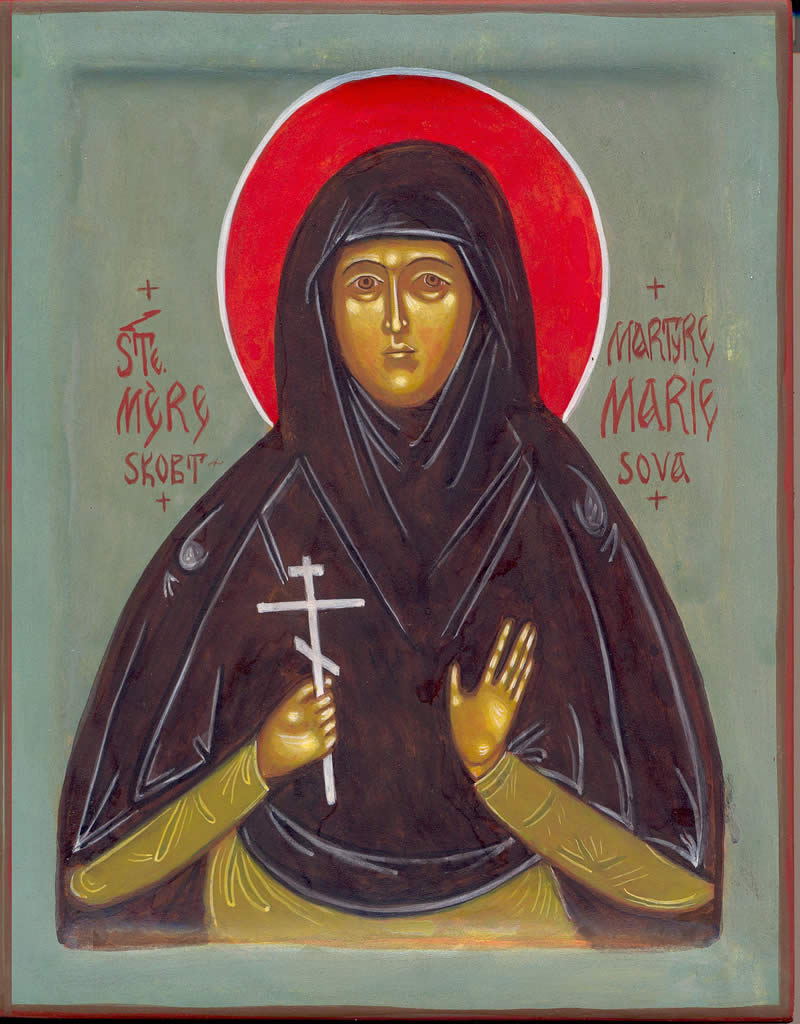
GOD IS LOVE. TWO SERVANTS OF GOD'S LOVE, ONE ORTHODOX, ST MARY SKOBTSOVA, & ONE CATHOLIC, DOROTHY DAY.

MOTHER MARIA SKOBTSOVA

Mother Maria Skobtsova — now recognized as Saint Maria of Paris — died at Ravensbrück concentration camp in 1945, paying with her life for her vocation of hospitality. In many ways, it was a life that  similar to that of Dorothy Day. The extraordinary courage Mother Maria displayed in confronting Nazism is becoming better known, thanks to her recent canonization, but English translations of her essays have been difficult to obtain. Now Mother Maria Skobtsova: Essential Writings is available as part of the Orbis Modern Spiritual Masters Series.

Here is one review:

When, during Great Lent of 1932, Metropolitan Evlogii received the monastic vows of Elisaveta Skobtsova at the church of St. Serge Institute in Paris, many must have been scandalized. After all, this woman had been twice divorced, had an illegitimate child by another man, had leftist political sympathies and was an original by any standard. At her profession she took the name of Maria in memory of St. Mary of Egypt, a prostitute who became a hermit and extreme ascetic. As a religious, Mother Maria continued to scandalize. Her “angelic habit” was usually stained with grease from the kitchen and paint from her workshop; she would hang out at bars late at night; she had little patience with the long Orthodox liturgies, and found the strict and frequent fasts a burden. And — horror of horrors — she even smoked in public in her habit! Her canonization process has been initiated by the Orthodox church. Her “essential writings” constitute the latest book in the Orbis series of Modern Spiritual Masters.

Jim Forest introduces this volume with a biographical essay of Mother Maria. The book consists mainly of articles published in obscure magazines and one long text discovered only recently. This is not stuff for the faint-hearted. The charity that Mother Maria proposes as an obligation of Christian life is severe, absolute, uncompromising and insane. We must love others as Jesus loved, without reserve, in an utter and unconditional self-sacrificing of everything. We must follow the Son of Man not only to Golgotha but beyond — to the very depths of hell where God is absent. We must be willing, as was St. Paul, to be separated from Christ so long as we can see our brothers saved. For we are not alone before God. As members of the body of Christ, each of us shares the fate of all; each of us is justified by the righteous and bears responsibility for the sins of sinners. This means taking upon oneself the crosses of all: their doubts, griefs, temptations, falls and sins.

And Mother Maria leaves us no wiggle room: “It goes without saying that it seems to every man as if nothing will be left of his heart, that it will bleed itself dry if he opens it, not for the countless swords of all of humanity, but even for the one sword of the nearest and dearest of his brothers. … Natural law, which in some false way has penetrated into the spiritual life, will say definitively: Bear your cross responsibly, freely, and honestly, opening your heart now and then to the cross-swords of your neighbor and that is all. … But if the cross of Christ is scandal and folly for natural law, the two- edged weapon that pierces the soul should be as much of a folly and scandal for it. … All that is not the fullness of cross-bearing is sin.” This is, of course, sheer madness — the madness of the Eternal Wisdom, judged and condemned, spat upon and mocked, abused and humiliated, making his the sins of all and descending to the place of the damned.

Mother Maria has no patience with those who are preoccupied with their “spiritual life” and their personal relationship with God. It is precisely this spiritual life that must be lost, given in sacrifice, if one truly loves. If this is not given, tongues and prophecy are useless, faith and martyrdom are in vain. Christian egocentrism is a contradiction in terms. He who seeks to save his soul will lose it. There is no room for complacency or self-righteousness. These are idols that must be destroyed. There is a gift to be given and it must be a total gift — “thine own of thine own.”


What applies to individuals applies also to the church. In her final essay on “Types of Religious Life” (which really concerns types of piety), Mother Maria examines certain aspects of the church’s inner life and the danger of a fascination with its institutional structures, rituals, esthetic beauties and ascetical practices as ends in themselves to the detriment of a relationship to the Living Christ whose image is found in every person. Although she refers directly to the Orthodox church, her words are equally valid for all Christian churches:

“The eyes of love will perhaps be able to see how Christ himself departs, quietly and invisibly, from the sanctuary that is protected by a splendid iconostasis. The singing will continue to resound, the clouds of incense will arise, the faithful will be overcome by the ecstatic beauty of the services. But Christ will go out onto the church steps and mingle with the crowd: the poor, the lepers, the desperate, the embittered, the holy fools. Christ will go out into the streets, the prisons, the low haunts and dives. Again and again Christ lays down his soul for his friends … and so he will return to the churches and bring with him all those he has summoned to the wedding feast, has gathered from the highways, the poor and maimed, prostitutes and sinners … and [they] will not let him into the church because behind him will follow a crowd of people deformed by sin, by ugliness, drunkenness, depravity, and hate. Then their chant will fade away in the air, the smell of incense will disperse and Someone will say to them: ‘I was hungry and you gave me no food …’ ”

This does not imply a rejection of traditions and usages. In another essay, “In Defense of the Pharisees,” Mother Maria underlines the necessity of the collective memory of past blessings and the need for securities and points of reference. During certain historical epochs, of persecution or even in times of relative stability and in the absence of prophecy, adherence to traditions could be the predominant note in the life of the church, its anchor and guarantee. But this fidelity to the past must not become a paralyzing slavery. History is constantly presenting new challenges, and the church must be free to receive the prophetic gifts when such gifts are given and renew itself accordingly. Faced with modernity and bearing witness to the Gospel in our contemporary world, the church cannot let itself be bound by archaic and irrelevant structures.

Mother Maria’s view of the Christian life is anything but horizontal. She has no use for “trends of social Christianity … based on a certain rationalistic humanism [that] apply only the principles of Christian morality to ‘this world’ and do not seek a spiritual and mystical basis for their constructions.” The gift of oneself to others must be rooted in an intense and loving communion with the Son of God “who descended into the world, became incarnate in the world, totally, entirely, without holding any reserve, as it were, for his divinity. … Christ’s love does not know how to measure and divide, does not know how to spare itself.” Our love should not be any different.

In her writings, Mother Maria expresses what she tried to live. After taking her monastic vows — which she saw as a means of committing herself irrevocably to her vocation within the church — she rented a building that became her monastery, a soup kitchen and a refuge for the rejects of society. It resembled a Catholic Worker house more than anything else. One observer described the “monastery” as “a strange pandemonium; we have young girls, madmen, exiles, unemployed workers and, at the moment, the choir of the Russian opera and the Gregorian choir of Dom Malherbe, a missionary center, and now services in the chapel every morning and evening.” The monastery hosted lectures and discussions with speakers from the St. Serge Institute. Mother Maria’s very intense, mystical and personalist convictions did not prevent her from organizing on a larger scale. She founded a sanatorium for impoverished Russians suffering from tuberculosis and was instrumental in the launching of Orthodox Action with its multiple charitable works.

When the German armies occupied Paris, the monastery of Mother Maria became a refuge for persecuted Jews until escape routes could be found. For those who requested them, false baptismal certificates were provided. The Nazis eventually discovered what was going on. Mother Maria, her son Yuri, the monastery’s chaplain and its lay administrator were detained and sent to concentration camps. Only the lay administrator would survive. Those who knew Mother Maria in the camps bore witness to the courage, hope and optimism she imparted to others in the worst of conditions. The date and circumstances of her death are uncertain. There were reports that her name appeared on a list of those sent to the gas chambers on April 31, 1945, and that she offered herself in the place of a young Polish woman — but that has not been fully established.

Maria Skobtsova is, indeed, in the tradition of those fools for Christ who call the church to its essential mission, who strip aside illusions and delusions, a sign of contradiction to all that is human prudence and human “decency.” She challenges us in our complacency and self-satisfaction, our half-measures and sterile piety. She brings a sledgehammer to the all-too-prevalent contemporary search for personal fulfillment, harmony, peace and satisfaction in religion. But she would not be Orthodox if death and suffering were to have the final word — for it is precisely by descending into hell, losing himself among the godless, that life vanquished the dominion of death; where life has entered, death can no longer exist. It is from the tomb that the glory of the resurrection shines forth.

Olivier Clement did the preface to this book. His final paragraph is worth citing: “If we love and venerate Mother Maria it is not in spite of her disorder, her strange views and her passion. It is precisely these qualities that make her so extraordinarily alive among so many bland and pious saints. Unattractive and dirty, strong, thick and sturdy, yes, she was truly alive in her suffering, her compassion, her passion.”

— Jerry Ryan (National Catholic Reporter)

The book can be ordered from the publisher: http://www.maryknollsocietymall.org/description.cfm?ISBN=978-1-57075-436-4


THE MEASURELESSNESS OF CHRISTIAN LOVE
 by Mother Mary Skobtsova
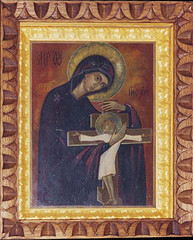
The cross-bearing Theotokos
by Mother Mary Skobtsova
Saint Mary of Paris
my source: Streams of the River


The Eucharist . . .  is the Gospel in action. It is the eternally existing and eternally accomplished sacrifice of Christ and of Christ-like human beings for the sins of the world. Through it earthly flesh is deified and having been deified enters into communion again with earthly flesh. In this sense the Eucharist is true communion with the divine. And is it not strange that in it the path to communion with the divine is so closely bound up with our communion with each other. It assumes consent to the exclamation: “Let us love one another, that with one mind we may confess Father, Son and Holy Spirit: the Trinity, one in essence and undivided.” 

The Eucharist needs the flesh of this world as the “matter” of the mystery. It reveals to us Christ’s sacrifice as a sacrifice on behalf of mankind, that is, as his union with mankind. It makes us into “christs,” repeating again and again the great mystery of God meeting man, again and again making God incarnate in human flesh. And all this is accomplished in the name of sacrificial love for mankind. 

But if at the center of the Church’s life there is this sacrificial, self-giving eucharistic love, then where are the Church’s boundaries, where is the periphery of this center? Here it is possible to speak of the whole of Christianity as an eternal offering of the Divine Liturgy beyond church walls. What does this mean? It means that we must offer the bloodless sacrifice, the sacrifice of self-surrendering love not only in a specific place, upon the altar of a particular temple; the whole world becomes the single altar of a single temple, and for this universal Liturgy we must offer our hearts, like bread and wine, in order that they may be transubstantiated into Christ’s love, that he may be born in them, that they may become “Godmanhood” hearts, and that he may give these hearts of ours as food for the world, that he may bring the whole world into communion with these hearts of ours that have been offered up, so that in this way we may be one with him, not so that we should live anew but so that Christ should live in us, becoming incarnate in our flesh, offering our flesh upon the Cross of Golgotha, resurrecting our flesh, offering it as a sacrifice of love for the sins of the world, receiving it from us as a sacrifice of love to himself. Then truly in all ways Christ will be in all. 

Here we see the measurelessness of Christian love. Here is the only path toward becoming Christ, the only path which the Gospel reveals to us. What does all this mean in a worldly, concrete sense? How can this be manifested in each human encounter, so that each encounter may be a real and genuine communion with God through communion with man? It implies that each time one must give up one’s soul to Christ in order that he may offer it as a sacrifice for the salvation of that particular individual. It means uniting oneself with that person in the sacrifice of Christ, in flesh of Christ. This is the only injunction we have received through Christ’s preaching of the Gospel, corroborated each day in the celebration of the Eucharist. Such is the only true path a Christian can follow. In the light of this path all others grow dim and hazy. One must not, however, judge those who follow other conventional, non-sacrificial paths, paths which do not require that one offer up oneself, paths which do not reveal the whole mystery of love. Nor, on the other hand, is it permitted to be silent about them. Perhaps in the past it was possible, but not today. 

Such terrible times are coming. The world is so exhausted from its scabs and its sores. It so cries out to Christianity in the secret depths of its soul. But at the same time it is so far removed from Christianity that Christianity cannot, should not even dare to show a distorted, diminished, darkened image of itself. Christianity should singe the world with the fire of Christian love. Christianity should ascend the Cross on behalf of the world. It should incarnate Christ himself in the world. Even if this Cross, eternally raised again and again on high, be foolishness for our new Greeks and a stumbling block for our new Jews, for us it will still be “the power of God and the wisdom of God” (1 Cor. 1:24). 


We who are called to be poor in spirit, to be fools for Christ, who are called to persecution and abuse — we know that this is the only calling given to us by the persecuted, abused, disdained and humiliated Christ. And we not only believe in the Promised Land and the blessedness to come: now, at this very moment, in the midst of this cheerless and despairing world, we already taste this blessedness whenever, with God’s help and at God’s command, we deny ourselves, whenever we have the strength to offer our soul for our neighbors, whenever in love we do not seek our own ends.

The Asceticism of the Open Door
by Mother Maria Skobtsova
my source: In Communion


This is an extract from an essay, “The Second Gospel Commandment,” in Mother Maria Skobtsova: Essential Writings, published by Orbis. The book’s editor is Helene Klepinin Arjakovsky, daughter of Fr. Dmitri Klepinin, co-worker with Mother Maria, who died, as she did, in a concentration camp. The translation is by Richard Pevear and Larissa Volokhonsky.

“The sign of those who have reached perfection is this: if ten times a day they are given over to be burned for the love of their neighbor, they will not be satisfied with that, as Moses, and the ardent Paul, and the other disciples showed. God gave His Son over to death on the Cross out of love for His creature. And if He had had something more precious, he would have given it to us, in order thereby to gain humankind. Imitating this, all the saints, in striving for perfection, long to be like God in perfect love for their neighbor.”

“No man dares to say of his love for his neighbor that he succeeds in it in his soul, if he abandons the part that he fulfills bodily, as well as he can, and in conformity with time and place. For only this fulfillment certifies that a man has perfect love in him. And when we are faithful and true in it as far as possible, then the soul is given power, in simple and incomparable notions, to attain to the great region of lofty and divine contemplation.”

These words from St. Isaac the Syrian, both from the Philokalia, justify not only active Christianity, but the possibility of attaining to “lofty and divine contemplation” through the love of one’s neighbor — not merely an abstract, but necessarily the most concrete, practical love. Here is the whole key to the mystery of human relations as a religious path.

For me these are truly fiery words. Unfortunately, in the area of applying these principles to life, in the area of practical and ascetic behavior toward man, we have much less material than in the area of man’s attitude toward God and toward himself. Yet the need to find some precise and correct ways, and not to wander, being guided only by one’s own sentimental moods, the need to know the limits of this area of human relations — all this is very strongly felt. In the end, since we have certain basic instructions, perhaps it will not be so difficult to apply them to various areas of human relations, at first only as a sort of schema, an approximate listing of what is involved.

Let us try to find the main landmarks for this schema in the triune makeup of the human being — body, soul, and spirit. In the area of our serving each of these main principles, ascetic demands and instructions emerge of themselves, the fulfillment of which, on the one hand, is unavoidable in order to reach the goal, and, on the other hand, is beyond one’s strength.

It seems right to me to draw a line here between one’s attitude toward oneself and one’s attitude toward others. The rule of not doing to others what you do not want done to yourself is hardly applicable in asceticism. Asceticism goes much further and sets much stricter demands on oneself than on one’s neighbors.

In the area of the relation to one’s physical world, asceticism demands two things of us: work and abstinence. Work is not only an unavoidable evil, the curse of Adam; it is also a participation in the work of divine economy; it can be transfigured and sanctified. It is also wrong to understand work only as working with one’s hands, a menial task; it calls for responsibility, inspiration, and love. It should always be work in the fields of the Lord.

Work stands at the center of modern ascetic endeavor in the area of man’s relation to his physical existence. Abstinence is as unavoidable as work. But its significance is to some degree secondary, because it is needed mainly in order to free one’s attention for more valuable things than those from which one abstains. One can introduce some unsuitable passion into abstinence — and that is wrong. A person should abstain and at the same time not notice his abstinence.

A person should have a more attentive attitude toward his brother’s flesh than his own. Christian love teaches us to give our brother not only material but spiritual gifts. We must give him our last shirt and our last crust of bread. Here personal charity is as necessary and justified as the broadest social work. In this sense there is no doubt that the Christian is called to social work. He is called to organize a better life for the workers, to provide for the old, to build hospitals, care for children, fight against exploitation, injustice, want, lawlessness.

In principle the value is completely the same, whether he does it on an individual or a social level; what matters is that his social work be based on love for his neighbor and not have any latent career or material purposes. For the rest it is always justified — from personal aid to working on a national scale, from concrete attention to an individual person to an understanding of abstract systems of the right organization of social life. The love of man demands one thing from us in this area: ascetic ministry to his material needs, attentive and responsible work, a sober and unsentimental awareness of our strength and of its true usefulness.

The ascetic rules here are simple and perhaps do not leave any particular room for mystical inspiration, often being limited merely to everyday work and responsibility. But there is great strength and great truth in them, based on the words of the Gospel about the Last Judgment, when Christ says to those who stand on His right hand that they visited Him in prison, and in the hospital, fed Him when He was hungry, clothed Him when He was naked. He will say this to those who did it either on an individual or on a social level.


Thus, in the dull, laborious, often humdrum ascetic rules concerning our attitude toward the material needs of our neighbor, there already lies the pledge of a possible relation to God, their spirit-bearing nature. ❖


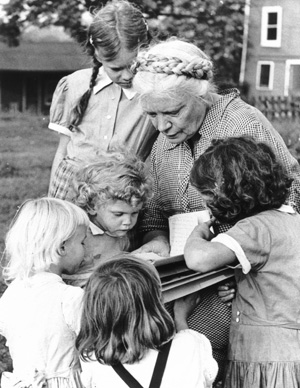
Servant of God Dorothy Day
By
This essay by Jim Forest was originally written for The Encyclopedia of American Catholic History, published by the Liturgical Press; the text was updated for this web site in 2013. Jim Forest, once a managing editor of The Catholic Worker, is the author of All Is Grace: A Biography of Dorothy Day; and Living With Wisdom: A Biography of Thomas Merton. Both are published by Orbis Press.

“What you did to the least person, you did to me.”

— Jesus, Gospel of Matthew, 25:40

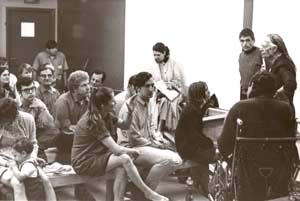
At their 2012 annual meeting, the Catholic bishops of the United States unanimously recommended the canonization of Dorothy Day, founder of the Catholic Worker movement. By then the Vatican had already given her the title “Servant of God,” the first step in formally recognizing Dorothy Day as a saint. On Ash Wednesday, 2013, preaching in Saint Peter’s Basilica in Rome, Pope Benedict XVI spoke of Dorothy Day as a model of conversion.

While awareness of her remarkable life has been growing steadily, she is at present still not widely known. Who was Dorothy Day? Why do so many people regard her as a model of sanctity for the modern world?

She was born into a journalist’s family in Brooklyn, New York, on November 8, 1897. After surviving the San Francisco earthquake in 1906, the Day family moved into a tenement flat on Chicago's South Side. It was a big step down in the world, made necessary because John Day was out of work. Day's understanding of the shame people feel when they fail in their efforts dated from this time.

Her father was passionately anti-Catholic, but in Chicago Day began to form positive impressions of Catholicism. Later in life she would recall her discovery of a friend's mother, a devout Catholic, praying at the side of her bed. Without embarrassment, she looked up at Day, told her where to find her daughter, and returned to her prayers. "I felt a burst of love toward her that I have never forgotten," Day recalled.

When John Day was appointed sports editor of a Chicago newspaper, the Day family moved into a comfortable house on the North Side. Here Dorothy began to read books that stirred her conscience. A novel by Upton Sinclair, The Jungle, inspired Day to take long walks in poor neighborhoods on Chicago's South Side, the area where much of Sinclair’s novel was set. These long walks were the start of a life-long attraction to areas many people avoid.

Day had a gift for finding beauty in the midst of urban desolation. Drab streets were transformed by pungent odors: geranium and tomato plants, garlic, olive oil, roasting coffee, bread and rolls in bakery ovens. "Here," she said, "was enough beauty to satisfy me."

Day won a scholarship that brought her to the University of Illinois campus at Urbana in the fall of 1914, but she was a reluctant scholar. Her reading drew her in a radical social direction. She avoided campus social life and insisted on supporting herself rather than living on money from her father.

Dropping out of college two years later, she moved to New York where she found a job reporting for The Call, the city's one socialist daily; she covered rallies and demonstrations and interviewed people ranging from butlers to revolutionaries.

She next worked for The Masses, a magazine that opposed American involvement in the European war. In September, the Post Office rescinded the magazine's mailing permit. Federal officers seized back issues, manuscripts, subscriber lists and correspondence. Five editors were charged with sedition. Day, the newest member of the staff, was able to get out the journal’s final issue.

Day’s conviction that the social order was unjust changed in no substantial way from her adolescence until her death, though she never identified herself with any political party.

In November 1917 Day went to prison for being one of forty women arrested in front of the White House for protesting women's exclusion from the electorate. Arriving at a rural workhouse, the women were roughly handled. The women responded with a hunger strike. Finally they were freed by presidential order.

Returning to New York, Day felt that journalism was a meager response to a world at war. In the spring of 1918, she signed up for a nurses’ training program in Brooklyn.

Her religious development was a gradual process. As a child she had attended services at an Episcopal Church in Chicago and been baptized. As a young journalist in New York, she would sometimes make late-at-night visits to St. Joseph's Catholic Church on Sixth Avenue. The Catholic climate of worship appealed to her. While she knew little about Catholic belief, Catholic spiritual discipline fascinated her. She saw the Catholic Church as "the church of the immigrants, the church of the poor."

In 1922, in Chicago working as a reporter, she roomed with three young women who went to Mass every Sunday and holy day and set aside time each day for prayer. It was clear to her that "worship, adoration, thanksgiving, supplication ... were the noblest acts of which we are capable in this life."

Her next job was with a newspaper in New Orleans. Living near St. Louis Cathedral, Day often attended evening Benediction services.

Back in New York in 1924, Day bought a beach cottage in the New York borough of Staten Island using money from the sale of movie rights for The Eleventh Virgin, an autobiographical novel she had written. She also began a four-year common-law marriage with Forster Batterham, a botanist she had met through friends in Manhattan. Batterham was an anarchist who opposed both marriage and religion. In a world of such cruelty, he found it impossible to believe in a God. By this time Day's belief in God was unshakable. It grieved her that Batterham didn't sense God's presence within the natural world. "How can there be no God," she asked, "when there are all these beautiful things?" Batterham’s irritation with her "absorption in the supernatural" often led them to quarrel.

What transformed everything for Dorothy was discovering she was pregnant. She had been pregnant once before, years earlier, as the result of a love affair with a journalist. This resulted in the great tragedy of her life, an abortion. The affair’s awful aftermath, Day concluded in the years following, had left her barren. "For a long time I had thought I could not bear a child, and the longing in my heart for a baby had been growing," she confided in her autobiography, The Long Loneliness. "My home, I felt, was not a home without one."

Her pregnancy with Batterham seemed to Day nothing less than a miracle. Batterham, however, did not rejoice. He didn't believe in bringing children into such a violent world.

On March 3, 1926, Tamar Theresa Day was born. Day could think of nothing better to do with the gratitude that overwhelmed her than arrange Tamar's baptism in the Catholic Church. "I did not want my child to flounder as I had often floundered. I wanted to believe, and I wanted my child to believe, and if belonging to a Church would give her so inestimable a grace as faith in God, and the companionable love of the Saints, then the thing to do was to have her baptized a Catholic."

Following Tamar's baptism, there was a permanent break with Batterham, a heart-breaking event for Day. On December 28, she was received into the Catholic Church. A period commenced in her life as she tried to find a way to bring together her religious faith and her radical social values.

In the winter of 1932 Day travelled to Washington, D.C., to report for two Catholic journals, Commonweal and America, on a radical protest called the Hunger March. Day watched the protesters parade down the streets of Washington carrying signs calling for jobs, unemployment insurance, old age pensions, relief for mothers and children, health care and housing. What kept Day in the sidelines was that she was a Catholic and the march had been organized by Communists, a party at war with not only capitalism but religion.

It was December 8, the Feast of the Immaculate Conception. After witnessing the march, Day went to the Shrine of the Immaculate Conception where she expressed her torment in prayer: "I offered up a special prayer, a prayer which came with tears and anguish, that some way would open up for me to use what talents I possessed for my fellow workers, for the poor."

Her prayer was quickly answered. The next day, back at her apartment in New York, Day met Peter Maurin, a French immigrant 20 years her senior, who was to change her life.

Maurin, a former Christian Brother, had left France for Canada in 1908 and later made his way to the United States. When he met Day, he was a handyman at a Catholic boys' camp in upstate New York, receiving meals, use of the chaplain's library, living space in the barn and occasional pocket money.

During his years of wandering, Maurin had come to a Franciscan attitude, embracing poverty as a vocation. His celibate, unencumbered life offered time for study and prayer, out of which a vision had taken form of a social order instilled with basic values of the Gospel "in which it would be easier for men to be good." A born teacher, he found willing listeners, among them George Shuster, editor of Commonweal magazine, who gave him Day's address.

As remarkable as the providence of their meeting was Day's willingness to listen. It seemed to her he was an answer to her prayers, someone who could help her discover what she was supposed to do.

What Day should do, Maurin said, was start a newspaper to publicize Catholic social teaching and promote steps to bring about the peaceful transformation of society. Day readily embraced the idea. If family past, work experience and religious faith had prepared her for anything, it was this.

Day found that the Paulist Press was willing to print 2,500 copies of an eight-page tabloid paper for $57. Her kitchen was the new paper's editorial office. She decided to sell the paper for a penny a copy, "so cheap that anyone could afford to buy it."

On May 1, the first copies of The Catholic Worker were handed out on Union Square.

Few publishing ventures meet with such immediate success. By December, 100,000 copies were being printed each month. Readers found a unique voice in The Catholic Worker. It expressed dissatisfaction with the social order and took the side of labor unions, but its vision of the ideal future challenged both urbanization and industrialism. It wasn't only radical but religious. The paper didn't merely complain but called on its readers to make personal responses.

For the first half year The Catholic Worker was only a newspaper, but as winter approached, homeless people began to knock on the door. Maurin's essays in the paper were calling for renewal of the ancient Christian practice of hospitality to those who were homeless. In this way followers of Christ could respond to Jesus' words: "I was a stranger and you took me in." Maurin opposed the idea that Christians should take care only of their friends and leave care of strangers to impersonal charitable agencies. Every home should have its "Christ Room" and every parish a house of hospitality ready to receive the "ambassadors of God."

Surrounded by people in need and attracting volunteers excited about ideas they discovered in The Catholic Worker, it was inevitable that the editors would soon be given the chance to put their principles into practice. Day's apartment was the seed of many houses of hospitality to come.

By the wintertime, an apartment was rented with space for ten women, soon after a place for men. Next came a house in Greenwich Village. In 1936 the community moved into two buildings in Chinatown, but no enlargement could possibly find room for all those in need. Mainly they were men, Day wrote, "grey men, the color of lifeless trees and bushes and winter soil, who had in them as yet none of the green of hope, the rising sap of faith."

Many of the down-and-out guests were surprised that, in contrast with most charitable centers, no one at the Catholic Worker set about reforming them. A crucifix on the wall was the only unmistakable evidence of the faith of those welcoming them. The staff received not salary, only food, board and occasional pocket money.

The Catholic Worker became a national movement. By 1936 there were thirty-three Catholic Worker houses spread across the country. Due to the Great Depression, there were plenty of people needing them.

The Catholic Worker attitude toward those who were welcomed wasn't always appreciated. These weren't the "deserving poor," it was sometimes objected, but drunkards and good-for-nothings. A visiting social worker asked Day how long the "clients" were permitted to stay. "We let them stay forever," Day answered.. "They live with us, they die with us, and we give them a Christian burial. We pray for them after they are dead. Once they are taken in, they become members of the family. Or rather they always were members of the family. They are our brothers and sisters in Christ."

Some justified their objections with biblical quotations. Didn't Jesus say that the poor would be with us always? "Yes," Day once replied, "but we are not content that there should be so many of them. The class structure is our making and by our consent, not God's, and we must do what we can to change it. We are urging revolutionary change."

The Catholic Worker has also experimented with farming communes. In 1935, a house with a garden was rented on Staten Island. Soon after came Maryfarm in Easton, Pennsylvania, a property finally given up because of strife within the community. Another farm was purchased in upstate New York near Newburgh. Called the Maryfarm Retreat House, it was destined for a longer life. Later came the Peter Maurin Farm on Staten Island, which later moved to Tivoli and then to Marlborough, both in the Hudson Valley. Day came to see that the vocation of the Catholic Worker was not so much to found model agricultural communities, though several have been productive and long-lasting, as rural houses of hospitality.

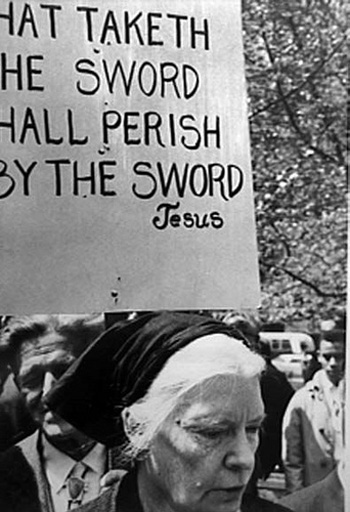
What got Day into the most trouble was pacifism. A nonviolent way of life, as she saw it, was at the heart of the Gospel. She took as seriously as the early Church the command of Jesus to Saint Peter: "Put away your sword, for whoever lives by the sword shall perish by the sword."

For many centuries the Catholic Church had accommodated itself to war. Popes had blessed armies and preached Crusades. In the thirteenth century Saint Francis of Assisi had revived the pacifist way, but by the twentieth century, it was unknown for Catholics to take such a position.

The Catholic Worker's first expression of pacifism, published in 1935, was a dialogue between a patriot and Christ, the patriot dismissing Christ's teaching as a noble but impractical doctrine. Few readers were troubled by such articles until the Spanish Civil War in 1936. The fascist side, led by Franco, presented itself as defender of the Catholic faith. Nearly every Catholic bishop and publication rallied behind Franco. The Catholic Worker, refusing to support either side in the war, lost two-thirds of its readers.

Those backing Franco, Day warned early in the war, ought to "take another look at recent events in [Nazi] Germany." She expressed anxiety for the Jews and later was among the founders of the Committee of Catholics to Fight Anti-Semitism.

Following Japan's attack on Pearl Harbor and America's declaration of war, Dorothy announced that the paper would maintain its pacifist stand. "We will print the words of Christ who is with us always," Day wrote. "Our manifesto is the Sermon on the Mount." Opposition to the war, she added, had nothing to do with sympathy for America's enemies. "We love our country.... We have been the only country in the world where men and women of all nations have taken refuge from oppression." But the means of action the Catholic Worker movement supported were the works of mercy rather than the works of war. She urged "our friends and associates to care for the sick and the wounded, to the growing of food for the hungry, to the continuance of all our works of mercy in our houses and on our farms."

Not all members of Catholic Worker communities agreed. Fifteen houses of hospitality closed in the months following the U.S. entry into the war. But Day's view prevailed. Every issue of The Catholic Worker reaffirmed her understanding of the Christian life. The young men who identified with the Catholic Worker movement during the war generally spent much of the war years either in prison or in rural work camps. Some did unarmed military service as medics.

The world war ended in 1945, but out of it emerged the Cold war, the nuclear-armed "warfare state," and a series of smaller wars in which America was often involved.

One of the rituals of life for the New York Catholic Worker community beginning in the late 1950s was the refusal to participate in the state's annual civil defense drill. Such preparation for attack seemed to Day part of an attempt to promote nuclear war as survivable and winnable and to justify spending billions on the military. When the sirens sounded June 15, 1955, Day was among a small group of people sitting in front of City Hall. "In the name of Jesus, who is God, who is Love, we will not obey this order to pretend, to evacuate, to hide. We will not be drilled into fear. We do not have faith in God if we depend upon the Atom Bomb," a Catholic Worker leaflet explained. Day described her civil disobedience as an act of penance for America's use of nuclear weapons on Japanese cities.

The first year the dissidents were reprimanded. The next year Day and others were sent to jail for five days. Arrested again the next year, the judge jailed her for thirty days. In 1958, a different judge suspended the sentence. In 1959, Day was back in prison, but only for five days. Then came 1960, when instead of a handful of people coming to City Hall Park, 500 turned up. The police arrested only a few, Day conspicuously not among those singled out. In 1961 the crowd swelled to 2,000. This time forty were arrested, but again Day was exempted. It proved to be the last year of dress rehearsals for nuclear war in New York.

Another Catholic Worker stress was the civil rights movement. As usual Day wanted to visit people who were setting an example and therefore went to Koinonia, a Christian agricultural community in rural Georgia where blacks and whites lived peacefully together. The community was under attack when Day visited in 1957. One of the community houses had been hit by machine-gun fire, and Ku Klux Klan members had burned crosses on community land. Day insisted on taking a turn at the sentry post. Noticing that an approaching car had reduced its speed, she ducked just as a bullet struck the steering column in front of her face.

Concern with the Church's response to war led Day to Rome during the Second Vatican Council, an event Pope John XXIII hoped would restore "the simple and pure lines that the face of the Church of Jesus had at its birth." In 1963 Day was one of fifty "Mothers for Peace" who went to Rome to thank Pope John for his encyclical Pacem in Terris. Close to death, the pope couldn't meet them privately, but at one of his last public audiences blessed the pilgrims, asking them to continue their labors.

In 1965, Day returned to Rome to take part in a fast expressing "our prayer and our hope" that the Council would issue "a clear statement, `Put away thy sword.'" Day saw the unpublicized fast as a "widow's mite" in support of the bishops' effort to speak with a pure voice to the modern world.

The fasters had reason to rejoice in December when the Constitution on the Church in the Modern World was approved by the bishops. The Council described as "a crime against God and humanity" any act of war "directed to the indiscriminate destruction of whole cities or vast areas with their inhabitants." The Council called on states to make legal provision for conscientious objectors while describing as "criminal" those who obey commands which condemn the innocent and defenseless.

Acts of war causing "the indiscriminate destruction of ... vast areas with their inhabitants" were the order of the day in regions of Vietnam under intense U.S. bombardment in 1965 and the years following. Many young Catholic Workers went to prison for refusing to cooperate with conscription, while others did alternative service. Nearly everyone in Catholic Worker communities took part in protests. Many went to prison for acts of civil disobedience.

Probably there has never been a newspaper so many of whose editors have been jailed for acts of conscience. Day herself was last jailed in 1973 for taking part in a banned picket line in support of farmworkers. She was seventy-five.

Day lived long enough to see her achievements honored. In 1967, when she made her last visit to Rome to take part in the International Congress of the Laity, she found she was one of two Americans — the other an astronaut — invited to receive Communion from the hands of Pope Paul VI. On her 75th birthday the Jesuit magazine America devoted a special issue to her, finding in her the individual who best exemplified "the aspiration and action of the American Catholic community during the past forty years." Notre Dame University presented her with its Laetare Medal, thanking her for "comforting the afflicted and afflicting the comfortable."

Among those who came to visit her when she was no longer able to travel was Mother Teresa of Calcutta, who had once pinned on Day's dress the crucifix normally worn only by fully professed members of the Missionary Sisters of Charity.

Long before her death on November 29, 1980, Day found herself regarded by many as a saint. No words of hers are better known than her brusque response, "Don't call me a saint. I don't want to be dismissed so easily." Nonetheless, having herself treasured the memory and witness of many saints, she is a candidate for inclusion in the calendar of saints. Cardinal John O’Connor, Archbishop of New York, launched the canonization process in 1997, the hundredth anniversary of Day’s birth.

"If I have achieved anything in my life," she once remarked, "it is because I have not been embarrassed to talk about God."

* * *

Bibliography:

Robert Coles, Dorothy Day: A Radical Devotion (Reading, MA: Addison-Wesley, 1987)

Tom Cornell, Robert Ellsberg and Jim Forest, editors, A Penny a Copy: Writings from The Catholic Worker (Maryknoll, NY: Orbis, 1995)

Dorothy Day, The Long Loneliness. (Chicago: Saint Thomas More Press, 1993)

Robert Ellsberg, editor, Dorothy Day: Selected Writings (Maryknoll, NY: Orbis, 1992)

Robert Ellsberg, editor, The Duty of Delight: The Diaries of Dorothy Day (Marquette University Press, 2007)

Robert Ellsberg, editor, All the Way to Heaven: The Selected Letters of Dorothy Day (Marquette University Press, 2010)

Jim Forest, All Is Grace: a biography of Dorothy Day (Maryknoll, NY: Orbis, 2011)

William Miller, Dorothy Day: A Biography (New York: Harper & Row, 1982)


Search This Blog

La Virgen de Guadalupe

La Virgen de Guadalupe

Followers

My Blog List

Fr David Bird

Fr David Bird
Me on a good day

Blog Archive