"Today the concept of truth is viewed with suspicion, because truth is identified with violence. Over history there have, unfortunately, been episodes when people sought to defend the truth with violence. But they are two contrasting realities. Truth cannot be imposed with means other than itself! Truth can only come with its own light. Yet, we need truth. ... Without truth we are blind in the world, we have no path to follow. The great gift of Christ was that He enabled us to see the face of God".Pope Benedict xvi, February 24th, 2012
The Church is ecumenical, catholic, God-human, ageless, and it is therefore a blasphemy—an unpardonable blasphemy against Christ and against the Holy Ghost—to turn the Church into a national institution, to narrow her down to petty, transient, time-bound aspirations and ways of doing things. Her purpose is beyond nationality, ecumenical, all-embracing: to unite all men in Christ, all without exception to nation or race or social strata. - St Justin Popovitch
Earlier this year an extraordinary event took place in the Vatican. Bishop Tony Palmer -- a bishop in an Anglican breakaway church met with Pope Francis. Palmer and then-Archbishop Bergoglio had become friends when the Evangelical Charismatic Anglican minister was a missionary in Argentina.
Once he was wearing the white soutane, Pope Francis telephoned Palmer and asked to meet.
During their extended breakfast the Pope asked Tony Palmer what he could do to encourage unity with Evangelical Protestants. Bishop Tony pulled out his iPhone and said, “Why not record a video greeting to the group of influential charismatic Christians I am going to meet at a conference in Texas next week?
Pope Francis obliged and the greeting can be viewed here.
After Pope Francis’ greeting was played to the conference of Protestant Evangelical leaders, the television evangelist Kenneth Copeland gave a warm response and said he wanted to visit with the Pope.
That meeting has now taken place. Rick Wiles reports that a delegation led by Bishop Tony Palmer traveled to Rome and met with Pope Francis for three hours. James and Betty Robison hosts of the Life Today television program and Kenneth Copeland founder of Kenneth Copeland ministries were accompanied by Reverend Geoff Tunnicliff, CEO of the World Evangelical Alliance; Rev. Brian Stiller and Rev. Thomas Schirrmacher, also from the World Evangelical Alliance. Also in attendance were Rev. John Arnott and his wife, Carol, co-founders of Partners for Harvest ministries in Toronto, Canada.
This meeting is all the more remarkable since not too long ago conservative Evangelicals in North America were inclined to view the Catholic Church as the “great whore of Babylon” and the Pope as the antichrist.
The Evangelical leaders were not only impressed by the simplicity and warmth of Pope Francis's welcome, but they clearly had a fellowship in Christ that has been lacking in the past.
How can we understand the warmth between conservative Evangelical Protestants and Pope Francis? What we are witnessing is the fruit of a historic realignment in Christianity.
For some time now the real division in Christianity has not been between Catholics and Protestants. It has been between those Christians who believe in a revealed religion and those who believe in a relative religion. The real divide is between progressives who wish to alter the historic faith according to the spirit of the age, and those who believe the spirit of the age should be challenged by the eternal and unchanging truth of the Christian gospel.
Those who believe in a relative, progressive and modernist form of Christianity dismiss the miraculous element of religion, believe the church and the Scriptures are merely man made accidents of history and think the church should adapt completely to the needs of modern society. The progressives see the church as an agent of social change and think the main task of Christians is to be political activists.
The other side are those who believe the gospel of Jesus Christ is revealed by God for the salvation of souls and the transformation of the world. These historic Christians believe the Scriptures are inspired by God and that the gospel cannot be changed by the culture of any age. They might be called classical Christians because they believe the “old, old story” of a sinful humanity and a merciful God who gave his own Son for the salvation of the world.
Progressive and Classical Christians can be found in all the denominations and ecclesial structures. There are classical and progressive Catholics and classical and progressive Protestants. The recent meeting between Pope Francis and the Evangelical leaders reveals that the classical Christians of all traditions have more in common than the classical Christians have with progressives.
The astounding thing about the papacy is that the words and actions of popes are not only rooted firmly in the past, but they very often are prophetic of the future. The words and actions of St. John Paul II and Benedict XVI were both rooted in the past and yet pointed to the future.
Likewise with Pope Francis. His meeting with Evangelical leaders points to a new alignment within global Christianity. As the progressive Christians merge increasingly with the spirit of the age the divide between them and classical Christians will become increasingly acute. As this happens the classical Christians of all denominations will begin to coalesce and cooperate more closely. Classical Christians from Eastern Orthodoxy through Roman Catholicism, classical Anglicanism and Evangelicalism will all find an increasing understanding and agreement.
The increasingly close fellowship with Evangelicals will be hastened as progressive Christianity moves away to become something other than Christian. The rapprochement between classical Evangelicals and Catholics will also burgeon as dark forces on various fronts rise up against Christ and his church. Opposition to classical Christianity and simmering threat of persecution will foster a new depth of meaning to the term “Evangelical Catholic.”
Fr. Dwight Longenecker is the author of More Christianity: Finding the Fullness of the Faith.
We are continuing to find articles on Pentecost long after Pentecost is over, which makes me wish that we still had "time after Pentecost". I know that Pentecost is the feast that completes the Paschal Mystery which leads up to it. Nevertheless, the time of the Church is not so much the "time after Pentecost" as the "time IN Pentecost", because the Holy Spirit is still coming down. We live in the situation, in the context of Pentecost. In fact, the Church is no less in Pentecost as were the Apostles; and our understanding of Christ's revelation, whether we belong to East or West, reflects this. After all, we are integral parts of the same Eucharist.
It follows that we must take seriously not only all we have in common - I have never read anything of Metropolitan Anthony which has not illumined my path as a Catholic - but we must take seriously our objections against each other. They are not like the objections of the Protestant Reformation, even though these Protestant objections have sometimes been adopted by Orthodox in their verbal conflicts with Catholics. Authentic Orthodox objections arise, not from a rejection of Tradition, but from fidelity to their own Tradition which, for a thousand years at least, was identical to our own. Once both sides accept that the two versions of Tradition, separated from each other by the schism, are rooted in a more fundamental unity brought about by the Holy Spirit in the celebration of the same Eucharist, then they might be able to accept the need to understand each other, as is being done in the Orthodox - Catholic dialogue. However, I accept the Russian Orthodox claim that this will not happen until we discover the need for each other in our ordinary, day-to-day ecclesial lives. Meanwhile, let us both concentrate on the re-conversion of Europe, discover our true identity in the other.
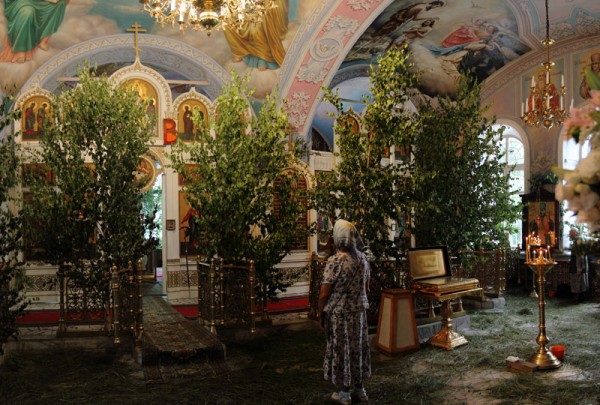
The colour of Pentecost in the East is green, the colour of life; and churches are decorated with branches, as in the photo above.
In the name of the Father, the Son and the Holy Ghost.
The Church of God is not an institution, it is a miracle and it is a mystery. It is a miracle because who and how could we expect that closeness of God which is revealed to us in the Church. And it is also a mystery in the original sense of the world, something which cannot be either explained or conveyed in words, something that can be known only through a spellbound communion with God. The English word “God” comes from a Germanic root that means “him, before whom one prostrates in adoration”. This is where our knowledge of God begins – the sense of the divine presence that forces us down to our knees, spellbound, silent, not with an empty silence that is ours at times but with a silence which is nothing but intent worshipful listening, listening to the presence, listening to that presence which is at the core of the silence. And he who speak to us within this silence is the Holy Spirit, who unveils before our minds and hearts what the words spoken by God, revealed to us in the Gospel truly convey. It is only under the guidance of the Holy Spirit that we can both believe and understand what Christ spoke because words in themselves are always equivocal, they may be clear or obscure, they may be made to mean what they never meant. And this is the role of the Holy Spirit — to make us understand God’s word as it was born in the divine silence and unfolded before us in words which we could understand. But these words are not a prison, they are an open door as Christ is the door leading to the Father and leading to eternal life. It is the Holy Spirit who according to the promise of our Lord unveils for us the meaning of the Scriptures, it is not scholarship, it is worship and a worship that allows us to commune with the mind of God and the heart of God. The Spirit of truth, but also Him whom the Scripture calls the Paraclete, a complex word as so many of the words of ancient languages. It means “the Comforter”, Him who gives consolation. It means ‘Comforter’ in the sense that He gives us strength, it means also “Him, who brings joy”. And these three meanings are important but He can be to us the Comforter in these various ways only if we are in need of His comfort.
What kind of consolation do we need? Most of us feel perfectly comfortable in our lives and indeed in our worship and our spiritual lifem and who of us is in a position to say with all the intensity and depth with which St. Paul spoke these words, “For me life is Christ, death would be a gain because as long as I live in the body, I am separated from Christ.” Can we honestly say that for us life is Christ, that all that He stands for is life-giving, all that is contrary to Him, to us is death? Can we say that we have died with Christ to everything which is alien to God? Can we say that we are alive only when the things of God come our way — prayer, deep meditation, the kind of understanding which the Spirit of God reveals to us? And so we must ask ourselves very sternly a first question: is Christ my life or not? Would it be enough for me to feel that life is fulfilled, complete to be at one with Christ in all things or do I feel that there are so many things which I love and which I am not prepared to let go off even to be with Christ?
And again, Christ is in the midst of us invisibly, mysteriously. Yes, but He is not with us in the way in which He was with the Apostles. We cannot say with St. John that we speak of what we have seen, what we have heard, what our hands have touched. We know Christ in the spirit, no longer in the flesh, and yet Christ rose in the flesh, Christ ascended and is seated at the right hand of the Father in His body glorified. Paul longed to be with Him in this companionship full of veneration, of reverence, of love. He wanted to be at one with Him without anything separating from Him. Who shall make me free of this body of corruption, of this body against which my thoughts and my prayers and my best inclinations, and my most passionate impulses for good break down? Can we say that? Is death what we expect longingly because it will unite us to Christ? Or are we still pagan at heart and do we wish to flee from death? And instead of saying, “Lord, Jesus, come and come soon,” aren’t we prepared to say, “Tarry, o Lord, tarry, give me time,” in the way in which Augustine prayed to the Lord after his conversion, “Lord, give me chastity but not just now.” Isn’t it that our condition — not concerning chastity alone but everything in life: not just now, o Lord, the time will come when all my energies will be spent, when age will have come and made life much less attractive or unpalatable — then take me. No, this is not it. And so when we think of the Holy Spirit as our Comforter, as one who consoles us from the absence of Christ by making us to commune with the essence of things, where do we stand? Is He our Comforter while we need no comfort?
And again, in our ministry how often do we feel that we are totally, ultimately helpless, that what we are called to do is simply beyond human possibilities? In the beginning of the Eucharistic celebration in the Orthodox Church, when the priest is vested, when he has prepared the Holy Gifts, when he is about to give the first liturgical exclamation, when in his naivety he may think, “Now I will perform miracles on earth,” the deacon turns to him and says, “And now, father, it is for God to act.” All you could do, you have done, you have prayed and prepared yourself, made yourself open to God, you have vested yourself and become an image – but only an image not the thing. You have prepared the bread and the wine and now what is expected of you is something which you cannot do, you cannot by any power including apostolic succession make this bread into the Body of Christ, this wine into the Blood of Christ, you have no power over God and you have no power over the created world. It is only Christ who is the only celebrant because He is the High Priest of all creation who sending the Holy Spirit can break through into time, open it up so that eternity can flow, indeed, make eruption into it and within this eschatological situation in which eternity fills time make possible the impossible, make bread into the Body of Christ crucified and risen, the wine into the Blood of Christ crucified and risen.
And all our function depends only on the Holy Spirit. Strength? St. Paul hoped for strength, he prayed for it and the Lord answered him, “My grace suffices unto thee, My strength is made manifest in weakness.” And Paul rejoices in his weakness, so, he says, that all should be the power of God. Not the weakness of our slackness, of our laziness, of our timidity, of our cowardice, of our forgetfulness, no, not that weakness but the frailty recognised, which is given to God, the surrender of ourselves.
If I may use an image, it is that of the sail of a sailing ship. Of all the parts of the ship the sail is the frailest, the weakest and yet filled with the wind, and the word “wind” in ancient languages is the same as “spirit” “ruah”, “πνευμα” it can carry the heavy structure of the ship to its haven. This is the kind of weakness, of frailty which we have got to offer to God, such frailty that He can use it freely, without resistance, and then our strength will be stronger than anything which the created world can possess. The martyrs were frail, as frail as we were, but they abandoned themselves to God and they lived and died in the power of the Spirit. We need that strength.
And then the Paraclete is the one that gives joy, the joy of entering already now into eternity, the joy of being joined to Christ in the communion of the one body, the joy of giving our lives for Him and if necessary – our death, a joy which the world cannot give but which the world cannot take away.
I will end on one example of this joy of the Spirit. I met a few years ago in Russia an elderly priest who had spent 36 years in prisons and concentration camps. He sat opposite me with eyes shining with joy and gratitude and he said, “Do you realise, can you imagine, how infinitely good God had been to me? The Soviet authorities did not allow a priest either into prisons or into camps; and He chooses me, a young, inexperienced priest and sends me first to prison and then to camp to look after his lost sheep.” There was nothing in him but gratitude and joy. And that joy, that kind of gratitude against the history of his life was truly an outpouring of the Holy Spirit.
Let us therefore in all our life, whether we pray, listen to the unutterable groanings of the Spirit within us, teaching us ultimately to call the God of Heaven our Father if we are in Jesus Christ, in the words of Irenaeus of Lyon, sons of God in the Only-Begotten Son of God. Let us open ourselves and listen intently when we have got to preach, so that it should not be a work of our intellect or learning but a sharing of something which we have learnt from God. However poor, childlike, simple it may seem, let it be God’s. And when we come to the celebration of the Holy Mysteries, let us remember that we stand where no-one can stand but the High Priest of all creation, the Lord Jesus Christ and let us turn to the Holy Spirit calling Him to make the bread and the wine into the Body and Blood of Christ in an act Divine which we can only mediate by faith and in obedience to Christ’s own command. Amen.
I know that many will look on the title of this article and will exclaim, "How preposterous!" It is well known that this is a purely western devotion: it oozes Roman Catholicism! How can a devotion so western, so post-schism, be where East and West meet? I am not suggesting that, one day, some time in the future, this devotion may become a meeting place. Nor am I saying that, for it to to become an expression of unity, the Orthodox have to adopt the devotion. I am saying that East and West unite in this devotion, without either side having to do anything: it manifests a unity that already exists. It is a unity at a very profound level; though, unfortunately, its discovery is not enough to provide answers to all our differences, nor does it herald an almost immediate union between East and West.
One problem is that any practice, any devotion, any idea that has developed in the West and that has no direct Orthodox equivalent, is automatically condemned by too many Orthodox as unOrthodox. I remember one Orthodox lampooning devotion to the Sacred Heart as devotion to Christ's body parts. The truth is that devotion to the Sacred Heart is as much devotion to Christ's body parts as the Orthodox teaching that we should bring our minds into our hearts is an invitation for us to become contortionists. The word "heart" in "Sacred Heart" and in Orthodox spiritual doctrine means exactly the same thing.
The heart is central in Orthodox Spirituality. This is biblical: if your heart is pure, your actions are pure. If your heart is impure, so will your actions be. In our Orthodox tradition, the heart is bigger than the mind and the mind is located in the heart; the combination is referred to as the nous. The heart is not identified with the physical heart, but it is understood to be the center of our spiritual existence. God takes up residence in the heart (Galatians 4:6; Ephesians 3:17). Christ refers to this residency in the heart as “the Kingdom of God,” which is not a state like New Mexico or Montana, but rather may be understood as a reign or ruling. It is a verbal noun; it is not, in other words, static but energetic. When Christ says, “The Kingdom of God is within you” (Luke 17:21), he means that we are energized by God’s power through the Holy Spirit. This is where we know the “peace of God that passes all understanding” (Philippians 4:7), to which Paul also testifies at Romans 5:5. In the heart we receive both the grace of God and the enlightenment of our lives (II Corinthians 4:6). The heart is the location for our feelings, for our will, and for our thinking.
When Christ says, "He who eats my flesh and drinks my blood, I will live in him and he in me," it is in our heart that he takes up residence; and when, through prayer and denial of our own will and self-sufficiency, we become "pure in heart" and we enter into it, it is there we will find his eucharistic presence: the heart of each one is his personal tabernacle. At its deepest level, the heart is the metaphysical point where God's creative act brings about and keeps in existence the human being. It is what Thomas Merton saw in Louisville, "at the corner of Fourth and Walnut". He saw that the very source of our uniqueness as persons is also the source of our unity with all human beings. He exclaimed, "“Then it was as if I suddenly saw the secret beauty of their hearts, the depths of their hearts, where neither sin nor desire nor self-knowledge can reach, the core of their reality, the person that each one is in God’s eyes. If only they could all see themselves as they really are. If only we could see each other that way all the time;” and, "I have the immense joy of being man, a member of a race in which God Himself became incarnate. As if the sorrows and stupidities of the human condition could overwhelm me, now I realize what we all are. And if only everybody could realize this! But it cannot be explained. There is no way of telling people that they are all walking around shining like the sun.” One reading of the Parable of the Prodigal Son sees this heart as the Father's house which the younger son leaves to seek the pleasures of the exterior world. Growth in the Christian life can be seen as the prodigal's return into his heart, his inner purification. The people of Louisville do not know of the light within because sin has separated their feelings, their minds and their decision making from the centre of their being; and, to use the metaphor that Grisha uses to the young Prokhor (the pre-monastic name of St Seraphim of Sarov), a rock, made up of self-sufficiency, pride, lack of faith and mis-directed desires, separates their minds from their hearts. In communion, Christ enters their hearts, but their minds are little affected. In order to bring their minds into their hearts, they need to chip through the rock with the sharp arm of humble obedience. Only then will they pray constantly in harmony with Christ who is praying within them. This is praying in the Spirit. The heart is designed to receive God because the human being is capax Dei; but, because it is a created reality and God is uncreated, this is only possible in and through the Incarnation. Leaving aside purely hypothetical questions about what would have happened if human beings had not sinned, it is safe to say that the Incarnation is the only possible means by which created reality can share in the divine life: therefore, the heart was designed to receive Christ. That which makes people most human can only be provided by Christ's presence. Christ is never alone, not only because he shares in the life of the Blessed Trinity, but because, by the power of the same Holy Spirit in whom he is united to the Father, he is also united to the whole human race across time and space, and, most especially, to those whose hearts house the same eucharistic presence. The prodigal son's return from existence on the surface of life where God's presence is ignored into his heart, his Father's house, where, through dint of much prayer and change, he will find Christ, is also a move from an egoistic, cut-off existence into a discovery of the whole human race "in Christ". Something of this vision was given to Thomas Merton in Louisville. It is this presence of the whole Church of heaven and earth, time and space, in Christ and the presence of Christ in the heart that St Peter Damian could write in "Dominus Vobiscum":
Indeed, the Church of Christ is united in all her parts by such a bond of love that her several members form a single body and in each one the whole Church is mystically present; so that the whole Church universal may rightly be called the one bride of Christ, and on the other hand every single soul can, because of the mystical effect of the sacrament, be regarded as the whole Church... Therefore let no brother who lives alone in a cell be afraid to utter the words which are common to the whole Church; for although he is separated in space from the congregation of the faithful yet he is bound together with them all by love in the unity of faith; although they are absent in the flesh, they are near at hand in the mystical unity of the Church (Chapter 18, 73-74).
Further, because the whole of the human race is united to Christ by the Holy Spirit so that he could bear our sorrows and our sins, so the Church is united to the whole race "in Christ", interceding for it and serving it. If that were not so, seeing Christ in the poor and in all who are in need would be a pious fiction. If at the heart of each human being there is a place where human existence flows out of God's creative act, and in the heart of each Christian there is an ongoing liturgy in which Christ unites heaven and earth in his love, what can be said of the heart of Christ? Remember, this is not a body part: it is a heart that beats in perfect harmony with the divine will; it is the source and profoundest centre of Christ's divine/human love for humankind and for all creation; and. as St John's Gospel says, he is in us and we are in him. He is in our heart, and we are in his. This quotation from Vultus Christi says of Christ's heart:
The Wounded Heart
The solitary life demands a maturity that comes only from suffering. Sometimes suffering causes one to shut down and close in upon oneself. In such a case, solitude is a particularly dangerous form of self-indulgence. Paradoxically, when suffering breaks one’s heart and opens it to God, it is the best preparation for the solitary life. One who goes into solitude without having had his heart broken, or wounded, or pierced through, cannot remain there, because the transformation of solitude into communion with God passes necessarily, and always, through a heart that has been opened by suffering, through a heart that remains open because it is wounded by love. Perhaps this is why true solitaries find themselves drawn to the mystery of the Heart of Jesus wounded by our sins. The Heart of Christ, once opened by the soldier’s lance, remains eternally open.
We began this article by saying that the Sacred Heart actually unites East and West It does so because all who receive Christ in their heart at communion or in any other way all take up their abode in Christ's heart. This is the work of the Holy Spirit. Moreover, all who are united in his heart are also united in the hearts of each of us. It does so whether we recognise it or no. Deep in the hearts of the monks of Athos, Roman Catholics lie hidden in the heart of Christ! The heart of Jesus is much wider than our prejudices. Devotion to the Sacred Heart, and to the Immaculate Heart of Mary, that moon to Christ's sun, remind us what the Eastern monastic tradition keep telling us, that our religion at its deepest level, has its existence within us. Devotion to the Sacred Heart should not just be expressed in sentimental pictures and statues. To be authentic, we must dig down deep within us, break through the rock of our egoistic infidelity, and find Christ's living heart within our own.
The Territory of Creativity
-
[image: Holy Martyr Elizabeth Feodorovna, 2017. Wood, gesso, relief gesso,
egg tempera.]This article was originally published in the magazine “Slovo i
Kame...
Who Art in Heaven
-
Why God, who is everywhere, seems so far away Our Father, who art in
heaven. The familiar beginning of the Lord’s Prayer. I have said those
words more time...
You Can't Give What You Don't Have?
-
Father Matthew Gonzalez, a priest in the Archdiocese of Newark, New Jersey,
had the idea to create a group for boys in grades eight to 12 that focuses
on...
It’s Time to Say Goodbye
-
Christ is Risen! After almost 20 years of keeping a blog, I’ve decided I
will close down this site at the end of summer, 2022. You can find my
posts on th...
When America Met Thich Nhat Hanh
-
. by Jim Forest I first met Thich Nhat Hanh in May 1966. At the time Lyndon
Johnson was America’s president. The steadily rising level of US troops in
Viet...
The Byzantine Gender Reveal
-
When I see the way my wife comforts our children, I see God as the Mother
loving them through her. I may not see this image of God perfectly, but I
kn...
Certain brethren of good repute and holy life (XXI)
-
CHAPTER XXI. Of the Deans of the Monastery 26 Feb. 28 June. 28 Oct. Should
the community be large, let there be chosen from it certain brethren of
good rep...
Why Not Use Ancient Rites?
-
*It's been more than 2 years since I last posted. So I'll try to revive
things here with this post.*
As the Apostles and their successors evangelized thr...
Get It
-
I haven’t updated this blog in over six years, so probably no one is going
to read this post, since all my former readers gave up on me a long time
ago. Bu...
The Diligent Pastor
-
"O you pastors, be made like that diligent pastor, the chief of the whole
flock, who cared so greatly for his flock. He brought near those that were
a...
The Big Picture - ISIS, NATO and Russia
-
Clarion: Journal of Spirituality and Justice - The Big Picture ~ ISIS, NATO
and Russia
The civilized world, especially those in the West and in Russia, i...
Temporarily – No Comment
-
God willing, the content of this blog will be migrated to its new site,
starting sometime after midnight (here in East Coast America). I have been
asked to...




 Posts
Posts

