EXPAND YOUR READING!!

"Today the concept of truth is viewed with suspicion, because truth is identified with violence. Over history there have, unfortunately, been episodes when people sought to defend the truth with violence. But they are two contrasting realities. Truth cannot be imposed with means other than itself! Truth can only come with its own light. Yet, we need truth. ... Without truth we are blind in the world, we have no path to follow. The great gift of Christ was that He enabled us to see the face of God".Pope Benedict xvi, February 24th, 2012

The Church is ecumenical, catholic, God-human, ageless, and it is therefore a blasphemy—an unpardonable blasphemy against Christ and against the Holy Ghost—to turn the Church into a national institution, to narrow her down to petty, transient, time-bound aspirations and ways of doing things. Her purpose is beyond nationality, ecumenical, all-embracing: to unite all men in Christ, all without exception to nation or race or social strata. - St Justin Popovitch

Wednesday, 25 June 2014

THE POPE WHO PROCLAIMS THE TRADITION by Sandro Magister

The theme of God's mercy is not a “discovery” of Jorge Mario Bergoglio. It has always been at the center of the Church's preaching. Cardinal Giacomo Biffi explains why, with a stunning quote from Saint Ambrose. 

by Sandro Magister


ROME, June 24, 2014 – Among the great pastors who marked the season of John Paul II is the cardinal and theologian Giacomo Biffi, 86, Milanese, archbishop of Bologna from 1984 to 2003. 

In 1989 pope Karol Wojtyla called upon him to preach the spiritual exercises for the beginning of Lent to him and the leading figures of the Roman curia.

In a little more than a month Biffi prepared the twenty-two meditations that now, at a distance of years, he has decided to make public for the first time in a volume published by Cantagalli, just out in bookstores.

It makes for one of those readings that generate happy astonishment before the “manifold wisdom of God”: a quote from the letter of Paul to the Ephesians that is used as the title of the volume.

In his clear, crystalline style Biffi narrates and extols the "mirabilia Dei" that constitute the essence of the Christian faith, without however avoiding disputed questions like the conception of the Church as “holy and sinful” or priestly celibacy.

Below is a passage from the book concerning sin and forgiveness in the plan of God: a theme that is constantly at the center of the preaching of Pope Francis but that it is entirely improper to attribute to the current pontiff as his own particular “discovery.”

Biffi demonstrates, on the contrary, that the attention to the pairing sin-forgiveness was already very strong in the early centuries of the Church, in the writings of the Fathers and in particular those of the holy patron of the archdiocese of Milan, Ambrose, the bishop who baptized St. Augustine.

And it is precisely from St. Ambrose that he moves on to explain the meaning of that “felix culpa" of which the Church sings in the Exultet of the Easter Vigil.

The positive character of sin and the sinner in God's plan is one of the most profound mysteries of Christianity. Which Ambrose expressed in the most brilliant of ways when, in commenting on the days of creation, he wrote that God “rested” only after having created man so that finally “he had created a being whose sins he could forgive.”

___________


SIN AND FORGIVENESS IN THE PLAN OF GOD

by Giacomo Biffi


The figure in Christian tradition who expressed with the greatest insistence and vigor the conviction that sin has its own valuable positive character in God's plan, and therefore from the beginning is part of the project that gave rise to this universe that in fact exists, was, I believe, St. Ambrose.

He possesses the liveliest sense of sin, of its gravity, of its universality, of its decisive presence in the life of man. But the consideration of sin is something that he always adopts in order to focus attention on the divine mercy, which is given to us in Christ and is the primary characteristic of this order of providence. This is the source of the insistence with which he affirms the spiritual “utility” that grace is always able to find even in the most serious transgressions.

I propose a reflection on some of the many statements of Ambrose that could be cited.

“My fault has become for me the price of redemption, through which Christ came to me. For me Christ tasted death. Transgression is more profitable than innocence. Innocence had made me arrogant, transgression made me humble” (De Iacob et vita beata, I, 21).

“The Lord knew that Adam would fall and then be redeemed by Christ. Happy ruin, that has such a beautiful reparation!" a phrase that we also find paraphrased in the Exultet [of the Easter Vigil]: "O happy fault . . ." ( Commentary on Psalm 39, 20).

"We who have sinned more have gained more, because your grace makes us more blessed than our absence of fault does" (Commentary on Psalm 37, 47).

“Evil in fact has a utility within itself and evil has even insinuated itself into the saints by the providential will of the Lord" (Apologia David, 7).

“O Lord Jesus, I am more a debtor to your outrages for my redemption than to your power in my creation. It would have been useless for us to have been born if we had gone without the benefit of being redeemed.” A phrase that we find we reproduced down to the letter in the Exultet: "Nihil enim nasci profuit nisi redimi profuisset" (In Lucam II, 41).

“The offense did us more good than harm, because it gave the divine mercy the opportunity to redeem us” (De institutione virginis, 104).

“God preferred that there should be more men to save and whose sense he could forgive, rather than have only Adam who would remain free from fault” (De paradiso, 47).

The crowning point of this little anthology cannot be any other than the extraordinary thought with which he concludes his commentary on the six days of creation. And precisely the number of citations made so far (which could have been greatly increased) persuades us that the affirmation is not due to careless oratory, but is thoroughly meditated and probably constitutes the fulcrum of his entire personal theological conception.

"Gratias ago Domino Deo nostro, qui huiusmodi opus fecit, in quo requiesceret. Fecit caelum, non lego quod requieverit, fecit terram, non lego quod requieverit, fecit solem et lunam et stellas, nec ibi lego quod requieverit, sed lego quod fecerit hominem et tunc requieverit habens cui peccata dimitteret."

"I thank the Lord our God who created such a marvelous work in which to find his rest. He created the heavens, and I do not read that he rested; he created the earth, and I do not read that he rested; he created the sun, the moon, the stars, and I do not read that even then he rested; but I read that he created man and that at this point he rested, having a being whose sins he could forgive” (Hexameron, IX 76).

As can be seen, according to Ambrose God creates the universe for man, and creates man in order to be merciful. It cannot be said that he creates man as a sinner or in order that he should sin; but it must certainly be said that the ultimate rest of Christ in his redemptive death and manifestation of divine mercy represent the ultimate and highest meaning of creation.

The Ambrosian liturgy seems to echo the voice of its Father and Teacher when in one of its prefaces it proclaims: “You bent down over our wounds and healed us, giving us a medicine stronger than our afflictions, a mercy greater than our fault. In this way even sin, by virtue of your invincible love, served to elevate us to the divine life” (Sunday XVI per annum).

God is always first; this is why his mercy does not follow sin, but anticipates it. It is true that the divine tenderness spreads over the world as a remedy for the fault, but it is even more profoundly true that the fault is taken up into the eternal plan in order that forgiveness may manifest itself.

God could have chosen from among infinite possible worlds. None of these could have manifested all of the divine perfection; each one of them would have manifested some. By choosing an order entirely centered on his Son made man, crucified and risen, redeemer and head of a multitude of brothers, the Father preferred to every other a universe that would express above all his joy in forgiving and would exalt within man the humility of penitent love.

This makes clearer to us the truth of Jesus' affirmation that “there will be more joy in heaven for a converted sinner than for the ninety-nine just who have no need of conversion” (Luke 15:7).

The sinner who repents expresses in a direct way the specific meaning and emergent value of this universe that was in fact willed by God.

In this way we arrive at understanding that our infidelities, our foolishness, our capricious "no's" (for which we are and should be humbled and confused) can become the opportunity for a more intense spiritual life; and that our very fault is overcome and overthrown at its birth by the greater power of the love of the Father who saves.

It is painful to see oneself in one's own pettiness. But it is precisely in recognizing my pettiness that I see myself called to salvation and drawn near to my redeemer: my sin is not able to express itself before it is already exceeded and dissolved by the divine will for redemption.

In the end there is something like a bittersweet gladness that does not forget our infidelities and does not neglect to weep over them, but is no longer able to see them other than as surpassed by the greater impetus of the Father's mercy.

If you understand Italian or Portugese, please watch this film.   If you don't, please get it translated into English: it is worth it.  I am not sure that I believe in the image of the Oratorians projected by the "Reform of the reform" people - it cannot be the whole picture - but I certainly believe in St Philip Neri:

Monday, 23 June 2014

THE FEAST OF ST JOHN THE BAPTIST

The Birth of the holy forerunner, St John the Baptist
St John the Baptist and the Blessed Virgin are the only saints whose human births were announced by the Archangel Gabriel and celebrated as feasts in the Catholic and Orthodox churches.

THE ABBOT'S CONFERENCE ON THE EVE OF ST JOHN THE BAPTIST


            In a few moments we will be celebrating First Vespers for the Solemnity of the Nativity of St John the Baptist. This important feast reminds me that it’s a long time since I said anything about the prophetic nature of our monastic life and vocation. Of course, a great deal was spoken and written about this theme in the 60s and 70s when there was renewed interest in and study of the monastic charism as a result of the Second Vatican Council and the desired renewal of Benedictine and Cistercian life. Not that the notion of the monastic life being prophetic in nature was in any way new. In fact, it was the return to the sources that highlighted a partially forgotten aspect of the life. However, as we all know from our personal experience, a good deal of monastic scholarship, if it’s not historic and factual, can be somewhat theoretic and far removed from the reality of our day to day lives as EBC monks and members of this very middle-of-the-road Benedictine community. That’s not a criticism, but the way things are.

            Be that as it may, let us look briefly at the Baptist’s conception and birth, which we celebrate tomorrow, and see what light they throw on our vocation as monks of Belmont. We begin with the vision of Zechariah, as he served in the Temple and entered the Lord’s sanctuary to burn incense there. Two things are clear about John’s vocation. In the first place, John might be the forerunner of Jesus, but his parents are his forerunners by the holiness and integrity of their lives, their utter dependency on God and fidelity to his law. Secondly, John was chosen by God to be a prophet, even before he came to be in his mother’s womb, and called to have an important prophetic role to play not only in Israel, but in the whole world. “He will be your joy and delight and many will rejoice at his birth. Even from his mother’s womb, he will be filled with the Holy Spirit and will bring back many of the sons of Israel to the Lord their God. With the spirit and power of Elijah, he will go before him to prepare for the Lord a people fit for him.” Not only has he been chosen by God, but his work too, his prophetic task, has been decided and planned by God.

Let’s be honest, a Christian vocation, whatever form it might take, is not the haphazard whim of someone who doesn’t quite know what to do with his life and can never be the object of human uncertainty. While we need to discern a vocation, in the words of St Benedict, to see whether we are truly seeking God, for we can also be beguiled by the devil into some sort of delusion, nevertheless God is very clear in his choices and decisions and never makes mistakes. Jesus didn’t beat around the bush when he met his first disciples on the shores of Lake Galilee. He simply said, “Follow me.” And on the road to Damascus, Saul was in no doubt as to whom he had seen and by whom he had been called. “I am Jesus and you are persecuting me.” Going back to St John, we note in Luke Chapter 1 how often his name is mentioned. The angel says, “You must name him John.” Elizabeth repeats, “He is to be called John.” His father asks for a tablet and writes, “His name is John.” In his name lies his identity and vocation. Luke tells us that, “the hand of the Lord was with him. The child grew up and his spirit matured.”  That short sentence, “The hand of the Lord was with him,” is so important and, I’m sure, it sums up the vocational experience of each one of us. Looking back over our lives, whether long or short, we can discern the hand of God guiding and protecting us, especially in the difficult moments, those times and periods, when, perhaps, we had erred from the right path and followed our own ways rather than the Lord’s.

It is at this stage that Zechariah, filled with the Holy Spirit, utters his own prophecy, which the Church has traditionally sung each morning as the sun rises, “Benedictus Dominus Deus Israel.” In the course of this prophetic canticle, he addresses his own infant son, saying “You shall be called Prophet of the Most High, for you will go before the Lord to prepare the way for him.” And how will he prepare the way for the Lord but by “giving his people knowledge of salvation through the forgiveness of their sins,” and this “by the tender mercy of our God,” who in Christ, the Light of the world, will “give light to those who live in darkness and the shadow of death and so guide our feet into the way of peace.” As St Paul wrote, “God was in Christ, reconciling the world to himself.” In what way is the prophetic work of St John the Baptist reflected in our own life and vocation? A monastery is a community of monks, who, through prayer and penance, patience and forgiveness, hard work and fraternal charity, constantly prepare the way of the Lord, whether for ourselves, our brethren or those with whom we come into contact, for whatever reason the Lord has placed them on our path or, indeed, in our way. No encounter with another person has not been planned and willed by God, so each meeting should become a moment of grace, when we witness to “the tender mercy of our God.” The question for us all is, do we behave like that? Am I a prophet for you or you for me? Do I speak with the mind of Christ and act with the heart of God? Do I get in the way of God’s plans, of his will, or am I an instrument of his peace and loving kindness? To what extent is my life prophetic? Can others see Christ in me and do I search for Christ in others, in my brethren, guests, parishioners, casual acquaintances and so on?

            Tonight, then, we ask the good Lord to make us ever more conscious of the divine nature of our calling and to grant us every grace we need to live our prophetic vocation, like St John the Baptist, to the full with joy and thanksgiving, humbly accepting the limitations of our sinful nature and the inevitable weaknesses of our human frailty due to health or age. We yearn to be faithful and true. We long to love and serve the Lord as he has loved and redeemed us in Christ. Through the intercession of St John the Baptist, may he grant our heart’s desire. Amen.

This post will grow during the day.


Repentance According to Saint Gregory Palamas

by ABBOT EPHRAIM OF VATOPEDI | 01 APRIL 2013
my source: Pravmir.com

(Apart from the rather silly swipe at the West, which is sadly typical of Mount Athos, this is an excellent article on repentance.  We read a homily by S.t Gregory Palamas in our Benedictine office of Vigils on the Feast of St John the Baptist - Fr David)
As we all know, Saint Gregory Palamas is a great luminary of the Orthodox Church, who with the whole of his theology – the fruit of his life in Christ – managed, in his day, to revive Orthodox theology in all its profundity. It is said on the Holy Mountain that Saint Gregory Palamas’ theology covered all the gaps from the past and the future.


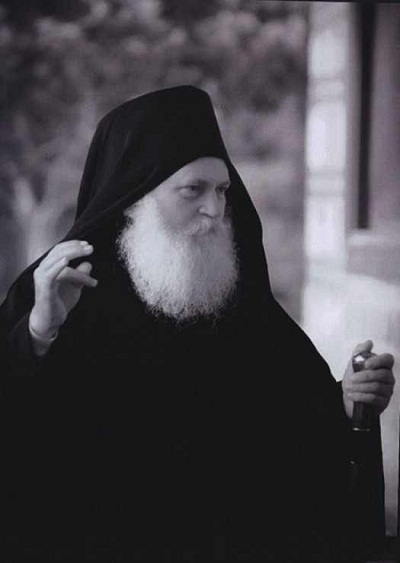
Abbot Ephraim of Vatopedi
The Athonite saint began his life on the Mountain at the monastery of his “repentance,” i.e. where he was tonsured, the Great Monastery of Vatopaidi, being taught the tasks of the spirit and the ascetic life by Saint Nikodimos the Hesychast the Vatopaidan. Illumined by the uncreated energies of the Holy Spirit, Saint Gregory acquired spiritual wisdom and became an outstanding teacher of the virtues and of the life according to God.

Following in the pure Patristic tradition, he did not accept a moralist view of the spiritual life, which some people were attempting to bring from the West and to project onto the sphere of Orthodoxy.

Throughout the whole of the Patristic tradition it is emphasized that repentance is not exhausted by certain objective improvements in behaviour, nor in external formalities and patterns, but rather that it has to do with a more profound and more general change within a person. It is not a passing feeling of being crushed by the awareness of having committed some sin or other, but rather a permanent spiritual state, which means that the person turns steadfastly to God and has an enduring readiness for reform, cure and engagement in the spiritual struggle. Repentance is a new outlook, a new, correct spiritual direction which should accompany people until the time of their death. Repentance is the dynamic progression from the unnatural state of the passions and sin into the area of naturalness and virtue, it is the total rejection of sin and the road of return to God.

Saint Gregory Palamas repeatedly points out this truth. “Repentance,” he says, “is to hate sin and love virtue, to abjure evil and to do good.” It is perfectly clear from this definition that the Holy Father was unable to see repentance as a formal, mechanical change, since he defines it as an ontological renewal of the person. For precisely this reason, the fact of repentance cannot be objectivised within the dimensions of an impersonal recipe or tactic, but is always a contingent personal revelation. “A person who repents from the soul reaches God by good intentions and avoidance of sin” (Homily 3, PG 151, 44B).

For Palamas and all the Holy Fathers in general, this personal nature of repentance precludes any of the shades of piety that the West has wanted to give to repentance, and, in consequence, to the whole of the spiritual life. The holy Hesychast stressed that:  “Godliness is not in our words but in our actions” (To Filotheos 6, Writings II, p. 521).

But since repentance is the beginning and the end of the life in Christ and since it is the aim of that life, it follows that everything will be seen through it and will acquire merit or demerit. Even “faith is beneficial if people lives their lives in good conscience and re-purify themselves through confession and repentance” (Homily 30, PG 151, 185A). This in any case is given as a promise and agreement at the moment of Holy Baptism.

A fundamental stage, which precedes repentance, is the recognition and awareness of sins “which is the great cause for propitiation,” as the Holy Archbishop of Thessaloniki put it (Homily 28, P.G. 151, 361C). According to Palamas, for people to come to repentance it is sufficient that they first arrive at recognition “of their own transgressions” and show remorse before God, to Whom they have recourse “with a contrite heart.” They cast themselves upon the sea of His mercy and believe, like the Prodigal Son, that they are unworthy of God’s clemency and to be called His children. And when with recognition and awareness of their sinfulness they draw upon themselves the mercy of God, they obtain complete release through self-censure and confession.

In his efforts to define all the stages of repentance, the wise Father said this: “Recognition of one’s own sins is followed by self-condemnation; this is the sorrow for one’s sins which Paul declared to be Godly.” He tells us that this sorrow is followed by confession to God with a contrite heart, by supplication and by the promise to avoid evil in future. And this is repentance.

As a new condition in people’s lives, repentance is accompanied by certain consequences which, in Biblical and Patristic language, are called “the fruits of repentance.” The first of this is highlighted by Saint Gregory as being confession, since, through this, the cure and purification of the soul of the believer is gained and the new life inaugurated: “For the confession of sins is the beginning of this cultivation, that is to say, repentance and the preparation for people to receive within themselves the seed of salvation, that is the Word of God” (Homily 56).

Confession is not, however, the only fruit of repentance. In calling people to repentance through his preaching, Saint John the Baptist urged people to embrace charity, justice, humility, love and truth, as well as confession, because these are the attributes of the transforming power of the truth.

In his Homily 23, the saintly Athonite hierarch emphasizes that people who really live their repentance do not return to their former sins, nor attach themselves to people and things of corruption, nor engage in doubtful pleasures, but rather they scorn the present, look to the future, struggle against the passions, pursue the virtues, are vigilant in prayer, do not seek unfair profits, are lenient to those who have done them harm, compassionate towards those who plead, and willing to help, with words, deeds or even sacrifices those who have need. And when Saint Gregory urges Christians to acquire works of repentance, he particularly stresses a humble outlook, compunction and spiritual grief. Summarizing all the attributes of those Christians who live their repentance, he says that they are serene and calm, full of mercy and sympathy towards others, they desire justice, seek purity, have peace and bring it, suffer pain and trouble patiently and feel joy and satisfaction in persecutions, insults and slander, losses and anything else they suffer for the sake of justice and truth (Homily 31, PG, 151, 392C).

The path of correction through repentance, of escape from enslavement to the passions and of asceticism in order to follow the divine commandments, is that of holy beings who have been glorified. Starting with this truth, Saint Gregory emphasizes the following: “If not all Christians can equal the Saints and the great and wonderful achievements which characterize their lives and are, as a whole, inimitable, they can and should emulate and follow them on their path towards repentance.” Because on an everyday basis, “they are unwittingly at fault in many things” and the sole hope of salvation for all of us remains, according to Saint Gregory, the embracing and experiencing of “abiding repentance” (Homily 28, PG, 151, 361C).

Remorse as a condition for asceticism

A fundamental condition for the escape from the bonds of the passions and, at the same time, for the beginning and source of repentance is Godly remorse, what the Fathers call “mourning.” In his texts, Saint Gregory refers very frequently refers to this “mourning” and to the painful but also joyful condition through which Christians have to pass if they want to live the real life. This is why he does not hesitate to call Great Lent the supreme period of mourning and spiritual struggle, as a symbol of the present age and a pre-condition for resurrection for the lives of the faithful.

Saint Gregory, who really did live Godly repentance and who said that his deep sighs “illumined my darkness,” rightly could not see how anyone could pass from the life of sin into “real life” without remorse and repentance. He said that when the faculty of direct perception, the “nous,” is liberated from every perceptible thing, it rises above the maelstrom of earthly things and can see the inner person, since it is able to perceive what he calls the “hateful mask” which the soul has acquired through its vagrancy among worldly things. At this point it hastens to scour the defilement with tears of repentance (Discourse on Peter the Athonite, PG, 150). The more people distance themselves from worldly cares and return to themselves, the more receptive they become as regards divine mercy. Christ commended those who mourn for their sins and for the loss of their salvation, which is caused by sin. This is, in any case, the reason why this remorse is called “blessed.”

While, according to the Patristic and ascetic tradition, mourning is a fruit of God, it still presupposes the co-operation of people themselves, and this requires humility, self-censure, mortification, fasting, vigilance, and, above all, prayer. And this persistence in cultivating the virtues and striving to achieve Godly remorse is reinforced by the experience of hesychasm, which testifies that this “mourning” does not cause debility and hopelessness, but creates in people the conditions to experience spiritual gladdening, comfort, and, according to Palamas “the procurement of sweet joyfulness” (To Xeni, PG, 150). And when it assists the nous to lift the veil of the passions, it softly introduces it into the true treasuries of the soul and habituates it in the prayer “in secret” to the Father.

There are many reasons which should cause the faithful to mourn. Just as the Lord’s disciples were saddened when they were deprived of the “truly good teacher, Christ,” so we, who experience the same deprivation and absence of Christ from our lives, ought to have within us and cultivate this same sorrow (Homily 29, PG, 151). But there is also another reason to mourn: the ejection from the realm of truth in paradise to that of pain and passions. This fall is so painful because it contains the whole drama of the banishment from God, the withdrawal of the “person to person” discourse with Him, of eternal life and co-glorification with the angels. Saint Gregory asks: who has ever completely realized the deprivation of all these things and not mourned? And he urges all the faithful who live “in awareness of this deprivation” to mourn and to wash away with Godly remorse “the stains of sins” (Homily 29, PG 151). This exhortation on the part of the saint is completely in accord with the exhortation and experience of the Church, which, in the hymnography for the Sunday of Cheese-Week calls upon Christians, on the eve of the Great Fast, to remember their banishment from forfeited Paradise and to mourn this loss.

According to Saint Gregory, mourning is the most natural and spontaneous expression of the soul wounded by sin and coming to repentance. The saint uses a wonderful simile to prove that it is people’s wounds that cause the pain, not the fact of repentance itself, which brings only joy and comfort to the soul. Just as, if someone’s tongue has suffered damage, honey might seem tart to them and they need to be cured in order to taste the sweetness, the same is true of the fear of God: in souls where it is engendered, on hearing the message of the Gospels, it causes sorrow, since these souls are still surrounded by the wounds of their sins; but as soon as they cast these off, through repentance, they feel the joy of the good news (Homily 29 PG 151, 396B). This is, in any case, why Godly sadness is also called “joyous.”


St. Gregory Palamas
Investing the Lord’s second beatitude, which refers to mourning, Palamas justifies Christ’s placing of it immediately after the beatitude about spiritual poverty by the fact that mourning co-exists with spiritual poverty.

A typical attribute of those who mourn in a Godly way is the refusal to transfer or pass off the responsibility for their sins onto other people. It is a basic principle which Palamas sets out, in discussing Godly remorse, that we should flay ourselves for our sins and avoid transferring the responsibility for them onto others (Homily 29, PG 151 369C). In any case, it was Adam and Eve’s transfer of the responsibility for ignoring God’s commandment that deprived them of the salvation of penitential mourning (Gen. 3, 12-13). Because, since God gave Adam and Eve self-determination and they received, according to Palamas, “the imperial office over the passions within the realm of their souls” and “there was nothing withheld from or imposed upon them” (Homily 29, PG, 151, 369C), then through self-censure and Godly sorrow they would have been able to regain what they had lost by their refusal to accept responsibility for their sin. This is why Saint Gregory, in an effort to give a definition of mourning says: “for this is Godly sadness for our salvation, to find the reason in ourselves and not in any of the things which other people have done inadequately. And we should be sad ourselves and, through the confession of our sins and sorrowful contrition over them, conciliate God” (Homily 29, PG, 151, 369C).

Self-censure is an integral state for the soul where there is humility. Initially, it leads to fear of Hell. It brings to mind the dreadful punishments, as described by the Lord in the Gospel, which become even more terrifying by the eternal dimension they acquire. So people who mourn their sins here and censure themselves because of them, avoid the useless, comfortless and endless mourning engendered in those who come to recognition of their sins through punishment. There, with no hope of redemption or salvation, the pain of mourning is increased by the unwanted reprimands of the conscience. And this permanent and abiding mourning, since it has no end, causes more mourning and dreadful darkness and searing heat, with no respite, and this leads to the inexpressible depth of dejection (To Xeni, PG, 150, 1076D-1077A). In contrast to Adam and Eve, Palamas refers to Lamech as an example of someone who came to self-censure and contrition for his sins (Homily 29, PG151, 369D).

It should be especially emphasized that, within Orthodox Christian tradition, asceticism is completely interwoven with grief. The pain of the fall and the joy of the resurrection are experienced by monks with joyful mourning. With bodily poverty and humility, which is hunger, thirst, hardship and affliction of the body, means by which the sensations of the body are brought under rational control, not only is mourning engendered, but also tears begin to flow. Saint Gregory gives a clear explanation for this spiritual state in his letter to the nun Xeni. He says that, just as bodily ease, relaxation and pleasure cause callousness, insensitivity and a hard heart, so plain, meagre fare, eaten with restraint, brings a broken and contrite heart. Through these, the activities of evil are thwarted, and inexpressible and sweetest joy are given to the soul. Without a contrite heart, no one can be liberated from the passions. And the heart comes to contrition only through restraint as regards sleep, food and bodily comforts. When the soul is liberated from the passions and the bitterness of sin through contrition, it then receives spiritual delight (To Xeni PG 150, 1076 BC). This is the comfort which the Lord says will be the portion of those who mourn. Only in this way can we explain how the alteration of sorrow into joy, about which the Lord spoke to His disciples, becomes an experience with which the monk is acquainted on a daily basis. Mourning becomes joyful and blessed because it brings to fruition in people the pledge of eternal joy.

Self-censure and the sense of sinfulness are the conditions which prepare the soul for mourning. For a long time, says Saint Gregory, like an intelligible weight on the scrutinizing part of the soul, they press down and crush in such a way that the saving wine “that gladdens people’s hearts” is distilled. This wine is contrition, which, thanks to mourning and the active part of the soul, also crushes the passionate aspect. And once it liberates it from the dark weight of the passions, it fills the soul with blessed joy (To Xeni PG 150, 1077 B).

However painful this mourning may be in the initial stages, because it exists alongside the fear of God, so much greater, with the passage of time and as the soul prospers spiritually, does it become joyful, because people really do see blessed, sweet fruits. The longer mourning lingers in the soul, the more the love of God increases and, in a manner beyond conceiving, is united to it. When the soul experiences mourning profoundly, it tastes the consolation of the benevolence of the Comforter. For the soul, this is such a sacred, sweet and mystical experience that those who have no personal taste of it cannot even suspect its existence (To Xeni PG 150, 1077 B).

A fundamental view in the theology of mourning is that it is not only the soul that participates but also the body. And the “consolation” which the Lord said would be a blessing for those who mourn is a fruit which not only the soul but, as Saint Gregory says, “the body also receives in a variety of ways” (On the Hesychasts 1, 3, 33). The clearest proof of this reality, he says, is “the sad tears with which they mourn their sins” (Ibid).

Another fruit of Godly remorse is that people become steadfast in virtue, since, as the Apostle Paul says: “Godly sorrow brings repentance that leads to salvation and leaves no regret” (II Cor. 7, 10). Because, according to Palamas, people can become poor in a Godly manner and be humbled, but unless they also acquire remorse, their disposition alters easily – they may well return to the inappropriate and sinful actions they have abandoned and, once more, transgress against God’s commandments, given that a desire and appetite for a sinful life will again arise within them. But if they remain in the poverty that the Lord declared blessed, and cultivate spiritual mourning within themselves, then they become steadfast and secure in the spiritual life, thus expelling the danger of returning to the point where they began. (To Xeni PG 150, 1085C).

So this Godly mourning does not merely draw down consolation and God’s forgiveness, offering the pledge of eternal rejoicing, but, at the same time, guards the virtues the soul has, since, according to Saint Gregory, the soul that has learned to mourn is much less likely to be moved to evil (To Xeni PG 150, 1085D).

Finally, the Athonite hesychast and Archbishop of Thessaloniki, in his essay on the passions and the virtues, which, to a great extent, is dedicated to mourning, uses a most expressive example to demonstrate the path people follow towards remorse. He compares the beginning of mourning with the return of the Prodigal Son, which is why the remorseful person is cheerless and is brought to repeating the words: “Father, I have sinned against heaven and in your sight.” And then again, he pictures its end with the imperative and wide-open embrace of God the Father “in which by the richness of the incomparable poverty he had suffered, and having acquired great joy and frankness through it, kissed and was kissed and, on entering, sat down to eat with the Father, both enjoying heavenly bliss” (To Xeni PG 150, 1085C). This is why the term “bright sorrow,” which is commonly used by ascetics to describe the experience of eschatological transcendence of pain, is perhaps the most expressive symbol of the whole of their ascetic life, a life mostly of tears and mourning (See G. Mandzaridis, “I peri theoseos didaskalia” in Palamika 1973, p. 215).

In this brief and, one might say, rough presentation of the positions of Palamas on repentance, we see that Saint Gregory, as the outstanding person of the inner life, was interested not only in us correcting our external shortcomings, but in our inner repentance, with mourning and tears. Saint Gregory was himself a man of repentance and also a true preacher of it.


Now that the period of Great Lent is approaching we humbly pray that, in what is, according to Saint Gregory, the principal period of repentance, we may “fall down and weep before our God” so that we may taste the blessedness of His kingdom. Let us not forget that correction of ourselves, and, indeed, of society as a whole, begins and is founded upon the personal repentance of each of us. In any case, “enduring repentance” is, as Saint Gregory emphasizes, the spirit of Athonite monasticism. Amen.

ALSO CLICK ON
by Metropolitan Hilarion Alfeyev

Saturday, 21 June 2014

CORPUS CHRISTI


INTRODUCTION:

The Word did not become words: he became flesh; and thus he was available to ALL the senses for those whom he met. The revelation of Christ has all the dimensions of the world around us.  Of course, it took the gift of faith, given by the Holy Spirit, for Simeon to "see" God`s salvation in the little baby he held in his arms, or for St John to be able to say with certainty, "It is the Lord," as looked at Christ from the boat.   Nevertheless, they were expressing more than an opinion when they said what they believed: they were seeing beyond the evidence of their eyes to the reality behind the evidence; and this ability to see beyond was an immediate contact with that reality, brought about by the Holy Spirit.    It is the same today; which is why the  the Scriptures alone are an insufficient vehicle for Christian revelation: they need to become flesh, to take on the dimensions of the world around them, to appeal to all the senses. 

 As with the Incarnation, this process of turning the words that reveal the Word into flesh is the work of the Holy Spirit; and his tools are Word and Sacrament.  In doing so, he turns people into Church, transforming them from within so that they become Body of Christ together.


The Gospel message is transformed into liturgy which, in the words of Pius XI, is "the chief organ of the ordinary magisterium of the Church," and is understood to the degree that it is lived and celebrated. This understanding by members of the Church who live it and celebrate it, in so far as it is guided by the Holy Spirit, is one with the understanding of   those who first listened to Christ and with his disciples down the ages and and one with all across the world who are moved by the same Spirit. 

The name for this is Tradition: not the passing down of dead credal formulas, but the sharing across time and space of an understanding always enlightened by the Holy Spirit who is particularly active in the Liturgy.   It is  in keeping with new paradigms, new insights,  ideas and devotions, as long as they are all coherent with one another,  reflecting the unity that is a characteristic of all that eminates from the same Holy Spirit. 


   Only then does Scripture reach its full potential as Christian revelation. Only then does it achieve its purpose, when it is understood and lived by the Church.  Revelation takes concrete form in the Church and, in this form appeals to all the senses.   Hence, the First Letter of St John could say, long after Christ had ascended into heaven:
We declare to you what was from the beginning, what we have heard, what we have seen with our eyes, what we have looked at and touched with our hands, concerning the word of life - this life was revealed, and we have seen it and testify to it, and declare to you the eternal life that was with the Father and was revealed to us - we declare to you what we have seen and heard so that you also may have fellowship with us.  

That is why the New Evangelisation is as much about seeing as hearing.   The world will not just hear that God is love: it will see that love at work in the love of the Christian community; it may be challenged by this love through the actions of a St Maximilian Kolbe; it may be touched by this love in the caresses of a Mother Teresa of Calcutta;  it may even taste this love in food banks through the generosity of ordinary Christians.   The revelation is reflected in the lives of a multitude of Christians with different but coherent vocations, like light reflected from the many facets of a diamond and receiving the source of their unity in the liturgy.

 However, and  above all, this happens when the Church is really united in love, in a love that transcends all human divisions because its source is from within the life of the Holy Trinity, then the Gospel will be proclaimed by our lives, and the world will understand enough to be challenged by the revelation contained in Scripture.  

The people who wander confused without a shepherd will see that there is a valid alternative to a secularism that leaves the world devoid of meaning and to Islam which appears to many as an alternative for ex-Christians who have lost their way..   

Hence the first step in any New Evangelisation is to be evangelised ourselves, so that we freely love one another.   Jesus says in his priestly prayer to the Father: 
I ask not only on behalf of these, but also on behalf  of those who will believe in me through their word, that they may all be one.    As you, Father, are in me and I am in you, may they also be in us, so that the world may believe that you have sent me.   The glory that you have given me I have given them, so that they may be one as we are one, I in them and you in me, that they may become completely one, so that the world may know that you have sent me and have loved them even as you have loved me.
THE EUCHARIST:

In between our becoming Christians and being maturely Christian enough to bear testimony to the world as members of Christ's body, there are the sacraments and, above all else, the Eucharist.   As St Paul says, "Because there is one bread, we who are many are one body, for we all partake of the one bread" (1 Cor. 10: 17)    

In every Mass, the unity of the Church across time and space and between heaven and earth is made manifest in the community celebrating: they are like the visible top of an iceberg because, in being united to Christ, they are united by the Holy Spirit to all who are united to Christ, both human beings and angels, and with them they are brought up into the presence of God the Father (Hebrews 12). 

To understand this we must concentrate our attention on the death, resurrection and ascension of Jesus Christ.   His death was an historic event which took place two thousand years ago.   However, he was connected in the Incarnation by the Holy Spirit both to his Father and to the whole human race across time and space, and, indeed to the whole cosmos.   By his death, resurrection and ascension, his death, a temporal event, was brought into eternity.   It was not only a temporal event: it was a personal event that lived on in the resurrection.   Thus the lamb in the Apocalypse as though slain but standing (Revelation 5: 6).  The death, resurrection and ascension of Christ have become, through the activity of the Holy Spirit, a kind of black hole through which the human race must pass from time to eternity: we must die with Christ and rise with him and ascend with him; and, on the Last Day, the whole cosmos will be so transformed, heaven and earth will become a single whole.  The process of approaching the Father is called by St Paul dying and rising with Christ.   In the Eucharist, the Church already anticipates, celebrates and shares in this event of time entering eternity through Christ`s sacrifice, and in the unity between heaven and earth.  In the Holy Sacrifice of the altar, we offer Christ's death as our sacrifice so that we may share in his resurrection-ascension.

However, there is another aspect of the Eucharist  that is absolutely invaluable both in our personal lives and as an evangelisation tool.   The Spanish discovered this in the conversion of Latin America.   On a certain date very close to Corpus Christi, the Inca king publicly manifested his presence to his people in Cusco.   After the Conquista, this procession was replaced by the Corpus Christi procession, and it was a major element in the conversion of the Peruvian native population.

I have come across many people who became convinced of the presence of Christ in the tabernacle.   One was my own father who was a practising Anglican.   He fell in love with my mother, and she took him into a Catholic church for the first time.  He was totally surprised by the sense of Christ's presence, a sense he never lost when entering a Catholic Church.  

 A young officer who survived the First World War, having experienced the horror of the worst battles, was wounded and invalided back to England.   He belonged to the Southern Irish Protestant aristocracy; and, although their servants were Catholic, he knew absolutely nothing about their religion.  Having come out of hospital, still in uniform, he was walking aimlessly down an English street when he came across a Catholic church.  He had never been in one.   Out of sudden curiosity, he entered and was immediately bowled over with a sense of Christ's presence; something he had never experienced before.   There was a priest kneeling and praying in the church, so he went over and asked him how he could explain it.   The priest pointed to the tabernacle and told him what it contained.   The officer became a Catholic, a monk, and a priest.

I know other examples.   I remember Archbishop Anthony Bloom, a well known Orthodox metropolitan, who spoke of his conversion after experiencing the presence of Christ while reading the Gospel of St Mark from cover to cover.   He later became a scientist, but could never even doubt the authenticity of this experience.   I have met many converts to Catholicism whose experience of Christ was every bit as convincing, an experience they connected with the Blessed Sacrament.

There are Orthodox who deny any Catholic practice that is not found in Orthodoxy.  I believe that this is because they are on the defensive: they feel threatened by the Catholic presence.   However, there have been happier times when, in places like Cyprus where Orthodox and Catholics rubbed shoulders, Orthodox priests joined Catholic processions of Corpus Christi with lighted candles.


THE THEOLOGICAL JUSTIFICATION FOR ADORATION OF THE BLESSED SACRAMENT

     It was given by the Holy Spirit to the Catholic West, not because of its strength, but because of its weaknesses.   It is proof that the Church is Catholic, not because of our merits, but because of God`s merciful love.   It would probably never have come to light if the tradition of receiving communion at Mass had been faithfully observed or if the Church in the West had faithfully and enthusiastically accepted the whole doctrine of the Seventh Ecumenical Council, the Council of Nicaea on icons.   Both the falling away of frequent communion - only rectified by Pope Pius X - and the lack of enthusiasm for icons, due to anti-Greek feeling and suspicion, left a vacuum in Catholic devotion which was filled by Adoration of the Blessed Sacrament.

20th century liturgists, even revered ones like Jungmann, could not see how the liturgical piety that they were advocating could have any room for "individualistic" devotion to the Blessed Sacrament.   They could not have been more wrong. Hardly anybody is in favour of the "old" Mass, now called the extraordinary rite, in Lima where I live; but the number of chapels is growing  dedicated to Exposition of the Blessed Sacrament all day and every day, and some even have twenty four hour adoration organised by the parishioners  The most successful new religious families are also advocates of Eucharistic devotion, even if they are formed in the "new" post-Vatican II liturgy. & This needs an explanation.

   Where did Jungmann &Co. go wrong?   I am talking about my own heroes whose understanding of theology and liturgy I greatly admire and accept.  However, I must admit they had a blind spot.   I think they were victims of their own skills.   It was enough for them to show that adoration of the Blessed Sacrament was a substitute for receiving communion for them to believe that the practice would wither away once holy communion was given its rightful place. They over-estimated the study of texts to reveal the fulness of Catholicism and under-estimated the activity of the Holy Spirit which cannot be a direct object of scholarly enquiry.

Let us start by quoting from the epiclesis of the Liturgy of St Basil.


That thy Holy Spirit may come upon us and upon these gifts here set forth, and bless them and hallow them and show this bread to be itself the precious Body of our Lord, God and Savior Jesus Christ, and this cup to be itself the precious Blood of Lord, God and Savior Jesus Christ… 

I choose this text because it is Eastern Orthodox, but also a Catholic liturgy which is, according to Pius XIth, "the chief organ of the ordinary magisterium of the Church": it is an expression of the universal Catholic/Orthodox Tradition.  It is as succinct and as accurate as any doctrinal definition, and comes directly from the Church of the Fathers.


This epiclesis is a part of a prayer expressing the humble obedience of the Church, obeying in faith the command of Christ at the Last Supper.   Christ, in making intercession to the Father, makes this prayer his own.


He and the Church ask for the Holy Spirit to come down on us and on the gifts in order the show the bread to be the body of Christ and the cup to be the precious blood of Christ.   In the Liturgy of St Basil, the consecration is a theophany.

For Symeon to have seen the salvation of Israel in a little baby, he needed an insight which goes beyond what he saw with his eyes, an ability to "see" that comes from the Holy Spirit.  For Peter, James and John to see Christ transfigured in light on Mount Tabor, they needed to have their eyes opened by the Holy Spirit to see the effect of the divine Presence which, in fact, was always there, but was invisible to eyes unaided.

For the consecration to be a theophany, the Holy Spirit needs to change the bread and wine into Christ's body and blood; but he also needs to allow us to see the bread and wine, so consecrated, with the eyes of faith, and to recognise them to be vehicles of Christ's divine /human presence.   That is exactly what the epiclesis prays for.

Hence,:  just as the continual presence of Christ as body and blood is the direct result of the continual activity of the Holy Spirit,  every time we recognise the consecrated elements to be the body and blood of Christ, the Holy Spirit is at work. It is a pentecostal moment to simply adore Christ in the host!  All types of Eucharistic devotion outside the Mass are nothing else than the extension of that moment between consecration and communion to different times and places, so that we may grow to appreciate all that we receive at Mass.   We have also discovered it to be a wonderful way to project Christ's presence among people who do not know him.   The Mass, besides being Sacrifice and Communion, is also  Theophany; and we have been taught by the Holy Spirit to extend that aspect of the Eucharist to all kinds of situations, wherever the Spirit may lead.


THE BLESSED SACRAMENT AS AN EVANGELISTIC TOOL.

,


New monastic communities and ecclesial movements are prominent in their devotion to the Blessed Sacrament, especially those who also use icons: they show how compatible they are because both the Eucharistic monstrance and the icon make grace VISIBLE without threatening anyone, or requiring a certain status or the observance of any rules or conditions: it does not even require even that the person is a Christian.   That is why the Blessed Sacrament is such a wonderful evangelistic tool.   Watch this video:


De Lubac explained the loss of faith in the city on there being no opportunity in the lives of a great number of city dwellers to encounter the sacred.   It was for this that the ressourcement theologians wanted liturgical reform, but were terribly disappointed when togetherness took the place of a sense of the holy in the way so many celebrated Mass.  They saw the drop-out from the practice of the faith to be a direct result of this.  The New Evangelisation aims to give people just this sense of the holy; and, in this video you see it being done.

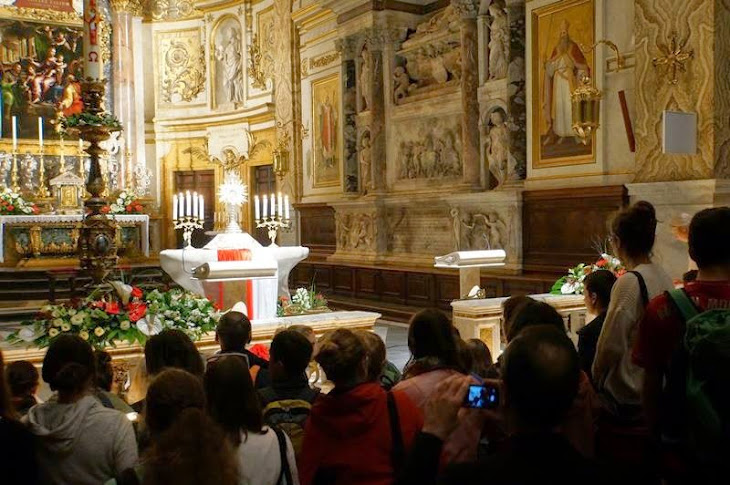
Another example is "Nightfever".


Idea

The idea behind Nightfever is simple and brilliant at the same time: we want to open the church during the night and invite everyone to a moment of tranquility to find their inner peace.

First church, then dance club? Or rather the other way around?

Nightfever particularly invites Teenagers and Young Adults to encounter with God. Young people nowadays usually don’t relate to the Christian faith and even less with the Catholic Church. Therefore we would like to try out a new way of approach to hand out invitations to them in the pedestrian zone.

Whoever goes out on a Friday or Saturday night usually have other destinations like pubs, dance clubs or cinemas on their mind. For this reason we want to address these people to pause for a moment, to put aside their initial plan and to come into the church. We offer the guests a candle and invite them to light it up in the church.    

Feel free to come and leave as you want!

Whoever enters the church is usually surprised by the nice atmosphere, since the church is illuminated almost exclusively by candles, and there is quiet Live Music that goes on throughout the night. Inside the church you are welcome to light up a candle, to receive a paper with a quote from the bible or simply just take a seat and write down a prayer intention or to speak with a priest.

It is entirely up to you what you feel you are comfortable with. You can either take a long walk through the church or simply just stay at one spot where you want to be. You are also free to stay as long as you want: for a few minutes, half an hour or even the whole evening.      

How did we come up with the idea of Nightfever?


The idea of the Nightfever evenings was born right after the World Youth day 2005 that took place in Cologne, Germany. In the beginning, there were only two students from Bonn who initially planned a one off evening on the 29th of October 2005. However it has become an international initiative today.

Nightfever includes many different elements. Those elements can help you to grow closer to God and to reach a good level and basis for communicating with Him.

Prayer

Prayer is the center of Nightfever. We come together in front of the altar in order to adore Jesus in the form of the bread. Adoration means talking to and with Jesus, to enter into a relationship with Him.
We do not have to pretend and disguise ourselves for Jesus, we do not need a special technique in order to pray properly and we certainly do not need to be accomplished individuals.

We may talk to Jesus just as we are, about everything that makes us happy or depresses us. Even if our thoughts are chaotic and unstructured, this time of silence can help us to gain a clear and peaceful mind again.

Enkindling candles

We invite passerby, young and old, to come into the church for a few minutes, to light a candle and to put it in front of the altar, in front of the Blessed Sacrament. Even when these people leave, their candles burn on as a symbol of their concerns and thoughts.


Within the dark church those candles bring light and spread/shine forth hope and faith in God. They also create the special atmosphere of Nightfever.

Biblical sayings


On the steps in front of the altar you can find baskets with biblical sayings. You are invited to take one for yourself. Often the drawn saying fits perfectly to our life, almost like it was meant especially for us. They can give us impulses for our prayer, for our conversation with God.

Conversation and reconciliation

Many things concern and occupy us in our lives. Oftentimes a conversation can help us to find an orientation again. During the Nightfever-evenings, priests sit at the sides of the church. They are there for these conversations. They listen, give advice and are absolutely closemouthed and discreet.


You also have the possibility of receiving the sacrament of penance (confession) and thus to experience the liberation from many burdens. In the sacrament of penance, Jesus gives us his love and mercy. The liberation from the burden of sin enables us to happily start anew and to continue on our path to God.

Blessings


The priest can also give you a blessing. For these blessings the priest puts his hands on the head of the faithful/visitor. This action can be an amazing opportunity to feel God's presence. In the blessing we can experience God as the one who is present in the lives of us humans. God himself is the originator and guarantor of this blessing

Prayer Request

Besides praying for oneself, there also is the possibility of letting someone pray for you and for certain concerns and requests. These requests one can write on a piece of paper and put it into a red box which is also placed near the Blessed Sacrament. Nuns of a monastery are then going to pray for your concerns.


Workshops and talks

Sometimes Nightfever also offers workshops or talks about some interesting topics on faith in everyday life. These talks are offered because even though Christian mysteries of the faith cannot be proven, faith needs to answer to our reason, needs to live up to our reason.

In those talks we think about how our faith and the teachings of the Church can be lived and practiced in our everyday life.


HERE IS ONE VERY GOOD WAY TO CELEBRATE THE CORPUS CHRISTI MASS

Search This Blog

La Virgen de Guadalupe

La Virgen de Guadalupe

Followers

My Blog List

Fr David Bird

Fr David Bird
Me on a good day

Blog Archive