EXPAND YOUR READING!!

"Today the concept of truth is viewed with suspicion, because truth is identified with violence. Over history there have, unfortunately, been episodes when people sought to defend the truth with violence. But they are two contrasting realities. Truth cannot be imposed with means other than itself! Truth can only come with its own light. Yet, we need truth. ... Without truth we are blind in the world, we have no path to follow. The great gift of Christ was that He enabled us to see the face of God".Pope Benedict xvi, February 24th, 2012

The Church is ecumenical, catholic, God-human, ageless, and it is therefore a blasphemy—an unpardonable blasphemy against Christ and against the Holy Ghost—to turn the Church into a national institution, to narrow her down to petty, transient, time-bound aspirations and ways of doing things. Her purpose is beyond nationality, ecumenical, all-embracing: to unite all men in Christ, all without exception to nation or race or social strata. - St Justin Popovitch

Friday, 3 May 2013

ORTHODOX EASTER SUNDAY by Metropolitan Anthony of Sourozh, Father Alexander Men & Protopriest Alexander Schmemann


Christ is risen!
by Metropolitan Anthony Bloom
of Sourozh

When Christ first rose from the tomb and appeared to His disciples and the myrrh-bearing women, He greeted them with the word "Rejoice!". And then later when He appeared to the Apostles His first words were "Peace be unto you!"; peace, because their confusion was very great - the Lord had died. It seemed as though all hope had perished for the victory of God over human wickedness, for the victory of good over evil. It would seem that life itself had been slain and light had faded. All that remained for the disciples who had believed in Christ, in life, in love, was to go on existing, for they could no longer live. Having tasted eternal life they were now condemned to expect cruel persecution and death at the hands of Christ's enemies. "Peace be unto you", proclaimed Christ. "I have arisen, I am alive, I am with you, and henceforth nothing - neither death nor persecution - will ever separate us or deprive you of eternal life, the victory of God". And then, having convinced them of His physical resurrection, having restored their peace and an unshakable certainty of faith, Christ uttered words which may in the present age sound menacing and frightening to many, "As the Father sent Me, so I send you". Only a few hours after Christ's death on the cross, not long after the fearful night in Gethsemane, the betrayal by Judas when Christ had been taken by His enemies, condemned to death, led out beyond the city walls and died on the cross, these words sounded menacing. And it was only faith, the conquering certainty that Christ had risen, that God had conquered, that the Church had become an invincible force that transformed these words into words of hope and triumphant God-speed.

And the disciples went out to preach; nothing could stop them. Twelve men confronted the Roman empire. Twelve defenceless men, twelve men without legal rights were out to preach the simplest message, that divine love had entered the world and that they were willing to give their lives for the sake of this love, in order that others might believe and come to life, and that a new life might begin for others through their death. [I Cor. IV :9-13]

Death was indeed granted them; there is not a single apostle except St. John the Divine who did not die a martyr's death. Death was granted them, and persecution and suffering and a cross (II Cor. VI: 3-14).

But faith, faith in Christ, in God Incarnate, faith in Christ crucified and risen, faith in Christ who brought unquenchable love into the world, has triumphed. "Our faith which has conquered the world is the victory."
This preaching changed the attitude of man to man; every person became precious in the eyes of another. The destiny of the world was widened and deepened; it burst the bounds of earth and united earth to heaven. And now we Christians, in the words of a western preacher, in the person of Jesus Christ, have become the people to whom God has committed the care of other people; that they should believe in themselves because God believes in us; that they should hope for all things because God puts His hope in us; that they should be able to carry our victorious faith through the furnace of horror, trials, hatred and persecution - that faith which has already conquered the world, in the faith in Christ, God crucified and risen.

So let us also stand up for this faith. Let us proclaim it fearlessly, let us teach it to our children, let us bring them to the sacraments of the Church which, even before they can understand it, unite them with God and plant eternal life in them.

All of us, sooner or later, will stand before the judgment of God and will have to answer whether we were able to love the whole world - believers and unbelievers, the good and the bad - with the sacrificial, crucified, all-conquering love with which God loves us. May the Lord give us invincible courage, triumphant faith, joyful love in order that the kingdom for which God became man should be established, that we should truly become godly, that our earth should indeed become heaven where love, triumphant love lives and reigns. Christ is risen!


modified on 28 December 2007 at 14:00 ••• 2,431 views
Victory over Death

This and Concerning Eternal Life are sermons given by Fr Alexander Men. Victory over Death is an Easter sermon, simple but with some touches of interest, from a defunct website of Roman Pomarenko.
With the setting of the sun on April 8th the Sabbath rest had come to an end but the women still had to buy the aromatic powders and ointments which were used to embalm. Thus visitation of the tomb was postponed to the morning of the following day. Of the guards they knew nothing; they were only bothered by the thought: Who will help us roll away the heavy stone?
Mary Magdalene came earlier than her friends. In the twilight of the dawn, coming up to the cave, she stopped in confusion: the stone had been rolled away.
What did this mean? Were not the enemies of the Teacher satisfied even after His death?
Meanwhile Salome and Mary, the mother of James arrived and, looking into the cave, were convinced that it is empty. In tears Mary Magdalene ran to Peter and John and told them the horrible news: “They have taken the Lord from the tomb and we do not know where they have put Him.” Both disciples hurriedly left the house where they were hiding and ran after Mary to Joseph's garden.
At first they ran together, but late Simon fell behind and John reached the cave first. Seeing that Mary was right he got caught up in speculation: Who would violate the law and embitter a place of eternal rest? The youth leaned towards the opening but strongly hesitated to enter.
When Peter arrived at the enclosure he was virtually out of breath but he was not the sort of person to think things out at length. Not stopping, he immediately entered the dark cavern. That emboldened John and he followed Simon. Next to the stone mat they saw the shroud and a cover for the face. The one who had been buried had disappeared.
The disciples were afraid to ask questions, protest or seek the body. They returned to the city filled with sorrowful doubt. Clearly, their enemies had decided to make fun of them as long as possible.
Mary Magdalene remained at the tomb alone. Immersed in her owe, she did not notice that the rest of the women had gone somewhere. Literally not believing the misfortune, Mary again drew near to the opening of the cave and unexpectedly saw there two unknown persons in white robes.
“Woman, why do you weep?” they asked.
“Because you have taken my Lord and I do not know where you have laid Him.”
A hope awoke in her: maybe these people will explain to me what happened? But at the same moment Mary Magdalene felt the presence of someone standing behind her and she turned around to see who it was.
“Woman, why do you weep? Whom do you seek?” asked the stranger.
Thinking only about her concern, Mary decided that standing in front of her was a gardener who would definitely know where the body was.
“Sir”, she said pleading, “if you have taken Him away, tell me where you have placed Him and I will take Him.”
“Mariam!” shouted out a painfully familiar voice. Everything inside her went topsy-turvy. There was no doubt. It is He…
“Rabuni!” cried Mary Magdalene and fell at His feet.
“Do not touch me”, Jesus warned her, “for I have not yet gone to my Father; but go to my brethren and tell them: ‘I go up to my Father and your Father, to My God and your God.’”
Driven crazy with joy, barely understanding what had happened, Mary ran out of the garden. The herald of the rare, unheard of news ran into the house, where mourning reigned, but not one of her friends took her amazing words seriously. All decided that the poor woman had gone out of her mind. They thought the same thing when, after her, there appeared Joanna the wife of Chuza, Mary the mother of James, and Salome. They, speaking all at once, began to give testimony that the Teacher is alive, that they had seen Him with their own eyes. They told of how when they had gone down into the cave, as Mary Magdalene was leaving to call the disciples, and found there the youth in a white robe.
“Do not be frightened!” he said. “You are seeking Jesus of Nazareth, the Crucified One. He is risen, He is not here. There is the place, where He was laid. But go and tell His disciples and Peter, that He will precede you to Galilee. There you will see Him, as He said to you.”
The women admitted that at first it was horrible for them to speak of this vision, but that later Jesus Himself appeared to them on the road and repeated the order for all of them to go to Galilee.
The apostles just looked at each other, listening to this account. Luke notes that to the apostles “this story of the women seemed pure nonsense, and they did not believe them.” After the recent disaster, the disciples were far from hoping for a miracle and least of all did they expect that soon God would transform them from people who had been shaken and nearly destroyed by catastrophe into the proclaimers of a new faith.
The annals of history contain much what is incomprehensible, but one can safely say, that the least probable historical event is the life of Jesus of Nazareth and the mystery which crowned His life. It is correct to say that this mystery goes beyond the bounds of what is accessible to human reason. Even so there are observable facts, found in the field of vision of a historian. At the same time as the Church which had barely been born seemed to have perished forever, when the project put forth by Jesus lay in ruins and His disciples had lost all faith—everything suddenly changes radically. Exultant joy replaced disappointment and despair; those who had only recently abandoned the Teacher and denied Him, boldly proclaim the victory of the Son of God. Something happened, without which there would be no Christianity.
That “something” was the revelation of the Son of God in glory, which Jesus Himself had foretold to Caiphas at His trial. The high priest perceived blasphemy in His words, and the tragic end of the Nazarene was to confirm the opinion of the Sanhedrin. To the Apostles the paschal appearances showed the truthfulness of prophecy. Jesus revealed Himself now not only as the Christ and the Teacher, but as the Lord, the Lord who is the incarnate Living God.
Neither Pilate nor the members of the tribunal saw the Risen One. If it had been the irrefutable and obvious nature of a miracle which would have forced them to confess Him, that would have been an injustice to the spirit which is free to oppose God. Only those who loved Christ, who were chosen by Him for service, could “see His Glory, the Glory that is His as the only Son of the Father, full of grace and truth.”
For the apostles the Resurrection was not only the joy of again finding the Teacher; it meant victory over the powers of darkness, it became the guarantee of the final triumph of God's Truth, sign of the invincibility of the Good personified in Jesus of Nazareth.
“If Christ is not risen,” says the Apostle Paul, “vain is our preaching and vain is our faith.”
This is the thought by which Christianity will live, for on the day of Pascha the Church does not merely confess faith in the immortality of the soul, but the overcoming of death, darkness and disintegration.
“Christ is Risen, and Hades is overthrown! Christ is Risen and the demons have fallen! Christ is Risen and the Angels rejoice! Christ is Risen and Life reigns!”


Victory over Death
by Father Alexander Men
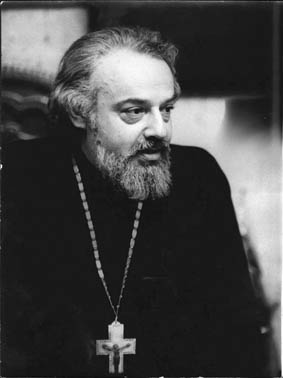
This and Concerning Eternal Life are sermons given by Fr Alexander Men. Victory over Death is an Easter sermon, simple but with some touches of interest, from a defunct website of Roman Pomarenko.
With the setting of the sun on April 8th the Sabbath rest had come to an end but the women still had to buy the aromatic powders and ointments which were used to embalm. Thus visitation of the tomb was postponed to the morning of the following day. Of the guards they knew nothing; they were only bothered by the thought: Who will help us roll away the heavy stone?
Mary Magdalene came earlier than her friends. In the twilight of the dawn, coming up to the cave, she stopped in confusion: the stone had been rolled away.
What did this mean? Were not the enemies of the Teacher satisfied even after His death?
Meanwhile Salome and Mary, the mother of James arrived and, looking into the cave, were convinced that it is empty. In tears Mary Magdalene ran to Peter and John and told them the horrible news: “They have taken the Lord from the tomb and we do not know where they have put Him.” Both disciples hurriedly left the house where they were hiding and ran after Mary to Joseph's garden.
At first they ran together, but late Simon fell behind and John reached the cave first. Seeing that Mary was right he got caught up in speculation: Who would violate the law and embitter a place of eternal rest? The youth leaned towards the opening but strongly hesitated to enter.
When Peter arrived at the enclosure he was virtually out of breath but he was not the sort of person to think things out at length. Not stopping, he immediately entered the dark cavern. That emboldened John and he followed Simon. Next to the stone mat they saw the shroud and a cover for the face. The one who had been buried had disappeared.
The disciples were afraid to ask questions, protest or seek the body. They returned to the city filled with sorrowful doubt. Clearly, their enemies had decided to make fun of them as long as possible.
Mary Magdalene remained at the tomb alone. Immersed in her owe, she did not notice that the rest of the women had gone somewhere. Literally not believing the misfortune, Mary again drew near to the opening of the cave and unexpectedly saw there two unknown persons in white robes.
“Woman, why do you weep?” they asked.
“Because you have taken my Lord and I do not know where you have laid Him.”
A hope awoke in her: maybe these people will explain to me what happened? But at the same moment Mary Magdalene felt the presence of someone standing behind her and she turned around to see who it was.
“Woman, why do you weep? Whom do you seek?” asked the stranger.
Thinking only about her concern, Mary decided that standing in front of her was a gardener who would definitely know where the body was.
“Sir”, she said pleading, “if you have taken Him away, tell me where you have placed Him and I will take Him.”
“Mariam!” shouted out a painfully familiar voice. Everything inside her went topsy-turvy. There was no doubt. It is He…
“Rabuni!” cried Mary Magdalene and fell at His feet.
“Do not touch me”, Jesus warned her, “for I have not yet gone to my Father; but go to my brethren and tell them: ‘I go up to my Father and your Father, to My God and your God.’”
Driven crazy with joy, barely understanding what had happened, Mary ran out of the garden. The herald of the rare, unheard of news ran into the house, where mourning reigned, but not one of her friends took her amazing words seriously. All decided that the poor woman had gone out of her mind. They thought the same thing when, after her, there appeared Joanna the wife of Chuza, Mary the mother of James, and Salome. They, speaking all at once, began to give testimony that the Teacher is alive, that they had seen Him with their own eyes. They told of how when they had gone down into the cave, as Mary Magdalene was leaving to call the disciples, and found there the youth in a white robe.
“Do not be frightened!” he said. “You are seeking Jesus of Nazareth, the Crucified One. He is risen, He is not here. There is the place, where He was laid. But go and tell His disciples and Peter, that He will precede you to Galilee. There you will see Him, as He said to you.”
The women admitted that at first it was horrible for them to speak of this vision, but that later Jesus Himself appeared to them on the road and repeated the order for all of them to go to Galilee.
The apostles just looked at each other, listening to this account. Luke notes that to the apostles “this story of the women seemed pure nonsense, and they did not believe them.” After the recent disaster, the disciples were far from hoping for a miracle and least of all did they expect that soon God would transform them from people who had been shaken and nearly destroyed by catastrophe into the proclaimers of a new faith.
The annals of history contain much what is incomprehensible, but one can safely say, that the least probable historical event is the life of Jesus of Nazareth and the mystery which crowned His life. It is correct to say that this mystery goes beyond the bounds of what is accessible to human reason. Even so there are observable facts, found in the field of vision of a historian. At the same time as the Church which had barely been born seemed to have perished forever, when the project put forth by Jesus lay in ruins and His disciples had lost all faith—everything suddenly changes radically. Exultant joy replaced disappointment and despair; those who had only recently abandoned the Teacher and denied Him, boldly proclaim the victory of the Son of God. Something happened, without which there would be no Christianity.
That “something” was the revelation of the Son of God in glory, which Jesus Himself had foretold to Caiphas at His trial. The high priest perceived blasphemy in His words, and the tragic end of the Nazarene was to confirm the opinion of the Sanhedrin. To the Apostles the paschal appearances showed the truthfulness of prophecy. Jesus revealed Himself now not only as the Christ and the Teacher, but as the Lord, the Lord who is the incarnate Living God.
Neither Pilate nor the members of the tribunal saw the Risen One. If it had been the irrefutable and obvious nature of a miracle which would have forced them to confess Him, that would have been an injustice to the spirit which is free to oppose God. Only those who loved Christ, who were chosen by Him for service, could “see His Glory, the Glory that is His as the only Son of the Father, full of grace and truth.”
For the apostles the Resurrection was not only the joy of again finding the Teacher; it meant victory over the powers of darkness, it became the guarantee of the final triumph of God's Truth, sign of the invincibility of the Good personified in Jesus of Nazareth.
“If Christ is not risen,” says the Apostle Paul, “vain is our preaching and vain is our faith.”
This is the thought by which Christianity will live, for on the day of Pascha the Church does not merely confess faith in the immortality of the soul, but the overcoming of death, darkness and disintegration.
“Christ is Risen, and Hades is overthrown! Christ is Risen and the demons have fallen! Christ is Risen and the Angels rejoice! Christ is Risen and Life reigns!”


Easter in the Liturgical Year
by Father Alexander Schmemann

In the center of our liturgical life, in the very center of that time which we measure as year, we find the feast of Christ’s Resurrection. What is Resurrection? Resurrection is the appearance in this world, completely dominated by time and therefore by death, of a life that will have no end. The one who rose again from the dead does not die anymore. In this world of ours, not somewhere else, not in a world that we do not know at all, but in our world, there appeared one morning Someone who is beyond death and yet in our time. This meaning of Christ’s Resurrection, this great joy, is the central theme of Christianity and it has been preserved in its purity by the Orthodox Church. There is much truth expressed by those who say that the real central theme of Orthodoxy, the center of all its experience, the frame of reference of everything else, is the Resurrection of Christ.

The center, the day, that gives meaning to all days and therefore to all time, is that yearly commemoration of Christ’s Resurrection at Easter. This is always the end and the beginning. We are always living after Easter, and we are always going toward Easter. Easter is the earliest Christian feast. The whole tone and meaning of the liturgical life of the Church is contained in Easter, together with the subsequent fifty-day period, which culminates in the feast of the Pentecost, the coming down of Holy Spirit upon the Apostles. This unique Easter celebration is reflected every week in the Christian Sunday, which we call in Russian "Voskresenie" (Resurrection Day). If only you would take some time to read the texts of Sunday Matins you would realize, though it may seem strange to you, that every Sunday we have a little Easter. I say "Little Easter," but it is really "Great Easter." Every week the Church comes to the same central experience: "Having seen Thy Resurrection..." Every Saturday night when the priest carries the Gospel from the altar to the center of the church, after he has read the Gospel of the Resurrection, the same fundamental fact of our Christian faith is proclaimed: Christ is risen! St. Paul says: "If Christ is not risen, then your faith is in vain." There is nothing else to believe. This is the real center, and it is only in reference to Easter as the end of all natural time and the beginning of the new time in which we as Christians have to live that we can understand the whole liturgical year. If you open a calendar, you will find all our Sundays are called Sundays after Pentecost, and Pentecost itself is fifty days after Easter. Pentecost is the fulfillment of Easter. Christ ascended into heaven and sent down His Holy Spirit. When He sent down His Holy Spirit into the world, a new society was instituted, a body of people, whose life, though it remained of this world and was shared in its life, took on a new meaning. This new meaning comes directly from Christ’s Resurrection. We are no longer people who are living in time as in a meaningless process, which makes us first old and then ends in our disappearance. We are given not only a new meaning in life, but even death itself has acquired a new significance. In the Troparion at Easter we say, "He trampled down death by death." We do not say that He trampled down death by the Resurrection, but by death. A Christian still faces death as a decomposition of the body, as an end; yet in Christ, in the Church, because of Easter, because of Pentecost, death is no longer just the end but it is the beginning also. It is not something meaningless which therefore gives a meaningless taste to all of life. Death means entering into the Easter of the Lord. This is the basic tone, the basic melody of the liturgical year of the Christian Church. Christianity is, first of all, the proclamation in this world of Christ’s Resurrection. Orthodox spirituality is paschal in its inner content, and the real content of the Church life is joy. We speak of feasts; the feast is the expression of joyfulness of Christianity.

The only real thing, especially in the child’s world, which the child accepts easily, is precisely joy. We have made our Christianity so adult, so serious, so sad, so solemn that we have almost emptied it of that joy. Yet Christ Himself said, "Unless you become like children, you will not enter the Kingdom of God." To become as a child in Christ’s terms means to be capable of that spiritual joy of which an adult is almost completely incapable. To enter into that communion with things, with nature, with other people without suspicion of fear or frustration. We often use the term "grace." But what is grace? Charisma in Greek means not only grace but also joy. "And I will give you the joy that no one will take away from you..." If I stress this point so much, it is because I am sure that, if we have a message to our own people, it is that message of Easter joy which finds its climax on Easter night. When we stand at the door of the church and the priest has said, "Christ Is Risen," then the night becomes in the terms of St. Gregory of Nyssa, "lighter than the day." This is the secret strength, the real root of Christian experience. Only within the framework of this joy can we understand everything else.


(Excerpts from the lecture "The Sanctification of Life" on the Third Annual Church School Conference sponsored by the Metropolitan Council Religious Education Committee, July 1963.)


EASTER IN RUSSIA

 Пасха (“Pashka”) is how Russians call Easter, the single most important day in the Orthodox calendar and what makes it really special is the over 1,000 year history of Christianity in Russia. Important traditions are celebrated in the various regions of Russia, Ukraine and Belarus during this holy holiday. The name Пасха (Pashka) means “great night” of which the idea is of the night of Christ’s passion in the garden before his death. The Orthodox Easter liturgy begins on Saturday night and flows through Sunday morning with the pictorial of the death, burial and then resurrection of Christ. At church don’t be surprised to see friends kissing (gender doesn’t matter) three times on alternating cheeks. As we’ve written previously, the Russian word for Easter is taken from Greek and is Пасха (“pahsh-ka”). 

 The signs proclaim Христос воскрес! Christ has risen! (photo: Tatyana Alekseeva Shino) Whether Христос воскрес (Christ is risen) is said as a greeting from one person to another or when in a service is shouted by the priest, the congregation responds with Воистину воскрес (va-IST-in-oo vas-KRES) which means “truly risen!.” Easter liturgy inside a Russian village church. (photo: Tatyana Alekseeva Shino) Another greeting is c Пасхой (SPAS-khee), literally meaning “with Easter.” It could be also understood as “with Christ” or “with Christ’s resurrection at Easter.” In historic Christianity the early Orthodox church understood that the only way to participate personally in the hope of resurrection was to be “with” or “in” Christ. To be found outside of Christ, outside of the resurrection, was to be without hope in eternal life. So as we approach the final days of holy week, the Mendeleyev Journal extends the faithful greeting to those who have ears to hear. Христос воскрес! (Christ is risen) Воистину воскрес! (Truly risen) Here is an updated list of Orthodox Easter dates: 2013 – Easter Sunday – May 5th 2014 – Easter Sunday – April 20th (same as Roman Catholic) 2015 – Easter Sunday – April 12th In Eastern Europe and Asia, Easter is usually celebrated at a later date than in the West. This happens because Easter dates are determined by different calendars. The Russian Orthodox Church uses the old Julian calendar, whereas the Roman Catholic (and its daughter/breakaway Protestant churches) switched to the Gregorian calendar in the 16th century.

No pews in an Orthodox Church, faithful stand for the 2-3 hour liturgy service and generally a woman’s head is covered with a scarf. 40 days of fasting before Easter: For 40 days before Easter many Russians observe the Great Lenten fast in which no meat, meat products, milk, eggs, alcohol or oil is consumed in meals. This tradition which is marked by all the Orthodox churches worldwide calls believers to prayer and repentance and is a small picture of the isolation and plain diet which Christ experienced during the 40 day period prior to his resurrection. The fasting begins with Maslenitsa (Масленица): This is also known as Cheesefare Week, Butter Week, or Pancake week is a Russian religious and folk holiday. It is celebrated during the last week before Great Lent—that is, the seventh week before Pascha (Easter). Maslenitsa signals the coming of the fast and celebrates with feasts of pancakes. Sometimes it is called “Cheesefare” week, the last week when cheese is okay for consumption. The previous week was called “Meatfare” week for the same reasons. During Maslenitsa week, meat is already forbidden to Orthodox Christians, making it a “myasopustnaya nedelya” (мясопустная неделя) “meat-empty week” or “meat-fast week”. During Lent, meat, fish, dairy products and eggs are forbidden. Furthermore, Lent also excludes parties, secular music, dancing and other distractions from the spiritual life. Thus, Maslenitsa represents the last chance to partake of dairy products and those social activities that are not appropriate during the more prayerful, sober and introspective Lenten season. Setting aside certain foods, parties and celebrations, ( some couples abstain from sex, or curtail frequency during the fast), etc, have to do with self discipline, a key Eastern principle almost completely unheard of in the West. This explains to baffled Westerners why a normally nonreligious person will join in the Orthodox Nativity fast for 40 days before Christmas and the Pashka (Easter) fast 40 days before Easter. Its part of the Eastern belief that self discipline is good for the body, good for the soul, and good for mental health. In countries such as Russia, Bulgaria, Belarus, and Ukraine, etc, the government changes it’s diet for the Easter fast. In Moscow the Kremlin kitchens are among the nation’s largest producers of Easter bread/cakes. The Easter time celebration is by far the most important in the Russian Orthodox Church. Preceding Easter is the month-and-a-half-long Lenten fast. In Russia, Lent starts on Monday instead of on Wednesday, and is traditionally preceded by a whole week of pancake dinners, called Maslenitsa. Although not everyone observing Lent do to church on a regular basis, people observe the Orthodox Lenten fast, which is entirely vegan (no meat or animal products), which is of sufficient popularity that most restaurants advertise “fasting” dishes during this time. The week before Easter, Palm Sunday, is called “Pussywillow Sunday.” Russia doesn’t have too many palm trees, and traditionally pussywillows, which begin to bloom right around Easter, symbolized triumph and victory, just like palm trees did in ancient Palestine. Leading up to Palm Sunday, you can buy pussywillows all over town.

Христос Воскресе! = Christ is risen!


Many Orthodox churches in hold services twice a day, morning and evening.  During Holy Week there is a huge increase in church attendance.  Preparations for Easter include lots of cooking and cleaning and inviting company over for a large Easter dinner.  Eggs are decorated, and traditional dishes include kulich, a special Easter cake, and paskha, a creamy cheese dish that is kind of like to cheesecake without the crust.  Eggs and cakes are frequently decorated with the letters XB (in English, KH V, short for “Khristos Voskres,” Christ is Risen!) Orthodox believers take kulich and eggs to the church on Saturday to have them blessed.


RECEIVING THE HOLY FIRE WHICH HAS BEEN FLOWN FROM THE HOLY SEPULCHRE IN JERUSALEM
 Easter Week (Palm Sunday to Easter Sunday) 
Holy Week, beginning with Palm Sunday, is a time of great activity in Russian homes, including spring cleaning and baking Easter bread. On Holy Thursday, Russians paint their Easter eggs using their traditional method of boiling onion peels and scraps of silk together with the eggs. On Holy Saturday, a strict day fasting in which no food may be eaten at all, families are nonetheless busy preparing for the Easter feast. The feast, served to break the fast after the midnight mass, includes the Paskha Easter cake, baked on Holy Saturday.
Easter liturgy in an Orthodox church begins on Saturday night. Worshippers congregate in a totally darkened church, which symbolises the despair of a world without faith in Jesus Christ. Historically, the eve of Holy Saturday was considered a haunted time, in which satanic creatures tormented townsmen. People were afraid to go out after dark, but persevered to attend Liturgy, since Church was considered a safe haven.

HRISTOS VOSKRESE CHRIST IS RISEN: A SERBIAN EASTER SONG 
 GOD

Thursday, 2 May 2013

POPE' BENEDICT XVI'S "FIRST CONVERT" by Roger Dubin. The story of how a New York Jew wrestled with Christ and became a Catholic.


Groucho Marx once said, “I wouldn’t want to belong to any club that would have a guy like me as a member.” 

So began my witness testimony at the Easter Vigil on April 7, 2007, when my wife Barbara and I entered the Catholic Church. For a New York Jew, who’d detested the name “Jesus” for as long as he could remember, to be standing before a packed congregation at Sacred Heart Church in Prescott, Arizona, having to recount in three minutes how he got there—well, you can imagine what a surreal a moment that was.

Yet now, when instead of three minutes I have three thousand words, plus six years as a Catholic, the resignation of Pope Benedict XVI and the election of Pope Francis for perspective, the task is, if anything, even more daunting. But Carl E. Olson, editor of Catholic World Report, asked me to give it a shot, so here goes.

On April 2, 2005, there came the news of the death of Pope John Paul II. I’d always admired the pope for his courage in confronting the horrors of communism, and for aligning with President Reagan and Prime Minister Thatcher in a united front that led to the downfall of the Soviet Union. Yet as a spiritual leader he meant nothing to me.

Nevertheless, Barbara and I found ourselves becoming involved in the events and the funeral as they unfolded on television. Even the typically skewed commercial coverage couldn’t disguise the tributes from all corners of the globe, and the love for the pope and grief at losing him from Catholics and people of every faith. At some point in the two weeks following, Barbara—a long-lapsed Protestant who’d never lost her regard for Christianity—turned to me and said, “You’ve got to get religion, Roger. You’ve been drifting way too long.”

Early on the morning of April 19, I left on a business trip, first taking the commuter flight from Prescott, our home since 2001, to the Sky Harbor Airport in Phoenix. There was a wait before my next flight to the west coast, so I stopped for coffee, and soon after I arrived at the gate, the white smoke appeared over the roof of the Sistine Chapel on the television monitor. Sipping my cappuccino, I watched with a large group of travelers, interested—as a news hound mostly—in who’d been chosen. From my casual observation, however, quite a few in the crowd were Catholics, and far more invested in the outcome than I.

When the announcement was made that Cardinal Ratzinger had been elected, people around me seemed to register either shock or joy. I had a pretty good sense of the reason for the split. In the days following Pope John Paul’s passing, I’d noted the avuncular and, to all appearances, mild-mannered cardinal playing a high-profile role in the funeral and related proceedings. I’d also heard quite a bit of commentary about his staunchly conservative stance as head of the Congregation for the Doctrine of the Faith, set in contrast to the “modernization” and “progress” many were hoping for and demanding. That hoary theme, complete with groan-inducing code words and liberal shibboleths straight out of American politics, brought on a depressing sense of déjÀ vu. “God’s Rottweiler,” some even called him, a denigration that struck me as both outrageous and naïve, though I knew almost nothing about him.

I’d been a senior corporate executive for many years, I’ve had my own consulting business since 1996, and I understood that the cardinal, like the centurion in Matthew 8:9, was “ a man under authority.” Which meant that whatever he’d done to garner his reputation had been undertaken with the guidance and approval of his boss. Yet the criticism fell on him, which also told me he was a loyal lieutenant, willing to do his superior’s will and take the hit himself without complaint. People who viewed it otherwise, I grumbled, likely had an axe to grind, or were reluctant to criticize Pope John Paul, or were simply fools.

That’s not very charitable, I admit. But remember, I was nowhere near being “Christian” in my judgments at the time. (Actually, I’m still nowhere near where I should be, yet I’m trying.) How often I’ve marveled since then at Pope Benedict’s kindness to everyone, even as he took on the agonizing work of expunging the “filth” from the Church and laying the foundation for renewal. How often I’ve wished I could feel his Christian charity towards the enemies within. But the rockiest rise on the road to becoming Christian, at least for someone like me, is learning to love as Pope Benedict loves—especially those whom you’d much rather smack upside the head and who richly deserve far worse. I suspect I’ll be wrestling with that one for a long time.

So there I was at the gate—standing now, with just a few minutes left before I’d need to board my flight. If I had to miss the introduction of the new pope, it was no big deal, though I was vaguely hoping I wouldn’t. And then Pope Benedict XVI walked onto the balcony. The camera zoomed in, his eyes seemed to look right at me and through me, and that’s the exact instant my conversion happened.

I’ll tell you more about that a little later, but first I want to affirm what I bet some of you are already thinking. I, too, have seen reruns of the video of that moment, and the reality is, the camera does not zoom in, certainly not in the way I experienced it. Nor do the pope’s eyes appear to look right at me, much less through me. I guess that was just one more minor miracle of that miraculous morning.

In the years since, I’ve enjoyed saying that I’m Pope Benedict’s first convert, or tied for first, which marked an inauspicious beginning indeed to his pontificate. I’ve also joked numerous times that my conversion was like Saint Paul’s—one of my huge heroes—minus the saint part. I suppose I tend to make light of it all because the event remains utterly inexplicable to me. Indeed, with the passage of time, I’ve wondered occasionally if it actually occurred. The only concrete evidence is that I am Catholic, though that’s evidence enough for anyone who’s ever known me.

I was raised in a family of Russian heritage that was troubled, dark, and often violent—thanks to my poor late father’s volcanic temper—among wealthy, successful relatives whose Judaism was solely about tradition, survival, and identity, not God. My little sister was born autistic, my elder sister and I fought, and my mother was completely overwhelmed. Not at all a happy home, and when I could escape, I would shut myself away and read—searching, I came to realize later, for something beyond, for truth, for understanding, for what it all meant. Because somehow, despite my parents’ agnosticism and my father’s draconian regime, I believed in God. Though I didn’t like him much.

For the sake of tradition, my mother attempted—risking derision and explosions from her husband—to have us observe the High Holy Days, and urged me to become Bar-Mitzvahed for the same reason. The ceremony was rather a sham: a long-suffering rabbi crash-tutored me, taught me my Hebrew phonetically, and walked me through a Cliff Notes version of the Old Testament and the Torah. But it pleased my mother and my relatives.

As for the New Testament, that was another matter entirely. My rabbi never once mentioned it, I knew little about it, and what I did know I viewed with suspicion. Yet I’d picked up the basics from my own reading and the movies—the big Technicolor sword-and-sandal epics of the time in particular, which I liked because they were, well, big, and in most cases about God in some fashion, and offered something more nourishing than popcorn to chew on. I understood how Jesus Christ came to be crucified, and the role of the Jewish leaders of the day in the show trial and sentence. Nevertheless, it was still bizarre and infuriating when I had several encounters regarding that general topic with Catholic boys. Evidently, I’d personally murdered their Lord (guess I must have dozed off there, for a couple thousand years), and they were none too pleased about it. Fists flew on both sides, despite the insanity of it all.

To say I developed an antipathy towards Christianity would be an understatement. It was a prejudice shared by most among my relatives, though especially towards Catholics—who were blamed for the medieval passion plays, the pogroms, the worldwide discrimination, even some aspects of the Holocaust. I don’t recall whether it ever occurred to me that this prejudice was as irrational as the one that held me responsible for killing Jesus, but probably not.

Being Jewish in my clan was more about what we were against, than what we were for—except for supporting Israel; about huddling together, not reaching out—except to help other Jews; about grim fatalism, not faith in God—except to complain about him. Perhaps understandably, as I became a young adult, I would rarely mention my being Jewish unless I sensed someone might be anti-Semitic. Then I’d drop the potential bomb to gauge the reaction. Words, by that point, had taken the place of fists, and I learned to wield them like a lepidopterist, leaving the moths pinned to their hatred and illogic.

But the truth is, I never felt Jewish, in any God-centric way, until I became Catholic.

All the foregoing, though, still doesn’t explain my loathing for the name “Jesus.” The reason I acquired that was the manner in which popular Christianity had abused it, and overused it, and commercialized it, and exploited it; and the way—in art, movies, and written depictions—the person of Jesus Christ himself was so often feminized: like some long-haired, blue-eyed flower child, floating just above the ground, spouting weightless fluff about peace and love. Maybe that’s unfair, but it’s how it came across to me and it made me ill.

After all, he was a Jew, I reasoned, and a carpenter’s son to boot. That was hard work in a hard time; you needed to be tough and strong to do it. In fact, I figured the Yeshua who strode the dusty earth of ancient Israel had to have been a powerhouse—with one hand holding a dove, but the other a hammer, and always the smartest guy in the room. Otherwise, what Jew would have followed him? And where was the Christ who said in Matthew 10:34—yes, even I couldn’t avoid picking up some actual quotes from the New Testament, as long as they fit my viewpoint: “Do not suppose that I have come to bring peace to the earth. I did not come to bring peace, but a sword.”

I liked that mental picture a lot: a muscular Jesus wielding a sword. Evidently no one else did, though, at least not since the good old days of the Knights Templar and such. Whoever Jesus really was I assumed was unknowable, given all the myths and hoo-hah about him, but my guess was that the God of Abraham, Isaac, and Jacob probably felt much the same as I did about who he’d become in modern times. Kind of like Brando in The Godfather, when he uncovers James Caan’s body at the undertaker’s and weeps, “Look how they massacred my boy.”

In any case, at the age of 16 and just graduated from high school, I’d had enough of everything. I lied my way into the Merchant Marine and shipped out as an ordinary seaman on a decrepit tramp freighter bound for North Africa. When I came home, I embarked on what became a series of regrettable forays into several colleges—the regret was mutual, mine and the colleges’—and then, at the age of 22, I drifted “east.” What I found in the concepts of karma and reincarnation, and the moral relativism inherent in eastern mysticism and the New Age, was a way to understand God that let me off the hook, so to speak, for my sins and transgressions. Which, unfortunately, were legion. 

Following a first marriage that produced no children and failed in four years, and a rootless life as a professional musician, writer, and editor, in 1981 I met my wife Barbara—a gifted and inspired fine artist, and a guileless and giving human being. She had two children from her former marriage and had been a single parent for three years. Although fatherhood was not something I’d ever desired, her children—ages three and six at the time—were well mannered and charming. Barbara and I fell in love, got married, and I legally adopted the little ones. 

At around the same time that I’d drifted east, Barbara had experienced a sudden and intense pull to Christ—toward the very source of the forgiveness, kindness, and optimism that was the gentle Christianity she’d grown up with. Yet without a church to fulfill her needs, she was soon seduced by the New Age as well, though her reasons were nothing like mine. She was attracted to the emphasis on creativity that matched her fire and joy for life, the sense of freedom within God’s kingdom, and the concept of being a co-worker with God throughout eternity. Her Christian values, ethics, and view of humanity, however, never left her; indeed, as the years went by, her main goal was to help other New Agers become more Christ-like, for she discovered that so many of them were off-track. Perhaps not surprisingly, in the 1990s she felt herself drawn again to Jesus. One time—and one time only, she tells me—she dared, after all these years away, to speak personally to him and pray fervently for my conversion, certain that if she came back to Christianity on her own, our marriage would end and our children would suffer.

I know without ambiguity that the detour she made into the New Age was made for my sake. Had she been Christian, we never would have met, and in order for the Holy Spirit to save me, he needed Barbara to reach her hand into my hell, take mine and never let go. I could be glib and call this sacrifice but another of the many she constantly, and quietly, makes for the sake of others, except that this one almost destroyed her. And yet, she has thanked me endlessly for the sole gift I gave her in return: bringing her into the Catholic Church, the very church she’d always imagined was more closed in and confined than any other on earth.

So now, a guy who’d never wanted kids had an instant family. I embarked on a successful, though nomadic, business career, and struggled to make myself a better man. I loved the children dearly, yet couldn’t stop the rages of my father becoming my own. Over and over, the demons of the past would rise up and bring darkness to our family, and over and over the eastern teachings had no answers. The so-called “spiritual exercises” were all me-centered and ego-centered, and the last thing in the universe I needed was more selfishness. It fell to Barbara to hold everything together and bring the light back to our home. Of course, there were many beautiful times too, now glittering memories of their wonderful childhood and adolescence, and we remain to this day a very close and loving family. Yet it’s only because of Barbara’s strength and wisdom that our kids were able to grow into such exceptional adults.

Roughly drawn, then, this is a sketch of the angry and deeply anti-Christian Jew who stood at the gate in Sky Harbor Airport on April 19, 2005, when Pope Benedict XVI greeted the world for the first time. I had neither the slightest inkling of, nor the remotest desire for, what was about to occur.  But I had been given a warning.

Almost exactly a year before—I wrote it down—I experienced a dream so vivid that I remember it now just as I did then. I was in a business suit, walking the empty street of a city, going to work. Waiting for me at the entrance of a building, also in a business suit, was Jesus Christ—and he didn’t have to introduce himself. He looked a lot like I’d always thought he must: tough, no nonsense, all man, all-knowing. He certainly seemed to know everything about me, but didn’t care.

We shook hands and he said, “I need you to do something. Go up to the top floor of this building and kill Satan.” Why me? I asked. “Why not?” he replied. I had no answer for that, so in I went. It was ultra-plush—marble and chrome and polished wood. I took the elevator to the top and there, at his massive desk in a huge office, was a handsome, well-groomed executive with a pleasant expression. Still, I knew who it was. He knew who I was too, and who’d sent me, because he stood and came over, intimidating except for the fear in his eyes. I laid my hands on his shoulders and said: “In the name of Jesus Christ…” The next words formed in my mind as “I kill you,” but they came out, “I kiss you.” His face went white, I kissed him on the forehead, and he crumpled down dead.

Clearly, I thought on awakening, this had been some colossal cosmic mistake, as if I’d opened the wrong hotel room door and seen things I shouldn’t have. But I know now that the Body of Christ requires all sorts of parts for all sorts of purposes, and when Our Lord decides—for whatever arcane reason of his own—that he wants to get you, you’re got. Resistance is futile, so you might as well make the best of it.

Because as Pope Benedict walked onto the balcony and raised his arms, and the camera appeared to zoom in, an unstoppable power and presence came through his eyes and sliced me open. I burst into tears, and everything I ever thought I was, or wasn’t, poured out.

It was the Sword of Christ, and there would be no peace in me until I offered him mine.

So ended, with those exact words, my witness testimony on April 7, 2007. I wish I could say that, in the years since, I’ve fulfilled the promise of my conversion, or returned a fraction of the priceless treasure I was given. But I can’t.

I’ve served on the RCIA team every year. I’m on the Pastoral Council. I never miss Sunday Mass, pray every day, sit a weekly hour in the Perpetual Adoration Chapel, and support charities. I could check a few more boxes as well, but why bother? Because on the morning I heard that Pope Benedict had resigned, I was struck with the most crushing sense of personal failure and shame. This profoundly holy, heroic, and humble man—in whose luminous thoughts and words I’ve tried to immerse myself, and whom Barbara and I were blessed to see in person twice, and whose pontificate has been so historic and revolutionary—what have I done to help him? Have I ever really kissed and killed Satan, either in the wide world or my own soul? And as for Saint Paul—have I even attempted to follow his footprints?

It’s all been too easy, being Catholic. Hardly any trouble at all. But no more.

Ever since Pope Benedict’s resignation, I’ve been like Kevin Costner in the movie The Untouchables, and a bullet-riddled Sean Connery is grabbing me by the shirt and crying out with his last breath: “What are you prepared to DO?”

We shall see.

About the Author
Roger Dubin

Roger Dubin is the author of the novel The Coin of the Realm and president of Dubin Marketing Inc.

Wednesday, 1 May 2013

SAINT THOMAS AQUINAS, BETWEEN EAST AND WEST by Dr Marcus Plested (Orth)


This talk by an Orthodox lecturer of Cambridge University is quite startling, and well worth listening to.   Did you know that the leader of those who opposed union with Rome at the Council of Florence always carried around with him an abridged copy of the Summa Theologica and said that he was the most keen disciple of St Thomas Aquinas in both East and West?  Did you know that St Gregory Palamas, while he did not know the thought of St Thomas, counted Dominicans among his friends, that some of his disciples were keen on St Thomas, while Barlaam, his great opponent, was also opposed to St Thomas Aquinas? Listen and enjoy!!
.
Dr. Marcus Plested: Aquinas, between East and West. from James Hyndman on Vimeo

We shall continue with the commentary on Fr Alexander Schmemann's book "For the Life of the World" tomorrow..


The April 22nd kidnapping of Syrian archbishops Mar Gregorios Ibrahim of the Syriac Orthodox Church and Paul Yazigi of the Greek Orthodox Church of Antioch, and the killing of their driver, has reminded us once again of the vulnerability of ancient Christian peoples living in the Middle East. More than 1,000 Christians have been killed to date in the Syrian conflict and more than 80 churches have been destroyed. The majority of Christians in Syria are Greek or Syriac Orthodox or Melkite Greek Catholic. This recent violence in Syria can remind us to pray for suffering Christians in the Middle East and afford us the opportunity to practice solidarity with our Greek Catholic and Orthodox Christian brothers and sisters.

Catholic World Report had the recent privilege of asking Archimandrite Robert Taft, SJ for his perspective on current Orthodox-Catholic relations. Father Taft has been the leading scholar in Byzantine liturgical studies for decades. Taft has devoted his life to preserving the liturgical treasury of the East and building bridges between Orthodox and Catholic Christians. As a young Jesuit, Taft first became interested in the liturgical traditions of the Christian East while teaching at the Baghdad Jesuit College in Iraq (1956-1959).

In 1963, Taft was ordained a Catholic priest of the Byzantine Slavonic (Russian) Rite. He is Professor-emeritus of Oriental Liturgy at the Pontifical Oriental Institute, Rome, where he received his doctorate in 1970 and remained to teach for 38 years. The Oriental Institute is the most prestigious institute in the world for Eastern Christian studies.

A prolific writer, his bibliography comprises more than 800 articles and 26 books, including A History of the Liturgy of St. John Chrysostom (vols. II-VI), Orientalia Christiana Analecta, Rome, 1978-2013. Several of his writings have been translated into other languages.

Taft is the personal friend of many prominent Orthodox scholars, living and deceased, like Father Alexander Schmemann and Father John Meyendorff. He has many friends in and ties to the Russian Orthodox community, where he is admired and respected. For example, he directed the doctoral studies for both of St. Vladimir Seminary’s liturgical professors: Paul Meyendorff and Father Alexander Rentel.

CWR: Father Robert, thank you very much for your willingness to share with us some of your recent thoughts on Eastern Christian ecumenism.

Many people who are sensitive to Orthodox-Catholic dialogue noticed that when Pope Francis appeared on the balcony a month ago, he was not only very humble, but spoke of the Church of Rome as the Church “which presides in love” and referred to himself as the bishop of Rome concerned for the Christians of Rome. These past few weeks he has definitely set the tone for his pontificate.

This quotation from the second-century letter of St. Ignatius of Antioch to the Roman Church, “which presides in love,” could not have been coincidence considering Pope Francis’ noteworthy sensitivities to Eastern Christian ecclesiology. Plus, the historically unprecedented response to Francis’ election in the form of Ecumenical Patriarch Bartholomew’s attendance at the papal installation Mass seems to mark Pope Francis as another welcomed bridge-builder between East and West. As an aside, I think it is beautiful that pontifex means “bridge-builder” in Latin. Perhaps Pope Francis will bring a new understanding of that title through his ecumenical dialogue and his local focus on the duties of the bishop of Rome? Could you comment on how you think Pope Francis’ humble “style” will be viewed by Orthodox Christians?

Taft: Pope Francesco is making a wonderful impression on most of the world by just being himself, the self of a real Christian in love, not with himself or his image, but with what real Christians love…God and all His creatures He died to save, especially the poor and needy and downtrodden. This has come across clearly to all of us, including Orthodox I know, who as real Christians can spot a fellow-Christian a mile away.

In addition, even more interesting from the ecumenical perspective is Francesco’s emphasis on his primary title, “Bishop of Rome.” Because a prelate’s title to his primacy comes from his local primatial see, not from some personal or super-imposed ecclesiological distinction. I can’t imagine that any of our attentive Orthodox observers have missed that!

CWR: Most Catholics probably envision future unity between the Orthodox Churches and the Catholic Church as a re-installment of one world Church organization with the pope of Rome at the top of the governing pyramid. A look at history shows that such a model never existed, so what could Orthodox-Catholic communion actually look like if it were achieved? A renewal of Eucharistic communion? The possibility of an eighth ecumenical council? A resolution for the dating of Pascha/Easter?

Taft: What it would look like is not a “reunion” with them “returning to Rome,” to which they never belonged anyway; nor us being incorporated by them, since we are all ancient apostolic “Sister Churches” with a valid episcopate and priesthood and the full panoply of sacraments needed to minister salvation to our respective faithful, as is proclaimed in the renewed Catholic ecclesiology since Vatican II and enshrined in numerous papal documents from Paul VI on, as well as in the wonderful Catechism of the Catholic Church. So we just need to restore our broken communion and the rest of the problems you mention can be addressed one by one and resolved by common accord.

CWR: According to the most recent joint statement of the North American Orthodox-Catholic Theological Consultation (2010), future communion would include several key elements:

·         Mutual recognition: The numerous Orthodox Churches and the Catholic Church would have to “explicitly recognize each other as authentic embodiments of the one Church of Christ, founded on the apostles”;

·         A common confession of faith: The “Filioque” ought to be dropped in order to reflect the common Confession of Faith “canonized at the Council of Constantinople in 381”;

·         Accepted diversity: Orthodox-Catholic Christians would “live in full ecclesial communion with each other without requiring any of the parts to forego its own traditions and practices”;

·         Liturgical sharing: “Members of all the Churches in communion would be able to receive the sacraments in the other Churches”;

·         Synodality/conciliarity: “Bishops of all the Churches would be invited to participate fully in any ecumenical councils that might be summoned.

Synodality would operate at various levels of ecclesial institutions: local, regional, and worldwide”;

·         Mission: “As sister Churches, they would also engage in common efforts to promote the realization of a Christian moral vision in the world”;

·         Subsidiarity: “Those elected to major episcopal or primatial offices would present themselves to other Church leaders at their level”;

·         Renewal and reform. They would “commit themselves to continuing [Christian] renewal and growth—together.”

The statement goes on to say, “Conscience holds us back from celebrating our unity as complete in sacramental terms, until it is complete in faith, Church structure, and common action.” Can you clarify what you mean by “restoring our broken communion” so that the other existing problems “can be addressed one by one and resolved by common accord”? It seems like we already have “mutual recognition,” “accepted diversity,” and “mission”; what is the next step and how many steps will it take before we get to “liturgical sharing” which is what I think of when you say “broken communion?”

Taft: Yes, much that is put forward in this excellent historic document is already a reality or on the way to being so. For instance there is no “Filioque” in the Creed Russian Catholics chant in our Slavonic liturgy, and some years ago Rome issued a clarification of its Trinitarian belief about which the late French Orthodox theologian Olivier Clément said if that is the Catholic teaching on the issue then the problem has been resolved. As for “ecumenical councils,” the Catholic Church might specify more clearly its list of those, which as far as I know we have never defined. Are the purely Roman Catholic post-schism councils to be considered ecumenical councils of the undivided Church? If so, says who?

CWR: How could the papal claims of Rome be modified in a way that would be both acceptable to the Orthodox Churches and faithful to the tradition of the Catholic Church? Do you think the jurisdiction issue really is a hang-up for the Orthodox since they also practice cross-jurisdiction throughout Western Europe, the Americas, Australia, and East Asia? 

Taft: The new Catholic “Sister Churches” ecclesiology describes not only how the Catholic Church views the Orthodox Churches. It also represents a startling revolution in how the Catholic Church views itself: we are no longer the only kid on the block, the whole Church of Christ, but one Sister Church among others. Previously, the Catholic Church saw itself as the original one and only true Church of Christ from which all other Christians had separated for one reason or another in the course of history, and Catholics held, simplistically, that the solution to divided Christendom consisted in all other Christians returning to Rome’s maternal bosom.

Vatican II, with an assist from those Council Fathers with a less naïve Disney-World view of their own Church’s past, managed to put aside this historically ludicrous, self-centered, self-congratulatory perception of reality. In doing so they had a strong assist from the Council Fathers of the Melkite Greek Catholic Church whose concrete experience of the realities of the Christian East made them spokesmen and defenders of that reality.

In this context I would recommend the excellent new book by Robert Louis Wilken, The First Thousand Years: A Global History of Christianity (New Haven & London: Yale U. Press 2012). Professor Wilken, a convert to Catholicism who is a recognized expert on Early Christianity and its history and literature, shows that Early Christianity developed not out of some Roman cradle but as a federation of local Churches, Western and Eastern, each one under the authority of a chief hierarch who would come to be called Archbishop, Pope, Patriarch, or Catholicos, each with its own independent governing synod and polity, all of them initially in communion with one another until the vicissitudes of history led to lasting divisions.

CWR: Many Orthodox theologians claim that even if the Ecumenical Patriarch of Constantinople or the Patriarch of Moscow were to unite with Rome tomorrow, the lay faithful and the monastics would probably not accept it and therefore there would be no actual union. Given the history of Lyons and Florence do you think this is true, or has the Orthodox mood changed recently?

Taft: Part of the problem is that some Orthodox do not instruct their people adequately and update them, so ecumenical progress on the upper level often does not filter down to the ordinary faithful. In addition of course, there is the problem of the bigotry of many of the monastics and others towards anyone who is not Orthodox. On how they square this with what Christianity is supposed to be according to Jesus’ explicit teaching in the New Testament, we still await their explanation. One Catholic remedy for this—its usefulness proven by the rage it provokes in the exposed bigots—is the factual diffusion of their views, objectively and without editorial comment, in publications like Irénikon in French, or in English Father Ronald Roberson’s highly informative monthly SEIA Newsletter on the Eastern Churches and Ecumenism, distributed gratis to subscribers via email and eventually preserved for permanent reference in the Eastern Churches Journal. These publications just give the news without comment, including quotations from the bigots permanently recorded for posterity, thereby exposing them to the public embarrassment they merit. This is especially important for some representatives of Orthodoxy who speak out of both sides of their mouth, saying one thing at international ecumenical venues, and quite another for the consumption of Orthodox audiences or in publications they do not expect the non-Orthodox to read.

CWR: You mentioned the fact that documenting statements from Orthodox representatives has the potential to nail down the real arguments and eradicate equivocation. How has modern technology, especially the Internet, helped (or hindered) ecumenical dialogue?

Taft: Anything that helps spread the news and the flood of ever-new documentation on inter-church relations can only be viewed positively. And it is a mistake to think that this is not true in countries of the less-developed so-called “third world,” where those interested in the rest of the world are often more computer-literate than those of us in the West. Some of my Orthodox friends in far away countries are computer whizzes compared to me!

CWR: It seems as though Western Catholic theologians have been interested in Eastern theology for the past 1,500 years and have generally sought to integrate it into their own theology. On the other hand, many modern Eastern Orthodox theologians are very leery about anything Western and have furthermore severed themselves from their roots in Hellenic philosophy. Is this statement accurate? Is this a recent phenomenon? And are there any schools of Eastern Orthodox theology that do not see the integration of Western theology and philosophical inquiry as a threat to Eastern theology?

Taft: First of all, the roots of ALL of us include a Neo-Platonic heritage that no one has abandoned in East or West since it is part of Christianity’s DNA, so drop that notion. As for Orthodox theologians, we must distinguish the second-stringers from the best ones. Lest my list be endless, let me mention just a few in each Orthodox Church who are fully conversant with present western Catholic theology. Among the Greeks: Metropolitans Kallistos Ware and Ioannes Zizioulas, Archpriest Stefanos Alexopoulos, Prof. Pantelas  Kalaitzidis of Volos, and the professors of Holy Cross Hellenic Greek College in Brighton, Massachusetts. Among the Russian Orthodox: Metropolitan Ilarion Alfayev, Sr. Dr. Vassa Larin, Protoierej Mixail Zheltov, and numerous others. Then in the USA we have the Professors of St. Vladimir’s Orthodox Seminary of the OCA, and on and on. So there are in fact plenty of top Orthodox theologians au courant in modern non-Orthodox theological thought.
Christopher B. Warner 

Christopher B. Warner, a former Marine Corps officer and veteran, is a graduate student of Orthodox theology at the Antiochian House of Studies. Christopher has a BA in Catholic theology from Franciscan University of Steubenville, Ohio. He has worshipped with the Eastern Christian community since 2001, and currently serves as a cantor for his parish of St. George in Milwaukee, Wisconsin. Christopher and his wife, Katy, are both teachers at Trinity Academy.

Search This Blog

La Virgen de Guadalupe

La Virgen de Guadalupe

Followers

My Blog List

Fr David Bird

Fr David Bird
Me on a good day

Blog Archive