EXPAND YOUR READING!!

"Today the concept of truth is viewed with suspicion, because truth is identified with violence. Over history there have, unfortunately, been episodes when people sought to defend the truth with violence. But they are two contrasting realities. Truth cannot be imposed with means other than itself! Truth can only come with its own light. Yet, we need truth. ... Without truth we are blind in the world, we have no path to follow. The great gift of Christ was that He enabled us to see the face of God".Pope Benedict xvi, February 24th, 2012

The Church is ecumenical, catholic, God-human, ageless, and it is therefore a blasphemy—an unpardonable blasphemy against Christ and against the Holy Ghost—to turn the Church into a national institution, to narrow her down to petty, transient, time-bound aspirations and ways of doing things. Her purpose is beyond nationality, ecumenical, all-embracing: to unite all men in Christ, all without exception to nation or race or social strata. - St Justin Popovitch

Saturday, 6 April 2013

THE FALL OF AN EMPIRE - THE LESSON OF BYZANTIUM


This video is well worth watching.   It gives the story of the fall of the greatest empire the world had ever seen,   When the West was given over to wars and disorder,with a complete lack of education except among the clergy,  Byzantium had universal education, and a high cultural life for a thousand years.   Its fall is very sad; and this video gives a detailed and nuanced account of the process by which a strong, well- governed society crumbled from within before it ever fell to the Muslim hoards.   It sends us a warning because, what happened to Byzantium could happen to us.

However, there is something else that is sad.  This Russian Orthodox video only sees Rome and Western Europe as they behaved towards Byzantium and shows no awareness of other aspects of Western life.  Of course, there is no reason why the video should explore these other aspects; but lack of awareness of the other dimensions can lead to false conclusions, even about the Fall of Byzantium. 

It makes sweeping statements about the West, that it was all war and pillaging.   That is so sweeping as to give a very incomplete picture.   There is no mention of western monasticism, the rise of the great monasteries, the evangelization, the saints, the holiness of common people. In fact, you only have to go to Wales with its holy wells and to Belarus with its holy wells to realise that the common people on both sides of the divide had a faith and practice very similar to one another, whatever pope or patriarch may have said, and whatever fate Byzantium may have been preparing for itself   The "megahistory" may have been different, but the "microhistory",  the real history, the history of souls in East and West, all of which have been paid for by the Precious Blood of the Lamb, was and is startlingly the same.   

As these details are not considered, the Orthodox can use the account to re-inforce the "us and them" approach, hanging on to the illusion that in dealing with Roman Catholicism, they are dealing with a completely different species of animal, and seeing the West as the source of all its ills.   The archimandrite says in the video that the Fall of Byzantium is a key to understand the modern world.

The video does not realise that the warring, pillaging and disorder in the West was far more of a threat, because it was constant, to the western Catholic Church than it was to Orthodoxy which lay secure within the boundaries of the Byzantine Empire, until, of course, it collapsed.   The Catholic Church had to build up defences against chaos and protect the unity of the Church in spite of centrifugal forces directed by half-converted bandits and rogues.   To bring about reform, to save western Christian civilisation and the unity of the Church in very difficult circumstances, successive popes and their allies built up a centralised papacy. To survive as a single unit, the Church had to become self-sufficient     Many saints were involved in the process and in the reforms that this centralised papacy brought about or encouraged. On the whole, those who opposed it were also opposed to reform, and they probably used argumentsto defend their corrupt ways  like the ones that later were heard from the Orthodox for very different reasons.  As Catholicism judged Orthodoxy by western standards and Orthodoxy judged Rome by eastern standards, this led to each side completely misunderstanding each other's motives.


To understand the motives behind the growth of papal power, you have only to look at St Peter Damian.   Born in Ravenna, he became a hermit, but was called from his hermitage to serve the pope.   His theology was thoroughly patristic, his ecclesiology thoroughly eucharistic, his spirituality thoroughly monastic; but his main task was to lay the basis in Canon Law for a centralised papacy.   He did so out of  reforming zeal  because church reform was impossible across boarders and corruption was protected by kings and warlords.   For the same reason, local churches queued up to get the privilege of having their bishops chosen by the pope, because, in that way, they could escape the heavy hand of the local lord every time there was an election.


Unfortunately, when the western popes came to interpret the reactions of the eastern bishops, the only model they knew was their own experience with western bishops who opposed their centralisation plans. Also, the Orthodox viewed the growing self-assertiveness of the popes as the result of unChristian  pride.  Neither could see that both positions arose from two highly Christian responses to two very different cultural realities.   Each was sure of the rightness of its own intentions: neither could interpret correctly the intentions of the other. The tools for examining the effect of environment on Christian belief and practice simply had not yet been invented: hence, differences hardened into schism.  

 I believe that this schism was something far worse than the Fall of Constantinople.   Empires come and go, but the Church continues until the Second Coming.   Never has the devil had such a good time, from the beginning of the world until now, as when Catholicism and Orthodoxy fell into schism.

Perhaps the diabolical temptation began after the conversion of Constantine, when Christians dreamt of an empire that would include the whole universal Catholic Church.   It was diabolical because it was unrealistic.   The first victims of this dream were the Christian churches of the Persian Empire who were not invited to the Council of Ephesus but were required to accept its conclusions.   They refused to do so and became Nestorians.   Then the Egyptians wanted to become independent, and this got mixed up with theological debate; and they became Monophysites.   One big problem was that the Byzantine Empire could not function in the West because it did not have the resources.  The Legend of King Arthur and the Round Table comes from the time after the retreat of the Roman Empire from Britain.   The allegience pf the Catholic Church to the Empire began to disappear when that entity was unable to protect it, to keep order or to fulfil any other function of an Empire.   Pope St Gregory the Great had to take charge in Italy; and, in time, the West had to choose its own emperor: there was no choice. The Church in the West had to organise itself without the Byzantine Empire, while Orthodoxy clung to it: hence the schism.   Instead of being a unifying factor, the Byzantine Empire became a source of division; perhaps because it was an unrealistic dream on which some Orthodox are still hooked.

Nevertheless, the video is well worth watching.   It is thoughtful and a lesson for all of us. 

Friday, 5 April 2013

THE MONASTIC COMMUNITY OF BOSE by Joseph A. Komonchak (of DotCommonweal)


Posted by Joseph A. Komonchak
Halfway between Milan and Turin, in a little hollow below a glacial morain, with the foothills of the Italian Alps providing the distant horizon, sits the monastery of Bose, one of the most important religious foundations in Italy since the Second Vatican Council. On the day the Council closed, December 8, 1965, Enzo Bianchi, a 21-year-old layman, began to live a monastic life in an abandoned farm house. It would be only in August of 1968 that three others decided to join him at Bose. One of them was a pastor in the Swiss Reformed Church, and one of them was a woman. With them two of the chief characteristics of the monastic community of Bose were established: it would be ecumenical in membership and would include both men and women. The experiment had to survive the opposition of the local bishop, but thanks to the support of the cardinal archbishop of Turin, the community survived and grew and eventually won the formal approval of a later bishop.

Forty years later the community consists of some eighty members, with the men in a slight majority; the median age is around 40. Most of the members are from northern Italy, but several other European countries are represented, and there is one American. One member is the retired Orthodox Metropolitan of Sylivira, Emilianos Timiadis, who had served as personal representative of the Ecumenical Patriarch at the World Council of Churches; there are at least four Protestants in the community. The primary vocation is monastic and so only five of the monks are ordained priests to see to the sacramental needs of the community and of the thousands of guests who descend upon the monastery throughout the year. The community has its own monastic rule, which borrows from earlier monastic traditions but follows none of them exactly.

The day is structured around the common prayer. The monks arise at 4:30 for private prayer and then join in common morning prayer at 6:00. The rest of the morning is devoted to the various activities that monks perform (from iconography to tending the gardens; from carpentry to writing; from translating to bottling teas, condiments, olive oil, and spices). Midday prayer is at 12:30, and after an afternoon of work and study, evening prayer is chanted at 6:30. The altum silentium runs from 8:00 PM to 8:00 AM.

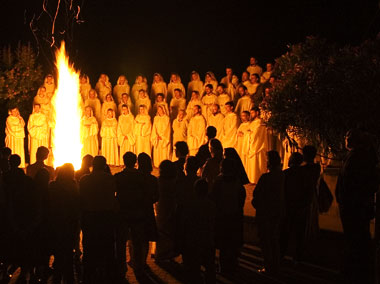
The common prayer is sung in Italian with an adaptation of Gregorian chant sung in lovely harmonies. The texts of the Psaltery have been newly translated from the Hebrew and with an eye also to the traditional christological interpretation of the Psalms. The antiphons are always drawn from the Scriptures, and they constantly invoke the redemption effected in Christ, with particular, continuous insistence on Christ’s resurrection. The Sunday liturgy especially focuses on the resurrection. At a Saturday vigil, one of the monks leads a public lectio divina of the next day’s scriptural passages; Sunday morning prayer is called a “celebration of the resurrection,” at which, following an Orthodox tradition, one of the Gospel resurrection narratives is read. The spirituality cultivated at Bose is wholly centered upon the Word of God in the Scriptures, illumined also by the meditations of the Fathers and of the great spiritual masters.

The community has its own publishing house, Qiqayon (the Hebrew name of the shrub that grew up to shelter Jonah from the heat), which has published many texts of theology and of the various schools of Christian and Jewish spirituality. The monastery has hosted scholarly symposia on ecumenical, inter-religious, spiritual and theological subjects. Monks offer regular courses in biblical Hebrew and Greek. Enzo Bianchi offers frequent “Encounters,” talks on spiritual and theological themes. The Sunday I was there he gave the second in a series of meditations and reflections on “The Experience of God in the Old Testament.” Over 500 people attended, and I was told another 250 had to be turned down for lack of space.

Bianchi, prior of the community but never ordained himself, has become an important figure in the Church in Italy. He is regularly called upon to give retreats for bishops and priests. He writes regular columns on contemporary affairs for newspapers: one recent one was on “the code of mediocrity” exemplified by a certain popular novel. He was asked to compose the liturgies of repentance that Pope John Paul II led on the first Sunday of Lent in 2000.

To accommodate the growing number of people who want to come to share the experience of prayer and spiritual commitment, the community recently opened a new guesthouse, and the monks are now constructing a better facility for those who wish to camp out at the monastery. Guests are welcomed regardless of their ability to pay, although, of course, recommendations for daily expenses are provided for those who can pay. Guests are welcome to attend and participate in the daily prayer and in the twice-weekly eucharists. Priests are available for confession, and monks for spiritual conversation. The area is very quiet, and walks are possible along rural roads and on paths through the woods, where, however, one may find oneself pausing at the sign that announces that the hunting of wild boar is permitted in these woods. A ten-minute walk brings one to the restored Romanesque church of San Secondo, built in the eleventh and twelfth century, the main church being the simplest of constructions to which was added a bell-tower that is considered one of the finest examples of Romanesque architecture in the region. There are various views of the church that enable one to imagine how it must have looked in the Middle Ages, quiet opportunities to reflect on the living of the faith in tiny communities like the one that built this church: the Church alive then, as now, only in and as Churches like the community of men and women of San Secundo.

The monastic community of Bose has its own Web site with information about the community and a few photos.

Perhaps others can comment on their experience at Bose. In any case, if you ever wish to include time for personal spiritual reflection on a trip to Europe, give some thought to going to Bose.
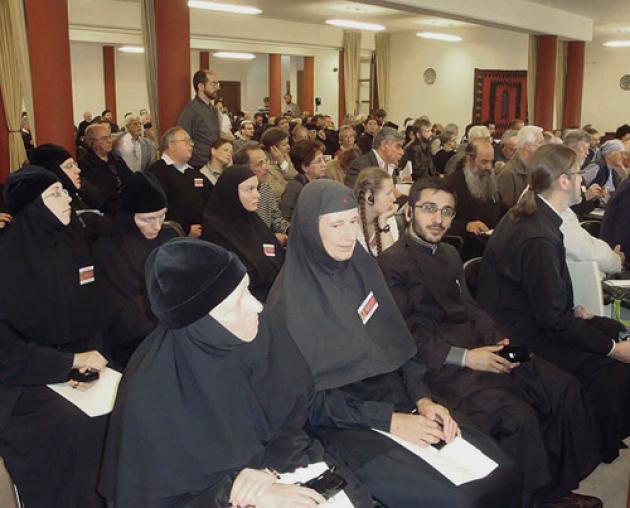
an ecumenical conference in Bose

An example of ecumenical contacts is taken from the website of the Department for External Relations of the Russian Orthodox Church.   It says:
Hegumen Philip Riabykh, vice-chairman of the Moscow Patriarchate’s department for external church relations, met on 29 April 2010 with Brother Adalberto Mainardi of the Bose monastic community, Italy, and Prof. Alberto Melloni from Bologna.Brother Adalberto, speaking on behalf of the whole community and its founder Brother Enzo Bianchi, conveyed greetings and deep gratitude to His Holiness Patriarch Kirill of Moscow and All Russia and the chairman of the Department for External Church Relations, Metropolitan Hilarion of Volokolamsk, for support and long-standing cooperation in organizing international symposia on topical questions of Orthodox spiritual tradition, held annually in Bose since 1993. The next, 18th colloquium will be attended by a representative delegation of the Russian Orthodox Church, which will be led by Archbishop Feognost of Sergiev Posad, abbot of St. Sergius’s Laura of the Trinity. The colloquium will discuss not only the monastic tradition under the theme ‘Fellowship and Solitude’, but also important components of the modern man’s spiritual life. The Russian Orthodox delegation will take an active part in discussing this theme at a round-table conference and in free communication with other participants and guests of the colloquium.


 The icons of Bose  
icon painting

The icon laboratory of the monastery of Bose started its activity about twenty years ago. Nowadays a small group of brothers and sisters of the community share with many monks of the Christian East this ancient art of icon painting.

The Byzantine iconographic tradition was the starting point of our activity thanks to our friendship with Greek monks and nuns, who passed on to us the wisdom of their art. The Greek icon painter Emanuele Panselinos is the main reference for our models in the Byzantine style.

Since the '90s we turned our attention to the Italian painting tradition. Italian painters of the thirteenth and fourtheenth centuries, such as Duccio di Boninsegna and Berlinghieri, are the main reference for our models in the Italic style.

The Russian tradition, and particularly the two great Russian icon painters Dionisij and A. Rublëv, is a source of inspiration for our models and technique.

In recent years we have widened our artistic horizons to include also the Coptic tradition and the Ethiopian tradition.

the icon exhibition room

Since June 2005 an exhibition room with a collection of our liturgical icons is open to the public (for visiting hours contact the monastery).

At the moment one picture for each iconographic style, some photographs of the exhibition room, and a full list of all the subjects (with available size) are published on this website.

A comprehensive photographic catalogue is available in the hall next to the reception room of the monastery.
To order icons and to ask for an estimate contact our laboratory.


Some of the icons are on display in the hall next to the reception room of the monastery.

BIBLICAL, PATRISTIC AND LITURGICAL RESEARCH

 
a computer room
Scripture, the writings of the Church fathers, and liturgy are at the core of the community life. For this reason Biblical, Patristic, and liturgical research, as well as the edition and translation of Christian sources have developed since the founding of the community.

Since the first years of monastic life at Bose, several brothers and sisters have devoted their energies to the study of Western and Eastern languages, both ancient and modern, in order to read and translate Biblical texts and Patristic writings. As a result, through the publications of our publishing house Edizioni Qiqajon, precious treasures of the Christian spiritual tradition, which have been at the heart of the community spiritual life for many years, can now be offered to our guests and friends.

This research, even if based on solid, intellectual training, is not aimed at a merely intellectual knowledge at all. Its only purpose is to draw spiritual wisdom from Scripture, the fathers, and liturgy, as the monastic tradition has always pointed out.


INTERVIEWS WITH BROTHERS FROM BOSE, TAIZE & CHEVETOGNE AFTER A CONFERENCE IN KIEV


BROTHER ADALBERT OF BOSE IS INTERVIEWED

 BROTHER RICHARD OF TAIZE IS INTERVIEWED


FATHER ANTOINE LAMBRECHTS OF CHEVETOGNE IS INTERVIEWED

THE MONKS OF HEILIGENKREUZ


THE MONASTIC COMMUNITY OF JERUSALEM IN PARIS: LAUDS TODAY

Wednesday, 3 April 2013

POPE FRANCIS' IDEAS OF WHAT IS AT THE HEART OF THE CHURCH by Alejandro Bermudez


 Of all the people in the world, the Orthodox ought to know what we mean by "Devotion to the Sacred Heart of Jesus".   Central to Orthodox spirituality is "Prayer of the Heart".   When we speak of the "heart of Jesus" we are using the word "heart" in exactly the same sense as they do when they talk of the "prayer of the heart".   Instead, we get jokes about our devotion to particular parts of Our Lord's body.   

For us, "heart" means the deepest centre of the human being, where even psychology cannot touch, the point where every person that comes into the world is enlightened by the Word, the place where the eucharistic Lord lodges his presence: the place in which our prayer begins, in harmony with the prayer of the Spirit calling, "Abba, Father".

   Surely, if Christ in truly human,then he too has this profound central space where God became man, where God continues to become man in intimate union, where divine Love and human love act in perfect harmony as from a single personal centre to save and embrace the world.   This centre is the Sacred Heart of Jesus.  Long before we reach this point, the Orthodox I have known become restless.  Perhaps they will learn something from their Western brethren, a possible approach to the central reality of Christianity that they have not yet explored, even though the "prayer of the heart" says it all.   Better to take refuge in jokes about particular parts of Christ's body than to plunge with us into a shared understanding and love of the Incarnation.

I think we have to make ourselves clear to the Orthodox who read our articles.  We do not regard ourselves as heterodox seeking entrance to the Orthodox Church.   Our desire for unity with the Orthodox Church arises from our fundamental belief that we are as Orthodox as they are; but, at the same time, we believe that our orthodoxy needs unity with the Orthodox in order to be ourselves - in that sense, we need them, - and we also believe that they too need us to be true to themselves, that the fullness of Catholicism can be discovered in the Eucharist that both churches celebrate, and that the celebration of the Divine Liturgy unites us, whether we want to be united or not.   This means that our division is a product of our own ecclesiastical imagination; and the sooner we wake up to the reality that we are united by the same Mass, the sooner it will be better for us and for the whole world. 

Of course, I do not expect my Orthodox friends to agree with me, and I respect their convictions because I respect them and value their friendship.   However, I believe that some such ecclesiology is implicit in the use of the term "sister churches" which is applied by members of both churches when talking of inter-church relations.  

Unfortunately, however, many things have happened since we came to believe that we are separated,and these things need to be dealt with before we move out of the dream into reality.  Some things are real problems which will take patience, love, humility and intelligence to resolve.   Some of these things belong to the substance of dreams, and all we have to do is wake up to understand that they are without substance.   One example is devotion to the Sacred Heart.   In no doctrine are we closer in reality: in no doctrine do our differences stand out more clearly for those of us who are still asleep. 

 We now have a Pope to whom the heart is central.   Let us leave aside the problem of the Ukraine where, according to the Russians, Catholics are converting Orthodox, and Guatemala, where Orthodox are converting Catholics:  let us shake ourselves awake and, with Pope Francis, look into the human heart and the heart of the Gospel together.   Both will be richer that way; and, in God's good time rather than our own, ut omnes unum sint.

.
Italian television covered the personal struggle of a 20-something, non-practicing Catholic woman who was deeply moved by Pope Francis’ first two encounters with the world after his election: directly on the day of his election and via television the next day, when he presided at the cardinals’ Mass in the Sistine Chapel.
The young woman told the Italian state-run television station RAI that she felt moved to buy a Bible and was planning to read the Gospels over the weekend.
RAI caught up with her again on the following Monday, after Pope Francis’ Mass and homily at the tiny Church of St. Anna inside the Vatican walls. “What I saw in Pope Francis’ person is totally consistent with what I read in the Gospels. ... I think I now need to go back to the Church,” the young lady said.
If Pope Francis could describe his mission, the encounter recounted by RAI would be a prime example.
This early in his pontificate many have attempted to describe Pope Francis either based on his past — sometimes even a false account of it — or on his small, widely publicized gestures.
Much has been said, positively or negatively, about his call for a Church that is “poor and for the poor” or about his liturgical decisions, such as not wearing the papal cape and stole during his first appearance, his choice of the third Eucharistic Prayer for his first solemn Mass, and his celebrating Holy Thursday Mass at a Rome juvenile detention center and kissing the feet of two females during the washing of the feet.
An equal amount of electronic ink has been shed about his decision not to wear red shoes or to wear a silver ring rather than one made of gold.
This overreading, which leads to concluding about things too early in the pontificate, either disturbing or encouraging trends, comes from the long, frequently divisive debate regarding what is at the heart of the Church.
Some would say the heart is the liturgy, since it is the “source and summit of the life and mission of the Church,” to quote from the Second Vatican Council’s dogmatic constitution on the Church, Lumen Gentium.
Others, instead, judge Francis through the prism of Matthew 25 and the belief that the Final Judgment is at the heart of the Church.
But for Pope Francis, the heart of the Church is, well, the heart. That is, the human heart and its transformative relationship with God’s heart.
The heart in Jesuit spirituality is a crucial concept. The Jesuits were the first to promote devotion to the Sacred Heart of Jesus around the world. Initially, they were accused of heresy for promoting the concept that the human heart of Jesus was a permanent living source of mercy, as revealed by God to St. Marguerite Marie Alacoque in the 17th century.
Unlike the modern reduction of the heart to the experience of feelings, which are to be followed at the expense of our brains, in the Jesuit tradition, the heart is the core of the human person, the place of the soul, where the encounter between God and man takes place. The heart is, in fact, not only the most inner sanctum of the human person, but also the root of the human will. According to the Jesuit understanding, the heart is the source of human action and endurance. Therefore, both personal conversion and solidarity begin with the human heart.
This is the concept of heart that has formed Pope Francis. In 10 years of written homilies, speeches and pastoral letters, the then-archbishop of Buenos Aires has mentioned the heart from this perspective an average of four times per occasion. In some documents, like one of his Lenten pastoral letters, the human heart is mentioned as much as 26 times.
Or 22 times in his homily during the opening Mass at the 2004 National Eucharistic Congress, where he said:
“When Peter perceives that it is the Lord, he dives into the water to arrive first. He throws himself in. He doesn’t doubt. If it is the Lord, this is what we must do. His vocation grants him the strength to exercise the Christian virtue of courage, that of boldness.”
He continued, “This is the boldness to dive into the water when I see my Lord because I find everything with Jesus. He changes our hearts and makes us audacious, bold, to defend what we’ve received, what is non-negotiable. They would rather receive martyrdom than negotiate what they had received, thus sealing the certainty of this encounter with their very lives.”
In another homily, addressed that same year to teachers from Catholic schools in the Buenos Aires Archdiocese, he said: “To those who lead these institutes, I ask for your courage, the courage to assume the responsibility of forming Christian hearts, hearts that know they have encountered Jesus Christ.”
The centrality of the human heart modeled according to the heart of Jesus has not only been an issue frequently mentioned by Pope Francis in these first weeks of his papacy. It has also been at the heart (pun intended) of his message. And it is a message he believes can be shared with other religious traditions; in fact, also in 2004, Cardinal Bergoglio was invited by the Buenos Aires Jewish community — one of the world's largest — to deliver the comment after the reading of the Scripture during the feast of Rosh Hashanah.
Commented Cardinal Bergoglio: “‘And these words, which I instruct to you this day, shall be in your heart. And you shall explain them to your sons. And you shall meditate upon them sitting in your house and walking on a journey, when lying down and when rising up’ (Deuteronomy 6:6-7). This is our memory. We cannot lose it. The fascination with idols leads us to a weakening of the memory of us all, each and every day of our lives.”
Does Pope Francis dismiss the importance of liturgical gestures, great or small? Does he believe that Catholics will only be saved by practicing social justice?
No. He is a deep lover of the Church’s liturgical traditions. He is also a strong supporter of the need to influence politics and culture, as he has shown repeatedly in his writings. But, most importantly, he believes that if there are no changed hearts, there will be no eyes with which to praise God at the sight of elegant liturgical vestments; no families to enjoy the true definition of marriage; no person to receive with love a newborn baby.  
Or, in his own words, which we are challenged to take personally: “This is the Lord’s commandment: Surrender our hearts.   Open them and believe in the Gospel of truth; not in the Gospel we’ve concocted, not in a light Gospel, not in a distilled Gospel, but in the Gospel of truth.”
Alejandro Bermudez is the Register’s Latin-America correspondent.


Search This Blog

La Virgen de Guadalupe

La Virgen de Guadalupe

Followers

My Blog List

Fr David Bird

Fr David Bird
Me on a good day

Blog Archive