"Today the concept of truth is viewed with suspicion, because truth is identified with violence. Over history there have, unfortunately, been episodes when people sought to defend the truth with violence. But they are two contrasting realities. Truth cannot be imposed with means other than itself! Truth can only come with its own light. Yet, we need truth. ... Without truth we are blind in the world, we have no path to follow. The great gift of Christ was that He enabled us to see the face of God".Pope Benedict xvi, February 24th, 2012
The Church is ecumenical, catholic, God-human, ageless, and it is therefore a blasphemy—an unpardonable blasphemy against Christ and against the Holy Ghost—to turn the Church into a national institution, to narrow her down to petty, transient, time-bound aspirations and ways of doing things. Her purpose is beyond nationality, ecumenical, all-embracing: to unite all men in Christ, all without exception to nation or race or social strata. - St Justin Popovitch
ONCE IN ROYAL DAVID'S CITY from Kings
SILENT NIGHT from Kings
Christmas Eve 2011
“Today a Saviour has been born to you: he is Christ the Lord.”
In the name of the monastic community I welcome you all to this Midnight Mass of Christmas. I know that many churches have now given up this traditional practice and gone for the soft option of an evening Mass. I don’t blame them but it seems to me that it is important still to keep vigil through the night together with those shepherds watching their flocks who were the first to hear the good news of the Saviour’s birth. “Today a Saviour has been born to you: he is Christ the Lord.” Today.
I welcome our regular worshippers and give a warm welcome to our visitors. I know that many people only come to Mass at Christmas, so a very, very special welcome to you. Remember, this church is your home, you belong here and there will always be a welcome no matter how long it’s been since you last set foot in a church, no matter what it is that prevents you from practising your faith. God loves you, he always will and Christ was born today for you.
It’s interesting how in the History of Salvation all the important things happen at night, in darkness. Go back to Creation: there was nothing but darkness and void until God said, “Let there be light,” and there was light. It was in the middle of the night that, under the leadership of Moses, God led the People of Israel from slavery in Egypt to freedom in the Promised Land and it was at night that he gave them the Law on Sinai. We often walk in darkness and don’t know where we’re going or even why. Life is a dark mystery without the light of faith. Yet the prophet Isaiah wrote long ago, “The people that walked in darkness has seen a great light; on those who live in a land of deep shadow a light has shone.” We are that people. Each one of us walks in darkness when we walk without the light of Christ.
It was in the middle of the night that Christ was born. Mary “wrapped him in swaddling clothes and laid him in a manger because there was no room for them at the inn.” Not only the darkness of night when Jesus was born but the darkness of rejection and exclusion. How many of us feel like that! And yet it is when the night is darkest that the angel of the Lord appears and the glory of the Lord shines brightest. Like the shepherds we are often more frightened of the light than of the darkness. “Do not be afraid. I bring you news of great joy, news to be shared by all the people. Today a Saviour has been born to you: he is Christ the Lord.” The shepherds run to the manger and, seeing the baby, are filled with joy. Darkness evaporates and they return home rejoicing. The same happens with the Three Kings or Wise men. In their darkness they are guided by a star that leads them to Bethlehem, where they bow down before the Christ Child and worship him, offering gifts of gold, frankincense and myrrh. Like the Magi we often journey through life in darkness with just a star to guide us, though at times the cloud is thick and we see nothing. All we can do then is hang on for dear life and persevere in hope.
The Gospels tell us that darkness had covered the earth when Christ died crucified on Calvary and it was at night, at that darkest hour just before dawn, when on Easter Sunday he rose from the dead. The darkness of death and the prison of the tomb could not hold him back. “Light and life to all he brings, risen with healing in his wings,” we sing tonight, already thinking ahead to Easter, because Christmas and the Epiphany are in fact Paschal feasts. We know that the Child lying in the manger is the Crucified Christ, our Risen Lord. The night of death most surely awaits each one of us and we mourn the death, untimely and undeserved, of our loved ones, but in Christ and in the power of his Resurrection we know that death opens out into glory and that darkness gives way to light.
My dear brothers and sisters in Christ, may the Nativity of our Lord Jesus Christ fill your hearts with joy and may he, the Saviour born for us today, bless you and your loved ones this Christmas and always. Amen
HANDEL'S HALLELUIA CHORUS
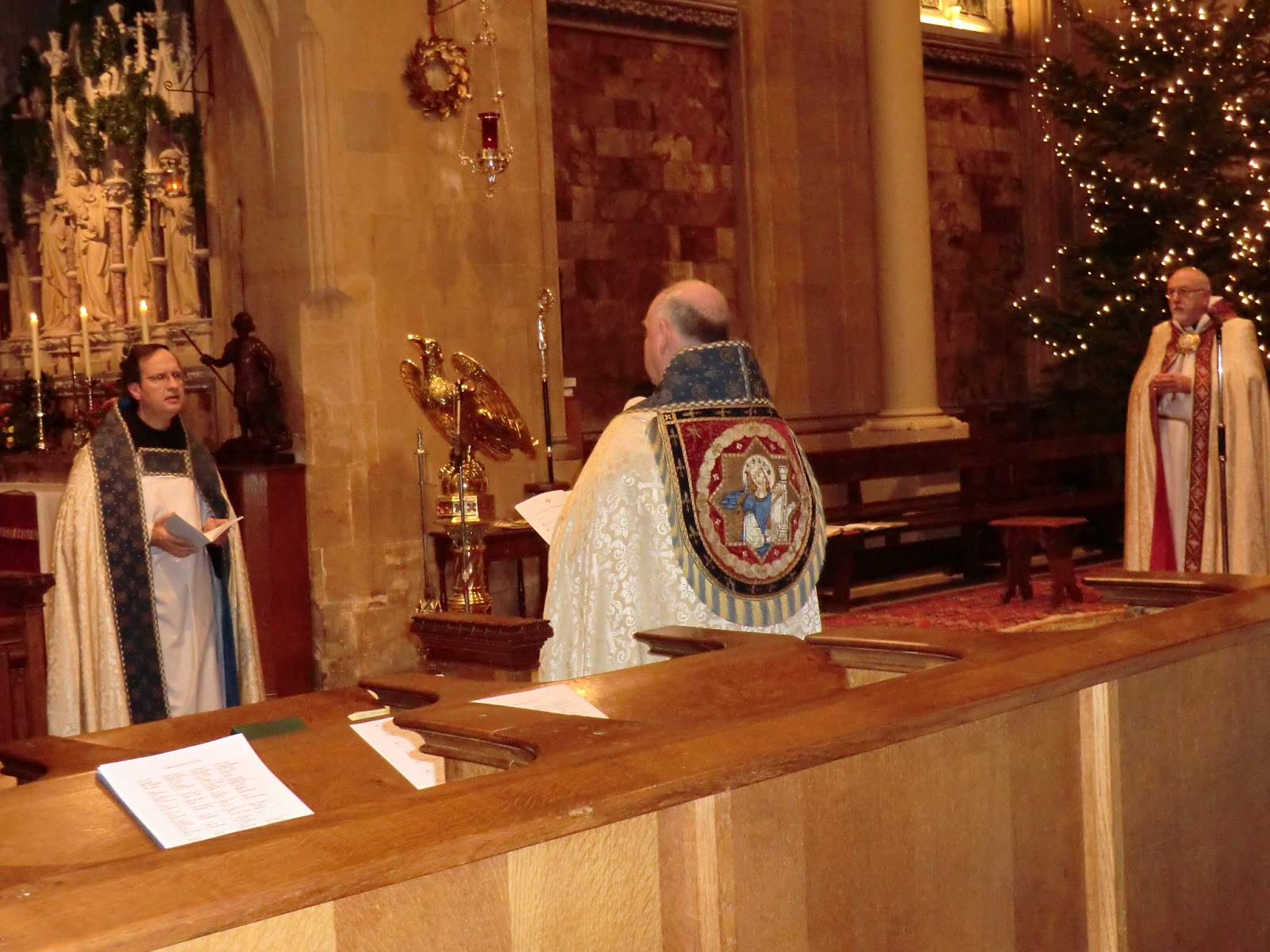
These photos were taken at the Christmas Day Mass at 11.00am. We have a really beautiful liturgy which is novus ordo, "facing the people", but fully within the Tradition of the Church: it can be done!!
Christmas Day 2011
“All that came to be had life in him and that life was the light of men, a light that shines in the dark, a light that darkness could not overpower.” Wonderful words taken from St John’s Prologue, this morning’s Gospel.
On behalf of the monastic community I welcome you all to this Mass of Christmas Day. A particular welcome to our guests and visitors and a very special welcome to those who only come to Mass once a year or who might have come today out of curiosity or in compliance with the wishes of a relative or friend. Perhaps not all of us really want to be here and would rather be somewhere else. And there must be some of you who are thinking more about getting your Christmas dinner ready than plumbing the depths of St John’s Gospel. For whatever reason we happen to be here this morning and no matter what else is going on in our minds, Christ was born for us today. We have life in him. He alone is the light that shines in the dark, a light than not even our own darkness can put out.
You either love Christmas or you hate it, and there are some of us who both love and hate it at the same time. I must confess that I love everything about Christmas, even all the stuff that’s really got nothing to do with religion or faith. I love it all and always have. But at the heart of Christmas there has to be Christ, the Word made flesh, he who lives among us, he whose glory we behold even today. In the darkness of our world, and this past year we really have come to see how dark it can be and how much suffering and hardship there is, even in the Church, Christ alone shines out as a light in the darkness, a light that darkness cannot overpower.
At the Midnight Mass we heard in St Luke’s Gospel of the birth of Jesus, the quintessential Christmas story of shepherds in the fields watching over their flocks by night and of angels singing “Glory to God in the highest.” We heard of the babe in the manger, of Mary and Joseph, the ox and the ass, and all the other bits we associate with Christmas. And, of course, we sang lots of carols, most of them going way beyond what we read about in the Bible, but all of them trying to figure out what Christmas means for us.
This morning we have the profound reflexion of St John’s magnificent Prologue, as the Lord invites us to stand back for a moment and take stock of what Christmas really means for us and for the whole of creation, what it’s all about. I know it’s too much to take in when you’re worrying about your Brussels sprouts, but, don’t worry, almost nobody knows how to get them right!
“The Word was made flesh, he lived among us, and we saw his glory, the glory that is his as the only Son of the Father, full of grace and truth.” In Jesus Christ we see God and know him; in Jesus Christ God sees us and knows us. From the moment of the Incarnation, when God took human flesh of the Virgin Mary and became a man like us in all things but sin, he chose to see us in Christ and to love us in his Only-Begotten Son, the Beloved. We often worry, “How can God possibly love me?” We consider ourselves to be wretched sinners, hopeless cases, good-for-nothing. Alternatively, pride takes over and we become defensive, arrogant and self-righteous. Now Christ came to set us free from all that and to show us how much God loves us and longs for our happiness and salvation. That is the peace Christ came to share with us, the saving knowledge that God loves us and wants only what is best for us, ultimately, what will make us happy for all eternity.
We can see God’s glory reflected not only in the face of Christ, but, if we just open the eyes of faith, we can see his glory in the face of those with whom we live, in the face of those we love, even in the face of those we hate. For you see, “from his fullness we have all received grace in return for grace.” Salvation has got nothing to do with what we think we can do or should do for God, but rather it is God’s gift to us, his gift to us in Christ. It is what we allow God to do for us in Christ, “the light that shines in the dark, the light that darkness cannot overpower.”
A very Happy Christmas to you all and may Christ, the Word made flesh, he who is our light and our life, bless you and your loved ones this Christmas and for ever. Amen
The above pictures are from 2nd Vespers of Christmas, 2011. The "hoods" of the cantors' copes are very ancient and are supposed to have belonged to the royal chapel of Queen Catherine of Aragon, but we have no proof of this..
The following is an excerpt from Advent of the Heart: Seasonal Sermons and Prison Writings by Alfred Delp, S.J., priest and martyr.
The meaning of our Christian holy days is not primarily our external holiday celebration, but that particular mysteries of God happen to us, and that we respond. Something in the deepest center of our being is meant here, more than the exterior symbols can even indicate. Anyone who lacks spiritual eyes, and whose soul has not become open and watchful, will not understand the reason we are so often festive in the cycle of the liturgical year. The Church stands before us with great gestures and great pomp and ceremonial rites. This is only an attempt to indicate something that reaches much deeper and must be taken much more seriously.
We need to celebrate holy days in three ways. First, by recalling a historical event. The feasts are always based on verifiable, historical facts. We should not just get carried away with unbridled enthusiasm. What is really going on? This is a question of discernment and recognition. Seen from God's perspective, there is always a clearly defined event connected to the mystery, a clear statement intended, a fact.
This brings us to the second point. Within all of the foregoing, a great mystery--the Mysterium--is hidden. Something happens between Heaven and earth that passes all understanding. This mystery is made present to us, continues in the world till the end of time, and is always in the process of happening--the abiding Mysterium.
These two points are followed by the third way in which we must consider the feast to be serious and important. Through the historical facts and through the workings of the mystery, the holy day simultaneously issues a challenge to each individual life, a message that demands a particular attitude and an interior decision from each person to whom it is proclaimed.
The Christmas celebration is the birth of the Lord. It is verifiable that Christ was born on this night. The great mystery behind this is the marriage covenant of God with mankind; that mankind is fulfilled only insofar as it has grown into this covenant. Concretely, it is meaningful to establish what this covenant, which began between divinity and humanity on that Holy Night, signifies as a challenge and message for each one of us.
In view of these preconditions, we want to read some passages from the Holy Scriptures about the mystery of Christmas--the three readings of the three Christmas Masses.
1. The Epistle for the Third Christmas Mass: "In many and various ways God spoke in times past to our fathers through the prophets; but in these last days He has spoken to us through a Son, whom He appointed the heir of the cosmos, through whom also He created the world. He reflects the glory of God and bears the very stamp of His nature, upholding the universe by His Word of power" (Heb 1:1-3). Basically, before moving on to personal devotions and contemplation or reading stories of the Holy Night, one should read these weighty verses of Saint Paul to be spiritually touched by the impact of this holy day we are celebrating. We Germans run the risk of concealing Christmas behind bourgeois customs and sentimenta1ity, behind all those traditions that make this holiday dear and precious to us. Yet perhaps the deep meaning is still hiding behind all those things.
What this celebration is about is the founding of a final order for the world, a new center of meaning for all existence. We are not celebrating some children's holiday, but rather the fact that God has spoken His ultimate Word to the world. Christ is the ultimate Word of God to the world. One must let this idea really sink in these days when people are seeking new values. If you take God seriously--this relationship between God and the world--and if you know how important God is to society as well as to private life, then this has to touch you. The ultimate Word of God to the world! God does not contradict Himself and does not repeat Himself. One must use every ounce of willpower to comprehend this, and let this concept sink in: Christ, as the ultimate Word of God to the world.
And Christ came and placed Himself before us as a message. That He came as a child proves how much it matters to God that the message be accepted. From this Holy Night onward, the world has had the possibility of living in nearness to God or living apart from God. The entire Epistle wants to communicate one thing: take this, take what has happened here, really seriously.
What came into the world is the very image of the Divine Being, is God Himself. He lifted mankind out of every false order in this consecrated night, in this blessed night. What is said to us here gives life its meaning, individual life as well as the life of all mankind.
The ultimate Word of God to mankind. This idea is expanded upon as follows:
2. The Epistle of the Second Mass of Christmas: "The goodness and kindness of God our Savior appeared; He saved us, not because of deeds done by us in righteousness, but by virtue of His own mercy" (Tit 3:4-7).
The impact of these facts is further developed in two ways. What does this mean for man's inner reality, where he must come to an understanding of himself? And what does it mean for the fundamental attitudes toward life, the point at which the mystery becomes present and calls for a concrete response? To begin with the first question: What has happened to the measure of our being, through this Word that God has spoken into the world? The goodness and loving-kindness of God have appeared, so that we know and seriously must recognize ourselves as the substance of a divine commitment to man. Since then, God has taken no other position in relation to us than this "benignitas et humanitas [goodness and lovingkindness]". Because God's commitment upholds each and every one of us, even to the extent of His sharing in the very poorest and most helpless phase of human infancy, He has fully realized and made Himself accessible in the Incarnation. And now, in the background, our great, gruesome time stands up.
"Not because of deeds done by us in righteousness, but by virtue of His own mercy" (Tit 3 :5). The second tiling we need to know is that it is not because man is proud and worthy, but because God upholds us. Man needs to know that we live from grace; we live from God's merciful commitment to mankind, from His mercy. Not as miserable wretches, however, but renewed in spirit; so that we know our intrinsic dignity, know that we are raised up above and beyond all else, because we mean so much to God. This is how we attain maturity in the presence of God.
3. Now--in the Epistle of the First Mass of Christmas--the effect of the foregoing is described. We will not be abused and violated, not even forced to be good or forced to love. We are challenged to do so, but it calls for a decision. The grace of God our Savior "teaches us to renounce godlessness and to live moral, upright, and pious lives in this world" (Tit 2:12). There are three great fundamental attitudes there, three great, foreign qualities of Christians in the world, three great commandments for perfection of life.
First [renouncing godlessness]: if the meaning of our lives is that God is really in covenant with mankind, then there can be no more godlessness--that would be loss of being--there is no more will to live. Godlessness is a calumniation of the divine life.
Second [regarding moral, upright, and godly living]: man should recognize that his innermost purpose is to find the way home to God and to be caught up in His life, to seek God for Himself. The fundamental concept of man in this world never can be that of certainty, but rather that of wait- ing for this ultimate revelation of that which began in the Holy Night. Such people, who know they are hastening to meet a great fulfillment, are always people under way.
Third [to become His own followers]: [1] these are people of loneliness, the people whom God wanted to have as His people, gripped by a great passion that God be well pleased, and ablaze with the divine fire that will be cast upon the earth.
And now, here is the last question: What does all of this mean today--the message of the great Kyrios, the Lord, the message of the fundamental attitude that the Holy Night demands? This is no Christmas life today. Neither is it a Christmas life according to people's inner attitude. Neither is it a Christmas holy day according to a religious perspective. The world is hostile and rejects everything. But we are experiencing the other side of Christmas. All of these blessings have already been taken away, and the night has descended again.
The first message is that the Kyrios, the Lord, is coming. The Lord does not stand in the center anymore. He is replaced by the power brokers. How man keeps lapsing into heresy! The power brokers, under whose power man has gone astray, stand in the center. One no longer sees God as the center of the world, as the foundational support.
And what has developed out of this? We are standing without any foundation--we have nothing permanent anymore. There is no more talk of man's life being dependent upon mercy. Therefore the world has become so unmerciful. When has anyone taken away more from man than this? This is a time in which "apparuit benignitas et humanitas [the goodness and loving-kindness of God our Savior appearing]" is no longer acknowledged. What has become of man, that he does not want to be human in relation to God anymore? Beforehand, the Christmas words were sent packing. [2] This is a world in which it no longer can be said that "we await the great revelation of the Lord", a world that must cling to each day because it already knows that, in mere seconds, everything can be over. There is nothing left of peace and security. This is a world that no longer knows of the Holy Night, of the Consecration-Night, the Christ-Mass. [3] That is the one thing that we honestly have to see. The world in which we stand is un-Christmaslike, not because God is unmerciful, but rather because man has outlawed the message, and there is no room anymore for the promise.
Nevertheless, we must also look at this in a positive way. For us personally, this message of the Holy Night still does contain its great meaning and content. There are two things we need to have in terms of consciousness and attitude, and we should take possession of them today: we should not come to Midnight Mass as if we do not live in the year 1942. The year must be redeemed along with everything else. And from the Gloria, we have to take with us the peace and faith in the glory of God. There is nothing else that surpasses this night, and nothing that should be taken as more important than this event. Whatever may happen around us, let us not break down, for then we would not be taking the Lord seriously, or what we know about consecrated people seriously, or what we know about these messages. Therefore, deep down, we are the people who are comforted; and we are the last refuge for the homeless people who do not know anything about the Lord anymore. May we know about the indisputable fact of this Child and not let ourselves be disconcerted, not even by our own great un-freedom. "Apparuit benignitas et humanitas [the goodness and lovingkindness of God our Savior appearing]" (Tit 3:4). That should find its expression in the positive attitudes we take with us from this experience of the Holy Night. May we impart the goodness. May we attend to humanity again, and witness to the Lordship of God again, and know of His grace and mercy, and have gentle hands for other people again. And may we go away from Christmas Eve with the consolation that we mean so much to God that no external distress can rob us of this ultimate consolation. Our hearts must become strong, to make the divine heartbeat into the law of life again. God's readiness is established, but our gates are locked.
These should be the meaning of our wartime Christmas:
-- that we petition Him,
-- that He redeems us through the mystery,
-- that we are rich and capable enough through God's comfort to give mankind the comfort that it needs so much,
-- that we go away from this celebration as the great comforters, as the great knowers, the great blessed ones who know what it means to be consoled by God.
Endnotes:
[1] The context of Tit 2:12 clarifies Fr. Delp's point. The complete text, translated from the Latin, reads: "The grace of God our Savior has appeared to all mankind. It teaches us to renounce godlessness and the worldly passions, and to live sober, upright, and godly lives in this world. Meanwhile, we await, in blessed hope, the glorious coming of our great God and Savior, Jesus Christ, who gave Himself up for us to redeem us from all iniquity and to purify us so that we become His own: a people who are pleasing to Him, who follow in good works" (Tit 2:11-15). -- TRANS.
[2] References are to Nazi regulations restricting or forbidding Christian practice and customs. -- TRANS.
[3] The German word for Christmas is Weihnacht, but Fr. Deip wrote "WeiheNacht" (Consecration-Night). Compare "Meditation for the Fourth Sunday of Advent, 1944", note 13, p. ii. -- TRANS.
"Hail, Full of Grace": Mary, the Mother of Believers | Joseph Cardinal Ratzinger |
"From henceforth all generations will call me blessed"–these words of the Mother of Jesus handed on for us by Luke (Lk 1:48) are at once a prophecy and a charge laid upon the Church of all times. This phrase from the Magnificat, the spirit-filled prayer of praise that Mary addresses to the living God, is thus one of the principal foundations of Christian devotion to her.
The Church invented nothing new of her own when she began to extol Mary; she did not plummet from the worship of the one God to the praise of man. The Church does what she must; she carries out the task assigned her from the beginning. At the time Luke was writing this text, the second generation of Christianity had already arrived, and the "family" of the Jews had been joined by that of the Gentiles, who had been incorporated into the Church of Jesus Christ. The expression "all generations, all families" was beginning to be filled with historical reality. The Evangelist would certainly not have transmitted Mary's prophecy if it had seemed to him an indifferent or obsolete item. He wished in his Gospel to record "with care" what "the eyewitnesses and ministers of the word" (Lk 1:2-3) had handed on from the beginning, in order to give the faith of Christianity, which was then striding onto the stage of world history, a reliable guide for its future course.
Mary's prophecy numbered among those elements he had "carefully" ascertained and considered important enough to transmit to posterity. This fact assumes that Mary's words were guaranteed by reality: the first two chapters of Luke's Gospel give evidence of a sphere of tradition in which the remembrance of Mary was cultivated and the Mother of the Lord was loved and praised. They presuppose that the still somewhat naive exclamation of the unnamed woman, "blessed is the womb that bore you" (Lk 11:27), had not entirely ceased to resound but, as Jesus was more deeply understood, had likewise attained a purer form that more adequately expressed its content. They presuppose that Elizabeth's greeting, "blessed are you among women" (Lk 1:42), which Luke characterizes as words spoken in the Holy Spirit (Lk 1:4 1), had not been a once-only episode.
The continued existence of such praise at least in one strand of early Christian tradition is the basis of Luke's infancy narrative. The recording of these words in the Gospel raises this veneration of Mary from historical fact to a commission laid upon the Church of all places and all times.
The Church neglects one of the duties enjoined upon her when she does not praise Mary. She deviates from the word of the Bible when her Marian devotion falls silent. When this happens, in fact, the Church no longer even glorifies God as she ought. For though we do know God by means of his creation–"Ever since the creation of the world [God's] invisible nature, namely, his eternal power and deity, has been clearly perceived in the things that have been made" (Rom 1:20)–we also know him, and know him more intimately, through the history he has shared with man. just as the history of a man's life and the relationships he has formed reveal, what kind of person he is, God shows himself in a history, in men through whom his own character can be seen.
This is so true that he can be "named" through them and identified in them: the God of Abraham, of Isaac, and of Jacob. Through his relation with men, through the faces of men, God has made himself accessible and has shown his face. We cannot try to bypass these human faces in order to get to God alone, in his "pure form", as it were. This would lead us to a God of our own invention in. place of the real God; it would be an arrogant purism that regards its own ideas as more important than God's deeds. The above cited verse of the Magnificat shows us that Mary is one of the human beings who in an altogether special way belong to the name of God, so much so, in fact, that we cannot praise him rightly if we leave her out of account.
In doing so we forget something about him that must not be forgotten. What, exactly? Our first attempt at an answer could be his maternal side, which reveals itself more purely and more directly in the Son's Mother than anywhere else. But this is, of course, much too general. In order to praise Mary correctly and thus to glorify God correctly, we must listen to all that Scripture and tradition say concerning the Mother of the Lord and ponder it in our hearts. Thanks to the praise of "all generations" since the beginning, the abundant wealth of Mariology has become almost too vast to survey. In this brief meditation, I would like to help the reader reflect anew on just a few of the key words Saint Luke has placed in our hands in his inexhaustibly rich infancy narrative.
Mary, Daughter Zion–Mother of Believers
Let us begin with the angel's greeting to Mary. For Luke, this is the primordial cell of Mariology that God himself wished to present to us through his messenger, the Archangel Gabriel.
Translated literally, the greeting reads thus: "Rejoice, full of grace. The Lord is with you" (Lk 1:28). "Rejoice": At first sight, this word appears to be no more than the formulaic greeting current in the Greek-speaking world, and tradition has consistently translated it as "hail". But looked at against the background of the Old Testament, this formula of greeting takes on a more profound significance. Consider, in fact, that the same word used by Luke appears four times in the Septuagint, where in each case it is an announcement of messianic joy (Zeph 3:14; Joel 2:21; Zech 9:9; Lam 4:21).
This greeting marks the beginning of the Gospel in the strict sense; its first word is "joy", the new joy that comes from God and breaks through the world's ancient and interminable sadness. Mary is not merely greeted in some vague or indifferent way; that God greets her and, in her, greets expectant Israel and all of humanity is an invitation to rejoice from the innermost depth of our being. The reason for our sadness is the futility of our love, the overwhelming power of finitude, death, suffering, and falsehood. We are sad because we are left alone in a contradictory world where enigmatic signals of divine goodness pierce through the cracks yet are thrown in doubt by a power of darkness that is either God's responsibility or manifests his impotence.
"Rejoice"–what reason does Mary have to rejoice in such a world?
The answer is: "The Lord is with you." In order to grasp the sense of this announcement, we must return once more to the Old Testament texts upon which it is based, in particular to Zephaniah.
These texts invariably contain a double promise to the personification of Israel, daughter Zion: God will come to save, and he will come to dwell in her. The angel's dialogue with Mary reprises this promise and in so doing makes it concrete in two ways. What in the prophecy is said to daughter Zion is now directed to Mary: She is identified with daughter Zion, she is daughter Zion in person.
In a parallel manner, Jesus, whom Mary is permitted to bear, is identified with Yahweh, the living God. When Jesus comes, it is God himself who comes to dwell in her. He is the Savior–this is the meaning of the name Jesus, which thus becomes clear from the heart of the promise. René Laurentin has shown through painstaking textual analyses how Luke has used subtle word play to deepen the theme of God's indwelling. Even early traditions portray God as dwelling "in the womb" of Israel–in the Ark of the Covenant. This dwelling "in the womb" of Israel now becomes quite literally real in the Virgin of Nazareth. Mary herself thus becomes the true Ark of the Covenant in Israel, so that the symbol of the Ark gathers an incredibly realistic force: God in the flesh of a human being, which flesh now becomes his dwelling place in the midst of creation.
The angel's greeting–the center of Mariology not invented by the human mind–has led us to the theological foundation of this Mariology. Mary is identified with daughter Zion, with the bridal people of God.
Everything said about the ecclesia in the Bible is true of her, and vice versa: the Church learns concretely what she is and is meant to be by looking at Mary. Mary is her mirror, the pure measure of her being, because Mary is wholly within the measure of Christ and of God, is through and through his habitation. And what other reason could the ecclesia have for existing than to become a dwelling for God in the world? God does not deal with abstractions. He is a person, and the Church is a person. The more that each one of us becomes a person, person in the sense of a fit habitation for God, daughter Zion, the more we become one, the more we are the Church, and the more the Church is herself.
The typological identification of Mary and Zion leads us, then, into the depths. This manner of connecting the Old and New Testaments is much more than an interesting historical construction by means of which the Evangelist links promise and fulfillment and reinterprets the Old Testament in the light of what has happened in Christ. Mary is Zion in person, which means that her life wholly embodies what is meant by "Zion". She does not construct a self-enclosed individuality whose principal concern is the originality of its own ego. She does not wish to be just this one human being who defends and protects her own ego. She does not regard life as a stock of goods of which everyone wants to get as much as possible for himself.
Her life is such that she is transparent to God, "habitable" for him. Her life is such that she is a place for God. Her life sinks her into the common measure of sacred history, so that what appears in her is, not the narrow and constricted ego of an isolated individual, but the whole, true Israel. This "typological identification" is a spiritual reality; it is life lived out of the spirit of Sacred Scripture; it is rootedness in the faith of the Fathers and at the same time expansion into the height and breadth of the coming promises. We understand why the Bible time and again compares the just man to the tree whose roots drink from the living waters of eternity and whose crown catches and synthesizes the light of heaven.
Let us return once more to the angel's greeting. Mary is called "full of grace". The Greek word for grace (charis) derives from the same root as the words joy and rejoice (chara, chairein). Thus, we see once more in a different form the same context to which we were led by our earlier comparison with the Old Testament. Joy comes from grace. One who is in the state of grace can rejoice with deep-going, constant joy. By the same token, grace is joy.
What is grace? This question thrusts itself upon our text. Our religious mentality has reified this concept much too much; it regards grace as a supernatural something we carry about in our soul. And since we perceive very little of it, or nothing at all, it has gradually become irrelevant to us, an empty word belonging to Christian jargon, which seems to have lost any relationship to the lived reality of our everyday life. In reality, grace is a relational term: it does not predicate something about an I, but something about a connection between I and Thou, between God and man. "Full of grace" could therefore also be translated as: "You are full of the Holy Spirit; your life is intimately connected with God." Peter Lombard, the author of what was the universal theological manual for approximately three centuries during the Middle Ages, propounded the thesis that grace and love are identical but that love "is the Holy Spirit".
Grace in the proper and deepest sense of the word is not some thing that comes from God; it is God himself. Redemption means that God, acting as God truly does, gives us nothing less than himself The gift of God is God–he who as the Holy Spirit is communion with us. "Full of grace" therefore means, once again, that Mary is a wholly open human being, one who has opened herself entirely, one who has placed herself in God's hands boldly, limitlessly, and without fear for her own fate. It means that she lives wholly by and in relation to God. She is a listener and a prayer, whose mind and soul are alive to the manifold ways in which the living God quietly calls to her. She is one who prays and stretches forth wholly to meet God; she is therefore a lover, who has the breadth and magnanimity of true love, but who has also its unerring powers of discernment and its readiness to suffer.
Luke has flooded this fact with the light of yet another round of motifs. In his subtle way he constructs a parallel between Abraham, the father of believers, and Mary, the mother of believers. To be in a state of grace means: to be a believer. Faith includes steadfastness, confidence, and devotion, but also obscurity. When man's relation to God, the soul's open availability for him, is characterized as "faith", this word expresses the fact that the infinite distance between Creator and creature is not blurred in the relation of the human I to the divine Thou. It means that the model of "partnership", which has become so dear to us, breaks down when it comes to God, because it cannot sufficiently express the majesty of God and the hiddenness of his working. It is precisely the man who has been opened up entirely into God who comes to accept God's otherness and the hiddenness of his will, which can pierce our will like a sword.
The parallel between Mary and Abraham begins in the joy of the promised son but continues apace until the dark hour when she must ascend Mount Moriah, that is, until the Crucifixion of Christ. Yet it does not end there; it also extends to the miracle of Isaac's rescue-the Resurrection of Jesus Christ. Abraham, father of faith-this title describes the unique position of the patriarch in the piety of Israel and in the faith of the Church. But is it not wonderful that-without any revocation of the special status of Abraham–a "mother of believers" now stands at the beginning of the new people and that our faith again and again receives from her pure and high image its measure and its path?
The Territory of Creativity
-
[image: Holy Martyr Elizabeth Feodorovna, 2017. Wood, gesso, relief gesso,
egg tempera.]This article was originally published in the magazine “Slovo i
Kame...
Who Art in Heaven
-
Why God, who is everywhere, seems so far away Our Father, who art in
heaven. The familiar beginning of the Lord’s Prayer. I have said those
words more time...
You Can't Give What You Don't Have?
-
Father Matthew Gonzalez, a priest in the Archdiocese of Newark, New Jersey,
had the idea to create a group for boys in grades eight to 12 that focuses
on...
It’s Time to Say Goodbye
-
Christ is Risen! After almost 20 years of keeping a blog, I’ve decided I
will close down this site at the end of summer, 2022. You can find my
posts on th...
When America Met Thich Nhat Hanh
-
. by Jim Forest I first met Thich Nhat Hanh in May 1966. At the time Lyndon
Johnson was America’s president. The steadily rising level of US troops in
Viet...
The Byzantine Gender Reveal
-
When I see the way my wife comforts our children, I see God as the Mother
loving them through her. I may not see this image of God perfectly, but I
kn...
Certain brethren of good repute and holy life (XXI)
-
CHAPTER XXI. Of the Deans of the Monastery 26 Feb. 28 June. 28 Oct. Should
the community be large, let there be chosen from it certain brethren of
good rep...
Why Not Use Ancient Rites?
-
*It's been more than 2 years since I last posted. So I'll try to revive
things here with this post.*
As the Apostles and their successors evangelized thr...
Get It
-
I haven’t updated this blog in over six years, so probably no one is going
to read this post, since all my former readers gave up on me a long time
ago. Bu...
The Diligent Pastor
-
"O you pastors, be made like that diligent pastor, the chief of the whole
flock, who cared so greatly for his flock. He brought near those that were
a...
The Big Picture - ISIS, NATO and Russia
-
Clarion: Journal of Spirituality and Justice - The Big Picture ~ ISIS, NATO
and Russia
The civilized world, especially those in the West and in Russia, i...
Temporarily – No Comment
-
God willing, the content of this blog will be migrated to its new site,
starting sometime after midnight (here in East Coast America). I have been
asked to...




 Posts
Posts


