THE LIFE OF BLESSED MATRONA OF MOSCOW
Commemorated April 19/May 2
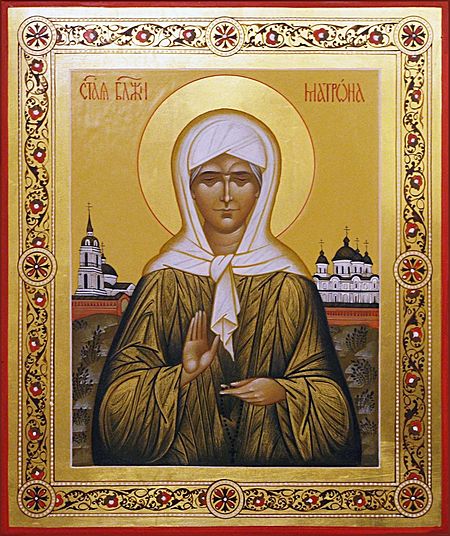
Blessed Matrona (Matrona Dimitrievna Nikonova) was born in 1881 in the village of Sebino of Epiphansky district (now Kimovsky district) of Tula region. The village is only 20 km away from the famous Kulikovo field, where the Russian army defeated the Mongols in 1380.
Her parents, Dimitry and Natalia, were devout, honest and hardworking people. They were poor. They had four children: two brothers, Ivan and Mikhail, and two sisters, Maria and Matrona. Matrona was the youngest. When she was born, her parents were no longer young.
As the Nikonovs were a poor family, a fourth child would be a real burden. Because of the desperate circumstances the mother wanted to get rid of the child. Murdering a child in the mother’s womb was out of the question in a patriarchal peasant family. But there were a lot of asylums where illegitimate or very poor children were raised at the government’s or benefactors’ expense.
Matrona’s mother made up her mind to take the future child to Prince Golitsyn Asylum in a neighbouring village but then had a prophetic dream. She saw her unborn daughter as a white bird with a human face and closed eyes who came from above and perched on her right hand. The God-fearing woman took the dream for a sign and gave up the thought of sending the child away. The daughter was born blind, but her mother loved her “poor child”.
The Holy Scripture tells us that sometimes the All-knowing God pre-elects His servants before their birth. Before I formed thee in the belly I knew thee; and before thou camest forth out of the womb I sanctified thee, and I ordained thee a prophet unto the nations (Jer. 1:5).
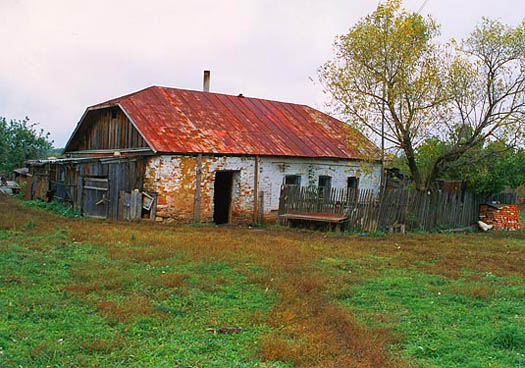
Matrona's family house in the village of Sebino.
Having chosen Matrona for a special ministry, the Lord from the very beginning gave her a heavy cross that she bore throughout her life meekly and patiently.
At her baptism the girl was given the name of St. Matrona of Constantinople, a Greek ascetic of the fifth century, whose memory we celebrate on the 9th (22nd) of November.
According to St. Matrona’s relative, Pavel Ivanovich Prokhorov, who was there at the baptism, when the priest immersed the child in the Baptismal font, everyone saw a wispy column of aromatic smoke above the baby. By this God was showing that He had chosen her. The priest, Fr. Vasily, who was revered by his parish as righteous and blessed, was very much surprised: “I’ve baptised a lot of people but I’ve never seen anything like that. This baby will be holy.” And he added: “If the girl asks for anything, come to me directly, come without hesitation and tell me what she needs.” He also added that Matrona would take up his place and would even foretell his death. And it did happen so. One night Matrona told her mother that Fr. Vasily had died. The surprised and frightened parents rushed to the priest’s house. On their coming they saw that, indeed, he had just passed away.
There was a mark on St. Matrona’s body that showed that the girl was God’ chosen one. It was a cross-shaped swelling on her chest. Once when St. Matrona was about six, her mother reproached her for taking her cross off her neck. “Mummy, I’ve got a cross of my own on my chest,” the girl replied. “Dear daughter, forgive me! Why do I keep blaming you?” said Natalia coming to her senses.
On another occasion, Natalia was complaining to a friend when Matrona was still a baby: “I don’t know what I should do about the baby: the girl won’t take the breast on Wednesdays and Fridays. During these days she sleeps all day and it’s impossible to wake her up.”
Not only was Matrona blind, she had no eyes at all. The recesses were covered by the eyelids closed firmly together, just like the white bird that her mother saw in a dream. But the Lord gave St. Matrona the gift of spiritual vision. When still an infant, at nights she would miraculously get to the icon corner herself, take the icons from the shelf, put them onto the table and play with them in the quiet dark of the night.
Children often teased and bullied Matrona. Girls whipped her with nettles knowing she would never guess who was doing it. Sometimes they put her in a ditch and watched her crawling out of it and walking home slowly. Finally she gave up playing with other children and stayed at home most of the time.
At the age of seven or eight Matrona displayed the gifts of prophesy and of healing the infirm. The Nikonovs’ house was near the Church of Dormition of the Mother of God. A beautiful temple, it was the only church in the neighbourhood of seven or eight villages. Matrona’s parents were pious and liked going to church together. Matrona also grew up in church. First she attended the services together with her mother, and later she came alone using every opportunity. When the mother lost sight of the girl, she nearly always found her in the church. Matrona had her own favorite place there—left of the entrance, at the west wall. She stood there quietly during service. She knew the church singing well and often joined in from where she was. She must have acquired the gift of constant prayer in childhood.
When her mother called her “a miserable child”, Matrona was surprised: “Am I miserable? It is my brothers, Vanya and Misha, who are miserable.” She knew that God gave her much more than He gave others.
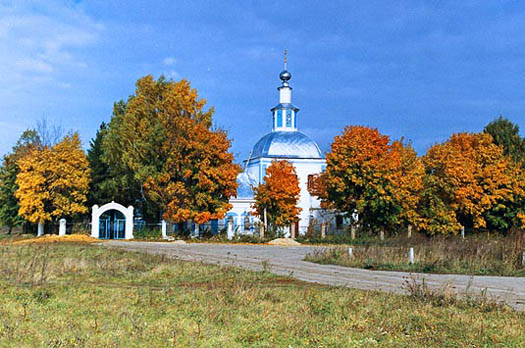
Church in St. Matrona's native village of Sebino.
Matrona acquired spiritual discernment, vision, wonderworking and healing at an early age. Her family and neighbours noticed that she knew not only about people’s sins and crimes but their thoughts as well. She saw the coming of dangers and social catastrophes. Her prayer healed the sick and comforted the suffering. Soon people started coming to her for comfort, advice and healing. They would come on foot or bring their ill relatives on carts to the Nikonov’s house from all around the village and even from remote places. The girl would heal them all. Visitors left food and gifts for Matrona’s family. So, instead of being a burden, she became a breadwinner for her family.
As we already said, Matrona’s parents would often go to church together. Once, on a feast day, Matrona’s mother invited her husband to join her for the service as usual. But he did not go. He decided to pray and sing at home. Matrona stayed with him, too. Throughout the service Natalia was thinking about her husband and felt sorry that he hadn’t come with her. When Natalia was back home after the Liturgy, Matrona said: “You haven’t been to church, Mother.” Natalia was surprised: “Don’t you know I am just back and taking off my coat?” “Father was in church, but you were not.” Matrona saw that even though her mother attended the service her heart was not praying.
Once in autumn Matrona was sitting near the house. Her mother asked her why she would not come in, as it was cold outside. “I cannot be in the house, I’m exposed to fire and pierced with a garden fork.” Natalia was puzzled: “There’s no one in the house”. Matrona explained: “You can’t understand, Mum. Satan is tempting me.”
Once Matrona said to Natalia: “Mum, get ready for my wedding.” The mother told the priest about it, and he came and gave the girl Holy Communion. He always came to Matrona’s house to give the girl Holy Communion when she asked. A few days later there came lots and lots of carts and people asked for Matronushka.[1] She prayed for them and healed many. Mother was very surprised and asked: “What’s that, Matrushenka?” “I told you I would have a wedding,” she replied.
Xenia Ivanovna Sifarova, a relative of Matrona’s cousin, related: “Matrona says to her mother: “I’m leaving now. Tomorrow there’ll be a fire, but your house won’t suffer.” As she said, fire broke out in the morning, nearly the whole village burned down. But then the wind changed and Natalia’s house remained untouched.
When St. Matrona was still young, God granted her a chance to be a pilgrim. The daughter of a local estate owner, a devout kind girl, Lydia Yankova, took Matrona with her on pilgrimages: to the Kiev Caves Lavra, the Holy Trinity St. Sergius Lavra, St. Petersburg, and other holy places in Russia. Once Matrona met Holy Righteous John of Kronstadt. After the Liturgy in Andreevsky Cathedral, St. John asked the people to make way for the fourteen-year-old Matrona and said loudly: “Matronushka, come, come to me. Here is my replacement, the eighth pillar of Russia.”
Matronushka never explained the meaning of these words, but her family believed that Fr. John had foreseen her special ministry to Russia and the Russian people during the years of persecution of the Church.
Some time later, when Matrona was a little over sixteen, she was deprived of the ability to walk: all of a sudden she could not walk any more. The eldress however pointed out the spiritual reason for this disability. It was in church after Holy Communion. St. Matrona knew that a woman would come and take away her physical strength. It all happened as she expected. “I did not try to avoid it. It was the will of God”, she said. So, to the end of her days she could only sit. Her sitting in various houses and flats where she found temporary shelter lasted fifty years. She never complained about her disability but humbly carried this heavy cross that God entrusted her.
While still a child, Matrona foresaw the revolution in Russia. “Churches will be robbed and destroyed, and people will be persecuted.” She showed vividly the way the land would be re-distributed and how people would grab it greedily trying to get more and more—only to leave everything behind and flee. “Then no one would need it”, she said. Before the revolution Matrona advised an estate owner whose name was Yankov to sell everything and go abroad. If he had taken the advice of the blessed saint, he wouldn’t have witnessed the robbing of his property. He would have avoided premature death and would have saved his daughter painful wanderings.
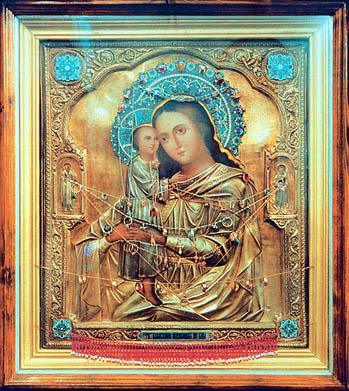 |
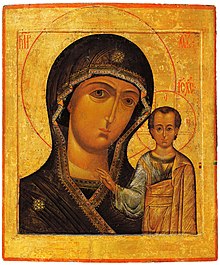
| The icon, "The Search of the Lost," ordered by Matrona for her village church. It is now kept in the Dormition Monastery near Tula. |
A neighbour of Matrona’s, Yevgenia Ivanovna Kalachkova, narrates: Before the revolution a rich lady bought a house in Sebino. She came to Matrona and said that she wanted to build a bell-tower. Matrona replied: “What you have planned is not going to happen.” The lady was surprised: “Why won’t it? I’ve got everything: the money and materials.” But the bell-tower was never built.
Once at Matrona’s request, an icon was painted for the church of Dormition. Here is how it happened. Matrona asked her mother to tell the priest that in his library, on a shelf, there was a book with a picture of the icon “Search of the Lost”. The priest was surprised. However the picture was found, and Matrona told her mother that she was going to have this icon painted. Matrona said that she saw the icon in her dreams: “The Mother of God wants to come to our church.” Matrona’s mother was very worried how they would pay for it. Matrona blessed the women of Sebino to collect money for the icon in neighbouring villages.
Among the sponsors there were two men, one of whom gave a rouble with an uneasy heart, and the other gave a kopeck for a joke. The money was finally brought to Matrona. She took it and started checking coins one by one. Having found the rouble and the kopeck, she removed them saying: “Give them their money back, Mum. It spoils the rest of the money.”
When the necessary sum was collected, they invited a painter from the town of Epiphan. His name remained unknown. Matrona asked him whether he was able to paint the icon. He answered that it was his usual business. Matrona told him to have confession and receive Holy Communion. Then she asked him again whether he was sure he would be able to do it. The painter said ‘yes’ and started working. After a long time he came to Matrona and said he could not do it at all. She said to him: “Go and repent of all your sins.” She knew that he had one serious sin, which he had not confessed. He was struck that she knew about it. Then he went to a priest, had confession, received Holy Communion again and asked Matrona to forgive him. She answered: “Go and paint the icon of the Heavenly Queen. Now you will do it.”
The remaining money raised was spent on another copy of the icon of the Mother of God “Search of the Lost” that was ordered to be painted in Bogoroditsk. When it was ready, a procession carried the icon from Bogoroditsk to the church in Sebino. Matrona went to meet the icon when it was four kilometers away. She was led there. All of a sudden she said: “Don’t go any further, they are nearly here.” The blind woman was speaking as if she could see: “In half an hour they’ll be here and they’ll bring the icon.” Indeed, in half an hour the procession arrived. After a moleben[2] the procession went on to Sebino. Matrona was holding on to the icon on the way back. “Search of the Lost” became the main locally venerated icon there. It soon got famous for many miracles. Whenever there was a drought, the icon was taken to the center of the village and people prayed for rain. No sooner had they come home than it would rain.
All through her life, icons surrounded Matrona. In the room where she lived for a particularly long time there were three icon corners, with icons and icon lamps from the floor to the ceiling. A woman who worked at a Moscow church and often visited Matrona, remembers St. Matrona saying to her: “I know all the icons in your church, where each of them stands.”
It was surprising that Matrona, unlike a blind-born person, had a very good idea of the world around her. Once a woman close to her, Zinaida Vladimirovna Zhdanova, said she was sorry for Matrona’s blindness: “It is such a pity, Matushka, that you can’t see the beauty of the world!” Matrona replied: “Once God opened my eyes and showed me His creation. I saw the sun and the stars in the sky, and the beauty of the earth: the mountains, rivers, the green grass, flowers, birds…”
There is another piece of striking evidence of the gift of spiritual vision that the Blessed Eldress had. Z.V.Zhdanova narrates: “ Matushka was illiterate, but knew everything. In 1946 I had a diploma project on the architectural ensemble of the Admiralty. I was a student of the Institute of Architecture in Moscow. My supervisor harassed me for no reason at all. For the five months that I had worked at the diploma we had not had a single meeting because he had decided to fail my project. A fortnight before the viva he said: “Tomorrow a committee will come and see that your work is unsatisfactory.” I came back home in tears: my father was in prison and Mother was my dependant. My only hope was to get the diploma and start working. Matushka listened to me and said: “Come, you’ll do it. We’ll have tea in the evening and talk.” I could hardly wait till evening. Matrona said: “We’re now going to Italy, to Florence, to Rome, we’ll have a look at the works of great masters…” And she started naming the streets and buildings! Then she made a pause: “Here is Pitti Palazzo, and here’s another palace with arches. You should copy this: the first three levels with big bricks and two arches for entrance.” I was struck by her knowledge. In the morning I rushed to the Institute. I quickly did the necessary corrections and at 10 a.m. the committee came. They looked at my project and said: “It looks great! Congratulations!”
In the neighbourhood, 4 km away from Sebino, there lived a man who could not walk. Matrona said: “Let him crawl to me. Let him start in the morning. By three he’ll have crawled.” He crawled all the way there and went back home on foot.
Once, during the Easter week, three women came to Matrona. Matrona was sitting by the window. She gave a prosphora[3] to one of them, some water to another, and a red egg to the third. She told the third woman to eat the egg behind the village. When they came out of the village, the woman broke the egg and to her horror found a mouse in there. The women got frightened and hurried back. When they were coming to the house, Matrona said: “It’s disgusting to eat a mouse, is it not?” “Matronushka, how can I possibly eat it?” “And how did you dare to sell the milk from a container with a mouse in it to people, particularly to orphans and widows who did not have a cow? There was a mouse in the milk, you took it out and sold the milk.” “Matronushka, they never saw the mouse.” “But God saw it!”
A.F. Vybornova tells about the healing of her uncle. “My mother is from Ustye village, where her brother still lives. Once he woke up and found out that he could not move his arms and legs. They softened and became lifeless like ropes. He had never believed in Matrona’s healing power. His daughter came to my mother for help: “Come, Godmother, Father is very unwell, he has become like an idiot: the arms are hanging loose, his glance is not sensible and he can hardly move his tongue.” My mother and father went to him on a cart. The moment he saw her, he pronounced ‘sis-ter’ with great difficulty. She took him to Sebino. In Sebino, she left him in her house and went to Matrona to ask for permission to take him to her. Matrona said: “Your brother said that I could not do anything and look what’s become of him.” She said this before she saw him! And then she added: “Take him here, I’ll help you.” She prayed over him, gave him some water and he fell asleep. After a very deep sleep he woke up healthy. Matrona said to him: “Thank your sister, her faith has healed you”.
Matrona’s helping had nothing to do with witchcraft, the so-called “extrasensory abilities” or magic, when someone gets in touch with the powers of darkness. Her helping had an absolutely different source and was of Christian nature. That is why witches and occultists hated Matrona. People who got to know Matrona in Moscow give evidence of that. First of all, Matrona prayed for people. She had spiritual gifts in abundance and when she asked God for help, she was persistent in her prayer and people were healed. The history of the Orthodox Church has many examples when not only priests or ascetics but also righteous lay people could heal the sick.
Matrona read prayers over water and gave it to people. Those who drank the water or washed their faces with it got relief. We do not know what prayers Matrona read. Of course, it could not be the blessing of the water, which only priests can do. But we know that not only water blessed in church but also that taken from springs, rivers and wells can have the healing power because of the holy people who lived and prayed near it.
In 1925 Matrona moved to Moscow, where she stayed until her death. In the huge capital there were lots of miserable, spiritually infirm people who maybe even had lost their faith or burdened their souls with multitude of sins and who therefore needed her support. Having lived in Moscow for about three decades, Matrona ministered to people and stopped many from perishing and directed them to salvation.
Matrona loved Moscow very much, saying that it was a holy city, the heart of Russia. Both Matrona’s brothers, Michael and Ivan, became Communists. Michael became a village activist. It went without saying that having a blessed sister near, who was receiving many people daily and taught them to hold on to the Orthodox faith, was unbearable to the brothers. They were afraid of persecution. Matrona felt pity and compassion for them and her parents (Matrona’s mother died in 1945) and left them for Moscow.
At that moment, her lengthy wanderings started. She was moving from one family of friends or relatives to another, living in flats, houses and basements. Almost everywhere Matrona lived without local registration. On a few occasions she escaped imprisonment only by a miracle. As we said, it was now a new period of her zealous life. She became a homeless wanderer. Together with her lived her helpers who took care of her. But sometimes she had to live with people who were hostile towards her. The housing situation in Moscow was difficult and one’s place, if any, was not a matter of choice.
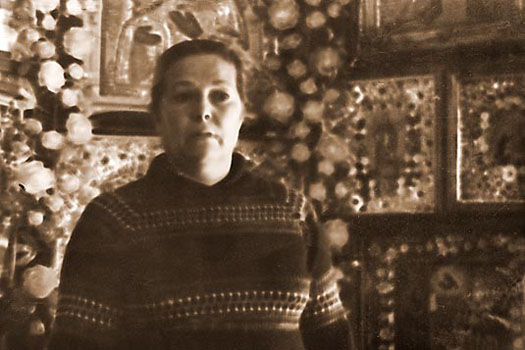
Zinaida Zhdanova.
Z. V. Zhdanova tells about the hardships of Matrona’s life: “I came to Sokolniki to visit Matushka. She lived in a small clapboard house that was let to her for a while. It was late autumn. I came in and found myself in a cloud of thick and wet steam, which came from an iron stove. I came up to Matushka. She was lying in bed facing the wall. Her hair had frozen to it. We could hardly tear the hair off the wall. I was horrified: “What’s this, Matushka? You know that I live together with my mother. My brother is at the front and my father is in prison. We have two rooms in a warm house, 48 square meters, with a separate entrance. Why didn’t you ask us to host you?” Matushka sighed and said: “God did not allow me so that you wouldn’t regret it afterwards.”
Before the war Matrona lived at a priest’s, Fr.Vasily’s, the husband of her care-giver Pelagia. Then St. Matrona lived in Pyatnitskaya Street, in a summer shed in Sokolniki, in Vishnyakov Lane in the basement at her niece’s, at Nikitskye Gates, in Petrovsko-Razumovskoye, in Sergiev Posad (then Zagorsk) at her nephew’s, and in Tsaritsyno. Her longest stay was on the Arbat. Here lived E.M. Zhdanova with her daughter Zinaida. They came from Matrona’s native village. They occupied a room of 48 square meters in an old wooden house. It was that room where icons occupied three walls, from the floor to the ceiling. Old icon lamps were hanging in front of the icons. The room was decorated with heavy, expensive curtains. Before the revolution of 1917 the house belonged to Zhdanova’s husband, who was from a rich noble family.
Sometimes Matrona would move out in a hurry, foreseeing the coming trouble. She did it always a day before the militia came to arrest her as she lived without registration. It was a hard time and people were afraid of registering her at their addresses. So, not only did Matrona escape arrests, but also saved the people she lived with.
However, Matrona was nearly arrested many times. Some of those around her were imprisoned or exiled. For example, Zinaida Zhdanova was sentenced as a member of a religious monarchist group.
Once Matrona called on her nephew Ivan in her prayer. Ivan lived in Zagorsk. Then he came to his boss and asked for a day off: “I really need to visit Auntie.” He came to her without knowing why. Matrona urged him to take her to his mother-in-law. Right after they left, the militia came. Things like that happened many times.
Once a militiaman came to arrest Matrona but she said: “Go home quickly! It’s an emergency. I am blind and can’t walk and won’t escape from you.” He believed her and rushed for home. There he found his wife who was accidentally severely burned. He was just in time to take her to hospital. The next day they asked him at work: “Have you arrested the blind one?” He answered: “I’ll never arrest her. But for her I would have lost my wife.”
While living in Moscow Matrona paid visits to her village. Sometimes people wanted her to support them. Sometimes she would come just because she missed her mother.
Apparently, her life was the same routine: ministering to people during the day, and praying at night. Like the ancient ascetics, she never really slept comfortably in bed. She normally had a short sleep lying on her side, her head resting on a small fist. The years passed.
Around 1940 Matrona once admonished someone saying: “Now you are quarrelling, but war is coming. Of course, many people will die, but the Russians will win.”
In the beginning of 1941 a woman asked Matushka if she should go on holiday. She was offered leave at work but did not want to have a break in winter. Matushka said to her: “One should go on holiday now as there’ll be no holidays for a long, long time. It will be war. We’ll win. Moscow won’t suffer from the enemy, but will burn a little. There’ll be no need to flee from Moscow.”
When the war began, Matushka asked people to bring her willow branches. She made sticks of the same length, peeled off the bark and prayed. Her fingers were sore. As we said, Matrona could visit different places spiritually and there was no obstacle to her spiritual vision. She often said that she was at the front line invisibly to help our soldiers. When the Germans were approaching Tula, she told everyone that they would never take hold of it. Her prophecy came true.
Matronushka saw up to forty people a day. They were bringing her their grief, sufferings, physical and emotional pain. No one was refused help, apart from those who came with a dishonest intention.
Some saw in her a sort of healer able to relieve people from misfortunes caused by evil-wishers. But after speaking to her they realised that she was a true servant of God. Meetings with St. Matrona turned many towards the Church and its sacraments. Matrona’s help was self-denying. She did not take anything from the people she helped.
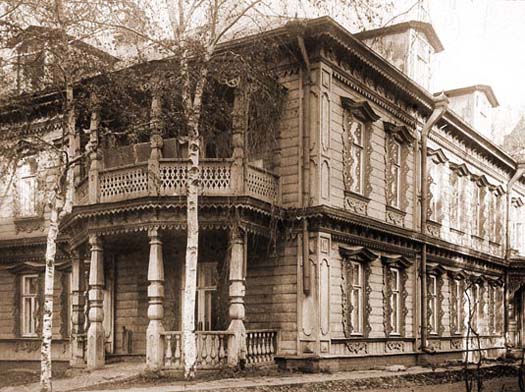
where St. Matrona live from 1942-49.
Matushka always read prayers loudly. These were usual prayers we hear in church and say at home: “Our Father”, “Let God arise”, Psalm 90, “O Lord Who upholdest all things, God of hosts and all flesh.” Matrona stressed the fact that it was not she who helped but God: “Do you think Matrona is God? Only God helps!”
Healing the infirm, Matrona demanded that they should trust in God and change their lives. For example, she asked a woman who visited her once whether she believed that God had the power to heal her. On another occasion, St. Matrona told a woman who suffered from epilepsy to attend every Sunday service and have confession and Holy Communion every time she was in church. Those whose marriage was not sanctified by the church were advised to go through a service of marriage. Wearing a cross was a must.
People came to Matrona with the usual needs and problems: an incurable disease, a loss, someone’s husband abandoning the family, broken hearts, job problems, harassment at work. They also asked for Matrona’s advice about getting married, moving or changing job.
There were also lots of infirm people: someone would fall ill, others would start barking all of a sudden, some would get paralysed or develop hallucinations. These sufferings were caused by witches, and were a result of demonical influence.
Once four men took an old woman to Matrona. The woman was waving her hands like a windmill. When Matushka had read the prayers of exorcism, the woman became quiet and got healed of her miserable condition.
A woman that often visited her brother in a mental hospital met a family on the way there. Their eighteen-year-old daughter was to be discharged from the hospital. On their way back she started barking. The woman said to her mother: “I feel so much for you. We are passing Tsaritsyno, let us take your daughter to Matronushka”. The girl’s father, a general, wouldn’t hear of it, but the mother insisted.
When the girl was approaching Matrona, her body became stiff like a stick and she started spitting at Matrona trying to get loose. “Leave her alone, she won’t cause any harm now”, Matrona said. They let her go. She fell on the floor in agony and vomited blood. Then she fell asleep and slept for three days. They looked after her. When she woke up, she asked her mother: “Where are we, Mummy?” “We are at a holy person’s house, daughter”. And she told her everything. The girl was healed of her disease.
Once an important woman came to see Matrona. Her husband died during the war and her only son had gone insane. It went without saying she was an atheist. She took her son to Europe to be examined by famous doctors, but that was not successful. “I have come to you in despair. I have no other place to go.” Matrona asked her: “If the Lord heals your son, will you believe in God?” “I don’t understand what it means—to believe.” Then Matrona asked for some water and started reading a prayer loudly over the water, in the presence of the woman. Then she gave her the water and said: “Go to the Kashchenko hospital and tell the orderlies to hold your son tight when they take him out. He’ll have an agony, but you should try to sprinkle the water into his eyes and mouth.”
After a while the woman came to Matrona again. She knelt down before Matrona and thanked her: her son was healed. She told her how it happened. She came to the hospital and was approaching the barrier in the visitors’ hall when her son came out. The small bottle with the water was in her pocket. Her son was shivering all over and shouting out: “Mother, throw away what you have in your pocket! Stop torturing me!” She was struck: how did he know? She sprinkled the water onto his face. When it got to his mouth, he became calm suddenly, and sense appeared in his eyes. “How wonderful!” he exclaimed. Soon he was discharged.
Often Matrona put her hands onto the head of a sick person and said: “In a minute I’ll cut your wings, but now you can fight a bit.” She would ask: “Who are you?” Suddenly something would buzz inside the person. Matrona would repeat the question, and the buzzing would get louder. Then she would pray saying: “The mosquito has had enough.” And the person would become healthy again.
Matrona also helped those who had problems in their family life. Once a woman came to her and complained that she had not married for love and her relationship with her husband left much to be desired. “Who’s to blame? You are to blame. Our head is the Lord, and the Lord has an image of a Man. We, women, should obey men. You should keep your wedding crown to the end of your days. So, it is you who are to blame for the uneasy situation,” Matrona said. The woman took Matrona’s advice and her married life changed for the better.
Zinaida Zhdanova says about Matrona: “Matushka Matrona fought for every soul that came to her and won. She never complained about the difficulties of her labour. I cannot forgive myself for never feeling sorry for Matushka, though I saw that she had a very hard time, sharing the burden of each of us. The light of those days still warms me. Icon lamps were lit in the house, and Matushka’s love and peace penetrated the soul. There was holiness, joy, peace and blessed warmth at home. It was a war time, but we lived like in heaven.”
What was she like, what image remained in the memory of those who knew her closely? She had miniature hands and feet, like those of a child. We remember her sitting on the bed or chest, with fluffy hair. Firmly closed eyelids. A kind face radiating light. A gentle voice.
She comforted the infirm, stroked them on the head, and blessed them with the sign of the cross. Sometimes she would joke, and sometimes reproach strictly and teach. But she wasn’t strict. She was tolerant to human weaknesses and was compassionate, warm and sympathetic. She was always joyful and never complained about her health and sufferings. Matushka did not preach. She gave some practical advice about a particular situation, prayed and blessed people.
She was not a person of many words and answered the questions laconically. Some of her general advice remained:
Matushka taught not to judge our neighbour. “Why judge other people? Think more of yourself. Every sheep will be hung by its tail. What business do you have with others’ tails? Think of yours.” Matushka taught people to leave their lives to God’s will, to live with prayer, to cross oneself and everything around to protect oneself from evil. She advised to have Holy Communion often. “Protect yourselves with the sign of the cross, prayer, holy water, frequent Communion…Light lamps before the icons.”
She also taught to love and forgive the old and infirm. “If the old or infirm or someone not in his right mind tells you something that hurts you, take no notice but help them. You should help the infirm eagerly, doing your best, and should forgive them whatever they say.”
Matrona forbade believing dreams: “Take no notice of them, they can be from the evil one, to upset a person, to make him think of empty things.”
Matrona warned people not to spend time looking for elders. By asking many different priests for advice in search of an elder one can lose spiritual strength and the right direction in life.
Here are her own words: “The world lies in evil, and delusion and temptation will be open, not disguised. Take care not to fall.” “If you go to an elder or priest for advice, pray that the Lord gives him wisdom to tell you the right thing.” She taught not to be curious of priests and their lives. She told those who wanted to reach Christian perfection not to stand out from the rest in appearance or manner, for example, by wearing black or something like that.
She taught to be patient. Once she said to Zinaida Zhdanova: “Go to church and don’t watch anyone there. Pray with your eyes closed or look at some icon.” St. Seraphim of Sarov gave the same advice, as well as some other holy fathers. All in all, there was nothing in Matrona’s advice that contradicted the Holy Fathers.
Matushka considered using make-up a serious sin. By doing so women distort the image of God in them by adding features that the Lord did not make. This creates false beauty that leads to corruption.
St. Matrona would say to those girls that first came to God: “God will forgive everything of you virgins, if you are faithful to Him. Those who decide to remain in chastity should be firm to the end. The Lord will give you a crown for that.”
“When the enemy approaches you, you should pray. A sudden death can occur if one does not pray. The enemy sits on our left shoulder, and the angel—on the right. Each of them has a book: sins are written down in one book, and good deeds in the other. Cross yourself as frequently as possible! The cross is like a lock on the door.” She also taught not to forget to bless the food: “Protect yourself with the power of the Holy and Life-giving Cross.”
About witches Matushka taught: “For those who voluntarily unite with the powers of evil and practise witchcraft, there is no way out. One should never ask ‘healers’ for help. They heal one thing and harm the soul.”
Matushka often told her close people that she was fighting with those practising witchcraft, invisibly. Once a very noble-looking old man with a white beard came to Matrona and knelt down before her in tears: “My only son is dying.” Matushka bent to him and asked in a low voice: “How bad did you do it to him? To death or not?” “To death.” “Go away from me, you shouldn’t have come to me.”
After he left she said: “Wizards and witches know God. If only you could pray like them when they ask God to forgive them for the evil they caused!”
Matushka venerated the late priest Valentine Amphiteatrov. She said he was great in the eyes of God and helped those who asked for his help at his grave. Sometimes she sent her visitors to take some sand from his grave.
Massive disbelief, aggressive attacks on the Christian faith, growing estrangement and malice among people, rejection of the tradition by millions of people, and sinful life without repentance had many tragic consequences. Matrona understood it well.
On the days of communist processions Matushka asked us not to go out and to shut the windows and doors tightly because she said crowds of demons occupied the whole space and all people. Maybe the Blessed Eldress, who often spoke in parables, thus reminded us of the necessity to keep our senses—“the windows of the soul” in the terminology of the Holy Fathers—shut against the evil spirits.
Zinaida Zhdanova once asked Matushka, “Why did God let it happen that so many churches were closed or destroyed?” Matushka answered: “There is God’s will in that, as there’ll be few believers and ministers.” “Why is no one fighting against that?” “The people are hypnotised; horrible powers have come… This power is in the air, everywhere now, and it penetrates everything. Earlier it lived only far away in the bogs and forests. People went to church, wore crosses and their houses were protected by icons and lamps and were blessed. Demons could not enter houses like that, but now they live even in people because humans are now rejecting the faith and God.”
Some people wanted to unveil the mystery of Matrona’s spiritual life and watched her secretly during the night. St. Matrona would pray and prostrate whole nights through.
While living at the Zhdanovs’, Matronushka had confession and Holy Communion from Fr. Dimitry, a priest in a church in Krasnaya Presnya. Constant prayer helped Blessed Matrona to bear the cross of serving people, which was a real labour and martyrdom, the highest expression of love. Praying for people possessed by demons, as well as for everyone else, sharing people’s grief Matushka got so tired that by the end of the day she couldn’t speak and only moaned quietly, having laid her head on her tiny fist. As regards her inner life, it remained secret even for her nearest and dearest.
Though no one knew Matushka’s spiritual life, people did not doubt her holiness and asceticism. Her ministry was in her great patience that came from her pure heart and ardent love of God. It is this patience that will save the Christians of the last times, as holy fathers of the Church prophesied. As a real ascetic, the Blessed Eldress taught not only by her words, but also by her whole life. Apparently blind, she taught people how to acquire spiritual vision. Unable to walk, she taught and is teaching us even now how to walk on the hard path to salvation.
Zinaida Zhdanova writes: “Who was Matronushka? Matushka was a warrior angel, as if she had a sword of fire in her hands to fight the evil power. She healed people with prayer and holy water… She was small as a child. She always half-lay on her fist and half-sat. That was the only way she slept; she never lay comfortably. When she received people she sat with her hands over the head of the visitor. She would bless the person, say the most important thing and pray for him.
She never had a house of her own, nor did she possess anything. She lived in those houses or flats where she was invited. When grateful visitors brought food to her, she had no right of distributing it herself the way she thought best. She always had to obey a woman called Pelagia who was unkind and who commanded in the house, giving nearly all presented food to her relatives. Matushka could neither eat nor drink without her consent.
Matushka seemed to know everything ahead. Every day of her life was a stream of grief and miseries of her visitors. She helped the infirm, comforted and healed them. Her prayer healed many. She would take the head of the crying person into her hands, comfort and warm him with her holiness, and he would leave as if on wings. And she, exhausted, would only sigh and pray all night long. She had a kind of dimple on her forehead as a result of crossing herself frequently. She always did it very carefully taking her time, the fingers were searching for the dimple…”
During the war, many times she answered the question that many of her visitors were worried by most: what happened to their relatives, particularly to those on the front—were they alive, or not? To some she would say: “Wait for him, he’s alive.” Some were told to pray for their loved ones as for the departed.
It is very likely that those who wanted spiritual guidance asked Matrona to be their teacher. Many priests in Moscow and monks in St. Sergius Holy Trinity Lavra knew about Matushka. But Providence chose it so that Matrona had no disciples who could witness her life to be able to tell future generations about it.
People from her native village often visited her. She also received notes with questions from those in her neighbourhood, and answered them. Some would come for help from areas as remote as two hundred or three hundred kilometres away, and she knew their names. There were Muscovites as well as visitors from other cities that heard of Matushka’s gift of spiritual vision. They were people of all ages: young, old and middle-aged. She would receive some, and reject others. With some people she spoke plainly, with others—in parables.
Once Zinaida complained about her nerves. Matushka answered: “There are no nerves at war or in prison… One should be self-possessed and patient.”
Matushka taught that one should not ignore medical treatment. The body is like a house given by God so it sometimes needs repair. God created the world and, in it, medical herbs, and one should not ignore them.
Matushka felt sorry for her close ones: “I am so sorry for you, you’ll live to the last times. Life will get worse and worse. The time will come when they put the cross and the bread in front of you and ask you to make your choice.” “We’ll choose the cross, but how shall we live?” “We’ll pray to God, take some soil, form it into little balls, eat them and be no more hungry.”
On another occasion she comforted a person and urged not to fear anything: “Imagine a carefree child who is carried around in the sledge. The Lord will sort out everything.”
Matronushka often said: “If a nation loses faith in God, it faces scourges, and if it does not repent, it disappears from the earth. How many peoples have disappeared, but Russia existed and will exist. Pray, ask, repent! The Lord will not abandon you and will keep our land!”
Matrona’s last shelter on earth was in a place outside Moscow, Skhodnya, where she moved from the city centre. Matrona’s distant relation lived there. Here, too, came a stream of visitors bringing their suffering. Only before death, Matushka, who had grown weak, wanted to limit the number of people she could see. But people kept coming, and she could not refuse them help. They say that she knew the day of her death from God three days in advance, and she made all the necessary arrangements. Matushka asked for the burial service to be conducted in the Church of Laying of the Robe in Donskaya Street. She asked not to bring wreathes or artificial flowers to her funeral.
During her last days, she had the sacraments of confession and Holy Communion from priests that visited her. As anyone else, she was afraid of dying and did not conceal her fear from her close ones. Right before her death, Fr. Dimitry came to her to hear her confession. She was worried whether she put her arms on her chest correctly before taking the Sacrament. He asked her in surprise: “Are you afraid of dying?” “I am, indeed.”
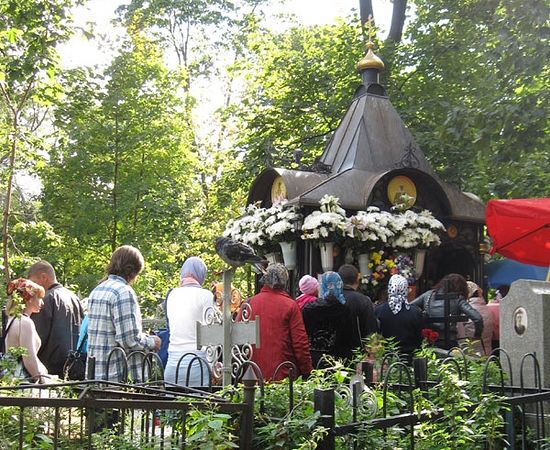
St. Matrona's grave in the Danilov cemetery.
On May the 2nd, 1952 St. Matrona departed this life. On the next day, the name of newly departed Blessed Matrona came on an intercession list to the St. Sergius-Holy Trinity Lavra. The celebrating hieromonk noticed it and immediately went out of the sanctuary and asked the people in worry: “Who brought the note? Did she die?” No wonder he knew, her because many monks in the Lavra venerated Matrona. An old woman and her daughter who came from Moscow confirmed that Matushka had died the day before, saying where her body would be placed the next morning for farewell. This is how the monks in the Lavra learned about her death and were able to come to her funeral. After the burial service that was celebrated by Fr.Nikolay Golubtsov, everyone came to kiss her hands.
On May the 4th, the Sunday of Myrrh-bearing women, was the day of Matrona’s funeral. According to her wish she was buried in Danilov Cemetery so that “she could hear the service”. Great numbers of Orthodox people started venerating St. Matrona as a true servant of God immediately after her funeral.
St. Matrona's grave in the Danilov cemetery.
St. Matrona's grave in the Danilov cemetery.
Blessed Matrona said: “After my death few people will come to my grave, only my closest. When they die, my grave will be abandoned, and will bevisited only occasionally… But many years later people will learn about me and will come in crowds to ask for help in their troubles. They will ask me to pray for them to the Lord, and I will hear and help everybody.”
Before her death she said: “Come, come to me, all. Tell me about your troubles, as if I were alive, and I will see you and hear you, and help you.” Matushka also said that those who would seek her intercession before God would be saved. “All those who ask me for help I will meet after their death, everyone.”
Over thirty years after she died, her grave in Danilov Cemetery became one of the holy places in the Orthodox Moscow. People from all over Russia and abroad would come there with their miseries and illnesses exactly as they did when she was alive.
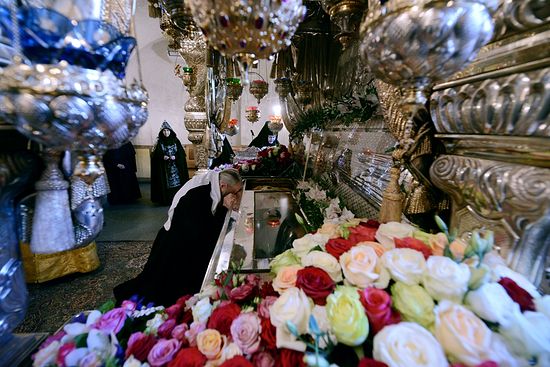
Patriarch Kirill at the relics of St. Matrona of Moscow in the Protection Monastery, Moscow, where they rest today.
Blessed Matrona was an Orthodox Christian in the very deep and traditional meaning of the word. Compassion to people that came from the bottom of her loving heart, her prayer, the sign of the cross, her unfailing faithfulness to the holy statutes of the Orthodox Church were the core of her ardent spiritual life. The nature of her ministry originates in the centuries of godliness and piety. That is why her assistance to people bears spiritual fruit: people become firm in the Orthodox faith, they become attached to the Church outwardly and in their inner self, they actively participate in the daily life of prayer.
Matrona is known by tens of thousands of Orthodox people. They call her affectionately “Matronushka”. She helps people as in the days when she lived. Those who ask her for intercession soon feel it, and she prays for them to God with great boldness.
The Convent of the Protection, Moscow
Translation by Liudmila and Evgeny Selensky
01 / 05 / 2015







 Posts

