
Below, please find the full text of Fr. Raniero Cantalamessa, OFMCap, Preacher of the Papal Household, delivered Good Friday, April 6th, 2012, in St. Peter's Basilica, during the Passion liturgy.
****************************
Father Raniero Cantalamessa, ofm cap: “I DIED, AND BEHOLD I AM ALIVE FOR EVERMORE”
(Revelation 1:18)Homily of Good Friday 2012 in Saint Peter’s Basilica

Some ancient Fathers of the Church enclosed in an image the whole mystery of the redemption. Imagine, they said, that an epic fight took place in the stadium. A courageous man confronted a cruel tyrant who had the city enslaved and, with enormous effort and suffering, defeated him. You were on the terraces; you did not fight, or make an effort or get wounded. However, if you admire the courageous man, if you rejoice with him over his victory, if you intertwine crowns, arouse and stir the assembly for him, if you kneel joyfully before the triumphant one, kiss his head and shake his right hand; in a word, if you rave so much as to consider his victory yours, I tell you that you will certainly have part of the victor’s prize. However, there is more: imagine that the victor had himself no need of the prize he had won, but wished more than anything to see his supporter honored and considers as the prize of his combat the crowning of his friend, in that case, perhaps, will that man not obtain the crown also though he has not toiled on been wounded? He certainly will obtain it![1]
It happens thus, say the Fathers, between Christ and us. On the cross, he defeated the ancient enemy. “Our swords – exclaims Saint John Chrysostom – were not bloodied, we were not in agony, we were not wounded, we did not even see the battle and yet we obtain the victory. His was the fight, ours the crown. And because we are also the conquerors, let us imitate what soldiers do in such cases: with joyful voices let us exalt the victory, let us intone hymns of praise to the Lord!”[2] It is not possible to explain better the meaning of the liturgy we are celebrating. * * *
However, is what we are doing itself an image, a representation of a reality of the past, or is it the reality itself? It is both things! “We – said Saint Augustine to the people – know and believe with very certain faith that Christ died only once for us […]. You know perfectly that all that happened only once, and yet the solemnity renews it periodically […]. Historical truth and liturgical solemnity are not opposed to one another, as if the second is fallacious and the first alone corresponds to the truth. In fact, of what history says occurred only once in reality, the solemnity repeatedly renews the celebration in the hearts of the faithful.”[3]The liturgy “renews” the event: how many discussions have taken place for the past five centuries on the meaning of this word, especially when it is applied to the sacrifice of the cross and to the Mass! Paul VI used a verb that could smooth the way to an ecumenical agreement on such an argument: the verb “to represent,” understood in the strong sense of re-presenting, namely to render what happened again present and operative.[4]
There is an essential difference between the representation of Christ’s death and that, for example, of the death of Julius Caesar in Shakespeare’s tragedy of the same name. No one celebrates as a living person the anniversary of his own death; Christ does because he is risen. Only he can say, as he does in Revelation: “I died, and behold I am alive ever more” (Revelation 1:18). We must be careful on this day, visiting the so-called sepulchers or taking part in processions of the dead Christ, not to merit the reproach that the Risen One addressed to the pious women on Easter morning: “Why do you seek the living among the dead?” (Luke 24:5). The affirmation of certain Orthodox authors is bold but true. The anamnesis, namely the liturgical memorial, “renders the event truer than when it happened historically the first time.” In other words, it is more true and real for us who relive it “according to the Spirit,” than it was for those who lived it “according to the flesh,” before the Holy Spirit revealed the full meaning to the Church.
We are not only celebrating an anniversary but a mystery. Again, it is Saint Augustine who explains the difference between the two things. In the celebration “by way of anniversary,” nothing else is required – he says – than to “indicate with a religious solemnity the day of the year in which the recollection of the event itself takes place;” in the celebration by way of mystery (“in sacrament”), “not only is an event commemorated but it is also done in a way in which its meaning is understood and it is received devoutly.”[5]This changes everything. It is not just a question of attending a representation, but of “accepting” the significance, of passing from spectators to actors. It is up to us therefore to choose what part we want to play in the drama, who we wish to be: Peter, Judas, Pilate, the crowd, the Cyrenean, John, Mary … No one can remain neutral; not take a position, means to take a very precise one: Pilate’s who washes his hands or the crowd “standing by, watching” (Luke 23:35).
If when going home this evening, someone asks us “Where are you coming from? Where have you been?” We must also answer, at least in our heart: “on Calvary!”* * *
However, all this does not happen automatically, just because we have taken part in this liturgy. It is a question of “accepting” the meaning of the mystery. This happens with faith. There is no music where there is no ear to hear it, no matter how loud the orchestra sounds; there is no grace where there is no faith to receive it. In an Easter homily of the 4th century, the bishop pronounced these extraordinarily modern, and one could say existentialist, words: “For every man, the beginning of life is when Christ was immolated for him. However, Christ is immolated for him at the moment he recognizes the grace and becomes conscious of the life procured for him by that immolation.”[6]
However, let us stay on the safe side; let us listen to a doctor of the Church. “What I cannot obtain by myself – writes Saint Bernard --, I appropriate (literally, I usurp!) with confidence from the pierced side of the Lord., because he is full of mercy. Hence my merit is the mercy of God. I am certainly not poor in merits, as long as he is rich in mercy. If the mercies of the Lord are many (Psalm 119:156), I will also abound in merits. And what about my own righteousness? O Lord, I will remember only your righteousness. In fact, it is also mine, because you are righteousness for me on behalf of God” (cf. 1 Corinthians 1:30).[7]Did this way of conceiving holiness make Saint Bernard, perhaps, less zealous in good works, less committed to the acquisition of virtues? Did perhaps the apostle Paul neglect to mortify his body and reduce it to slavery (cf. 1 Corinthians 9:27), he who, before all and more than all, had made of this appropriation of Christ’s righteousness the purpose of his life and of his preaching (cf. Philippians 3:7-9)?
In Rome, as unfortunately in all big cities, there are so many homeless people, human persons who only have a few rags upon their body and some poor belongings that they carry along in a plastic bag. Let us imagine that one day this voice spreads: on Via Condotti (everyone knows what Via Condotti represents in Rome!) there is the owner of a fashion boutique who, for some unknown reason, whether out of interest or generosity, invites all the homeless of Termini rail way station to come to her shop; she invites them to take off their soiled rags, to have a good shower and then choose the garment they want among those displayed and take it away free of charge.All say in their heart: “This is a fairy-tale, it never happens!” Very true, but what never happens among men is what can happen every day between men and God, because, before Him, we are those homeless people! This is what happens in a good confession: you take off your dirty rags, your sins, receive the bath of mercy and rise “clothed in the garments of salvation, covered with the robe of righteousness” (Isaiah 61:10).
The tax collector of the parable went up into the temple to pray; he said simply but from the depth of his heart: “God, be merciful to me a sinner!”, and “he went down to his house justified” (Luke 18:14), reconciled, made new, innocent. The same could be said of us, if we have his same faith and repentance, when we go home after this liturgy. * * *
Among the personages of the Passion with whom we can identify, I realize that I have neglected to name one that more than all awaits those who will follow his example: the good thief. The good thief made a complete confession of sin; he says to his companion who insults Jesus: “Do you not fear God, since you are under the same sentence of condemnation? And we indeed justly, for we are receiving the due reward of our deeds; but this man has done nothing wrong” (Luke 23:40f.). Here the good thief shows himself an excellent theologian. Only God in fact, if he suffers, suffers absolutely as innocent; every other being who suffers should say: “I suffer justly,” because even if he is not responsible for the action imputed to him, he is never altogether without fault. Only the pain of innocent children is similar to God’s and because of this it is so mysterious and so sacred.
How many atrocious crimes in recent times remained anonymous, how many unresolved cases exist! The good thief launches an appeal to those responsible: do like me, come out into the open, confess your fault; you also will experience the joy I had when I heard Jesus’ word: “”today you will be with me in Paradise!” (Luke 23:43). How many confessed offenders can confirm that it was also like this for them: that they passed from hell to heaven the day that they had the courage to repent and confess their fault. I have known some myself. The paradise promised is peace of conscience, the possibility of looking at oneself in the mirror or of looking at one’s children without having to have contempt for oneself. Do not take your secret to your grave; it would procure for you a far more fearful condemnation than the human. Our people are not merciless with one who has made a mistake but recognizes the evil done, sincerely, not just for some calculation. On the contrary! They are ready to be merciful and to accompany the repentant one on his journey of redemption (which in every case becomes shorter). “God forgives many things, for a good work,” says Lucia to the Unnamed in Manzoni’s novel “The Betrothed”; with greater truth we can say, he forgives many things by one act of repentance. He promised it solemnly: “though your sins are like scarlet, they shall be as white as snow; though they are red like crimson, they shall become like wool” (Isaiah 1:18).
Let us take up now and do what we heard at the beginning, it is our task this day: with joyful voices let us exalt the victory of the cross, intone hymns of praise to the Lord. “O Redemptor, sume carmen temet concinentium”[8]: And you, O our Redeemer, receive the song we raise to you.
1. Nicholas Cabasilas, Vita in Christo, I. 9 (PG 150, 517)2. Saint John Chrysostom, De coemeterio et de cruce (PG, 49, 596).
3. Saint Augustine, Sermon 220 (PL 38, 1089).4. Cf. Paul VI, Mysterium fidei (AAS 57, 1965, p. 753 ff).
5. Augustine, Epistle 55, 1, 2 (CSEL 34, 1, p. 170). 6. Paschal Homily of the year 387 (SCh 36, p. 59 f.).
7. Saint Bernard of Clairvaux, Sermons on the Canticle, 61, 4-5 (PL 183, 1072). 8. Hymn of Palm Sunday and of the Chrism Mass of Maundy Thursday.

By: Father Alexander Schmemann
Friday: The Cross
From the light of Holy Thursday we enter into the darkness of Friday, the day of Christ's Passion, Death and Burial. In the early Church this day was called "Pascha of the Cross," for it is indeed the beginning of that Passover or Passage whose whole meaning will be gradually revealed to us, first, in the wonderful quiet of the Great and Blessed Sabbath, and, then, in the joy of the Resurrection day.
But, first, the Darkness. If only we could realize that on Good Friday darkness is not merely symbolical and commemorative. So often we watch the beautiful and solemn sadness of these services in the spirit of self-righteousness and self-justification. Two thousand years ago bad men killed Christ, but today we -- the good Christian people -- erect sumptuous Tombs in our Churches -- is this not the sign of our goodness? Yet, Good Friday deals not with past alone. It is the day of Sin, the day of Evil, the day on which the Church invites us to realize their awful reality and power in "this world." For Sin and Evil have not disappeared, but, on the contrary, still constitute the basic law of the world and of our life. And we who call ourselves Christians, do we not so often make ours that logic of evil which led the Jewish Sanhedrin and Pontius Pilate, the Roman soldiers and the whole crowd to hate, torture and kill Christ? On what side, with whom would we have been, had we lived in Jerusalem under Pilate? This is the question addressed to us in every word of Holy Friday services. It is, indeed, the day of this world, its real and not symbolical, condemnation and the real and not ritual, judgment on our life... It is the revelation of the true nature of the world which preferred then, and still prefers, darkness to light, evil to good, death to life. Having condemned Christ to death, "this world" has condemned itself to death and inasmuch as we accept its spirit, its sin, its betrayal of God -- we are also condemned... Such is the first and dreadfully realistic meaning of Good Friday -- a condemnation to death...
The Day of Redemption

But this day of Evil, of its ultimate manifestation and triumph, is also the day of Redemption. The death of Christ is revealed to us as the saving death for us and for our salvation.
It is a saving Death because it is the full, perfect and supreme Sacrifice. Christ gives His Death to His Father and He gives His Death to us. To His Father because, as we shall see, there is no other way to destroy death, to save men from it and it is the will of the Father that men be saved from death. To us because in very truth Christ dies instead of us. Death is the natural fruit of sin, an immanent punishment. Man chose to be alienated from God, but having no life in himself and by himself, he dies. Yet there is no sin and, therefore, no death in Christ. He accepts to die only by love for us. He wants to assume and to share our human condition to the end. He accepts the punishment of our nature, as He assumed the whole burden of human predicament. He dies because He has truly identified Himself with us, has indeed taken upon Himself the tragedy of man's life. His death is the ultimate revelation of His compassion and love. And because His dying is love, compassion and co-suffering, in His death the very nature of death is changed. From punishment it becomes the radiant act of love and forgiveness, the end of alienation and solitude. Condemnation is transformed into forgiveness...
The Destruction of Death
And, finally, His death is a saving death because it destroys the very source of death: evil. By accepting it in love, by giving Himself to His murderers and permitting their apparent victory, Christ reveals that, in reality, this victory is the total and decisive defeat of Evil. To be victorious Evil must annihilate the Good, must prove itself to be the ultimate truth about life, discredit the Good and, in one word, show its own superiority. But throughout the whole Passion it is Christ and He alone who triumphs. The Evil can do nothing against Him, for it cannot make Christ accept Evil as truth. Hypocrisy is revealed as Hypocrisy, Murder as Murder, Fear as Fear, and as Christ silently moves towards the Cross and the End, as the human tragedy reaches its climax, His triumph, His victory over the Evil, His glorification become more and more obvious. And at each step this victory is acknowledged, confessed, proclaimed -- by the wife of Pilate, by Joseph, by the crucified thief, by the centurion. And as He dies on the Cross having accepted the ultimate horror of death: absolute solitude (My God, My God, why hast Thou forsaken me!?), nothing remains but to confess that "truly this was the Son of God!..." And, thus, it is this Death, this Love, this obedience, this fullness of Life that destroy what made Death the universal destiny. "And the graves were opened..." (Matthew 27:52) Already the rays of resurrection appear.
Such is the double mystery of Holy Friday, and its services reveal it and make us participate in it. On the one hand, there is the constant emphasis on the Passion of Christ as the sin of all sins, the crime of all crimes. Throughout Orthros during which the twelve Passion readings make us follow step by step the sufferings of Christ, at the Hours (which replace the Divine Liturgy: for the interdiction to celebrate Eucharist on this day means that the sacrament of Christ's Presence does not belong to "this world" of sin and darkness, but is the sacrament of the "world to come") and finally, at Vespers, the service of Christ's burial the hymns and readings are full of solemn accusations of those, who willingly and freely decided to kill Christ, justifying this murder by their religion, their political loyalty, their practical considerations and their professional obedience.
But, on the other hand, the sacrifice of love which prepares the final victory is also present from the very beginning. From the first Gospel reading (John 13:31) which begins with the solemn announcement of Christ: "Now is the Son of Man glorified and in Him God is glorified" to the stichera at the end of Vespers -- there is the increase of light, the slow growth of hope and certitude that "death will trample down death..."
And when, at the end of Vespers, we place in the center of the Church the image of Christ in the tomb, when this long day comes to its end, we know that we are at the end of the long history of salvation and redemption. The Seventh Day, the day of rest, the blessed Sabbath comes and with it -- the revelation of the Life-giving Tomb.
AN ORTHODOX INTRODUCTION TO THE
GREAT AND HOLY FRIDAY
By: Father Alexander Schmemann
Friday: The Cross
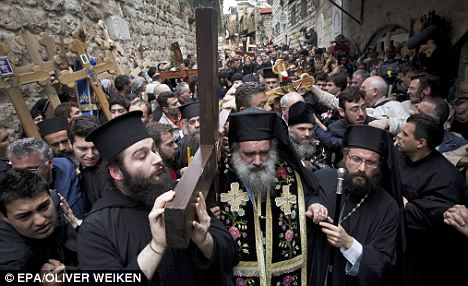
From the light of Holy Thursday we enter into the darkness of Friday, the day of Christ's Passion, Death and Burial. In the early Church this day was called "Pascha of the Cross," for it is indeed the beginning of that Passover or Passage whose whole meaning will be gradually revealed to us, first, in the wonderful quiet of the Great and Blessed Sabbath, and, then, in the joy of the Resurrection day.
But, first, the Darkness. If only we could realize that on Good Friday darkness is not merely symbolical and commemorative. So often we watch the beautiful and solemn sadness of these services in the spirit of self-righteousness and self-justification. Two thousand years ago bad men killed Christ, but today we -- the good Christian people -- erect sumptuous Tombs in our Churches -- is this not the sign of our goodness? Yet, Good Friday deals not with past alone. It is the day of Sin, the day of Evil, the day on which the Church invites us to realize their awful reality and power in "this world." For Sin and Evil have not disappeared, but, on the contrary, still constitute the basic law of the world and of our life. And we who call ourselves Christians, do we not so often make ours that logic of evil which led the Jewish Sanhedrin and Pontius Pilate, the Roman soldiers and the whole crowd to hate, torture and kill Christ? On what side, with whom would we have been, had we lived in Jerusalem under Pilate? This is the question addressed to us in every word of Holy Friday services. It is, indeed, the day of this world, its real and not symbolical, condemnation and the real and not ritual, judgment on our life... It is the revelation of the true nature of the world which preferred then, and still prefers, darkness to light, evil to good, death to life. Having condemned Christ to death, "this world" has condemned itself to death and inasmuch as we accept its spirit, its sin, its betrayal of God -- we are also condemned... Such is the first and dreadfully realistic meaning of Good Friday -- a condemnation to death...
The Day of Redemption

But this day of Evil, of its ultimate manifestation and triumph, is also the day of Redemption. The death of Christ is revealed to us as the saving death for us and for our salvation.
It is a saving Death because it is the full, perfect and supreme Sacrifice. Christ gives His Death to His Father and He gives His Death to us. To His Father because, as we shall see, there is no other way to destroy death, to save men from it and it is the will of the Father that men be saved from death. To us because in very truth Christ dies instead of us. Death is the natural fruit of sin, an immanent punishment. Man chose to be alienated from God, but having no life in himself and by himself, he dies. Yet there is no sin and, therefore, no death in Christ. He accepts to die only by love for us. He wants to assume and to share our human condition to the end. He accepts the punishment of our nature, as He assumed the whole burden of human predicament. He dies because He has truly identified Himself with us, has indeed taken upon Himself the tragedy of man's life. His death is the ultimate revelation of His compassion and love. And because His dying is love, compassion and co-suffering, in His death the very nature of death is changed. From punishment it becomes the radiant act of love and forgiveness, the end of alienation and solitude. Condemnation is transformed into forgiveness...
The Destruction of Death
And, finally, His death is a saving death because it destroys the very source of death: evil. By accepting it in love, by giving Himself to His murderers and permitting their apparent victory, Christ reveals that, in reality, this victory is the total and decisive defeat of Evil. To be victorious Evil must annihilate the Good, must prove itself to be the ultimate truth about life, discredit the Good and, in one word, show its own superiority. But throughout the whole Passion it is Christ and He alone who triumphs. The Evil can do nothing against Him, for it cannot make Christ accept Evil as truth. Hypocrisy is revealed as Hypocrisy, Murder as Murder, Fear as Fear, and as Christ silently moves towards the Cross and the End, as the human tragedy reaches its climax, His triumph, His victory over the Evil, His glorification become more and more obvious. And at each step this victory is acknowledged, confessed, proclaimed -- by the wife of Pilate, by Joseph, by the crucified thief, by the centurion. And as He dies on the Cross having accepted the ultimate horror of death: absolute solitude (My God, My God, why hast Thou forsaken me!?), nothing remains but to confess that "truly this was the Son of God!..." And, thus, it is this Death, this Love, this obedience, this fullness of Life that destroy what made Death the universal destiny. "And the graves were opened..." (Matthew 27:52) Already the rays of resurrection appear.
Such is the double mystery of Holy Friday, and its services reveal it and make us participate in it. On the one hand, there is the constant emphasis on the Passion of Christ as the sin of all sins, the crime of all crimes. Throughout Orthros during which the twelve Passion readings make us follow step by step the sufferings of Christ, at the Hours (which replace the Divine Liturgy: for the interdiction to celebrate Eucharist on this day means that the sacrament of Christ's Presence does not belong to "this world" of sin and darkness, but is the sacrament of the "world to come") and finally, at Vespers, the service of Christ's burial the hymns and readings are full of solemn accusations of those, who willingly and freely decided to kill Christ, justifying this murder by their religion, their political loyalty, their practical considerations and their professional obedience.
But, on the other hand, the sacrifice of love which prepares the final victory is also present from the very beginning. From the first Gospel reading (John 13:31) which begins with the solemn announcement of Christ: "Now is the Son of Man glorified and in Him God is glorified" to the stichera at the end of Vespers -- there is the increase of light, the slow growth of hope and certitude that "death will trample down death..."
"Hell shuddered when it beheld Thee, the Redeemer of all Who was laid in a tomb. Its bonds were broken; its gates were smashed! The tombs were opened; the dead arose. Then Adam cried in joy and thanksgiving: Glory to Thy condescension, O Lover of man!”
And when, at the end of Vespers, we place in the center of the Church the image of Christ in the tomb, when this long day comes to its end, we know that we are at the end of the long history of salvation and redemption. The Seventh Day, the day of rest, the blessed Sabbath comes and with it -- the revelation of the Life-giving Tomb.
Good Friday. Via Crucis
by Pope Benedict XVI
March 21, 2008
The Byzantine icon has the insignia “King of Glory” which indeed is the true title of the crucified Christ
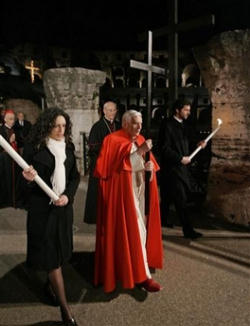
Dear brothers and sisters, this year too we have walked along the way of the cross, the Via Crucis, evoking again with faith the stages of the passion of Christ. Our eyes have turned to contemplate the sufferings and the anguish that our Redeemer had to bear in the hour of great sorrow, which entailed the highpoint of his earthly mission. Jesus dies on the cross and lies in the tomb. The day of Good Friday, so permeated by human sadness and religious silence, closes in the silence of meditation and prayer. In returning home, we too, like those who were present at the sacrifice of Jesus, beat our breasts, recalling what happened. Is it possible to remain indifferent before the death of the Lord, of the Son of God? For us, for our salvation he became man, so as to be able to suffer and die.
Brothers and sisters, let us direct today our gaze toward Christ, a gaze frequently distracted by scattered and passing earthly interests. Let us pause to contemplate his cross. The cross, fount of life and school of justice and peace, is the universal patrimony of pardon and mercy. It is permanent proof of a self-emptying and infinite love that brought God to become man, vulnerable like us, unto dying crucified.
Through the sorrowful way of the cross, the men of all ages, reconciled and redeemed by the blood of Christ, have become friends of God, sons of the heavenly Father. "Friend," is what Jesus calls Judas and he offers him the last and dramatic call to conversion. "Friend," he calls each of us, because he is the authentic friend of everyone. Unfortunately, we do not always manage to perceive the depth of this limitless love that God has for us. For him, there is no distinction of race or culture. Jesus Christ died to liberate the humanity of old of their ignorance of God, of the circle of hate and violence, of the slavery to sin. The cross makes us brothers and sisters.
But let us ask ourselves, in this moment, what have we done with this gift, what have we done with the revelation of the face of God in Christ, with the revelation of the love of God that conquers hate. Many, in our age as well, do not know God and cannot encounter him in Christ crucified. Many are in search of a love or a liberty that excludes God. Many believe they have no need of God.
Dear friends: After having lived together the passion of Jesus, let us this night allow his sacrifice on the cross to question us. Let us permit him to challenge our human certainties. Let us open our hearts. Jesus is the truth that makes us free to love. Let us not be afraid: upon dying, the Lord destroyed sin and saved sinners, that is, all of us. The Apostle Peter writes: "He himself bore our sins in his body upon the cross, so that, free from sin, we might live for righteousness" (1 Peter 2:24). This is the truth of Good Friday: On the cross, the Redeemer has made us adoptive sons of God who he created in his image and likeness. Let us remain, then, in adoration before the cross.
Christ, give us the peace we seek, the happiness we desire, the love the fills our heart thirsty for the infinite. This is our prayer for this night, Jesus, Son of God, who died for us on the cross and was resurrected on the third day. Amen.
Station of the Cross Meditations 2016
This year’s meditations for the Stations of the Cross have been written by Cardinal Gualtiero Bassetti, archbishop of Perugia.In a March 16 interview with L’Osservatore Romano, Cardinal Bassetti said he chose the title “God Is Mercy” for this year’s meditations. He said the Way of the Cross as well as the Year of Mercy “speak to all men and women of today who seem to me more and more lonely and confused, inserted into a society in continuous movement that rapidly consumes everything — goods, affections and desires — and that seems to have lost both the notion of sin and truth.”People today, he said, “seem to me dramatically unhappy and suffering.”He highlighted how there is currently the “visible suffering” seen in the poor, the migrant, the sick, the alone and the abandoned. “But at the same time, we meet rich men who seem to have everything, but, in reality, have nothing — they live an empty life and, in some cases, even desire death. As someone once wrote, evil, therefore, can also be ‘banal,’ but Jesus on the cross gives another meaning to life and shows a different path: that of conversion.”Cardinal Bassetti said he will make many references to the magisterium and draw on the teachings of John XXIII, John Paul II, Benedict XVI and Pope Francis. But more important than quotes, he said he has tried to “speak to the human heart.”“In every station, I have tried to make reference to current events,” he said, adding that he refers to the “new martyrs” who are being killed for being Christian, migrants and refugees and the scourge of violence against children. “When I wrote those lines, I had the feeling I wasn’t using a pen and a piece of paper, but a chisel on a piece of marble, so much was the suffering in the face of these plagues.”Cardinal Bassetti said the first (Christ’s exchange with Pilate), fourth (Jesus’ encounter with his mother) and 11th (Crucifixion) stations affected him most when writing them. All three, he said, are linked by the “dimension of power”: the “political power” of Pilate, the “generating” power of Mary and the “divine power” of the cross
Read more: http://www.ncregister.com/daily-news/celebrating-holy-week-2016-at-the-vatican/#ixzz43uRbepRG

(Vatican Radio) At St Peter's Basilica, the Preacher of the Pontifical Household, Father Raniero Cantalamessa, O.F.M. Cap., gave the homily for the Liturgy of the Lord’s Passion.(English translation courtesy of Zenit):
Fr. Raniero Cantalamessa, ofm cp.
God . . . through Christ reconciled us to himself and gave us the ministry of reconciliation. . . . We beg you on behalf of Christ, be reconciled to God. For our sake he made him to be sin who knew no sin, so that in him we might become the righteousness of God. Working together with him, then, we entreat you not to accept the grace of God in vain. For he says, “At the acceptable time I have listened to you, and helped you on the day of salvation.” Behold, now is the acceptable time; behold, now is the day of salvation! (2 Cor 5:18–6:2)
These words are from Paul’s Second Letter to the Corinthians. The apostle’s call to be reconciled to God does not refer to the historical reconciliation between God and humanity (which, as we just heard, already occurred “through Christ” on the cross); neither does it refer to the sacramentalreconciliation that takes place in Baptism and in the Sacrament of Reconciliation. It refers to an existential and personal reconciliation that needs to be implemented in the present. The call is addressed to baptized Christians in Corinth who belonged to the Church for a while, so it is therefore also addressed to us here and now. “The acceptable time, the day of salvation” for us, is the Year of Mercy that we are now in.
But what does this reconciliation with God mean in its existential and psychological dimension? One of the causes, and perhaps the main one, for people’s alienation from religion and faith today is the distorted image they have of God. What is the “predefined” idea of God in the collective human unconscious? To find that out, we only need to ask this question: “What ideas, what words, what feelings spontaneously arise in you without thinking about it when you say the words in the Lord’s Prayer, ‘May your will be done’”?
People generally say it with their heads bent down in resignation inwardly, preparing themselves for the worst. People unconsciously link God’s will to everything that is unpleasant and painful, to what can be seen as somehow destroying individual freedom and development. It is somewhat as though God were the enemy of every celebration, joy, and pleasure—a severe inquisitor-God.
God is seen as the Supreme Being, the Omnipotent One, the Lord of time and history, that is, as an entity who asserts himself over an individual from the outside; no detail of human life escapes him. The transgression of his law inexorably introduces a disorder that requires a commensurate reparation that human beings know they are not able to make. This is the cause of fear and at times hidden resentment against God. It is a vestige of the pagan idea of God that has never been entirely eradicated, and perhaps cannot be eradicated, from the human heart. Greek tragedy is based on this concept: God is the one who intervenes with divine punishment to reestablish the order disrupted by evil.
Of course in Christianity the mercy of God has never been disregarded! But mercy’s task is only to moderate the necessary rigors of justice. It was the exception, not the rule. The Year of Mercy is a golden opportunity to restore the true image of the biblical God who not only has mercy but is mercy.
This bold assertion is based on the fact that “God is love” (1 Jn 4:8, 16). It is only in the Trinity, however, that God is love without being mercy. The Father loving the Son is not a grace or a concession, it is a necessity; the Father needs to love in order to exist as Father. The Son loving the Father is not a mercy or grace; it is a necessity even though it occurs with the utmost freedom; the Son needs to be loved and to love in order to be the Son. The same can be said about the Holy Spirit who is love as a person.
It is when God creates the world and free human beings in it that love ceases for God to be nature and becomes grace. This love is a free concession; it ishesed, grace and mercy. The sin of human beings does not change the nature of this love but causes it to make a qualitative leap: mercy as a gift now becomes mercy as forgiveness. Love goes from being a simple gift to become a suffering love because God suffers when his love is rejected."The LORD has spoken: ‘Sons have I reared and brought up, but they have rebelled against me’” (Is 1:2). Just ask the many fathers and mothers who have experienced their children’s rejection if it does not cause suffering—and one of the most intense sufferings in life.
***
But what about the justice of God? Has it been forgotten or underestimated? St. Paul answered this question once and for all. The apostle begins his explanation in the Letter to the Romans with this news: “Now the righteousness of God has been manifested” (Rom 3:21). We can ask, what kind of righteousness is this? Is it the righteousness that gives “unicuique suum,” each person his or her due, and distributes rewards and punishments according to people’s merits? There will of course come a time when this kind of divine righteous justice that gives people what they deserve will also be manifested. The apostle in fact wrote shortly before in Romans that God
will render to every man according to his works: to those who by patience in well-doing seek for glory and honor and immortality, he will give eternal life; but for those who are factious and do not obey the truth, but obey wickedness, there will be wrath and fury. (2:6-8
But Paul is not talking about this kind of justice when he writes, “Now the righteousness of God has been manifested.” The first kind of justice he talks about involves a future event, but this other event is occurring “now.” If that were not the case, Paul’s statement would be an absurd assertion that contradicts the facts. From the point of view of distributive justice, nothing changed in the world with the coming of Christ. We continue, said Jacques-Bénigne Bossuet, to see the guilty often on the throne and the innocent on the scaffold. But lest we think there is some kind of justice and some fixed order in the world, although it is upside down, sometimes the reverse happens and the innocent are on the throne and the guilty on the scaffold.[1] It is not, therefore, in this social and historical sense that the innovation brought by Christ consists. Let us hear what the apostle says:
Since all have sinned and fall short of the glory of God, they are justified by his grace as a gift, through the redemption which is in Christ Jesus, whom God put forward as an expiation by his blood, to be received by faith. This was to show God’s righteousness, because in his divine forbearance he had passed over former sins; it was to prove at the present time that he himself is righteous and that he justifies him who has faith in Jesus. (Rom 3:23-26)
God shows his righteousness and justice by having mercy! This is the great revelation. The apostle says God is “just and justifying,” that is, he is just to himself when he justifies human beings; he is in fact love and mercy, so for that reason he is just to himself—he truly demonstrates who he is—when he has mercy.
But we cannot understand any of this if we do not know exactly what the expression “the righteousness of God” means. There is a danger that people can hear about the righteousness of God but not understand its meaning, so instead of being encouraged they are frightened. St. Augustine had already clearly explained its meaning centuries ago: “The ‘righteousness of God’ is that by which we are made righteous, just as ‘the salvation of God’ [see Ps 3:8] means the salvation by which he saves us.”[2] In other words, the righteousness of God is that by which God makes those who believe in his Son Jesus acceptable to him. It does not enact justice but makes people just
Luther deserves the credit for bringing this truth back when its meaning had been lost over the centuries, at least in Christian preaching, and it is this above all for which Christianity is indebted to the Reformation, whose fifth centenary occurs next year. The reformer later wrote that when he discovered this, “I felt that I was altogether born again and had entered paradise itself through open gates.”[3] But it was neither Augustine nor Luther who explained the concept of “the righteousness of God” this way; Scripture had done that before they did:
When the goodness and loving kindness of God our Savior appeared, he saved us, not because of deeds done by us in righteousness, but in virtue of his own mercy” (Titus 3:4-5).
God, who is rich in mercy, out of the great love with which he loved us, even when we were dead through our own trespasses, made us alive together with Christ—by grace you have been saved. (see Eph 2:4-5)
Therefore, to say “the righteousness of God has been manifested” is like saying that God’s goodness, his love, his mercy, has been revealed. God’s justice not only does not contradict his mercy but consists precisely in mercy!
***
What happened on the cross that was so important as to explain this radical change in the fate of humanity? In his book on Jesus of Nazareth, Benedict XVI wrote, “That which is wrong, the reality of evil, cannot simply be ignored; it cannot just be left to stand. It must be dealt with; it must be overcome. Only this counts as a true mercy. And the fact that God now confronts evil himself because men are incapable of doing so—therein lies the ‘unconditional’ goodness of God.”[4]
God was not satisfied with merely forgiving people’s sins; he did infinitely more than that: he took those sins upon himself, he shouldered them himself. The Son of God, says Paul, “became sin for us.” What a shocking statement! In the Middle Ages some people found it difficult to believe that God would require the death of his Son in order to reconcile the world to himself. St. Bernard responded to this by saying, “What pleased God was not Christ’s death but his will in dying of his own accord”: “Non mors placuit sed voluntas sponte morientis.”[5] It was not death, then, but love that saved us!
The love of God reached human beings at the farthest point to which they were driven in their flight from him, death itself. The death of Christ needed to demonstrate to everyone the supreme proof of God’s mercy toward sinners. That is why his death does not even have the dignity of a certain privacy but is framed between the death of two thieves. He wants to remain a friend to sinners right up to the end, so he dies like them and with them.
***
It is time for us to realize that the opposite of mercy is not justice but vengeance. Jesus did not oppose mercy to justice but to the law of retaliation: “eye for eye, tooth for tooth” (Ex 21:24). In forgiving sinners God is renouncing not justice but vengeance; he does not desire the death of a sinner but wants the sinner to convert and live (see Ez 18:23). On the cross Jesus did not ask his Father for vengeance.
The hate and the brutality of the terrorist attacks this week in Brussels help us to understand the divine power of Christ’s last words: “Father, forgive them, for they know not what they do” (Lk 23:24). No matter how far the hate of human beings can go, the love of God always has been, and will be, greater. In these current circumstances Paul’s exhortation is addressed to us: “Do not be overcome by evil but overcome evil with good” (Rom 12:21).
We need to demythologize vengeance! It has become a pervasive mythic theme that infects everything and everybody, starting with children. A large number of the stories we see on the screen and in video games are stories of revenge, passed off at times as the victory of a good hero. Half, if not more, of the suffering in the world (apart from natural disasters and illnesses) come from the desire for revenge, whether in personal relationships or between states and nations.
It has been said that “Beauty will save the world.”[6] But beauty, as we know very well, can also lead to ruin. There is only one thing that can truly save the world, mercy! The mercy of God for human beings and the mercy of human beings for each other. In particular, it can save the most precious and fragile thing in the world at this time, marriage and the family.
Something similar happens in marriage to what happened in God’s relationship with humanity that the Bible in fact describes with the image of a wedding. In the very beginning, as I said, there was love, not mercy. Mercy comes in only after humanity’s sin. So too in marriage, in the beginning there is not mercy but love. People do not get married because of mercy but because of love. But then after years or even months of life together, the limitations of each spouse emerge, and problems with health, finance, and the children arise. A routine sets in that quenches all joy.
What can save a marriage from going downhill without any hope of coming back up again is mercy, understood in the biblical sense, that is, not just reciprocal forgiveness but spouses acting with “compassion, kindness, lowliness, meekness and patience” (Col 3:12). Mercy adds agape to eros, it adds the love that gives of oneself and has compassion to the love of need and desire. God “takes pity” on human beings (see Ps 102:13). Shouldn’t a husband and wife, then, take pity on each other? And those of us who live in community, shouldn’t we take pity on one another instead of judging one another?
Let us pray. Heavenly Father, by the merits of your Son on the cross who “became sin for us” (see 2 Cor 5:21), remove any desire for vengeance from the hearts of individuals, families, and nations, and make us fall in love with mercy. Let the Holy Father’s intention in proclaiming this Year of Mercy be met with a concrete response in our lives, and let everyone experience the joy of being reconciled with you in the depth of the heart. Amen!
[1] See Jacques-Bénigne Bossuet, “Sermon sur la Providence” (1662), inOeuvres de Bossuet, eds. B. Velat and Y. Champailler (Paris: Pléiade, 1961), p. 1062.
[2] See St. Augustine, The Spirit and the Letter, 32, 56, in Augustine: Later Works, trans. and intro. John Burnaby (Philadelphia: Westminster Press, 1955), p. 241; see also PL 44, p. 237.
[3] Martin Luther, Preface to Latin Writings, in Luther’s Works, vol. 34 (Philadelphia: Fortress Press, 1960), p. 337.
[4] Joseph Ratzinger [Benedict XVI], Jesus of Nazareth, Part II (San Francisco: Ignatius Press, 2011), p. 133.
[5] St. Bernard of Clairvaux, Letter 190, “Against the Errors of Abelard,” in Anthony N. S. Lane, Theologian of the Cross (Collegeville, MN: Liturgical Press, 2013), pp. 201-202. See also PL 182, p. 1070.
[6] Fyodor Dostoevsky, The Idiot, III, 5, trans. Henry and Olga Carlisle (New York: New American Library, 1969), p. 402

(Vatican Radio) At St Peter's Basilica, the Preacher of the Pontifical Household, Father Raniero Cantalamessa, O.F.M. Cap., gave the homily for the Liturgy of the Lord’s Passion.(English translation courtesy of Zenit):
Fr. Raniero Cantalamessa, ofm cp.
“BE RECONCILED TO GOD”
Good Friday Sermon, 2016, in St. Peter’s BasilicaGod . . . through Christ reconciled us to himself and gave us the ministry of reconciliation. . . . We beg you on behalf of Christ, be reconciled to God. For our sake he made him to be sin who knew no sin, so that in him we might become the righteousness of God. Working together with him, then, we entreat you not to accept the grace of God in vain. For he says, “At the acceptable time I have listened to you, and helped you on the day of salvation.” Behold, now is the acceptable time; behold, now is the day of salvation! (2 Cor 5:18–6:2)
These words are from Paul’s Second Letter to the Corinthians. The apostle’s call to be reconciled to God does not refer to the historical reconciliation between God and humanity (which, as we just heard, already occurred “through Christ” on the cross); neither does it refer to the sacramentalreconciliation that takes place in Baptism and in the Sacrament of Reconciliation. It refers to an existential and personal reconciliation that needs to be implemented in the present. The call is addressed to baptized Christians in Corinth who belonged to the Church for a while, so it is therefore also addressed to us here and now. “The acceptable time, the day of salvation” for us, is the Year of Mercy that we are now in.
But what does this reconciliation with God mean in its existential and psychological dimension? One of the causes, and perhaps the main one, for people’s alienation from religion and faith today is the distorted image they have of God. What is the “predefined” idea of God in the collective human unconscious? To find that out, we only need to ask this question: “What ideas, what words, what feelings spontaneously arise in you without thinking about it when you say the words in the Lord’s Prayer, ‘May your will be done’”?
People generally say it with their heads bent down in resignation inwardly, preparing themselves for the worst. People unconsciously link God’s will to everything that is unpleasant and painful, to what can be seen as somehow destroying individual freedom and development. It is somewhat as though God were the enemy of every celebration, joy, and pleasure—a severe inquisitor-God.
God is seen as the Supreme Being, the Omnipotent One, the Lord of time and history, that is, as an entity who asserts himself over an individual from the outside; no detail of human life escapes him. The transgression of his law inexorably introduces a disorder that requires a commensurate reparation that human beings know they are not able to make. This is the cause of fear and at times hidden resentment against God. It is a vestige of the pagan idea of God that has never been entirely eradicated, and perhaps cannot be eradicated, from the human heart. Greek tragedy is based on this concept: God is the one who intervenes with divine punishment to reestablish the order disrupted by evil.
Of course in Christianity the mercy of God has never been disregarded! But mercy’s task is only to moderate the necessary rigors of justice. It was the exception, not the rule. The Year of Mercy is a golden opportunity to restore the true image of the biblical God who not only has mercy but is mercy.
This bold assertion is based on the fact that “God is love” (1 Jn 4:8, 16). It is only in the Trinity, however, that God is love without being mercy. The Father loving the Son is not a grace or a concession, it is a necessity; the Father needs to love in order to exist as Father. The Son loving the Father is not a mercy or grace; it is a necessity even though it occurs with the utmost freedom; the Son needs to be loved and to love in order to be the Son. The same can be said about the Holy Spirit who is love as a person.
It is when God creates the world and free human beings in it that love ceases for God to be nature and becomes grace. This love is a free concession; it ishesed, grace and mercy. The sin of human beings does not change the nature of this love but causes it to make a qualitative leap: mercy as a gift now becomes mercy as forgiveness. Love goes from being a simple gift to become a suffering love because God suffers when his love is rejected."The LORD has spoken: ‘Sons have I reared and brought up, but they have rebelled against me’” (Is 1:2). Just ask the many fathers and mothers who have experienced their children’s rejection if it does not cause suffering—and one of the most intense sufferings in life.
***
But what about the justice of God? Has it been forgotten or underestimated? St. Paul answered this question once and for all. The apostle begins his explanation in the Letter to the Romans with this news: “Now the righteousness of God has been manifested” (Rom 3:21). We can ask, what kind of righteousness is this? Is it the righteousness that gives “unicuique suum,” each person his or her due, and distributes rewards and punishments according to people’s merits? There will of course come a time when this kind of divine righteous justice that gives people what they deserve will also be manifested. The apostle in fact wrote shortly before in Romans that God
will render to every man according to his works: to those who by patience in well-doing seek for glory and honor and immortality, he will give eternal life; but for those who are factious and do not obey the truth, but obey wickedness, there will be wrath and fury. (2:6-8
But Paul is not talking about this kind of justice when he writes, “Now the righteousness of God has been manifested.” The first kind of justice he talks about involves a future event, but this other event is occurring “now.” If that were not the case, Paul’s statement would be an absurd assertion that contradicts the facts. From the point of view of distributive justice, nothing changed in the world with the coming of Christ. We continue, said Jacques-Bénigne Bossuet, to see the guilty often on the throne and the innocent on the scaffold. But lest we think there is some kind of justice and some fixed order in the world, although it is upside down, sometimes the reverse happens and the innocent are on the throne and the guilty on the scaffold.[1] It is not, therefore, in this social and historical sense that the innovation brought by Christ consists. Let us hear what the apostle says:
Since all have sinned and fall short of the glory of God, they are justified by his grace as a gift, through the redemption which is in Christ Jesus, whom God put forward as an expiation by his blood, to be received by faith. This was to show God’s righteousness, because in his divine forbearance he had passed over former sins; it was to prove at the present time that he himself is righteous and that he justifies him who has faith in Jesus. (Rom 3:23-26)
God shows his righteousness and justice by having mercy! This is the great revelation. The apostle says God is “just and justifying,” that is, he is just to himself when he justifies human beings; he is in fact love and mercy, so for that reason he is just to himself—he truly demonstrates who he is—when he has mercy.
But we cannot understand any of this if we do not know exactly what the expression “the righteousness of God” means. There is a danger that people can hear about the righteousness of God but not understand its meaning, so instead of being encouraged they are frightened. St. Augustine had already clearly explained its meaning centuries ago: “The ‘righteousness of God’ is that by which we are made righteous, just as ‘the salvation of God’ [see Ps 3:8] means the salvation by which he saves us.”[2] In other words, the righteousness of God is that by which God makes those who believe in his Son Jesus acceptable to him. It does not enact justice but makes people just
Luther deserves the credit for bringing this truth back when its meaning had been lost over the centuries, at least in Christian preaching, and it is this above all for which Christianity is indebted to the Reformation, whose fifth centenary occurs next year. The reformer later wrote that when he discovered this, “I felt that I was altogether born again and had entered paradise itself through open gates.”[3] But it was neither Augustine nor Luther who explained the concept of “the righteousness of God” this way; Scripture had done that before they did:
When the goodness and loving kindness of God our Savior appeared, he saved us, not because of deeds done by us in righteousness, but in virtue of his own mercy” (Titus 3:4-5).
God, who is rich in mercy, out of the great love with which he loved us, even when we were dead through our own trespasses, made us alive together with Christ—by grace you have been saved. (see Eph 2:4-5)
Therefore, to say “the righteousness of God has been manifested” is like saying that God’s goodness, his love, his mercy, has been revealed. God’s justice not only does not contradict his mercy but consists precisely in mercy!
***
What happened on the cross that was so important as to explain this radical change in the fate of humanity? In his book on Jesus of Nazareth, Benedict XVI wrote, “That which is wrong, the reality of evil, cannot simply be ignored; it cannot just be left to stand. It must be dealt with; it must be overcome. Only this counts as a true mercy. And the fact that God now confronts evil himself because men are incapable of doing so—therein lies the ‘unconditional’ goodness of God.”[4]
God was not satisfied with merely forgiving people’s sins; he did infinitely more than that: he took those sins upon himself, he shouldered them himself. The Son of God, says Paul, “became sin for us.” What a shocking statement! In the Middle Ages some people found it difficult to believe that God would require the death of his Son in order to reconcile the world to himself. St. Bernard responded to this by saying, “What pleased God was not Christ’s death but his will in dying of his own accord”: “Non mors placuit sed voluntas sponte morientis.”[5] It was not death, then, but love that saved us!
The love of God reached human beings at the farthest point to which they were driven in their flight from him, death itself. The death of Christ needed to demonstrate to everyone the supreme proof of God’s mercy toward sinners. That is why his death does not even have the dignity of a certain privacy but is framed between the death of two thieves. He wants to remain a friend to sinners right up to the end, so he dies like them and with them.
***
It is time for us to realize that the opposite of mercy is not justice but vengeance. Jesus did not oppose mercy to justice but to the law of retaliation: “eye for eye, tooth for tooth” (Ex 21:24). In forgiving sinners God is renouncing not justice but vengeance; he does not desire the death of a sinner but wants the sinner to convert and live (see Ez 18:23). On the cross Jesus did not ask his Father for vengeance.
The hate and the brutality of the terrorist attacks this week in Brussels help us to understand the divine power of Christ’s last words: “Father, forgive them, for they know not what they do” (Lk 23:24). No matter how far the hate of human beings can go, the love of God always has been, and will be, greater. In these current circumstances Paul’s exhortation is addressed to us: “Do not be overcome by evil but overcome evil with good” (Rom 12:21).
We need to demythologize vengeance! It has become a pervasive mythic theme that infects everything and everybody, starting with children. A large number of the stories we see on the screen and in video games are stories of revenge, passed off at times as the victory of a good hero. Half, if not more, of the suffering in the world (apart from natural disasters and illnesses) come from the desire for revenge, whether in personal relationships or between states and nations.
It has been said that “Beauty will save the world.”[6] But beauty, as we know very well, can also lead to ruin. There is only one thing that can truly save the world, mercy! The mercy of God for human beings and the mercy of human beings for each other. In particular, it can save the most precious and fragile thing in the world at this time, marriage and the family.
Something similar happens in marriage to what happened in God’s relationship with humanity that the Bible in fact describes with the image of a wedding. In the very beginning, as I said, there was love, not mercy. Mercy comes in only after humanity’s sin. So too in marriage, in the beginning there is not mercy but love. People do not get married because of mercy but because of love. But then after years or even months of life together, the limitations of each spouse emerge, and problems with health, finance, and the children arise. A routine sets in that quenches all joy.
What can save a marriage from going downhill without any hope of coming back up again is mercy, understood in the biblical sense, that is, not just reciprocal forgiveness but spouses acting with “compassion, kindness, lowliness, meekness and patience” (Col 3:12). Mercy adds agape to eros, it adds the love that gives of oneself and has compassion to the love of need and desire. God “takes pity” on human beings (see Ps 102:13). Shouldn’t a husband and wife, then, take pity on each other? And those of us who live in community, shouldn’t we take pity on one another instead of judging one another?
Let us pray. Heavenly Father, by the merits of your Son on the cross who “became sin for us” (see 2 Cor 5:21), remove any desire for vengeance from the hearts of individuals, families, and nations, and make us fall in love with mercy. Let the Holy Father’s intention in proclaiming this Year of Mercy be met with a concrete response in our lives, and let everyone experience the joy of being reconciled with you in the depth of the heart. Amen!
[1] See Jacques-Bénigne Bossuet, “Sermon sur la Providence” (1662), inOeuvres de Bossuet, eds. B. Velat and Y. Champailler (Paris: Pléiade, 1961), p. 1062.
[2] See St. Augustine, The Spirit and the Letter, 32, 56, in Augustine: Later Works, trans. and intro. John Burnaby (Philadelphia: Westminster Press, 1955), p. 241; see also PL 44, p. 237.
[3] Martin Luther, Preface to Latin Writings, in Luther’s Works, vol. 34 (Philadelphia: Fortress Press, 1960), p. 337.
[4] Joseph Ratzinger [Benedict XVI], Jesus of Nazareth, Part II (San Francisco: Ignatius Press, 2011), p. 133.
[5] St. Bernard of Clairvaux, Letter 190, “Against the Errors of Abelard,” in Anthony N. S. Lane, Theologian of the Cross (Collegeville, MN: Liturgical Press, 2013), pp. 201-202. See also PL 182, p. 1070.
[6] Fyodor Dostoevsky, The Idiot, III, 5, trans. Henry and Olga Carlisle (New York: New American Library, 1969), p. 402




 Posts

