EXPAND YOUR READING!!

"Today the concept of truth is viewed with suspicion, because truth is identified with violence. Over history there have, unfortunately, been episodes when people sought to defend the truth with violence. But they are two contrasting realities. Truth cannot be imposed with means other than itself! Truth can only come with its own light. Yet, we need truth. ... Without truth we are blind in the world, we have no path to follow. The great gift of Christ was that He enabled us to see the face of God".Pope Benedict xvi, February 24th, 2012

The Church is ecumenical, catholic, God-human, ageless, and it is therefore a blasphemy—an unpardonable blasphemy against Christ and against the Holy Ghost—to turn the Church into a national institution, to narrow her down to petty, transient, time-bound aspirations and ways of doing things. Her purpose is beyond nationality, ecumenical, all-embracing: to unite all men in Christ, all without exception to nation or race or social strata. - St Justin Popovitch

Thursday, 18 February 2016

SUFFERING IN SYRIA AND ELSEWHERE IN THE MIDDLE EAST


SYRIA IS NOT THE UKRAINE

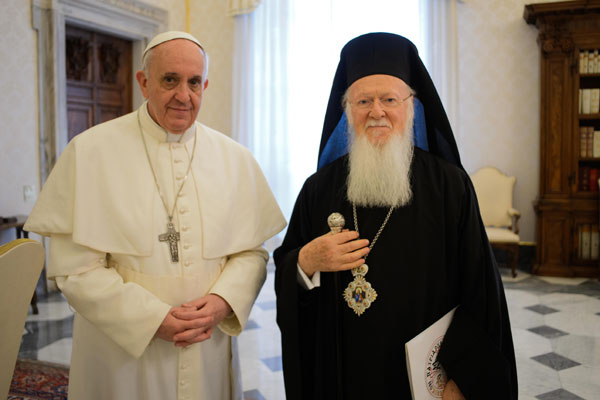
Everybody believes himself to be the centre of the world, and those with their backs against the wall tend to interpret everything in the light of the difficulties they face.  This means it is easy to lose a balanced perspective.   This is illustrated by the reaction of many Ukrainian Greek Catholics to the meeting between Pope Francis and Patriarch Kirill of Moscow.   
Sandro Magister, the Italian commentator on papal affairs  has an article entitled, "The Protest of Ukrainian Catholics: 'The Pope Supports Russian Aggression'”

I understand their concern and sympathize with their suffering, though, actually, the joint declaration did publicly state that they have a right to exist and to do the things that churches do, which is an advance from the Russians.  However, it must be admitted that this was a side issue at the meeting.  The problems that occupied the main attention of pope and patriarch were the plight of Christians in the Middle East and militant secularism in the West.  The situation of Christians in the Middle East is too urgent to put off until a solution is found in the Ukraine: Christians are dying every day in Syria, Libya.   Shamefully, Pope Francis and Eastern Christians cannot rely on help from Obama and David Cameron whose priorities do not include supporting or protecting the Christians, and who are allies of the very countries whose mercenaries have brought about the situation.

Ukraine and Syria could not be more different.   Western Ukraine looks to the West, and they regard Russia and the Russian Orthodox Church as foreign.  In the Middle East, Britain and America have had a number of disastrous wars which have left behind failed states in which extremist Islam can flourish. Unabashed by the chaos they have left behind in Iraq and Libya, they wanted to interfere, once more, in Syria to overthrow another despot, Asaad, so they backed so-called "moderate" muslims to do the job.  When the Christians said that a large part of the "moderate" mercenaries aren't moderate at all, they were ignored, as their fate is being ignored now.  Little wonder that Russia has stepped into the vacuum created by western action.

For years now, unlike the Ukraine, many Christians have been seeking Russian passports, and the Christian community looks to Russia for protection.   Catholics and Orthodox alike know that Putin, by his words and by his actions is clearing spaces where people can live in peace and where Christianity can flourish once again, in contrast to the western attempts.

That is not to say that the West is doing nothing.  United States and Britain are pouring money into helping the refugees in the camps; however, this aid mostly favours Muslim refugees because Christians are not welcome there; so a greater proportion of the refugees who try to make it to Europe are Christians.  Typically, David Cameron won't help them, concentrating on giving aid to the camps where the people are Muslims. I don't know the religion of Obama, but Cameron claims to be a Christian: he ought to be ashamed of himself.

 Catholic charities like "Caritas" and "Aid to the Church in Need" are doing an enormous amount of good in Syria itself, as well as in the camps and among the refugees, Catholic and Orthodox. The aid given to all by other bodies often does not reach the Christians: (listen to the podcast from Vatican radio by clicking the title).

Hence, I think the Ukrainian Greek Catholics, along with Sandro Magister, should have a little patience with Pope Francis and Patriarch Kirill, and just be grateful that they are not in Syria.


The Suffering of Christians in Syria

The persecution of Christians by radical Islamic groups in Syria over the past two years has been appalling—and largely ignored


from an article by Raymond Ibrahim  My source: Frontpage Mag.Wherever U.S. leadership has helped Islamic jihadis topple secular autocrats in the name of “democracy and freedom,” indigenous Christian minorities are being forced to convert to Islam or die. 

Many are accepting death.
Most recently, on August 28 near Aleppo, the Islamic State (IS or ISIS) tortured, mutilated, publicly raped, beheaded and crucified 12 Christians for saying “they would never renounce Christ” for Muhammad.
The jihadis took one group in front of a large crowd.  They cut off the fingertips of a 12-year-old boy, who steadfastly refused to submit to Islam.  They “severely beat him, telling his father they would stop the torture only if he, the father, returned to Islam.”  He refused, so they “also tortured and beat him and the two other ministry workers. The three men and the boy then met their deaths in crucifixion.”
According to a Christian leader associated with the martyrs, “They were left on their crosses for two days. No one was allowed to remove them.”  A sign saying “infidels” was placed next to their crosses.
"Do you realize what you have done?" — Vladimir Putin, President of Russia


West has ‘betrayed the Christians of the East’, says Syrian Patriarch
by STEVE RAY on NOVEMBER 28, 2015
Syria, November 19, 2015: The head of the Syrian Catholic Church, Mar Ignace Youssif III Youan, has said the West has betrayed Syrians and caused an endless conflict in the country.

Speaking to Le Messenger, an Egpytian Catholic magazine, Youan spoke passionately about the “chaos” that Western governments have caused by ignoring the advice of Syrians, assuming that Assad’s regime could be destroyed in a few months, and now having faith in airstrikes as the answer when ISIS has thoroughly infiltrated Iraq, Syria and beyond.

“We Christians are not able to live in this chaos,” the Syrian Patriarch said. “The West has betrayed us.”

The patriarch accused Western governments of wanting to “perpetuate the endless conflict in Syria” and of having “betrayed the Christians of the East. We explained from the beginning that our situation was different from that of other nations in the region, they were not listened to. And now we mourn deaths over the past five years. ”

He described the current situation in Syria as “dramatic, and all the Syrian people are living in pain” as they are trapped under the regime of ISIS and other terrorist groups “who use Islam as an excuse to ‘purify’ areas under their control in the name of religion, and Muslim scholars who tell us that Islam is alien to these facts.

“It’s a shame that the West has abandoned Christians to this situation,” he said.

The patriarch said that terrorist groups, with financing from Saudi Arabia and other countries in the area, have thoroughly infiltrated Iraq and Syria, and there are now terrorists moving into Europe posing as refugees.

ISIS “have already infiltrated in European populations. For years they have received money, weapons and religious indoctrination from Saudi Arabia and the Gulf countries, with the supervision of the West. To claim that the solution is to carry out air strikes [in Syria and Iraq] is a lie”, he said.

This is futile, he said, “because their supporters have infiltraded the population, they are financed and have access to weapons and religious indoctrination.”

ISIS, genocide, and us
Western politicians seem to fear that naming the genocide of Christians for what it is, or treating Christian refugees as refugees, will be taken as a gesture of disrespect for Islam.
February 17, 2016 01:25 EST  by George Weigel
        (Photo illustration: us.fotolia.com | fusolino)

my source: Catholic World Report
The Monuments Men was a disappointing movie, but one of its most chilling scenes sticks in my mind as an analogue to the appalling wickedness underway in the Middle East. 

In the film, SS Colonel Wegner supervises the destruction of art works plundered by the Nazis: treasures intended for Hitler’s fantasized Fuehrer Museum in Linz, Austria. But as the Allies close in on Germany in 1945, Hitler decides that, if he and his goons can’t have these masterpieces, their rightful owners – and the future – won’t have them, either. So Wegner and an SS squad armed with flamethrowers incinerate painting after painting, including Raphael’s Portrait of a Young Man. Colonel Wegner, we learn later, was an extermination camp superintendent before he got busy destroying paintings.

The Nazi destruction of stolen was an act of gratuitous violence against Europe’s cultural heritage, undertaken in service to a demented ideology – the corollary, in the field of culture, of the far more wicked Nazi slaughter of Jews, Slavs, Gypsies, the mentally ill, and all those who fell under the category of Lebensunwertes Leben: “life unworthy of life.” Similarly gratuitous destruction of ancient cultural centers and artifacts is now underway wherever the black flag of the Islamic State, ISIS, is raised in Iraq and Syria. And so is another genocide, this time of Christians.

The jihadists of ISIS routinely tear the crosses and bells from Christian churches in areas under their control, even as they hammer Christian images and statues into dust, desecrate Christian tombs, and do everything possible to destroy the artifacts of a Christian civilization that dates back to the days of the apostles. But, as with the Nazis, even greater evils are visited upon people. In ISIS-controlled areas, Christians are murdered by beheading or crucifixion for refusing to convert to Islam. Rape, regarded as a religious benefice by maniacal barbarians who “pray” before and after violating their Christian victims, is a routine occurrence in these ISIS enclaves, from which Christians are also sold into slavery, including sex-slavery.

The most recent cultural outrage to come to light was Islamic State’s demolition of the vast stone monastery of St. Elijah in Mosul. As the indefatigable human rights campaigner Nina Shea wrote, the monastery, a house of Christian worship for a millennium and a half, was “reduced to rubble” by the “determined application of sledgehammers, bulldozers, and explosives.” But as Ms. Shea went on to note, the wanton destruction of a sacred place is also a metaphor for “the genocide of Iraq’s Christian people and their civilization.” 

Martyrdom is a daily fact of life wherever the black flag of ISIS stains the Mesopotamian sky. Those Christians who can flee have done so. Yet they cannot take shelter in U.N.-run camps, where they are often targets of Muslim violence. And the U.S. State Department treats Iraqi Christians fleeing ISIS to autonomous Kurdistan as “internally displaced persons” who have no claim to resettlement. So the Iraqi Christians are stuck in ramshackle, Church-run camps or housing, stateless in fact if not in law, and increasingly desperate: for in Kurdistan they cannot legally work, drive, or open bank accounts. Which means they have, literally, no future.

Many Iraqi Christian leaders are pleading with western countries to accept their people along with their priests, so that these Christians can rebuild their lives and save their culture. Thus far, the West has been craven and cruel in its response: Nina Shea reports that the U.S. State Department even sent one Iraqi girl, brought to the U.S. by the Knights of Columbus for a life-saving operation, back to Kurdistan, although she has relatives in Arizona.

Which takes us back to the era of The Monuments Men. Then, Franklin Roosevelt and Winston Churchill both declined to prioritize Jewish refugees from Nazism, for fear of offending anti-Semitic elements in the political coalitions they led. Today, western politicians seem to fear that naming the genocide of Christians for what it is, or treating Christian refugees as refugees, will be taken as a gesture of disrespect for Islam.


This is shameful. The shadow that their decisions in the 1930s and 1940s now cast over the historical reputations of Roosevelt and Churchill should stand as a warning to western political leaders today.


The number of Christian martyrs has tripled in two years.
Cross of the Martyrs. Credit: Aaron Groote via Flickr (CC BY-NC-SA 2.0).
Washington D.C., Jan 15, 2016 / 04:03 pm (CNA/EWTN News).- In 2013, there were some 2,100 Christians killed for faith-related reasons across the globe. Last year, that number rose to at least 7,100, according to a recent report from an advocacy group.

“The persecution of Christians is getting worse – in every region in which we work – and it’s getting worse fast,” Lisa Pearce, CEO of Open Doors UK and Ireland, said in the group’s 2016 report. “Many countries have dropped down the list, not because persecution there is decreasing, but simply because others are getting worse faster. And it wasn’t good three years ago.”

“We can and must be strenuous in protecting Christians and all others facing persecution for their faith,” Pearce added.

Open Doors has worked to help persecuted Christians for over 60 years. It was founded by a Dutchman known as Brother Andrew. He smuggled Bibles into Eastern Europe at a time when communist regimes severely restricted Christianity and other religions.

The organization works in 60 countries. Each year, it compiles instances of anti-Christian persecution and evaluates the global situation.


The latest report found that anti-Christian persecution reached a new peak in 2015, with thousands more people killed for faith-related reasons. About 4,000 Christians were killed in Nigeria, over 1,200 in the Central African and over 700 in Chad throughout 2015.

In addition, over 2,400 churches were attacked or shut down for faith-related reasons, the Open Doors report said.

Open Doors’ World Watch List evaluates Christian persecution in the world’s countries and ranks the worst 50. The worst 10 countries on the 2016 list are North Korea, Iraq, Eritrea, Afghanistan, Syria, Pakistan, Somalia, Sudan, Iran and Libya.

North Korea, a communist state, is still the country where it is most difficult to be a Christian, the group found. It has about 300,000 Christians in a population of 24.5 million. The country has headed Open Doors’ watch list for 14 years.

News from the isolated country is difficult to confirm. However, Open Doors said the country’s leadership sees Christianity as “deeply Western and despicable.”

“Christians try to hide their faith as far as possible to avoid arrest and being sent to a labor camp. Thus, being Christian has to be a well-protected secret, even within families, and most parents refrain from introducing their children to the Christian faith in order to make sure that nothing slips their tongue when they are asked.”

In Iraq, hundreds of thousands of Christians have fled their homes for fear of violence, especially from ISIS.

“Iraq has suffered from years of structural uncertainty, conflict and instability under a government incapable of enforcing the rule of law and providing a minimum of security,” Open Doors said.

In Eritrea, there are about 2.5 million Christians out of a population of 6.7 million.


“The Eritrean regime is absolutely authoritarian and intolerant towards any form of association, dissent and free expression,” Open Doors commented.

The government aims to control all religious institutions and has deposed the Eritrean Orthodox Patriarch. The country has consistently supported the rise of radical Islam in the region, including arming the Islamist extremist group Al-Shabaab.

The Open Doors watch list cited several trends worsening anti-Christian persecution.

These trends include the expansion of self-styled Islamic caliphates, who now operate across international borders. Governments who fear Islamic extremism respond by working to increase nationalist sentiment or they tighten rules and increase surveillance over religious expression. In addition, some Muslims are becoming stricter out of fear of extremist takeovers or ISIS sleeper groups.

According to the report, the Middle East, Africa and Central Asia were the fastest growing areas of persecution. More states suffer lawlessness, which means minorities there suffer more violence. Religious extremism, including Islamic, Hindu and Buddhist extremism, is the greatest source of anti-Christian persecution. The report blamed tribal antagonism as well as churches that do not want to recognize Christians of other denominations.

Mexico ranks 40th on the list, while Colombia ranks 46th. They are the only countries in the Americas to appear on the list. Open Doors said that drug trafficking is largely at the root of anti-Christian persecution in Latin America. Local church leaders are often the only ones who will oppose drug traffickers, but then become targets for violence and extortion.

“There is always hope, and yet we are in unmarked territory – the pace and scale of persecution of Christians is unprecedented and growing fast.  We should not expect that to change unless we are part of changing the situation,” Pearce said.

She found hope in areas where Christian churches grow despite persecution. In countries like Syria, Christian communities care for their Muslim neighbors. In places like Mandera, Kenya, Muslims opposed anti-Christian attackers, saying, “You kill all of us or none of us.”

HELP PERSECUTED CHRISTIANS IN THE MIDDLE EAST FOR LENT


New Haven, Conn., Feb 10, 2016 / 07:12 pm (CNA).- A gift of 40 dollars in Lent could help persecuted Christians and other refugees in the Middle East, thanks to the latest appeal from the Knights of Columbus.

“During the Lenten season, we recall Christ’s suffering and death,” Knights of Columbus Supreme Knight Carl Anderson said Feb. 9. “In turn, remembering and assisting those who are today suffering and dying for their belief in Christ is an excellent way to do good where it is most needed and to enter more deeply into the spirit of this season.”


Anderson noted the traditional Lenten habit of making sacrifices. He said the Knights of Columbus wanted to provide “an opportunity for their sacrifice to make a difference – not only in their own life, but in the lives of others.”

The Catholic fraternal order is promoting its “40 Bucks for Lent” donation campaign using the hashtag #40BucksForLent to benefit its Christian Refugee Relief Fund.

The Knights of Columbus began the relief fund in 2014. It has raised nearly $10 million for persecuted Christians and other religious minorities, particularly those from Iraq and Syria fleeing the violence of ISIS.

The fund helps provide housing, food, medical aid, education and other relief. In 2015, the Knights of Columbus helped bring a young Iraqi girl to the U.S. so she could receive specialized medical care.

The fund also supports efforts to raise awareness about the refugees’ situation through television commercials and news stories.


Anderson has testified on Capitol Hill about the refugee situation. He has also joined other U.S. leaders in asking the U.S. State Department to recognize the persecution of Middle Eastern Christians as genocide.

The Knights of Columbus has nearly 1.9 million members worldwide.

Donations to the refugee relief fund are tax deductible. The Knights of Columbus said that 100 percent of all donations support humanitarian assistance and awareness raising efforts.

The Christian Refugee Relief Fund’s website is at http://ChristiansAtRisk.org.

A HIGHLY INFORMATIVE AND INTERESTING PODCAST (Vatican Radio):


Tuesday, 16 February 2016

POWER IN THE CHURCH IS ABOUT HOW MANY FEET ONE CAN WASH, THE SERVICE OF THE CROSS: POPE FRANCIS AND TWO PATRIARCHS.

What Orthodox Christians Can Learn from Pope Francis
Source: Orthodox Christian Network


my source: Pravmir.com
Power in the Church is not about who kisses one’s hand but how many feet one can wash in the service of Christ. Pope Francis made this clear when he visited a youth prison in 2013 and chose to wash the feet of the offenders including one who is an Orthodox Christian. “Real power is service.
by ANDREW F. ESTOCIN | 30 APRIL 2014
What Orthodox Christians Can Learn from Pope Francis


The world will be watching from May 24-25, 2014 as Ecumenical Patriarch Bartholomew of Constantinople and Pope Francis welcome each other in Jerusalem to observe the anniversary of the historic encounter between Pope Paul VI and Ecumenical Patriarch Athenagoras and the subsequent lifting of mutual anathemas. The main focus of the many scholars and reporters who will cover this event will be the elusive question of “Old Rome and New Rome” that is the question of unity between Roman Catholic and Orthodox Christians. However, hidden amidst all this media coverage will be a unique opportunity for Orthodox Christians to follow the example of Ecumenical Patriarch Athenagoras of blessed memory and to meet the Pope of Rome again as if for the first time.

At first glance, the idea of Orthodox Christians being able to learn from the Pope of Rome appears out of place if not altogether wrong. However, Orthodox Christians should pause before rushing to judgment about such matters and remember that prior to the Great Schism of 1054, the Pope of Rome was honored with reverence and respect throughout the Orthodox World. Today, Orthodox Christians honor many Popes of Rome as saints including St. Leo the Great, St. Gregory the Dialogist and St. Martin the Confessor. Orthodox Tradition celebrates the lives of many Popes throughout the liturgical year.

Despite these facts, one of the present realities that is most disappointing is how some of our brothers and sisters have portrayed the Pope of Rome. “Dictator” and “anti-christ” are just some of the clichés that have been sadly used. While there have certainly been corrupt Popes throughout history (as there have been corrupt Patriarchs), Orthodox Christians must ask themselves whether or not the last 35 years have greatly challenged such stereotypes, especially when it comes to Popes such as John Paul II, Benedict XVI, and the current Pope of Rome, Francis. Orthodox Christians should especially pause and take notice of the unique witness of Pope Francis. He is in many ways a bishop who reflects the Christianity of the first millennium when the Church was undivided. Pope Francis also models a form of leadership that is greatly needed in Orthodox Christianity today.

Here are a few lessons that Orthodox Christians can learn from Pope Francis:

Authentic Power is Service: One of the great tragedies of modern times is that Orthodox Christians constantly argue over power and status rather than service to the weakest among us. Church leaders debate about who is first and who is last. Clergy argue about the physical boundaries of Churches, who is entitled to govern them as well as about ancient titles that have their place in an ancient world that has long since disappeared. Amidst these arguments, Orthodox Christians need to pause and remember that power in the Church is a paradox. It is also neither a title nor a jurisdiction. Power in the Church is not about who kisses one’s hand but how many feet one can wash in the service of Christ. Pope Francis made this clear when he visited a youth prison in 2013 and chose to wash the feet of the offenders including one who is an Orthodox Christian. “Real power is service. As He did, He who came not to be served but to serve, and His service was the service of the Cross. He humbled Himself unto death, even death on a cross for us, to serve us, to save us. And there is no other way in the Church to move forward. For the Christian, getting ahead, progress, means humbling oneself. If we do not learn this Christian rule, we will never, ever be able to understand Jesus’ true message on power.” St. John Chrysostom echoes this belief from ancient times: “To love Christ means not to be a hireling, not to look upon a noble life as an enterprise or trade, but to be a true benefactor and to do everything only for the sake of love for God.”

The Church Lives On the Frontiers of Society: The greatest triumphs of Orthodox Christianity have taken place when the Church has lived as a missionary Church and not as an institutional Church. Pope Francis challenges Orthodox Christians with the following words: “I prefer a Church which is bruised, hurting and dirty because it has been out on the streets, rather than a Church which is unhealthy from being confined and from clinging to its own security. I do not want a Church concerned with being at the center and then ends by being caught up in a web of obsessions and procedures. If something should rightly disturb us and trouble our consciences, it is the fact that so many of our brothers and sisters are living without the strength, light and consolation born of friendship with Jesus Christ, without a community of faith to support them, without meaning and a goal in life.” Sts. Cyril and Methodios, St. Patrick of Ireland, and Metropolitan Philip Saliba are all examples of Orthodox Christians who took incredible risks and in the process grew the Church and spread the Gospel. There is no doubt that each of these men experienced their share of bruises in their work. Pope Francis reminds Orthodox Christians that a risk-taking Church-–a church that is not afraid to fail–is much healthier than a Church that is focused on institutional security and closed in on itself. St. Tikhon of Moscow could not say it better when he writes that “The light of the Orthodox Faith has not been lit to shine only for a small circle of people. No, the Orthodox Church is catholic; she remembers the commandment of her Founder, ‘Go ye into all the world and preach the Gospel to every creature and teach all nations’ (Mark 16.15; Matt. 28.19). We must share our spiritual richness, truth, light, and joy with others who do not have these blessings.”

Make Some Noise: The idea of Orthodox Christians making noise would seem contrary to our inheritance. Yet, a look at history shows that the Orthodox Church has been making a noisy mess of things since Apostolic times when the first disciples were labeled “Those people who have been turning the world upside down”(Acts 17:6). Such noise means rowing upstream against the world and challenging the world inside and outside of the Church to be faithful to the Gospel. Holiness always has a component that upsets the status quo. Pope Francis provided this bold exhortation to young people in Rio de Janeiro: “Let me tell you what I hope will be the outcome of World Youth Day: I hope there will be noise. … I want you to make yourselves heard in your dioceses, I want the noise to go out, I want the Church to go out onto the streets, I want us to resist everything worldly, everything static, everything comfortable, everything to do with clericalism, everything that might make us closed in on ourselves.” In order for the Orthodox Church to be faithful to Her Tradition, she must step outside of Her comfort zone and proclaim the Gospel in its fullness with compassion and without apology. Evangelism is by its very nature a “noisy” business.

There is no doubt that countless words will be written in the following weeks about Roman Catholic and Orthodox unity. In truth, it is highly doubtful that such unity will take place any time soon. Common sense reveals that there are serious doctrinal and cultural issues that make unity extremely difficult if not impossible. Any serious Catholic and Orthodox Christian would confess as much. Orthodoxy matters and should never be compromised for the purpose of ecumenical convenience or social acceptance. That being said, the Church has always looked to the horizon outside of itself and has at times found truth in the most surprising of places. Fr. Thomas Hopko is correct: “God is not a prisoner of His own Church!” In this light, Orthodox Christians would do well to follow the present-day example of our father Ecumenical Patriarch Bartholomew and give Pope Francis our kindness, consideration, and our prayers. After all, if the Pope of Rome can humble himself and wash the feet of an Orthodox Christian, then the Holy Spirit can indeed work in ways that we never before thought possible.

Pope Francis’ Thoughts on Pastoring in the 21st Century
Source: OCA
my source: Pravmir.com
by ARCHPRIEST JOHN JILLIONS
     Chancellor of the Orthodox Church of America

| 07 OCTOBER 2015

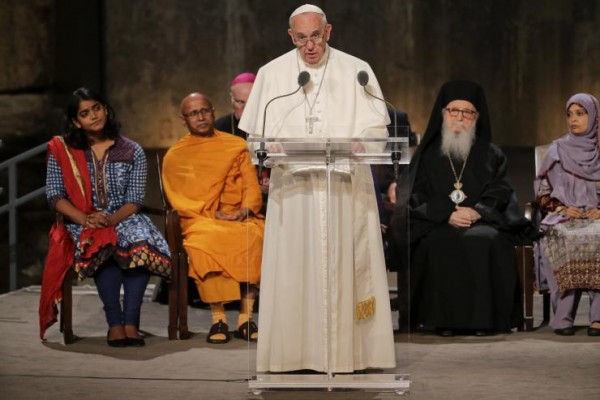
On September 25, 2015, His Beatitude, Metropolitan Tikhon and I attended the multi-religious gathering with Pope Francis at the Museum of the National 9/11 Memorial at in lower Manhattan.  Representatives of most of the Eastern and Oriental Orthodox Churches were present.  The gathering had been organized only a few weeks earlier, which under normal circumstances—for people with chock-full schedules booked a year in advance—would be impossible.  But, as one of the Orthodox bishops in attendance remarked, “We have trouble getting together as Orthodox, but when the Pope calls we drop everything and go!”

Pope Francis is the single most visible Christian leader in the world.  Roman Catholicism has 1.2 billion followers world-wide, and a third of the US population identifies as such.  So it’s not surprising that there was an avalanche of news coverage on his recent visit.  Still, I found it instructive and inspiring that in this supposedly secular country, so much attention was lavished on Pope Francis by gushing journalists.

Much has been written about “the Francis effect,” his historic speech to Congress, his appearance at the United Nations and the 9/11 Memorial and other major events.  But in reflecting on his visit, it is his words to bishops, clergy and religious at two underreported stops that most struck a chord with me.  The first was the Vesper service at New York’s Saint Patrick’s Cathedral.  The second was his meeting with Catholic bishops in Philadelphia.  At these smaller gatherings with “church professionals,” his message about the aims and temptations of “apostolic work” in the 21st century deserve attention from Orthodox Christians, even as we express concern about “expanding our mission” and caring for people being shaped by unprecedented social changes.  Here is a distillation of his main points, in his words.

1. Gratitude and the love of God.  The joy of men and women who love God attracts others to Him.  Priests and religious are called to find and radiate lasting satisfaction in their vocation.  Joy springs from a grateful heart.  Truly, we have received much, so many graces, so many blessings, and we rejoice in this.  It will do us good to think back on our lives with the grace of remembrance—remembrance of when we were first called, remembrance of the road travelled, remembrance of graces received, and, above all, remembrance of our encounter with Jesus Christ so often along the way.  Remembrance of the amazement which our encounter with Jesus Christ awakens in our hearts.  To seek the grace of remembrance so as to grow in the spirit of gratitude.

2. Hard work.  A grateful heart is spontaneously impelled to serve the Lord and to find expression in a life of commitment to our work.  Once we come to realize how much God has given us, a life of self-sacrifice, of working for Him and for others, becomes a privileged way of responding to His great love.  Yet, if we are honest, we know how easily this spirit of generous self-sacrifice can be dampened.  There are a couple of ways that this can happen; both are examples of that “spiritual worldliness” which weakens our commitment to serve and diminishes the wonder of our first encounter with Christ.

3. Measure by the Cross, not by efficiency, good management and outward success.  We can get caught up measuring the value of our apostolic works by the standards of efficiency, good management and outward success which govern the business world—not that these things are unimportant!  We have been entrusted with a great responsibility, and God’s people rightly expect accountability from us.  But the true worth of our apostolate is measured by the value it has in God’s eyes.  To see and evaluate things from God’s perspective calls for constant conversion in the first days and years of our vocation and, need I say, great humility.  The cross shows us a different way of measuring success.  Ours is to plant the seeds; God sees to the fruits of our labors.  And if at times our efforts and works seem to fail and produce no fruit, we need to remember that we are followers of Jesus… and that His life, humanly speaking, ended in failure, the failure of the Cross.

4. Rest with the poor and don’t be jealous of your free time.  Another danger comes when we become jealous of our free time, when we think that surrounding ourselves with worldly comforts will help us serve better.  The problem with this reasoning is that it can blunt the power of God’s daily call to conversion, to encounter with Him.  Slowly but surely, it diminishes our spirit of sacrifice, renunciation and hard work.  It also alienates people who suffer material poverty and are forced to make greater sacrifices than ourselves.  Rest is needed, as are moments of leisure and self-enrichment, but we need to learn how to rest in a way that deepens our desire to serve with generosity.  Closeness to the poor, the refugee, the immigrants, the sick, the exploited, the elderly living alone, prisoners and all God’s other poor will teach us a different way of resting, one which is more Christian and generous.

5.  Be shepherds to all in times of unprecedented change.  Should we blame our young people for having grown up in this kind of society?  Should we condemn them for living in this kind of a world?  Should they hear their pastors saying that “it was all better back then,” “the world is falling apart and if things go on this way, who knows where we will end up?”  No, I do not think that this is the way.  As shepherds following in the footsteps of the Good Shepherd, we are asked to seek out, to accompany, to lift up, to bind up the wounds of our time.  To look at things realistically, with the eyes of one who feels called to action, to pastoral conversion.  The world today demands this conversion on our part.  “It is vitally important for the Church today to go forth and preach the Gospel to all—in all places, on all occasions, without hesitation, reluctance or fear.  The joy of the Gospel is for all people: no one can be excluded” [Evangelii Gaudium, 23].

6. Holy boldness.  We need to invest our energies not so much in rehearsing the problems of the world around us and the merits of Christianity, but in extending a sincere invitation to young people to be brave and to opt for marriage and the family.  Here too, we need a bit of holy parrhesia [boldness]!  A Christianity which “does” little in practice, while incessantly “explaining” its teachings, is dangerously unbalanced.  I would even say that it is stuck in a vicious circle….  A pastor serenely yet passionately proclaims the word of God.  He encourages believers to aim high.

7. More shepherding, less talking.  A pastor watches over the dreams, the lives and the growth of his flock.  This “watchfulness” is not the result of talking, but of shepherding.  Only one capable of standing “in the midst of” the flock can be watchful, not someone who is afraid of questions, contact, accompaniment.  A pastor keeps watch first and foremost with prayer, supporting the faith of his people and instilling confidence in the Lord, in his presence.  A pastor remains vigilant by helping people to lift their gaze at times of discouragement, frustration and failure.  We might well ask whether in our pastoral ministry we are ready to “waste” time with families, whether we are ready to be present to them, sharing their difficulties and joys.

8. Sowing seeds in crooked furrows.  If we prove capable of the demanding task of reflecting God’s love, cultivating infinite patience and serenity as we strive to sow its seeds in the frequently crooked furrows in which we are called to plant, then even a Samaritan woman with five “non-husbands” will discover that she is capable of giving witness.  And for every rich young man who with sadness feels that he has to calmly keep considering the matter, an older publican will come down from the tree and give fourfold to the poor, to whom, before that moment, he had never even given a thought

New post on Byzantium on Brew
my source; Pravmir.com

A Historical Day
by Nelson

The big news in the Catholic and Orthodox Church is the historic meeting between Pope Francis and Patriarch Kirill of Moscow and All Russia. This has caused quite a stir on various Orthodox and Eastern Catholic blogs and forums. Sadly, this historic event has brought to light some old prejudices towards Uniates. The amount of hatred espoused in the comment sections of certain blogs towards Eastern Catholics has made me at times angry and at other times sad. Given that background, I did not place much hope in the meeting between the Pope and the Patriarch.

This afternoon the two meet and produced a joint statement.The full text can be found here.  It is a timely document. The Pope and Patriarch call for the protection of Middle Eastern Christians, laud the ideal of Christian unity (much to the displeasure I imagine of certain sectors of Orthodoxy), call for the sanctity of life and marriage. It also addresses a new (and frightening) development that of manipulation of human reproduction:

We are also concerned about the development of biomedical reproduction technology, as the manipulation of human life represents an attack on the foundations of human existence, created in the image of God. We believe that it is our duty to recall the immutability of Christian moral principles, based on respect for the dignity of the individual called into being according to the Creator’s plan.

It is the section on Ukraine and Eastern Catholics that surprised me the most. Four paragraphs are given to this topic.

Paragraph twenty-four states:

Orthodox and Catholics are united not only by the shared Tradition of the Church of the first millennium, but also by the mission to preach the Gospel of Christ in the world today. This mission entails mutual respect for members of the Christian communities and excludes any form of proselytism.

We are not competitors but brothers, and this concept must guide all our mutual actions as well as those directed to the outside world. We urge Catholics and Orthodox in all countries to learn to live together in peace and love, and to be "in harmony with one another” (Rm 15:5).

Consequently, it cannot be accepted that disloyal means be used to incite believers to pass from one Church to another, denying them their religious freedom and their traditions. We are called upon to put into practice the precept of the apostle Paul: "Thus I aspire to proclaim the gospel not where Christ has already been named, so that I do not build on another's foundation” (Rm 15:20).

The Gospel is to be proclaimed to all nations by Catholics and Orthodox. The Apostolic faith of the Church is message needed desperately in the modern world.

Paragraph twenty-five states:

It is our hope that our meeting may also contribute to reconciliation wherever tensions exist between Greek Catholics and Orthodox. It is today clear that the past method of "uniatism”, understood as the union of one community to the other, separating it from its Church, is not the way to re–establish unity. Nonetheless, the ecclesial communities which emerged in these historical circumstances have the right to exist and to undertake all that is necessary to meet the spiritual needs of their faithful, while seeking to live in peace with their neighbours. Orthodox and Greek Catholics are in need of reconciliation and of mutually acceptable forms of co–existence.

I can not believe that the Russian Patriarch agreed (and signed) to this statement, given the contempt of Greek Catholics exhibited by many Orthodox. I thank God. Greek Catholics have been calling for reconciliation for a long time, maybe now the ROC will begin to dialogue with the UGCC. Maybe a meeting between the head of the UGCC and the Patriarch of Russia could be arranged? Now, the practical implications of this in Ukraine and Russia will be interesting to see.

Paragraph twenty-six states:

We deplore the hostility in Ukraine that has already caused many victims, inflicted innumerable wounds on peaceful inhabitants and thrown society into a deep economic and humanitarian crisis. We invite all the parts involved in the conflict to prudence, to social solidarity and to action aimed at constructing peace. We invite our Churches in Ukraine to work towards social harmony, to refrain from taking part in the confrontation, and to not support any further development of the conflict.

Amen. May Russia's occupation of Eastern Ukraine end soon and a peaceable resolution found.

Paragraph twenty-seven states:

It is our hope that the schism between the Orthodox faithful in Ukraine may be overcome through existing canonical norms, that all the Orthodox Christians of Ukraine may live in peace and harmony, and that the Catholic communities in the country may contribute to this, in such a way that our Christian brotherhood may become increasingly evident.

Orthodox Christians in Ukraine are divided into three major churches: The Ukrainian Orthodox Church of the Moscow Patriarchate, the Ukrainian Orthodox Church of the Kievan Patriarchate, and the Ukrainian Autocephalous Orthodox Church. I think that overcoming their divisions will be a hard task but then again I didn't think the Pope and Patriarch would ever meet. With God all is possible.

Paragraph twenty-eight states:

In the contemporary world, which is both multiform yet united by a shared destiny, Catholics and Orthodox are called to work together fraternally in proclaiming the Good News of salvation, to testify together to the moral dignity and authentic freedom of the person, "so that the world may believe” (Jn 17:21). This world, in which the spiritual pillars of human existence are progressively disappearing, awaits from us a compelling Christian witness in all spheres of personal and social life. Much of the future of humanity will depend on our capacity to give shared witness to the Spirit of truth in these difficult times.

Amen. Let us Orthodox and Catholic Christians work together to proclaim the Good new of salvation in Jesus the Christ.

Today was a historic day indeed. To God be the Glory.


Sunday, 14 February 2016

FEBRUARY 15th: ANNIVERSARY OF THE BRUTAL MURDER OF 21 COPTIC CHRISTIANS, EXACTLY ONE YEAR AGO by LORD DAVID ALTON

Icon of the 21 Coptic Christians beheaded in Libya in February 2015
It is especially important that we mark the anniversary of the brutal murder of the 21 Coptic Christians in Libya a year ago, not only to keep them in our memory, but to remember and advocate for all those who continue to face persecution in the Middle East. What is happening to Christians and minorities in the region is nothing short of Genocide and we must not stand by and watch as whole communities  are eradicated. These 21 Coptic Christians who lost their lives are testimony to the strength of Faith and courage of many Christians around the world, but are also a reminder that we all have a role to play in safeguarding those suffering religious persecution and gross violations of their basic human rights.

Coptic martys

On February 12, 2015, ISIS - Daesh - released a report in their online magazine Dabiq showing photos of 21 Egyptian Coptic Christians - migrant  workers - that they had kidnapped in the city of Sirte, in Libya, and whom they threatened to kill to "avenge the [alleged] kidnapping of Muslim women by the Egyptian Coptic Church".The men, who came from different villages in Egypt, 13 of them from Al-Our, Minya Governorate,  had been kidnapped in Sirte in two separate attacks on December 27, 2014, and in January 2015.
coptic martyrs 

On February 15, a five-minute video was published, showing the beheading of the captives on a beach along the southern Mediterranean coast. A caption in the video called the captives the "people of the cross, followers of the hostile Egyptian Church" In the video one of the killers in camouflage declared in North-American English:

"Oh people, recently you've seen us on the hills of Al-Sham [Greater Syria] and on Dabiq's Plain, chopping off the heads that had been carrying the cross delusion for a long time..." 
After beheading the hostages, the speaker  finally declares "We will conquer Rome, by Allah’s permission," pointing his knife toward the sea. As in other ISIL videos, the captives wore orange jumpsuits, intended as a reference to the attire of  Guantanamo prisoners.The leader of the squad performing the killings was identified as a Libyan expatriate who calls himslef Al Qaqa'a Ben Omro.

President Sisi of Egypt  announced a seven-day period of national mourning  and in a televised address, al-Sisi declared his country reserved the right for retaliation.

On February 21, 2015 Pope Tawadros III, the head of the Coptic Orthodox Church announced that the 21 murdered Copts would be commemorated as martyr saints, on the 8th Amshir of the Coptic calendar, which is February 15 of the Gregorian calendar.

After the beheadings, the Coptic church released their names, and it was later learned that the 21st martyr was named Mathew Ayairga and that he was from Ghana. Originally a non-Christian, he saw the immense faith of the others, and when the terrorists asked him if he rejected Jesus, he reportedly said, "Their God is my God", knowing that he, too, would be killed.

Matthew-Ayairga-beheaded-Ghana-ISIS (1)


On Wednesday February 10th, 2016, Ash wednesday, a Service of Commemoration to mark the killing of the 21 Christian Coptic Martyrs was held in the Crypt chapel of Our Lady Undercroft, in the Houses of Parliament. The Service was led by His Grace, Bishop Angaelos, and the Service Booklet contained messages from HRH the Prince of Wales , the Archbishop of Canterbury and the Prime Minister.


Copts pray in the burnt husk of a church

Meanwhile, Egyptian Christians have been rebuilding their churches which were desecrated in an orgy of violence.

Below, please find the most recent list of names of the 21 New Martyrs of Libya for use in prayers and publications.

Milad Makeen Zaky
Abanub Ayad Atiya
Maged Soliman Shehata
Youssef Shukry Younan
Kirollos Boshra Fawzy
Bishoy Astafanous Kamel
Samuel Astafanous Kamel
Malak Ibrahim Sinyout
Tawadros Youssef Tawadros
Gerges Milad Sinyout
Mina Fayez Aziz
Hany Abdel Mesih Salib
Samuel Alham Wilson
Ezzat Boshra Naseef
Luka Nagaty Anis
Gaber Mounir Adly
Essam Baddar Samir
Malak Farag Abrahim
Sameh Salah Farouk
Gerges Samir Megally

Mathew Ayairga (from Ghana)

Egypt's Copts are under daily attack

Embracing the Cross
an extremely important video


"Can Catholics recognise the 21 murdered Coptic Christians as martyrs?"

The 21 Coptic Martyrs are role models for all Christians and a Catholic heart wants to honour them as such.

The murder of the 21 Coptic Christians in Libya by ISIS has raised the issue for Catholics as to whether we can acknowledge them as martyrs as the Copts have done. The SSPX and the Josias blog, for instance, contend that the Copts are heretics and schismatics. The Josias asks if a Copt being murdered by a militant anti-Christian “for his Christian profession, would… suddenly… [be] a good Christian? Would it gain him entry into heaven and blot out his sins?”

First, are Copts actually heretics? After the Council of Chalcedon in 451 the Copts, with other Oriental churches, were cast out as monophysite heretics. As so often happens, the argument was more about vocabulary than substance. The Copts formally rejected monophysitism, but they explained their orthodox view of the two natures of Christ with a vocabulary different to Chalcedon’s.

However, the issue is dead. In 1988 the Catholic and Coptic Churches issued an Agreed Statement which affirmed the orthodox understanding of Christ. After another agreed Christological statement, in 1994 with the Assyrian Church of the East, it became possible for members of either Church to receive Communion in the other under certain conditions. Could not the same arrangement could be made with the Copts?

Yet perhaps we can be bolder yet. When I discussed these martyrs with Graham Hutton, chairman of Aid to the Church in Need, we addressed Pope Francis’s recent reference to an “ecumenism of blood” that unites Christians. He has not developed it theologically, which leaves the way for theologians to take this up and run with it.

So we took this ecumenism of blood a little further in light of the ancient doctrine of baptism by blood, which holds that the unbaptised who die for Christ are baptised by their death. So could it be possible to speak of an absolution by blood, by which a Christian’s dying for Christ would absolve any grave sins, even those of schism or even heresy? Pope Francis implies this when he said a few days ago that…

 [T]he blood of our Christian brothers and sisters is a testimony which cries out to be heard… It makes no difference whether they be Catholics, Orthodox, Copts or Protestants. They are Christians! Their blood is one and the same. Their blood confesses Christ. This is not to minimise differences, nor to turn a blind eye to them. However, in dying for Christ do such divisions among Christians retain real relevance? In dying for Christ one has become the perfect disciple, and enters a real communion with Christ’s Body in heaven. 

The Coptic Church has acclaimed the 21 victims as martyrs by inserting them into their liturgical calendar (February 15), much like our own equivalent canonisation. Pope Francis has informally though publicly called them martyrs. Theologians need urgently to investigate the possibility of an ecumenism by (or in) blood, as well as an absolution by blood. This seems authentic ecumenism, acknowledging difference, yet also respecting the highest form of Christian discipleship.

The 21 Coptic Martyrs of Libya are role models for all Christians, and a Catholic heart wants to honour them as such. Could we not join the Copts in calling on their martyrs’ intercession before God in whose presence, surely, they now dwell, eternally?

Nothing builds the Church like the blood of martyrs. The 21 Coptic Martyrs of Libya may offer a path to the renewal that the struggling Western Church so sorely needs.

Search This Blog

La Virgen de Guadalupe

La Virgen de Guadalupe

Followers

My Blog List

Fr David Bird

Fr David Bird
Me on a good day

Blog Archive