EXPAND YOUR READING!!

"Today the concept of truth is viewed with suspicion, because truth is identified with violence. Over history there have, unfortunately, been episodes when people sought to defend the truth with violence. But they are two contrasting realities. Truth cannot be imposed with means other than itself! Truth can only come with its own light. Yet, we need truth. ... Without truth we are blind in the world, we have no path to follow. The great gift of Christ was that He enabled us to see the face of God".Pope Benedict xvi, February 24th, 2012

The Church is ecumenical, catholic, God-human, ageless, and it is therefore a blasphemy—an unpardonable blasphemy against Christ and against the Holy Ghost—to turn the Church into a national institution, to narrow her down to petty, transient, time-bound aspirations and ways of doing things. Her purpose is beyond nationality, ecumenical, all-embracing: to unite all men in Christ, all without exception to nation or race or social strata. - St Justin Popovitch

Sunday, 20 May 2012

LOVE WITHOUT LIMITS by Fr Lev Gillet

Love Without Limits
By the Very Rev. John Breck
Feb 1, 2010, 10:00


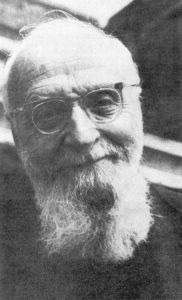
Fr. Lev Gillet
Archimandrite Lev Gillet, who signed many of his books “A Monk of the Eastern Church,” was one of the great Orthodox spiritual guides of the last century. His biography, written by his longtime friend Mme. Elisabeth Behr-Sigel, has been translated into English and offers invaluable insight into the life of Fr Lev, as well as of the circumstances surrounding the growth of Orthodox Christianity in Western Europe, especially following the Russian Revolution.

In 1990, St. Vladimir’s Seminary published two essays of Fr Lev in a volume titled Serve the Lord With Gladness. The first, “Our Life in the Liturgy,” is a simple and highly accessible introduction to the Orthodox Divine Liturgy or Eucharistic service. The second, “Be My Priest,” is a profound meditation on the significance of the priesthood, which appeals to both ordained clergy and others who make up the “universal priesthood” of baptised believers.

In this series of webpage columns dedicated to “Life in Christ,” we will be offering occasional translations of chapters from another of Fr Lev’s books, Amour Sans Limites (Love Without Limits), published in 1971 by “Éditions de Chevetogne,” a Roman Catholic monastery in Belgium (where the monks celebrate both Western and Byzantine rites). It is difficult to render Fr Lev’s lyrical French into English, but we hope that these efforts will provide readers with something of the spiritual richness and profound theological insight that characterized this humble monk, who was truly a modern Father of the Church.


Whoever you are, whatever you may be, says the Lord of Love, my hand is resting upon you at this very moment. By this gesture, I am letting you know that I love you and that I call you for my own.

I have never ceased loving you, speaking to you, or calling you. Sometimes it was in silence and solitude. Sometimes it was there, where others were gathered in my name.

Often you did not hear this call, because you were not listening. At other times you perceived it, but in a way that was vague and confused. Occasionally you were at the point of responding with acceptance. And sometimes you gave me that response without any lasting commitment. You were deeply moved to hear me. You recoiled from the decision to follow me.

Never thereafter did you finally submit, totally and exclusively, to the calling of Love.

Yet now, once again, I come to you. I want to speak to you once more. I want you wholly for myself. Let me repeat: Love desires you, totally and exclusively.

I will speak to you in secret, confidentially, intimately. I will place my mouth close to your ear. Hear, then, what my lips want to speak to you in hushed tones – what they want to murmur to you.

I am your Lord, the Lord of Love. Do you want to enter into the life of Love?

This is not an invitation to some realm of tepid tenderness. It is a calling to enter into the burning flame of Love. There alone is true conversion: conversion to incandescent Love.

Do you wish to become someone other than you have been, someone other than you are? Do you wish to be someone who lives for others, and first of all for that Other and with that Other who calls all things into being? Do you wish to be a brother to all, a brother to the entire world?

Then hear what my Love speaks to you.

My child, you have never known who you really are. You do not yet know yourself. I mean, you have never really known yourself to be the object of my Love. As a result, you have never known who you are in me, or all the potential within yourself.

Awake from this sleep and its bad dreams! In certain moments of truth, you see nothing in yourself but failures and defeats, set-backs, corruption, and perhaps even crimes. But none of that is really of you. It is not your true “me,” the most profound expression of your true self.

Beneath and behind all that, deeper than all your sin, transgressions and lacks, my eyes are upon you. I see you, and I love you. It is you that I love. It’s not the evil you do – the evil that we can neither ignore nor deny nor lessen (is black actually white?). But underneath it all, at a greater depth, I see something else that is still very much alive.

The masks you wear, the disguises you adopt might well hide you from the eyes of others – and even from your own eyes. But they cannot hide you from me. I pursue you even there where no one has ever pursued you before.

Your deceptive expression, your feverish quest for excitement, your hard and avaricious heart – all of that I separate from you. I cut it away and cast it far off from you.

Hear me. No one truly understands you. But I understand you. I can speak about you such wonderful, marvellous things! I can say these things about you. Not about the “you” that the powers of darkness have so often led astray, but about the “you” who is as I desire you to be, the “you” who dwells in my thoughts as the object of my love. I can say these things about the “you” who can still be what I want you to be, and to be so visibly.

Become visibly, then, what you already are in my mind. Be the ultimate reality of yourself. Realize all the potential I have placed within you.

No man or woman is capable of realizing any inner beauty that is not equally present within you. There is no divine gift toward which you cannot aspire. Indeed, you will receive all those gifts together, if you truly love, with me and in me.

Whatever you may have done in the past, I will set you free, I will loose your bonds. And if I loose your bonds, who can prevent you from rising up and walking?


II
"Fire burst forth from the burning bush, yet the bush was not destroyed. Draw near to the Burning Bush, my child. Reflect on this great vision, and why the bush burned and still was not consumed.


"The fire that burns the bush without destroying it is a fire nourished by nothing apart from itself. It subsists alone, by itself. And of itself it spreads abroad in infinite growth. This fire does not destroy the wood of the bush. Rather, it purifies the wood. It eliminates everything in the wood that is merely brambles and thorns. Yet it does not deform the bush. It respects its original structure, even while it eliminates its superfluous growth. It renews without killing. It transforms the wood itself into fire, a lasting fire.


"Surely, according to the most simple, the most elementary interpretation, you can behold in the Burning Bush the expression of divine protection, which sustains your existence in the face of every burning pain and suffering. There, my child, you can find the assurance of a supreme Compassion, a preserving Mercy. There you can see as well the sign of a divine Purification: one painful for you to endure, yet one that sets you free.


"The Burning Bush, however, has a still deeper meaning. It bears a Revelation of your Lord and God Himself.


"The Burning Bush is an expression of the divine nature. In the flame of the bush you can have a glimpse of Who I am. As the Scripture declares, your Lord, the Lord of Love, is a consuming fire!


"Like the flame of the Bush, I am Love that gives endlessly of itself. I am that generosity that knows no bounds. No one can say of my Love: it extends to this point, and no further.


"I am that Love that always tends to incorporate and assimilate every element of human existence it encounters (indeed, I am the very Source of those elements). Just as the fire burns without consuming the wood of the bush, I never destroy the persons I have created. I only wish to make disappear whatever there is within a person that conflicts with the essence of Love.


"I take for myself and make it my own. I transform and I transfigure. I bestow life. I transpose human life on to a higher plane.


"He who loves unites himself to those whom he loves. I unite myself to you, my beloved. Nevertheless, there can be no confusion between myself, who am Love, and you, who receive that Love.


"Can you now behold this Great Vision? Do you see the flame that no one lights, the flame that leaps forth from my very Heart, the flame which is my very Being? Do you see the divine Fire that spreads out across the world? The entire universe is the Burning Bush!"


 The above are two who were Protestants who became Orthodox. Many have become Catholics for the same reasons. We all need each other.  Unfortunately, in an otherwise wonderful testimony to the Truth, Fr Seraphim's rhetorical question about where are there heroes in Western Christianity shows a certain blindness.   Starting with Russia, Baptists suffered martyrdom along with Orthodox.   In the Ukraine, there were many Orthodox martyrs, but the Ukrainian Greek Catholics suffered even more than the Orthodox, and they were imprisoned in the same gulags as the Orthodox and enjoyed a communion of suffering with them.  In the Middle East, Catholics and Orthodox suffer together right now.  Of course, we in the West have not suffered since the fall of the Nazis, but, for example, in the "White Rose" group, the Germans executed Christian heroes who were Catholic, Lutheran and Orthodox, including the Orthodox saint, Alexander Schmorell     May God preserve all of us, Catholics, Orthodox and Protestants from our own blindness about each other!!


Here is another video about Orthodoxy. If, like me, you are Catholic, then put "Catholic" wherever they say "Orthodox", you will discover how close we are to each other.  In fact, the schism is obscene.


THE ASCENSION OF OUR LORD by Blessed John Henry Newman


from a Sermon of Cardinal John Henry Newman
(taken from the monastic Office of Vigils for the Ascension)

Upon the glorious aacension of their Lord, the apostles worshipped him, says the text, and returned to Jerusalem with great joy, and were continually in the temple, praising and blessing God.  Now how was it that when nature would have wept, the apostles rejoiced?   When Mary came to the sepulchre and found not our Lord's body she stood without at the sepulchre weeping. and the angels said to her, as Christ did afterwards, Woman, why are you weeping?   Yet, on our Saviour's departure forty days afterward, when the angels would reprove the apostles, they did but say, Why do you stand gazing up to heaven? There was no sorrow in the apostles in spite of their loss, in spite of the prospect before them but great joy and continual praise and blessing.   May we venture to surmise that this rejoicing was the high temper of the brave and noble-minded who have faced danger mentally and are prepared for it?   Moses brought out of Egypt a timid nation, and in the space of forty years trained it to be full of valour for the task of conquering the promised land; Christ in forty days trains the disciples to be  bold and patient instead of cowards.  They mourned and wept at the beginning of the season, but in the end they are full of courage for the good fight: their spirits mount high with their Lord, and when he is received out of their sight, and their own trial begins, they return to Jerusalem with great joy, and are continually in the temple, praising and blessing God.

For Christ had surely taught them what it was to have their treasure in heaven, and they rejoiced, not because their Lord was gone, but that their hearts had gone with him.   Their hearts were no longer on earth, they were risen aloft.   When he died on the cross, they knew not whither he was gone.   Before he was siezed, they said to him, Lord, where are you going?  Lord, we don't know where you are going.   They could but follow him to the grave and mourn, for they knew no better; but now they saw him ascend on high, and in spirit they ascended with him.   Mary wept at the grave because she thought enemies had taken him away, and she knew not where they had laid him.   Where your treasure is, there will your heart be also.   Mary had no heart left to her because her treasure was lost; but the apostles were continually in the temple, praising and blessing God, for their heart was in heaven, or, in St Paul's words, they were dead, and their life was hid with Christ in God.

Strengthened, then with this knowledge, they were able to face those trials that Christ had first undergone himself, and had foretold as their portion.   Whither I go, he said to Saint Peter, you cannot floow me now, but you shall follow me afterward.   And he told them, They shall put you out of the synagogues; yes, the time will come that whosoever kills you will think that he does God service.   That time was now coming, and they were able to rejoice in what so troubled them forty days before.  For they understood the promise,  To him that overcomes, I will grant to sit with me on my throne, even as I overcame, and am set down with my Father on his throne.

Saturday, 19 May 2012

HOLY TRADITION by Pope Benedict XVI & AN ORTHODOX PRIEST ON THE SAME SUBJECT

A HAPPY AND HOLY ASCENSION FEAST FOR ALL WHO CELEBRATE IT TODAY(SUNDAY)!!
Pope Benedict celebrating Mass in Nazareth
This post is a repeat, but well worth repeating)

ZE06042606 - 2006-04-26
Permalink: http://www.zenit.org/article-15858?l=english

Role of Church Tradition


"Communion Embraces All Times and All Generations"

VATICAN CITY, APRIL 26, 2006 (Zenit.org).- Here is a translation of the address Benedict XVI gave today at the general audience, on the theme "Tradition: Communion in Time."

* * *

Dear Brothers and Sisters:

Thank you for your affection! In the new series of catechesis initiated a short time ago, we tried to understand the original design of the Church desired by the Lord to comprehend better our participation, our Christian life, in the great communion of the Church. Until now we have understood that ecclesial communion is aroused and sustained by the Holy Spirit, guarded and promoted by the apostolic ministry. And this communion, which we call Church, does not extend only to all believers of a certain historical moment, but embraces also all times and all generations. Therefore, we find ourselves before a double universality: the synchronic universality -- we are united with believers in all parts of the world -- and the universality called diachronic, that is, all times belong to us: Believers of the past and of the future form with us only one and great communion.

The Spirit appears as the guarantor of the active presence of mystery in history, who assures its realization through the centuries. Thanks to the Paraclete, the experience of the Risen One, made by the apostolic community in the origins of the Church, will always be able to be lived by successive generations, in the measure that it is transmitted and actualized in faith, in worship and in the communion of the People of God, pilgrim in time. And, in this way, we, now, in Eastertide, live the encounter with the Risen One not only as something of the past, but in the present communion of the faith, of the liturgy, of the life of the Church.

The Church's apostolic Tradition consists in this transmission of the goods of salvation, which makes of the Christian community the permanent actualization, with the force of the Spirit, of the original communion. It is called thus because it was born from the testimony of the apostles and of the community of the disciples in the early years, was given under the guidance of the Holy Spirit in the writings of the New Testament, and in the sacramental life, in the life of faith, and the Church makes constant reference to it -- to this Tradition that is the always present reality of the gift of Jesus -- as its foundation and norm through the uninterrupted succession of the apostolic ministry.

In his historical life, Jesus limited his mission to the House of Israel, but he already made it understood that the gift was destined not only for the people of Israel, but for the whole world and for all times. The Risen One then entrusted, explicitly to the apostles (cf. Luke 6:13) the task to make disciples of all nations, guaranteeing his presence and help until the end of time (cf. Matthew 28:19ff).

The universality of salvation calls for, among other things, that the Easter memorial be celebrated in history without interruption until Christ's glorious return (cf. 1 Corinthians 11:26). Who will actualize the salvific presence of the Lord Jesus, through the ministry of the apostles, heads of the eschatological Israel (cf. Matthew 19:28) -- and of the whole life of the people of the New Covenant? The answer is clear: the Holy Spirit. The Acts of the Apostles -- continuing with the plan of Luke's Gospel -- present the mutual understanding between the Spirit, those sent by Christ, and the community gathered by them.

Thanks to the action of the Paraclete, the apostles and their successors can realize in time the mission received through the Risen One: "You are witnesses of these things. And (behold) I am sending the promise of my Father upon you" (Luke 24:48-49). "But you will receive power when the holy Spirit comes upon you, and you will be my witnesses in Jerusalem, throughout Judea and Samaria, and to the ends of the earth" (Acts 1:8). And this promise, initially incredible, was already realized in the time of the apostles: "We are witnesses of these things, as is the holy Spirit that God has given to those who obey him" (Acts 5:32).

Therefore, it is the same Spirit who, through the imposition of hands and the prayer of the apostles, consecrates and sends the new missionaries of the Gospel (for example, in Acts 13:3ff and 1 Timothy 4:14). It is interesting to observe that, whereas in some passages it is said that Paul establishes the presbyters in the Churches (cf. Acts 14:23), in others it is affirmed that it is the Holy Spirit who constitutes the pastors of the flock (cf. Acts 20:28).

In this way, the action of the Spirit and of Paul is profoundly fused. In the hour of solemn decisions for the life of the Church, the Spirit is present to guide her. This presence-guide of the Holy Spirit was experienced particularly in the Council of Jerusalem, in whose conclusive words resounded the affirmation: "It is the decision of the holy Spirit and of us" (Acts 15:28); the Church grows and walks "in the fear of the Lord and with the consolation of the Holy Spirit" (Acts 9:31).

This permanent actualization of the active presence of the Lord Jesus in his people, realized by the Holy Spirit and expressed in the Church through the apostolic ministry and fraternal communion, is what is understood by the term Tradition in the theological sense: It is not the mere material transmission of what was given at the beginning to the apostles, but the efficacious presence of the Lord Jesus, crucified and risen, which accompanies and guides in the Spirit the community gathered by him.

Tradition is the communion of the faithful around their legitimate pastors in the course of history, a communion that the Holy Spirit nurtures assuring the nexus between the experience of the apostolic faith, lived in the original community of the disciples, and the present experience of Christ in his Church.

In other words, Tradition is the organic continuity of the Church, holy temple of God the Father, built on the foundation of the Spirit: "So then you are no longer strangers and sojourners, but you are fellow citizens with the holy ones and members of the household of God, built upon the foundation of the apostles and prophets, with Christ Jesus himself as the capstone. Through him the whole structure is held together and grows into a temple sacred in the Lord; in him you also are being built together into a dwelling place of God in the Spirit" (Ephesians 2:19-22).

Thanks to Tradition, guaranteed by the ministry of the apostles and their successors, the water of life that flowed from the side of Christ and his saving blood comes to the women and men of all times. In this way, Tradition is the permanent presence of the Savior who comes to meet, redeem and sanctify us in the Spirit through the ministry of his Church for the glory of the Father.

Concluding and summarizing, we can therefore say that Tradition is not the transmission of things or words, a collection of dead things. Tradition is the living river that unites us to the origins, the living river in which the origins are always present, the great river that leads us to the port of eternity. In this living river, the word of the Lord that we heard at the beginning from the lips of the reader: "And behold, I am with you always, until the eng of the age" is fulfilled again (Matthew 28:20).

[Translation by ZENIT]

[At the end of the audience, the Holy Father greeted pilgrims in 12 languages. In English, he said:]

Dear Brothers and Sisters,

Ecclesial communion embraces all times and all generations. Thanks to the action of the Holy Spirit, the early apostolic community experienced the Risen Lord. Successive generations do the same, as the faith is transmitted and lived through worship and the communion of the pilgrim People of God.

From the beginning, Jesus intended that this saving work should extend to all the world and indeed, as we have heard today, the Risen Lord entrusted to the apostles the task of making disciples of all nations while guaranteeing his own presence with them.

This ongoing actualization of the presence of Jesus -- through the work of the Spirit and through the Church's apostolic ministry and fraternal communion -- is what we mean by the term Tradition; it is not just a transmission of "things," but the efficacious presence of the Lord who accompanies and guides the gathered community.

The Holy Spirit nurtures this communion, assuring the connection between the apostolic faith experienced by the first communities of disciples, and our experience today of Christ in his Church. Let us rejoice in the presence of the Savior who comes to meet us, to redeem us, and to sanctify us through the ministry of his Church!

I welcome all the English-speaking pilgrims present, including the pupils and staff from Holy Faith Convent School in Dublin. May your Easter pilgrimage be a time of deep spiritual renewal. Upon you and your families I invoke an abundance of God's blessings of peace and joy!

Why Incentives Matter

When I first became Orthodox a Protestant friend of mine, a minister as it happened, noted that in becoming Orthodox I joined a pre-modern tradition in a post-modern fashion.  Simply put, I decided to submit myself to the Tradition of the Church.

For some this decision to accept the Tradition of the Church embodies within it a distancing from the same.  After all, so the thinking goes, in accepting the Tradition of the Orthodox Church rather than the Catholic Church, didn’t I assume the ability–even the right–to judge both traditions? Well maybe that is what happened psychologically, but I’m not sure that–even if it holds true–that the psychology of the decision exhausts its meaning.  Nor does the fact of human choice invalidate the objective character of the Tradition; much less does it mean that the person judges the Tradition as a master judges a servant or a teacher a student.

Rather the Tradition of the Church is that which makes human choice both possible and meaningful.

Metropolitan Hilarion in a recent speech (Address by Metropolitan Hilarion of Volokolamsk Chairman of the Moscow Patriarchate’s Department for External Church Relations to the Annual Nicean Club Dinner, Lambeth Palace, 9 September 2010) observes that unlike Protestant Christianity,  the Orthodox Church has ” a different understanding of Holy Tradition.”  He continues by quoting   It is aptly “Vladimir Lossky: ‘Tradition is the life of the Holy Spirit in the Church – the life giving to every member of the Body of Christ the ability to hear, accept and know the Truth in its inherent shining, not in the natural light of human reason.’”   To grasp the anthropological import of this it is important that we remember that the human will, as St Augustine and others have noted, is not meant for choosing between options–will I have toast or cereal for breakfast this morning–but as the faculty by which I am freely and personally in communion with God and, in God, the whole of humanity and indeed the cosmos.

To exercise my will apart from God is neither an act of freedom nor of self-expression.  Rather it is to cripple the will and degrade the self binding it that which is transitory.  Both personal experience and psychological research illustrates this.  Every discrete choice has the consequence of limiting in someway my ability to act.  Sitting here writing means I can’t be watching television.  Yes, the example, like the choice of what to eat for breakfast is trivial.  Trivial or not thought, it illustrates the point that human freedom and so happiness  is not found in the mere fact that I can exercise my will this way rather than that.  In fact, and again experience and research demonstrates this, the more choices I have the more unhappy and anxious I am likely to feel.
Does this mean that there should be no choice or that we should be coerced to accept the Gospel?  No of course not.  The fact that I misuse my will, does not mean my will should be violated.  It does however mean that my will must be formed so that I am able to evermore fully choose God.   Returning to an earlier post, this is why incentives matter not only in economics but also the spiritual life.  This isn’t a quid pro quo–if I do this for God, God will do that for me–but of explaining that personal freedom and self-expression that are culture rightly values are only possible in Christ.

But doesn’t this degrade the Tradition?  Doesn’t it turn it into but one more consumer option?  It may to be sure but only because the contemporary consumer culture, like all cultures, is a pale reflection of Holy Tradition.

The Acton Institute‘s Samuel Gregg in his analysis of Pope Benedict XVI‘s visit to Great Britain (Benedict’s Creative Minority) writes that “to be an active Catholic in Europe is now, …, a choice rather than a matter of social conformity.”  He continues that “This means practicing European Catholics in the future will be active believers because they have chosen and want to live the Church’s teaching.”   The irony here, and it is an irony that is as applicable to Orthodox Christians as it is Catholics, is that living the Gospel is NEVER a matter of mere social conformity–of playing along to get along–but of personal choice rightly understood.

All of this means that  Christians (and as Gregg points out not simply Christians) must do the hard work of wooing the human heart.  Along the way, as the pastoral experience of both the Catholic and Orthodox Churches illustrates, we will invariably make mistakes.  It is always tempting to try to sidestep the hard ascetical work of growing in holiness for the quick return of marketing or social coercion  or, for that prominence and  respectability.  Complicating this temptation is that it will not always be clear whether I have put my foot on the wrong path.  Gregg offers the example of Thomas More who “stood almost alone against Henry VIII’s brutal demolition of the Church’s liberty in England.”

At the time, “many dismissed his resistance as a forlorn gesture.” But when we take a somewhat longer view, “More, … , turned out to be a one-man creative minority. Five hundred years later, More is regarded by many Catholics and non-Catholics alike as a model for politicians. By contrast, no-one remembers those English bishops who, with the heroic exception of Bishop John Fisher, bowed down before the tyrant-king.”

While  More’s response was unique to his situation, his actions have a foundational quality as well.  Christians are always called to bear witness to Christ before a tyrant-king who demands our obedience  or at least silent collusion.  This fact shapes, or should shape, our understanding of why incentives matter not simply in economics but also, and more importantly, the Gospel.  The Enemy of souls offers his own inducements. Or rather, what he offers is a parody of God’s blessings to humanity, blessings that we who are in Christ have received in abundance and which  in obedience to Christ and for the sake of our neighbor, we need to proclaim.

In Christ,
+Fr Gregory

Search This Blog

La Virgen de Guadalupe

La Virgen de Guadalupe

Followers

My Blog List

Fr David Bird

Fr David Bird
Me on a good day

Blog Archive