"Today the concept of truth is viewed with suspicion, because truth is identified with violence. Over history there have, unfortunately, been episodes when people sought to defend the truth with violence. But they are two contrasting realities. Truth cannot be imposed with means other than itself! Truth can only come with its own light. Yet, we need truth. ... Without truth we are blind in the world, we have no path to follow. The great gift of Christ was that He enabled us to see the face of God".Pope Benedict xvi, February 24th, 2012
The Church is ecumenical, catholic, God-human, ageless, and it is therefore a blasphemy—an unpardonable blasphemy against Christ and against the Holy Ghost—to turn the Church into a national institution, to narrow her down to petty, transient, time-bound aspirations and ways of doing things. Her purpose is beyond nationality, ecumenical, all-embracing: to unite all men in Christ, all without exception to nation or race or social strata. - St Justin Popovitch
The long term effect of the conversion of Constantine and the "Peace of the Church" was to divide Christendom into three blocks, according to the relationship of each with the Byzantine Empire.
Firstly, there were the "Orthodox" who lived in territories at peace with the Byzantine Empire or, after its fall, hoped that the Russian Tsar would replace the emperor as his natural successor. This block lived in the most stable environment where Christianity had the upper hand. They could continue to rely on the emperor to unify the Church within his domain and had little temptation to find an alternative. For them, the emperor (or Tsar) served as the centre of administrative unity. At certain times they showed a respect toward and acceptance of the Roman see as successor of St Peter, especially when emperors adopted heresies or when they needed western intervention; but, in general, the pope lived too far away to be constantly in their thoughts, and the emperor was very much nearer. Because they lived in a stable environment where the Empire functioned, they suffered the illusion that they alone remained faithful to the Gospel and all churches were to be judged according to their distance or nearness to Orthodoxy which, after all, was only a portion of the Church, albeit an important portion.
From very early on in the West, the Byzantine Empire was too weak to fulfil even the basic functions of government. It could neither keep order nor defend the West against its enemies, and it certainly could not guarantee the unity of either church or state. The saga of King Arthur and the Round Table has its origins in the retreat of the Empire and the defence of the Romanized Celts against the barbarian hoards from Germany. Historical accident or divine Providence left Gregory the Great as the only person capable of organizing the people of a large part of Italy in such a way that they could live in relative peace and be protected from the invaders. The representative of the Byzantine Emperor could do nothing except look pretty.
In contrast to the Byzantine empire, it became the function of the Church to impose order, even in secular affairs; and it was Rome that made sure that Western Europe, ecclesiatical and civil, did not disintegrate. Because the Byzantine Empire did not function in the West, the Catholic Church had to find a means to unify the Church within its own constitution; and the Bishop of Rome, accepted by all as successor of St Peter, was the obvious candidate. It must be emphasized that this was a question of survival in the west. The fact that, where Roman unity became the norm, there was a flourishing of new religious communities and many saints, and that where it was resisted it was normally for the very worst of reasons, led Rome to believe that, wherever the centralizing power of Rome was resisted, even in the Byzantine Empire where there were different problems. It was for the same corrupt reasons: the Eastern bishops were in the pockets of the civil authority, were doing very nicely and were resisting the rigours of the Gospel. Thus, the West, like the East when it thought of Catholicism, interpreted Orthodoxy from its own limited standpoint. Moreover, the Frankish Empire resented its Eastern counterpart that claimed, with reason, to be the only authentic Roman Empire, and wanted to use any method to discredit it. The way was open to schism.
The third block could be called the "Semitic" block. Its liturgical language was neither Greek nor Latin, but a semitic language. It retained a far stronger Judeao-Christian influence than in the other two blocks (worshipping with head covered, for instance. Again, the division was along political lines and can be divided between the Assyrian Church of the East, that lived outside the Byzantine Empire and hence did not attend the historic ecumenical councils, and the Coptic Church with Ethiopia and the Syrian Orthodox Church that lived within the Empire but wanted to be free from its yoke. The Assyrian Church, the Syrian Orthodox and the Catholic Maronites had Aramaic, the language of Christ, as their liturgical language - indeed they spoke a more current version of the language in their everyday life and were Syrians by race, while the Copts and Ethiopians celebrated the liturgy in Ge'ez, another Semitic language. It is out of that aprt of the Church that had a strong semitic influence that monasticism sprang. In Syrian Christianity, there was the strange phenomenon of the "Sons and Daughter of the Covenant"in Syria in the 3rd and fourth centuries who only baptized celebates and who shared a strictly communal life; and it was from the Church of Alexandria that was a centre of Jewish spiritual and intellectual life even before Christianity arrived, that the first monks went into the desert. The words "Abbot", "Aba", "Abuna" come neither from Egyptian, Greek or Latin, but from Aramaic.
History of christianity in Iraq
Philip Jenkins writes; Over the last thirty years scholars have discovered the many spiritual currents that characterized the early church, the various lost or forgotten Christianities that were remembered, if at all as heretical byways of the faith."
"The untold history of the church's First thousand Year, p.8
"Mesopotamia or Iraq retained a powerful Christian culture at least through the 13th century. In terms of the number and splendor of its churches and monasteries, its vast scholarship and dazzling spirituality, Iraq was through the late Middle Ages at least as much a cultural and spiritual heartland of Christianity as was France or Germany, or indeed Ireland."
Philip Jenkins, p.6
Assyrian cities of "Nissibis and JundiShapur were legendary centers of learning that kept alive the culture and science of the ancient world, both of the Greco-Roman and the Persians. In their scholarship, their access to classical learning and science, the eastern churches in 800 were at a level that the Latin europe would not reach at least until 13th century." Jenkins, p.7
"Our common mental maps of Christian history omit a thousand years of that story, and several million square miles of territory. No reasonable historian of modern christianity would leave Europe out of the story; and omitting Asia from medieval record is just as unconscionable." Jenkins, p.11 see also;
The golden age of Christianity
The language you hear is that of Our Lord Rome recognizes the Assyrian Church of the East as a "proper local church of orthodox faith" because there is continuity with the apostles in its liturgy and doctrine, even though it is separated from us..
Christians of Iraq trace their ancestry to the ancient Assyrians and Babylonians.They are known by various names such asAssyrians, Chaldeans for those who belong to the Chaldean-Church and Syriacs for the members of the Syrian Orthodox church. There is no specific statistics about the total population of Christians in Iraq but their population was estimated to have been about 800.000 strong before the 2003 United State invasion of the country. Since then about half a million of christians have been forced to flee to the neighboring countries or have migrated to the West. Some hundred thousand internally displaced have taken shelter in northern Iraq in the Plain of Nineveh.
During the relatively tolerant period of the Abassid Caliphate (758-1258) Assyrians scholars of both Nestorian and Jacobite denominations contributed greatly to the advancement of the Islamic civilization by translating the available knowledge form the Syriac and the Greek languages into the Arabic. This ushered the era known as the "Golden Age". The first directors of the "House of Wisdom "an institution established by AI-Mamun in 830 AD to translate all the available existing knowledge including, medicine philosophy, mathematics, astronomy and other sciences into the Arabic were Assyrians, also known as Nestorians and Jacobites.
(Arab Civilization to AD 1,500", D. M. Dunlop, New York 1971 p.220)
See also: The Legend of the Middle Ages
In comparing the extent of the 8th century Church of the East to the Church of England of that time Jenkins writes; while the Medieval church had two metropolitans; respectively, at york and Canterbury Timothy [the 8th century patriarch of the Church of the East] himself presided over 19 metropolitans and eighty-five bishops .jenkins p.10-11
To show the extent of the Assyrian contribution to educating the Arabs it suffices to say that from a hundred Galen's treaties ninety six were translated form the Syriac language the rest directly from the Greek. Many original Greek books no longer exist in their native language. Yuhanna ibn Masswaya a physician and teacher was the first director of the House of Wisdom and the president of the first Arab University. He has been credited with having written nearly fifty works. His students were known to be well versed in logic and the writings of Galen. He conducted an assembly in Baghdad on regular basis known as "Majlis" [gathering] which was a combination of lecture room and consulting hour where he saw patients, lectured his students and discussed scientific topics for the benefit of the general public. One of his most famous students was Hunayn ibn-Isahq who became the second director of the House of Wisdom.(Arab Civilization to AD 1,500", D. M. Dunlop, New York 1971 p.220)
See also: The Legend of the Middle Ages
Hunayn is considered to be the greatest and the most productive translator of all. "According to Ibn-abi-Usahbi'ah he was the author of more than one hundred original works, but few of these are extant". (Whiple 27) He translated twenty books of Galen into Syriac, and fourteen treaties into Arabic. He revised sixteen translations made previously by Sergius of Ras al-'Ayn (Rish-Ayna). The Arab translators such as Khwarizmi, al-Kindi and al-l-Hajjaj, the first translator of Euclid's Elements, received their training from Hunayn, and Thabit beit Qurra.
Translation from the Syriac language to Arabic was so widespread that even the Nestorian Patriarch Timothy who was a good friend of Calmed and his sons Musa, Harun and Ali is known to have translated the 'Topics of Aristotle' first from the Syriac in (782-3), later re-translated it from the Greek original with the help of the Malikite Patriarch.
.Christian Doctors were famous for their extensive medical skills. The Medical training and teaching facilities of Jundi Shappor designed, built, and managed by the Assyrian scholars was transferred to Baghdad. The Jundi Shappur Bimarestan became model for hospitals built in Baghdad, Damascus, Allepo and Cairo. (Whipple 28) The teaching and training of the Physicians was done in the hospital as it is presently the case in the British Medical Schools. Ahamd Eisa gives a list of twelve physicians from Jundi Shaper practicing in Baghdad. (Whipple p.28)
Members of the Bakht-Eisho family served as court doctors for seven generations. The Beit Qarra family of Harran who were still practicing a corrupted form of the ancient Assyro-Babylonian religion contributed greatly to the Arab Knowledge of astronomy and mathematics. The rise of the Arabic as a language of education contributed to the decline of scholarship in the Syriac language.
The arrival of the Crusaders followed by the Mongols inflamed Moslem passions against the non-Moslem communities. Because of continued massacres the Assyrians population gradually declined in number but survived mostly in the plain of Nineveh, Southeast Turkey, Mountains north of Mosul, and and northwest Iran.
Turkey's world war one massacres resulted in the death of 750,000. During Saddam's wars with the Kurds, hundreds of Assyrian villages were destroyed their inhabitants were rendered homeless, driven out of their historic homeland, and scattered as refugees in large cities or the neighboring countries. dozens of ancient churches some dating to the early centuries of Christianity were bombed and turned into rubble. The teaching of the Syriac language was prohibited and Assyrians were forced to give their children Arabic names in an effort to undermine their true identity. Those who wished to hold governmental jobs had to sign ethnicity correction papers which declared them arabs.
The fall of Saddam which was hoped to bring peace to Iraq has unleashed religious violence against the Christian community in Iraq. Unless special attention is given to their plight by the US and the Iraqi government this ancient people will continue to suffer grievously as they have in the past.
Patriarch Emmanuel III of the Chaldean Catholic Church.
As early as the 13th century, Catholic missionaries – primarily Dominicans and Franciscans – had been active among the faithful of the Assyrian Church of the East. This resulted in a series of individual conversions of bishops and brief unions, but no permanent community was formed.
In the mid-15th century a tradition of hereditary patriarchal succession (passing from uncle to nephew) took effect in the Assyrian church. As a result, one family dominated the church, and untrained minors were being elected to the patriarchal throne.
When such a patriarch was elected in 1552, a group of Assyrian bishops refused to accept him and decided to seek union with Rome. They elected the reluctant abbot of a monastery, Yuhannan Sulaka, as their own patriarch and sent him to Rome to arrange a union with the Catholic Church. In early 1553 Pope Julius III proclaimed him Patriarch Simon VIII “of the Chaldeans” and ordained him a bishop in St. Peter’s Basilica on April 9, 1553.
The new Patriarch returned to his homeland in late 1553 and began to initiate a series of reforms. But opposition, led by the rival Assyrian Patriarch, was strong. Simon was soon captured by the pasha of Amadya, tortured and executed in January 1555. Eventually Sulaka’s group returned to the Assyrian Church of the East, but for over 200 years, there was much turmoil and changing of sides as the pro- and anti-Catholic parties struggled with one another. The situation finally stabilized only on July 5, 1830, when Pope Pius VIII confirmed Metropolitan John Hormizdas as head of all Chaldean Catholics, with the title of Patriarch of Babylon of the Chaldeans, with his see in Mosul.
The Chaldean Catholics suffered heavily from massacres during World War I (1918) when four bishops, many priests, and about 70,000 faithful died.
The location of the Patriarchate shifted back and forth among several places over the centuries, but gained a measure of stability after it was set up at Mosul in 1830. In 1950 it moved to its present location in Baghdad after substantial migration of Chaldean Catholics from northern Iraq to the capital city.
The Chaldean Catholic Church’s relationship with the Assyrian Church of the East improved dramatically after the signing of a joint christological agreement between the Pope and the Assyrian Patriarch in Rome in November 1994. In August 1997 the Holy Synods of the two churches formally instituted a commission for dialogue to discuss pastoral cooperation at all levels [see Assyrian Church of the East].
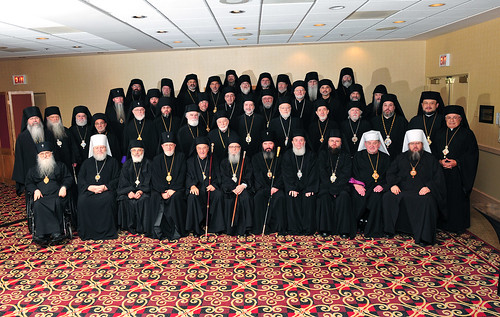
Patriarch Synod in Bagdad
Chaldean candidates for the priesthood study at St. Peter’s Patriarchal Seminary in Baghdad. In 1991 the Chaldean Holy Synod established Babel College for Philosophy and Theology next to St. Peter’s Seminary. It aims to provide a higher scientific education for priests, monks, nuns and interested lay people, and is affiliated with the Pontifical Urban University in Rome. Today the largest concentration of these Catholics remains in Baghdad. There are ten Chaldean dioceses in Iraq, four in Iran, and four others in the Middle East.
The Chaldean liturgy can be traced back to the Syriac Christian culture of Edessa, and attained its present basic structure in the 7th century. The liturgical language is Syriac, and a number of Latin customs have been adopted.
ECUMENICAL RELATIONS:
Alone among the Eastern Rite churches in union with Rome, the Chaldean Catholic Church outnumbers the Assyrian Church separated from Rome. Persecution from the Moslems in Iraq ( a reality that the Allies like to pretend isn't happening), and two Gulf wars have dispersed both Assyrians and Chaldeans all over the globe - there are more Assyrians and Chaldeans in London than in Bagdad - and have forced them into each other's arms. This is the most successful ecumenical process to date. De facto intercommunion between them is now normal and is accepted by Rome for pastoral reasons. Both churches are conscious that they represent a genuine apostolic tradition that is truly Semitic, Judeo-Christian that could play a vital part in the dialogue between Christians, Jews and Moslems - if the Moslems don't kill them all first. The steps towards the present situation are told below.
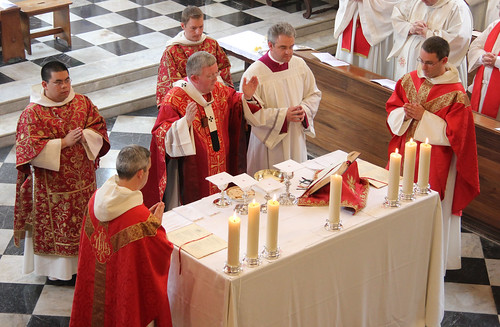
Pope John XXIII invited many other Christian denominations, including the Assyrian Church of the East, to send "observers" to the Second Vatican Council (1962–1965). These observers, graciously received and seated as honored guests right in front of the podium on the floor of the council chamber, did not formally take part in the Council's debate, but they mingled freely with the Catholic bishops and theologians who constituted the council, and with the other observers as well, in the break area during the council sessions. There, cordial conversations began a rapproachment that has blossomed into expanding relations among the Catholic Church, the Churches of the Orthodox Communion led by the Ecumenical Patriarch of Constantinople, and the other Ancient Churches of the East.
On November 11, 1994, a historic meeting between Mar Dinkha IV and John Paul II took place in Rome. The two patriarchs signed a document titled "Common Christological Declaration between the Catholic Church and the Assyrian Church of the East". They declared:
The Word of God, second Person of the Holy Trinity, became incarnate by the power of the Holy Spirit in assuming from the holy Virgin Mary a body animated by a rational soul, with which he was indissolubly united from the moment of his conception. Therefore our Lord Jesus Christ is true God and true man, perfect in his divinity and perfect in his humanity, consubstantial with the Father and consubstantial with us in all things but sin. His divinity and his humanity are united in one person, without confusion or change, without division or separation. In him has been preserved the difference of the natures of divinity and humanity, with all their properties, faculties and operations. But far from constituting "one and another", the divinity and humanity are united in the person of the same and unique Son of God and Lord Jesus Christ, who is the object of a single adoration. Christ therefore is not an "ordinary man" whom God adopted in order to reside in him and inspire him, as in the righteous ones and the prophets. But the same God the Word, begotten of his Father before all worlds without beginning according to his divinity, was born of a mother without a father in the last times according to his humanity
They went on to explain each other's formulations of titles for the Virgin Mary, the key to the dispute at the First Council of Ephesus about Nestorianism and the title Theotokos:
The humanity to which the Blessed Virgin Mary gave birth always was that of the Son of God himself. That is the reason why the Assyrian Church of the East is praying [to] the Virgin Mary as "the Mother of Christ our God and Saviour". In the light of this same faith the Catholic tradition addresses the Virgin Mary as "the Mother of God" and also as "the Mother of Christ"
They then recognised each other's formulations as being valid:
We both recognize the legitimacy and rightness of these expressions of the same faith and we both respect the preference of each Church in her liturgical life and piety.
.
One side effect of this meeting was that the Assyrian Church's relationship to the Chaldean Catholic Church began to improve.[31]
In 1996, Patriarch Mar Dinkha IV signed an agreement of cooperation with the Chaldean Catholic Patriarch of Baghdad, Raphael I Bidawid, in Southfield, Michigan. In 1997, he entered into negotiations with the Syrian Orthodox Church and the two churches ceased anathematizing each other.
LITURGY:
The roots of the liturgy of both Assyrian and Chaldean churches are found in the Judeo-Christian tradition of the early Church. Classicly, the churches are bare of any icons or statues except the cross, "just like a mosque or synagogue".
The liturgical language is Aramaic, the language of Our Lord. In fact, their native tongue is a form of Aramaic, so that the earthly Jesus and they may well have understood each other if they had met in the street. They use several Eucharistic Prayers, but the one they use most commonly is the Anaphora of Sts. Addai and Mari, which one of the oldest, perhaps the very oldest in use anywhere, dating from the second century. From the very beginning of the Mass you can see how the "Our Father" has helped form their liturgy. It begins:
In the Name of the Father and of the Son and of the Holy Spirit, for ever.
Glory to God in the highest (three times) and on earth peace and good hope to men of all times for ever. Amen.
All pray: Our Father in heaven,hallowed be Thy name,Thy kingdom come.Holy, Holy, Holy art Thou, our Father in heaven. Heaven and earth are full of the greatness of Thy glory; angels and men cry out to Thee:Holy, Holy, Holy art Thou.Our Father in heaven, hallowed by Thy name, Thy kingdom come, Thy will be done, as in heaven so on earth. Give us the bread of our need this day, and forgive us our offences, as we have forgiven those who haveoffended us. And bring us not into trial but deliver us from the evil one. For Thine is the kingdom and the power and the glory, for ever and ever. Amen. Priest: Strengthen, our Lord and our God, our weakness by Thy grace that we may administer the holy mysteries which were given for the renewal and redemption of our nature, through the mercies of Thy beloved Son, Lord of all, Father, Son and Holy Spirit, for ever. Amen.
Here follows verses from Psalms 96 or 144, the choir responds by singing alternative clauses. After each clause is said: Hal-le-lu-Yah.
Priest: Before the glorious throne of Thy majesty, my Lord, and the high and exalted seat of Thy honour and the awesome judgement seat of the power of Thy love, and the absolving altar which Thy will has established and the place where Thy honour dwells, we, Thy people and the sheep of Thy pasture, with thousands of Cherubim which sing halleluiahs to Thee, ten thousand Seraphim and Archangels which hallow Thee, do kneel and worship and confess and glorify Thee at all times, O Lord of all, Father, Son and Holy Spirit, for ever. Amen.
We are back in the world of the Old Testament theophanies, the Book of Revelation and the Epistle to the Hebrews. It is a wonderful liturgy. However, in the first Gulf War, when Catholic Chaldeans and separated Assyrians began to spontaneously go to one another's churches, the Catholic Chaldean Patriarch was forced by events to consult Rome. The classical Roman theology teaches that the sacraments aare made up of matter and form, the matter in the Eucharist being bread and wine, and the form being the words, "This is my body....This is the chalice of my blood..." The Anaphora of SS. Addai and Mari, in common use by our separated Assyrian brethren, does not have these words. Certainly, there is a place where you can put them in; but they are not part of the original text, nor do they consider it necessary. They are often put in to allow Catholics who are participating in the Mass to feel at home. The full story can be found in Robert Taft's article Mass Without Consecration? (click title). The important answer, signed by a number of Cardinals, including Ratzinger, and backed by the most prestigious liturgists available, and initialled by Pope John Paul II, has enormous implications for Catholic eucharistic theology as well as for ecumenism and ecclesiology. It says of the separated Assyrian Church of the East (often called the Nestorian Church): ".... the Catholic Church recognises the Assyrian Church of the East as a true particular Church, built upon orthodox faith and apostolic succession." If the Assyrian Church is that, so are other apostolic churches. It also says something of the doctrinal authority of the Liturgy, even when celebrated by a small "true particular church" which has been separated since the sixth century. Here is the full fext of the Vatican's reply GUIDLINES TO THE ADMISSION TO THE EUCHARIST BETWEEN THE CHALDEAN CHURCH AND THE ASSYRIAN CHURCH OF THE EAST. .(click title)
Here is a translation from the Aramaic of the Anaphora of Addai and Mari. Remember that the Words of Institution are optional in the Assyrian Church of the East, but not in the Chaldean Catholic Church
THE ANAPHORA OF SS. ADDAI AND MARI
The grace of our Lord Jesus Christ, and the love of God the Father, and the communion of the Holy Ghost, be with us all, now, etc.
He signs the sacraments,
People: Amen.
Priest: Lift up your minds:
People: They are towards Thee, O God of Abraham, Isaac, and Israel, O glorious King.
Priest: The oblation is offered to God, the Lord of all.
People: It is meet and right.
Deacon: Peace be with you .
The Priest puts on the incense, and says this prayer:O Lord, Lord, grant me an open countenance before Thee, that with the confidence which is from Thee we may fulfil this awful and divine sacrifice with consciences free from all iniquity and bitterness. Sow in us, O Lord, affection, peace, and concord towards each other, and toward every one.
And standing, he says quietly:Worthy of glory from every mouth, and of thanksgiving from all tongues, and of adoration and exaltation from all creatures, is the adorable and glorious name of Father, Son, and Holy Ghost, who created the world through His grace, and its inhabitants through His clemency, who saved men through His mercy, and showed great favour towards mortals. Thy majesty, O Lord, thousands of thousands of heavenly spirits, and ten thousand myriads of holy angels, hosts of spirits, ministers of fire and spirit, bless and adore; with the holy cherubim and the spiritual seraphim they sanctify and celebrate Thy name, crying and praising, without ceasing crying unto each other.
People: Holy, holy, holy, Lord God Almighty; full are the heavens and the earth of His glory.
The Priest quietly: Holy, holy, holy art Thou, O Lord God Almighty; the heavens and the earth are full of His glory and the nature of His essence, as they are glorious with the honour of His splendour; as it is written, The heaven and the earth are full of me, saith the mighty Lord.
Holy art Thou, O God our Father, truly the only one, of whom the whole family in heaven and earth is named. Holy art Thou, Eternal Son, through whom all things were made. Holy art Thou, Holy, Eternal Spirit, through whom all things are sanctified.
Woe to me, woe to me, who have been astonied, because I am a man of polluted lips, and dwell among a people of polluted lips, and my eyes have seen the King, the mighty Lord. How terrible today is this place! For this is none other than the house of God and the gate of heaven; because Thou hast been seen eye to eye, O Lord.
Now, I pray, may Thy grace be with us, O Lord; purge away our impurities, and sanctify our lips; unite the voices of our insignificance with the sanctification of seraphim and archangels. Glory be to Thy tender mercies, because Thou hast associated the earthly with the heavenly.
The Priest says quietly, in a bowing posture: And with those heavenly powers we give Thee thanks, even we, Thine insignificant, pitiless, and feeble servants; because Thou hast granted unto us Thy great grace which cannot be repaid. For indeed Thou didst take upon Thee our human nature, that Thou mightest bestow life on us through Thy divinity; Thou didst exalt our low condition; Thou didst raise our ruined state; Thou didst rouse up our mortality; Thou didst wash away our sins; Thou didst blot out the guilt of our sins; Thou didst enlighten our intelligence, and Thou didst condemn our enemy, O Lord our God; and Thou didst cause the insignificance of our pithless nature to triumph.
Here follow the words of institution, after which: Through the tender mercies of Thy grace poured out, O clement One, pardon our offences and sins; blot out my offences in the judgment. And on account of all Thy aids and Thy favours to us, we shall ascribe unto Thee praise, honour, thanksgiving, and adoration, now, always, and for ever and ever.
The Priest signs the sacraments.
People: Amen.
Deacon: In your minds, pray for peace with us.
The Priest says this prayer bowing, and in a low voice: O Lord God Almighty, accept this oblation for the whole Holy Catholic Church, and for all the pious and righteous fathers who have been pleasing to Thee, and for all the prophets and apostles, and for all the martyrs and confessors, and for all that mourn, that are in straits, and are sick, and for all that are under difficulties and trials, and for all the weak and the oppressed, and for all the dead that have gone from amongst us; then for all that ask a prayer from our weakness, and for me, a degraded and feeble sinner. O Lord our God, according to Thy mercies and the multitude of Thy favours, look upon Thy people, and on me, a feeble man, not according to my sins and my follies, but that they may become worthy of the forgiveness of their sins through this holy body, which they receive with faith, through the grace of Thy mercy for ever and ever. Amen.
The Priest says this prayer quietly: Do Thou, O Lord, through Thy many and ineffable mercies, make the memorial good and acceptable with that of all the pious and righteous fathers who have been pleading before Thee in the commemoration of the body and blood of Thy Christ, which we offer to Thee upon Thy pure and holy altar, as Thou hast taught us; and grant unto us Thy rest all the days of this life.
The Great Oblation
O Lord our God, bestow on us Thy rest and peace all the days of this life, that all the inhabitants of the earth may know Thee, that Thou art the only true God the Father, and Thou didst send our Lord Jesus Christ, Thy Son and Thy beloved; and He Himself our Lord and God came and taught us all purity and holiness. Make remembrance of prophets, apostles, martyrs, confessors, bishops, doctors, priests, deacons, and all the sons of the Holy Catholic Church who have been signed with the sign of life, of holy baptism. We also, O Lord:
We, Thy degraded, weak, and feeble servants who are congregated in Thy name, and now stand before Thee, and have received with joy the form which is from Thee, praising, glorifying, and exalting, commemorate and celebrate this great, awful, holy, and divine mystery of the passion, death, burial, and resurrection of our Lord and Saviour Jesus Christ. And may Thy Holy Spirit come, O Lord, and rest upon this oblation of Thy servants which they offer, and bless and sanctify it; and may it be unto us, O Lord, for the propitiation of our offences and the forgiveness of our sins, and for a grand hope of resurrection from the dead, and for a new life in the kingdom of the heavens, with all who have been pleasing before Him. And on account of the whole of Thy wonderful dispensation towards us, we shall render thanks unto Thee, and glorify Thee without ceasing in Thy Church, redeemed by the precious blood of Thy Christ, with open mouths and joyful countenances:
Canon: Ascribing praise, honour, thanksgiving, and adoration to Thy holy, loving, and life-giving name, now, always, and for ever.
The Priest signs the mysteries with the cross People: Amen.
Back in 2007, which marked the 16th centenary of the death of St John Chrysostom—whose feast is celebrated today in the West (it is celebrated on November 13th in the East)—Pope Benedict XVI gave two general audiences and wrote a fairly lengthy letter about the great Eastern Father and Doctor. In the first general audience, given on September 19, 2007, Benedict presented an overview of Chrysostom's life and work, stating:
Chrysostom is among the most prolific of the Fathers: 17 treatises, more than 700 authentic homilies, commentaries on Matthew and on Paul (Letters to the Romans, Corinthians, Ephesians and Hebrews) and 241 letters are extant. He was not a speculative theologian.
Nevertheless, he passed on the Church's tradition and reliable doctrine in an age of theological controversies, sparked above all by Arianism or, in other words, the denial of Christ's divinity. He is therefore a trustworthy witness of the dogmatic development achieved by the Church from the fourth to the fifth centuries.
His is a perfectly pastoral theology in which there is constant concern for consistency between thought expressed via words and existential experience. It is this in particular that forms the main theme of the splendid catecheses with which he prepared catechumens to receive Baptism.
On approaching death, he wrote that the value of the human being lies in "exact knowledge of true doctrine and in rectitude of life" (Letter from Exile). Both these things, knowledge of truth and rectitude of life, go hand in hand: knowledge has to be expressed in life. All his discourses aimed to develop in the faithful the use of intelligence, of true reason, in order to understand and to put into practice the moral and spiritual requirements of faith.
In the second audience, given a week later on September 26, 2007, the Holy Father said:
It is said of John Chrysostom that when he was seated upon the throne of the New Rome, that is, Constantinople, God caused him to be seen as a second Paul, a doctor of the Universe. Indeed, there is in Chrysostom a substantial unity of thought and action, in Antioch as in Constantinople. It is only the role and situations that change. In his commentary on Genesis, in meditating on God's eight acts in the sequence of six days, Chrysostom desired to restore the faithful from the creation to the Creator: "It is a great good", he said, "to know the creature from the Creator", He shows us the beauty of the creation and God's transparency in his creation, which thus becomes, as it were, a "ladder" to ascend to God in order to know him. To this first step, however, is added a second: this God Creator is also the God of indulgence (synkatabasis). We are weak in "climbing", our eyes grow dim. Thus, God becomes an indulgent God who sends to fallen man, foreign man, a letter, Sacred Scripture, so that the creation and Scripture may complete each another. We can decipher creation in the light of Scripture, the letter that God has given to us. God is called a "tender father" (philostorgios) (ibid.), a healer of souls (Homily on Genesis, 40, 3), a mother (ibid.) and an affectionate friend (On Providence 8, 11-12). But in addition to this second step - first, the creation as a "ladder" to God, and then, the indulgence of God through a letter which he has given to us, Sacred Scripture - there is a third step. God does not only give us a letter: ultimately, he himself comes down to us, he takes flesh, becomes truly "God-with-us", our brother until his death on a Cross. And to these three steps - God is visible in creation, God gives us a letter, God descends and becomes one of us - a fourth is added at the end. In the Christian's life and action, the vital and dynamic principle is the Holy Spirit (Pneuma) who transforms the realities of the world. God enters our very existence through the Holy Spirit and transforms us from within our hearts.
Against this background, in Constantinople itself, John proposed in his continuing Commentary on the Acts of the Apostles the model of the primitive Church (Acts 4: 32-37) as a pattern for society, developing a social "utopia" (almost an "ideal city"). In fact, it was a question of giving the city a soul and a Christian face. In other words, Chrysostom realized that it is not enough to give alms, to help the poor sporadically, but it is necessary to create a new structure, a new model of society; a model based on the outlook of the New Testament. It was this new society that was revealed in the newborn Church. John Chrysostom thus truly became one of the great Fathers of the Church's social doctrine: the old idea of the Greek "polis" gave way to the new idea of a city inspired by Christian faith. With Paul (cf. I Cor 8: 11), Chrysostom upheld the primacy of the individual Christian, of the person as such, even of the slave and the poor person.
In his letter presented on August 10, 2007, Benedict reflected in more detail on various aspects of Chrysostom's thought, including his understanding of the intimate relationship between liturgy, Eucharist, and ecclesial communion—a topic of great interest to the Holy Father:
John held that the Church's unity was founded on Christ, the Divine Word who with his Incarnation was united to the Church as the head is united to the body. "Where the head is, there also is the body", and that is why "there is no separation between the head and the body". He had comprehended that in the Incarnation the Divine Word not only became man but also united himself to us, making us his body: "Since it did not suffice for him to make himself a man to be scourged and killed, he united himself to us not only through faith but also de facto makes us his body". Commenting on the passage of the Letter of St Paul to the Ephesians: "In fact, he put all things under his feet and has made him the head over all things for the Church which is his body, the fullness of him who is fully realized in all things", John explained that "it is as if the head were completed by the body, because the body is made up and formed of its various parts. His body is therefore composed by all. Thus, the head is completed and the body rendered perfect when we are all clustered closely together and united". John then concluded that Christ unites all the members of his Church with himself and with one another. Our faith in Christ requires us to work hard for an effective, sacramental union among the members of the Church, putting an end to all divisions.
For Chrysostom, the ecclesial unity that is brought about in Christ is attested to in a quite special way in the Eucharist. "Called "Doctor of the Eucharist' because of the vastness and depth of his teaching on the Most Holy Sacrament", he taught that the sacramental unity of the Eucharist constitutes the basis of ecclesial unity in and for Christ. "Of course, there are many things to keep us united. A table is prepared before all... all are offered the same drink, or, rather, not only the same drink but also the same cup. Our Father, desiring to lead us to tender affection, has also disposed this: that we drink from one cup, something that is befitting to an intense love". Reflecting on the words of St Paul's First Letter to the Corinthians, "The bread which we break, is it not a participation in the body of Christ?", John commented: for the Apostle, therefore, "just as that body is united to Christ, so we are united to him through this bread". And even more clearly, in the light of the Apostle's subsequent words: "Because there is one bread, we who are many are one body", John argued: "What is bread? The Body of Christ. And what does it become when we eat it? The Body of Christ; not many bodies but one body. "Just as bread becomes one loaf although it is made of numerous grains of wheat..., so we too are united both with one another and with Christ.... Now, if we are nourished by the same loaf and all become the same thing, why do we not also show the same love, so as to become one in this dimension, too?"
Chrysostom's faith in the mystery of love that binds believers to Christ and to one another led him to experience profound veneration for the Eucharist, a veneration which he nourished in particular in the celebration of the Divine Liturgy. Indeed, one of the richest forms of the Eastern Liturgy bears his name: "The Divine Liturgy of St John Chrysostom". John understood that the Divine Liturgy places the believer spiritually between earthly life and the heavenly realities that have been promised by the Lord. He told Basil the Great of the reverential awe he felt in celebrating the sacred mysteries with these words: "When you see the immolated Lord lying on the altar and the priest who, standing, prays over the victim... can you still believe you are among men, that you are on earth? Are you not on the contrary suddenly transported to Heaven?". The sacred rites, John said, "are not only marvellous to see, but extraordinary because of the reverential awe they inspire. The priest who brings down the Holy Spirit stands there... he prays at length that the grace which descends on the sacrifice may illuminate the minds of all in that place and make them brighter than silver purified in the crucible. Who can spurn this venerable mystery?"
With great depth, Chrysostom developed his reflection on the effect of sacramental Communion in believers: "The Blood of Christ renews in us the image of our King, it produces an indescribable beauty and does not allow the nobility of our souls to be destroyed but ceaselessly waters and nourishes them". For this reason, John often and insistently urged the faithful to approach the Lord's altar in a dignified manner, "not with levity... not by habit or with formality", but with "sincerity and purity of spirit".
This same topic was addressed by Adrian Fortescue over a hundred years ago in his classic study, The Greek Fathers: Their Lives and Writings (Ignatius Press, 2007; orig. 1908):
Most of the Doctors of the Church have some one point of the faith of which they are the classic exponents: thus, Saint Athanasius is the Doctor of the Divinity of Christ, Saint Augustine is the "Mouth of the Church about Grace". By universal consent, Saint John Chrysostom is looked upon as the great defender of the holy Eucharist. He is the Doctor Eucharisticus. The Blessed Sacrament and the Real Presence are the subjects to which he turns most often; his writings on this question form a complete defence and exposition of the teaching of the Catholic Church about her most sacred inheritance. In his homilies On the Sixth Chapter of St John, he develops the ideas that our Lord has given us "Bread from Heaven, that he who eats it may not perish", that he himself is the "Living Bread that came down from heaven", that we are to "eat his Body and drink his Blood". "We must listen", says Chrysostom, "to this teaching with fear, because what we have to say today is very awful." He points to the altar and says, "Christ lies there sacrificed" "His Body lies before us", "That which is there in the chalice is what flowed from the side of Christ. What is the Bread? The Body of Christ." "Think, man, what sacrifice you receive in your hand [people took the Blessed Sacrament in their right hands], what altar you approach. Consider that you, dust and ashes, receive the Body and Blood of Christ." We not only see the Lord, "we take him in our hand, eat, our teeth pierce his flesh, that we may be closely joined to him." "What he did not allow on the cross, that he allows now at the Liturgy; for your sake he is broken, that all may receive." "It is not a man who causes the Offering to become the Body and Blood of Christ, but he himself who died for us. The priest stands there as his minister when he speaks the words, but the power and grace come from the Lord. This is my Body, he says. This word changes the Offering." "With confidence we receive your gift," he says in a prayer, "and because of your word we firmly believe that we receive a pledge of eternal life, because you say so, Lord, Son of God, who live with the Father in eternal life." (pp. 120-21)
Is God the Author of Sin?
-
Is God the author of sin? The question assumes paramount importance when
evaluating the construal of divine and human agency advanced by Hugh J.
McCann. Ch...
The Territory of Creativity
-
[image: Holy Martyr Elizabeth Feodorovna, 2017. Wood, gesso, relief gesso,
egg tempera.]This article was originally published in the magazine “Slovo i
Kame...
You Can't Give What You Don't Have?
-
Father Matthew Gonzalez, a priest in the Archdiocese of Newark, New Jersey,
had the idea to create a group for boys in grades eight to 12 that focuses
on...
It’s Time to Say Goodbye
-
Christ is Risen! After almost 20 years of keeping a blog, I’ve decided I
will close down this site at the end of summer, 2022. You can find my
posts on th...
When America Met Thich Nhat Hanh
-
. by Jim Forest I first met Thich Nhat Hanh in May 1966. At the time Lyndon
Johnson was America’s president. The steadily rising level of US troops in
Viet...
The Byzantine Gender Reveal
-
When I see the way my wife comforts our children, I see God as the Mother
loving them through her. I may not see this image of God perfectly, but I
kn...
Certain brethren of good repute and holy life (XXI)
-
CHAPTER XXI. Of the Deans of the Monastery 26 Feb. 28 June. 28 Oct. Should
the community be large, let there be chosen from it certain brethren of
good rep...
Why Not Use Ancient Rites?
-
*It's been more than 2 years since I last posted. So I'll try to revive
things here with this post.*
As the Apostles and their successors evangelized thr...
Get It
-
I haven’t updated this blog in over six years, so probably no one is going
to read this post, since all my former readers gave up on me a long time
ago. Bu...
The Diligent Pastor
-
"O you pastors, be made like that diligent pastor, the chief of the whole
flock, who cared so greatly for his flock. He brought near those that were
a...
The Big Picture - ISIS, NATO and Russia
-
Clarion: Journal of Spirituality and Justice - The Big Picture ~ ISIS, NATO
and Russia
The civilized world, especially those in the West and in Russia, i...
Temporarily – No Comment
-
God willing, the content of this blog will be migrated to its new site,
starting sometime after midnight (here in East Coast America). I have been
asked to...





 Posts

