EXPAND YOUR READING!!

"Today the concept of truth is viewed with suspicion, because truth is identified with violence. Over history there have, unfortunately, been episodes when people sought to defend the truth with violence. But they are two contrasting realities. Truth cannot be imposed with means other than itself! Truth can only come with its own light. Yet, we need truth. ... Without truth we are blind in the world, we have no path to follow. The great gift of Christ was that He enabled us to see the face of God".Pope Benedict xvi, February 24th, 2012

The Church is ecumenical, catholic, God-human, ageless, and it is therefore a blasphemy—an unpardonable blasphemy against Christ and against the Holy Ghost—to turn the Church into a national institution, to narrow her down to petty, transient, time-bound aspirations and ways of doing things. Her purpose is beyond nationality, ecumenical, all-embracing: to unite all men in Christ, all without exception to nation or race or social strata. - St Justin Popovitch

Saturday, 27 November 2010

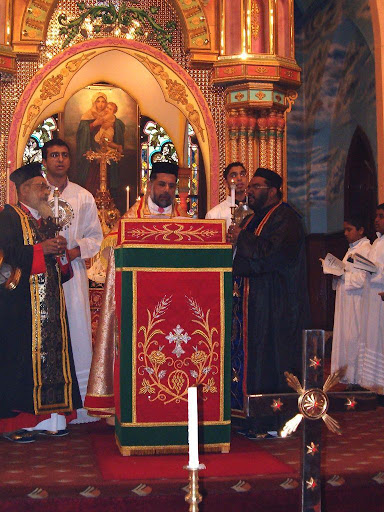
Worship in the Syriac Orthodox Church


The Syriac Orthodox Church is heir to an ancient tradition of Christian worship that is distinguished by the antiquity and beauty of its prayers and rituals. As recounted in the Acts of the Apostles, the early adherents of the Christian faith fleeing persecution in the Holy Land reached Antioch, a prominent center of commerce in the eastern part of the Roman empire. There they were first called Christians. St. Peter is believed to have founded a church in Antioch in AD 39. Meanwhile, in Edessa, the capital of the Kingdom of Urhoy on the borders of Syria and Mesopotamia, a Church was in existence before the end of the first century. In the course of the next two centuries Edessa became the centre of a Christian culture using the Edessene dialect of Aramaic, called Syriac, as its language. While the Church in the West adopted Greek as its language for worship, the Church in the East, addressing itself largely to the Jewish Christians of the diaspora, continued to speak Aramaic. The forms of worship in the Syriac Orthodox Church reflect the Antiochene and Edessene heritage of the Church.
The sense of awe and wonder before the divine Mystery pervades the Syriac Church. The Syrian liturgy is dominated by the scene in the vision of the prophet Isaiah, when, he saw the Lord on a high and lofty throne in the temple in Jerusalem, and heard the angels crying, ‘holy, holy, holy’ before him. In every Syriac church there is a ‘veil’ drawn across the sanctuary, representing the veil in the temple of Jerusalem, and the sanctuary itself is held to be the ‘holy of holies’, the place where God himself appears in the New Covenant with his people, This scene is recalled at the beginning and the end of every office of prayer and the sense of wonder and mystery which inspires it fills the whole liturgy. Together with this sense of awe in the presence of the holiness of God is a profound sense of human sin. As the prophet was led to cry out, ‘Woe is me, for I am man a of unclean lips and I dwell among a people of unclean lips’, so the Syriac liturgy is filled with this sense of human sin and unworthiness. One of the principal themes of the liturgy is that of ‘repentance’. But this sense of sin and the need for repentance is accompanied by, or rather an expression of, the awareness of God’s infinite love and mercy, which comes down to man’s need and raises him to share in his own infinite glory. Thus there is a wonderful balance of dreadful majesty and loving compassion, of abasement and exaltation.
The Syriac Orthodox liturgy, reflecting the Christological history of the Church, places emphasis on the divine nature in Christ. Its Trinitarian doctrine, mostly derived from the Greek and even using Greek terms, is distinctive in the custom of addressing prayer directly to Christ as ‘our God’ and not to the Father through ‘Jesus Christ our Lord’. Immense veneration is paid to Mary as the ‘Mother of God’, or more literally ‘She who brought forth God’. This profound devotion is based entirely on a continued meditation on the fact that the person whom Mary brought forth was truly God. This is the source of endless wonder and at the same time of amazing paradox, which is expressed in poetic terms: ‘in your arms you embraced the flames and gave milk to the devouring fire; blessed is he, the infinite, who was born of you’. This deeply biblical and theological devotion to the Virgin Mary grew up in the Church as a direct consequence of belief in the Incarnation.
Together with devotion to the Mother of God goes a devotion to the prophets, apostles and martyrs, as members of the Mystical Body of Christ, those who proclaimed and those who died for the sake of the Gospel. Here again this devotion to the saints is expressed in one of its purest forms, deeply rooted in a biblical view of life and springing wholly from devotion to the person of Christ and the authentic message of the Gospel. What is most evident throughout the Syrian liturgy is its biblical background. It is as though the liturgy sprang from the very same soil as the Old and the New Testament. The ‘saints’ of the Old Testament, Abraham, Isaac and Jacob; Moses and David and the Prophets, and in’ particular Job and Daniel and three holy men in the furnace of Babylon, are as familiar figures as the apostles and are felt as living witnesses to the mystery of Christ always alive within the Church. Even more interesting is the frequent reference to ‘our father Adam and our mother Eve’, which takes the mystery of salvation back to the first man and woman, and sees Christ descending ‘to Sheol, the place of the dead, at the resurrection, to proclaim the message of salvation to all the dead and to raise up Adam and Eve. The feeling for the dead as waiting in Sheol for the resurrection at the second coming of Christ is also a theme which takes us back to early Jewish Christian theology, from which the Syriac theology so largely derives, and helps us to see how devotion to the faithful departed grew up spontaneously in the early Church.
The Syriac Orthodox liturgy is derived from the prolific works of its poet-theologians. Works of Mor Ephrem, Mor Ya`qub of Sarug, Mor Philoxenos of Mabbug, Chor Episcopus Mor Balay, among others figure prominently in the liturgies. Liturgy is poetic in form, being based on a regular syllabic pattern, but still more in spirit. They are, in fact, one of the most authentic expressions of the Christian spirit. All the mysteries of the Christian faith, the Trinity and the Incarnation, the Cross and the Redemption, the Resurrection and the Second Coming, the Church as the Bride of Christ, Mary, the Mother of God and the saints of the Old and New Testament, the dead in ‘Sheol’ and the expectation of the return to Paradise, all these themes are treated with a wealth of poetic beauty. The meditation on the mysteries of faith seems to awake in these writers (who were mostly monks) an inexhaustible flower of poetry, which is both profoundly theological and astonishingly original. The liturgies have long antiphons known as qolos and bo`oothos and the shorter antiphons known as eqbos and enyonos. It is in these songs that the immense poetic beauty of the Syriac liturgy is found.
In accordance with Psalm 119, verse 164, “Seven times in the day have I praised thee for thy judgments, O Righteous One,” the Syriac Orthodox Church set the times for prayer to seven: Evening or ramsho prayer (Vespers), Drawing of the Veil or Sootoro (meaning ‘Protection’ from the Psalm 91, which is sung at this prayer, ‘He who sits under the protection of the Most High’), Midnight or lilyo prayer, Morning or saphro prayer (Matins), the Third Hour or tloth sho`in prayer (Prime, 9 a.m.), the Sixth Hour or sheth sho`in prayer (Sext, noon) and the Ninth Hour or tsha` sho`in prayer (Nones, 3 p.m.). The Midnight prayer consists of threeqawme ‘watches’ (literarily ‘standing’). The ecclesiastical day begins in the evening at sunset with theramsho. Today, even in monasteries, the evening and compline prayers are said together, as also the midnight and morning prayers, and the three, six and nine o'clock prayers, reducing the times of prayer to three.
Each of the hours has its own particular theme or themes and the sense of the natural background of morning, evening or night is often present and often calls forth the most charming poetry. Thus the natural and the supernatural world are marvellously blended and provides a sense of wholeness. It is the whole mystery of Christ which is presented here in all its majesty from the creation of the world to the Second Coming of Christ, from the Trinity in the height of heaven with the angels and the watchers, who surround it, to man on earth, his sin and suffering in this passing world with all its beauty, his redemption by the Cross and his hope of glory with the prophets and apostles and martyrs, who have entered into glory, and to the dead who wait in Sheol for the coming of the Son of Man and the general Resurrection.
Sources:
Patriarch Ignatius Aphram I Barsoum, The History of Syriac Literature and Sciences. tr. Matti Mousa. (Pueblo, CO: Passeggiata Press, 2000).
Fr. Bede Griffith, The Book of Common Prayer of the Syrian Orthodox Church, Kurishumala Ashram.

Explanation about the Holy Qurbana

Attention: open in a new window. PDFPrintE-mail
At the beginning of the public service, the veil closing the sanctuary is drawn aside, signifying the appearance of the promised Messiah. At this time we speak of St. Mary who brought forth the Christ and John the Baptist who baptized Him. The whole congregation sings a song of praise while the priest, the deacon and the servers go solemnly around the altar carrying lights and incense, and waving the fans. These two Saints are remembered and their prayers are asked for because they were the two most intimately connected with the incarnation of the Lord, Mary who brought Him forth and John who prepared His way.
The priest offering incense along with deacons holding candles move in a procession around the altar. The priest represents Christ, the High Priest.  The deacon who leads the procession represents John the Baptist, and the other deacons represent the Apostles and Disciples of Christ.
 Trisagion

“Holy art thou, O God!
Holy art thou, Almighty,
Hoy art thou, Immortal,
Crucified for us,
Have mercy on us.”


According to Bar Sleebi three sets of angels came down at the time of burial of Christ. They sang, the first set ‘Holy art thou god’, the second, ‘Holy are Thou mighty’, and the third ‘Holy art Thou immortal’ and Joseph of Arimathea and Nicodemose (Mark 15:43) inspired by the Holy Spirit burst forth ‘Thou that was crucified for us have mercy on us’.

God is a trinity and so the number three has special significance. After the Trisagion the priest and the congregation chant kurielaison (Lord have mercy upon us) thrice.
Readings of the Scripture
In the Malankara Syrian Orthodox Church and Syrian Orthodox Church, there are three readings, one from the Acts, one from St. Paul and one from the 
Gospel. They are each preceded by a chant.
  1. The first reading is done by the deacon from the northern side of the chancel, standing on the steps. It represents preaching of the gospel to the Jews.
  2. The second reading is done form the southern side, representing preaching of the gospel to the gentiles.
  3. The reading from the Gospel is done with great solemnity, as in all liturgies, the priest standing in the center of the sanctuary, while the servers carry lights and incense.
Blessing of the Censer

The prayers for the blessing of the censer are proclamations of the faith in Trinity.  The chains on the censer represent the Holy Trinity. The first chain stands for God the Father. The second and third chains represent the human and Godly nature of the Son. The fourth chain represents the Holy Spirit. 

The priest puts incense in the censer and grasps one of the chains and makes sign of cross over it and says: ‘Holy is the Holy Father’. Grasping two more chains the priest proclaims: ‘Holy is the Holy Son’ and finally he grasps the last chain and says ‘Holy is the Holy Spirit’.

The Nicene Creed

We believe the following:

  • In the one True God, the Father Almighty
  • In the one Lord Jesus Christ who took birth for the salvation of humanity
  • In the one living Holy Spirit
  • In the One Holy, Catholic (universal) and Apostolic Church
  • We acknowledge one baptism for the remission of sins
  • In the Resurrection of the dead
  • In the new life in the world to come
  • St. Mary is described as the Mother of God and so this is a confession of faith against Nestorians
What does the priest pray privately in the kneeling position?

While the creed is being said, the priest turns to the clergy and people and asks for forgiveness and requests them to pray to the Lord to accept his oblations. The priest then kneels before the altar and beseeches the Lord for remission of sins and acceptance of his offering. The priest prays for and makes the sign of the cross with his right thumb on the altar mentioning the names of those alive and departed for whom prayers have been requested. 

The deacon goes about the whole nave and returns to the altar. This signifies that:

  • God the Word came down from heaven and offered himself for us all
  • This is a sign for the un-baptized to leave

THE ANAPHORA OF THE FAITHFUL
The word ‘Ana’ means ‘Up’ and ‘Phora’ means ‘to carry’. The Anaphora is the solemn prayer of thanksgiving which our Lord uttered at the Last Supper and the works and actions which He used when he instituted the Eucharist. The original Anaphora of the rite of Antioch is that of St. James, but there are a great many others, eighty-eight in all, which were introduced in later times. Of these about sixty-four have their authors identified, which may be used for celebration.

The Kiss of Peace

The kiss of peace is of apostolic origin (Rom 16:16, 1 Cor. 16:20) and is used in every liturgy to signify the ‘fellowship of the Spirit’ of which the Eucharist is the outward sign. It shows the love and harmony which should exist among the followers (disciples) of Christ. By this we fulfill the word of theLord which says, “If thou offer thine offering and remembers that thy brother hath aught against thee; leave thine offering, and go, be reconciled with thy brother” (Mathew 5:23)
Bowing of Head

After the kiss of peace, we bow our heads. This is to express our humility and receptive mood for Gods blessings. According to Bar Sleebi, we collectively bow before Christ who sees all secrets and cleanses, lightens, and completes each one as he or she deserves.
The covering and Lifting of the Anaphora

When the Holy sacrifice is about to begin the veil is lifted form the paten and chalice and solemnly waved over the offering.  The prayer which the priest says, compares the veil to the stone which covered the sepulcher (tomb) of Christ, which is now rolled away and to the rock of the desert which gave water to the people of God, signifying the water of life which Christ gives to his people in the Qurbana (2 Cor. 10:4).
Benediction given by the priest

When the celebrant turns to bless, he turns to the right side after making the sign of cross on him-self and then makes the sign of the cross on the people. The priest blesses the people three times during the Qurbana. The first blessing is using the words of St. Paul: “The grace of the Lord Jesus Christ, the love of God and the fellowship of the Holy Spirit, be with you all” (2 Cor. 13:14)
The Eucharistic Prayer

The dialogue between the priest and people which follows is one of the most ancient liturgical formulas found in all liturgies at this point. The people are asked to lift up their hearts and minds to where Christ sits, at the right hand of God the Father, and then to give thanks. Then the congregation breaks with the song of the angels ‘Holy, holy, holy…’ (Isaiah 6: 3) and ‘Blessed is He that cometh…’ (Psalms 118: 26) recalling that the angels are present at this 
solemn moment, joining their praise to that of the church on earth.

“The people are directed to lift up their heart to heaven, to see heaven not earth, the heavenly altar not the earthly altar, the heavenly priest not the earthly priest, the heavenly Body and Blood, not the earthly bread and wine, the heavenly worshipping host, not the earthly congregation.” (Bishop Pakenham Walsh p. 36)
Celebration of the Holy Qurbana

The priest narrates that which the Lord did, and blesses the bread and wine by making the sign of the cross. Thus, they become the Body and Blood of our Lord. If we allow Him to bless us, just as the ordinary bread is changed to His Body, we ordinary men and women, our ordinary lives, are thus transformed into the vehicle of God’s grace (Jn 2:9).  By giving His blood, our Lord has given us everything He has. He makes our whole being His, when He blesses us.

Anamnesis or the Sacrificial Memorial


The priest and the people together recall the mystery of the death and resurrection of Christ which is made present in all its saving power, while they look forward to the second coming of Christ, for which this mystery prepares them. The spoon and cushion are lifted up and placed on the left side of the Thronos (Altar). The priest lifts them over head in his right hand quickly, signifying the second coming of the Lord on the last day, which will be like a flash of lightning.  “For just as lightning comes from the east and flashes even to the west, so shall the coming of the Son of Man be” (Matthew 24:27).

Invocation of the Holy Spirit 

The consecration is followed by invocation of the Holy Spirit in which the Holy Spirit is called upon to descend upon the gifts. The mystery of the Holy sacrifice is considered to be complete and perfected by the action of the Holy Spirit. The priest waves his hands over the bread and wine with a fluttering motion, signifying the descent of the Holy Spirit. We find the deacon warning the people to stand in awe as the Holy Spirit is descending and hovering over the mysteries. The Holy Spirit is here represented by the dove, flying and hovering over (Mark 1:10). The hands signify the wings of the dove. 

This is followed by the thrice repeated earnest prayers of the priest. “Answer me, O Lord” and the people respond with a three fold, “Kurie-elaison” meaning “Lord have mercy”. This reminds us of the repeated prayer of Elijah on Mount Carmel to send down fire from heaven upon the sacrifice - “Hear me, Lord, hear me” (1 Kings 18:36-39).  The coming of the Holy Spirit upon the offering is to transform the offerings into the Body and Blood of our Lord.
Diptychs (Thubden) – The Great Intercessions
  1. For the living spiritual Fathers who tend the Church
  2. For the living faithful brethren
  3. For the living faithful rulers
  4. Intercession of the Mother of God and Saints
    • St. Mary – Most revered saint of the church
    • John the Baptist – The forerunner of Christ (Feast on 7th of January)
    • St. Stephen – Known as the head of deacons and is the first martyr of the Church. He was stoned to death. Death looming, he saw the heavens open and the Son of God standing at the right hand of God (Acts 7:56). The church commemorated his memory through the feast held on the 8th of January.
    • St. Peter – Was called to tend the Church by Lord Jesus Christ and is thus known as the chief of the Apostles. He is the foundation of the One Apostolic and Catholic (Universal) Church and was the first Patriarch of the Church of Antioch (Mathew 16:17). He was publicly crucified by the Emperor of Rome. He was nailed to the cross with his head downward, at his own request, symbolically kissing the feet of His Lord (Pollock, 1985).
    • St. Paul – The greatest evangelist of the church. Originally a persecutor of the Church, he transformed into its most eloquent leader. He was born at Tarsus and was known as Saul. He was finally condemned by the Roman Senate and was beheaded on the same day St. Peter was crucified. His memory is commemorated by the Church on the 29th of June along with that of St. Peter.
    • St. Thomas – It is traditionally believed that He arrived in Malankara (Kerala) in A.D. 52. It is believed that St. Thomas installed seven crosses in different parts of Kerala and performed several miracles. St. Thomas was martyred at Mylapore, near Madras, India in A.D. 72. His mortal remains were transferred to Uraha (Edessa) in A.D. 394. The feast of St. Thomas is celebrated on July 3rd, presumable the day the mortal remains were transferred to Uraha.
  5. For the departed spiritual Fathers of the Church
  6. For the faithful departed – The names of the departed for whom the Qurbana is said are remembered, after asilent prayer. The priest draws the sign of cross on the right rim of the paten while remembering the names of the departed.
Prayers for the Faithful Departed

The Church believes that the faithful departed are present in the Holy Mass along with the living faithful. St. Peter ascertains that the judgment is for both the living and the dead. Therefore, Jesus Christ preached the Gospel to the departed. “That is why the Good News was preached also to the dead” (1 Peter 4:6). Thus the congregation intercedes for the remission of sins of the faithful departed, so that the Lord may make them worthy of inheriting the heavenly kingdom. 

Why is the Sanctuary closed after the above?


The veil is pulled over the sanctuary as a reminder of the time of His redemptive passion, death, burial, and resurrection, when the earth was engulfed in darkness (Luke 23:44, 24:1; Mat 28:1; John 20:1)

The Fracture and Commixture performed by the priest while the sanctuary is hidden: The breaking of the host (bread) signifies the suffering and death of our Lord. The priest breaks the bread and anoints it with the precious blood, signifying that the body and blood of Christ, which are separated in death, were reunited at resurrection. Then the host is lifted signifying our Lords resurrection.
The Seraphic Hymn (While sanctuary is hidden) – “Anpudayonae (Hearken gracious)”: Hymn is based on Isaiah’s vision (Isaiah Ch. 6). It describes the worship of the seraphim and our desire to draw near to our Lord. 

The veil is opened symbolizing the appearance of our Lord to His disciples after his resurrection several times, before Pentecost.

The Lords Prayer (Mat. 5:6)


It is the family prayer of the Church, addressed to the Father in heaven by His little children. It is all inclusive, and can be used for every kind of intention. Every clause is wonderful in its combined depth and simplicity. But its very familiarity makes men repeat it hurriedly without thinking of its meaning in other words, saying it, instead of praying it. This we must avoid.

Elevation of the Holy Mysteries

The priest holds up the sacred mysteries, bells rings, two lighted candles on either side, and fans on either side shaken (Acts 1:10). The deacon calls to watch with fear and trembling, emphasizing the solemnity of the occasion. This commemorates the ascension of our Lord Jesus Christ to heaven.
Hymns of Eucharistic Devotion

The Church commemorates the saints and seeks their intercession through these hymns. The Church venerates the 
memory of St. Mary, the mother of God, the patron saint of the parish or the saint whose feast is being celebrated. 
The congregation also intercedes for the departed clergy and the faithful departed through these hymns, based on 
Psalms:
  •  “The righteous man will flourish like the palm tree…” Psalms 92:12-14
  •  “Let Thy priests be clothed with righteousness…” Psalms 132:9-10, 12
  •  “Just as a father has compassion on his children...” Psalms 103:13, 15
Why is the sanctuary closed again?

It symbolizes that our Lord is now hidden to our bodily eyes and also the age in which the Church awaits the second coming of our Lord. 

THE SECOND COMING
The veil is then opened symbolizing the second coming of our Lord and the Day of Judgment. The priest, carrying the paten in his right hand and the chalice in his left hand, turns counter-clockwise to face the congregation to specially signify the coming of the Lord of judgment. This is in contrast to the usual clockwise turn, which is symbolic of the first coming of our Lord as the Redeemer. The priest then proceeds west in a procession which signifies the anticipated second coming. 

The accompanying deacon’s with lighted candles, marvahtso (fans), and bells represent the tumultuous second coming of the Lord with trumpets and accompanied by the angels. (Mathew 25: 31 - “And He will send forth His angels with a great trumpet and they will gather together his elect from the four winds…”)

The priest returns to the altar where he sets the paten and chalice on the tablitho.
Prayers of Thanksgiving

Also known as the concluding prayers, the priest thanks the Father on behalf of the congregation for having considered us worthy of partaking in the Body and Blood of Jesus Christ. After the prayers of thanksgiving, the faithful are dismissed by saying ‘depart ye in peace and pray for me always’.

How is the Holy Qurbana concluded?

The Qurbana is concluded behind the veil when the priest completes his communion. He concludes by kissing the altar three times saying: “Farewell, O Holy and divine altar of the Lord. Henceforth, I know not whether I shall return to Thee or not…” This reminds that death is always at the door and makes us vigilant in preparing ourselves to meet the Lord whenever the call comes.
Compiled From:
  1. Samuel, A. Yeshu, H. E. (1967). Anaphora - The Divine Liturgy of Saint James, the first bishop of Jerusalem. New York.
  2. Rajan, Mani Rev. Dr. (1994). Queen of the Sacraments. Seminary Publications.  Mulanthuruthy.
  3. Panoor, Punnose Dr. (1994). A Guide to the Orthodox Liturgy and Faith. Madras.

Thursday, 25 November 2010

[Irenikon] Met. Hilarion on Monasticism--"Choosing repentance as a way of life"


Importance of Monasticism for Orthodoxy Today – paper presented by Metropolitan Hilarion of Volokolamsk at the round table of 4th International Theological Conference


19.11.2010 · DECR Chairman
On November 18, 2010, the last day of the 4th International Theological Conference of the Russian Orthodox Church on Life in Christ: Christian Ethics, Ascetic Tradition of the Church and Modern Challenges, a round-table talk was held at the Department for External Church Relations Metropolitan Hilarion of Volokolamsk to discuss common Orthodox witness. Metropolitan Hilarion chaired the meeting and presented the following paper on the Importance of Monasticism for Orthodoxy Today:

Introduction:

Be perfect, therefore, as your heavenly Father is perfect (Mt. 5:48). Obedient to her Divine Founder, the Church of Christ has sought for almost 2000 years to attain what cannot be attained without the grace of God’s ideal of perfection given by the Lord in his Sermon on the Mount and underlying the great Christian ascetic tradition. This tradition, which has produced a great assembly of holy ascetics, did not appear overnight but became a fruit of ages-long development and refinement of its forms and norms. The progressive nature in which the ascetic tradition developed is attested to in the passage of the Gospel in which the Lord, relieving his disciples from some traditional forms of asceticism during his ministry on earth, points to the time when the bridegroom will be taken from them; then they will fast (Mt. 9:15). It is equally doubtless that the typology of Christian asceticism is rooted in the pre-Christian religious culture and not only in that of the Old Testament. In some sense, we can speak about one typology of asceticism built on some common human religious experience.
The specifics of Christian asceticism probably need to be found precisely in a synthesis of various ascetical traditions of religious and religious-philosophical origin – the synthesis which became possible through the closeness between the biblical idea of the image of God in man and the idea of becoming like God voiced in the Platonic religious-philosophical tradition.[1] The ascetic theology emerging at the junction of doctrine and ascetical practice is strongly dependent also on anthropology as it acquires a particular overtone depending on the tradition of thinking standing behind the anthropological views of a particular author (biblical, Stoic or Platonic). Even the very notion of ascesis, let alone other borrowings, goes back to a great extent to the Stoic favourite theme of ἄσκησις ἀρετῆς (‘exercise in virtue’), though in its origin it belongs to the sphere of gymnastics.[2]
This paper, however, is not about the theory of Christian ascesis, nor is it about the history of ascetical teachings but about the importance that the church estate – for which ascesis is a principal way of life, one can say ‘profession’ – has for Orthodoxy today. I mean monasticism.
But before moving to the discussion of this special matter, I would like to dwell on three fundamental points characteristic of Christian asceticism in essence, whatever the age or estate in which and by which it is exercised. First of all, every manifestation of asceticism in the Church is subject to the aim of bringing people closer to God, making them like God, training our nature for virtue and preparing it for a meeting with God which takes place, according to the economy of our salvation, in Jesus Christ. Thus, any manifestation of asceticism in Christianity cannot be viewed as an aim in itself or self-value (as, say, the ideal of passionlessness – ἀπάθεια in Stoicism) but it is to be viewed only as a means, as μέθοδος, and using this means, endless generations of Christians transform through God’s grace the human nature with its inclination to evil to become the beneficial vessels of the Word (Gradual, Tone 6).
Secondly, ascesis, not being an aim in itself, is at the same time an integral part and invariable companion of spiritual life as it affects equally the physical and spiritual spheres. The basic opposition in Christian ascetical tradition is not between body and spirit, not between the material and the immaterial as it is in various dualistic systems (Platonism, Manichaeism, some trends of Gnosticism, etc.) but between life according to the flesh (κατὰ σάρκα) and life according to the spirit (cf. Rom. 8:1-8off). While a life according to the flesh implies the imposition on oneself of some restrictions out of fear of punishment and is furnished with a system of bans (do not murder, to not commit adultery, do not desire… etc.), a life according to the spirit implies an inner urge for perfection in God motivated by the love of Him. In this context, every form of ascesis acquires a positive and creative meaning, not restricting one’s freedom according to the flesh but offering the ways of finding true freedom according to the spirit, tested by thousands of experiences.
And the third point stems from the first and second ones: it is the purely individual nature of ascetic work defining the measure of accomplishment considering the spiritual need of the individual in his growth into the whole measure of the fullness of Christ. (Eph. 4:13). The point is not absolute independence of Christians from one another in their ascetical practice, as it is impossible to hand down the living experience of the Church, which is the Tradition proper, Παράδοσις, without teaching and discipleship, without St. Paul’s I urge you to imitate me as I imitate Christ (1 Cor. 2:16). The point is that any ascetical norm, be it abstention in all its manifestations, the work of prayer both in public and in private or accomplishments reflected in monastic vows, is positive only if related to the general dynamic of a Christian’s spiritual growth and his acquirement of the mind of Christ (1 cor. 2:16) and his adoption of the main law of Christian life – the law of love.[3] This dilemma is pointed in Christ’s parable about ten maidens in which interpreters, beginning from Chrysostom, clearly see oil as mercy or love of men, that is, effective Christian love. Without attaining it, an ascetic, even if he has reached great ascetic heights, remains only a resounding gong or a clanging cymbal (1 Cor. 13:1).
Paradoxically, the same law of love making up the central pivot in the life of one church organism consolidates at certain times the ascetic work of individual members of this body into one devotional or ascetic burst aimed to oppose a certain spiritual or even material threat, like the mobilization of all vital resources that takes place in a human body struggling with an illness or in face of a threat. It is precisely how the present order of long and short fasts has been formed. This is how the Church fullness normally reacted to various dangers and disasters. This is how people impelled God and his saints towards mercy and beneficial help at the hardest moments of history. It is in this vein that we should consider the emergence of various monastic rules which used to gather together their followers into a brotherhood strong spiritually precisely in their unity and solidarity.
At this point we have come close to the main part of the paper in which we will speak about monasticism as the highest state of Christian perfection and a ministry of the Church and about some problems of monasticism today.
Monasticism as the highest stage in Christian perfection

The only goal of Christian growth is the mysterious meeting with God and entering into communion with God. There are different ways however that lead to this height. One of them, more gentle and long, is marriage, while the other, more steep and short, is monasticism. The life of the Baptist and some of the apostles of Christ as well as some episodes from the Gospel and letters of St. Paul suggest a possibility for an early achievement of this goal in celibacy. Indeed, the ministry of the Saviour on earth, too, could be carried out only if it was free from everyday family chores. During the taking of monastic vows, the Gospel is read, made up of two passages which contain the whole ‘philosophy’ of monastic life:
Anyone who loves their father or mother more than me is not worthy of me; anyone who loves their son or daughter more than me is not worthy of me. Whoever does not take up their cross and follow me is not worthy of me… Come to me, all you who are weary and burdened, and I will give you rest. Take my yoke upon you and learn from me, for I am gentle and humble in heart, and you will find rest for your souls. For my yoke is easy and my burden is light (Mt. 10:37-38; 11:28-30).
The desire ‘to be perfect’ includes the condition that one should ‘give all his possessions to the poor and then follow Me’ (cf. Mt. 19:16-22). Each Christian is called to a life of virtue but only a monk is obliged to seek perfection with all his heart. Each Christian is called to live according to the Gospel, but only a monk embodied the gospel’s ideal most radically by seeking to imitate Christ in everything. Each Christian gives in baptism a vow of faithfulness to God, but only a monk promises to God to follow the way of absolute non-possession, chastity and obedience. Each Christian is called to repent but only a monk’s lament should become a continued and everyday accomplishment. While the Lord commands a family man to be chaste in marriage, not to commit adultery, nor to look at women with desire, He demands from a monk to be absolutely lonely and to abstain absolutely from matrimony. While the Lord orders a lay person not to accumulate treasures on the earth but to be concerned in the first place for the Kingdom of God, a monk must reject every earthly possession altogether and have nothing of his own but give whatever is his own and his own self to God. While a lay person is commanded ‘not to love this world and whatever in the world’, a monk is called to reject the world fully and to hate it.
Therefore, monasticism appears to be the most radical form of following Christ’s call to perfection, selflessness and carrying the cross. Monasticism is a beneficial yoke of Christ, taken by a monk on himself voluntarily. It is the fullest imitation of the One Who is meek and humble in the heart and for Whom a monk gives up his parents, relatives and the entire world.
This yoke of Christ is expressed most clearly in the following vows pronounced by a person in the face of the Church before he or she assumes ‘the angelic image’:
  • to stay in a monastery and hold fast until the last breath;
  • to preserve oneself in virginity, chastity and reverence;
  • to obey the abbot and all the brethren in Christ;
  • to remain until death in non-possession and voluntary poverty in coenobitic life for the sake of Christ;
  • to accept all the rules of monastic life, the rules of holy fathers and orders of the abbot;
  • to be ready to endure every inconvenience and sorrow of the monastic life for the sake of the Heavenly Kingdom.[4]
One’s taking of these vows marks one’s entering a new life full of various feats and struggles.
The vow of virginity is not reduced to corporal chastity but also includes the protection of one’s thoughts and heart from impure feelings. ‘Chastity’ (Greek σωφροσύνη) means literarily ‘sanity’, when one in all one’s actions and thoughts is guided by wisdom coming from above, which is Christ Himself – the Logos of God.
Non-possession means that one rejects any attempt to seek richness and temporal benefits. A monk possesses only that which is necessary for life, while giving the rest to the poor and being never attached to anything temporal so that his mind may be always free from any concern for things vain and temporal but be busy with the concern for the salvation of himself and his neighbours. ‘Steps’ and other monuments of ascetical writings speak of the virtue of pilgrim’s journey when a monk understands that there is no permanent city for him here, on the earth, and seeks a city to come because his spiritual homeland is the Heavenly Jerusalem, and it is to this city that his mental eye is directed.
Obedience has a special importance. It is the feat difficult to understand and accept for the modern man, while it constitutes the very essence of monastic work. Obedience lies in the basis of monasticism. Archimandrite Sophronius Sakharov, a great modern ascetic, writes: ‘Monasticism is first of all the purity of the mind. Without obedience it is impossible to attain it, and for this reason, there is no monasticism without obedience. A disobedient person is not a monk in the true sense of this word. God’s great gifts including even the perfection of a martyr are quite possible outside monasticism as well, but the purity of the mind is a special gift given to monks, unknown on other paths, and this condition can be attained by a monk only through the feat of obedience’.
Obedience to a spiritually experienced guide helps or a monk understand the science of monasticism. Only the one who has passed this school can later become a guide for the next generation of monks.
‘Obedience is the grave of one’s own will and the resurrection of humbleness’, says St. John Climacus, ‘An obedient one, like a dead one, will not contradict or judge either in good things or what may seem evil to him; for the responsibility for everything is borne by the one who piously deadened his soul’.[5]
Prayer is the most important occupation of a monk, which supports him in observing the vows he has given; it is his spiritual weapon. For this reason, the monastic rules assign daily rounds of various prayers in church, in his cells, prayers common and individual. A monk, being constantly in prayer, should take communion as frequently as possible in order to become united with the divine nature of Christ and to live already here, on earth, the life of the age to come.
The inner mood of a monk should be closely bound up with repentance and lament. In the very beginning of his tonsure to the minor schema, the father superior, calling the tonsured one who has humbled himself down to the ground, says: Wise God as the Father Who loves his children, looking at your humbleness and sincere repentance, accepts you like a prodigal son who repents and comes to bow before him wholeheartedly.

A monk assumes the feat of repentance not because he is more sinful than other people but because he chooses repentance for himself as a way of life. St. Isaac the Syrian speaks of monasticism as the way of lament: The monk (Syr. abila, lit. ‘lamenting’) is he who, in hope for future blessings, spends all days of his life in hunger and thirst. The monk he who dwells outside of the world and always prays to God to give him future blessings. The treasure of a monk is consolation found in lament…[6]

In this continued grief a monk also finds a spiritual joy born from lament and repentance. In the chapter about ‘the joy-creating lament’, St. John Climacus says, Take effort to hold on the blissful and joyful sorrow of sacred tenderness and do not stop training yourself for this work until it puts you beyond all the earthly things and present you pure to Christ. He who clothed oneself in a blessed and beneficial lament as a conjugal vestment has learnt the spiritual laugh of the soul. Thinking about the ability of tenderness, I amaze at how lament and the so-called sorrow contain joy and merriment, like honey is contained in a cell… This tenderness is truly a gift of the Lord… because God gives consolation to those who grieve in the heart in a mysterious way.[7]
Consolation is sent down from God Himself Whom a monk serves by the whole of his life. Addressing a novice in the end of the tonsure, the father superior says: May all-generous God accept and embrace and protect and may that wall be firm in the face of an enemy…, lying down and standing up together with you, pleasing and cheering your heart with the consolation of His Holy Spirit.

Monasticism, unlike marriage, is a destiny of the chosen not in the sense that they are better than others but in the sense that they feel called and have taste for loneliness. If a person has no need to stay alone, if he is bored by being one on one with himself and with God, if he always needs something external to fill him, if he does not like to pray and is incapable of being engulfed in the element of prayer and coming closer to God through prayer, he should not take monastic vows.
In many respects it is much more difficult to live in the world. Monasticism is a ‘narrow path’ in the sense that one has to reject many things which belong to ordinary people by right. And monastics reject many external things for the sake of finding things internal. But I do not think that monasticism is higher than marriage or it is more conducive to the attainment of sanctity than marriage. Any path chosen by one, if one seeks God, is difficult because it is ‘a narrow door’. If one seeks to live according to the gospel, one will always encounter obstacles and will have to always surmount them. Monastic life, like a life in marriage, is given for one to realize one’s inner potential as fully as possible. It is given to find the Kingdom of God which can become a destiny for each of us after death, but we can partake of it by experience already here, on earth.
In the early Church, monasticism developed gradually. There were groups of ascetics who took the vow of celibacy. Some of them went to deserts, while other remained to live in cities. They set themselves as their principal aim to carry out spiritual work on themselves. This is what the Old Testament describes as ‘walking before God’ when the whole life of a person is directed to God, when every deed and word is devoted to God.
There is no contradiction between not only monasticism and marriage but also between monasticism and a life in the world. St. Isaac the Syrian says that ‘the world’ is a totality of passions. And a monk retreats from such a ‘world’, not the world as God’s creation, but the fallen and sinful world steeped in vices. He retreats not because he hates the world but because he disdains it, because outside the world he can accumulate in himself the spiritual potential which he will eventually realize in the service of people. St. Siluan of Mount Athos says, ‘Many accuse monks of wasting their bread, but the prayer they lift up for people is much more valuable than many things people do in the world for the benefit of their neighbours’.
St. Seraphim of Sarov said, ‘Seek the spirit of peace, and thousands around you will be saved’. Retreating to desert for five, ten, twenty and thirty years, hermits acquired ‘the spirit of peace’ – the inner peace which those who live in the world are lacking so much. But then they returned to people in order to share this peace with them. And really, thousands of people were saved around such ascetics. Of course, there were a great deal of ascetics who retreated from the world never to come back to it, who died in obscurity, but it does not mean that their feat was in vain, because the prayers they lifted up for their neighbours helped many. Having attained sanctity, they became intercessors and protectors for thousands who were saved by their prayers.
Monasticism as a church ministry

In this relationship between monasticism and the Church we begin to discern a special importance of monasticism for the whole Body of the Church along with other church ministries. It has turned out that a monk does not choose the thorny path full of temptation for his own sake. The spiritual richness he has accumulated will nourish dozens, hundreds and thousands of people, thus building the Body of Christ not only through sacraments and instruction as it is done in the ministry of Priesthood but through the example of the whole life of a monk who dedicates himself wholly to the service of God and people.
A testimony to this is the very monastic tonsure which is commonly ranked among the rites, though early church authors (Dionysius the Areopagite, Theodore the Studite) called them sacraments and included them in the list of other essential church mysteries.
Indeed, the initiation to monasticism is a grace-giving and mysterious beginning of a new life of a person in his service of the Church. There are some analogies with other sacraments, Baptism, Priesthood, Marriage and even Chrismation. The first and the closest analogy is that tonsure culminates in the partaking of the Holy Mysteries of Christ, thus being filled with grace. A person taking monastic vows is given forgiveness for all the sins he committed before; he renounces his former life and pronounces vows of faithfulness to Christ; he throws off his secular clothes to be clothed in a new vestment. Being born anew, he voluntarily becomes an infant in order to attain into the whole measure of the age of Christ (Eph. 4:13).
The tonsure takes place in the midst of the community and for the community which is the image of the whole Church of Christ. In this respect, the first question asked by the farther superior is characteristic: Have you come, brother, bowing before the holy altar and before this holy community? (that is, before a concrete monastic community?).
A new member’s entry into a brotherhood involves a new name to be given to him. The customs of changing one’s name in taking monastic vows is very old, going back in its essence to the Old Testament custom of one’s changing the name as a token of obedience (2 Kings 23:34; 24:17). From the moment of tonsure, the life of a monk does not belong to him; it belongs to God and to His Holy Church (in the person of the community). A monk is voluntarily cut off from his own will, which steps back before the will of God and the will of the church supreme authorities (in the person of the father superior). The rejection of all that belongs to him in favour of things common is another manifestation of the fullness of the gospel’s ideal embodied in the monastic community.
Assuming monasticism, a person assumes the responsibility not only before himself but also before those who will look to him, trying to find in him spiritual support. St. Isaac the Syrian says, A monk in the whole of his image and in all his deeds should be an edifying model for everyone who sees him so that, because of his virtues shining forth like rays, even the enemies of the truth looking at him may even involuntarily admit that Christians have a firm and unshakable hope for salvation… For monastic life is a praise of the Church of Christ.

The life of a monk does not belong to him but to God and the Church. A monk justifies his calling only if his life brings forth fruits for both God and the Church. A monk is beneficial for God if he continually works on himself and, progressing spiritually, comes ‘from strength to strength’. He is beneficial for the Church if he conveys to people the spiritual experience he has gained or is gaining to share it eventually with the weak members of the Church or simply to pray for people.
The monastic task is to listen attentively to the will of God and to bring one’s own will as close as possible to the will of God. A monk is the one who voluntarily abandons his own will, putting all his life in the hands of God. The communication of God’s will to church members, whether it is done verbally and individually or through the example of the life of a monastic community in the spirit of brotherly love and peace of Christ, is the fulfilment of the prophetic ministry in the Church.
Choosing only few Christians to carry out this ministry and calling them to live a special life, the Lord through them and in them maintains His Church in sanctity, soundness, meekness and love. If all the disciples of Christ are called to be the salt of the earth, if this world still stands thanks to Christians,[8] monasticism represents the salt of Christianity, the quintessence of the Gospel’s way of thinking which does not allow Christianity to be demoralized and to yield to the pernicious impact of the surrounding world.
On some problems of modern monasticism
In this ecclesiological dimension of monasticism, those who embark on this path bear a great responsibility since it is responsibility before the whole Church. Truly blessed is the monk who manifests to people the beauty and magnificence of life in Christ, and woe be to the monk whose way of life serves as a temptation for the faithful.
According to the Church Tradition, monastic vows are taken by one once and for all, and according to the canonical rules of the Church, even the monk who has taken off his monastic vestments and married continues to be regarded as monk but a monk who has fallen and who lives in sin. In this sense, monastic vows place on a person the obligations which are even greater than marital vows. The Church can recognize a marriage as invalid for a number of reasons and she even gives her blessing to the innocent party to inter into a new marriage, but no ‘dis-tonsure’ is recognized by the church canons.
Monasticism cannot take place as a sacrament of the church and as a church ministry if a person takes monastic vows against his will and out of obedience to another person or in too early an age out of one’s folly or under the influence of the mood or enthusiasm which will pass later to leave the person before the choice of whether to return to the world or become a bad monk when you remain such only not to violate the vows while feeling no joy or inspiration but feeling ‘chained to the oar’ and cursing your fate.
In Russian monasticism today, this happens because of the two serious failures: a rash decision to take monastic vows or absence of teachers experienced in spiritual work.
The examples I have encountered in my life have reaffirmed my conviction that the decision on tonsure can be made only after a very sober and serious reflection, only after one has been profoundly strengthened in his desire to live a monastic life and only after one has become sure that it is one’s calling from God, only one has been tested by a long temptation. As long as one has even a shadow of doubt, one should not assume monasticism. The error can have fateful consequences because, after taking monastic vows and then realizing that monasticism is beyond one’s power, one is seldom capable of returning to a normal life. He remains spiritually traumatized and morally maimed to the rest of his life.
On the monastic path, just as in a marriage, there may be ups and downs. The initial admiration at monastic life tends to be replaced by disappointment and habit. To survive these hard times a monk needs only an experienced spiritual teacher who himself was tempted and able to help those who are being tempted (Heb. 2:18). The power of monasticism lies precisely in the succession of spiritual guidance which, like the apostolic succession, comes from the early Christian times as spiritual experience has been handed down from a teacher to a disciple and then the disciple himself becomes a teacher who will hand down his experience to his own disciples.
In the history of Christian sanctity, there are great many examples when monastic experience was handed down from a teacher to a disciple. St. Simeon the New Theologian was a disciple of St. Simeon the Righteous. Having received from his teacher profound knowledge of ascetical and mystical life, he wrote it down and handed it down to his own disciples. Nicetas Stephatus, who wrote ‘The Life’ of Simeon the New Theologian, was his closest disciple. And naturally Nicetas Stephatus himself had disciples. The uninterrupted chain in the succession of spiritual experience has continued from old times to our day. Even in the Soviet time this chain was not broken in the Russian Orthodox Church, though it was weakened since spiritually experienced guides, starets, were a great rarity at the time but they still existed.
Today the number of monasteries in the Russian Orthodox Church has exceeded 800, but not every one of them can boast of having a spiritually experienced teacher. It is understandable, since it takes decades for spiritual leader to grow and for them to grow, there must be a lasting monastic tradition. Spiritual directors themselves must be disciples of experienced teachers. And what can a young abbot teach equally young monks unaccustomed to obedience if he himself has not been through a long school of obedience?
A way out of this situation may be as follows: just as in antiquity, people of the conscious age were not baptized without due catechization and were not tonsured until they reached spiritual maturity, a person should undergo a long preparation before taking monastic vows. Tonsure should become not the beginning of a monastic life but a certain result of a long temptation as it should reconfirm that a person is ready for monasticism, that his desire to become a monk was not hasty and that it was his own desire, not that of another person who tried to coerce him into monasticism.
The establishment of a monastery should involve the availability of a spiritually experienced leader. It should not be a situation in which such-and-such nun is assigned to act as abbess with ‘a cross placed on her as befits her office’ only because the monastery is standing there but there is no one else who can lead it. A monastery should be opened because there is an experienced spiritual guide around whom a new brotherhood has gathered.
Deeply rooted spiritual work and the feat of obedience to which a monk is called can help to heal another widely-spread illness of today’s monasticism – the ardour for condemning so uncharacteristic of monasticism. Without having an adequate theological training or a spiritual vision of the essence of church problems, monks begin to present their own inventions as the voice of the Church, coming into confrontation with the supreme church authorities. The voice of monastic communities can be considered the voice of the Church only if it sounds in unison with the voice of the supreme church authorities.
The practice of early ordination of monks to priesthood with granting them broad powers of spiritual guidance is senseless. Before they become strong in the struggle with their own thoughts, before they have learnt genuine obedience and humbleness, young ‘starets’ begin to subdue those who come to them, involving themselves in every twist and turn of their lives. It is appropriate to remind them of the word of the Saviour: You hypocrite, first take the plank out of your own eye, and then you will see clearly to remove the speck from your brother’s eye (Mt. 7:5).
It appears more reasonable to use the practice of the Athonite monasteries in which the number priest-monks in a monastery is very limited, while most of the brethren live all their monastery life as ordinary monks who fulfil the most important tasks in the monastery. Among such was St. Siluan of Mount Athos, who was a long-standing economic father of St. Panteleimon’s Monastery without being ordained to priesthood. And the present Administrator of the Holy Mount has no priestly rank. He wears a small cross and holds the Administrator’s staff as befits his office and is called ‘starets’ only in respect for his age.
There is a special stratum among the monastics who have to live outside the monastery walls due to their line of work or in obedience to the supreme authorities. These are parish priest-monks, teachers at theological schools, staff of diocesan and Synodal departments. Their monastic path is especially difficult, for their task is to turn their ordinary home into a monastic cell, while the surrounding world with all its temptations should become a desert for them. For them, monasticism is first of all a path of inner work, and they cannot always rely on their spiritual guide. But if they always look at the image of Christ and do not miss opportunities for retreat and prayer and for being nourished by the spiritual meal of holy fathers and teachers of asceticism, they can well establish themselves as monastics. A serious blunder is made by those who assume tonsure for the sake of church career. In the modern practice of the Russian Orthodox Church, only a monk can become a bishop. This leads to the situation where people with career aspirations assume monasticism to reach the church heights. But only few reach these heights because there are many monks but few bishops. Monasticism can be assumed only if a person is wholly oriented toward God and is ready to give his life to God and to go through the narrow door. Monasticism is the utter expression of this ‘narrow’ path about which the Lord says in Mt. 7:13 and Lk. 13:24. It is a path of reaching the inner heights, the path of internal findings with external losses. But the assumption of tonsure for the sake of career corrupts the very essence of monasticism.
It is inadmissible to assume monasticism in obedience. Regrettably, often a person at some stage of his life cannot decide whether he should take up monasticism or enter into a marriage. Lacking his own inner power to make an independent decision, he goes to starets for an answer. This approach is vicious. A person should make every important decision himself or herself and to appeal to starets only for a blessing for the implementation of this decision.
Conclusion

The first Christian martyrs were ready to die for the name of Christ, wishing to imitate Him in everything up to accepting death.[9] They became the first saints to be venerated by the Church for their uncompromising stand and faithfulness to Christ. After the persecution was over, it was bloodless martyrs – hermits who escaped from the world to serve God alone – who became the ardent fulfillers of the Gospel. The opposition between the monastic way and the Church was overcome in history since the Church realized the importance of monasticism while monastics sought to dedicate themselves to the Church. In the Orthodox awareness imbued as it is with symbolism and imagery, monastic communities always remain an image of the Church in which it is possible to this day to realize the early Christian ideal in which everything is in common possession and every one occupies his or her own place and obedience is filled with mutual love between the one who orders and the one who fulfils the order, in which tears bring joy in the Holy Spirit, in which Christ is present in every sigh and every thought of a monastic.
Monasticism is called to carry out a special ministry in the Church. But this ministry can be realized only if monasticism becomes a way of perfection and transformation of a person’s life, changing it in the most radical way. Monasticism which wishes to become truly ecclesiastical is subject to the words said by Christ about Himself: Unless a kernel of wheat falls to the ground and dies, it remains only a single seed. But if it dies, it produces many seeds (Jn. 12:24). In imitation of Christ, a monk follows the way of extreme exhaustion in order to serve the neighbour as far as possible so that he may lay down his life for his friends (Jn. 15:13) and that the devil in his heart may be defeated.
Monasticism remains today an integral part of church life. A great deal of the most difficult and necessary church tasks are fulfilled by monks and nuns. But monasticism becomes a true sacrament of the Church only if it overcomes all the dangers that lie in wait for it in the present era.
At a time when Christianity is attacked by the godless world, when young souls are overwhelmed with doubts because they do not have any support from the customs of devotion, the sanctity and purity of monastic life should become a beacon that will direct all those who swim in the sea of life, both those who are in the Church and who are yet coming to her. For this a monk needs to hear the voice of God and to dedicate his whole self to God. For this he has to come to hate himself and to love his enemy. For this he needs to purify his heart and give Christ Himself an opportunity to work in it. Following this way, monasticism will render a priceless service to the whole Church of Christ.

[1] This closeness was effected in the depth of the Alexandrian theology beginning from Philo to Origen. See, Festugiere P. Divinisation du chrétien // Vie Spirituelle. 1939; J. Daniélou «La mystique d’Origène» // Daniélou J. Origène. P., 1948. P. 287 [2] St. Paul himself repeatedly conveys the reality of spiritual life through sports metaphors of running (δρόμος) and wrestling (ἀγών) (Gal. 2: 2; Phil. 2:16; 2 Tim. 4:7). However, he uses the verb ἀσκέω in some trite meaning ‘to train oneself, to try (to do something)’ as it is conveyed by the author of the Acts, only ones in his apology to Lysias (Act. 24:16).
[3] Cf. also 1 Tim 4:7-8 ‘Train yourself to be godly. For physical training is of some value, but godliness has value for all things, holding promise for both the present life and the life to come’.
[4] The rite of tonsure in a minor schema
[5] That is to say, the one he obeys
[6] Прп. Исаак Сирин. Слово 58 (309). Слова Подвижнические. СПб., 1911. С. 309.
[7] Прп. Иоанн Лествичник. Лествица 7, 9; 7, 40; 7, 49.
[8] Letter to Diognetus, 5
[9] Holy Martyr Ignatius the God-Bearer. To the Romans 7.


ADVENT II

ADVENT I - ABBOT PAUL ON ADVENT

This is a Russian Orthodox choir singing about the Annunciation, surely an Advent theme.

The next two videos show Pope Benedict XVI presiding at First Vespers (Saturday evening) on the First Sunday of Advent last year.

A Gregorian chant from Advent.

The next two videos are from the Greek Catholic parish of St Elias in Toronto, one of the Cherubic Hymn and the other another chant from the celebration of Advent in that parish. The Eastern pre-Christmas fast lasts forty days and thus begins on November 15th, while the Latin Rite celebrates the last four Sundays before Christmas.


This is the celebration of Advent from Bethlehem:

Here are Bishop Fulton Sheen's reflections on the first week of Advent.

We are fallen | December 4

God certainly did not create us this way. We are fallen. All the facts support this view. There is a voice inside our moral conscience that tells us that our immoral and unmoral acts are abnormal. They ought not to be there. There's something wrong with us, something dislocated. God did not make us one way. Or rather, he did make us one way. And we have made ourselves, in virtue of our freedom, in other ways. He wrote the drama; we changed the plot. We are not jut animals that failed to evolve into humans. We are humans who have rebelled against the divine. If we are riddles to ourselves, we are not to put the blame on God or on evolution. But we are to put the blame on ourselves. We are not just a mass of corruption, but we bear within ourselves the image of God. We are very much like a man who has fallen into a well. We ought not to be there, and yet we cannot get out. We are sick; we need healing; we need deliverance; we need liberation, and we know very well that we cannot give this liberation and this freedom to ourselves. We are like a fish on top of the Empire State Building. Somehow or another we are outside of our environment. We cannot swim back into the stream. Someone has to put us back.

Eternity | December 5

Why must heaven be outside of time? Simply because none of us would want an endless existence on this earth. If it were possible for us to live four hundred years with some kind of vitamin, do you think that we would all swallow them? There would certainly come one moment in our existence when we would want to die. Have you ever been in any one place on this earth that you were absolutely sure would be one in which you would want to spend every day of your life? It is not very likely. The mere extension of time to most of us would probably be a curse instead of a blessing. Then, too, have you ever noticed that your happiest moments have come when eternity almost seems to get inside of your soul? All great inspirations are timeless, and that gives us some suggestion of heaven. Mozart was once asked when he received his inspirations for his great music. He said he saw them all at once in a great heat, a great warmth, a great light. Then there came the succession of notes. So it is in writing a speech. When I prepare a talk, or a telecast, or a book, there comes a moment when the end is seen at the beginning. One cannot write fast enough. There comes to everyone, whether he is good or bad, some dim intimations of immortality such as Wordsworth wrote about. There are, however, men who try to immunize themselves from these thoughts of eternity. They put on a kind of God-proof raincoat, so that the drops of his grace will not get through to them. They shut out eternity.

Heaven is in here | December 6

Too often we think of heaven as being way out there. We draw all kinds of pictures about heaven. Most of them are quite unreal, and because we think of heaven, and even hell, as something that happens to us at the end of time, we keep on postponing it. As a matter of fact, heaven is not way out there; heaven is in here. Hell is not way down there; hell could be inside of a soul. There is no such thing as dying and then going to heaven, or dying and going to hell. You are in heaven already; you are in hell already. I have met people who are in hell. I am sure you have too. I have also seen people with heaven in them. If you ever want to see heaven in a child, look at that child on the day of his first communion. If you want to see how much love is related to heaven, just look at the bride and groom at the altar on the day of the nuptial Mass. Heaven is there; heaven is there because love is there. I have seen heaven in a missionary nun who was spending herself among the lepers.

Sometimes you see a virtuous young person and you see heaven there. The beauty of such a person is not put on the outside, it is a kind of imprisoned loveliness that comes from within, as if it were breaking down the bars of flesh in order to find some outward utterance.

A man who wanted to go to hell | December 7

I remember once attending a man in a hospital. When I asked him to make his peace with God he said, "I suppose you’re going to tell me I’m going to hell."

"No," I said, "I’m not."

"Well," he said, "I want to go to hell."

I replied, "I have never in my life met a man who wanted to go to hell, so I think I will just sit here and watch you go." Of course, I did not intend to let time pass without doing something, but I was absolutely sure that if he had a few minutes to himself, he might change his point of view. So I sat alone with him for twenty minutes. I could see him going through a kind of soul struggle.
Then he said to me, "You really believe there is a hell?"

I asked him, "Do you feel unhappy on the inside? Are you fearful? Is there dread, anxiety? Are all the evil things of your life coming up before you as a specter, a ghost?" Well, it was not long until he made his peace with God.

Why the virgin birth? | December 8

Our human nature was very much like a polluted stream up until the Incarnation. Imagine a ship, for example, sailing in polluted waters. It wishes to sail in clear waters, but without the pollution coming from one into the other. How could the transfer of the ship be made except by a lock? So the ship in the foul waters would be put into a lock where there would be a separation of waters, then the ship would be raised to the level of the unpolluted waters. Now the Immaculate Conception and the virgin birth were that lock. The pollution stopped because there was no union of man and woman. It was simply woman alone who gave a human nature to Christ and began the new humanity.

Heaven grows in us | December 9

Heaven is very close to us because heaven is related to a good life in much the same way that an acorn is related to an oak. An acorn is bound to become an oak. He who does not have heaven in his heart now will never go to heaven, and he who has hell in his heart when he dies will go to hell. We must not think that heaven is related to a good life in the same way a gold medal is related to study. Because a gold medal need not follow study. It is purely extrinsic to study. Rather, heaven is related to a good and virtuous life in just the same way that knowledge is related to study. One necessarily follows the other. Hell is not related to an evil life in the same way that spanking is related to an act of disobedience. Spanking need not follow an act of disobedience. As a matter of fact, it rarely follows disobedience today. Rather, it is related in the same way that corruption is related to death. One necessarily follows the other. Therefore, heaven is not just a long way off, we are not to postpone it. It is here. That is to say, it begins here.

Like the Israelites in the desert | December l0

Heaven starts here, but it doesn’t end here. We just get faint glimpses of it now and then. If we postpone the thought of heaven until the moment we die, we will be very much like the Israelites during their wanderings in the desert. They were at one time within about eleven days of the promised land. It took only three weeks for them to make the journey from Egypt to the promised land, but because of their disobedience, their failures, their backsliding, and their rebellion against Moses, it took them forty years to get into the promised land. That forty years represents a pilgrimage in the lives of most of us. We make progress, and then we slip back. Thank heavens we have a merciful Lord who puts up with us and forgives us seventy times seven. Therefore, time is necessary in order to gain heaven, but the lapse of time itself does not bring me to heaven. What brings me to heaven is how I live, how I die.


Taken from HOMILY SIX – TO ENCOURAGE FASTING

by Saint Gregory Palamas
(INCLUDING A BRIEF WORD ON THE ORIGIN OF THE WORLD)

  THE INVISIBLE SERPENT, the originator of evil, is inventive, versatile and extremely skillful in contriving wickedness. He has means to hinder our good purposes and actions as soon as they begin. But if he fails to prevent them initially, he sets up other devices by which he can render them useless once they are underway. If he is unable to make them worthless when they are half way to completion, he knows other tricks and ways to invalidate them even once they are finished, and makes them a source not of reward but of harm to all but the most careful. First of all he points out how laborious and difficult to accomplish virtue is. In this way he fills us with laziness and despair, as though we were attempting difficult and impossible things and were therefore incapable of putting our intentions into action. Then he engenders disbelief in the rewards which God has promised to those who struggle.
  2. But we, brethren, should rise above this trap by our soul’s courage, eagerness and faith. We should bear in mind the fact that just as the earth cannot yield worthwhile fruit without labor, so the soul cannot acquire anything which pleases God or leads to salvation without spiritual struggles. But while it is possible to find earth which is unsuitable for cultivation, every human soul is naturally suited to virtue. As we are all unavoidably condemned, however, by the judgment given against our forefather, to live by labor and toil, let us turn necessity into an honor and willingly offer to God what is ours not by our own will. Let us give up transitory things in exchange for things that endure, and receive what is beneficial in exchange for what is harmful, transforming short-lived toil into a means to gain eternal ease. If we labor here for the sake of virtue we shall certainly attain to the rest promised in the age to come. He who promised is trustworthy and is at hand to help all who readily take on the struggle for virtue. If He who can do all things gives us His help, is anything impossible to achieve?
  3. When we remember this and eagerly apply ourselves to virtuous actions, the evil one, knowing that nothing can be good unless it is done in a good way, strives to persuade us not to accomplish any good work with the object of pleasing God or of winning His approval, but to look for other people’s approval. By this means he can deprive us of our reward from God and of all spiritual and heavenly honors. Let us frustrate these efforts of his by considering the great recompense stored up for those who live as God pleases, and how insignificant other people’s approval is. Not only is it not worth mentioning in comparison with the great and holy glory to come, but it is also insufficient reason to neglect and waste our flesh.
  4. Even after suffering this defeat, the originator of evil undermined us with pride, the last and worst abyss. He suggests conceited thoughts and persuades us to boast as though we had managed to be virtuous through our own ability and intelligence. But let us remember that the Truth says, “Without me ye can do nothing” (John 15:5), and fend off all the evil one’s schemes. Let us do good works in a good way, with appropriate humility. If someone has a jar of precious perfume, whether he pours it out on to dung, or pours dung into the jar, he ruins and destroys the perfume. Be aware that, in the same way, whether someone rejects and discards virtue by his inaction, or mixes evil with his virtuous actions, he equally ruins and destroys virtue.
  5. I am speaking to your charity on this subject in this present season of fasting, so that we may observe it together for our own sake unalloyed with anything evil. Fasting was of no benefit to that Pharisee in the Gospel, even though he always fasted two days a Week, because he had adulterated it with pride and condemnation of his neighbor (Luke 18:11-12). Not that this means fasting is unprofitable. Moses, Elijah and the Lord Himself showed how beneficial it is for those who fast properly in a way pleasing to God.


6. Moses fasted for many days. Awaken your minds, I entreat You, and lift them up at this opportune time, in company with Moses when he went up the mountain towards God. In this way may you start off afresh on your ascent, and be lifted up together with Christ, who did not merely go up a mountain but up to heaven, taking us with Him. Moses fasted for forty days on the mountain and according to the Scriptures he saw God, not darkly but face to face (Exod. 24:18). He talked to Him as someone would speak to his friend (Exod. 33:11, Deut. 34:10). He learnt from God and taught everyone about Him: that He is He Who eternally Is (Exod. 3:14) and will never cease to be, that He summoned what did not exist into existence, brought all things out of non-being and will not let them fall back into non-existence. In the beginning He brought the whole visible creation out of nothing all at once, just by a nod and His will. “In the beginning”, it says, “God created the heaven and the earth” (Gen. i:i), not empty of course, nor without all that lies between them. The earth was interspersed with water, and both were full of air, animals and plants of various kinds, whereas the heavens were full of the various lights and fires, from which the universe is formed.
  7. So then, “in the beginning God made heaven and earth”, as matter able to endure anything and strong enough to bear everything, rightly thereby dealing a blow from a distance to those who falsely hold that matter existed independently beforehand. Then He developed the world and embellished it. In six days He assigned to each of His creatures which made up His world its own due order. By His command alone He made the distinction between things, as if He were drawing out different kinds of treasure stored up in secret. He disposed and composed all things in complete natural harmony between themselves, each in relation to all, and all in relation to each. He surrounded the motionless earth, as a central point, with the higher circle of the perpetually moving heavens, holding them it, place by means of what lies between, all according to His wisdom, that the universe might stay stable while in motion. When the heavenly bodies all around were moving unceasingly and at great speed, the motionless earth had of necessity to take its place at the centre, its stability counterbalancing the motion, test the sphere of the universe roll off its course.
  8. When the great Craftsman had assigned to each of the two boundaries of the universe its place, He made fast and set in motion this whole orderly world. He allotted to everything between heaven and earth its own properties. Some of His works He placed aloft and ordered them to move along a high course, going round at the same time as the upper boundary of the universe with beautiful regularity for ever. Such heavenly bodies are light, highly active and can be turned to the advantage of what lies below. They are wisely set very high above the central point so that, turning all around, they can sufficiently disperse the earth’s excessive coldness, while their own extreme heat is contained in its place. In a way they can also restrain the excessive speed of the upper heavenly limits by themselves moving in the other direction, and they keep these limits in place by their counterbalancing orbit. They provide us with the great benefits of distinct annual seasons, a means of measuring periods of time and, to those who are able to understand, knowledge of God who created, arranged and ordered them.
  9. So some of His works He set spinning and dancing round in mid-air in the upper regions, both for the sake of the world’s beauty and to bestow a variety of benefits. Others, those which are heavy and have a passible nature, he put low down round the center. By their nature they come into being and pass away, are distinguishable from, yet comparable with, one another. When they suffer change they become more serviceable. He laid down an order for those creatures and how they relate to each other, that the whole might truly be called a world of perfect order.
  10. At the creation first one thing was brought into existence, then another, then another and so on in turn. Last of all came man (Gen. 1:26), who was worthy of God’s greater honor and consideration both before and after his creation. All the visible world was made before him for his sake. Immediately after the foundation of the world, before he existed, the kingdom of heaven was made ready for him. A divine Counsel concerning him preceded him, and he was created by God’s hand and in His image. He did not take his whole being from matter or the visible world, like the other living creatures did, but only his body. His soul he took from the heavenly realms, from God Himself when He breathed fife into him in a way that defies description (Gen. 2:7). Man was a great wonder surpassing all else, towering above everything, superior to all. Man was capable of knowing God, as well as receiving Him and declaring Iiim, and was most certainly the highest achievement of the Creator’s sublime majesty. He had paradise for his home, specially planted by God (Gen. 2:8ff). There it was his lot to have sight of God, speak to Him face to face and receive a counsel and commandment from Him concerning the fasting appropriate to that place (Gen. 2:16-17). If he kept and observed this, he would remain free from death, toil and pain for ever.
11. Alas, he chose the treason of the serpent, the originator of evil, in preference to this commandment and counsel, and broke the decreed fast. Instead of eternal life he received death and instead of the place of unsullied joy he received this sinful place full of passions and misfortunes, or rather, he was sentenced to Hades and nether darkness. Our nature would have stayed in the infernal regions below the lurking places of the serpent who initially beguiled it, had not Christ come. He started off by fasting (Matt. 4:2, Luke 4:2, cf. Mark 1: 13) and in the end abolished the serpent’s tyranny, set us free and brought us back to life, as Moses foretold (Deut. 18:15, 18-19, Acts 3:22; 7:37). After fasting on the mountain Moses received tablets, the work of God (Exod. 31:18), and later received again, on a second set of tablets, the law written by the finger of God (Exod. 34:1-4). He instructed the holy nation in the law and by his work he hinted at, and showed a glimpse of, Christ’s future ministry. As Moses appeared as the liberator and savior of Abraham’s race, so later Christ did the same for the whole human race.
  12. Elijah, when he too had fasted forty days (I Kgs. 19:8), saw the Lord on the mountain, not in fire, as the elders of Israel had earlier (Exod. 24:9-10, Deut. 5:23), but passing beyond the fiery vision by his God-pleasing fast, he saw the Lord in the sound of a light passing breeze (I Kgs. 19:12 LXX). He had approached more closely to our Lord’s words, “God is a Spirit: and they that worship him must worship him in spirit and in truth” (John 4:24). For the sound prefigured the Truth and the preaching of Him who is Truth Itself, which rang out round all the ends of the earth, and the passing breeze prefigured the Spirit and grace.
  13. From this vision while fasting Elijah also received power to anoint a prophet in his stead and bestow upon him a double portion of the grace he possessed, and to mount up above the earth in mid-air (2 Kgs. 2:9-11). This pointed clearly towards Christ’s ascension from earth to heaven which was to happen later (Acts 1:9-11). While Christ Himself was fasting in the wilderness, He defeated our tempter by force and took away his power against mankind (Matt. 4:1-11, Mark 1:13, cf. Luke 4:1-13). Having at last put down his tyranny, he set our nature free and handed him over for sport to all those willing to live according to His Gospel. In this way He fulfilled the words of the prophets and by His works inscribed grace and truth upon the symbolic events which took place in ancient times.
  14. You see the benefits of fasting, and how it has made us worthy of so many great gifts? Even from its opposite, unlimited eating and self-indulgence, it is possible to see the advantage of fasting. For the last two weeks our city was given over to gluttony and lack of self-restraint, and straight away we had troubles, shouting, fights, disturbances, shameless songs and obscene laughter. But this week when the fast came it made everything more honorable. It took us away from frivolity’s expensive cares, stopped us tolling for the sake of our useless stomachs, set us instead to works of repentance and persuaded us not to labor for the food which perishes but for the food which endures to eternal life.
  15. Where now are the slaughter of animals, the aroma of roasting meat, the variety of sauces and the cooks’ best endeavors? Where are the men who run around the streets and pollute the air with their impure voices? Where are those who beat the drum and make music around houses and tables, and their devotees who join in with applause and eat their fill of the food set before them to the accompaniment of kettledrums and flutes? Where are those who spend their days and nights at parties, who are always looking for places to drink, who keep each other company in drunkenness and the shameful acts that result from it? Once the fast was proclaimed all these evils went away and all things good took their place. Instead of disgusting songs, mouths now sing holy psalms. Instead of obscene laughter, there is salutary sorrow and tears. Instead of undisciplined outings and wanderings, everyone takes one and the same way to Christ’s Holy Church. If unlimited eating produces a dense swarm of sins, fasting is the root of all virtues and the foundation of God’s commandments.
16. Lack of self-control is actually an evil both ancient and modern, though it did not precede its antidote, fasting. By means of our forefathers’ self-indulgence in paradise and their contempt for the fast already in existence there, death entered the world. Sin reigned and brought in the condemnation of our nature from Adam until Christ.
The flood covered the whole earth because of the self-indulgence of Adam’s descendants in this world of ours and their disdain for the chastity which came before. In those days God said to Noah, “My Spirit shall not abide in these men, for they are flesh” (cf. Gen. 6:3 LXX). The deeds of those who are flesh are none other than unlimited eating, drunkenness, sensual pleasure and the evils that spring from them. Because of the abominable depravity and self-indulgence among the men of Sodom, fire fell on them from heaven (Gen. 19:24). “Behold”, says the prophet Ezekiel, “this was the iniquity of the men of Sodom, in fulness of bread they committed abomination” (cf. Ezek. 16:49-50). By means of this abomination, ignoring human nature they fell into unnatural unions. What deprived Esau, Isaac’s firstborn, of his birthright and his father’s blessing? Of course it was lasciviousness and an unreasonable demand for food (Gen. 25:25-34; 26:34-35, Heb. 12:16). Why were Eli’s sons condemned to death, and why did he meet a violent death at the news of the death of his children, whom he had not disciplined with proper care? Surely it was because they took the meat from the cauldrons before the time and used it (1 Sam. 2:12-17; 4:11, 17-18). Also, the whole Hebrew nation, while Moses was fasting on the mountain for their sake, were indulging themselves to their own detriment. They ate and drank and rose up to play, as the Scripture says (Exod. 32:6), and their sport was worshipping an idol, for it was then that the incidents surrounding the fashioning of the calf took place among them.
  17. Sensual pleasure causes ungodliness as well as sin, but fasting and self-control result in the fear of God as well as virtue. Fasting must be accompanied by self-control. Why? Because eating our fill, even of humble foods, is a hindrance to the purifying mourning, godly sorrow and contrition in our souls, which bring about unswerving repentance leading to salvation. For without a contrite heart we cannot really lay hold of repentance. It is the restriction of self-indulgence, sleep and the senses according to God’s will that crushes our hearts and makes us mourn for our sins.
  18. When that rich man in the Gospel said to himself, “Eat, drink and be merry” (Luke 12:19), the wretch made himself fit for the eternal flames and unfit for this present life. Let us, on the contrary, brethren, tell ourselves to be temperate, to fast, to keep watch, to be restrained, to be humble and to suffer hardship for our salvation. Then we shall finish this present life in a good way pleasing to God and inherit the blessed life without end.
  19. May we all attain to this by the grace and love towards mankind of our Lord Jesus Christ, to whom belong glory, might, honor and worship, together with I lis Father without beginning and the life-giving Spirit, now and for ever and unto the ages of ages. Amen


Search This Blog

La Virgen de Guadalupe

La Virgen de Guadalupe

Followers

My Blog List

Fr David Bird

Fr David Bird
Me on a good day

Blog Archive